Archive | Uncategorized RSS feed for this section

I Was Fifty One Percent Bitch, In Case You Were Wondering

9 Jul


So there’s this quiz that I’ve seen circulating on my Facebook feed. It’s charmingly titled “How Bitchy Are You?” and features a series of questions meant to determine your bitchiness quotient (presented in the form of a percentage, so, I mean, SCIENCE).

And like I just want to straight up say that I’m all for marginalized groups reclaiming slurs as their own. I’m so down with that! If a woman wants to call herself a bitch, that’s cool. I personally am trying to back away from using the word bitch for various reasons, but I’m not going to police other women for using it, especially when they’re applying it to themselves in what they feel is a positive manner.

BUT (for reals don’t pretend you didn’t know there was a but coming). BUT. Let’s take a look-see shall we at the ways in which the quiz quantifies bitchiness. Let’s ALSO talk a little bit about how these behaviours would be perceived if we saw them being acted out by men.
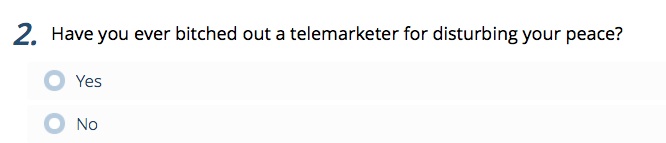
Screen Shot 2014-07-09 at 3.16.50 PM

I’m preeeetty sympathetic to telemarketers because back in ye olde days when I was still in university, I worked in this weird little basement call centre where we would try to convince alumni to donate us more money. So in general I try to be pretty kind and patient when dealing with people trying to sell me shit over the phone. But for reals some of them can be really hard to get rid of, even once you’ve politely declined their offer. So I don’t think that getting a bit forceful while trying to get a telemarketer off the phone is being bitchy.

If a dude did this, we would call him assertive.

Screen Shot 2014-07-09 at 3.17.12 PM

You mean, have I ever disciplined a pet because, FOR EXAMPLE, they wantonly peed on my favourite black wool coat? Yes. Yes I have done that. As my mother likes to say, disciplining your child (or in this case a pet) is a form of loving them. If I just let these things slide, my cat would pee all over everything that I love and then shred my couch. So yeah, I will totally let a pet know if their behaviour is out of line.

If a dude did this? Like if he told his dog not to jump all over you? You would call him a good pet owner.
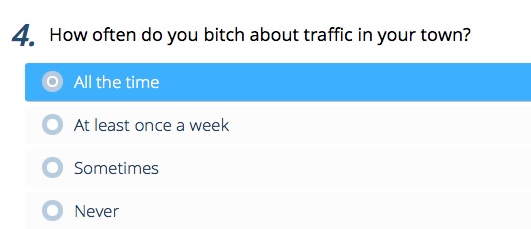
Screen Shot 2014-07-09 at 3.17.30 PM


OH YOU COMPLAINED ABOUT TRAFFIC? GAWD, YOU BITCH.

If a dude did this it would be called “making conversation.”

Screen Shot 2014-07-09 at 3.18.02 PM


Heaven forbid you expect timely service at a place where you are PAYING TO BE SERVED FOOD. And let’s be real, I am all about treating people in the service industry well because I know from personal experience that they get crap thrown at them all the time. But, like, expecting a server to come check on you after they’ve given you the menu and left you alone for a period of time? That is not outside the realm of appropriate expectations.

If a dude went to talk to the manager in order to speed things up and ease the hangry pains his table-mates are experiencing, he would be hailed as a FOOD HERO.

Screen Shot 2014-07-09 at 3.18.18 PM

Yeah, teaching your kid that it’s fine to be pushed around by others because “life isn’t fair” is totally legit. Sometimes you’ll get bullied, kid, because life just isn’t fair and pretty much you should just be a doormat and let people treat you however they want. Also talk about betraying your kids’ trust – as a parent you are there to make your kid feel safe as they figure out how to navigate this fucked up thing we call “life.” Teaching them that sometimes other kids are going to treat them badly and you’ll just stand there and do nothing is a really awful message to send them.

If a dude stood up for his kid at the playground, he would be hailed as King of the Dads.

Screen Shot 2014-07-09 at 3.18.44 PM


This is the one that really makes me see red. Because, you know, nothing says “bitch” like setting boundaries with strangers WHILE YOU ARE CLEARLY OCCUPIED WITH YOUR PHONE. Seriously, though, it says a LOT about our society that a woman is bitchy if she isn’t willing to stop what she’s doing and fake interest in a boring conversation with a stranger.

Also, what is up with people – DUDES SPECIFICALLY – who think it’s cool to interrupt a woman while her attention is happily engaged elsewhere? I can’t even count the number of times dudes have interrupted me while I’m reading in some public place to strike up a conversation with me. LIKE, DO YOU NOT SEE MY BOOK. I AM READING THIS BOOK. IT IS AN ACTIVITY THAT I ENJOY, WHICH IS WHY I’M DOING IT. IF I WANTED TO HAVE CONVERSATIONS WITH STRANGE DUDES I’M SURE I COULD ARRANGE THAT ON MY OWN. But no, women obviously only ever read books as a way to lure men. Actually, state secret: women can’t even really read. We just stare at the words and pretend to be smart in hopes that some man will walk by and decide we’re baby-making material.

Also, if a dude did this, he would again be called assertive and if the stranger was a woman everyone would roll their eyes over how pathetic and needy she was.
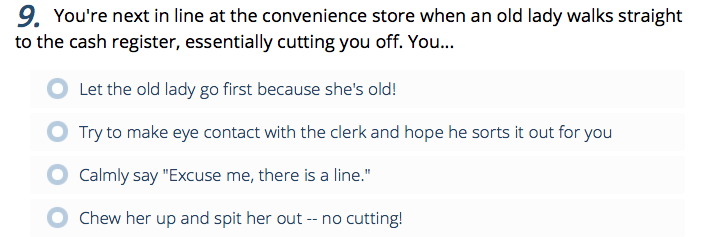
Screen Shot 2014-07-09 at 3.19.36 PM


NO, DON’T CALMLY TELL SOMEONE “EXCUSE ME THERE IS A LINE.” THAT IS TOO BITCHY. JUST LET PEOPLE WALK ALL OVER YOU. A WOMAN SHOULD ALWAYS BE PASSIVE AND SWEET AND LET EVERYONE ELSE DO WHATEVER THEY WANT. IN FACT, SPEAKING OF WANTS, A WOMAN SHOULD NEVER HAVE THEM UNLESS THEY’RE SOMETHING LIKE “I WANT TO MAKE MY HUSBAND A STEAK AND THEN GIVE HIM A BLOWJOB.” THAT IS THE ONLY ACCEPTABLE WANT FOR A WOMAN TO HAVE.

If a dude did this, everyone else in the line would thank him for saving them from entitled jerks who cut into lines.

Look. Bitch is an oppressive term that’s used to silence and belittle women. It’s a word used to gaslight women who dare to stand up for themselves. It’s one thing to say, “haha yeah I’m a tough bitch and I love it,” and totally another to say that a woman (and let’s just be clear here, this quiz is obviously aimed at women and I’ve only seen women sharing it) who doesn’t want to engage in conversation with boring strangers at the airport is a bitch. And I guess a lot of the people sharing this quiz think it’s cute to be like, “aw yeah look at me I’m 63% bitch,” but the fact is that this quiz says some pretty shitty things about how women are expected to behave.

So if you want to call yourself a bitch, then go ahead and own that shit. But let’s seriously think about the ways that this word impacts other women. Because it’s one thing to embrace the word for yourself, and a whole other ballgame when you start perpetuating shit that calls women bitchy for complaining about traffic.
10370420_10154373542955215_1493886680608469372_n

Seven Reasons You Should Thank A Feminist Today

4 Jul

If there is one thing in this world that makes me want to chew my own face off, it’s women who think that feminism has ruined their lives.

You know the type – women who want to live in some kind of souped up 1950s fantasy world where they get married right out of high school and their husband makes enough to support their family on just his income and they think the moral decline of society has something to do with the fact that women no longer wear crinolines and genteel white gloves and cute little hats. Never mind that, you know, lots and lots of families in the 1950s weren’t able to live off of a single income; trust me when I say that feminism did not invent the working mother. Leaving that little scrap of truth aside, I guess I can see what some women find appealing about this model. They want to live in a world where there were fewer expectations put on women – and lord knows that in this day and age, when women often work full time jobs outside of the home and yet are still expected to do the majority of the housework and childcare, the idea that there was a time when you only needed to be pretty and fertile might seem downright relaxing. I guess.

Of course, many women were miserable back then, and the feminine mystique and blah blah blah. I’m not going to get into all that Betty Friedan second wave fun here, but feel free to look it up if you don’t believe me. Life for women back then was like a fancy chocolate with some gross shit inside – really pretty to look at, but best left in the box so that some other sucker who HASN’T read the chocolate map gets tricked into eating it. Just kidding. No one should eat that chocolate – it’s a garbage chocolate and should be treated as such.

All that being said, the thing that REALLY makes me howl with exasperation over this time-travel housewife fetishization is that the vast, vast majority of the women who say that they hate feminism seem to be pretty damn happy to reap the benefits of it. So either they’re totally unaware of what feminism is, what it’s done, and how history works, or else they’re just total hypocrite jerks.

If it’s the latter:

tumblr_lqp810s8q01qkl8dr


But assuming that for some people it’s the former, here’s a short and totally not exhaustive list of things that they can do because of feminism.

1. Vote

Thanks to those lovely suffragettes, women have the legal right to help decide who runs your country. This means women get an actual say in legislation that directly impacts them and their daily life. THAT IS A REALLY AWESOME THING, regardless of whether or not you, personally, exercise your right to vote.

And just a heads up, I will jump-kick anyone who says that women were “given” the right to vote. No. Women were not given anything. They fought, endured violence, imprisonment and forced-feedings, and sometimes even died for the right to vote. So fuck you to anyone who wants to say otherwise.

Police arresting British suffragette Emmeline Pankurst

Police arresting British suffragette Emmeline Pankurst

2. Own property

Being able to own property is awesome. Being able to inherit property is also awesome. Know why? Because it totally helps you avoid a Sense and Sensibility type situation when you are your husband’s second wife and he totally wants to will everything to you and your daughters, BUT HE LEGALLY CANNOT. And then you have to go live in a cottage and the family that owns the cottage is the most annoying family in the world and then also Willoughby comes along and ruins everything even further. So.

The fact that women can now legally own property straight up means that the government can’t just walk in, take your house away, and give it to a dude (or keep it for themselves). The fact that women can now legally inherit property means that if a you are living in a house that a manly man owns and he wants to give you said house when he dies because he thinks you’re rad and maybe also you have nowhere else to live, he can TOTALLY DO THAT. This is seriously a huge thing and I can’t understand how any woman could be like, “huh, I wish I lived in a time when I could be turned out of my house because my presence has become inconvenient to a dude.”

women-pioneers_resized-750x506

3. Have Reproductive Rights

Do you like being able to have any kind of control over your baby-making parts beyond yelling “MAKE SURE YOU PULL OUT IN TIME” when a dude starts making his o-face? Great, then you can thank feminism. Feminists of many stripes have fought long and hard to make sure that women have access to birth control, reproductive healthcare and safe and easy abortion. So unless you’re, like, part of the Quiverfull movement or else a staunch Catholic, you can high five feminism for the fact that you can totally get it on without getting knocked up.

Birth-Control-vintage

4. Wear Pants

Pants are fucking awesome. And let’s not forget about pants’ cute little cousin, shorts. I’m really glad that I can wear pants, because they’re super warm in the winter and they allow me to sit in all kinds of unladylike positions without flashing my junk at everyone. Yay pants! Thank you, feminism, for my pants. I am wearing pants right now – charcoal skinny jeans, to be specific – and I’m just going to have a little moment of silence to express my gratitude for these pants.

One time, back in ye olden days (the 1960s), my grandmother’s boss wouldn’t let any of his female employees wear pants. And my grandmother, bless her, was like, fuck this noise I want to wear some goddamn pants to work. So she took her boss to the Ontario Human Rights Commission and totally won the right to wear pants to work. So if you ever have those days when you just don’t want to wear a skirt, you can totally thank feminism (AND MY GRANDMA) for the fact that you can put on a pair of pants and strut yourself to work.

tumblr_mgqjlcJNow1r8v6qjo1_400

5. Get An Education

Remember when we were growing up and our parents were all, “You can be whatever you want when you grow up!”? Well, that’s because of women who braved insults and abuse and alienation and all kinds of other shitty shit in order to be able to go to medical school or law school or like astronaut school or whatever. Women literally sat there in those classrooms and let their classmates and professors treat them like complete dirt in order to get a higher education. And that paved the way for women today being able to pursue any postsecondary studies they want to.

There are still so many girls on this planet who don’t have access to even a grade-school level education. Don’t forget that in some countries girls are threatened with violence or death for attempting to go to school. Stop taking your own education for granted and recognize the fact that thanks, in part, to feminism, you were able to go to, you know, walk into school without worrying about getting shot because you’re a girl.

single-sexblogpic_0

6. Work Outside The Home and Be Financially Independent

Whether or not you love your job, the fact that we are able to be respected members of the work force is so fucking important. Even if you’re the world’s happiest stay-at-home mom (and ain’t nothing wrong with being a stay-at-home mom), you should be grateful that, if need be, you could go out and get a job and make your own money. While, as noted above, women working outside the home is nothing new, the fact that they can do that AND be financially independent is. Ladies, you can make your own money and then keep it and choose what you spend it on. I mean, yes, this ties in with the whole idea of women being able to own things, but it’s so damn important it deserves its own entry.

Women need to have the ability to support themselves and their own families – whether they exercise that ability or not. Otherwise, we’re totally dependent on men for, well, everything. If your husband dies or leaves you or it becomes necessary for you to leave, then what the fuck are you going to do if you can’t get a job? So even if you’re not currently financially independent, the fact that you could be is really fucking huge.

7499300

7. Be A Person

You know what’s awesome? Being a full-fledged person in the eyes of the law. I really, really love not being a man’s property. I love having agency. I love being able to make my own decisions. I love that I live in a world where it’s no longer completely 100% legal for a man to rape his wife. Being a person is so fucking rad. And yeah, if you’re a woman, you can fucking thank feminism for the fact that you are legally a person.

feminism-is-the-radical-notion-that-women-are-people-4

The bottom line is:

I don’t give a fuck if you call yourself a feminist. I mean, you totally should, because feminism is awesome and patriarchy sucks, but you get to make your own choices about how you label yourself. However, I give all the fucks if you think that feminism is useless, or has never accomplished anything or, worse, is somehow responsible for all of your life problems. Because if you value any of the things mentioned above (and, spoiler alert, you should), then you can just give feminism a big old high five. Whether or not you’re a feminist is your own business, but for god’s sake at least acknowledge that you owe a debt of gratitude to the movement for so many of the rights and freedoms that you currently enjoy.

FEMINISM – FUCK YEAH

giphy


On Parenting and Pride and All That Other Good Stuff

30 Jun

When I was eighteen I was pretty sure that my mother was gay.

Not that she’d ever expressed an attraction to women. Actually, she’d never really expressed an attraction to anyone (aside from George Clooney, otherwise known as Thursday Night Dreamboat Doctor Ross, although I was more of a Noah Wyle girl myself), and the idea of my mother as a sexual being seemed completely foreign to me. At that point she’d been divorced for five years, and as far as I was concerned she didn’t have sex. Or want to have sex. Ever. End of story.

But still, I was pretty sure she was gay.

See, I found this book. I was in her room, doing my best impression of an intrepid girl detective and rummaging through her stuff. I wasn’t looking for anything in particular, but you never knew what you might find – a nice set of fake pearls, the poncho my grandfather had brought back from Peru when she was a kid, a beat up old copy of Peyton Place. So if I happened to find myself home alone, I would often find myself carefully removing everything from on top of her big wooden chest (mentally cataloguing where everything had been so that I could replace it in exactly the same spot and she would never suspect) and then rifling through its contents. STEALTH.

On this one particular day, as I was moving her small television and our ancient Nintendo system off the chest, I noticed a book that I’d never seen before. It was called Home Truths: Lesbian Mothers Come Out To Their Daughters. Inside the front cover was a hand-written note – “Dear [my mother’s name], don’t forget – always tell the truth. Love, Gloria.”

Truth, by the way, was underlined twice.

I mean.

Come on.

What else was I supposed to take from this other than the fact that my mother had a lesbian lover named Gloria?

Like, seriously.

And I mean of course she was gay; the signs had been there all along. She hadn’t dated anyone since my father had left. She had short hair. She wore sensible shoes. How could I possibly have missed it? The fact that she’d had three kids with a man didn’t mean anything – my friend C____’s mother had come out shortly after divorcing C____’s father and was now dating a woman. They drove to Toronto every year for pride and had matching rainbow lawn chairs. Oh god, were my mother and Gloria going to get matching rainbow lawn chairs and matching Birkenstocks and whatever other matchy-matchy things lesbians have?

And then suddenly I felt really bad, because I realized that she was probably pretty worried about how my sisters and I would react to all of this. I mean, why else would she buy a how-to book? Maybe she was staying up all night thinking about whether or not we’d be cool with her being gay. Maybe she was wondering if her family would disown her. I felt guilty that I came off as someone who might have been judgmental of her sexuality, and I decided that I had to say something.  I figured I would employ my stealth skills and start a super subtle conversation that would lead her to admit that she was in love with a woman, all without me having to admit that I’d been going through her stuff.

I had my chance that evening, as she was driving me to work. Please feel free to picture me in my vile Tim Horton’s uniform, with the maroon polyester pants and the maroon and white striped shirt.

Me: Mom? I just want you to know that I love you no matter what.

My mother: Thanks, Annie.

Me: Like, no matter what. No matter who you are or whatever.

My mother: Great. Thanks.

Me: Like, I don’t care who you love.

My mother: I appreciate that.

Me: I’ll always love you.

My mother (suspicious): What’s all this about?

Me: I just mean that if you’re gay that’s totally fine and I don’t care.

My mother: Why on earth would you think I was gay?

Me: Ok, I was in your room and I wasn’t snooping, I swear to god I wasn’t snooping I was just putting something in the hamper, and I accidentally saw this book next to the tv.

My mother: … what book?

Me: It was about lesbian mothers coming out to their daughters. And your girlfriend wrote you a note in it telling you to always tell the truth. And I don’t care, because I love you even if that is the truth.

My mother: (Dies laughing)

Me: (Sulks, because I hate being laughed at)

My mother: (Dies laughing some more. Like she is crying. Tears running down her face. She has to pull over because she can’t see well enough to drive)

Me: (SUPER SULKY)

My mother: Annie, that is a book my friend Gloria put together. She gave me a free copy and signed it. That’s all.

Me: Because I don’t care if you’re gay! You can just tell me, ok?

My mother: I’m not gay. It was my friend’s book, I swear that’s all. But I appreciate you saying all of this.

Now, looking back ten-plus years later, I’m the one who’s appreciative. I feel lucky that I grew up in a country that is fairly tolerant (although oh god there is still so much room for improvement). I also feel lucky that my parents were pretty laid back and liberal about everything, and worked hard to make sure that there was at least some amount of diversity in my life. When my father moved to Toronto, he rented a place on the edge of the gay village, and I loved visiting him and going off exploring on my own – there was such a weird frisson of excitement walking around in the middle of this culture that was pretty foreign to the rest of my life. I wanted to be like the girls that I saw there, with their half-shaved heads and facial piercings and boy’s clothes. Girls who held hands and kissed in public. I didn’t know any girls like that in Kitchener.

My father took me to my first Toronto Pride Parade when I was fifteen, and I remember being absolutely enchanted by a float of men wearing nothing but tighty whities and sailor hats. They were throwing bottles of water into the crowd. I was really excited when I caught one. I brought it back home with me like it was some kind of prize.

I think a lot about how Theo will view his sexuality as he gets older. I flip-flop from worrying about whether he might be teased or bullied if he deviates from traditional masculine ideas, to panicking over the fact that he might, against my best efforts, buy into those ideas and become a bully himself. The dice seem so loaded any way you roll them – like, I want him to be who he is, and I want him to be brave and stand up for marginalized and oppressed people, but I also want him to always be safe and happy. And I don’t know if I can have it both ways. Not that it’s really up to me – he’ll have to make his own discoveries and choices about himself, and while I can try to pass on my value system to him, I ultimately don’t have any say in who or what he is.

I just want him to know that, as I told my mother, I will love him no matter what his sexuality, no matter what his gender, no matter what, end of sentence, full stop.

I just hope that he always knows that I love him and I’m proud of him.

This. Kid. He just kills me.

This. Kid. He just kills me.

Robin Thicke and the Dynamics of Abuse

23 Jun

TW for domestic violence, abuse and rape

Robin Thicke is gross.

I mean, we knew that already, of course.

But today he has somehow managed to surpass his former grossitude and shot up through the I Can’t Even atmosphere and into the Outer Space Repository of Hella Gross Dudes.

But what could possibly have caused this intense leveling-up, you may well ask. How could he have done something worse than penning the summer’s unofficial rape album?

Well, for starters, he announced the release and official track list of his new album, Paula. Paula, by the way, refers to his estranged wife, Paula Patton. She recently left him. This album is his attempt to win her back.

Let’s take a look at the song titles, shall we?
1. “You’re My Fantasy”

2. “Get Her Back”

3. “Still Madly Crazy”

4. “Lock the Door”

5. “Whatever I Want”

6. “Living in New York City”

7. “Love Can Grow Back”

8. “Black Tar Cloud”

9. “Too Little Too Late”

10. “Tippy Toes”

11. “Something Bad”

12. “The Opposite of Me”

13. “Time of Your Life”

14. “Forever Love”

It’s honestly like reading an abuser’s check-list. She’s his fantasy. He needs to get her back. He’ll isolate her, maybe refuse to let her leave. He’ll lock the door. He’ll do whatever he wants. Because love can grow back. Because it’s a forever love.

These apologies, entreaties, promises and veiled threats are all a typical part of the cycle of abuse.  This is what psychologist Leonore E. Walker calls the “Reconciliation/Honeymoon Phase” – the abuser feels guilty, is contrite. He or she makes grand gestures of their affection, constructs elaborate apologies. They promise never to hurt their loved one again. They might promise to get help (though most likely they won’t). If that doesn’t work, they might threaten suicide or self-injury in order to gain sympathy or otherwise manipulate the situation. They will do literally anything they can to convince their victim not to leave them.

The cycle continues when the abused person, whether out of fear or out of genuine belief that things will get better, decides to reconcile.

All right, you might be saying, some of those track names are pretty questionable, but surely that doesn’t mean that Robin Thicke is an abusive partner, does it?

Well, take that track list in conjunction with the video for his new single “Get Her Back” that Thicke released today, and you might find yourself feeling a little more convinced.

The video is filled with texts that were, we are supposed to believe, exchanged by Thicke and Patton.

Here are the texts supposedly sent by Patton:

“I kept trying to warn you you were pushing me too far…”

“We had everything.”

“Why Why Why Why Why???”

“You drink too much.”

“You embarrassed me.”

“I can’t make love to you anymore.”

“I don’t even know who you are.”

“You ruined everything.”

“I have to go.”

“How could you do that to me?”

“you’re reckless”

And here are Thicke’s texts:

“I’m sorry.”

“Can I talk to you?”

“I hate myself.”

“Can I come see you?” (to which Patton apparently replies “It’s too soon.”)

“I wrote a whole album about you.” (which elicits the response “I don’t care.”)

“I miss u”

“This is just the beginning.”

That last text, by the way, is posted over a blurry image of Thicke walking away, his posture tense, ready for a fight. The words read very much like a threat.

This video is not romantic. It is an attempt by Thicke to use his huge public platform to manipulate and shame his wife into getting back together with him. Now, if she says no, she becomes the bad guy, and he becomes the victim. In fact, he’s already making himself out to be the victim – between his sad I’m-so-awful-and-pathetic texts, and the fact that his face is cut and bloody in the video, he’s doing his best to come off as the poor, heartbroken, sensitive man who’s been left by his mean, unrelenting wife. Sure he may have done some things that contributed to the breakup, but look how sorry he is. Look how willing to make amends. How could she be so cold and hard? And what about their children, don’t they deserve to have their father around?

What Robin Thicke is doing is trying to coerce his wife into coming back to him, by publicly shaming and humiliating her. I have no idea whether the texts in the video were actually from her (though I really, really hope that they’re not), but it doesn’t really matter, because he’s presenting them as hers. He is, as @middle_ladle said on twitter, punishing her for leaving him quietly. He’s exposing her to the world, looking for sympathy. He’s making it harder and hard for her to say no.

In fact, she keeps telling him no, over and over in those texts, and he ignores her requests to leave her alone and just keeps pushing. Because her needs don’t matter to him. All that matters is getting what he wants.

Leaving an abusive partner is the part of the cycle of abuse during which the victim is most vulnerable. Because after they’ve left, the abuser often feels like they have nothing left to lose. This is the point in the cycle when the abused is most likely to be hurt or killed. People wonder why so many victims of domestic violence go back to their abusers, but the sad truth is that often that choice is safer. Leaving is incredibly risky.

What Thicke is doing is threatening and frightening and we need to stop treating it as the ultimate in romance. This is not romantic, not in the slightest. This is abusive, coercive and manipulative. This is what domestic violence looks like, and we’re so accustomed to this type of behaviour that by now it seems totally normal and healthy to us.

It’s not. And we need to acknowledge that.

IMG_1845


Fuck “Sexy”

19 Jun

Sometimes I feel like I want to ban the word sexy. Like, take that shit out of the dictionary and impose a fine whenever someone uses it.

Which is pretty funny because I’m super sex-positive and I definitely want people to feel good about their bodies and secure in their sexuality, however it manifests itself.

But man am I ever fucking tired of how we use that word to shame girls and sell them on a bunch of gross patriarchal ideas about how they should be.

Take this picture, which was tweeted/posted by Floyd Mayweather and has been making the rounds over the past few days:

10402551_10152318424273113_4249204407973090687_n


Like, first of all, this is a dude who has been charged with two counts of domestic violence. Why would anybody think that what he has to say about women is even a little bit valid? I am not really down with anyone advising women on ways to dress or behave in order to meant specifically please men, but I am double-plus definitely one hundred percent not down with someone who hits women telling women how to behave. Talk about classic abusive behaviour. It’s impossible to get anything out of this other than, “Maybe if those women had dressed better and been quieter and more ladylike I wouldn’t have had to hit them.” I guess that according to him, they were asking to be disrespected. This whole post is basically an apologia for abuse.

Second of all, women aren’t fucking products that are trying to advertise themselves. They are for-real people who get to dress however they want. I can’t believe that I have to say this, but: The way I dress is not a fucking advertisement, it is some clothes that I put on my body because they make me feel good.

Third of all, no, how I’m addressed does not, in fact, depend on my attire. It depends on those addressing me recognizing that I am actually a person and that alone makes me deserving of their respect. Can we please stop putting the onus on women when it comes to respect? It’s not up to us to gain men’s respect – it’s up to men to recognize our personhood and stop throwing out ultimatums on when they will or won’t respect us.

Saying that respect is conditional on how you dress or behave means that respect can be revoked at any time, based on some arbitrary decision about what crosses the line from ladylike to slutty. It’s putting the power right back in the hands of the oppressor and it literally does no good whatsoever.

Speaking of respect, this morning I came across this lovely tweet, which describes a sentiment that I hear far too often:


You know what’s the best way to make a girl feel like she’s respected? Shame her for what she’s wearing!

Like, seriously, allow me to demonstrate how much respect I have for myself by flipping this dude off forever. Because fuck him for trying to control women under the guise of concern. Fuck him for making women feel less-than under the pretence of trying to build up their “self-respect.” Fuck him for implying that the only reason women might want to be self-respecting is so that they can be more attractive to men.

See, here’s the thing: while all of these posts seem to say that women who dress modestly and behave nicely and are self-confident are totally more attractive than any other women, what they’re really saying is, “being sexy is the most important thing for you to be, and please allow me to define what sexy is.” It is not even a little bit empowering to tell women that being modest is sexy; it’s just reinforcing the idea that we only exist to please men and that we should dress and act however they want. It’s saying that being attractive to men is the best and most wonderful thing that women can aspire to. It’s exactly the same shit we’ve been sold all of our lives, only re-packaged as obnoxious concern-trolling about women’s self-confidence.

Fuck. That.

If you really want to empower women, why don’t you try to build up their self-esteem instead of lecturing them on all the ways you think that they’re failing? Instead of telling them that no one will respect them based on the way they dress, why not instead list all the things that you value about them – that they’re funny, smart, capable and brave. Literally no one ever will gain confidence by being criticized for their appearance. No one will gain “self-respect” by having someone else list all of the ways that they’re lacking in that department. And, like, hell yes I want women to feel like they are worth more than their appearance. No one wants that more than me. But how in the fuck do you think you are making women believe than they have more value than just being pretty when your whole message hinges on what is and isn’t sexy?

Fuck sexy.

Fuck telling women how to be sexy.

Fuck “confidence is sexy,” because shaming women for not being confident enough will achieve the opposite of what you apparently want.

And while we’re at it, fuck Consent Is Sexy. Fuck the idea that we need to sell consent to kids by making it all shiny and pretty and “sexy.” People shouldn’t have consensual sex because it’s waaaaay hotter than other kinds of sex – people should have consensual sex because otherwise they are rapists. Consent isn’t a fun new thing that you should try out in the bedroom; it’s the way you should be living your life, all day every day. Consent is not sexy – it’s a human right.

So fuck “sexy” being used as a marketing tool. Fuck dudes who want to control how women behave. Fuck all the not-so-cleverly-disguised ways the patriarchy asserts itself. Fuck the idea that women only ever dress in a certain way to attract men. Fuck. That. Noise.

And to any women reading this, I want you to know that it’s great to feel sexy, whatever that word means to you. It’s even great to dress in a way that you think other people might find attractive – that’s a very normal thing to want to do. We dress in ways that our partners find attractive because it makes us happy to make our partners happy, and there is absolutely nothing wrong with that. There is nothing wrong with wanting sexual attention from other people, and dressing “sexy” is for sure a tried-tested-and-true way of achieving that. It’s good to feel sexy. Seriously. But I also want you to know that it’s not required. I want you to know that you don’t have to feel or be sexy, and that sexy isn’t the be-all-and-end-all of what you should accomplish. And I want you to know that you are funny and smart and capable and brave. Because you really, really are.

tumblr_mya3a8DsjD1t49i09o1_400

Dispatches From The Gynocracy

16 Jun

“WE HAVE KILLED ALL THE MEN. STOP. MADE THEM JERK OFF INTO CUPS FIRST. STOP. WILL USE THEIR SPERM FOR ARTIFICIAL INSEMINATION UNTIL WE DISCOVER ASEXUAL REPRODUCTION OR HAVE PERFECTED CLONING. STOP.”

“WE HAVE BANNED ALL THE LITERARY CLASSICS. STOP. WE DO NOT WANT OUR CITIZENS DEVELOPING PATRIARCHAL IDEAS ABOUT WOMEN BECAUSE OF THE GREAT GATSBY OR THAT DICK ERNEST HEMINGWAY. STOP. DID YOU KNOW ERNEST HEMINGWAY WAS A DICK. STOP.”

“WE WOULD LIKE TO EXTEND TO YOU A FORMAL INVITATION TO OUR ANNUAL ANDREA DWORKIN DAY CELEBRATIONS. STOP. PLEASE BRING YOUR OWN KNIVES FOR YOUR PARTICIPATION IN THE CEREMONIAL CASTRATION OF OUR SYMBOLIC PAPIER MACHÉ REPRESENTATION OF THE PATRIARCHY. STOP. AFTERWARDS THERE WILL BE A VEGAN MEAL SERVED IN THE TOWN SQUARE BECAUSE ANIMALS ARE OPPRESSED PEOPLE TOO. STOP.”

“WE HAVE BANNED ALL PHALLIC SYMBOLS. STOP. YOU HAVE NO IDEA HOW MANY THINGS LOOK PHALLIC WHEN YOU REALLY THINK ABOUT IT. STOP. LIKE PRETTY MUCH EVERYTHING LIKE STICKS AND PENCILS AND BASEBALL BATS AND SHIT. STOP. WE HAVE BANNED BASEBALL. STOP. ALTHOUGH WE MUST ADMIT THAT WE DO APPROVE OF THE SYMBOLISM OF HITTING BALLS. STOP.”

“OUR ARTIFICIAL INSEMINATION PROJECT WAS A SUCCESS. STOP. BUT NOW WHAT DO WE DO WITH ALL THESE MALE BABIES. STOP. WORRIED THAT IF WE LEAVE THEM ON A HILLSIDE THEY MIGHT BE SUCKLED BY SHE-WOLVES AND THEN FOUND AN EMPIRE. STOP. SHE-WOLVES ARE GENDER TRAITORS. STOP.”

“LIFE IS MUCH LESS FUN NOW THAT WE CAN NO LONGER MAKE FALSE RAPE ACCUSATIONS AGAINST MEN. STOP. WE HAVE STARTED UP A EUCHRE LEAGUE BUT OF COURSE HAD TO GET RID OF THE KING AND JACK CARDS. IF YOU NEED PROOF THAT WE ONCE LIVED IN A TOXIC PATRIARCHAL SOCIETY YOU ONLY NEED TO THINK ABOUT HOW THE KING CARD RANKS HIGHER THAN THE QUEEN. STOP. WE DO HOWEVER LIKE THE VAGINAL SHAPE OF THE SPADE SUIT. STOP.”

“WE HAVE ERECTED A STATUE IN THE VILLAGE SQUARE PORTRAYING A MAN WITH A NECKBEARD WEARING A FEDORA. STOP. THE INSCRIPTION READS AS FOLLOWS. STOP. TOP LINE: “MILADY”. STOP. BOTTOM LINE: “NEVER FORGET.” STOP.”

“SOMETIMES WE HAVE ABORTIONS JUST FOR FUN. STOP.”

“WE HAVE OUTLAWED RAZORS AND DEPILATORY CREAMS. STOP. YESTERDAY WE CAUGHT A WOMAN TRYING TO SHAVE WITH A SHARP ROCK. STOP. OBVIOUSLY SHE WAS HANGED IN THE VILLAGE SQUARE AS AN EXAMPLE. STOP.”

“WE EAT OUR PLACENTAS. STOP. THEY ARE DELICIOUS AND GIVE US SUPERPOWERS. STOP. THEY ARE BEST WHEN FRICASSEED. STOP. DON’T FORGET THE SALT. STOP.”

“I DON’T CARE THAT THE PLURAL OF PLACENTA IS PLACENTAE. STOP. DON’T MANSPLAIN PLACENTAS TO ME. STOP.”

“YES YOU CAN MANSPLAIN EVEN IF YOU’RE NOT A MAN. STOP. IT’S CALLED INTERNALIZED MISOGYNY LOOK IT UP. STOP.”

“THE DOWNSIDE TO COMMUNAL PARENTING IS THAT THERE ARE NO MORE CUSTODY BATTLES. STOP. WE MISS BEING ABLE TO USE THE COURTS TO EXERT OUR FEMALE PRIVILEGE AND SHAME FATHERS EVERYWHERE. STOP. THERE IS NO ONE HERE TO FALSELY ACCUSE OF CHILD MOLESTATION. STOP. SOMETIMES WE BECOME NOSTALGIC FOR THE GOOD OLD DAYS. STOP.”

“WE HAVE RUN OUT OF MALE TEARS TO BATHE IN. STOP. PLEASE SEND MORE. STOP. WE FEAR THAT OUR HIDEOUSLY DESICCATED SKIN WILL CRUMBLE WITHOUT THEM. STOP.”

“YESTERDAY WE HELD A BATTLE ROYALE BETWEEN THE WORKING MOTHERS AND THE STAY-AT-HOME MOTHERS. STOP. OBVIOUSLY IT WAS JUST A PRETEXT TO PUBLICLY EXECUTE ALL OF THE STAY-AT-HOME MOTHERS. STOP. THEY HAVE NO PLACE IN THE REVOLUTION. STOP. WE ARMED ALL THE WORKING MOTHERS WITH SABRES AND A VERY GOOD TIME WAS HAD BY ALL. STOP.”

“WE MAKE ART WITH OUR OWN MENSTRUAL BLOOD. STOP.”

“WE HAVE OUTLAWED CRYING. STOP. THERE IS NO CRYING ALLOWED IN THE GYNOCRACY. STOP. EXCEPT IN SPECIAL CIRCUMSTANCES. STOP. LIKE IF YOU THINK IT WILL GET YOU EXTRA PRIVILEGES OR HELP YOU NOT GET A SPEEDING TICKET. STOP.”

“WE MAKE SO MANY PRISON RAPE JOKES ABOUT MEN YOU HAVE NO IDEA. STOP.”

“NO ONE IS ALLOWED TO DRESS IN SEXY OUTFITS ANYMORE. STOP. UNLESS IT IS BECAUSE IT MAKES THEM FEEL GOOD AND PUTS THEM IN TOUCH WITH THEIR DIVINE FEMININE SEXUALITY. STOP. WE USE OUR GODDESS POWERS AND A LIE DETECTOR TEST TO DETERMINE SEXINESS MOTIVATION. STOP.”

“WE HAVE BURNED ALL THE BRAS. STOP. TURNS OUT THEY CREATE A LOT OF TOXIC SMOKE WHEN THEY BURN. STOP. WE HAVE HAD THREE BRA-BURNING FATALITIES THUS FAR. STOP.”

“ALL MEN ARE RAPISTS. STOP.”

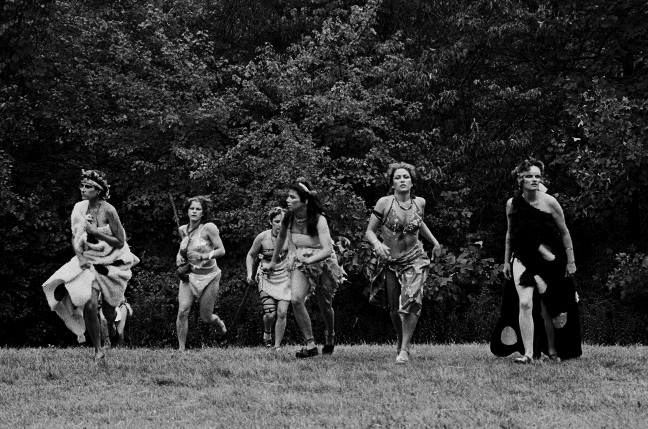
Teri Slotkin, photograph of the Cave Girls (left to right: Marnie Greenholtz, Cara Brownell, Verge Piersol, Julie Harrison, Ellen Cooper, Bebe Smith); 1982; © Teri Slotkin Photography.

Teri Slotkin, photograph of the Cave Girls (left to right: Marnie Greenholtz, Cara Brownell, Verge Piersol, Julie Harrison, Ellen Cooper, Bebe Smith); 1982; © Teri Slotkin Photography.

How Do You Mourn The Living?

14 Jun

Tomorrow is Father’s Day.

If you’re a fairly regular reader here, you may have noticed that I don’t often mention my dad, and when I do it’s always in the past tense. He’ll sometimes come up when I write about my childhood, but other than that I almost never talk about him. He’s not dead or anything – in fact, he lives in the same city that I do. He’s just not a part of my life.

A few years ago my father became estranged from my sisters and I. There’s a lot of backstory there, but I’m not going to get into the whole thing here. For one thing, it’s not entirely my story to tell. For another, I don’t want to write anything here that might hurt anyone. So I’ll just say that there was a long, protracted leave-taking that involved a lot of tearful discussions, tentative reconciliations, and a slow, steady breaking of my heart, with the outcome of all that being that he is no longer a presence in my life.

I love my father immensely. We were close when I was a kid, and I have about a billion memories of us being hilarious and fun together. When I was a teenager, he was the cool parent and would buy me beer and drugs when I came to visit him. He taught me about existentialism, and encouraged me to read Camus’ The Outsider (his favourite book) for my big, final high school English paper. We shared a love of music, and from him I learned the deep physical pleasure – the sort of secular reverence – one experiences while placing a record on a turntable and dropping the needle into the groove. He was a great storyteller, and listening to him geek out about our family history was one of my favourite ways to spend an evening. He read to me every night when I was a kid, even once I was old enough to read on my own, and would get grumpy if my mother had to read a chapter to me while he was working late because he always became just as involved in all my favourite books as I did. He would play make-believe games with me for hours on end, something my mother, bless her, didn’t have the patience or imagination for. He was the first person to talk to me like I was a living, breathing person with thoughts and feelings of my own. We shared the same dark sense of humour; maybe we still do.

He loved me. I know he did. I’m sure that if you asked him he would tell you that he loves me still. So how do I reconcile that with the fact that he’s hurt me, badly, and has hurt many other people that he cares about? It seems impossible.

You always read about little kids who blame themselves for their parents’ divorce. I was thirteen when my dad left, and was sure that I was old enough to know that sometimes grownups just fall out of love and that’s how life is. I knew that it had nothing to do with me, or my sisters. People change, and my parents had changed in ways that made them incompatible with each other. Case closed. Time to move on.

But lately I’ve been wondering if that’s really what I believe; I wonder if I’ve ever felt entirely blameless. Because, honestly, couldn’t we have done something more? Couldn’t we have charmed him into staying somehow? If only we had figured out the perfect way to be, the way that always made him happy, then he wouldn’t have left, would he? But we could never quite suss out the secret of making my father happy. Or maybe we just didn’t try hard enough, because we didn’t know exactly what was at stake. We never imagined that he’d leave.

And then, years later, he somehow managed to leave again. And I’m left sitting here trying to pick up the pieces, trying to figure out how to live my life without him. And it’s hard.

I told my therapist that it would, in some ways, be easier if he was dead. Not that I wish that he would die or anything, just that I would know the right procedure to go through. I would wear black. I would mourn. I would recall only the happy times. I would keep a picture of him on the wall, and my eyes would well up with tears whenever I saw it. I would love him, perfectly and unconditionally, the way you’re supposed to love a parent. I would know that he’d loved me.

But how do you mourn someone who’s still alive? How do you grieve the fact that they’ve left you, when at any moment they could walk back into your life? How is it possible to feel so angry and so hurt and yet also so hopeful that things might get better? It seems totally self-contradictory. And yet, here we are.

On a more basic level, I struggle to know how to talk about him to people who don’t know what’s happened. When they ask questions about him, am I supposed to answer as if we’re still close? Or do I straight-up tell them that we’re estranged? I don’t want to lie, but I also don’t want to make anyone else feel uncomfortable. Because it is uncomfortable for other people, isn’t it? Whenever I tell someone that my father and I don’t actually talk, I always feel like I immediately have to reassure them. I’ll smile big and say brightly, “It’s fine, though! We’ll figure it out!”

But the truth is that I don’t know how we could ever figure it all out. Not at this point. We might reconcile someday, but our relationship will never be what it was. How do you grieve a relationship that can’t ever be properly resuscitated?

My father has met my son twice. The first time was on a rainy day when Theo was about four months old, we ran into my father on the street corner. He peered through the stroller’s rain shield at my fat, sleeping baby and said that he was cute. He shook his head and said that he couldn’t believe he was a grandfather. He promised to call me. He didn’t.

The second time was when Theo was two. My sister and I had agreed to have coffee with our father, and then out of the blue I asked if he wanted to meet Theo. We all went to the museum together. Theo and my father had a great old time together, drumming out rhythms in the second floor gallery, choosing favourite fish in the aquarium. Afterwards, we promised to keep in touch, to try to set up another meeting. It never happened.

These days Theo is very interested in familial relationships. He’ll sometimes refer to me as “your wife” when speaking to Matt, and he’ll call his grandmother “Anne’s mother” instead of Gran. So the following conversation was bound to happen sooner rather than later.

Theo: Who’s your dad?

Me: His name is F____.

Theo: Where is he?

Me: Well, he lives here in Toronto, but we don’t get to see him very often for a variety of reasons. But I know that he loves you very much!

Theo: … Is he not a nice guy?

Me: He’s a nice guy. We – well, we just don’t get to see him very much. But he does love you.

Because I’m sure that, in some way, he does.

At the end of the day, I’m left wondering which father is my real father – the one who sat on the floor and played dolls with me for hours and hours, or the one who didn’t just flat out didn’t respond to the email announcing my pregnancy? The answer is both, I guess, but that truth is a lot to wrap my head around.

I miss my dad.

Anne youth photo0014


Pharmacopeia, or, The Drugs Don’t Work

11 Jun

TW for talk of suicide

Some days, as I rush around the apartment trying to get ready to face the world, I can’t help but feel like a traveling pharmacy. Inside the vast expanses of my purse, along with my laptop, my wallet, my keys, my book-du-jour, two shades of Sephora lipstick (neutral pink “charmer” and come-at-me crimson “tango”), my headphones, my phone, assorted bandaids, bobby pins and hair elastics, I neatly arrange the bottles of multicoloured pills through which I measure out my life like those metaphorical coffee spoons. Blood-red prescription iron supplements, safety-vest-orange Zoloft, dingy red-brown Seroquel, electric blue Imovane and, of course, the virginal pink birth control pills. My own private stash.

The pills are like little hand-holds to grab onto as I swing myself through my day. Orange and red with my breakfast, to keep my mood somewhere above apocalyptic-crying-level and to boost my energy, red again with supper, to keep my iron levels up over night, then red-brown, pink and blue at bedtime to respectively “enhance” my anti-depressant, make sure that I don’t accidentally bring forth another life onto this dismal planet, and then float me off to sleep the sleep of the innocents.

I’ve been on psychotropic drugs since I was sixteen, and can give you a poetic sort of laundry list of all the different types I’ve tried: Paxil, Prozac, Remeron Effexor, Elavil, Ativan, Wellbutrin, each at varying and increasing dosages. Paxil was the first one they tried on me, and when it perform as expected, they kept increasing the amount until I was a miserable wreck: twenty five pounds heavier, lethargic, awake all night and falling asleep in class. The funny thing was that my doctor kept telling me that it was working, that he was seeing improvements. Never mind that I felt worse than ever – to him, it definitely seemed as if I was getting better. It took months of arguing before he agreed to try a different drug.

The latest addition to my personal valley of the dolls is the Seroquel, typically used as an antipsychotic. I wondered if my doctor was trying to tell me something. I asked Nathan if he thought my doctor was trying to tell me something.

Me: It’s an antipsychotic. Do you think my doctor thinks I’m psychotic but just doesn’t want to say anything in case it upsets me? Am I psychotic?

Nathan: The medium isn’t always the message, Tiger. [Editor’s note: he likes to call me Tiger. Sometimes also Buddy or Slugger or Buckaroo. One time it was Tex.]

Me: But Marshall McLuhan said it was!

Nathan: Heritage Moments aren’t always right.

But then again, sometimes they are. So put that in your pipe and smoke it.

I’ve never really been able to tell if these drugs help at all (except for the sleeping pills, which are an insomniac’s best friend, and, of course, the birth control, thank god). Sometimes I take them and things get better, but it’s hard to know if that’s from the pills or from the natural dips and rises of my inner life. But I keep taking them, even after I swear that I won’t. They’re well-marketed, these drugs, and at my weakest moments I always find myself acquiescing. The doctors make a good case for acquiescing.

Those doctors always sell me on the antidepressants by telling me that I have a chemical imbalance, a lack of serotonin that causes my brain to short circuit and makes me want to die. That’s the best way to describe what it feels like to be suicidal – a short circuit, a glitch in the system, a design flaw. Killing yourself becomes the answer to everything. Your mind becomes like a record needle that jumps the groove, a sort of skip in your mental process where instead of going forward and thinking up solutions to your problems, all that you can come up with is, the only way out is to kill yourself. And the drugs are supposed to fix that skip, supposed to make it so that your record can play all the way until the end, and then you can flip it over, then put on another record, and so on ad infinitum, happily ever after.

The idea of a chemical imbalance is supposed to make you feel like you’re not crazy in the 19th century meaning of the word;  you’re not some kind of incurable case about to be shipped off to Bedlam. What’s wrong with you is physical – like a diabetic who lacks insulin (they’re always comparing selective serotonin reuptake inhibitors, or SSRIs to insulin for some reason), you just need a little medical help replacing something that your body is failing to make on its own, and then you’ll be fine. It’s not really a mental illness so much as it is a physical condition with mental manifestations. You’re not like those people.

By those people they mean, of course, the people with schizophrenia, or borderline personality disorder or some kind of nonspecific psychosis. Doctors never let you forget that there is a hierarchy of mental illnesses, one which you might slip down at any given moment. Doctors want you to remember that your place in the mental illness food chain is a relatively coveted one, lest you get any big ideas about going any crazier.

It’s easy to internalize the stigma against mental illness. Sure, you’re mentally ill, but you’re not like them. You don’t ever want to be like them.

Never mind that you already are one of them, no matter how you frame it. Never mind that all of your attempts to distance yourself, to other, only make things worse for everyone. Because you’re basically giving healthy people permission to other you.

You and your delicately imbalanced chemicals.

The chemical imbalance theory has been around since the 1960s. There was never much research done into the idea; it was just something that seemed like it could be right, and everyone sort of ran with it. Maybe they couldn’t properly test for that sort of thing back then. Maybe theories were the best they could go on. But now, fifty years later, it might be time to re-examine those theories.

According to Robert Whitaker, author of Anatomy of an Epidemic: Magic Bullets, Psychiatric Drugs, and the Astonishing Rise of Mental Illness in America, doctors have known for a long time that the chemical imbalance model is likely flawed. In an interview on CBC’s The Sunday Edition, he says,

And as early as 1998, the American Psychiatric Association in its textbook says we’re not finding that people with depression have any abnormality in their serotonin, but because it’s such an effective metaphor for getting people to take the drugs and sell the drugs, it’s continued to be promoted.

According to Whitaker, people who take psychiatric drugs were more likely to still have symptoms five years later than those who didn’t take psychiatric drugs. Because, see, here’s the catch – people who take SSRIs but don’t have low serotonin to begin with begin to rely on those drugs to manage their serotonin levels. SSRIs actually reduce the brain’s ability to produce serotonin.

So maybe the drugs have never actually been helping me, or any of us; maybe all they’ve done is create a population of people who are dependent on psychiatric medication.

And maybe The Verve were right after all, and the drugs don’t really work, they just make you worse.

It bears thinking about, anyway.

I’ve been reading about lobotomies recently (as any good mental health patient does, I suppose), and I came across this gem in Ronald Kessler’s The Sins of the Father describing Rosemary Kennedy’s lobotomy:

We went through the top of the head, I think she was awake. She had a mild tranquilizer. I made a surgical incision in the brain through the skull. It was near the front. It was on both sides. We just made a small incision, no more than an inch.” The instrument Dr. Watts used looked like a butter knife. He swung it up and down to cut brain tissue. “We put an instrument inside,” he said. As Dr. Watts cut, Dr. Freeman put questions to Rosemary. For example, he asked her to recite the Lord’s Prayer or sing “God Bless America” or count backwards….. “We made an estimate on how far to cut based on how she responded.” ….. When she began to become incoherent, they stopped.

Sometimes it’s hard not to feel like doctors take the same approach – albeit on a much smaller scale – with psychiatric drugs. Increase the dosage until the patient becomes incoherent, or at least docile. Push the pills until they don’t feel anything, because feeling nothing is better than feeling sad or confused or anxious. Don’t offer counselling, or therapy, or life management skills. Just fork over pills pills pills until some kind of effect (or affect – little psychiatric joke there for you) is achieved.

The truth is that we don’t know how psychiatric medication works – we just know that sometimes it does. If you’ve ever taken the pills, you know that it’s a lot of trial and error until you find something that gives you some kind of relief. Which is great and everything for the people who benefit from it, but where does it leave the rest of us? We become guinea pigs of a sort, choking down brightly-coloured pill after pill, praying that something, anything will work. Because, honestly, it’s better than the alternative.

The alternative is, of course, that the brain is still a vast unknown. That we are only just barely beginning to grasp its complexity, and we may never fully understand it. That those of us who suffer from mental illness are sailing in uncharted waters, with no stars to guide us. What looks like Cassiopeia or Orion to everyone else is just a jumble of unknown lights to us. And maybe for some, the drugs make the stars realign into their proper order – but for the rest of us, maybe we need to begin creating our own private constellations to ferry us from one point to another.

The thought is terrifying, and I feel unequipped to deal with it. I’m not an astrologer. I just want the same stars as everyone else.

I’m going to keep taking the drugs, at least for now. They feel like a sort of safety net, and I know that I’m not ready to walk the high wire without them. But someday, someday soon, I want to begin to chart my own inner universe. I want a map of my own personal stars, and there isn’t anyone else who can do that for me. If I’m not willing or able to play amateur stellar cartographer, well, then, what’s the point? A lifetime of one brightly-coloured pill after another, each with its own dreary side effects, none of them even remotely effective. I can’t live like that.

But I haven’t lost faith that I can, somehow, find a way to live.

Pills

Breastfeeding Revisited: Now You Are Three

10 Jun

When my son was a few weeks old, we did he requisite Extended Family Tour. We drove to Montreal to see my grandmother and assorted aunts and uncles, and then we went to Kingston to chill out at my mom’s and see even more aunts and uncles. During these visits I felt like a queen receiving supplicants – I would sit enthroned in a big, comfortable chair, my breastfeeding pillow on my lap and my son nestled against my chest. Breastfeeding back then was a bit of an ordeal – we were still using the nipple shield, which meant that in order to get Theo to nurse I had to expose my breast, fiddle around with the little silicone shield, get it firmly in place and make sure that it was airtight, and then try to get Theo latched (not always an entirely successful endeavour).

This trip marked the first time that I’d ever breastfed in public. I hadn’t planned on it, but halfway to Montreal the baby was doing that whole enraged purple-faced screaming, and it didn’t seem like the soothing bumpiness of the drive was going to lull him back to sleep anytime soon. So we stopped at a rest station, and I proceeded to the furthest, dimmest corner table to set up my boobtacular operation.

I couldn’t do it, though. I couldn’t pull out my breast, engorged and leaking milk everywhere. I couldn’t expose my nipple, red and inflamed and a little cracked. I just couldn’t.

Meanwhile, my son screamed beside me, guaranteeing that everyone in the place was now staring at us.

My mother came up behind me and said, “Just do it, Annie. Just do it. No one is looking. Just do it.”

And, clumsily, fumbling with that goddamn nipple shield, I did.

I scrunched down in my seat, waiting for one of those rent-a-cops to come over and tell me that someone had complained, that I needed to cover up, that I needed to go somewhere else. But nothing like that happened. Instead, my son finished, I packed my gear up, and we hit the road.

I had to nurse him again at my grandmother’s house (god, what is with these babies, always wanting to eat? it’s almost like they’re growing or something), and whenever I did, all my uncles would studiously look away.

“I think breastfeeding is wonderful,” said one of my aunts, “but some women seem to do it for themselves. I saw a woman on the metro the other day just sitting there with her kid hanging off her. She couldn’t have waited until she got home? When it’s public like that I think it’s more about the mother than the baby.”

The next day, when we were back in Kingston, my uncle and his three kids came over to meet Theo. They were fascinated by breastfeeding, and would crowd around me whenever I did it, shoving their heads as close as possible to my chest to get the best possible view of the action.

The youngest cousin was three, and she seemed enormous compared to Theo. Afterwards, I said to Matt, “I’m not breastfeeding him when he’s three.”

Matt, whose mother had been a La Leche League leader and who had been breastfed until he was nearly four, said, “You don’t have to.”

“Did you see how big that three year old was? I can’t breastfeed someone that big. I just can’t.”

“Yeah,” he said in agreement. “She was pretty big. I can see why that would seem weird. You don’t have to breastfeed Theo when he’s three – just do it as long as you feel comfortable with it.”

“I’m only going to do it for a year. That’s what all the books say. A year. At twelve months they can have cow’s milk.”

Because, see, I wasn’t going to be one of those breastfeeding mothers. Oh sure, I thought breastfeeding was great, and I was proud of how hard I’d fought to be able to do it, but I wasn’t going to be some kind of breastfeeding weirdo. No way.

And yet.

Here we are.

My son turned three in January, and still nurses once or twice a day – usually first thing in the morning, and right before bedtime. I’m not even producing milk anymore, but I don’t think that matters to him. It’s a comfort thing for him, and at a time when he’s going through so many changes, it’s hard to take it away from him. On top of all that, it doesn’t feel weird like I thought it would. It just feels normal – it’s  thing we’ve been doing every day for nearly three and a half years, after all. I guess I thought that there would be some magic cut-off date, at which point I would be like, “oh, ew, this is too gross to continue,” but that never happened.

I don’t feel weird when I’m breastfeeding Theo, but I do feel weird when I think about how society views me. All I have to do is look up all of the articles written about Jamie Lynn Grummet, the woman who was photographed nursing her three year old for the cover of TIME Magazine. She’s sick, she’s depraved, she’s doing it to satisfy some perverted sexual desire. Her kid is going to be fucked up. Her kid already is fucked up, and that’s why he’s still breastfeeding. She purposefully fucked her kid up so that he would always be tied to her apron strings. She is everything that’s wrong with modern parenting (never mind that extended breastfeeding has a long history in many different cultures around the world).

Breastfeeding older children (and by “older” I mean more than 12 months old) is associated with spoiled, bratty little kids and sexually deviant, overindulgent mothers. If you don’t believe me, I can easily trot out a bunch of example of this in popular culture. Peyton Place‘s Norman Page and his mother certainly fit this mother. Same with Lysa Arryn and her son in Game of Thrones. Or Christos Tsiolkas’ novel The Slap, whose titular event takes place because a bratty, breastfeeding three year old is slapped by an adult after hitting someone with a cricket bat.

Or you could look at the comments on a recent Facebook post I made, jokingly saying that I’m now basically the TIME breastfeeding mom – people reacting in disgust (as I once did) that they could never, ever imagine breastfeeding a three year old. People wondering how this would affect him as an adult, since he will probably have conscious memories of nursing (to which I replied that if they’re so curious, they can ask my husband, since, you know, he was older than Theo is now when he weaned). People saying that they couldn’t do it with their three year old because he’s too smart and too aware of the world (which is hard not to take as a dig at my own kid’s intelligence).

As a society, we are still pretty uncomfortable with breastfeeding in general, and we are hella uncomfortable with breastfeeding toddlers in particular.

But anyone who thinks it’s gross should meet my kid. My hilarious, bright, amazing-as-hell kid. My kid who snuggles up beside me and says, with an impish glint in his eye, “Can I have some mama’s milks? Can I have the left side first? Which side is the left side?” My kid who pretends to breastfeed his dolls, who says that when he grows up he wants to be a mama first and have breasts and make mama’s milks, and then be a dada and just have nipples. My kid who tried to make me nurse his Spiderman action figure the other day.

Breastfeeding gives him one certain thing in this wild new world he’s exploring and learning more about every day. It’s something solid for him to hold on to, while from minute to minute he gathers in new information that slowly but surely pulls the rug of what he understands out from under him. So many things about life are confusing and contradictory and even downright scary for him right now – how could I possibly take away something that’s not?

The answer is that I can’t.

Theo at 19 months - Photo by Diana Nazareth http://www.diananazareth.com

Theo at 19 months – Photo by Diana Nazareth http://www.diananazareth.com

You’re Supposed To Gain Weight While You’re Pregnant

5 Jun

x4wvywmpewed6h3obdau

When I saw that A Pea In The Pod Maternity is selling a shirt that says “Wake Me Up When I’m Skinny,” I pretty much lost my shit.

Wake me up when I’m skinny.

Like, are you kidding me?

First of all, thank you for contributing to fat-phobia and promoting the idea that women shouldn’t be seen or even awake unless they’re acceptably thin. But, you know, not too thin. Like the chair, the porridge and the bed in Goldilocks and the Three Bears, women must conform whatever size the male gaze has decided is juuuuust right. Spoiler alert: you will never achieve this size, because only fantasy women are ever the “right” size. If you’re a living, breathing, actual human woman, you will always somehow be the wrong size.

Second of all, you are a maternity store. Your job should be to create clothing that makes pregnant women feel better about their bodies, not worse. I mean, this shirt basically says, “I Feel Fat And I Hate It.” It’s not funny. It’s not cute. It’s gross and oppressive and sends so many damaging messages about women’s bodies.

Third of all, the Sleeping Beauty Diet is an actual thing and it’s gross. Apparently a favourite of Elvis Presley’s, the Sleeping Beauty Diet involved being sedated for several days at a time. It works on the rationale that if you aren’t awake, you can’t eat. GENIUS. Except, of course, it’s super unhealthy and it can cause brain damage and gah why do I live in a world where people think it’s a good idea to starve yourself while under sedation. In fact, that’s what the diet should be named – the old Sedate ‘n Starve. Like, let’s call a spade a spade here.

Fourth of all, can we stop pathologizing weight gain? Weight gain in general is not a disease, and in this specific case it is actually encouraged. You are supposed to gain weight when you’re pregnant. That’s how your body makes a healthy baby. It’s also how your body stays healthy during your pregnancy – because like it or not, your fetus actually acts as a parasite, and your body will prioritize its health over your own. If you are not taking in adequate baby-growing nutrition, your body will start depleting its own stores of calcium, iron, etc. in order to help the fetus grow.

In the 1950s, women were told to gain no more than 15 pounds while pregnant. In fact, my grandmother’s doctor told her that if she gained more than that, her husband might leave her because she was too fat. These days, it’s recommended that women gain between 25 and 35 pounds during pregnancy. I myself gained 45 pounds (and I gave birth a month early, too). At every doctor’s appointment my nurse would high five me after weighing me and tell me that I was doing a great job. I was a fucking rock star at gaining weight. I would hear other pregnant women echoing my grandmother, saying they only wanted to gain 15 or 20 pounds, and I was like, whatever, bring it on. Bring me all the butter and all the cheesecake and all the crème brûlée, because I’m about to gain all the weight.

And yet, after I gave birth, I felt super weird about my body. It was totally foreign – not the body I’d had before, and not my pregnant body, which had felt wonderfully voluptuous and life-giving. My body felt like an ugly deflated bag. Later that week, when I left my son at home with my mother while I went out to buy nursing bras, I started crying when the sales clerk told me that I should wait until I had the baby before figuring out what size I needed. Because I still looked pregnant, even though I wasn’t. And even though I knew that it was normal and healthy to look like that at a week postpartum, I was still ashamed of my body. As much as I wanted to own how real and perfect and fine my post-baby body was, I still struggled. I suspect that most women do.

There is so much pressure on women to lose their “baby weight” as soon as they give birth. I mean, the tabloids are always publishing pictures of so-and-so in a bikini only six weeks after giving birth, or what’s-her-name’s postpartum diet and exercise routine. As a society, we seem to care more about how quickly a woman’s body can snap back to what it was before pregnancy than we care about the actual product of that pregnancy – you know, the baby. And that is super fucked up.

Pregnancy is body-changing event; there’s just no getting around that. Your body will forever be altered after you grow a baby in it. Can we please start trying to embrace that fact, instead of holding women up to impossible standards? Can we start talking about how you might never lose the “baby weight” and that is totally fine and your body is wonderful no matter what size it is? Instead of fear-mongering about women’s postpartum bodies, can we start talking about how wonderful they are even after (especially after) they’ve been stretched out, widened and sometimes thickened by pregnancy? Because they are wonderful – you used that body to make a whole other human being. And like I don’t think that that’s the pinnacle of a woman’s existence or the best thing her body will ever do, but it’s still pretty fucking rad.

So hey, Pea In The Pod Maternity? How about you stop making women feel crappy about how they look? How about you start making clothing that celebrates how rad women’s bodies are? Because right now we really, really need that.

45 POUNDS LIKE A CHAMP

45 POUNDS LIKE A CHAMP

UPDATE: Pea In The Pod has apparently pulled the Wake Me Up When I’m Skinny t-shirt.