Tag Archives: I like to rant

Do We Have To Be Offended By Everything

9 Jan

You are a smart person and you pride yourself on your critical thinking abilities and general good taste.

You read or hear or watch something and find yourself smiling, nodding in agreement, maybe even laughing out loud. This, whatever this happens to be, is genius. Whoever created it somehow articulated exactly what you’ve been thinking but have never been able to put into words. Nothing has ever been more perfect.

You share what you’ve just read, heard or watched with your friends, expecting that they’ll be just as blown away by the insight and hilarity as you were. And some people do get it, so you high five to celebrate your mutual intelligence and awesomeness. But then a few of your friends start to voice misgivings, and then someone comes right out and says it:

This isn’t cool.

Here’s the thing – you’re not a bad person. In fact, you would typically describe yourself as kind-hearted, open-minded and even downright liberal.  You support marriage equality, you think that the patriarchy is a Real Thing, you’re against oppression and intolerance of any kind, and you use terms like social justicewhite privilege and problematic. You are a good person. So if you think that what you shared was cool, and so many other people that you like and respect thought it was cool, then it stands to reason that it must be cool. And rather than second-guessing yourself or taking a fresh look at the video or blog post or whatever it was you shared, you let your knee-jerk self-righteousness and fear take over. Because, let’s be honest – as much as you believe that you’re in the right right, you are also afraid. Afraid that you are what you purport to hate, or at the very least unconsciously participating in a system that you hate.

And so you begin to loudly dismiss and belittle the other person’s concerns.

“Calm down, it’s just a joke.”

“You’re taking this too seriously.”

“You’re reading something into this that just isn’t there.”

“Honestly, do we have to be offended by everything now?”

“You are way too sensitive.”

“I have a black/gay/trans*/female friend, and they don’t think this is racist/homophobic/transphobic/sexist.”

You might even throw in a word or two about censorship, if you’re in the right mood.

Because of course you must be in the right. If there was any problem with the content in question, you would have been the first to see it. If the joke was offensive, you wouldn’t have laughed. If this was something likely to hurt another person, you wouldn’t have shared it.

You are a good person.

So if someone is offended, that’s their problem, not yours. Maybe they’re too sensitive, or else maybe they’re just trying to show off somehow or cause a ruckus when there doesn’t need to be one. Chances are that they don’t even really feel hurt or upset; they have some other ulterior motive for their reaction. Or maybe they just don’t get it. Maybe they don’t understand satire, or maybe the joke went right over their head.

Whatever the case is, there is no possible chance that you could be wrong.

And yet.

What if you are wrong?

And what if your defensiveness has effectively shut down an opportunity to learn something?

And what if you genuinely did hurt someone?

Because the thing is, typically if someone is telling you that something isn’t cool, they’re not doing it out of a spirit of malice or a desire to police the things that you enjoy. They’re not trying to ruin all your fun. They’re telling you that this, whatever this is, could at best hurt someone’s feelings and at worst promote a dangerous and potentially violent world view.

Our experiences obviously vary a great deal from person to person, and the lens through which we view things can very much depend on factors like race, gender, sexuality and class. So something that might strike one person as harmless has the potential to affect someone else in a very different way. And I get that it’s hard to get outside of our own heads sometimes, and it’s hard to admit that we might be wrong, and it’s especially fucking hard to examine our own privilege and the way that privilege colours our perception, but seriously – how else do you expect to learn and grow as a person?

Take a moment right now to ask yourself what you are truly saying when you tell someone that they are too easily offended. That you value your ability to post rape jokes on Facebook more than you do their friendship? That the right to free speech is a one way street, open only to you and those agree with you? That you don’t care about something so long as it doesn’t directly affect you?

So I guess it all boils down to what kind of person you want to be – do you want to be someone who is caring and compassionate, someone who takes others’ feelings into consideration? Or do you want to be someone who is always right? Because there’s no way that you can be both.

Life is an ongoing exercise in empathy. As a human being, your job should be constantly learning how to make your own way in this world while causing as little harm as possible.  Which is why I’m ultimately baffled when people wonder aloud if they’re supposed to look at everything critically and worry about its potential to harm others. Because yes. Yes, that is exactly what you are supposed to do.

And while you may laugh at the ridiculousness of what some people find offensive, the fact is that one day you are going to stumble across something and it’s going to hurt you. When that day comes, you are going to want someone to listen to you and try to understand where you’re coming from. So you know what? You be that person. You be that person right now, and you listen to others, and you exercise empathy. Because one day you’re going to be on the other side of the calm-down-it’s-just-a-joke argument, and when that time comes you are going to bitterly regret every single instance in which you downplayed or ignored what someone else was trying to tell you.

Empathy 2

The Consolidated List of Stuff That Isn’t Feminist

9 Dec

As Charlotte Raven helpfully pointed out in the Feminist Times this morning, wearing high heels is not feminist. Nor, apparenty, is staying in an abusive relationship. After reading her piece, I hope that both shoe aficionados and domestic violence victims see how badly they’ve been fucking up and either shape up or ship out, because the feminist movement isn’t interested in the likes of them. I would also like to thank Ms. Raven for being brave enough to say what no one else was women to say – namely, that women who like fancy footwear and who just sit there and let their partners abuse them are failing all women everywhere and just need to find another way to get their kicks other than Louboutins and men who make them fear for their lives.

If I have one criticism of Raven’s piece, it’s just she didn’t go far enough. Sure, high heels are anti-feminist, but so are a lot of things! What we really need is a handy-dandy guide put together by a privileged white woman telling us exactly how to be as feminist as possible. Since Raven has failed us in this regard, it’s obviously necessary for someone to step in and correct this failing. Please allow me, a privileged and lily-white member of the feminist tribe, to be of service.

Feminists Do Not:

1. Wear makeup

2. Wear short skirts. Or any skirts. Or leggings. Or tights. Or tight jeans. Or a bra (note: bandeaus and cute lacy camisoles are fine).

3. Wear saucy shirts that reveal any of the following: cleavage, midriff, shoulders, elbows, collarbone, neck, wrists

4. Shave any part of their body (eyebrow maintenance is, however, strongly encouraged)

5. Get married, even if it’s to another woman. Seriously. Take a close look at the tradition of marriage and tell me WHICH part of that, exactly, is feminist? Is it the part where your father gives you away as if you’re a piece of property, or the part where you promise to love, honour and obey your husband? And don’t tell me that your marriage is different – it’s still promoting an institution that has been and continues to be oppressive to women. Be in a “committed” relationship all you want, but leave marriage out of it unless you want your feminist card revoked.

6. Take their partner’s name – this is basically like stamping “I am my husband’s property” on your forehead. I don’t care that it’s tradition, or that you think it’s nice, or you’re doing it for the kids – it doesn’t matter what argument you come up with, it’s still patriarchal bullshit.

7. Watch network television, except to criticize it (self-explanatory)

8. Let men hold doors, give compliments or pay for dinner. If a man you know tries this, offer him a swift kick in the groin.

9. Have children, unless they have access to a hospital-grade breast pump and a staff of round-the-clock nannies and nurses so that they don’t have to miss more than a few days of work at their high-power jobs.

10. Stay home with their children. Who ends up paying for your cushy suburban life of trips to the library and ice cream cones in the park? A man, that’s who. Feminists are self-reliant – if you think that a man funding your stay-at-home mommy life is empowering to women, you need to sit in the corner, read the Feminine Mystique, and think about what you’ve done.

11. Make jokes, laugh, or otherwise display a sense of humour. Duh.

12. Watch sports. They’re nothing but a masturbatory homage to heteronormative patriarchal ideals. Do you think it’s a coincidence that most sports feature BALLS of some sort? Well, think again. And let’s not even get into the phallic imagery of baseball bats, hockey sticks and golf clubs.

13. Watch ballet. You think high heels classify as self-harm? Check out the damage toe shoes do to feet.

14. Listen to Beyoncé, try to emulate Beyoncé, or even think about Beyoncé. And while we’re on the subject, let’s just be clear about one thing – Beyoncé is categorically not a feminist. How is this even up for discussion? She’s broken basically every rule on this list so far. SHE CALLED HER LAST TOUR THE MRS. CARTER WORLD SHOW TOUR. When the revolution happens, Beyoncé albums will be the first to be burned.

15. Let women of colour speak, unless it’s to toe the same old white feminist line that fails to address many of their most pressing problems. Real feminists know that intersectionality can only be addressed once all white women everywhere are equal.

16. Treat their children in any way that reinforces the gender binary. In the future, the terms “girl” and “boy” will be done away with and everyone will wear sexless onesies with snaps at the crotch. FEMINIST UTOPIA.

17. Diet, or otherwise try to lose weight. If you feel uncomfortable in your body, it’s your own damn fault for buying into patriarchal ideas about how women should look.

18. Smile, unless you’re smiling in anticipation while scheduling your next abortion.

19. Watch or enjoy anything even remotely problematic. See: everything in mainstream culture so far. I don’t care that the Gilmore Girls was your favourite show when you were a kid and you and your mother watched it together when she was dying and it gives you nothing but good feelings – that shit is PROBLEMATIC.

20. Experience any emotion other than rage. There is so much to be outraged about that I cannot fathom how you could feel anything else, unless it’s joy over the aforementioned abortion.

Real talk, though: a lot of the stuff on this list genuinely does not fall within the parameters of what would be considered feminist or egalitarian in a perfect world. In that world, I wouldn’t feel that in order to be attractive and respected I had to slather makeup on my face, shave my armpits, or dress a certain way. In a perfect world women wouldn’t find it romantic to ditch their own last name in favour of a man’s. In a perfect world we would all hold doors for each other, and acts of politeness would not have sexist undertones. But you know what? We do not live in that world.

Yes, we do things that buy into or even promote patriarchal beauty standards. Yes, we sometimes uphold traditions that have been oppressive to women. Yes, we sometimes enjoy stuff that could and maybe should be considered problematic. We’re only human, after all, and we all grew up being brainwashed by the same ideas about how women should look, dress and act. If I hadn’t grown up in a world that told me that removing all of my body hair was considered sexy, would I reach that conclusion on my own? If I didn’t live in a culture that prized a traditionally misogynist ceremony of lifelong commitment as super romantic and de rigueur for all women everywhere, would I have gotten married? The answer to both of those questions is: probably not! But nothing exists in a vacuum, not even feminism. Especially not feminism. And it’s not that we shouldn’t talk about these things – things like why we might get married or take our partner’s name or want our body to look a certain way. We definitely should talk about these things – and we should also talk about why we choose to do them.

We all do things that could be considered anti-feminist. We all compromise sometimes. We give in on some things, and fight tooth and nail on others. We pick our battles and learn to hold two opposing truths at the same time. We let ourselves feel pretty in high heels and makeup while still remembering that this is mainly because men have made us believe that these things make us pretty. We enjoy movies and books that don’t pass the Bechdel test and maybe say some not-so-great things about women, while acknowledging that media representation of women needs to be so much better than it is. We call our children “girl” or “boy” even while accepting that gender is a social construct. We do these things, and it doesn’t mean that we can’t call ourselves feminists.

If I were to make a real list of things that feminists don’t do, there would only be one item on that list: tell people how to be feminists. Because when an individual begins dictating what a movement looks like, then it stops being about what’s in the best interests of women everywhere (spoiler alert: very few things are in the best interests of all women everywhere) and becomes about that person’s biases and opinions. And that? Is pretty unfeminist.

Definitely Not A Feminist

Definitely Not A Feminist

High Tech Panties Won’t Stop Rape

28 Oct

There is currently an Indiegogo campaign created by AR Wear for a line that they call Anti-Rape Clothing. These garments, which include a pair of boy-cut brief-style panties, running shorts, leggings and “travelling shorts,” are allegedly designed and built to be unremovable except by the owner, who has some sort of key to release the locking mechanism on the waistband. Basically they act as a chastity belt, although of course we are not supposed to think of them as chastity belts. AR Wear wants us to believe that this is some sort of modern innovation, and not just a contemporary twist on an outdated garment meant to oppress and subjugate women. In fact, AR Wear wants us to believe that the opposite is true – that their anti-rape wear will actually empower women and offer them some sort of freedom that they might have been lacking.

Let’s get a few things straight:

Perpetuating the myth that rape is preventable or avoidable by anyone other than the rapist is not empowering.

Giving society one more reason to blame rape victims for their rape is not empowering.

Continuing to embrace the idea that rape has something to do with what kind of clothing you are wearing (or not wearing) is not empowering.

Nothing about this product is empowering, except maybe for rapists.

There is already a long list of things that women shouldn’t do if they don’t want to be raped – they shouldn’t wear revealing clothing, shouldn’t go out at night alone, shouldn’t drink, shouldn’t talk to strangers, shouldn’t trust men, any men, not even men they know. Really, the end game of all rape prevention advice is that women should stay at home, alone, in a locked house, but even that scheme isn’t 100% foolproof. There is no actual way for a woman to prevent being raped.

And yes, I’ve heard all the rhetoric about mitigating risks and being more careful, most of which boils down to telling women not to do one or all of the things listed above. One analogy that people often use is the seatbelt metaphor – that you wouldn’t drive without wearing a seatbelt, even if you are a good driver. The idea is that we all make choices every day to make our lives safer, and telling women not to indulge in risky behaviour like wearing a cute dress or going for a run alone is no different than telling someone to put on their seatbelt when they get in their car.

Except that car accidents are accidents. People don’t rear-end you on purpose. You don’t drive into a fence on purpose. You don’t skid off the road on purpose. These are things that happen by accident. Rape is not in any way comparable to a car crash. Rape is a violent crime committed by a rapist. Rape is done with the intention to rape.

I feel like I shouldn’t even have to say this, but I’ll say it anyway:

Rape is not an accident that happens to you because you didn’t take enough precautions or because you weren’t paying close enough attention. Rape is a deliberate choice for violence and harm made by another person.

AR Wear’s Anti-Rape clothing does little more than offer society one more reason to blame rape victims for their rape. It gives people the chance to say, “Well, if only she’d been wearing those special panties, this wouldn’t have happened.” This falls in line with the same old victim-blaming mentality of, “If only she’d been dressed differently, if only she hadn’t been drinking, if only she’d screamed or kicked or fought harder.” It’s all part of the same culture that still puts the responsibility on women not to be raped. It’s the same culture that says, “Of course rape is wrong, and of course what he did was terrible, but.”

There should never, ever be a but.

It also bears mentioning that idea behind this clothing operates off the assumption that most rapists are strangers, who attack women in dark alleys late at night, when actually the opposite is true – most rapists are acquaintances with, or even romantic partners of, the victim. So what would happen if a woman did have AR Wear’s Anti-Rape clothing on, removed said clothing of her own volition, and then was raped? It would be so unbelievably easy for a judge to rule that it couldn’t possibly have been rape, because the victim chose to take off her own protective clothing.

And what happens if a would-be rapist becomes frustrated trying to remove the Anti-Rape panties? Doesn’t it seem likely that rather than stopping a rapist cold, it might incite them to other forms of violence?

This clothing does not make women less vulnerable to the threat of rape. Not really. It just seeks to make a profit off of a deep and very legitimate fear that almost every woman has. And the reality of the situation is that this product does not, as the Indiegogo campaign claims, give women “more power to control the outcome of a sexual assault.” It is unbelievably damaging and ignorant to say that victims of sexual assault could have had more power to control the outcome of what happened to them. This is victim-blaming, pure and simple.

The only person who has the power to control the outcome of rape is the rapist.

The only person who can prevent rape is the rapist.

The only person responsible for rape is the rapist.

I don’t know how many more times this has to be said until it is properly understood.

AR Wear's Anti-Rape Clothing

AR Wear’s Anti-Rape Clothing

What It’s Like To Be A Writer Who Is Also A Woman

12 Aug

You will always be a woman first and a writer second.

When people refer to you, they will call you a “woman writer,” or “feminist writer,” or some other variation on that theme. There will always be some kind of qualifier added.

When your works are published, they will be included in women’s anthologies, or perhaps taught in women’s studies classes, or shelved in the “chick lit” sections of bookstores. This will feel simultaneously empowering and isolating. You know that this fact will guarantee that large segments of the population will choose never to read your work based solely on these classifications.

It will be thought that only other women can relate to your writing. When discussed by literary critics, your books will be described as works that all women should read; no one will ever call them works that everyone should read.

When a man says flattering things about your writing, you will always be left wondering whether it is your work that interests him, or the fact that you are young, conventionally attractive and female. Most frequently it will be the former, but still, you can never shake off the fear that you are not so much talented as you are naïve and pretty. You often feel as if you are only valuable in so much as men desire to fuck you.

Speaking of men desiring to fuck you, you must be very careful when interacting with male readers of your work, especially if those men are also writers. If you are married or in a committed relationship, mention this up front. Watch every word you say and make certain that none of them could ever be misconstrued as flirtatious. Do not ever behave in a way that might lead you to be accused of leading a man on – especially in situations where the man is in a position to promote your work. Remember that all of your motives will always be suspect.

Speaking of men, the first attributes used when describing you will be your relationships or lack thereof.

If you are married and/or have children, these things will become the focal point of any brief biographical sketch made of your life. Any other accomplishments must take a back seat to the fact that you have managed to find someone to put a ring on it and then convinced them to procreate with you. Your name will always be preceded by something like wife-and-mother-of-two, as if those titles are more important than any other that you might earn in this life.

If you are unmarried, you will be pitied. If you don’t have children, you will be pitied. People will wonder aloud what is wrong with you; it will be thought that your devotion to your career has left you lonely and barren. Your appearance will be dissected, your life choices examined as if under a microscope; perhaps the idea of medical infertility might be discussed. Anyone and everyone will have a theory about why and how you failed to produce children.

If you write about yourself, about your life and your feelings, your writing will be called confessional. The word will be said with a sneer; it is not meant as a compliment.

If you write about issues larger than yourself, your work will always be touted as a feminist perspective or a woman’s perspective on the subject; you can never have a thought or opinion without it being viewed by the rest of the world as being coloured by your gender.

If you write about the discrimination and inequality that women face, and don’t immediately follow up with a list of double standards imposed on men, you will be accused of misandry. If you discuss violence against women without adding in that yes, sometimes women can be violent towards men, you will be accused of misrepresenting the facts. If you don’t qualify every discussion about women’s issues with the fact that, yes, men have issues specific to them, then you don’t believe in equality.

You will find yourself inhabiting a scarcity mindset. If another woman achieves fame or success by writing on the same subjects as you, you will assume that all praise and recognition have been used up. Having grown up fed on a media diet of cartoons, books, video games and sitcoms featuring only one or two token female characters, you will truly believe that there is room for only one woman at the top of any given field. This will lead to intense feelings of jealousy any time another woman succeeds; this will lead to the desire to tear other women and their work down, in order to make room for yourself. Should you experience any kind of success, you will find yourself the target of the same type of fear and envy. You will become the subject of take downs by other women who see you as an obstacle standing in their way.

You will quickly learn that being seen as someone who embraces the middle ground, someone who constantly qualifies all of their beliefs with statements like, but I can understand the other side of the argument, will be greatly beneficial to your popularity as a writer. Seeing issues as black and white will earn you the label of “extremist,” and cause others to distance themselves from your work. As a woman, you will constantly need to tone it down, bite your tongue, and above all else present yourself as being sweet and unthreatening. Otherwise you will not be taken seriously.

You will quickly learn that constantly equivocating will lead others, especially women, to dismiss you as wishy washy. You will be accused of backtracking. Men will tell you that they do not enjoy your writing because it is lacking in bombast and ego. You have to come across as firm, uncompromising, certain in your beliefs. You have to approach writing with a take-no-prisoners mentality. Otherwise you will not be taken seriously.

You will quickly learn that when you challenge the glaring inequalities in the old boys’ club of the literary world, you will be branded as angry. People will insinuate, or outright say, that any obstacles that you might face are evidence of your lack of talent and commitment, rather than a systemic and deeply ingrained misogyny. You will be called paranoid and crazy, accused of engaging in victimology; no one will want to acknowledge how very sad and frustrated it makes you that you have to work twice as hard to be considered half as good.

You will quickly learn that you cannot ever, ever win.

woman_typing_vintage

Not That Girl

30 Jul

No, no, please don’t apologize. It was a good joke. Really funny.

Liquid panty remover. Hah. That’s great. I’ve never heard that one before! Oh man, that’s hilarious.

Don’t worry about telling jokes like that to me – I love those kinds of jokes. I’m not really the type to get offended, you know?

I mean, I’m not that kind of girl.

Like, I think that some people are just looking for things to get worked up over. Don’t get me wrong, I don’t think that, like, rape jokes are funny or anything. Not that I think your joke was a rape joke, because your joke was definitely funny, but, you know, rape-rape jokes for sure aren’t cool. On the other hand, people need to chill out. Like, there are so many things that are so much more degrading to women – I mean, look at the way that women are treated in the Middle East! If you’re gonna be outraged about something, you should be outraged about that, not a stupid joke.

I mean, do you really think that anyone hears a Daniel Tosh joke and goes out and rapes someone? No. That’s just not how it works.

I just don’t get why some people have to suck the joy out of everything. Like, I’m sorry if you don’t like that Robin Thicke song, but that’s you. I’m not going to apologize for listening to a fun pop song just because someone else doesn’t like the lyrics. I don’t see what’s wrong with the lyrics, anyway – people read way too much into everything.

Don’t get me wrong, I think that feminism is great and everything. I took women’s studies in college and I’m thankful for, like, Gloria Steinem or whatever, but isn’t it time we got past all that? I mean, all that negativity and bitterness and victimology – how are those things doing women any good? They’re not. Like, we have to live in the world with men, and that’s something you just can’t get away from. I think it’s better if we all just learn to get along, you know? That’s why I don’t call myself a feminist; that word is just so divisive. I don’t really like labels, but if I had to pick something I would say that I’m really more of a humanist. Because we’re all part of the human race, and we need to start acting like it.

I guess I just don’t feel like feminism does anything for me. Like, I feel way more empowered as a woman without it. I would rather think about how strong I am and all the things I can accomplish instead of blaming men or whatever for holding me back. Women are never going to get ahead if they’re stuck hating half their own species, you know?

And, I mean, I have friends that are feminist. I get where they’re coming from. I just think that some of these radical feminists go too far.

Like, I have friends who were raped. I used to volunteer in a rape crisis centre. I really do believe that rape culture is a thing. But I don’t think you can just wear whatever you want and drink a lot and flirt with guys and not see that as taking a risk. Of course no one deserves to be raped, but, well, rapists are out there and you have to protect yourself. Like even if you’re a good driver, you still wear a seatbelt, right? That’s just common sense. Because even if you drive safely, you can’t guarantee that everyone else will. You have to take precautions – we live in a dangerous world.

Oh.

I mean, I guess.

Yeah, that makes sense. Maybe rape culture is the wrong way to put it.

You’re right, I can see how that was a logical fallacy. Thanks for pointing that out.

No, seriously, thanks. I mean it. I’m not touchy like some girls – I don’t mind if anyone, guy or girl, lets me know when I’m wrong. How else am I going to learn, right?

Yeah, I totally get why you might have thought that I was being sarcastic. Lots of girls would probably get pretty worked up over being called out like that. I mean, Jesus, girls are crazy. I’m not embarrassed to say that, because it’s true. Especially during that time of the month. God, if you think it’s bad being a guy and having to deal with us, try being a girl surrounded by other girls. I mean, I love my girlfriends, but sometimes I just can’t deal with the crazy anymore.

Like, girls are so fucking catty. We’re just really fucking mean to each other. We tear each other down way more often than men do. Maybe feminists should start fixing how women treat each other before they worry about how men see us. I mean, charity begins at home, right?

No, yeah, you’re right. Charity was the wrong word. God I’m so stupid tonight.

Thanks for being so patient with me.

I guess I just meant that we need to fix our own problems first. I really think that that’s what feminists or whoever should be devoting their energy to. But they won’t, because they don’t want to admit that maybe not all of our problems are because of men.

I mean, I love men. Like, this, right now? Sitting with you? This is really great. We should get another drink, I’m really having a lot of fun just sitting here talking with you. Just one of the guys, right?

Yeah, sure, you can order for me. Go ahead and pick whatever, I can handle it.

No, whiskey is great! I love whiskey. On the rocks. Isn’t that what they say? On the rocks?

Aren’t they always drinking whiskey on Mad Men? God, I love that show. I wish I could live back then, you know? I mean, other than the racism or whatever, it looks like it was pretty great.

I just – I don’t get girls who think that things are so much better these days. Like, I guess it’s good to have options, but sometimes I think we have too many options now. I think it would be so much easier just to have to look good and marry someone nice. Imagine how great it would be to be a housewife! And always have men opening doors for you and being polite to you. And oh god the clothes – I could wear the shit out of those clothes.

I mean, I get that it was bad back in the early 1900s when women couldn’t vote or own property, but, like, after that things were pretty good for women. Sometimes I think that women in the 1960s or whatever didn’t know how good they had it.

I don’t think women will ever know how good they have it. Like, I think we’re just hardwired to be dissatisfied. We all just want to have our cake and eat it too. It’s crazy. I mean, you never hear men talking about how they want to “have it all”, you know?

Sorry, you’re right, air quotes are really corny. I have to remember to stop doing that.

No, yeah, you’ve got a good point. This is a pretty heavy topic for a Friday night. We should talk about something else. Tell me another joke!

That first joke was really funny, tell me another one like that.

Make it as offensive as you want, it won’t bother me.

Because I’m not like that. I’m not that kind of girl.

Don’t you think I’m a different kind of girl?

1930sdallasymcagirlsbasketball

Trayvon Martin, The East, and the Consequences of Privilege

16 Jul

I remember being a kid and wondering why the fuck all of the grownups I knew seemed so incredibly laissez-faire about everything that was wrong with the world.

I mean, here I was being told that I should treat other people with respect, that I should be kind to and tolerant of those who were different from me, that I should recycle and compost and pick up litter and do all kinds of stuff that was supposed to help turn me into a model citizen. And I did do all of those things, both because I was told they were important and because I wanted to; my understanding was that these things needed to be done if we were going to live in a decent world.

I remember thinking, though, that none of the adults around me seemed to be holding up their end of the bargain. Like, I was doing what little I could, but they should have been doing so much more: shutting down environmentally dangerous power plants or stopping cities from dumping raw sewage into the river or flying around the world ending wars or whatever. Instead, I would catch them tossing recyclable items into garbage cans, and when I called them out they would just shrug sheepishly.

And I was like, fuck grownups. It was pretty obvious to me that our world was such a fucking mess because all of the people in charge were both grossly incompetent and frighteningly uncaring. My only consolation was that some day I was going to be bigger and older, and then I would finally be able right all these wrongs.

Of course, every kid’s a zealot, and they don’t understand things like grey areas or compromise or picking your battles. Everything is done full-throttle, every issue is black and white, and every battle is there to be fought and won. If you’re in it, then you’d better be in it to win it, at any cost. And there’s really nothing wrong with living this way when you’re seven – in fact, these are very normal and natural tendencies to have. Unfortunately, this take-no-prisoners philosophy becomes a bit problematic once you have to earn your own living and raise your own kids.

All of which is to say that I’m not the grownup I thought I would be.

I have an easy life. It’s so easy that I mostly don’t even have to think about how easy it is. My life, society and culture are set up in such a way that I am able to benefit from certain things like race and class without ever really having to acknowledge that those realities exist. And, I mean, that’s real privilege, isn’t it? If you can forget that you even have privilege, or if you can easily ignore the various ways that it improves your life – well, that’s basically the definition of privilege.

Two things happened on Saturday night. First, I saw The Eastwhich is a smart, thoughtful movie about a woman who infiltrates an eco-terrorism group in an attempt to bring them down. Then, I got home and found out about George Zimmerman’s acquittal.

I should probably also add a third item to that list, namely the fact that after learning about Zimmerman’s verdict, I spent an hour on social media watching white people either denying that race had anything to do with the outcome of the trial or else trying to somehow make this whole thing about them.

The idea that we live easy lives built on conveniences that are deeply detrimental to others was a theme that came up over and over in The East. We burn coal for power, and the leftover waste poisons our rivers and lakes. We drive cars powered by fossil fuels and ignore the fact that burning those fuels is causing our planet to heat up at an alarming rate. Unless it directly affects us, we very conveniently ignore the environmentally destructive ways that both coal and oil are extracted from the earth. We buy clothing made in unsafe working conditions because it’s cheap. We cut corners in all sorts of dangerous ways because a few moments of ease is so much nicer than contemplating a lifetime of consequences.

The East is, for the most part, about a group of people who have decided that they’re not going to stand by and watch rich white people profit off of the misery of others. So they start fighting violence with violence, taking and eye for an eye and not really giving a shit if all of us end up blind because, to extend the metaphor a little further, most of us are already halfway to being sightless. Saying that an eye for an eye will make the world blind is to work off the assumption that all of us start out with two eyes, but really, that that’s just not true. Rich white people are born with two functioning eyes; the rest of the population has to figure out how to get ahead with whatever disadvantages they’re given.

On Saturday night I watched the neighbourhood watch captain of a gated community get off scot free for murdering a Black teenager in a hoody. I watched privilege play out both in the official news reports that I read and in people’s reactions on social media. I watched a whole fucking lot of people refuse to admit that the conveniences that make their lives as easy as they are exist as the flip side of the same coin that let Zimmerman walk free. I watched white people ask for comfort and sympathy when faced with hard evidence of a system that they are happy to benefit from until something like this comes along and shows its dark underbelly. I watched white people share pictures of kittens and cute babies, watched them tweet about how they were going to go home and hug their kids, without ever accepting the fact that because of their tacit permission for the way things are some folks wouldn’t ever hold their kids again.

I watched white people make this about them, and then I watched them slowly but surely provide themselves with the tools to forget that this had ever happened.

And I watched Black people wonder if their kid was next.

I live an easy life. I live on the backs of others, because I was lucky enough to be born at the top of a pile that has hurt and killed a whole lot of people. My life is safe, and the real kicker is that most of the choices that I make mean that it will continue to be so. And why shouldn’t I want to be safe? Why should I want an easy life, not just for myself, but for my kid?

Because my safety and ease come at a pretty fucking high cost, that’s why.

This is one of those days when the world seems to be nothing more than a relentless list of one terrible thing after another. It’s hard not to feel overwhelmed – how and where do I even start to fix any of this? It’s too much, and I’m not enough. I want to pick up my magic time-travel phone, call my seven-year-old self and explain that I’m really, really sorry, but I’m not who she wanted us to be. I’ll try to explain all about grey areas and compromise and all that stuff, and maybe she’ll even try to understand, but I think that both of us will know that I could have tried harder.

I should try harder.

I’m just not sure what trying harder would look like.

I mean, how do you fight against problems that are so deeply woven into the fabric of the way you live? How do you fight, for example, against environmentally destructiveness of coal-fired power when every time you turn on the light or plug in your computer or watch your favourite movie, your actions contribute to releasing an extra little bit of noxious gas into the air? How do you fight against huge, often unethical drug companies while at the same acknowledging that they create and manufacture the drugs that have helped keep you and your loved ones alive? How do you fight against something like the mining of the Alberta oil sands, when every time you ride in a gas-powered vehicle you add a little more carbon dioxide to the air? And sure, I don’t own a car, and I take public transit just about everywhere, but isn’t that what we call compromise? I mean, I tell myself that I’m less responsible for ruining the environment than, say, the dude with the fancy SUV, but really, I’m still culpable, you know? I’m still benefitting from mining and burning fossil fuels, and I’m certainly not doing anything to end these practices.

Most of all, how do you fight against all of the insidious, institutionalized racism that you encounter a thousand times every day? You can call out the more obvious stuff, you can take people to task for using racial slurs or referencing racial stereotypes, but what do you do about all the big and little ways that privilege affects your life? What do you do about the fact that you live in a mostly white neighbourhood, a neighbourhood whose whiteness is definitely a large part of why it’s considered to be “safe”? What do you do about the fact that your career caters almost exclusively to privileged white people? How do you handle the dawning realization that the majority of your encounters with people of colour are mostly when interacting with those working service jobs, and could, at best, be described as casually friendly?

My seven-year-old self would almost certainly want me to take the route of the eco-terrorists in The East, complete with living off-the-grid in the burned out shell of a house in the forest. My seven-year-old self would want me to fight fire with fire, taking no prisoners and teaching huge asshole corporations that they can’t knowingly hurt others and get away with it. My seven-year-old self would want to do something equally huge and visible as a protest against Zimmerman’s acquittal. She would want me to fly to Florida, raise a ruckus, start a riot; she would want everyone to know how outraged she was.

And ohhh of course there’s a part of me that sides with my seven-year-old self. I want to do something big; I want to stand up against evil, and, if I’m being totally honest with myself, I want everyone else to see me doing it. There’s a strong desire in me to right the wrongs of the world, of course, but there’s also a dash of ego in there, whispering that I should right those wrongs in a way that makes me out to be a hero.

I mentioned the other day on Facebook that I want to be a brave person who changes the world, but that I wasn’t sure what bravery was or how change happened. In response to this, my friend Jennie said,

Bravery is not a single decision. It’s the overall effect of every brave decision you make: every time you do something because it’s right, or kind, or honest, rather than because it’s convenient or because it’s less hard. So do the needful, kind, honest, things, one thing at a time. Then, when something really hard comes up, you’ll have the practice you need, and you’ll do the needful thing.

So this is how I’m going to start: by practicing bravery in all kinds of little ways, so that when the big things come, I’ll know what to do.

I’m going to initiate more discussions about my own privilege, and the privilege found both in my neighbourhood and in many parts of the Toronto yoga community.

I’m going to think about the ways that my life more closely resembles George Zimmerman’s than it does Trayvon Martin’s.

I’m going to think about more items that could be added to this list.

I’m going to start teaching Theo about racism and privilege in ways that are appropriate for his age.

Most of all, I’m going to try really, really hard to not make this about me. When people of colour raise their voice, I’m going to do my best to make sure that they get a megaphone, and then I’m going to hightail it to the back of the room and listen. I’m going to try harder to promote writing and thoughts and music and art that come from marginalized people. Rather than wearing a hoodie in solidarity or joking about starting riots, I’m going to talk about how I, a white woman, can do these things without fearing for my personal safety. I’m going to keep calling out racism and classism and sexism and ableism and homophobia and transphobia and all that other bad shit, even when I feel uncomfortable doing that.

I’m going to be brave.

civil-rights-march

Maybe You Dance

3 Jun

I spend a lot of time thinking about intolerance and the various things that I do to combat it. I mean, that’s what a lot of this blog is supposed to be, right? I’m trying, in my own small way, to fight against sexism, racism, homophobia, transphobia, and all the other isms and phobias that people, even nice people, even good people, throw at each other. And I think that I do an okay job for the most part, but it’s easy to fight this battle online, isn’t it? I mean, comparatively. Sure, the relative anonymity of the internet tends to bring out the absolute worst in people, and I’ve been told all kinds of awful things, some of which have hurt pretty badly. I’ve been told that I’m a waste of oxygen, that I should kill myself, and there have been a whole litany of comments, tweets and even entire blog posts by other people dedicated to what a terrible mother I am, and yeah, that sucks, but still.

Being a loudmouth who speaks out against hate on the internet very rarely results in physical violence.

Being a loudmouth who speaks out against hate in the real world is much more likely to result in broken bones, a smashed up face or even worse.

And I’m not saying that online threats or mean comments aren’t scary, because they definitely are, but also when it all gets to be too overwhelming I can just shut off my computer and walk away. But raising my voice publicly, in the middle of, say, a crowded bar full of drunken bigots, doesn’t afford me that same luxury.

There was, in fact, a crowded bar full of drunken bigots last night. And maybe this is a fairly normal occurrence – what do I know, I’m in bed by ten most nights, and when I do go out it’s to one of the genteel pubs in my genteel neighbourhood. And probably these guys are really super nice guys in real life, not the kind of guys to yell “faggots!” at a bunch of guys just because their band isn’t playing whatever kind of music it is they want to hear. I mean, unless they’re out late at night and it’s someone’s birthday and they’re all drunk, belligerent and three seconds away from a brawl with any given person that they encounter on the cramped dance floor.

So what do you do? What exactly do you do if you’re in this bar, and you hear people yelling the word faggot, and you’re sure that saying something, anything will result in getting punched in the face? What do you do if that’s your friend, or at the very least the friend of your friend, on stage, playing his bespectacled, skinny jean-clad heart out? Seriously, what the fuck do you do?

If you’re me, apparently you sit there grimacing and whispering to the girl next to you, demanding to know where the fuck all these terrible drunk dudes came from. If you’re me, you hunker down in your seat, and hope they don’t come anywhere near you. If you’re me, you hope that if they do make their way over to you, they somehow manage to keep their hands to themselves.

If you’re me, you die a little inside when you think about how you’re totally not standing up for what you believe in, and you hate yourself for being a coward.

And if you’re my friend Nathan, you get up and dance.

You get up, you stand dead centre in front of the stage, and you fucking dance to the spastic beat of the music.

For reasons that I can’t fully articulate, what happened last night was one of the nicest things I’ve ever seen. There was just something really lovely about seeing my friend standing there, trying to figure out how to move to the pseudo-eighties synthesizer amazingness coming from the stage. And as weird as this sounds, there was something both aggressive and earnestly affectionate about his body language as he danced – aggressive towards all the assholes behind him who were now demanding that the band play Wonderwall, and affectionate towards his friends onstage, who were trying their best to ignore what was going on. And Nathan just stood there, as steady and unmovable as a rock. And it was really, really nice.

And I got up and joined him, and so did a few other people, and the drunk assholes slowly backed off.

Afterwards, Nathan said to me, “I just didn’t want Drew to have to look out and have to see all those douchebags. I wanted there to be at least one friendly face out there.”

I’m glad he had the instinct to get up and dance, because I definitely didn’t. Maybe I only know how to fight with words, and when I feel like I can’t do that, I’m at a total loss. Or maybe I should be more willing to risk my personal safety for the stuff that I believe in. Regardless, I’m glad that he got up, because I think that it was the best thing that anyone could have done in that situation.

And, in the future, I really want to be able to remember that there are other ways of fighting intolerance besides my usual bag of tricks. Sometimes you can do it by standing there alone and, with great purpose and love, just fucking dancing like there’s no tomorrow.

tumblr_m00ql9dwQQ1qmh3xzo1_500

The Ten Dollar T-Shirt Is Not The Problem

6 May

In the wake of the April 24th Bangladesh factory collapse, which is now considered to be the most deadly accident in the history of the garment industry, I’ve been hearing a lot of people sharing some pretty uneducated and uninformed opinions.

I’ve heard stuff like, “Well, where did you think your ten dollar t-shirt came from?”

And, “Major clothing brands should refuse to do business with manufacturers in Bangladesh.”

And, “Why do we even make stuff overseas anyway? It’s all crap.”

There are a lot of problems with these types of statements. For one thing, the price of a piece of clothing is not at all indicative of the working conditions of its manufacturer. For another, implying (or outright saying) that there is something morally wrong with paying ten dollars for a t-shirt is incredibly classist. And finally, saying stuff like this shows a serious lack of understanding about how the garment industry works.

So let’s debunk a few of these myths, shall we?

1. Expensive, high end brands are ethically preferable

This is not at all true. Spending more money on an item of clothing doesn’t guarantee that the factory worker in Bangladesh who made it is earning a higher wage. It doesn’t even mean that the quality of the garment is any “better” than something you could buy for half the price. The truth is that when brand names charge higher prices for their items, that extra cash usually goes to two places: into the pockets of CEOs and other higher-ups, and into the company’s advertising budget.

Even buying clothing with a “Made in Italy” or “Made in the USA” label doesn’t guarantee that that piece of clothing was made by people working in decent conditions. In Italy, for example, labelling laws are extremely lax. A product can be almost totally manufactured elsewhere, but so long as it’s “finalized” in Italy (adding leather trim, for example, or sewing on buttons) it can be labelled as “Made in Italy.” As well, it should be noted that just because something is manufactured in Western Europe or North America doesn’t mean that the factory employees who made the item were paid a fare wage – illegal immigrants are often hired and paid under the table, meaning that employers can pay them whatever they like and the employees believe that they have no recourse for action. In Prato, Italy, Chinese immigrants were found to be working in garment factories for as little as €2 an hour.

But even when companies do pay their workers minimum wage, it’s often not enough. In many countries, minimum wage is not a living wage, especially if you live in a big city.

2. Our society’s desire for cheap clothing is exploitative and unsustainable. People should be willing to pay more money for their clothing.

First of all, let’s talk about how classist this assumption is. I mean, if you’re well off, then sure, you can probably afford to pay more than ten dollars for a t-shirt. But if you’re making minimum wage and living below the poverty line, then cheap clothing is the only type of clothing you can afford.

Take Toronto, for instance. Ontario’s minimum wage is $10.25 an hour, and the average cost to rent a bachelor apartment in Toronto is $840 per month (this figure most likely does not include utilities, phone/internet, or parking). If you’re making minimum wage, then you’re only bringing home $1,640 monthly before taxes. If you’re paying the bare minimum in income taxes (so, no union fees or anything like that), then you’ll be taxed $236.38 a month (according to this calculator on a government website), leaving you with $1,403.62. After paying rent, you’ll have $563.62. That $563.62 has to pay for everything other than rent – your phone, internet, food, transportation, utilities, clothing. And those are just the basics – what about entertainment? Things like going out to see a movie or having a few drinks with friends at a bar?

And all that is assuming that you’re single, childless and living in a bachelor apartment. Imagine how little would be left if you were the only breadwinner in a family with several dependents.

At that point, even a ten dollar t-shirt starts to seem astronomically expensive.

3. Major brands should just stop doing business with manufacturers in Bangladesh

And this would solve what, exactly? It certainly wouldn’t improve working conditions in Bangladesh factories. In fact, it would probably lead to a loss of employment opportunities in Bangladesh, meaning that the few companies that still hiring would be able to pay their employees even lower wages if they chose. People would be scrambling and competing for jobs, and would have to accept whatever came their way, no matter how badly it paid.

The other thing is that no matter what country those companies are manufacturing their goods in, so long as they are trying to keep their wholesale prices as low as they are, the manufacturers will have to cut corners, pay their workers substandard wages and skirt safety regulations in order to satisfy the companies’ demands.

Here’s what major brands actually should do: cut CEO salaries. Seriously. In the US, the average multiple of CEO compensation to rank-and-file employee is 204. Yes, you read that correctly. A CEO earns, on average, two hundred and four times what their retail employees earn. And let’s not even get into how much more a CEO earns when compared to one of the employees in their overseas factories.

How is that even a little bit ok?

Imagine how inexpensive clothing could be if we cut CEO wages. Imagine how much we could improve working conditions in countries like Bangladesh if CEO salaries were cut in half?

Companies also need to institute frequent, surprise inspections of the factories that manufacture their goods. They need to find ways to ensure that their goods are being made by employees who have fair wages and decent work environments. They need to actually take responsibility for how their business is being operated.

4. Why do we even make stuff overseas? Why not manufacture more stuff in North America/Europe/etc.?

The truth is that manufacturing clothing in North America and Europe is becoming more and more difficult. It’s less expensive to manufacture in Asia for a variety of reasons, and not just because labour is cheaper there. Another important cost factor is that many of the raw materials are now more readily available overseas than they are here. For example, China is the leading grower of cotton in the world, meaning that even if an item of clothing was sewn in Canada, the used would most likely come from overseas. Is there really a difference in how “ethical” your clothing is if the finished product is made here but the raw materials are harvested and processed by underpaid workers overseas? How ethical is it if the water used to grow those raw materials (cotton, for example, is a notoriously water-intensive crop) is partly responsible major water shortage in China? How can we ever make sure that every person who has somehow contributed to making our clothing is treated fairly?

Look. The garment industry is fucked up and major changes need to happen. Factories need to be unionized, workers need better conditions, and CEO pay needs to be cut. Here at home we need to increase minimum wage to a livable wage. We need to figure out a way to make sure that everyone who participates in the garment industry, whether they’re an employee in a retail store, a worker in a factory or a small child whose water supply is being used to water cotton crops, is getting a fair deal.

I don’t have all the answers. I’m not sure how we can make any of this happen, or what the world would look like if these changes were to take place. But what I do know is that the way that we live now is not sustainable, not by a long shot. I know that we need more accountability from the companies that make our clothing, and more tools like Good Guide to hep us figure out where to spend out money. We need to make more of an effort to educate ourselves about how and where our goods are made.

Most of all, though, I know that the ten dollar t-shirt is not the problem. It’s just a symptom of the problem.

images

Easter Is Not Named After Ishtar, And Other Truths I Have To Tell You

28 Mar

If there is one thing that drives me absolutely bananas, it’s people spreading misinformation via social media under the guise of “educating”. I’ve seen this happen in several ways – through infographics that twist data in ways that support a conclusion that is ultimately false, or else through “meaningful” quotes falsely attributed to various celebrities, or by cobbling together a few actual facts with statements that are patently untrue to create something that seems plausible on the surface but is, in fact, full of crap.

Yesterday, the official Facebook page of (noted misogynist and eugenics enthusiast) Richard Dawkins’ Foundation for Reason and Science shared the following image to their 637,000 fans:

Neither Reasonable Nor Scientific

Neither Reasonable Nor Scientific

Naturally, their fans lapped this shit up; after all, this is the kind of thing they absolutely live for. Religious people! Being hypocritical! And crazy! And wrong! The 2,000+ comments were chock-full of smug remarks about how naïve and stupid Christians were, accompanied by pats on the back for all the atheists who smart enough to see through all the religious bullshit and understand how the evil church had slyly appropriated all kinds of pagan traditions.

And you know what? That’s fine, I guess. I’m all for questioning religion and examining the sociological, historical and anthropological reasons that help explain the hows and whys of our lives today. I’m actually super fascinated by that kind of stuff, even if I do think that there’s a way to discuss it without making yourself sound smarter and more enlightened than the people around you.

But you guys? The image above is rife with misinformation. RIFE, I say.

Let’s start from the top:

This is Ishtar …

Okay, great. So far things are fairly accurate. The relief pictured here, known as the Burney Relief (also called the Queen of the Night relief) is widely considered to be an Ancient Babylonian representation of Ishtar (although some scholars believe that the woman depicted might be Lilitu or Ereshkigal). This relief is currently housed in the British Museum in London, but originates from southern Iraq and is nearly 4,000 years old.

… pronounced Easter.

Actually, in modern English we pronounce it the way it looks. A case could be made for pronouncing it Eesh-tar, but I have yet to come across a credible source that gives the original pronunciation as Easter.

Easter is originally the celebration of Ishtar, the Assyrian and Babylonian goddess of fertility and sex.

Ishtar was the goddess of love, war and sex. These days, thanks to Herodotus, she is especially associated with sacred prostitution* (also known as temple prostitution), which, in the religions of the Ancient Near East, allegedly took on the form of every woman having to, at some point in her life, go to the temple of Ishtar and have sex with the first stranger who offered her money. Once a woman entered the temple of Ishtar for the purpose of sacred prostitution, she was not allowed to leave until she’d done the deed. I can’t imagine that sacred prostitution sex was ever very good sex, but hey, what do I know? Probably some people were pretty into it – I mean, if you can imagine it, someone’s made porn about it, right?

Anyway, the point I am trying to make here is that, yes, Ishtar was associated with fertility and sex. However, her symbols were the lion, the gate and the eight-pointed star; I can’t find any evidence of eggs or rabbits symbolically belonging to her. And Easter has nothing to do with her.

Most scholars believe that Easter gets its name from Eostre or Ostara**, a Germanic pagan goddess. English and German are two of the very few languages that use some variation of the word Easter (or, in German, Ostern) as a name for this holiday. Most other European languages use one form or another of the Latin name for Easter, Pascha, which is derived from the Hebrew Pesach, meaning Passover. In French it’s Pâques, in Italian it’s Pasqua, in Dutch it’s Pasen, in Danish it’s Paaske, in Bulgarian it’s Paskha, and so on and so forth.

In the Christian Bible, Jesus returned to Jerusalem from his forty days in the desert just before Passover. In fact, in the Gospel according to John, Jesus was killed on the day before the first night of Passover, at the time when lambs were traditionally slaughtered for the Passover feast (because Jesus was the Lamb of God, etc. – SYMBOLISM, Y’ALL). There are a few differing accounts of when Jesus actually died, but most Christian texts, philosophers and scholars agree that it was around the time of Passover. Easter is still celebrated the week after Passover, which is why it’s a different day each year, because the Jewish calendar is lunar rather than solar.

Her symbols (like the egg and the bunny) were and still are fertility and sex symbols (or did you actually think eggs and bunnies had anything to do with the resurrection?).

Actually, according to Jacob Grimm’s Deutsche Mythologie, which he wrote after journeying across Germany and recording its oral mythological traditions, the idea of resurrection was part and parcel of celebrating the goddess Ostara:

OstaraEástre seems therefore to have been the divinity of the radiant dawn, of upspringing light, a spectacle that brings joy and blessing, whose meaning could be easily adapted by the resurrection-day of the christian’s God. Bonfires were lighted at Easter and according to popular belief of long standing, the moment the sun rises on Easter Sunday morning, he gives three joyful leaps, he dances for joy … Water drawn on the Easter morning is, like that at Christmas, holy and healing … here also heathen notions seems to have grafted themselves on great christian festivals. Maidens clothed in white, who at Easter, at the season of returning spring, show themselves in clefts of the rock and on mountains, are suggestive of the ancient goddess.”

Spring is a sort of resurrection after all, with the land coming back to life after lying dead and bare during the winter months. To say that ancient peoples thought otherwise is foolish, naïve and downright uninformed. Many, many pagan celebrations centre around the return of light and the rebirth of the land; these ideas are not new themes in the slightest.

And yes, rabbits and eggs are fertility symbols, and they are, in fact, associated with Eostre.
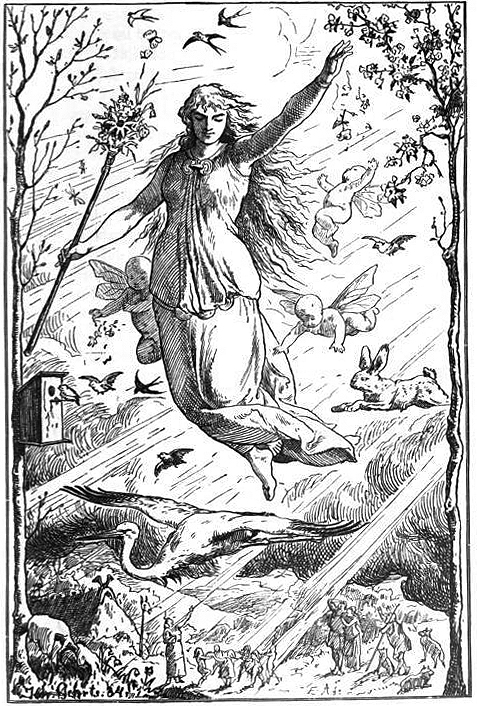
Ostara by Johannes Gehrts

Ostara by Johannes Gehrts

After Constantine decided to Christianize the Empire, Easter was changed to represent Jesus.

Hey! Guess what language Constantine, the Roman Emperor, spoke? Not English, that’s for sure! In fact, when he was alive, English didn’t even exist yet. He would have spoken Latin or Ancient Greek, so would likely have referred to Easter as Pascha or Πάσχα.

But at its roots Easter (which is pronounced Ishtar) was all about celebrating fertility and sex.

Look. Here’s the thing. Our Western Easter traditions incorporate a lot of elements from a bunch of different religious backgrounds. You can’t really say that it’s just about resurrection, or just about spring, or just about fertility and sex. You can’t pick one thread out of a tapestry and say, “Hey, now this particular strand is what this tapestry’s really about.” It doesn’t work that way; very few things in life do.

The fact is that the Ancient Romans were smart when it came to conquering. In their pagan days, they would absorb gods and goddesses from every religion they encountered into their own pantheon; when the Roman Empire became Christian, the Roman Catholic Church continued to do the same thing, in a manner of speaking.

And do you know why that worked so well? Because adaptability is a really, really good trait to have in terms of survival of the fittest (something I wish the present-day Catholic Church would remember). Scratch the surface of just about any Christian holiday, and you’ll find pagan elements, if not a downright pagan theme, underneath.

Know what else? Most Christians know this. Or, at least, most of the Christians that I’m friends with (which is, admittedly, a fairly small sampling). They know that Jesus wasn’t really born on December 25th, and they know that there were never any actual snakes in Ireland, and they know that rabbits and eggs are fertility symbols. But they don’t care, because they realize that religions evolve and change and that that’s actually a good thing, not a bad thing. The fact that many Christian saints are just re-imagined pagan gods and goddesses doesn’t alter their faith one iota; because faith isn’t about reason or sense, it’s about belief.

Look, go ahead and debate religion. Go ahead and tell Christians why what they believe is wrong. That’s totally fine and, in fact, I encourage it. A little debate and critical thinking are good for everyone. But do it intelligently. Get to know the Bible, so you actually know what you’re disagreeing with when you form an argument. Brush up on your theology so that you can explain why it’s so wrong. And have some compassion, for Christ’s sake – be polite and respectful when you enter into a debate, even when the person you’re debating with loses their cool. You want to prove that you’re better, more enlightened than Christians? Great, do it by remaining rational and level-headed in the face of someone who’s willing to stoop to personal attacks. To behave otherwise is to be just as bad as the people you’re debating.

Anyway, I hope you guys have a fantastic long weekend, no matter how you spend it. If your holiday involves chocolate, then I hope you enjoy that. If not, just enjoy the extra day or two off work and the (hopefully) warm weather. No matter what you believe in, I think that we can all agree that the end of winter and the rebirth of spring is worth celebrating.

And also? Richard Dawkins? You need to fact-check yourself before you fact-wreck yourself. Spreading this kind of misinformation to your foundation’s 637,000 fans is just plain irresponsible, especially coming from someone like you. Get with the program, buddy.

ETA: The post now seems to be removed from The Richard Dawkins’ Foundation for Science and Reason’s FB page. Thanks Richard! 

ETA Part Deux: Oh. It looks like it was deleted from their timeline but not the photo album. Welp.

*It should be noted that the only actual historical evidence that we have of sacred prostitution comes from Herodotus (I’ve included an excerpt from Herodotus’ Histories below) and no one is really sure how accurate it is. Herodotus is known for making shit up, like giant ants for example. But it makes for an amazing story and people still make the association between Ishtar and sacred prostitution, so I decided to mention it here.

The foulest Babylonian custom is that which compels every woman of the land to sit in the temple of Aphrodite and have intercourse with some stranger once in her life. Many women who are rich and proud and disdain to mingle with the rest, drive to the temple in covered carriages drawn by teams, and stand there with a great retinue of attendants. But most sit down in the sacred plot of Aphrodite, with crowns of cord on their heads; there is a great multitude of women coming and going; passages marked by line run every way through the crowd, by which the men pass and make their choice. Once a woman has taken her place there, she does not go away to her home before some stranger has cast money into her lap, and had intercourse with her outside the temple; but while he casts the money, he must say, “I invite you in the name of Mylitta” (that is the Assyrian name for Aphrodite). It does not matter what sum the money is; the woman will never refuse, for that would be a sin, the money being by this act made sacred. So she follows the first man who casts it and rejects no one. After their intercourse, having discharged her sacred duty to the goddess, she goes away to her home; and thereafter there is no bribe however great that will get her. So then the women that are fair and tall are soon free to depart, but the uncomely have long to wait because they cannot fulfil the law; for some of them remain for three years, or four. There is a custom like this in some parts of Cyprus.

That crack about ugly women was totally unnecessary, Herodotus. I am just saying.

**The first written reference we have for Eostre dates back to the 7th century AD and can be found in Venerable Bede’s Temporum Ratione, in a passage explaining that April was often referred to as Eostremonth:

“Eosturmonath” has a name which is now translated “Paschal month”, and which was once called after a goddess of theirs named Eostre, in whose honor feasts were celebrated in that month.

Jacob Grimm said that he found further evidence of Eostre and her associations with Easter, eggs and rabbits when researching his Deutsches Mythologie, although he was unable to discover any written records about her.

I Am Not Your Wife, Sister or Daughter

18 Mar

I don’t have to tell you that Steubenville is all over the news.

I don’t have to tell you that it’s a fucking joke that Trent Mays and Ma’lik Richmond, the two teenagers convicted of raping a sixteen year old girl, were only sentenced to a combined three years in juvenile prison. Each will serve a year for the rape itself; Mays will serve an additional year for “illegal use of a minor in nudity-oriented material.”

I probably don’t even have to tell you that the media treatment of this trial has been a perfect, if utterly sickening, example of rape culture, with its focus on how difficult and painful this event has been for the rapists who raped a sixteen year old girl then bragged about it on social media.

And I almost certainly don’t have to tell you that the world is full of seemingly nice, normal people who want to go to bat for the convicted rapists. I’m quite sure that you already know about the victim-blaming that’s been happening since this case first came to light. You know about the fact that people have actually come out and said that the real lesson to be learned here is that we need to be more careful with social media (i.e. go ahead and rape but make sure you don’t get caught). You already know that people seem to think that being a sports star and having a good academic record should somehow make up for the fact that you are a rapist.

I don’t have to tell you any of that because it’s all par for the course.

What I do want to tell you is that you need to stop using the “wives, sisters, daughters” argument when you are talking to people defending the Steubenville rapists. Or any rapists. Or anyone who commits any kind of crime, violent or otherwise, against a woman.

In case you’re unfamiliar with this line of rhetoric, it’s the one that goes like this:

You should stop defending the rapists and start caring about the victim. Imagine if she was your sister, or your daughter, or your wife. Imagine how badly you would feel if this happened to a woman that you cared about.

Framing the issue this way for rape apologists can seem useful. I totally get that. It feels like you’re humanizing the victim and making the event more relatable, more sympathetic to the person you’re arguing with.

You know what, though? Saying these things is not helpful; in fact, it’s not even helping to humanize the victim. What you are actually doing is perpetuating rape culture by advancing the idea that a woman is only valuable in so much as she is loved or valued by a man.

The Steubenville rape victim was certainly someone’s daughter. She may have been someone’s sister. Someday she might even be someone’s wife. But these are not the reasons why raping her was wrong. This rape, and any rape, was wrong because women are people. Women are people, rape is wrong, and no one should ever be raped. End of story.

The “wives, sisters, daughters” line of argument comes up all the fucking time. President Obama even used it in his State of the Union address this year, saying,

“We know our economy is stronger when our wives, mothers, and daughters can live their lives free from discrimination in the workplace, and free from the fear of domestic violence.”

This device, which Obama has used on more than one occasion, is reductive as hell. It defines women by their relationships to other people, rather than as people themselves. It says that women are only important when they are married to, have given birth to, or have been fathered by other people. It says that women are only important because of who they belong to.

Women are not possessions.

Women are people.

I seriously cannot believe that I have to say this in 2013.

On top of all of this, I want you to think of a few other implications this rhetorical device has. For one thing, what does it say about the women who aren’t anyone’s wife, mother or daughter? What does it say about the kids who are stuck in the foster system, the kids who are shuffled from one set of foster parents to another or else living in a group home? What does it say about the little girls whose mothers surrender them, willingly or not, to the state? What does it say about the people who turn their back on their biological families for one reason or another?

That they deserve to be raped? That they are not worthy of protection? That they are not deserving of sympathy, empathy or love?

And when we frame all women as being someone’s wife, mother or daughter, what are we teaching young girls?

We are teaching them that in order to have the law on their side, they need to be loved by men. That they need to make themselves attractive and appealing to men in order to be worthy of protection. That their lives and their bodily integrity are valueless except for how they relate to the men they know.

The truth is that I am someone’s wife. I am also someone’s mother. I am someone’s daughter, and someone’s sister. But those are not the things that define me, or make me valuable in this world. Those are not the reasons that I should be able to live a life free from rape, sexual assault or any kind of violent crime.

I have value because I am a person. Full stop. End of argument. This isn’t even a discussion that we should be having.

So please, let’s start teaching that fact to the young women in our lives. Teach them that you love, honour and value them because of who they are. Teach them that they should expect to be treated with integrity because it’s a basic human right. Teach them that they do not deserve to be raped because no one ever, ever, ever deserves to be raped.

Above all, teach them that they are people, too.

449850811_o