Archive | Uncategorized RSS feed for this section

13 Ways To Survive A Hangover

12 Apr

1. Stay in bed. Hunker down under the covers. Read Sheila Heti’s How Should A Person Be? and highlight the passages that you feel specifically apply to your life. Eat too many cookies. Let your cat lick your face clean, but stop her when she tries to groom your eyebrows.

2. Practice your humble-yet-flattered face in the mirror. Smile with genuine warmth, but look down bashfully. Shrug nonchalantly and say thank you, then quickly change the subject. Remind yourself that this is what you should be doing when people compliment you, instead of rolling your eyes and making a self-deprecating joke.

3. Don’t answer the phone. Don’t turn on the news. Don’t read any articles whose headlines contain the words government, statistics or attachment parenting

4. Make a list of potential titles for the memoir that you might someday write, e.g. My Heart Is An Autumn Garage, Everything Is Overrated, or The Blunder Years. Wonder why no one appreciates your clever Salinger references or your hilarious puns.

5. Write a letter to Simone de Beauvoir that begins,

Dear Simone, 

I wish you were still alive so that you could teach me to do my hair like yours. You always looked great.

Listen, I’m sorry Camus was such a dick to you, but let’s be honest, between him and Sartre, he was the better writer.

6. Look at pictures of baby otters:

zoo_baby_otters1

Or else this picture of a kitten cuddling a potato:

enhanced-buzz-18077-1365181268-6

7. Make a list of underused words that you love, and pledge to include them more often in your everyday vocabulary. These words might include bivouack, erstwhile, mawkish, hullaballoo, skullduggery, caterwaul, quotidian, skedaddle, peripatetic, zeitgeist.

8. Resist the urge to think about the future, dissect your failings or re-evaluate your life choices.

9. Invite your sister over. Drink fancy tea together. Watch Stand By Me and discuss what it would be like to a) live in 1950s America, b) have testicles, and c) discover a giant leech attached to said testicles.

Stand-By-Me-stand-by-me-31497936-245-170

10. Allow yourself wallow in whatever form of misery you currently feel like indulging in, for example self-pity, hopelessness or despair. Sure, your pain is self-inflicted, wallowing won’t help anybody, and you should just buck up and do something productive, but let’s be honest: that’s not going to happen today. And giving yourself permission to feel like crap is better than being angry at yourself for feeling bad, and also still feeling bad.

11. Hide your favourite pants, which now smell of gin, olives and regret, at the bottom of the laundry basket so that you don’t have to gag every time you walk by them.

12. Read your old journals. Marvel that your twenty-year-old self wrote the following:

This is the kind of love where you can be sitting watching a movie with someone and look over at them only to find them looking back at you, and you know in that instant that they were going to say exactly what you were going to say, so that in the end no actual words have to be exchanged. Maybe it’s not the most exciting kind of love, but sometimes it’s all that we’ve got.

And this:

If you can’t make it good or beautiful, at least make it interesting.

And this:

I’m lonely here, and I’m not tough enough for this neighbourhood – its inhabitants can see right through my translucent skin to my uncertain heart.

13. Swear that you will never, ever drink again.

Rehtaeh Parsons

9 Apr

The story is disturbingly familiar.

A teenage girl goes to some kind of get-together, maybe a party.

She is raped by multiple assailants.

The rape is photographed and distributed via social media.

The girl is subjected to horrifying acts of bullying and shaming. She is branded a slut. Her life becomes a living hell.

This girl is not Steubenville’s Jane Doe, although their stories bear a remarkable resemblance. This girl is Rehtaeh Parsons, a 17-year-old from Cole Harbour, Nova Scotia, who hanged herself on April 4th, a year and a half after being raped. Her family took her off life support this past Sunday.

Reading the account of what happened to Rehtaeh is like watching a deadly accident slowly, methodically unfolding in front of you. And there are bystanders, plenty of bystanders, who had any number of opportunities to step in and do something, but none of them do.

And, in many ways, you are one of these bystanders, too. I am, too. We all are.

Rehtaeh did not have a rape kit done because she was too ashamed to tell anyone about her rape until several days later, at which point it was thought to be too late to retrieve medical evidence.

The boys (there were four of them) accused of raping Retaeh were not interviewed until long after the family tried to press charges.

They were not separated for their interviews; they were interviewed together, meaning that they were easily able to corroborate each others’ stories.

The investigation took over a year. In the end, it was decided that there was insufficient evidence of sexual assault, no charges were laid, and the boys got off scot free.

No legal action was taken with regards to the photographs of the rape that were distributed through social media. Rehtaeh’s mother was told that this was because there was no way of proving who had taken the pictures.

Rehtaeh struggled to survive for seventeen months. She moved to Halifax, unable to cope with the fact that her rapists were also her high school classmates. She checked herself into the hospital when she felt suicidal and stayed there for six weeks. She made new friends. She saw a therapist. She fought to live. She fought hard.

And then one day, she couldn’t fight any longer.

And when I read her story, I can’t help but wonder:

Where the fuck were all the grownups?

Where were the grownups who were supposed to love her and protect her? Where were the grownups who should have kept her safe? Where were the grownups who were supposed to make sure that she received some kind of justice for what she suffered?

And I don’t mean her parents, because it’s clear that they, too, have been struggling for the past seventeen months, doing what they can to try to help and advocate for their daughter. I mean where the fuck were the school officials, the members of the law enforcement, the people who should have made sure that she had adequate follow-up mental health care after her hospitalization? Where were they, and why didn’t they do anything? Or if they did do something, why didn’t they do enough?

Rehtaeh’s rapists are still out there. They are still in high school, they are still going to parties and they are, quite likely, still raping. Why wouldn’t they? They got away with it once, didn’t they? Rehtaeh’s rapists are still living normal, untroubled lives, and she is dead.

She’s dead, but even in the wake of her suicide and the attention her case has gained, government officials are refusing to review why the RCMP declined  to lay charges against Rehtaeh’s rapist.

Instead, Nova Scotia’s justice minister, Ross Landry, released this fucking joke of a statement:

“As a community, we need to have more dialogue with our young people about respect and about support to educate our young boys and our young girls about what’s appropriate behaviour, what’s not appropriate behaviour,” Landry said.

“We have to make sure that we’re cognizant about what gets online and what doesn’t get online and what the impacts are, so it’s having that dialogue.

“That still doesn’t take away the fact that we’ve lost a beautiful young woman … and I’m very upset about the loss.”

Saying that we need to educate boys and girls about appropriate behaviour is victim-blaming. Saying that this wouldn’t have been a problem if the pictures hadn’t ended up online is like saying that rape is fine, but publicly broadcasting it isn’t. Calling Rehtaeh’s death a tragedy because we’ve lost a beautiful young woman is a joke – seriously, what bearing does her appearance have on how sad her death is? And since Landry is refusing to open an official review into how the RCMP handled this, isn’t he basically saying, “I think she was lying about the rape, but gosh, she sure was hot”?

All of this, every single word of this statement, all of the things that Rehtaeh endured, every single detail presented here is rape culture.

This is rape culture. This is our culture.

I never thought in a million years that I’d be saying this, but I wish that Rehtaeh’s case had had the same outcome as Jane Doe’s. Because while Jane Doe had to endure some spectacularly vile, awful shit, at least she made it out alive. At least her rapists suffered consequences. At least her case actually made it to trial.

rehtaeh parsons

This is Rehtaeh Parsons. When she was fifteen, she was raped by four boys. When she was seventeen, she committed suicide.

She is dead because we, as a society, failed her.

There is a petition up demanding an inquiry into the police investigation of Rehtaeh’s rape. I’m not sure if it will do anything to help, but signing it sure as hell won’t hurt. Right now, this petition and bringing awareness to what happened to Rehtaeh seem like the only concrete ways of helping her. Right now, I need to do something, anything to stop myself from feeling like a bystander. I’m not going to just shake my head and sigh over this. I’m going to raise my voice until everyone knows what happened to Rehtaeh.

Edited to add:

Ross Landry now says that he will be moving forward with a review of Rehtaeh’s case. Thank God. An excerpt from the article I linked to:

Justice Minister Ross Landry said today, April 9, he has asked senior government officials to present options, as soon as possible, to review the Rehtaeh Parsons case.

“This situation is tragic, I am deeply saddened – as I think are all Nova Scotians – by the death of this young woman,” said Mr. Landry. “As a parent, I can’t imagine the pain this family is going through at this time. My thoughts are with them.”

Mr. Landry said he hopes to meet with Leah Parsons, Rehtaeh’s mother, to discuss her experience with the justice system.

“I know that law enforcement and the public prosecution service do their best, every day, to administer and enforce the law,” said Mr. Landry. “It’s important that Nova Scotians have faith in the justice system and I am committed to exploring the mechanisms that exist to review the actions of all relevant authorities to ensure the system is always working to the best of its ability, in pursuit of justice.”

Mr. Landry said he has been reviewing details of the case and consulting with officials throughout the day, and expects options within the next few days.

How To Be Loved

8 Apr

Is there anything worse than being offered nice, pat aphorisms instead of actual advice?

For example, when you don’t get into your post-secondary school of choice and suddenly everyone and their mother gives you some variation on the old everything happens for a reason theme.

Or when your high school best friend is a jerk to you again and, instead of sympathizing, your mother reminds you that a leopard never changes its spots. Like, great, Mom, I just wanted a hug and maybe some chocolate, not a biology lesson about large jungle cats.

Or else how, when you were a kid and you were feeling kind of bummed out about the fact that your birthday party or whatever had just ended and all of your friends had to go home, some asshole grownup decided to remind you that all good things must come to an end. Like, no shit, Sherlock, I didn’t think I’d managed to bend the time-space continuum in order to create some kind of eternal birthday party. The fact that I knew that it was going to end didn’t make saying goodbye to my friends any less sucky.

For me, though, the worst saying was always, always, “You can’t love someone until you learn to love yourself.”

Seriously, hearing that is like the auditory equivalent of biting tin foil.

First of all, it always seems to come up whenever one of two things happens:

a) You’re experiencing abnormally high amounts of self-loathing

(slight digression: define “abnormally”)

b) You’ve just had some kind of romantic experience that ended badly

I used to get so irritated when people told me that I couldn’t love anyone else until I loved myself. I mean, first of all, it’s demonstrably untrue. I’m a chronic self-loather, and I fall in love at the drop of a hat. Seriously, a dude just has to say something smart, or be nice to a small child, or stand so that the light is hitting him in just the right way, and I’m done. Gone. Smitten. Head over heels.

Second of all, whenever I would hear this, I would think great, thanks, you’re basically telling me that I’m going to be single for the rest of my life. I mean, sure, it would be nice not to hate myself, but self-love isn’t really something that I see happening for me anytime soon. Don’t get me wrong, my therapist and I are working on it, but let’s be realistic here: Rome wasn’t built in a day, and those Ancient Romans had way more stick-to-itiveness than I do.

And you know what? I would even argue that it’s actually easier, in some cases, to love someone else when you don’t love yourself. Because what else are you going to do with all that pent up love and affection you’ve got stored away somewhere? And if that person doesn’t reciprocate, or treats you badly in any way, that just goes to show you that you weren’t really worth anything in the first place after all. The cycle perpetuates itself, and everybody wins. Except you, of course.

It’s also just kind of a weird, victim-blamey thing to say to someone. Like, maybe you could have love if you would stop feeling so shitty about yourself all the time. Just make a choice to be happy! Bootstraps, people. BOOTSTRAPS.

It wasn’t until I started dating Matt that I suddenly realized what this old saying actually meant. It’s not about being unable to love another person while you hate yourself because; it’s about how hard it is to be loved by someone else while you’re stuck in a deep pit of self-loathing.

Matt started using the L word (no, not lesbians) pretty early on in our relationship. And it made me uncomfortable, but it took me a while for me to figure out why, exactly, that was. I started feeling weird about him, started picking apart his behaviours, looking for something wrong with him. I called my friend Debbie, who had known him slightly longer than I had, and asked,

“What’s his deal? Is he some kind of weirdo or psychopath?”

“No,” she said, “he’s a totally nice guy, as far as I know. Why? Did he do something.”

“He keeps telling me he loves me.”

Debbie just laughed and said,

“Well, that’s nice, isn’t it? I mean, isn’t it?”

It didn’t feel nice, though. It felt weird.

I don’t remember what triggered it, but sometime during our first summer together I had some kind of epiphany. I realized that I was trying to figure out what was wrong with Matt because there was a part of me, a fairly big part of me, that didn’t believe that a sincerely nice, normal human being could actually love me or want to be with me. I figured that anyone who said they loved me and meant it probably had bodies buried in the basement or wanted to have sex with their mother or actually thought that Atlas Shrugged was a good book.

But Matt is nice, and (mostly) normal. He wasn’t the one who was fucked up. I was.

To be depressed is to constantly have his very calm, very rational voice whispering in your ear, telling you how awful and worthless you are. It’s being trapped inside an airless glass room, watching everyone around you pile up success after success while you can barely button your shirt or tie your shoes. It’s knowing that you are not capable of doing anything, not one single thing, of value.

Depression is mistrusting every good thing that happens. Depression is realizing that, when things seem to be going your way for once, this is always the part of the movie when aliens attack and destroy the earth. Depression is the need to constantly be on the lookout for the secret trap door, for the ulterior motive, for whatever the catch might be.

Depression is the certainty that you’ve finally taken off the rose-coloured glasses are seeing yourself quite clearly for the first time.

Depression is being sickened by your own reflection.

So how can you ever trust a person who loves someone like you?

And I’ve been wondering, lately, if it’s ever, at any time, possible to be depressed and love yourself? If you are someone who is clinically, chronically depressed, does that mean that you’re stuck with self-loathing for the rest of your life? Are misery and self-love ever able to co-exist? Or are those states totally, fundamentally contradictory?

I guess what I’m really trying to get at here is this:

Will I ever like, maybe even love, myself?

And I try. I really do.

I make lists. I remind myself of all of the good things in my life. I try to view my successes in their own right, rather than seeing them as opportunities to fail even harder somewhere further on down the road. I give myself pep talks. When all else fails, I call my mom.

Being depressed means that I have a hard time accepting anything positive. Good news makes me feel sick to my stomach. Compliments make me deeply uncomfortable. Smiling makes my cheeks ache.

And, after eight years of being with Matt, accepting the fact that someone else loves me is still a struggle. I ask him, often, if he still loves me. I make him promise that he’ll never leave me. I bury my face in his chest and tell him to wrap his arms around me as tightly as he can.

Other times, when I’m in a real low, I don’t even want him near me. I don’t want to be touched, I don’t want to be held, I don’t want to be loved. His affection for me irritates me, sometimes even angers me. When I’ve reached rock bottom, all I want is to be totally and utterly alone. Preferably forever.

I’m hard to love.

And I have a hard time being loved.

Eight years in and I’m still waiting for the other shoe to drop. I’m still waiting for the bodies in the basement to be discovered, or else for the Oedipus complex to be revealed.

Still.

I want to ask if this is going to get any easier, but I would guess that the truth is that it’s a process. You learn to stop the negative self-talk, and you learn to let other people get close to you. You learn to accept that good things happen, too, sometimes. You stop balking at the idea of happiness, that elusive state which somehow manages to simultaneously be the goal that you’ve spent the majority of your life chasing and also the thing that terrifies you the most.

You stop giving all of your love away and learn to keep some for yourself.

Maybe that’s the secret to being loved.

309_68974385214_3487_n

309_68974395214_3830_n

309_68974405214_4152_n

Desert Island Books

5 Apr

The funny thing is that you’re very rarely enough of anything for anyone.

When I write about radical-lady-type-stuff, I’m always too feminist for some people, and not feminist enough for others.

When I get worked about something, I’m always too outspoken for some, and not outspoken enough for others.

When I wrote that post about Easter, I was, according to commenters, either too Christian or else too atheist.

A few commenters even wondered if I was a pantheist, the thought of which sent me scrambling to my bookcase, scanning the shelves until I finally found Ann-Marie McDonald’s Fall On Your Knees.

I flipped to the end of the book, the section that’s an excerpt of Kathleen’s diary, and, after re-reading all of her love scenes with Rose, found the passage I was looking for:

O Diary. My loyal friend. There is love, there is music, there is no limit, there is work, there is the precious sense that this is the hour of grace when all things gather and distil to create the rest of my life. I don’t believe in God, I believe in everything. And I am amazed at how blessed I am.

That’s the kind of paragraph that makes me want to take a long drag on a cigarette, exhale the smoke oh-so-slowly , and mutter, Yes, yes, exactly, yes.

 Fall On Your Knees was my favourite book when I was a teenager. I mean, Jesus, what’s not to love about it? It’s a huge, generation-spanning Canadian epic that takes place in early 20th century Cape Breton (NOVA SCOTIA REPRESENT) and jazz-age New York. The writing is teeth-achingly beautiful, not to mention clever, funny and smart as hell. The characters are brilliant, multi-faceted and all that other good stuff that actual literary-type people say in actual book reviews; in fact, I think that my first ever girl-crush was on Frances Piper.

When I was in university, I had the chance to go see Ann-Marie McDonald give a reading from her latest, The Way The Crow Flies. She was gorgeous and articulate and funny (naturally), and I was totally smitten. Afterwards, I got the chance to meet her and have her sign my copy of Fall On Your Knees. I felt like I was meeting a movie star; my palms were sweaty, my mouth was dry, my chest felt tight. I felt light-headed, and kept having to remind myself to breathe.

When I made it to the head of the line and she asked me my name, I somehow managed to squeak out that her book had really been important to me. I knew that it was going to sound stupid and trite before I even said it, but I didn’t know what else I could say. Here was this person who had strung together the loveliest, smartest, best words possible to create an absolutely perfect story, one that I could disappear into any time that I needed a break from the real world. I wanted to tell her everything that I loved about her book, from why Frances was my favourite character all the way to how her brief mention of Nova Scotia’s Africville had spawned an hour-long conversation with my grandmother about Halifax’s racial landscape.

But how was I supposed to do that with the auditorium lights shining in my face as if I were being questioned for a crime I hadn’t committed? How was I supposed to tell her all this with my clumsy tongue and my woefully inadequate vocabulary?

So I told her that it was important. And she smiled and thanked me and scrawled For Anne, From Ann-Marie McDonald inside the front cover of my book. Afraid that I might embarrass myself, I hurried away, stumbled down the steps, and, while walking home, thought up a million brilliantly witty remarks that I could have made to McDonald if only I’d had the wherewithal.

(Hint: I very rarely have any wherewithal whatsoever)

All of which is to say – oh my dear sweet Jesus I love books so fucking much.

I love reading books, I love buying books, I love writing about books and I love talking about books.

So with that in mind, I asked you guys what your all-time favourite, desert-island books were.

Here’s what you had to say:

The Hitchhiker’s Guide To The Galaxy by Douglas Adams

Watership Down by Richard Adams

Little Women by Louisa May Alcott

In The Time Of The Butterflies by Julia Alvarez

Behind The Scenes At The Museum by Kate Atkinson

Cat’s Eye by Margaret Atwood

The Handmaid’s Tale by Margaret Atwood

Pride And Prejudice by Jane Austen

The Long Walk by Richard Bachmann/Stephen King

The Wasp Factory by Iain Banks

Oz series by Frank L. Baum

The Last Unicorn by Peter S. Beagle

Summer Sisters by Judy Blume

Dandelion Wine by Ray Bradbury

The Martian Chronicles by Ray Bradbury

The Mists of Avalon by Marion Zimmer Bradley

Jane Eyre by Charlotte Brontë

Villette by Charlotte Brontë

The Master And Margarita by Mikhail Bulgakov

The Secret Garden by Frances Hodgson Burnett

If On A Winter’s Night A Traveler by Italo Calvino

Alice In Wonderland by Lewis Carroll

Claudine series by Colette

Little, Big by John Crowley

The Alchemist by Paulo Cuelho

The Red Tent by Anita Diamant

Tam Lin by Pamela Dean

The Devil’s Teardrop by Jeffery Deaver

Crime And Punishment by Fyodor Dostoyevsky

The Neverending Story by Michael Ende

The Master Butchers Singing Club by Louise Erdrich

Wyrm by Mark Fabi

The Refugee Summer by Edward Fenton

Headhunter by Timothy Findley

White Oleander by Janet Fitch

The Great Gatsby by F. Scott Fitzgerald

The Pillars Of The Earth by Ken Follett

American Gods by Neil Gaiman

The Prophet by Kahlil Gibran

Neuromancer by William Gibson

China Court: The Hours Of A Country House by Rumer Godden

Memoirs Of A Geisha by Arthur Golden

Oblomov by Ivan Goncharov

The Wind In The Willows by Kenneth Grahame

Twenty Thousand Streets Under The Sky by Patrick Hamilton

The Hottest State by Ethan Hawke

The Scarlet Letter by Nathaniel Hawthorne

Red Planet by Robert A. Heinlein

Stranger In A Strange Land by Robert A. Heinlein

Dune series by Frank Herbert

Les Misérables by Victor Hugo

Brave New World by Aldous Huxley

A Prayer For Owen Meany by John Irving

Winter Of Fire by Sherryl Jordan

The Dharma Bums by Jack Kerouac

It by Stephen King

The Poisonwood Bible by Barbara Kingsolver

Prodigal Summer by Barbara Kingsolver

The Unbearable Lightness of Being by Milan Kundera

She’s Come Undone by Wally Lamb

Operating Instructions: A Journal Of My Son’s First Year by Anne Lamott

Love In The Time Of Cholera by Gabriel García Márquez

One Hundred Years Of Solitude by Gabriel García Márquez

Swan Song by Robert R. McCammon

Fall On Your Knees by Ann-Marie McDonald

If Nobody Speaks Of Remarkable Things by Jon McGregor

The Virgin Cure by Ami McKay

Cloud Atlas by David Mitchell

Anne of Green Gables by Lucy Maud Montgomery

Fool by Christopher Moore

The Night Circus by Erin Morgenstern

Lolita by Vladimir Nabokov

Apathy And Other Small Victories by Paul Neilan

The Good Mayor by Andrew Nicoll

Popular Music From Vittula by Mikael Niemi

1984 by George Orwell

Down And Out In Paris And London by George Orwell

Haunted by Chuck Palahniuk

Invisible Monsters by Chuck Palahniuk

A Catskill Eagle by Robert B. Parker

Zen And The Art Of Motorcycle Maintenance by Robert Pirsig

The Bell Jar by Sylvia Plath

Night Watch by Terry Pratchett

The Shipping News by E. Annie Proulx

His Dark Materials series by Philip Pullman

The Rapture of Canaan by Sheri Reynolds

Skinny Legs And All by Tom Robbins

Still Life With Woodpecker by Tom Robbins

Harry Potter series, specifically The Prisoner of Azkaban, by J.K. Rowling

The God Of Small Things by Arundhati Roy

Midnight’s Children by Salman Rushdie

The Sparrow by Mary Doria Russell

The Catcher In The Rye by J.D. Salinger

Franny And Zooey by J.D. Salinger

The Cat In The Hat by Dr. Seuss

Love Is A Mix Tape by Rob Sheffield

A Tree Grows In Brooklyn by Betty Smith

White Teeth by Zadie Smith

There’s A Girl In My Hammerlock by Jerry Spinelli

The Grapes of Wrath by John Steinbeck

To A God Unknown by John Steinbeck

The Log From The Sea Of Cortez by John Steinbeck

The Eagle Of The Ninth by Rosemary Sutcliff

The Queen Elizabeth Story by Rosemary Sutcliff

The Secret History by Donna Tartt

Miss Pym Disposes by Josephine Tey

Fear And Loathing On The Campaign Trail ’72 by Hunter S. Thompson

A Complicated Kindness by Miriam Toews

The Hobbit by J.R.R. Tolkien

Lord of the Rings trilogy by J.R.R. Tolkien

A Confederacy of Dunces by John Kennedy Toole

Mary Poppins series by P.L. Travers

The Making Of A Psychiatrist by David Viscott

Cat’s Cradle by Kurt Vonnegut

Slaughterhouse Five by Kurt Vonnegut

A Room Of One’s Own by Virginia Woolf

The Chrysalids by John Wyndham

The Book Thief by Markus Zusak

Please feel free to add your suggestions in the comments, and I will add them to the list!

library-old-photography-vintage-woman-woody-allen-Favim.com-102666

An Open Letter To My Son

4 Apr

You.

Sometimes I wonder about you.

I wonder, for instance, where you came from. I understand the dry facts, of course, the complex mechanics of ovulation and ejaculation. I understand how cells divide, and then divide again, their numbers growing exponentially as seconds tick by. I know a thing or two about gametes and zygotes and embryos.

What I don’t understand is how all of that made you.

The facts of your existence seem like they would be better explained by alchemy rather than biology. We made you out of nothing, or rather, we made you out of two randomly-selected bits of genetic code that we unintentionally sent slamming into each other deep in the darkest recesses of my body. And out of those tangled strands of DNA grew you, incredible, beautiful you, with your father’s blue eyes and my heart-shaped mouth.

It feels more like magic than science, really.

I don’t know that I believe in souls, but I do know that I have a hard time wrapping my head around the fact that there is now an entirely new, unique human being on this planet who has never been here before.

And I wonder how I managed to carry you for eight months inside of me without somehow fucking it up. I mean, this is me we’re talking about here – the person who is totally incompetent when it comes to the most mundane, run-of-the-mill tasks. I can’t swim or drive a car or even whistle properly, for God’s sake, but somehow I made an entire kid from scratch? How does that even work?

I’ve spent two years watching you unfold from a scrunched up, red-faced, newborn cipher into something that’s starting to bear a remarkable resemblance to a human being. You walk, you talk, you have feelings. You have preferences, even, very specific likes and dislikes that seem totally arbitrary to me. You have a sense of humour. You make jokes, on purpose, just to make me laugh.

You tell me that you love me and I wonder what you think that word means. At thirty, I’m still getting a handle on all of the possible interpretations of love, all of the implications and connotations that it might bring with it. I’ve learned to use the word cautiously, sparingly, oh-so-carefully, because those four innocent letters can be so incredibly loaded with meaning. But you, what do you know about meaning? You don’t know anything, or at least certainly not enough to overthink things the way I do; you just love me.

And oh God I love you so much. So fucking much.

And I wonder, how on earth do I protect you? How do I keep you safe?

Like some poor, naïve fairytale mother, I’m trying to help you navigate your way through a forest that’s by turns enchanted and haunted. The path is familiar, as if I walked it once years ago, but different, too; overgrown and seemingly impassable in some parts, and unexpectedly clear in others. And as we pick our way through the undergrowth, as we do our best not to trip on twisted roots and sharp stones, I try to remember the lessons I’ve learned from all folktales I used to know.

For example, I won’t make the mistake that Sleeping Beauty’s parents did when sending out invitations to her christening. Unlike them, I’ll be sure to invite the dark fairy godmothers as well as the good ones, because I know that they’ll come anyway, slipping in through back doors and lurking in corners where you least expect them. I’ll let them give you their murky gifts in broad daylight, so that I can look them in the eye while they do so. Then I’ll smile and thank them, recognizing that I have to let life give you the bad as well as the good.

And when I send you out into the world alone, as I know that I will someday have to, I’ll give you something more substantial than bread crumbs with which to find your way back home.

And I won’t make you go to your grandmother’s house alone until I can be sure that you can tell the difference between an old woman and a wolf in a nightgown.

I look at you and wonder what will happen once I’m not there to navigate this forest path with you. I wonder what trolls and goblins and clever tricksters you’ll have to face. Will your monsters look anything like mine?

I wonder what else I’ve passed on to you, along with the shape of my eyes, my love of books, and my brilliantly trenchant wit. What ticking little genetic time bombs lie dormant inside of you? My anxiety? My depression? The weird nail on my right big toe that turns black and falls off every winter?

If and when these things surface, what will I do?

Will I even be able to help you?

And how will I teach you about a world in which you, a white, middle class boy, will have more privilege than most?

And how do I teach you that it’s your job, among other things, to give a hand up to those less privileged than you, when everything else around you will seem to be telling you to grab whatever you can and run with it?

And how do I teach you that you’re allowed to cry, that you’re allowed to feel afraid or weak or inadequate?

How I do I help you decode all of the toxic messages that the world will try to shove down your throat?

What I want for you most of all is a place of safety. I want our home to be a place where you feel safe making mistakes, a place where you have a healthy respect for but never a fear of consequences. I want you to feel safe being yourself, whoever that is. And above all, when you’re out there, alone and afraid, I want you to know that you always have a safe place to come back to.

I will always love you, no matter what.

Photo by Diana Nazareth http://www.diananazareth.com

Photo by Diana Nazareth http://www.diananazareth.com

Nostalgia Machine: On Re-Watching Girl, Interrupted

1 Apr

Those of you who are fairly new to my blog may not know this, but on days when I’m not busy kicking the patriarchy square in the nuts or deconstructing inaccurate Facebook memes, I like to indulge in a little bit of nostalgia. Well, maybe a lot of nostalgia. Then I tweet extensively about my my indulgences, and sometimes end up writing about them here.

Which is all to say that I re-watched Girl, Interrupted the other night and now I want to talk about it.

I saw Girl, Interrupted in theatres, when it first came out, and it gave me a lot of Feelings. Actually, it gave me one main Feeling, namely that I basically was Winona Ryder’s character, if slightly less gamine and winsome. I mean, I was a depressed teenager who had a) frequently contemplated suicide, b) felt lonely and isolated, and c) wrote obsessively in serious-looking leather-bound journals. Of course I identified with the film version of Susanna Kaysen.

Every single scene, every thought, word, and action in that movie struck me as being perfectly, achingly true. Every time Winona Ryder looked at the camera with her wide, tearful eyes, every time her mouth trembled with emotion, every time she stared sadly off into the middle distance, I thought, yes. Yes, I get this.

Then, a few years ago, I bought Girl, Interrupted on DVD, fuelled by memories of how important it had been to me. But after watching it for less than an hour I had to turn it off. It was awful, unbearable even. The performances were overwrought, the dialogue ridiculously, almost comically, dramatic. I was embarrassed that I’d ever even liked this movie, let alone identified with the main character. I put the DVD back in its case, stuck it on the shelf and didn’t touch it again.

Or rather, I didn’t touch it until earlier this week, when Catherine, my sister and frequent accomplice in nostalgic endeavours, suggested that we watch it. Sure, I said, figuring that I could hate-watch it and then later make fun of it. Maybe we could even invent a drinking game, like, take a shot every time Susanna cries over how hard it is to be a white, middle-class American. Hilarious, right? I mean, right?

Except that on re-watching Girl, Interrupted, I discovered that it had, in the last five years, somehow gone past bad and straight back to good again.

At its core, this film isn’t really about mental health, or suicide, or Susannah Kaysen’s stay at the famed McLean Hospital. I mean, of course it is about all of those things, at least peripherally, but at its heart it’s about friendship. Specifically, it’s about a sort of intense, parasitic friendship that seems to exist only between young women, those deceptively bright, canny girls just on the cusp of entering the adult world.

And maybe this isn’t the type of friendship that every girl experiences. Maybe this is just me, projecting my own pathetic history onto the blank canvas of Winona’s smooth, perfect face. Maybe I’m the only one who sees this when I watch this movie. But I know that this is a type of friendship that I’ve engaged in not just once but over and over, and maybe I still do, to this day. It’s possible that it’s a pattern that will play out for the rest of my life, or at least until I grow up and finally get some sense knocked into me.

Can you believe that I’m thirty and still talking about growing up in the future tense?

The dynamics of this specific type of friendship are as follows: half of the friendship, let’s call her Girl One, is a strong, loud, brash character who doesn’t give a shit about what anyone thinks, says whatever’s on her mind and gives very little thought to the consequences of her actions. The other half is someone, call her Girl Two, who is almost the photographic negative of the first – quiet, reserved, terrified of how other people see her.

Think Peppermint Patty and Marcie from Peanuts, except amplified, grotesquely exaggerated.

When I say that this friendship is parasitic, maybe what I really mean is that it’s symbiotic. As a lifelong Girl Two, I’ve always thought that I needed Girl One more than she needed me, but I wonder, now, whether that’s true or now. Maybe we’ve needed each other in equal amounts. I’ve needed someone to act out all of the things that I would never, or could never, dare to do, someone whose own loud voice might give me permission to raise mine, someone who would never sugarcoat whatever they wanted to tell me. But perhaps my friends, in turn, needed someone to occasionally hold them back, someone to steady them, someone who would listen to them and not pass judgment.

The truth is that I don’t know why or how much these other girls loved or needed me, but I do know that I loved and needed them with an intensity that sometimes bordered on obsessive. Because these girls, these loud, strident girls, had both a popularity and notoriety (not that my teenage self could differentiate between the two) that I could only dream of. People either fiercely loved or passionately hated these girls; as for me, they didn’t even bother to notice that I existed.

But these girls noticed that I existed.

And the fact is that as much as I like to think that I’m the type to stand up for what I believe in, the type to shout down the misogynists, the racists, the homophobes, the transphobes, I still sometimes need someone to give me a push. I need someone to raise their voice first, show me how it’s done, teach me not to be afraid. Because for whatever reason, these gifts don’t exist inside of me, or if they do, they lie perpetually dormant, and need to be awakened again and again and again.

On my own, I am not good at challenging authority. Not really. I need other people, people like Angelina Jolie’s character Lisa, to egg me on. And, much like Winona Ryder’s Susanna, I’m not always good at figuring out when the Lisas in my life have gone too far. I put too much trust in them, and then end up places, sometimes frightening places, that I never intended to be. I let myself be blinded by love, or at least by longing and envy, and don’t notice that some of these Lisas are downright bad news. Or rather, I don’t notice until it’s too late.

So yeah, maybe at thirty years old I do still get Susanna. Maybe there are more layers to the similarities between us than I’d originally thought.

And all that absurd dialogue and overwrought acting? This time around, they seem to me to be a painfully realistic portrayal of how teenagers actually behave. When you’re in your teens, everything that you feel is so intense, so immediate, so overwhelming that you can speak only in terrible, laughable clichés. My mother has always said that teenagers are like toddlers with better language skills, and now, watching my son struggle to express frighteningly huge emotions with his sadly inadequate vocabulary, I’ve realized how right she is.

I’ve realized that when I watched Girl, Interrupted a few years ago, what embarrassed me the most was the idea that at one time I might have spoken or acted in any way that resembled Susanna. Surely, even as a teenager, I’d been too smart, too articulate to ever behave so pretentiously. But the truth is that I was ridiculously, probably amusingly, pretentious. I just didn’t recognize this trait because all of my peers were just as overwrought and dramatic as I was.

All of this is to say that I’m now back at a place in my life where I can like, maybe even love, this movie, if only because it seems like a neatly preserved time capsule of how I thought and felt half a lifetime ago. I remember what it was like to be where Susanna was. To suddenly find yourself at the end of high school faced with choices, choices, choices, and yet not to see any of them leading anywhere. When I was a teenager, I lived in terror of being “normal,” because I worried that choosing a normal path and ending up with a normal life would make me just as grey and miserable as all of the adults that surrounded me. There would come a time, of course, when having a normal life and a nuclear family and a nine-to-five job would seem wonderfully, almost exotically appealing to me, but that came much later. When I was in high school, I didn’t understand that opting out had its costs, some of which, it turned out, I wasn’t willing to pay.

And sometimes I miss my teenage self, because even if she lacked her own voice, she still somehow managed to be totally steadfast and uncompromising in her beliefs, even if those beliefs made her feel miserable and isolated. But mostly I’m just glad that I’ve learned how to trade off one thing for another, to give a piece of myself away in order to be able to keep a different part that is more necessary, more valuable. I’m grateful to the Lisas in my life who have taught me when to stand up mouth off and, somewhat by extension, when to sit down and shut up. I’m thankful for every time I’ve had to learn the lesson that it’s important not to trust the Lisas out there too implicitly, and that I need to learn how to think for myself. It’s a hard lesson, and one that it feels like I’ve had to learn often, but it’s a good one.

Mostly, though, I’m glad that I’ve found my way to where I am.

Girl--Interrupted-winona-ryder-154518_1000_667

Easter Is Not Named After Ishtar, And Other Truths I Have To Tell You

28 Mar

If there is one thing that drives me absolutely bananas, it’s people spreading misinformation via social media under the guise of “educating”. I’ve seen this happen in several ways – through infographics that twist data in ways that support a conclusion that is ultimately false, or else through “meaningful” quotes falsely attributed to various celebrities, or by cobbling together a few actual facts with statements that are patently untrue to create something that seems plausible on the surface but is, in fact, full of crap.

Yesterday, the official Facebook page of (noted misogynist and eugenics enthusiast) Richard Dawkins’ Foundation for Reason and Science shared the following image to their 637,000 fans:

Neither Reasonable Nor Scientific

Neither Reasonable Nor Scientific

Naturally, their fans lapped this shit up; after all, this is the kind of thing they absolutely live for. Religious people! Being hypocritical! And crazy! And wrong! The 2,000+ comments were chock-full of smug remarks about how naïve and stupid Christians were, accompanied by pats on the back for all the atheists who smart enough to see through all the religious bullshit and understand how the evil church had slyly appropriated all kinds of pagan traditions.

And you know what? That’s fine, I guess. I’m all for questioning religion and examining the sociological, historical and anthropological reasons that help explain the hows and whys of our lives today. I’m actually super fascinated by that kind of stuff, even if I do think that there’s a way to discuss it without making yourself sound smarter and more enlightened than the people around you.

But you guys? The image above is rife with misinformation. RIFE, I say.

Let’s start from the top:

This is Ishtar …

Okay, great. So far things are fairly accurate. The relief pictured here, known as the Burney Relief (also called the Queen of the Night relief) is widely considered to be an Ancient Babylonian representation of Ishtar (although some scholars believe that the woman depicted might be Lilitu or Ereshkigal). This relief is currently housed in the British Museum in London, but originates from southern Iraq and is nearly 4,000 years old.

… pronounced Easter.

Actually, in modern English we pronounce it the way it looks. A case could be made for pronouncing it Eesh-tar, but I have yet to come across a credible source that gives the original pronunciation as Easter.

Easter is originally the celebration of Ishtar, the Assyrian and Babylonian goddess of fertility and sex.

Ishtar was the goddess of love, war and sex. These days, thanks to Herodotus, she is especially associated with sacred prostitution* (also known as temple prostitution), which, in the religions of the Ancient Near East, allegedly took on the form of every woman having to, at some point in her life, go to the temple of Ishtar and have sex with the first stranger who offered her money. Once a woman entered the temple of Ishtar for the purpose of sacred prostitution, she was not allowed to leave until she’d done the deed. I can’t imagine that sacred prostitution sex was ever very good sex, but hey, what do I know? Probably some people were pretty into it – I mean, if you can imagine it, someone’s made porn about it, right?

Anyway, the point I am trying to make here is that, yes, Ishtar was associated with fertility and sex. However, her symbols were the lion, the gate and the eight-pointed star; I can’t find any evidence of eggs or rabbits symbolically belonging to her. And Easter has nothing to do with her.

Most scholars believe that Easter gets its name from Eostre or Ostara**, a Germanic pagan goddess. English and German are two of the very few languages that use some variation of the word Easter (or, in German, Ostern) as a name for this holiday. Most other European languages use one form or another of the Latin name for Easter, Pascha, which is derived from the Hebrew Pesach, meaning Passover. In French it’s Pâques, in Italian it’s Pasqua, in Dutch it’s Pasen, in Danish it’s Paaske, in Bulgarian it’s Paskha, and so on and so forth.

In the Christian Bible, Jesus returned to Jerusalem from his forty days in the desert just before Passover. In fact, in the Gospel according to John, Jesus was killed on the day before the first night of Passover, at the time when lambs were traditionally slaughtered for the Passover feast (because Jesus was the Lamb of God, etc. – SYMBOLISM, Y’ALL). There are a few differing accounts of when Jesus actually died, but most Christian texts, philosophers and scholars agree that it was around the time of Passover. Easter is still celebrated the week after Passover, which is why it’s a different day each year, because the Jewish calendar is lunar rather than solar.

Her symbols (like the egg and the bunny) were and still are fertility and sex symbols (or did you actually think eggs and bunnies had anything to do with the resurrection?).

Actually, according to Jacob Grimm’s Deutsche Mythologie, which he wrote after journeying across Germany and recording its oral mythological traditions, the idea of resurrection was part and parcel of celebrating the goddess Ostara:

OstaraEástre seems therefore to have been the divinity of the radiant dawn, of upspringing light, a spectacle that brings joy and blessing, whose meaning could be easily adapted by the resurrection-day of the christian’s God. Bonfires were lighted at Easter and according to popular belief of long standing, the moment the sun rises on Easter Sunday morning, he gives three joyful leaps, he dances for joy … Water drawn on the Easter morning is, like that at Christmas, holy and healing … here also heathen notions seems to have grafted themselves on great christian festivals. Maidens clothed in white, who at Easter, at the season of returning spring, show themselves in clefts of the rock and on mountains, are suggestive of the ancient goddess.”

Spring is a sort of resurrection after all, with the land coming back to life after lying dead and bare during the winter months. To say that ancient peoples thought otherwise is foolish, naïve and downright uninformed. Many, many pagan celebrations centre around the return of light and the rebirth of the land; these ideas are not new themes in the slightest.

And yes, rabbits and eggs are fertility symbols, and they are, in fact, associated with Eostre.
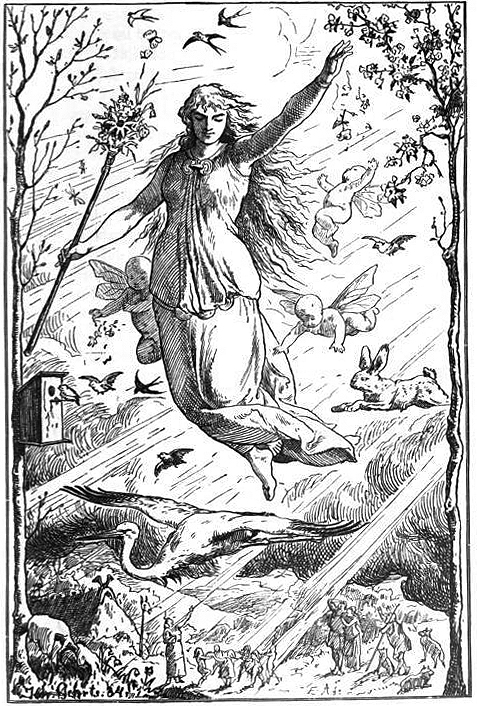
Ostara by Johannes Gehrts

Ostara by Johannes Gehrts

After Constantine decided to Christianize the Empire, Easter was changed to represent Jesus.

Hey! Guess what language Constantine, the Roman Emperor, spoke? Not English, that’s for sure! In fact, when he was alive, English didn’t even exist yet. He would have spoken Latin or Ancient Greek, so would likely have referred to Easter as Pascha or Πάσχα.

But at its roots Easter (which is pronounced Ishtar) was all about celebrating fertility and sex.

Look. Here’s the thing. Our Western Easter traditions incorporate a lot of elements from a bunch of different religious backgrounds. You can’t really say that it’s just about resurrection, or just about spring, or just about fertility and sex. You can’t pick one thread out of a tapestry and say, “Hey, now this particular strand is what this tapestry’s really about.” It doesn’t work that way; very few things in life do.

The fact is that the Ancient Romans were smart when it came to conquering. In their pagan days, they would absorb gods and goddesses from every religion they encountered into their own pantheon; when the Roman Empire became Christian, the Roman Catholic Church continued to do the same thing, in a manner of speaking.

And do you know why that worked so well? Because adaptability is a really, really good trait to have in terms of survival of the fittest (something I wish the present-day Catholic Church would remember). Scratch the surface of just about any Christian holiday, and you’ll find pagan elements, if not a downright pagan theme, underneath.

Know what else? Most Christians know this. Or, at least, most of the Christians that I’m friends with (which is, admittedly, a fairly small sampling). They know that Jesus wasn’t really born on December 25th, and they know that there were never any actual snakes in Ireland, and they know that rabbits and eggs are fertility symbols. But they don’t care, because they realize that religions evolve and change and that that’s actually a good thing, not a bad thing. The fact that many Christian saints are just re-imagined pagan gods and goddesses doesn’t alter their faith one iota; because faith isn’t about reason or sense, it’s about belief.

Look, go ahead and debate religion. Go ahead and tell Christians why what they believe is wrong. That’s totally fine and, in fact, I encourage it. A little debate and critical thinking are good for everyone. But do it intelligently. Get to know the Bible, so you actually know what you’re disagreeing with when you form an argument. Brush up on your theology so that you can explain why it’s so wrong. And have some compassion, for Christ’s sake – be polite and respectful when you enter into a debate, even when the person you’re debating with loses their cool. You want to prove that you’re better, more enlightened than Christians? Great, do it by remaining rational and level-headed in the face of someone who’s willing to stoop to personal attacks. To behave otherwise is to be just as bad as the people you’re debating.

Anyway, I hope you guys have a fantastic long weekend, no matter how you spend it. If your holiday involves chocolate, then I hope you enjoy that. If not, just enjoy the extra day or two off work and the (hopefully) warm weather. No matter what you believe in, I think that we can all agree that the end of winter and the rebirth of spring is worth celebrating.

And also? Richard Dawkins? You need to fact-check yourself before you fact-wreck yourself. Spreading this kind of misinformation to your foundation’s 637,000 fans is just plain irresponsible, especially coming from someone like you. Get with the program, buddy.

ETA: The post now seems to be removed from The Richard Dawkins’ Foundation for Science and Reason’s FB page. Thanks Richard! 

ETA Part Deux: Oh. It looks like it was deleted from their timeline but not the photo album. Welp.

*It should be noted that the only actual historical evidence that we have of sacred prostitution comes from Herodotus (I’ve included an excerpt from Herodotus’ Histories below) and no one is really sure how accurate it is. Herodotus is known for making shit up, like giant ants for example. But it makes for an amazing story and people still make the association between Ishtar and sacred prostitution, so I decided to mention it here.

The foulest Babylonian custom is that which compels every woman of the land to sit in the temple of Aphrodite and have intercourse with some stranger once in her life. Many women who are rich and proud and disdain to mingle with the rest, drive to the temple in covered carriages drawn by teams, and stand there with a great retinue of attendants. But most sit down in the sacred plot of Aphrodite, with crowns of cord on their heads; there is a great multitude of women coming and going; passages marked by line run every way through the crowd, by which the men pass and make their choice. Once a woman has taken her place there, she does not go away to her home before some stranger has cast money into her lap, and had intercourse with her outside the temple; but while he casts the money, he must say, “I invite you in the name of Mylitta” (that is the Assyrian name for Aphrodite). It does not matter what sum the money is; the woman will never refuse, for that would be a sin, the money being by this act made sacred. So she follows the first man who casts it and rejects no one. After their intercourse, having discharged her sacred duty to the goddess, she goes away to her home; and thereafter there is no bribe however great that will get her. So then the women that are fair and tall are soon free to depart, but the uncomely have long to wait because they cannot fulfil the law; for some of them remain for three years, or four. There is a custom like this in some parts of Cyprus.

That crack about ugly women was totally unnecessary, Herodotus. I am just saying.

**The first written reference we have for Eostre dates back to the 7th century AD and can be found in Venerable Bede’s Temporum Ratione, in a passage explaining that April was often referred to as Eostremonth:

“Eosturmonath” has a name which is now translated “Paschal month”, and which was once called after a goddess of theirs named Eostre, in whose honor feasts were celebrated in that month.

Jacob Grimm said that he found further evidence of Eostre and her associations with Easter, eggs and rabbits when researching his Deutsches Mythologie, although he was unable to discover any written records about her.

My Uncle Eric

26 Mar

When I was a kid I had this uncle, Uncle Eric.

Maybe you’ve heard of him? His name was Eric Donkin, and for a while (quite a while, actually) he was kind of a Big Deal in Canadian theatre.

Here is a picture of Uncle Eric as Julius Caesar:

$(KGrHqZ,!hgF!yT3+pS,BQQORki7vQ~~60_35

Pretty badass, no?

He wasn’t really my uncle. He was actually one of those family friends your parents force you to call auntie or uncle or cousin. His father had died over in England when he was a baby, and he and his mother had emigrated to Montreal when he was only 11 months old. His mother, who I called Nana Donkin, had met my grandparents not long after arriving in Canada and soon became their close friend. She used to babysit my mother and her siblings, and Eric had been like a (significantly) older brother to them.

Anyway, Uncle Eric was very well-established as an actor by the time I met him – he was already in his mid-50s when I was born and living in Stratford with mother and his friend John. Or rather, Nana Donkin lived in one large, gorgeous Victorian house in the middle of town, and Eric and John lived in another right next door.

My mother referred to John as Eric’s partner, and Nana Donkin called John his chum. My grandparents simply referred to John as Eric’s friend. None of the adults I knew ever spoke aloud what must have been obvious to everyone: that John was Eric’s lover, and, had gay marriage been legal back then, he likely would have been his husband.

As a kid, you don’t question language or titles a whole lot, I guess. So when my mother told me that John was Eric’s partner, I thought she meant business partner. I figured that they lived together because they had a lot of businessy stuff to do, and probably they were both bachelor-types who liked having the company of a roommate and friend.

As I grew older, I didn’t think to question John and Eric’s relationship. They were never demonstrative, never open about their love for each other; probably because both had grown up in a time when that just wasn’t done. Even when I was old enough to know what being gay or queer meant, and old enough to know that you couldn’t legally marry someone of your own sex, and certainly old enough to know that gay people often referred to their significant others as their partners, I still didn’t put two and two together.

It wasn’t until I was fifteen and attending Uncle Eric’s funeral that I realized that he was gay.

I was (and still am) a theatre nerd who, at the time, had dreams of someday sweeping across a Stratford stage in a period gown, loudly and beautifully enunciating my way through one of Shakespeare’s more famous monologues. So I was understandably a little overwhelmed by the fact that I was sitting in a private family-only box at the Festival Theatre listening to Richard Monette and Martha Henry eulogize my uncle. As I sat there entranced, drinking in every theatrically-spoken word, I had a lightbulb moment.

Someone, I can’t remember who, was reminiscing about performing with Uncle Eric at Montreal’s Centaur Theatre. She told a story about how one night, after whatever show it was that they were doing, all of the chorus girls ran into Eric’s dressing room and covered him in bright red stage-make-up-y kisses. Eric had just laughed and said, “I think I’m playing for the wrong team.”

There was, like, a record scratch sound that went off in my head.

Whoa. Hold up. What team were we talking about? What was she saying?

I leaned over and whispered to my mother, “Mom? Was Uncle Eric gay?”

“Shhh. Not now, Annie,” she said, distracted.

“No, but really,” I said, my voice entering “inappropriately loud” territory. “Was he gay? Why didn’t you tell me?”

“Annie,” my mother hissed. “We’re in the middle of a memorial service. We will talk about this later.”

How had I gone my entire life not knowing that John and Eric were in love? Why hadn’t anyone every told me?

It seriously still blows my mind by the time Eric died in 1998, we, as a family, still couldn’t talk about the fact that he was gay. And it’s not like my parents were in any way conservative or homophobic – they were usually very open and liberal about everything. We’d already discussed the fact that being gay was normal, that it was just fine and dandy to love or date or co-habitate with someone of your own sex. I had gay friends at school; my father had taken me to my first pride parade when I was 14.

Every single one of us said that it was okay to be gay, but we never talked about the fact that Uncle Eric was in love with a man.

Later, after eating miniature sandwiches at John and Eric’s home, after letting John show me the pond in their backyard that Eric had built and proudly stocked with goldfish, after I’d hiding myself in a corner with Eric’s copy of The Melancholy Death of Oyster Boy in an attempt to avoid having to talk to family, I grilled my mother about Eric. At fifteen, I was loud and somewhat abrasive, and I think I might have accused her of being a complacent middle-aged homophobe. For some reason, maybe as a way of transferring my grief and surprise at Eric’s death (he’d died suddenly of a heart attack during a rehearsal for Much Ado About Nothing), I was strangely upset about the fact that she’d never told me that Eric was gay.

“I don’t really know why, Annie,” she said. “I guess we were afraid of Nana Donkin knowing, and I thought if I said the word gay to you, you would repeat it in front of her.”

“She must have known, though. How could she not have known?”

“Well,” said my mother, not looking at me, “I think that it’s possible to stop yourself from knowing something if you really don’t want to know it. You have to remember that she grew up in a different time, and this wasn’t something that was acceptable back then.”

I’ve been thinking about Uncle Eric a lot today, what with the hearing regarding Proposition 8, which would ban gay marriage in California, that are happening at the US Supreme Court right now. I’ve been wondering how different things would have been if John and Eric had been allowed to marry. Surely, then, we would have had to talk about it. Surely we wouldn’t have been able to tiptoe around the issue the way we did.

Surely one of the number of articles and obituaries that I’ve read about him today would have mentioned John, his partner of dozens of years, if they’d been married.

There are people, nice people, who want to convince you that it’s possible for LGBTQ folks to have equality without necessarily having marriage equality. They want to ban gay marriage not because they’re homophobic, but because it goes against The Bible (which is obviously what should be informing American laws, because who needs separation of church and state?) and is somehow Morally Wrong. They’re totally fine with people being out of the closet, and starring in sitcoms and getting up to hilarious gay shenanigans, so long as they can’t get married.

And I think it’s great that so many people who, a generation ago, would have publically been against gay anything are now only against gay marriage. I do, actually, think that that’s a big step forward. But I believe that it’s wrong to say that the LGBTQ community is fully equal in a society that affords one, huge, particular right to straight people only.

And you know what? Remembering Uncle Eric has reminded how easy it is for straight allies to stay silent when their voices are needed the most. All of us, my whole family, could’ve spoken out against the casual, insidious homophobia that John and Eric faced. But we didn’t, and it’s hard for me to figure out the how and why of that.

Fifteen years later, I can’t help but be upset and embarrassed by the ways we let Uncle Eric down. I can’t help but re-examine my life to try to figure out the ways I’m letting down other oppressed groups that I call myself an ally of. I suspect that there might be more ways than I can think of.

For now, please enjoy this clip of Uncle Eric in The Mikado:

On Writing Fiction

23 Mar

Let’s begin with the assumption that I am a fairly talented wordsmith.

Before I say anything especially important, I have a few small digressions to make:

Digression the first – why wordsmith? Why not wordwright, like playwright or shipwright? Wordsmith makes me think of blacksmiths hammering out cold, dead things like horseshoes and nails and old-fashioned hinges. Shipwrights make boats, the best of which have delicate wooden ribs, can slice through the cold saltwater like knives, and creak and groan like living things.

Maybe bookwright is the word I want. Think we could get that into the OED?

Digression the second – I say “assumption” because, of course, talent is subjective. For instance, reading Wally Lamb’s She’s Come Undone made me want to claw my own eyes out, but I know a lot of smart, well-read people who sincerely enjoyed it.

No, but seriously, that book is terrible. It was so bad that it went past good and then all the way back to bad again.

Digression the third – I also say “assumption” because even after all the positive attention, all the accolades and kind words, I still don’t really know that it’s fact. And yes, I Am Not Your Wife was reposted to the The Believer‘s tumblr, Thought Catalog, The Frisky, and Huffington Post, and yes, those things are huge, but I still don’t feel especially talented. Maybe the problem is that those things are too huge, and it’s overwhelming.

Like, fuck. The Believer. Are you fucking kidding me right now? Their contributor’s list is basically a list of ALL OF MY FAVOURITE LIVING AUTHORS EVER. Being published in The Believer is a writer’s wet dream. And I somehow managed to get on their tumblr without even trying?

And for sure there’s a part of me that thinks that all this recognition is fantastic, and it’s only going to lead to better things, and blah blah optimism blah, but there’s another part of me, and admittedly much larger part of me, that thinks that this is all a fluke. That I’ll never write anything as smart or interesting or touching as I Am Not Your Wife, and now, at the age of 30, I’ve reached my peak of greatness, and now I’ll begin my slow decline.

In the future everyone will be famous for fifteen minutes, etc.

But enough digressing. What I really want to talk about is my love-hate relationship with writing fiction.

So.

Let’s begin with the assumption that I am a fairly talented wordsmith.

I am also someone who likes to write fiction.

And I guess that for a long time I thought that talent was all it took to write a good short story, or poem, or novel. I didn’t really think about writing being something that you would have to study or practice or learn. I thought that you were either talented, or you weren’t, and that determined whether or not you were going to succeed.

Then, in the summer of 2007, I took a creative writing class at the Humber School for Writers with Miriam Toews and she was fucking amazing. She had so many nice things to say about my writing, and even recommended me to the Humber School for Writers’ in-house literary agent, and I left that program feeling like a fucking rockstar.

Anyway, on one of the last days of the program, Miriam and I were having a serious writer-to-writer talk (because I was sure that I was a serious, for-real, grown-up writer) and she told me to forget taking classes and workshops, forget trying to learn the craft of writing, and to just go home and write. And this seemed like excellent advice, because she’d never taken a creative writing class in her life and she’d won the Governor General’s Award for English Fiction. So clearly, she knew what she was talking about.

I took her advice, and I went home, and I wrote. I wrote like a motherfucker (digression the fourth: how does a motherfucker write?) and ended up producing a folder full of short stories and a novel.

And I couldn’t get a damn thing published. I mean, I came pretty close, but still. No cigar.

(Digression the fifth: when I was a kid my mother would always say “close, but no cigar.” This made me think that cigars were fantastic and wonderful and  possibly delicious, which, in turn, made me believe that if I could just get something right for a damn change, she would give me one and my life would be perfect)

After querying and re-querying every damn agent and publisher and literary magazine on the continent, I quit. I was done. I just couldn’t take the heartbreak anymore.

Now, when I say heartbreak, a lot of people think that I mean the pain of rejection – and that’s fair, because that’s part of what breaks my heart.

But the truth is that the bulk of my heartbreak comes from the thought that I’ve somehow failed my stories. Because it’s not the stories themselves that are the problem – in theory, they’re sound enough – it’s the wording, the structure, the believable setting and the fleshed out characters. In the hands of a better writer, these stories would have lived. But mine didn’t.

All my poor, innocent stories were all stillborn. I’d tried my damnedest to get them to live, but I couldn’t. I didn’t know how.

I fell in love with each one, and each time I had my stupid heart broken and my foolish hopes dashed.

And I get that it’s about practice. I get that you have to hone your craft, and that suffering for your art doesn’t mean starving somewhere in a cold garrett but instead the grim misery of grinding away at your craft day after day after day. I get that no one is successful right away.

But what happens to all of those stories that I wrote and loved? Are they just collateral damage in the fight to become a good writer? Do I forget about them? Pretend that they never existed? Delete from from my hard drive?

How can I keep giving my heart away, over and over again, to stories that will never see the light of day?

But I want to write fiction. And (perhaps more importantly) I feel happier when I’m writing fiction. So I’ve started that up again, and sometimes it feels amazing, and sometimes it feels terrifying, and mostly it feels like both things at once.

But the thought of trying to get my stuff published again, the thought of going through all that rejection again, scares me shitless.

It doesn’t help that I feel like I’m running out of time. Most of the people my age have Serious Grownup Careers that they’ve been building since their mid-20s, and meanwhile here I am without a single published (fictional) word to my name. How do I ever catch up?

And, I mean, never mind catching up, how on earth do I ever compete with everyone else, all the amazing writers and wannabe writers on the internet? What sets me apart from them? Most of the time, I think that the answer is “nothing” – I’m just another faceless, nameless word-o-phile floating in a sea of fellow literary junkies.

These past few years have been rough. I’ve had a few friends and acquaintances, all people my age, die within the last year or two. There was Artem, of course, who was only 27 when he died of cancer. Then, a few months ago, there was Ryan, who I’d gone to university with; he died in his sleep of unknown causes. Most recently there was a friend-of-a-friend who died of a massive heart attack at the age of 32.

I think I might be running out of time.

So with that in mind, I’m going to try to find a good writing class. I’m going to find someone who can help me iron out the plot and pacing issues that plague all of my writing. I’m going to grind away at this like I should’ve been doing all along. I’m going to do this. Because as much as I love Miriam and think that what she said was right for her, I’m not sure that it was right for me.

In light of that, if anyone has any recommendations for good creative writing programs, preferably in the GTA, but I’m willing to travel, I would love to hear about them.

And to anyone who writes fiction – I would love to hear about your experiences, be they failures, successes, or something in between. I would love your commiseration. I would love to hear how you keep yourself going.

Most of all, though, I want someone to tell me to keep going, that this is worth it, and that I’ll get somewhere eventually. Because right now it feels like I’m driving round and round in circles, and I’m in danger of running out of gas.

Anne Sexton, at her typewriter

Anne Sexton, at her typewriter

I Am Not Your Wife, Sister or Daughter

18 Mar

I don’t have to tell you that Steubenville is all over the news.

I don’t have to tell you that it’s a fucking joke that Trent Mays and Ma’lik Richmond, the two teenagers convicted of raping a sixteen year old girl, were only sentenced to a combined three years in juvenile prison. Each will serve a year for the rape itself; Mays will serve an additional year for “illegal use of a minor in nudity-oriented material.”

I probably don’t even have to tell you that the media treatment of this trial has been a perfect, if utterly sickening, example of rape culture, with its focus on how difficult and painful this event has been for the rapists who raped a sixteen year old girl then bragged about it on social media.

And I almost certainly don’t have to tell you that the world is full of seemingly nice, normal people who want to go to bat for the convicted rapists. I’m quite sure that you already know about the victim-blaming that’s been happening since this case first came to light. You know about the fact that people have actually come out and said that the real lesson to be learned here is that we need to be more careful with social media (i.e. go ahead and rape but make sure you don’t get caught). You already know that people seem to think that being a sports star and having a good academic record should somehow make up for the fact that you are a rapist.

I don’t have to tell you any of that because it’s all par for the course.

What I do want to tell you is that you need to stop using the “wives, sisters, daughters” argument when you are talking to people defending the Steubenville rapists. Or any rapists. Or anyone who commits any kind of crime, violent or otherwise, against a woman.

In case you’re unfamiliar with this line of rhetoric, it’s the one that goes like this:

You should stop defending the rapists and start caring about the victim. Imagine if she was your sister, or your daughter, or your wife. Imagine how badly you would feel if this happened to a woman that you cared about.

Framing the issue this way for rape apologists can seem useful. I totally get that. It feels like you’re humanizing the victim and making the event more relatable, more sympathetic to the person you’re arguing with.

You know what, though? Saying these things is not helpful; in fact, it’s not even helping to humanize the victim. What you are actually doing is perpetuating rape culture by advancing the idea that a woman is only valuable in so much as she is loved or valued by a man.

The Steubenville rape victim was certainly someone’s daughter. She may have been someone’s sister. Someday she might even be someone’s wife. But these are not the reasons why raping her was wrong. This rape, and any rape, was wrong because women are people. Women are people, rape is wrong, and no one should ever be raped. End of story.

The “wives, sisters, daughters” line of argument comes up all the fucking time. President Obama even used it in his State of the Union address this year, saying,

“We know our economy is stronger when our wives, mothers, and daughters can live their lives free from discrimination in the workplace, and free from the fear of domestic violence.”

This device, which Obama has used on more than one occasion, is reductive as hell. It defines women by their relationships to other people, rather than as people themselves. It says that women are only important when they are married to, have given birth to, or have been fathered by other people. It says that women are only important because of who they belong to.

Women are not possessions.

Women are people.

I seriously cannot believe that I have to say this in 2013.

On top of all of this, I want you to think of a few other implications this rhetorical device has. For one thing, what does it say about the women who aren’t anyone’s wife, mother or daughter? What does it say about the kids who are stuck in the foster system, the kids who are shuffled from one set of foster parents to another or else living in a group home? What does it say about the little girls whose mothers surrender them, willingly or not, to the state? What does it say about the people who turn their back on their biological families for one reason or another?

That they deserve to be raped? That they are not worthy of protection? That they are not deserving of sympathy, empathy or love?

And when we frame all women as being someone’s wife, mother or daughter, what are we teaching young girls?

We are teaching them that in order to have the law on their side, they need to be loved by men. That they need to make themselves attractive and appealing to men in order to be worthy of protection. That their lives and their bodily integrity are valueless except for how they relate to the men they know.

The truth is that I am someone’s wife. I am also someone’s mother. I am someone’s daughter, and someone’s sister. But those are not the things that define me, or make me valuable in this world. Those are not the reasons that I should be able to live a life free from rape, sexual assault or any kind of violent crime.

I have value because I am a person. Full stop. End of argument. This isn’t even a discussion that we should be having.

So please, let’s start teaching that fact to the young women in our lives. Teach them that you love, honour and value them because of who they are. Teach them that they should expect to be treated with integrity because it’s a basic human right. Teach them that they do not deserve to be raped because no one ever, ever, ever deserves to be raped.

Above all, teach them that they are people, too.

449850811_o