
Check out this post that I wrote over at The Outlier Collective!
Archive | Uncategorized RSS feed for this section


Fiction: Georgiana
17 Jun*TRIGGER WARNING FOR SUGGESTION OF SEXUAL ASSAULT*
It’s important to find the perfect words.
Not everyone believes this, of course. People will often say that they don’t have the right words to explain or describe something, but in Georgiana’s experience, there is a perfect word for anything if only you’re willing to look hard enough for it.
Most people aren’t willing to make enough of an effort to find the perfect word. They’re happy to stick to the nouns, verbs and adjectives that they know, doing their best to to pinch and pull them into new shapes for new situations. This is, in Georgiana’s opinion, like trying to shove a square peg into a round hole – you might be able to do it, and you might even be able to convince yourself that it fits, but everyone else will still feel awkward and uncomfortable.
Right now, sitting at the kitchen table, she is testing out a new word. She does this by writing it out, letting her hand feel the truth of it as it guides the pen across the paper. First she prints COURTESAN in neat block letters across the top, then, after a moment’s consideration, she writes MY MOTHER IS A COURTESAN in elegant script half-way down the page. Georgiana’s handwriting is the best in her eighth-grade class. In fact, she won an award in a penmanship competition held at her school last year. Georgiana’s mother had snorted at this and said that it was ridiculous to give a prize for something no one cared about anymore, but Georgiana disagrees, and keeps the certificate they gave her in her second-best desk drawer. Penmanship, like baking bread or crocheting lace, is a skill that she has no immediate use for, but could very likely come in handy sometime in the unforeseeable future.
Georgiana slouches in her seat and stares at the paper, narrowing her eyes until her brow begins to furrow. My mother is a courtesan. Does it fit? Is it right? She tilts her head first to one side, then the other, then slowly lets her eyes drift out of focus. She’s feeling as though she’s getting quite close to something when the sound of her mother’s keys in the door interrupts her meditation. She quickly sits up and folds the paper neatly in half, then in half again before sliding it into the pocket of her skirt. A moment later, her mother, Peggy, appears in the kitchen and drops a quick kiss on the top of Georgiana’s head before heading over to refrigerator.
“Jesus Christ have I ever had a long day,” Peggy says to the carton of eggs on the second shelf. “I need about three drinks and then another drink on top of that. Honey, what do I want to drink? Do I want beer or wine?”
“I don’t know,” Georgiana answers, peevishly. “How should I know what you want? I’m not a mind-reader. You’re being stupid. You’re being stupid and you’re wasting energy by leaving the fridge open.”
“My thirteen-year-old daughter thinks I’m stupid. Quelle surprise. Next you’ll be insulting my taste in music.”
Georgiana twists a stray lock of hair around her finger as she watches her mother pour herself a glass of riesling.
“Mom,” she begins, keeping her voice carefully bored and distant. “Mom, what’s a courtesan?”
“Look it up. You know how to work a dictionary, and God knows that there are enough of them around here.”
“I tried, but I can’t find mine, and the door to your office is locked.”
This is patently untrue. Or rather, the lost dictionary is untrue, although Peggy’s office really is locked – it’s always best to add a little bit of truth into your lies, Georgiana has learned. It makes them that much more believable. With the right amount of fact and fiction, Georgiana knows that she can manipulate her mother into giving her some approximation of what the word means.
Not that she really wants a definition. What she wants is to see her mother’s reaction to the word.
Peggy sighs and rolls her eyes heavenward, as if deep in thought.
“Oh, I don’t know. I guess a courtesan is a woman who’s involved with a married man, and lives off the money and gifts he gives her. A sort of sex-worker, but not really in the way that we currently understand that term. She’s not exactly a prostitute, more like a professional mistress. I wouldn’t worry too much about it, though – it’s an old-fashioned word that no one really uses anymore.”
Like penmanship, Georgiana thinks, coolly maintaining her blank gaze as she watches her mother’s face. Is that a ripple of anxiety? Or embarrassment? It’s gone too soon for Georgiana to tell.
“Go change in to something nice,” says Peggy, ignoring her daughter’s stare. “We’re going to Eric’s for dinner,”
“But I’m already wearing a skirt,” Georgiana protests, conscious of the childish whine creeping into her voice.
“Well, I guess you’re going to have to put on a nicer skirt, then, aren’t you?”
And with that, her mother takes her drink into the living room and turns on the news, neatly ending the conversation before Georgiana can voice any other complaints. She sighs and begins to mount the stairs to her bedroom, dragging her feet as loudly and obnoxiously as possible.
Eric is her mother’s boss, and Georgiana is certain that the two of them are an item, as her grandmother would say. Although Eric has been a part of Georgiana’s life for nearly as long as she can remember, she has only recently become aware of his true feelings for her mother. After reviewing all of the evidence, though, Georgiana can’t believe she’s been so blind for so long.
First of all, there’s the fact that Georgiana and her mother should not be able to afford to live the way that they do. Take this house, for example – their neighbours all have high-powered, lucrative careers, and the street is dotted with doctors, lawyers and hedge fund managers. Peggy, meanwhile, is the arts editor for the small, left-wing magazine that Eric owns. Georgiana has heard Eric say more than once that the magazine will never be profitable. How, then, are they able to own this house? How is Peggy able to keep Georgiana adequately clothed and fed? How does the liquor cabinet manage to stay so well stocked?
Next, there are all the evenings that Peggy spends at Eric’s house, supposedly “working”. But why do they need to meet at night? They see each other at the office all day long.
Georgiana’s mother used to leave her with a babysitter on the evenings when she had to “work late”, but lately she’s been bringing her daughter along, forcing her to dress nicely and pick her way through so-called gourmet meals cooked by Eric himself. But where is Eric’s wife? She is always noticeably absent during Georgiana’s visits to his house. The official story is that Eric’s wife is frequently out of town, “on business”, a reply that is both vague and entirely unsatisfying.
And then there are the swanky vacations her mother takes, alone, if you believe what she says. At least once a year Georgiana is dumped at her grandmother’s apartment, left to navigate her way through a sea of porcelain figurines and doilies, while her mother flies off to Barcelona, Rio de Janeiro, Milan. Last year it was Paris. Paris! Who goes to the most romantic city in the world by themselves? It’s clear that, when thoughtfully examined, Georgiana’s mother’s stories are totally lacking in credibility.
There are other, smaller things, as well. There’s the way that her mother behaves during Eric’s late night phone calls, like a giddy schoolgirl who suddenly has the attention of the cutest boy in the class. There’s the mysterious jumble of soft, velvety jewellery boxes in her mother’s underwear drawer, a stash that has grown alarmingly over the past several years. Worst of all, there’s the way that Georgiana’s mother treats Eric’s thoughts and ideas as though they come from God himself. If Georgiana has to hear “Eric thinks…” or “Eric feels…” one more time, she might slit her wrists.
Up until today, Georgiana hadn’t exactly been entirely certain that something was going on between her mother and Eric. The problem was that she’d been missing the right word to describe their relationship. She’d tried out fuck-friend, but that was crass and uncouth and not befitting of two adults involved in an adult situation. She’d also given the term mistress a whirl, but it was too dowdy, too boring. The word courtesan, on the other hand, has a lovely sing-song rhythm that Georgiana can’t get out of her head. It sounds vaguely foreign, and yet is a perfectly respectable English word. It’s elegant, rich, sensual, and bordering on obsolete.
Exactly the term she’s been waiting for.
After pulling on a suitably nice dress, Georgiana stands in front of her mirror and braids her coarse, wavy brown hair. She stares at herself critically, then suddenly leans in towards her reflection and viciously whispers, your mother’s a whore and you’re a stupid, ugly bitch.
She stays suspended in this position, her mouth so close to the glass that her breath appears as a fog. The edge of the bureau digs uncomfortably into her stomach, but she doesn’t mind. It actually feels sort of good, in a strange way. She waits until the funny ache bisecting her abdomen becomes more than she can stand, then pushes herself back and turns to rummage around in her closet, pulling out a pair of well-worn ballet flats.
She steps into her shoes and then sits on the edge of her bed, her face as blank and impassive as a mask.
The drive to Eric’s house is short and silent. Georgiana slides as far down in her seat as possible, fiddling with her braid, clenching the end of it between her mouth and her nose to make a mustache. Her mother, who hates driving, stares grimly at the road, her hands clenched in a death grip around the wheel from the moment they leave the house until they pull into Eric’s driveway. Eric, as always, is waiting for them, ready to open the door before they can even ring the bell.
“Peggy, you look lovely,” Eric says, kissing Georgiana’s mother on the cheek as he takes her coat. “I can’t believe you’re the same person who was having a minor meltdown three hours ago.”
“Oh God,” Peggy laughs, “wasn’t that a nightmare? I need a drink. I mean, another drink.”
“And the young Georgiana, beautiful as always,” Eric continues as Georgiana shrugs her jacket into his waiting hands.
She watches him out of the corner of her eye, saying nothing, listening for the crackle of her secret paper, stealthily transferred from one pocket to another, as he hangs her jacket in the closet. The noise is wonderfully satisfying.
Dinner is paella, and Georgiana spends the first half of the meal picking out the vegetables and moving them to the edge of the plate. Once that’s done, she concentrates on the edible parts of the dish. She has her first forkful of beans, rice and meat halfway to her mouth when Eric says,
“So, Georgiana, what are you studying these days?”
Georgiana is hovering between answering his question and stuffing her mouth full of food when Peggy replies for her.
“Don’t bother asking her, she’ll just tell you she doesn’t remember. Gigi never remembers what she’s learned at school, it’s one of her charming trademarks.”
Georgiana drops her fork with a clatter and turns on her mother.
“Don’t call me that,” she spits out.
“What, Gigi? Don’t be silly, I’ve always called you that.”
Peggy rolls her eyes at Eric, a gesture so entirely dismissive that Georgiana feels her face and chest flush with rage. Part of her knows that she will later feel embarrassed by what she’s about to say, but right now all she can feel is the rush of it, the exhilarating sense of being swept up in her anger.
“It’s a stupid name. It’s the name for a dog. It’s so humiliating. No one calls me that but you.”
“What do your friends call you?” asks Eric.
It’s such an unexpected question that Georgiana is immediately disarmed. She looks between Eric and her mother, their faces both calm and inquiring, and feels herself deflate.
“George,” she says, neglecting to mention the fact that she doesn’t have any friends. “It’s nice and short and gets right to the point.”
“Ah, yes, but what is the point?” Eric wonders aloud.
Georgiana, unable to tell if he’s laughing at her, ducks her head and takes refuge in her dinner. After a few minutes the centre of her dish is clear, leaving only a ring of vegetables.
“May I take my dessert in the library?” she asks, pushing her plate away.
Eric looks at Peggy, who shrugs her assent.
“It’s the chocolate cake on the counter in the kitchen,” he calls out as she beats a hasty retreat.
Or rather, she beats what only appears to be a hasty retreat. After she’s taken several loud steps towards the kitchen, Georgiana does a quick pirouette on the hardwood floor of the hall and then creeps back towards the dining room. She lingers at the edge of the pool of light spilling from the doorway, her mouth hanging half open as she strains to listen.
“God, I’m so sorry about that,” she hears her mother say. “She’s been so terrible lately. I’m trying so hard to just ignore her, because I know that at that age any attention is good attention, but Jesus Christ is it ever hard not to smack her sometimes.”
Eric murmurs something in response, but Georgiana can’t hear what it is.
She know that she should be upset over what her mother said, but instead she feels meanly glad. Good, she thinks, I’m glad she wants to smack me. I hope she does someday. I hope she does tomorrow.
Eavesdropping makes her hungry, and Georgiana feels entirely justified in cutting herself two enormous slices of cake. She carries her plate and a glass of milk down the dim hallway, towards the back of the house. The library, as Eric calls it, is really just a small-ish sitting room lined with bookshelves and furnished with two comfortably ancient armchairs, a couple of mismatched lamps and a sturdy but beat up old table. Most of the shelves are tall, reaching almost to the ceiling, but one of them is a squat, handsome case fronted by two neat little glass doors. This houses Eric’s collection of rare, first edition and out-of-print books, and Georgiana makes a beeline for it.
She spends an hour and a half with a 19th century medical encyclopedia, poring over woodcut drawings of syphilis infected genitalia and deformed fetuses. The pictures are fascinating and nauseating at the same time; looking at them makes Georgiana’s skin crawl, but she feels compelled to keep turning the pages. When she finally can’t take any more she closes the book and reverently places it back on the shelf. She feels strange, shivery and sweat-slicked, as though she’s just awoken from a bad dream. A thin, piercing headache is blooming right between her eyes.
She decides to go find her mother. Peggy and Eric will be upstairs, she knows, in the office, which is shinier and newer than the library. The office is probably where they do it. The thought makes Georgiana’s stomach turn over and causes her headache to spread until she can feel it pulsing through every vein, her scalp alive with tiny filaments of pain. The door to the office is closed, and Georgiana can hear her mother and Eric talking and laughing softly behind it. She is about to knock, about to tell her mother that she’s feeling sick and wants to go home, when suddenly she hears something. It’s her mother’s voice, contorted almost beyond recognition, groaning, sighing. Georgiana turns on her heel and runs to the bathroom.
She crouches over the toilet, sweat beading along her hairline. Her arms are shaking and her heart is pounding, sickness welling inside of her as she stares at the water. She wishes that her mother was there to hold her hair. She wishes that she’d never left the library, that she hadn’t been so rude at dinner, that she’d never started this whole stupid thing. Her breath comes in gasps, her stomach clenches hard and she gags, but nothing comes up. Her body, completely beyond her control, relaxes and then stiffens as she gags again and again. Tears begin to drip down her face, splashing into the toilet bowl beneath her.
Then, slowly, the nausea begins to recede, leaving her trembling and empty. When she feels steady enough, she pushes herself to her feet and runs cold water in the sink, splashing it on her face. Her head still aches, so she eases the elastic off the end of her braid and shakes her hair out until it frames her face like a mane. Between the cloud of her hair and her thin, pale face, the effect is distinctly pre-raphaelite, a wan Rosetti goddess, perhaps, or a despairing angel. She takes a step back and turns first one way, then the other. Her dress is made out of soft, stretchy fabric and she pulls it down over her shoulders, exposing both breasts. She lightly runs her hand across her nipples until they stand up like pencil erasers. Something begins to uncoil inside of her, like a vine, like a snake.
In her earlier haste to get into the bathroom she left the door ajar and now it begins to swing inward. Georgiana turns towards it, sort of almost accidentally forgetting to pull her dress back up. Eric is outlined in the doorway, bright against the dimness of the hall behind him. Georgiana gives him a look that she hopes is defiant, daring, her lashes lowered over what she thinks of as smouldering eyes. She expects him to be embarrassed, or even shocked at the sight of her breasts, but the expression on his face is frank, appraising. She shrinks back as he takes a step towards her, pulling her dress up over her chest. She is trembling again.
“I think I had too much cake,” she hears herself say, her voice childish and faltering. To her relief, he turns away.
She watches Eric leave the room, hears him call her mother. Peggy comes, lays a hand on her daughter’s forehead, then guides her out of the bathroom and down the stairs. Georgiana feels dreamily detached, like a spectator seated very far away from the action. She stands calmly as her mother rushes around, gathering her notebooks and folders together. She allows Peggy to help her into her coat and shoes while Eric hovers solicitously in the background.
At home, Peggy leads her daughter up to her bedroom and peels the dress off her feverish body.
“I’m sorry,” Georgiana says she burrows under her sheets, although she’s not sure what she’s apologizing for.
“My poor Gigi,” Peggy says, kissing the tip of her nose, “I forgive you, even if Eric and I were in the middle of something very important.”
Georgiana, her cheeks flushing pink and her mouth suddenly twisting into a snarl, uses the last of her strength to push herself up close to her mother’s face.
“I know what you do,” she spits, “I know what you and Eric do together. I know exactly what you are, and I think you’re revolting. You make me sick.”
A look of deep, frightened hurt spread’s across Peggy’s face, but is quickly replaced by a wintry smile.
“Go to sleep,” Peggy says calmly, “it’s late. Call me if you need anything.”
Georgiana sinks back, exhausted, feeling strangely empty now that’s she’s divulged her secret. Her mind is very still and quiet, the restless anger drained from it like pus from an abcess.
The next day, Peggy lets her daughter stay home from school, although she herself goes to work. Georgiana, for her part, enjoys her fever, the lightness and giddiness of it, and also the weakness. She spends the day in bed, eating grapes and reading comic books. The light outside is grey, soothing. She is safe, cocooned in her illness.
The day darkens into twilight, and her mother comes home. She brings a little tissue paper-wrapped package into her daughter’s room and lays it on her lap. Georgiana peels back the soft, thin layers slowly, revealing a small, lacquered wooden box. On the lid there is a young deer looking nervously over its shoulder, its eyes somehow both frightened and curious.
“It’s from Eric,” her mother says, perhaps a bit too casually, “he says that it reminded him of you. Don’t ask me why.”
Georgiana feels a small surge of triumph as she turns the box over in her hands. Triumph over what? She will have to untangle this later. For now, she contents herself with watching her mother’s face. Is that anxiety, creasing the edges around her mouth? Is that anger flashing somewhere deep in her eyes? Georgiana isn’t sure.
She settles back against her pillow and looks at the box, stroking her fingers along the deer’s back.
“Tell him thank you,” she says, finally. “Tell him that I know exactly what it means.”
Peggy gets up and leaves the room. Georgiana falls asleep, her flushed cheek pressed up against the cool painted wood. Outside her window, the streetlights come on and the world, for once, is very, very quiet.

On Friendship (Or, How To Over-Think Everything)
13 JunThis past Sunday I took Theo to the park, hoping to score a little mother-and-son quality time. We went to the “Secret Park”, so-called because of the way it’s tucked behind our local high level pumping station, an Art Deco monstrosity that’s designed to fit in with the rest of the gorgeous early 20th century architecture in our neighbourhood (rich people: even their municipal pumping stations are pretty). My plan was for Theo and I to spend the morning chilling out on the climber, engaging in some witty banter and maybe taking turns pushing each other on the swings.
I hadn’t counted on my toddler totally ditching me for a new-found friend.
This other kid was already at the Secret Park when we got there, running around like a madman, waving a huge stick in the air and screaming. Theo was immediately entranced. He watched, shyly, as this boy tore around the grassy slopes, and I could tell that he wanted to join in but wasn’t quite sure how to achieve that. I suggested that we could go play on the climber or on the swings, thinking that doing some park-type stuff might make him feel a little more at ease and thus help put him into the right frame of mind to make friends. He shook his head, though, his eyes never leaving the other boy. Finally, still not looking at me, he said with a great deal of seriousness,
“I need a stick.”
So I found him a stick, and that was all it took for him to feel comfortable enough to start playing with the other boy (whose name, it turned out, was Duncan). Once Theo had that stick in his hand, he and Duncan were running around shrieking delightedly together. Then they played in the sand doing something at once precise and elaborate and yet totally mystifying with a plastic cup and a Christmas tree ornament shaped like a chilli pepper. Then they buried Duncan’s extensive collection of dinky cars, then dug them all up again and started racing them up and down the trunk of a nearby tree.
Insta-best-friends.
I was hella jealous.
I’ve been thinking about how that situation would have played out had it involved myself and some other adult who just happened to be doing something that I found incredibly intriguing. Would I have been able to just jump right in and befriend them, without even so much as an introduction? Oh, fuck, no. Here’s how it would have gone if I’d been in Theo’s place:
Anne’s internal monologue: Whoa, that person seems amazing. I really want to run around and wave sticks with her! But probably she’s way better at waving sticks than me. I mean, I guess I could ask her to teach me, but isn’t that a little pathetic? And anyway, I’m sure that she has more than enough friends. I’m sure that she doesn’t want to talk to me. Maybe if I google “how to wave sticks and scream” I could just do it by myself? Maybe it’ll turn out that I’m really great at it? Maybe if I do it awesomely enough, she’ll come over and try to make friends with me? Do I even really want to make friends with her, though? I mean, she seems great now, but she’s probably not as awesome as she seems. I have a lot of great friends – I don’t need this not-as-awesome-as-she-seems stick waver!
Anne (out loud): Guhhh nice stick!
At what age does the ability to instantly click with someone over something like screaming and waving sticks end? At what age do all these stupid, tangled thoughts take over and prevent people (and by people I mean me) from taking any kind of initiative from befriending others? My kid is (currently, at least) the kind of person who can just jump right in and assume that his awesomeness will be evident enough that he can make friends with anyone he wants to. Or, going even further, he doesn’t even bother to wonder about the state of his awesomeness. He just does his thing and goes from there. And I’m kind of jealous. I fucking want that personality trait so badly, like, you don’t even know.
I really, really want to be the type of person who sees someone cool and is like, “Hey, let’s hang out sometime.” But I’m not, and I never have been.
Instead, I am the type of person who, when I went camping as a little kid, would get my father to visit the campsites of families with kids and act as a sort of friendship matchmaker.
I am the type of person who daily descends into the bottomless black hole of saying too much and then trying to correct that by saying even more.
I am the type of person who goes out for dinner with a writer that she particularly admires and brings cue cards full of things to say in case the conversation lags.
I really, really want to be the kind of person who says, fuck cue cards, but you guys? I actually love cue cards. And I’m not saying that there’s anything wrong with loving cue cards, except that maybe it’s a problem when you come to depend on them as a sort of social crutch.
I don’t want to be the type of person who, in the middle of a nice dinner, whips out a list of interesting conversation topics, but what the fuck else am I supposed to do? Think thoughts and say words in real time? As Barney Stinson would say: please. Putting my thoughts down in a blog post is fairly easy, because I can edit and then re-edit until I’m sure that I’ve got it right. But having an actual, un-plannable, give-and-take conversation with another person is a different beast entirely.
I mean, seriously, how does anyone ever figure out the right thing to say? Because this must be something that other people are capable of doing, unless everyone else has somehow learned to be extremely stealthy with their cue cards. And how do people not only manage to say the right thing, but also avoid saying exactly the wrong thing? And how do you come to accept that it’s not actually a binary, that there is a wide gulf between right and wrong, a deep valley full of conversational material that’s perfectly fine, but for whatever reason isn’t particularly scintillating or thought-provoking.
And that’s just the basics of general small talk. That’s just beginner’s stuff. What about all the crap that comes later, once you’ve managed to become friends with someone and actually establish some kind of relationship? Then comes the really tricky stuff – carefully cultivating that relationship, making sure that you make time for that person, learning how to deal with any conflict that arises with them.
Ugh, conflict. Oh, conflict. My old nemesis.
On Sunday, I watched my kid get into an argument with Duncan over who got to hold which car. It didn’t quite come to blows, but there were definitely angry words and hurt feelings involved. Then, miraculously, two minutes later they were firm friends again, discussing the various merits of blue race cars versus red race cars as if nothing at all had happened. Meanwhile, when I get into a fight with someone, I end up spending days, sometimes even weeks, treading and retreading the same mental ground over and over and over again. I I spend ages trying to figure out what I could have done differently, as if I’m ever going to be presented with the exact same set of circumstances at some point in the future. Worst of all, I need an incredibly amount of reassurance that yes, I am a still good, yes, I am still loved.
This last one has been killing me lately. I’ve realized that a huge part of it is because when you take up residence in anxiety-town, you lose any ability to trust your own senses. So you end up feeling like you have to sort of crowdsource your thoughts and feelings, constantly asking, “Is this okay? Is this a normal reaction? Am I right to respond this way or am I going overboard? Do you still love me? Is it okay for me to love myself?” And yes, sometimes this way of coping is super helpful, but sometimes it can be totally toxic as well. Even when all of your neurons are misfiring in exactly the right way to make you feel like you are a terrible person, it’s dangerous to think that someone else can give you an accurate read on what you’re doing or how you should feel about yourself. On top of that, you might not get the answer that you want, and at the end of the day constantly demanding feedback and reassurance can make you feel pretty pathetic.
So what’s the answer? I’m not sure, to be honest. Lately I’ve been making a lot of checklists for myself (for whatever reason I find list-making to be very soothing). After a couple of days of trying to unsnarl this mess in my head that I call my brain, I now have a bunch of easily-accessible documents that I can refer to whenever I start to doubt any given situation. These lists are full of reminders about all of the empirical evidence that I have that yes, people do love me, and yes, there is value in the things that I say and do. I’ve also made lists that help me to remember that conflict isn’t the end of the world (even if it sometimes feels that way), and that it’s totally possible to have a horrible fight with someone and then move past it and maybe not exactly forget that it ever happened but also not let it be what defines your relationship from that moment forward.
All of this is to say: I really want to be the kid who one minute is screaming about how it’s my fucking turn to hold the red car, and then the next minute is fine. I want to be the kid who jumps right in without a single thought. I want to be that goddamn kid who runs around waving a stick and screaming without first having to google how and why I should do this so as to prevent myself from looking like an idiot.
Because that kid? That kid seems really fucking rad.
Roland Muller
7 JunYou get two biological parents in this life. If you’re lucky, you get to have at least two people (though not necessarily the two people whose genes you share) conduct you through the first eighteen or so years of your time on this planet, using that time to help you create a map that will, hopefully, allow you to spend the rest of your days navigating this confusing world.
But it’s not just parents who participate in this amateur cartography, is it? I mean, they do the majority of the work, and maybe they do the toughest work, but they don’t get all the credit, do they? So many people contribute to helping any given child flesh out their map, adding towns, rivers, and signs that say “Here There Be Dragons.” Children chart the world with their parents, yes, but also with their aunts and uncles, their grandparents, their babysitters, their neighbours, the old Korean couple who own the convenience store on the corner, that nice crossing guard who can’t speak English, and most of all, and especially, their teachers. Their dozens of daycare teachers, primary and high school teachers, and even college professors, all those people who work tirelessly fill their heads with words, numbers, new thoughts and hopefully a little bit of common sense.
Not all of your teachers will be good ones – for some of them, the best that you can say is that you only had to spend one semester in their class. A great teacher, though? A great teacher is worth their weight in gold.
A great teacher will stick with you for the rest of your life.
Roland Muller was a great teacher, maybe even the best. I was in the last ninth grade English class that he taught before retiring, and I will forever be thankful for whatever stars aligned to place me there, in the second row of that dingy first floor classroom at Eastwood Collegiate Institute, during the first period of day two (we had a day one, day two schedule instead of being semestered).
Mr. Muller was old-fashioned. He was impatient with, sometimes even downright uninterested in, newer teaching methods. He taught us English grammar, even though it wasn’t on the curriculum. When we misbehaved, he had us write lines. In fact, I still have the lines that he made me write – fifty of them – because I talked too much. They read, “henceforth, I will not babble incessantly in class.” I don’t know why I kept them, except that I thought that it was sort of nice and funny that I’d had to write lines. Like a character in one of the English boarding school books that I loved so much.

In spite of all of this, or maybe even partly because of it, we loved Mr. Muller. He was, hands down, the all-time favourite teacher of the majority of the students in his classes. And you know what? He loved us in return. I’ve rarely had a teacher who cared so damn much about his students. And I’m not sure that I’ve ever had a teacher who put in so much extracurricular time, both with academic issues and with any and everything to do with the Arts Package that he helped found in 1988.
And sure, sometimes his teaching methods were a little stuffy for some of us, but holy cats did that man ever love reading, writing and the arts. His classes fascinated and captivated us, and he found ways to make even the dullest subjects interesting. He was funny, too, sarcastic and snarky in the best way possible. And he was kind. And attentive. And interested in us, this scraggly pack of know-it-all fourteen year olds.
I was his pet that year. I don’t know why or how he took a liking to me, but he did, and I’m forever grateful for that fact. He was the first person who told me that I was going to be a writer, a thought that I found flattering but unlikely. When the school organized a special enrichment “Mystery Writing Tour” field trip for English students, he chose me to be one of only three ninth grade students invited along. When I was having a hard day, he always had a smile or a hug for me. During what was the first full school year after my father had left, he was kind of, sort of, maybe a little bit like a father to me, and I will always, always be grateful for that. I’m grateful for everything.
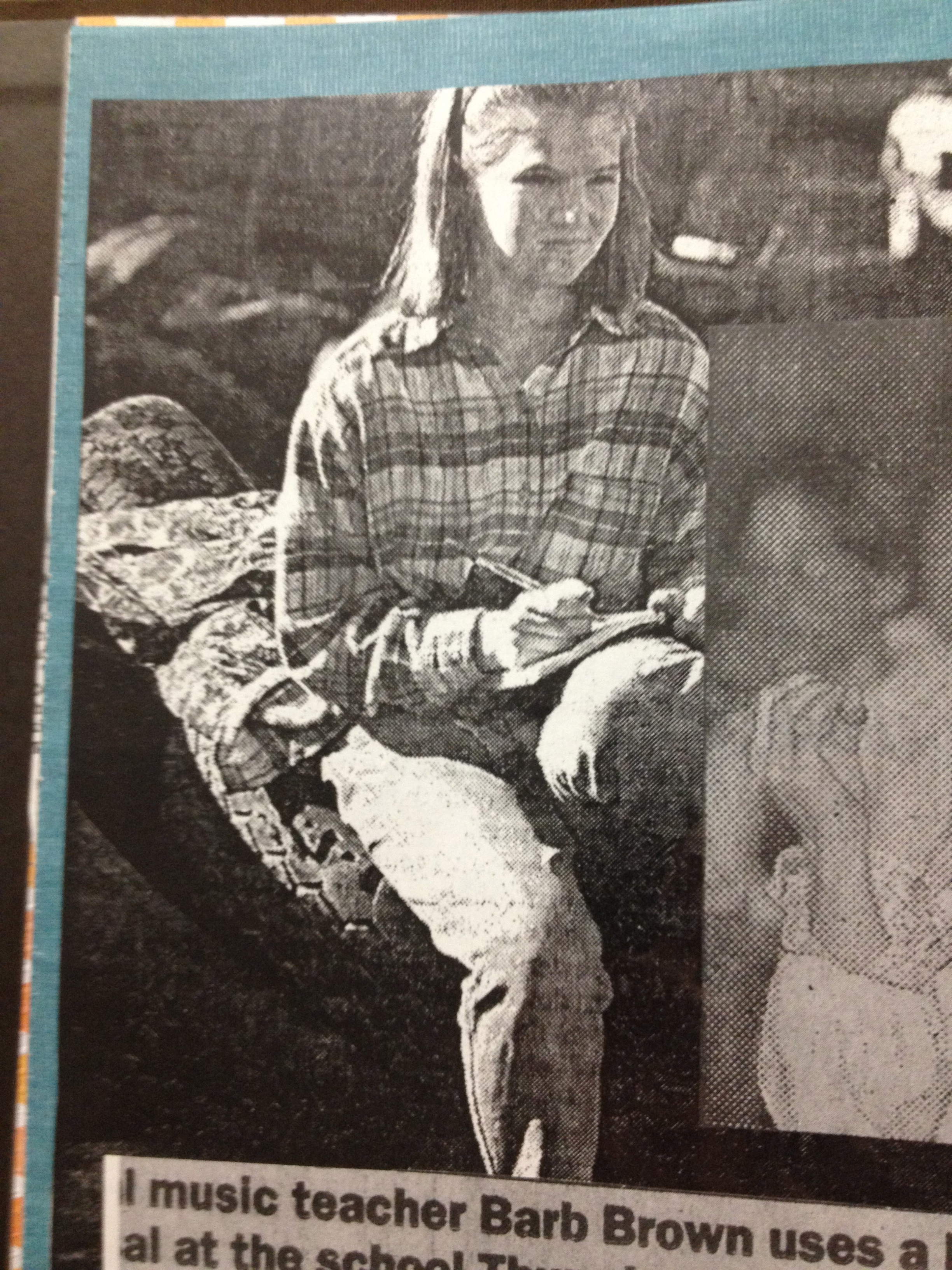
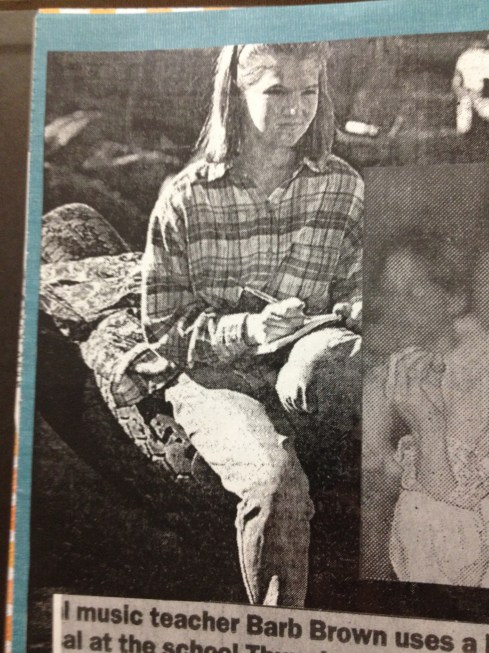
14-year-old me on the English enrichment “Mystery Writing Tour.”
I saw Mr. Muller just a little over a month ago at the 25th anniversary of the Arts Package. He didn’t recognize me right away (which led to me yelling, BUT MIS-TER MU-LLER, I WAS YOUR FAVOURITE STUDENT, I WAS YOUR PET), a fact that honestly isn’t surprising considering how many students he’d had over the years. It wasn’t long, though, before he’d figured out who I was. Once he realized that I was the girl he’d once spent a year referring to as Little Orphan Annie, I got this huge, irrepressible grin on my face. He grinned right back at me then turned to Matt and said, “See that smile? That smile is how she wrapped me around her little finger. How could I ever forget that?”
I only spoke to him briefly at the anniversary, partly because there were so many other former students who wanted to reconnect with him, and partly because I had some very important drinking and dancing to do. Although I hadn’t seen him in well over ten years, I figured that there would be other times, other places when we would be able to catch up or reminisce. I always think that I will have other chances; I never, ever think that anything is happening for the last time.
I wish I’d known that it was the last time.
Rest in peace, Mr. Muller. I know that I probably wasn’t an especially amazing kid to have in your class, and I’m sure that I don’t really stand out among all the other students you had, and I know that I talked waaaay too much. I’m not by any means your brightest or most successful or most talented former student. I wish that I had more to show for the year that I spent in your class, because that would give some kind of indication of how very much of an impact you had on my life. I guess the most that I can say is that now, sixteen years after I had you as a teacher, I’m finally coming around to what you knew all along: I’m a writer.
And if I’m at all a good writer, and if my words have any kind of impact in this world, a large part of that is because of you.
So thank you.

Roland Muller giving a speech at the Eastwood Arts Package Reunion, April 2013
Maybe You Dance
3 JunI spend a lot of time thinking about intolerance and the various things that I do to combat it. I mean, that’s what a lot of this blog is supposed to be, right? I’m trying, in my own small way, to fight against sexism, racism, homophobia, transphobia, and all the other isms and phobias that people, even nice people, even good people, throw at each other. And I think that I do an okay job for the most part, but it’s easy to fight this battle online, isn’t it? I mean, comparatively. Sure, the relative anonymity of the internet tends to bring out the absolute worst in people, and I’ve been told all kinds of awful things, some of which have hurt pretty badly. I’ve been told that I’m a waste of oxygen, that I should kill myself, and there have been a whole litany of comments, tweets and even entire blog posts by other people dedicated to what a terrible mother I am, and yeah, that sucks, but still.
Being a loudmouth who speaks out against hate on the internet very rarely results in physical violence.
Being a loudmouth who speaks out against hate in the real world is much more likely to result in broken bones, a smashed up face or even worse.
And I’m not saying that online threats or mean comments aren’t scary, because they definitely are, but also when it all gets to be too overwhelming I can just shut off my computer and walk away. But raising my voice publicly, in the middle of, say, a crowded bar full of drunken bigots, doesn’t afford me that same luxury.
There was, in fact, a crowded bar full of drunken bigots last night. And maybe this is a fairly normal occurrence – what do I know, I’m in bed by ten most nights, and when I do go out it’s to one of the genteel pubs in my genteel neighbourhood. And probably these guys are really super nice guys in real life, not the kind of guys to yell “faggots!” at a bunch of guys just because their band isn’t playing whatever kind of music it is they want to hear. I mean, unless they’re out late at night and it’s someone’s birthday and they’re all drunk, belligerent and three seconds away from a brawl with any given person that they encounter on the cramped dance floor.
So what do you do? What exactly do you do if you’re in this bar, and you hear people yelling the word faggot, and you’re sure that saying something, anything will result in getting punched in the face? What do you do if that’s your friend, or at the very least the friend of your friend, on stage, playing his bespectacled, skinny jean-clad heart out? Seriously, what the fuck do you do?
If you’re me, apparently you sit there grimacing and whispering to the girl next to you, demanding to know where the fuck all these terrible drunk dudes came from. If you’re me, you hunker down in your seat, and hope they don’t come anywhere near you. If you’re me, you hope that if they do make their way over to you, they somehow manage to keep their hands to themselves.
If you’re me, you die a little inside when you think about how you’re totally not standing up for what you believe in, and you hate yourself for being a coward.
And if you’re my friend Nathan, you get up and dance.
You get up, you stand dead centre in front of the stage, and you fucking dance to the spastic beat of the music.
For reasons that I can’t fully articulate, what happened last night was one of the nicest things I’ve ever seen. There was just something really lovely about seeing my friend standing there, trying to figure out how to move to the pseudo-eighties synthesizer amazingness coming from the stage. And as weird as this sounds, there was something both aggressive and earnestly affectionate about his body language as he danced – aggressive towards all the assholes behind him who were now demanding that the band play Wonderwall, and affectionate towards his friends onstage, who were trying their best to ignore what was going on. And Nathan just stood there, as steady and unmovable as a rock. And it was really, really nice.
And I got up and joined him, and so did a few other people, and the drunk assholes slowly backed off.
Afterwards, Nathan said to me, “I just didn’t want Drew to have to look out and have to see all those douchebags. I wanted there to be at least one friendly face out there.”
I’m glad he had the instinct to get up and dance, because I definitely didn’t. Maybe I only know how to fight with words, and when I feel like I can’t do that, I’m at a total loss. Or maybe I should be more willing to risk my personal safety for the stuff that I believe in. Regardless, I’m glad that he got up, because I think that it was the best thing that anyone could have done in that situation.
And, in the future, I really want to be able to remember that there are other ways of fighting intolerance besides my usual bag of tricks. Sometimes you can do it by standing there alone and, with great purpose and love, just fucking dancing like there’s no tomorrow.

A Safer And More Caring Society
30 MayI keep thinking of ways to start this post, but I can’t figure out the right words to use.
What do you say about someone whose contribution to your life, and the lives of all women, is invaluable?
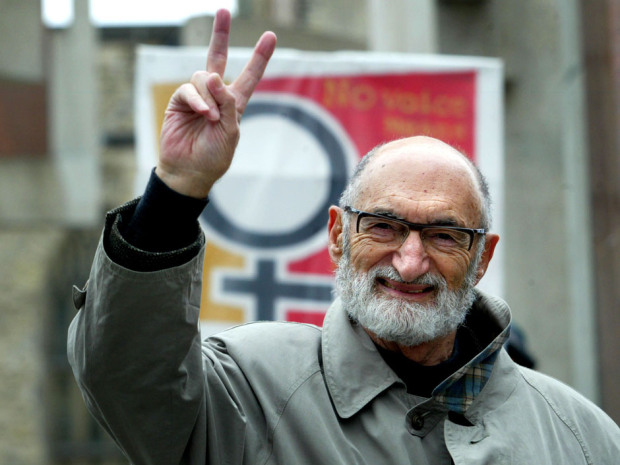
I guess that I should start with the most basic fact: Henry Morgentaler, doctor and agitator for women’s reproductive rights, died today. He was 90. His work helped save the lives of countless Canadian women.
Henry Morgentaler was born in Lodz, Poland, in 1923. A Polish Jew, he was sent to Auschwitz during the Nazi occupation of his homeland. He survived. His parents did not. He came to Canada in 1950. In 1955 he opened a family practice in Montreal. He soon began petitioning the government to reconsider their stance on abortion, and opened an abortion clinic in Montreal in 1969. At that time, attempting to induce an abortion was a crime punishable by life imprisonment. Dr. Morgentaler’s clinic was raided, and he was arrested, jailed and acquitted multiple times, both in Quebec and Ontario. Abortion was legalized in 1988, in no small part because of Dr. Morgentaler’s actions. In 2008, he was named to the Order of Canada.
I’m only giving the briefest of biographical details, because I know that tons of other publications will discuss and dissect his life much better than I can. And anyway, that’s not really what I want to talk about right now. I want to talk about how Dr. Morgentaler’s struggle to legalize abortion affected all of us, and continues to affect us to this day.
Full disclosure: I’ve never had an abortion, and I hope that I never have to. Not because I think they’re wrong or bad, but because I try to avoid medical procedures if and when I can. But I have friends, many friends, who have terminated pregnancies. And I know that most, maybe all of them would not be in the same happy, secure places in their lives had they chosen not to terminate.
Every baby should be a wanted baby. I have a son, and I wanted to have him. But carrying a pregnancy to term and then raising a kid is hard fucking work, and those things shouldn’t ever, ever be forced on any woman. My friends who have had abortions are able to live the lives that they do because they had the ability to choose. Many of them have very successful careers. Some of them have gone on to have planned, wanted children since then. Some of them already had children before, and have been able to enrich those children’s lives by giving them the time, care and resources that they worried would be diminished with the addition of another child. For some of them abortion was a difficult, emotional choice, and for others it wasn’t. But for nearly all of them, choosing to terminate meant being able to finish school, being able to work in demanding fields without having to make sacrifices for their families, or just being able to focus on their lives as they were, without adding an additional complication.
Anti-choice groups nearly always talk about what kind of cancer-curing genius any given fetus might grow up to be, but almost no one talks about what a woman might become if she chose to terminate her pregnancy. We already know that it’s basically impossible for the average woman to “have it all,” so really, who knows how many women would have gone on to make incredible scientific discoveries, be brilliant world leaders or do one of any number of things that might have changed the world for the better had they chosen to terminate a pregnancy. Or else consider the number of smart, successful women that you encounter every day – your doctor, maybe, or your lawyer – who may have been able to get where they are now because at some point in their lives they had to choose whether to have a child, and they chose not to. On a more mundane level, think of how many women would have felt able to leave abusive situations earlier if they didn’t have a child complicating the situation. Think of how many women there are worldwide live in grinding poverty, working two or more jobs just to make ends meet, because they were unable to choose to have an abortion.
Above all, think of how many lives Doctor Morgentaler saved by helping to legalize abortion. First of all, because the legalization of abortion helps Canadian women avoid the same awful fate as Savita Halappanavar, who died because Irish law prohibited her doctors from terminating a non-viable pregnancy that was medically dangerous to her. Second of all, because history has proved time and again that criminalizing abortions does not stop them from happening, it just makes them more deadly to women. Without Doctor Morgentaler’s work, Canadian women would still have to seek back alley abortions if they wanted to terminate a pregnancy, procedures which often resulted in infection, sterility or even death.
Doctor Morgentaler was someone who understood what true lack of freedom was. In 2005, after receiving an honorary doctor of law degree from the University of Western Ontario, he said,
“By fighting for reproductive freedom, and making it possible, I have made a contribution to a safer and more caring society where people have a greater opportunity to realize their full potential.”
He then went on to add,
“Well-loved children grow into adults who do not build concentration camps, do not rape and do not murder.”
Having seen what the escalating restrictions of rights and freedoms had resulted in during the Holocaust, Doctor Morgentaler dedicated his life to giving Canadian women autonomy over their own bodies.
He said, “I felt, as a humanist and as a doctor, that I had a moral duty to help these women.”
Thank you, Doctor Morgentaler. Thank you for fighting for my right to choose, should I ever need to do so. Thank you for working tirelessly so that my friends could have the freedom to do whatever they want with their lives. Thank you for letting working class mothers choose to devote the time, energy and resources that they have to their existing children, rather than forcing them to add another mouth to feed.
Thank you.
Thank you.
Thank you.
The Extra Bicycle
28 MayThere are three bicycles on my balcony right now.
Normally there are only two – my shiny blue bike, with its giant seat and extra-wide wheels, and Matt’s sturdy green mountain bike. But for the last week or so there’s been another bicycle out there, one with a funky wire basket and a badly-warped frame frame.
This third bike belongs to a mystery woman who was involved in a cycling accident at the foot of the hill that I live on. I don’t know exactly what happened, but I do know that she landed face-first on the pavement, and I know that by the time the paramedics arrived her breathing was shallow and her heart rate uneven.
Her bicycle ended up on my balcony because Matt and Theo happened to be walking by the scene of the accident shortly it happened. Theo is fascinated by and and all emergency vehicles, so the sight of the firetrucks and ambulances was an instant hit with him. Ever since that day, he keeps saying:
“The firefighters took the woman away. The firefighters took the woman to the doctor to make her better.”
For Matt, the scene was a reminder of my own bike accident, which happened almost five years ago. Seeing that woman being strapped onto a stretcher and loaded into the waiting ambulance triggered all kinds of memories for him of my ill-fated tangle with a set of streetcar tracks down at Church and Adelaide. That was why he brought the bike home and left his name and number with the paramedics – because he remembered the kind stranger who had dragged my bike out of the road and locked it up, then given me his business card in case I couldn’t find it when I went to get it back.
I think about that accident fairly often. It’s hard not to, to be honest; the stiffness and occasional ache in my left knee are a constant reminder of the fact that my leg is packed with hardware. And anyway, that crash was a sort of turning point in my life; I’m not going to get all dramatic on you and say that it was a near-death experience or that it changed my view of humanity, but it definitely altered the course that I thought I was on. At the time, I was upset, even angry about that, but now I’m mostly thankful for it, because if I hadn’t fallen and banged up my knee, who knows where I would be now? If I’d kept on going in the direction I was headed in, I probably wouldn’t have Theo, for one thing. For another, who knows if I’d be writing, or teaching yoga? Who knows where I would be at all?
The reason that I happened to be at Church and Adelaide that morning was because I was starting my second week of George Brown’s Sign Language Interpreter program. I was running late, and I probably, almost certainly, wasn’t being as careful as I should have been. I’d always been wary of streetcar tracks, because I knew of other people who had had dangerous interactions with them, but I guess that I let my guard slip a bit that morning. I remember that I had to turn left onto Adelaide and I had to move into the left lane to do that, so I was simultaneously pedalling furiously to make it to the intersection before the light changed while signalling the lane change with my left hand and also looking back over my shoulder, watching out for cars. Just as I was getting ready to turn, I felt the traction change underneath my front tire – it went from rumbling over rough pavement to, for just a moment, skidding sickeningly, uncontrollably over smooth metal. Then with a jolt my front wheel slid neatly into the groove of the track, and I was stuck. At the same time my back wheel jerked forward, causing my bike to jackknife beneath me.
I knew that I was going to fall, but I thought, for some reason, that I could prevent it. I put my left foot down to try to steady myself, but my bike’s momentum was too much. I went down.
I don’t actually have any recollection of falling. I remember realizing that I was screwed, and then I remember lying sprawled on the hot pavement, my bike upended beside me and its wheels spinning pathetically in the air. I don’t think that I blacked out or anything – I’d somehow managed to avoid hitting my (unhelmeted) head – but I guess that whatever I was experiencing in that moment was too much for my brain to handle and it just shut down or somehow blocked it all out.
I remember thinking that I should stay sitting there in the middle of the road, even though cars were zooming around me, because it seemed like the safest place. A crowd had gathered around me soon after I’d crashed, and a few of them had to convince me that it was much smarter to get over to the side of the road. Two people helped me up, and that was when I realized that I couldn’t put any weight on my left leg. It didn’t hurt, exactly, it just didn’t work. So these two people had to half carry me over to the curb, while a third person went and rescued my poor bike (her name was Frida, by the way, as in Frida Kahlo, and she had an elegant if heavy vintage solid metal frame with a beautiful, now-smashed, wicker basket on the front).
By the time I reached the side of the road I was crying, hard, and hyperventilating. Not because I was hurt or scared, but because it had suddenly hit me that I could maybe, possibly have died. A woman sat beside me and told me to breathe while someone else called an ambulance on their cell. A third person handed me their phone so that I could call Matt. Back then I didn’t have my own cell phone, so I told him that I didn’t know where they were taking me but would call him from the hospital once I got there.
Once I got to the hospital no one, myself included, thought that there was any rush to look at my leg. I was certain that my knee was just sprained or twisted – after all, it barely hurt at first, and I hadn’t even torn my jeans. But by the time Matt got there, my leg was aching something fierce, and he found me huddled up in a wheelchair in the waiting room, crying quietly, trying not to bother anyone with my sobbing.
Eventually, someone called my name, Matt wheeled me through the big metal door, had some x-rays done and then sat for another hour or two on a hospital bed. Finally, a doctor came in and said brusquely,
“Your left tibial plateau is fractured. An orthopaedic surgeon will be coming to discuss the details of your surgery with you. Okay bye!”
I mean, I’m sure it didn’t exactly play out like that, but that was the general feeling of it. The doctor’s routine view of what I’d managed to do to my left knee was miles and miles away from my experience as a person whose life had just been turned upside down by a few brief sentences. Everything suddenly started to sound like it was very grainy and far away, and my vision began to go dark. I had to lie down before I passed out.
The technical details of what happened were this: my left femur, that big, heavy, club-like thigh bone, had, in the course of my accident, slammed into my tibial plateau (the place where the tibia and fibula meet to form the bottom part of the knee joint) hard enough to dent it. Surgery was needed to build the surface of the plateau back up, or else I would almost certainly walk with a limp for the rest of my life. So they took a bone graft from their bone bank, and held it in place with a metal plate and a series of large metal pins.
Why yes, this does mean that I have a dead person’s bone in my body! I kind of hope that it comes from a murderer or a genius or a murderer-genius or some other interesting type of person, but of course you can’t be too picky in these types of situations.
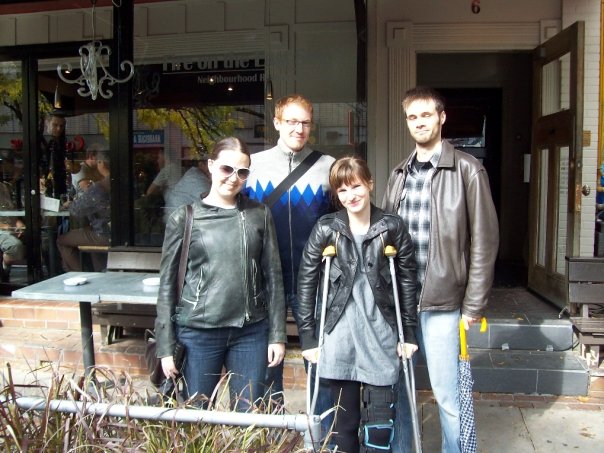
After surgery, I didn’t walk for three months. I went from having a giant, heavy cast to a much lighter, foam-and-plastic brace. When the took the cast off, I’d lost so much muscle mass that my thigh was narrower than my knee joint. It was gross. Oh and speaking of gross, if you ever want to terrify your needle-and-generally-medical-phobic partner, please invite them into the room while your cast is removed and the twenty six enormous metal stitches in your knee are suddenly revealed.
Yeah.
Matt had to leave after that.
Once I was ready to start putting weight on my leg again, I discovered that I’d somehow forgotten how to walk. I went to physiotherapy twice a week and, slowly and painstakingly, re-learned something that I’d mastered at the age of fourteen months. I still walk funny, even now, five years later – my left arch collapses and my entire left leg rolls inward, so that if I’m not thinking about it, I walk with a tiny bit of a limp. A limp, mind you, that becomes much more exaggerated when I’m tired or the weather is bad.
It goes without saying that I had to drop out of school – for the first few weeks after surgery, I could barely get out of bed, let alone go to class. On top of that, I was totally, totally loopy from the drugs I was on. I was so loopy that I read Twilight and thought it was good. No joke.
So I left school and, once I was able to function like a person with two legs again, returned to my nearly-minimum-wage retail job. I started trying to put my life back together and figure out what I wanted to do with myself, but I was at loose ends. I’d written a book the year before, and had had it tentatively accepted by a publisher and an agent, but the summer after my accident both of them ended up rejecting my manuscript. I didn’t know what to do with it, or myself. My life felt totally directionless.
In the summer of 2009 I married Matt, as planned. Eight months later I was suddenly, unexpectedly pregnant. And now, nearly five years after my accident, I have a hilarious toddler and a fantastic partner, I manage a yoga studio, I teach yoga, and I’m sorta, kinda, maybe accepting the fact that I might be a writer.
If I hadn’t fallen, there’s a chance that I would still be in an equally good, equally happy place in my life. But I’m not willing to take that gamble – if given the choice, I would always, always pick the prize on display over whatever’s behind the closed door. A bird in the hand, etc. So I guess that in a weird way I’m kind of thankful that my wheel slid into that streetcar track. I’m thankful that I ended up sprawled out on the ground, and I’m thankful that I smashed my knee up badly enough to need major surgery. Because all of that, every single little aspect of it, lead me to be right where I am.
I also think that falling off my bike was a big part of what helped me learn to love Toronto. I’d only been living here for a little over a year, and so far the city had seemed strange and unfriendly to me. If you’d asked me before my accident what would happen if a Torontonian fell off their bike in the middle of traffic, I would have said that everyone on the street would have gone about their business while that poor unlucky soul got run over. The people at Church and Adelaide that day proved me wrong, though, and since then I’ve learned over and over again that this city can, when necessary, have a heart.
The mystery woman, the woman whose bike is currently taking up real estate on my balcony, called this past weekend. She’d spent three days in the ICU, she said. She’d bled out into her brain and nearly died, she said. She kept thanking Matt for saving her life, and he had to tell her, over and over, that he’d only saved her bike.
She’s home now from the hospital, and her nephew is coming over sometime soon to pick up her bike. I hope she ends up being okay. I hope that someone told her just how many people stopped to help her, how much love and care she got from total strangers. Most of all, though, I hope that however this accident changes her life (as it certainly will) it ends up somehow being for the better.
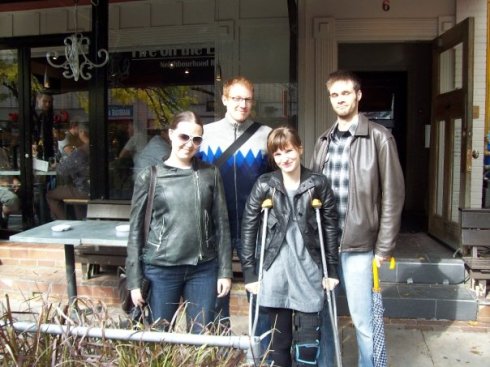
Me, on crutches, out for brunch with friends
On Self-Loathing
27 MayI hate myself.
I say those three words in conjunction with each other on a fairly regular basis. Most of the time, I’m joking – if I’ve screwed up while trying to do something easy, for example, I’ll roll my eyes, laugh and say oh God, I hate myself. Sometimes I say it in a half-kidding, half-serious way, like if I’m really frustrated with a situation that I feel is somehow my fault. Sometimes, though, I really, really mean it. Oh fuck do I ever mean it.
I hate every little thing about myself, but what I hate the most is how annoying I am. I hate the grating sound of my voice, the way I start to cry, publicly, when I’m too worked up or angry, and I especially hate what a goddamn Pandora’s Box my stupid heart is. The minute I open it, everything awful flies out. Worst of all, once that happens, I can’t seem to stop talking about all of the awfulness. It’s like there’s another me, standing there watching myself go on and on and on about everything, and I can see the glazed, irritated look on the other person’s face, but I can’t seem to stop. By that point, I’m annoying even myself, but I just keep on going, digging myself in deeper, thinking that the words that got me into this mess will somehow get me out of it.
I hate how often I look to other people for reassurance.
I hate how insecure I am about myself.
I hate how no one can fix this but me, but for some reason I seem to keep asking the people who love me to put me back together.
I’ll believe anything about myself, so long as it’s bad. I can hear a thousand nice things about the way I look, or how smart I am, or how great my writing is, but the moment someone criticizes me, I assume that they’re right and everyone else is wrong.
I sometimes think that one day I’ll go in for surgery and they’ll cut me open and there won’t be anything inside of me, nothing at all, just a black pit of self-loathing that goes on and on and on.
I sometimes think that I don’t believe in good things anymore, just things, regular, plain old things, each with their own unique capacity to hurt.
I sometimes think about myself and I feel sick. Actually, physically sick, like, the type of thing where you taste bile at the back of your throat.
The hardest part about all of this is the tendency to purposefully, if subconsciously, damage everything positive in my life. Because I know that I don’t deserve anything that makes me happy, so I set little traps, miniature emotional minefields for myself and other people to ensure that I stay miserable. And then I stupidly act surprised when these tactics work.
God, I hate myself so much.
And before you ask, yes, I see a therapist. I’ve seen a string of them. They always want to talk about stuff that happened when I was a kid, or how I feel about my parents, or when this all started. And I answer these questions as honestly as I can, but those answers never get me anywhere. It makes no difference knowing how or why you got somewhere when you know that you can’t go back by the way you came, and all the ways forward seem blocked
Part of it is probably that it’s easier to hate myself than anyone else. If someone else hurts me or upsets me, it’s so much easier to turn all of my bad feelings inward. That sounds counterintuitive, I know, but think about it this way: if I’m angry at someone else, then I have to use up all kinds of mental and emotional energy being upset with them, plus I have to take all this time explaining to them why what they did hurt me, and on top of that I may not even be in the right anyway. In fact, I’m really bad with conflict, so if I try to argue with someone about who was right and who was wrong in any given situation, I will invariably end up feeling like everything was my fault. So it’s much less complicated to assume that everything bad that happens is because of me, and leave it at that.
If I were a different person, I would probably try to kill the way I feel about myself with drinking or drugs. I would go out and do self-destructive things, I would lose control, I would, for even just a few minutes, feel completely different. But I’m not that type of person – for one thing, I’m terrified of not being in control of myself. For another, I have a kid, which isn’t really conducive to that type of lifestyle. So instead I sit at home and seethe with anger at myself, anger at how stupid I am and anger at my inability to change. I sit and make a list of all the ways that I’m toxic to other people, all the ways that I’m unintentionally hurtful, all the ways that I keep fucking up.
And then I go to bed and I don’t sleep and in the morning, when I get up, I’m still my own stupid self.

Wet (Or, I Am Acadian)
24 MayEarlier in the week I participated it Write Club Toronto, which is basically like Fight Club, but for writers. Eight writers are pitted against each other in two-person bouts, and whoever wins gets to pick a charity that the proceeds of the evening will be donated to. Each writer is given a topic, and has a little over a week to prepare a seven minute piece based on that topic. My topic was “wet” (my opponent’s, naturally, was “dry”), and I somehow emerged victorious even though I mostly wanted to throw up all over everyone.
I think that my proudest moment was when they asked what my charity was, and I accidentally said the Toronto Ripe Crisis Centre. Go team awkward.
Anyway, if you’re interested, you can find a free podcast of it here.
You can also read the full text below:
My great-grandmother, Alma LeBlanc, was born in this dilapidated old wooden house just outside of Arichat, Nova Scotia. If you’ve ever been to the east coast, you know exactly the kind of place that I mean – peeling paint, sagging walls, everything suffused with an air of grim defeat. The house was on the edge of a cliff on Ile Madame, which is an island off the coast of Cape Breton, and the place where it stood feels like the ends of the earth. When you stand on that cliff, all of North America lies behind you while in front of you the cold, dismal, grey Atlantic stretches on forever and ever. The ground drops away at your feet, and far below you the heartless, grinding waves smash against the rocks.
The climate is damp there, always. Sometimes it’s barely noticeable, just a faint clamminess blowing in off the ocean, and other times it takes the form of a suffocating fog so thick that the droplets of water hang suspended in the air, and it seems like a marvel that you can still breathe. But you can, and you do; you force yourself to keep breathing, you put one foot in front of the other, you keep going. And eventually the damp becomes a daily fact, and you barely notice its presence.
We’re a water people, us Acadians; it’s our element, you might say. This wasn’t always true – not so long ago we were farmers in the Annapolis Valley, that warm, rich, fertile strip of land across mainland Nova Scotia. In those days, our only interaction with water was through the dikes that we built. We were famous for those dikes. In fact, the other day, I did a google image search for “Acadian dykes” and not a single lesbian came up. Our dikes were ingenious, apparently, with mechanisms called aboiteaux that allowed fresh water in from the marshes but kept back the salt water from the sea. Our farms thrived. Things were good.
Of course, this idyllic life didn’t last for long. In 1755 The English rounded up the Acadians and put us all onto boats heading who-the-hell-knew where. Our expulsion officially had something to do with the Seven Year War, French and English politics, oaths we were supposed to swear and the religion that prevented us from doing so, but really, it was about the English wanting to have free run of the east coast.
We could have fought the expulsion, I guess, but that seems foolish when you consider the fact that the English had guns while we had pitchforks and shovels. We don’t come from fighting stock, anyway; most of us are short and pretty scrawny. So we went fairly quietly. But when the English turned us off our land, we threw aboiteaux wide open and let the salt water pour in, our own version of a scorched earth policy. Maybe that was the first time we realized that the water was our ally. A dangerous, unreliably ally, but an ally all the same.
We were split up, families torn apart, and sent off to wherever the English thought there might be room. We were dispatched to places like Baltimore, Boston, Williamsburg – they even built special forced labour camps in England. The boats were little more than prison ships, and over half of us died, but still. We kept going. We had to. And on those ships we learned to tentatively embrace our new home, the water, and treat it with equal measures of fear, love and respect. Thus far we’d thrown our lot in with the land gods, who were by and large fairly gentle and generous. The sea gods, on the other hand, are different. They’re cold, grey and pitiless, and view humans with complete contempt. You wouldn’t make a compact with them unless you had no choice.
We had no choice.
So we became fishermen and shipwrights, we learned to weave nets and build lobster traps. We added widow’s walks to our houses and learned to get used to losing our loved ones to the sea. Some of us straggled back home to Acadia, now called New Scotland, and settled the grim, barren coastlands that no one else wanted. We chose to isolate ourselves from the world around us, with the result that our clothing, speech and way of life didn’t much differ from what would have been found in 17th century France. We grew insular, as a way of protecting ourselves. We tried our best, on the whole, to steer clear of the modern world, and as a result we grew a bit peculiar.
Our names, for example, were peculiar.
I mentioned earlier that my great-grandmother’s name was Alma, but that’s not exactly true. Her full name was Marie Alma, and all of her sisters were also Marie, and all of her brothers were Joseph. Their middle names, though, the names they were called by, are what really fascinate me – Artemise, Evangeline, Sabine, Stella, Napoleon, Casimir, Leander. Strange names, old names, nearly all Greek or Latin; names you wouldn’t think to find among a largely uneducated population. I asked my great-grandmother once where they came from, and she said they came out of the “other” book. Because they had two books, the Bible and the “other” book, though exactly what that second book was she didn’t know.
Alma came from a family of twenty three – twenty three! I can’t even imagine. But as my grandmother says, “My God, Annie, what do you think they did on those long, cold winter nights? They didn’t have tv or radio, and they sure as hell didn’t have birth control.”
What they did have was a farm, and all those children came in handy as free labour. It was impossible to scrape a living for so many people out of that thin, rocky soil, so Alma’s father left his wife and children behind and took to the sea, wrestling the bitter Atlantic waters for whatever he could get. He would leave for weeks, sometimes even months at a time, often returning to discover that all that keeping-warm-on-cold-winter-nights had resulted in yet another mouth to feed. Meanwhile, Alma’s mother oversaw the farm, managed the household accounts and raised their children. Or rather, she did all of these things until she died giving birth to poor Joseph Alfred, unlucky baby number thirteen.
Alma’s father remarried almost immediately, because who the hell was going to take care of his thirteen kids? But like an evil stepmother straight out of a fairytale, his new wife hated her new life, and took out her resentment on her husband’s children. While he was off at sea, she beat them. She starved them. She let them freeze during the bitter winters. She forced one of them, Sabine, who had a bleeding disorder, to walk across sharp grass until her feet bled. The blood oozed out of her for nearly a week, and the priest came three times to give her extreme unction. Somehow, though, she managed to survive.
Survival is the reason that my great-grandmother left Cape Breton as soon as she was able to. Survival is the reason she married an Englishman, had ten English kids with ten English names, and gave up her mother tongue entirely. Assimilation can sometimes seem like the only way forward.
I’m pretty much assimilated. Really, I’m barely Acadian. I’m not even really sure what it means to be Acadian. Is it where you live? The food you eat? The language you speak? I mean, I speak French, but only rarely, and with great embarrassment. I grew up in the wilds of suburban southwestern Ontario, far from any ocean or sea. I don’t know the first thing about dikes or irrigation or anything like that. I can’t even swim, not really – the most I can manage is a pathetic dogpaddle.
Still, though, I’m a water person. It’s in my blood – I mean, both literally and figuratively. As removed as I am from the ocean, it’s still my element. I love being wet. I run outside during thunderstorms and let myself get soaked to the skin. If there’s a lake or river or stream, I have to be in it. Even a public fountain will do, if I have no other options.
Water is where I feel the most like myself.
And when I stand in the spot where my great-grandmother’s house was, and I feel the cold sting of the saltwater on my skin, and I look out into the vast grey Atlantic in front of me, I feel like I’m finally home.

Cape Breton
What It’s Like To Live Here, Part III
20 MayYour stupid, treacherous heart is like the Sacred Heart of Jesus, naked and quivering on your chest. Except that whereas Christ’s heart rests on his fully clothed breast, your bare skin has been cut and neatly pinned back, your torso resembling nothing so much as a biology class dissection. The muscle and sinew of your heart are gone, too. All that remains in the well of your chest is a tangle of glistening arteries and blood vessels, and a bundle of nerves, jangling and raw.
You talk and talk and talk as if you can’t stop. Words keep tumbling from your mouth, hard and fast, and you wince whenever they hit the ground. Everything sounds wrong, but by the time you’ve said it, it’s too late. You can’t ever call it back.
You feel as if you’re living underwater. People try to speak to you, but their words are warped, distorted beyond recognition. They might have meant something once, but it’s impossible to say, now, what their original shape might have been.
There is a grooved track inside your mind, and all of your favourite fears and worries follow it round and round and round. At night they gain momentum, and even though you’re tired, so goddamn tired, you can’t sleep. The racket in your brain never stops.
You try to explain what it feels like. You try to make people understand that this, this gibbering, twitching creature, isn’t really you. Everything you say falls short of what you mean, and you realize that every single word you know is completely insufficient. You wonder if this would be any easier in another language, if the Germans have a word for waking up to the raw, grey dread that’s become your norm.
You start to cry. You hate yourself for crying. Is there anyone that you will ever hate more than yourself?
You sit. You stand. You pace. You chew your nails. You check your email five times, and then once more for good luck. You put on your shoes. You walk across the street. You buy a pack of Belmonts. You strike a match, but your hand is shaking so badly that you can’t light your stupid cigarette. You wonder if people walking by think you’re some kind of junkie, and laugh because nothing could be further from the truth. You finally manage to light the damn thing, inhale deeply, and then immediately stub it out on the sidewalk beside you. You walk home. You take off your shoes. You sit. You feel as if you’ve accomplished something, even though all you’ve done is blow twelve bucks on something you’ll never use. But maybe the action itself was the accomplishment. Maybe it’s enough that you kept yourself busy, gave yourself some sort of direction, even for just five minutes. Maybe that was worth every penny you spent.
You lie in bed under your heavy down blanket, even though it’s still early in the afternoon and hot as hell outside. Your mouth is a cavernous desert; you couldn’t swallow even if you wanted to. A feeling of doom hangs over you, so palpable that you’re sure you could reach up and touch it. You listen to your neighbour downstairs playing twangy, plaintive songs on his guitar. You make a list of all the ways that you’ve wasted your life.
The telephone rings, over and over and over again. You don’t even consider answering it. There isn’t a single person in the world right now whose voice you want to hear.
You ride it out, like a bad bout of malaria. Anxious tremors wrack your body the way that fever chills might. Your bones seem as if they’re made of glass, and you can feel them clinking, gently, achingly, every time you move. Everything hurts. But still, somehow, you know that there’s a life on the other side of this. There is, of course, always the possibility that this time the disease is going to kill you, this time you won’t make it out alive, but still. It hasn’t yet. And that thought cheers you up, because in spite of everything, the odds are on your side. You feel almost optimistic.
The bundle of nerves in your chest, the ones that have replaced your heart, twitch and quiver. You know that it’s not safe to leave them exposed like this, but you don’t know how to protect them. They’ve always been like this, stripped down, bare, too painful to be of any real use. But they’re yours and, somehow, you wouldn’t have them any other way.

 The Belle Jar