Archive | Uncategorized RSS feed for this section

Intersectionality and Art

10 Sep

My friend Audra asked the following question on her Facebook a little over a week ago:

“Which do you think is worse: intentionally only ever buying art* made by women, or accidentally only ever buying art made by men?”

Now, just to clarify, I don’t think that either is worse, because I don’t think that either of those things are bad or wrong, necessarily. But I do think that it’s super important to look at how and why we consume media. I also think it’s necessary every once in a while to take a long hard look at the media choices we’re making, and ask ourselves whether or not we are making conscious decisions about the type of artists that we are supporting and promoting.

This point was driven home today as I took a short break from the enormous tome that is David Foster Wallace’s Infinite Jest (because what better time to tackle this beast than on a 60-hour train trip across Canada?) to read Dave Egger’s introduction to the book. In this brief five-page preface, Eggers manages to name-check the fourteen following artists:

Thomas Pynchon

Elmore Leonard

Jonathan Franzen

William Gaddis

Saul Bellow

William S. Burroughs

Fred Exley

Marcel Proust

Stephin Merritt

Howard Finster

Sufjan Stevens

Jack Kerouac

William T. Vollmann

Michael Apted

You’ll note two uniting features about everyone mentioned this list – they are all white, and they are all men.

Now, I don’t think that Dave Eggers only reads books by white dudes. In fact, I happen to know that Eggers both reads and promotes books by all kinds of non-white-dude writers. But I can’t help noticing that when he’s talking about the crème de la crème, when he’s mentioning the artists to whom he’s comparing a book that he claims will, ultimately, leave you a better person, they are all. white. men. Every single last one of them.

And I don’t think that the exclusivity of this list is intentional; I don’t think that Eggers really thinks that men are better writers than women, or that white folks are better writers than people of colour. But what I do think is that it’s really, really easy to fall into the trap of only consuming art made by white men. I mean, it’s the status quo, right? You go into a bookstore and almost all the featured books are by men (although, being in Canada, I have to admit that they pretty much always include at least one Atwood because it’s the law or whatever). Only four women have ever been nominated for an Academy Award for Best Director; only one has ever won. If you’ve ever been in a comic book store, you know how hard you often have to dig to find something by a woman, let alone a woman of colour.

And it’s like, sometimes I just feel invisible, you know? I mean, I’m really just starting out and I haven’t even published my first book and in spite of that I have a fairly decent online following and I am super grateful for that and I’m luckier than a whole lot of people, but. BUT. I feel like I’m always going to be excluded when it comes to these types of lists. I’m never going to be allowed into the Old Boys’ Club (because then it wouldn’t be a boys’ club, duh), or if I am permitted to join in every once in a blue moon, I’ll be treated as a pet, a sweet little thing, a curiosity, and never, ever as a serious writer. And this exclusion won’t be malicious, and it won’t be intentional; it’ll just be because my name (or any other woman’s name) will never be the first (or even fourteenth) to spring to mind when a man is coming up with a list of his all-time favourite, greatest, most influential writers.

And that sucks.

So let’s take a moment to share our favourite not-white-dude artists, and maybe (hopefully) we’ll all come away with some new and exciting books, movies, paintings, sculptures, songs, television shows, etc, to check out.

Here’s my list:

Persepolis by Marjane Satrapi

persepolis-1

Haim:

Margaux Williamson, Teenager Hamlet

margauxwilliamson_TEENAGERHAMLET_600g

The Romance Reader by Pearl Abraham

n337594

Ginger & Rosa, written and directed by Sally Potter

* Any form of art or media, be it literature, visual art, film, music, television, etc.
Slut-shaming, Suicide, and Mrs. Hall

6 Sep

Most of you have probably already seen Kim Hall’s post FYI (if you’re a teenage girl). Both the original and the many, many brilliant take-downs written in response have been circulating social media this week, so it’s been pretty hard to avoid. If by some chance you’ve managed to miss out on all the fun, I highly encourage you to take a moment to go read Mrs. Hall’s open letter to all girls everywhere. It sure is something.

A lot of really smart folks have written some incredible posts touching on Mrs. Hall’s contribution to societal problems like slut-shaming, rape culture and body image issues. I don’t have anything new or brilliant to say on those topics, but I do want to talk about an aspect of Mrs. Hall’s message that hasn’t really been touched on yet: the very real link between the ideas that she’s putting forward and the recent rise in cyber-bullying, online slut-shaming and teenage suicide.

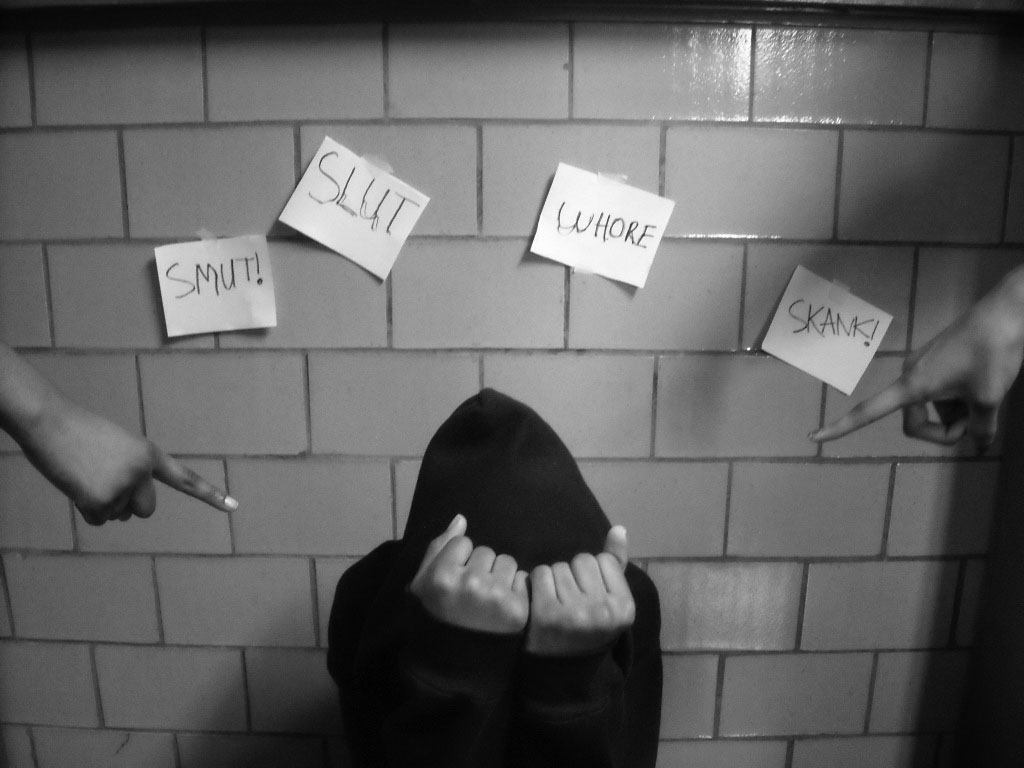
When I read Mrs. Hall’s letter, the first people that I thought of were Amanda Todd, Retaeh Parsons, Audrie Pott, Cherice Morales. In each of these cases, photographs of the girls that showed them either in various states of undress, or else showed them being sexually assaulted, or in some instances both at the same time, were circulated on social media. In each of these cases, the girls became social pariahs. In each of these cases, the girls committed suicide after enduring bullying and slut-shaming both online and offline.

I am not saying that Mrs. Hall is consciously suggesting that her children should shame or bully their classmates, especially those who have been sexually assaulted. If you asked her, I’m sure that she would tell you that those ideas are so far from what she intended to communicate as to be almost laughable. But still. Slut-shaming, ostracizing and bullying are the end-game of everything she is teaching her children.

When she writes:

And now – big bummer – we have to block your posts. Because, the reason we have these (sometimes awkward) family conversations around the table is that we care about our sons, just as we know your parents care about you.”

And:

And so, in our house, there are no second chances with pics like that, ladies. We have a zero tolerance policy.  I know, so lame. But, if you want to stay friendly with our sons online, you’ll have to keep your clothes on, and your posts decent.  If you post a sexy selfie (we all know the kind), or an inappropriate YouTube video – even once – it’s curtains.

What she is really telling her children is that girls who do not conform to her particular ideas of “modesty” are bad. She is telling them that the girls who post sexy selfies are worth less than the girls who cover up. She is telling them that the girls who pose with an “extra-arched back” and a “sultry pout” are not good enough to associate with her children. Worst of all, Mrs. Hall is telling her sons and daughter that it is fine – in fact, actively encouraged  in their household – to shun and ostracize these girls.

By saying that these teenage girls do not respect themselves, Mrs. Hall is teaching her kids that they are undeserving of anyone’s love or respect.

And that’s a pretty fucking toxic message.

If you think that this is too much of a reach, think about it this way: when Mrs. Hall and her family sit around their dining room table and critique the selfies posted online by her sons’ female friends and Mrs. Hall announces that yet another girl needs to be blocked because she’s showing too much skin, what her children learn is that the way that those girls are behaving is shameful and they deserve to be shamed in a way that makes them face real-life consequences. And when a Hall boy goes to school and tells his friend that he’s not allowed to hang out with so-and-so because her pictures are too slutty, and that friend tells a friend, and that friend tells a friend – well, it’s not hard to imagine what those real-life consequences will be.

And, of course, in high school, as in the Hall household, there are very rarely second chances.

When Mrs. Hall advises her son’s female friends to, “take down the closed-door bedroom selfies that makes it too easy for friends to see you in only one dimension,” I can’t help but wonder how many dimensions her sons and her sons’ friends saw those girls in before they heard those comments. Probably they saw them in the same way that they saw all their other female friends: as girls who were funny, girls who were smart, girls who were good at sports or art or music. Probably the Hall boys saw them as brilliant, well-rounded individuals, each contributing in their own interesting way to their lives. Probably they saw them as people.

But now?

Well, now they likely only see them in, as Mrs. Hall says, one dimension. That dimension being, of course, their physical bodies. Mrs. Hall has successfully reduced these girls to little more than pretty, shiny, skin-baring objects. And it’s pretty fucking easy to treat an object badly. It’s pretty easy to treat it cruelly, sub-humanly, even, because objects don’t have feelings. Objects don’t have thoughts. Objects exist only for the pleasure of others.

Objects are not people.

And so I worry about those girls, the girls that have already been branded as impure and immodest. I worry about the other girls that her sons will meet and, armed with their mother’s opinion, brand on their own. I worry for them because of the teasing and humiliation that they might have to endure; I worry about them because of the ways that the Hall boys and their friends might other, might even dehumanize these girls. I worry that when these girls tell adults about how they are being treated, they will be made to feel as if it is entirely their own fault, as if they were asking for it. I worry that they will start to think that, as Mrs. Hall said, there are no second chances. I worry that these girls will feel like their worlds are closing in on them, that one stray picture has ruined everything forever, that there is no way out of the mess that they believe they’ve created.

I worry for these girls’ lives.

slut

You Are Worth It

4 Sep

I sometimes feel as if you’ve spent most of your life surrounded by people who told you over and over that you weren’t good enough, or smart enough, or trying hard enough. These people seem to flock to you, maybe because they know that, head bowed and ashamed, you’ll listen to what they say. Some of them might be kind-hearted, trying to push you or fix you with tough love, while others just want someone to hurt and humiliate. Whatever their motivation, I wish I’d been there when they said these things, so that I could have raised a ruckus, shouted them down, told them how very wrong they were.

The real kicker is that you blame yourself for listening to these people; you honestly believe that you should have known better, should have held your own. Having grown up in a world that loves to quote Eleanor Roosevelt on how no one can make anyone feel inferior without their consent, you think that it’s your fault that these spiteful words and ideas crawled under your skin and wove themselves into the fabric of your being. It’s not, though. It’s not your fault. No one could ever endure that much raw malice without starting to doubt their own self worth.

You tell yourself that you’re nothing but wasted potential, when in fact the exact opposite is true. All of your potential is still intact; you still have every possibility of achieving the things that you want to achieve. That’s not to say that it will be easy, or that it will happen right away – I’m not discounting your struggles, both past and present. But still. A sixty-four-year-old woman just swam from Cuba to Florida after trying to do so for thirty five years. There is no statute of limitation on dreams.

You think that no one notices when you get up to leave the room or slip away early from the party, but we do. We all do. We miss you when you’re gone; we miss your laughter, your warmth, your kindness. We miss your bad jokes. Most of all, though, we miss your steadiness, your solid, comforting presence. We miss you.

You want so badly to keep everyone else safe. You’re the quiet fixer, the person in the background making sure the show runs smoothly, but you’re also the first person to stand up and say something when others are threatened or in danger. You think nothing of disregarding your own safety or well-being if someone else needs your help. You are always there to help.

You are astonishingly loving and protective of so many people, without ever feeling as though you deserve any love or protection for yourself. You put yourself in the line of fire over and over again, though you would never let anyone else return the favour. You act as though you have a debt to pay to the universe, although you’re not quite sure why or how. You act as though the only way that you can justify taking up real estate on this planet is by living only for other people. But you don’t have any debt to pay, and you are just as worthy of our love as we are of yours.

You deserve everything good in this life, starting with a person-shaped space that you can occupy without feeling guilty or inadequate. You have so much worth, not just because of the wonderful things that you do, but because of who you are and the particular talents and skills that you possess. You are worthy because you are you – a person who always thinks of others first, who keeps their head down and uncomplainingly does their work, who delights in bringing a smile to someone else’s face. In room full of people, children and animals are drawn to you first because they know that they can trust you. We all trust you.

When we run into you on the street, or catch sight of you across a crowded bar, or watch you quietly, hesitantly slip in through the door, we are always so happy to see you. We are always so happy that you are here.

You deserve this, all of this.

You deserve our delight in you.

You are worth it.

tumblr_mdbo9iGXDu1qjv482o1_500

On Miley Cyrus and Racism

26 Aug

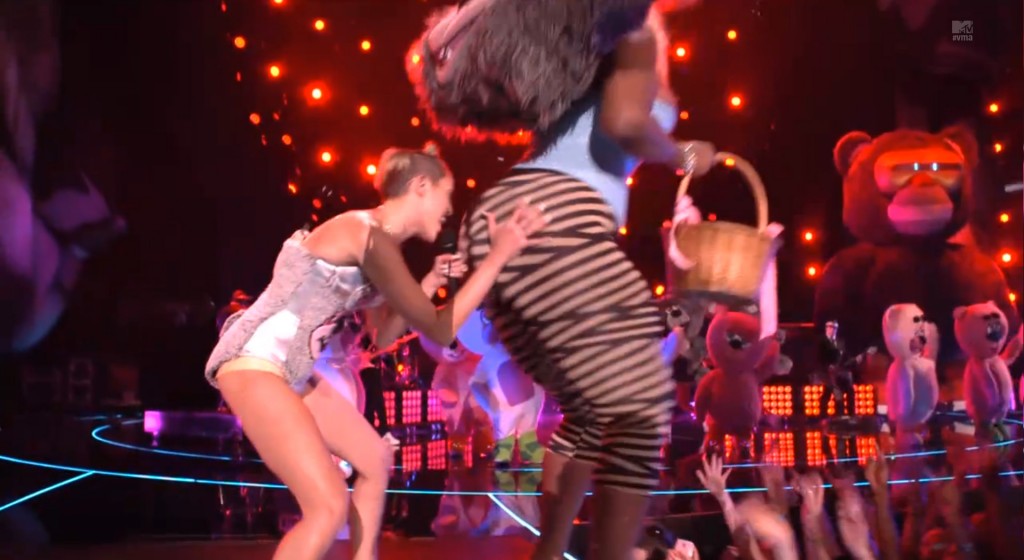
So this happened last night:

… and the internet (predictably) exploded.

And just to be clear, I agree that what Miley did was frankly disgusting, but not for the reasons that you might think.

Most of the criticism of Miley’s VMA performance has focussed on her attire and dancing style, with people claiming that her dress (or rather, state of undress) and sexual movements were vulgar, degrading and slutty. Quite a few people mentioned that her parents must be ashamed; there was a lot of discussion about how sad it was that sweet, innocent Hannah Montana had come to this. I saw a lot of derisive remarks about how Miley wants attention at any cost; some even went so far to say that Miley is sick and that this behaviour was a cry for help.

Then, this morning, I watched a fuckton of white feminists totally ignore the racist aspects of what Miley did in their rush to defend her from slut-shaming.

Now, let’s be clear: there was definitely a lot of slut-shaming going on, and it was really fucking disgusting. But what was equally disgusting was white feminists’ silence over Miley’s minstrel show.

What Miley is doing is cultural appropriation. She, a wealthy white woman, is taking elements from black culture in order to achieve a specific image. Her status as a member of a traditionally oppressive race and class means that she is able to pick and choose what parts of black culture she wants to embrace without having to deal with the racism and racialization that black women live with every day. In short, she can imagine that she is being “ghetto” without having any concept of what living in a ghetto would really mean.

Miley is doing her best to promote herself as a part of rachet culture, which Jody Rosen describes as “the potent sexual symbolism of black female bodies,” while simultaneously treating the black women in her videos and performances as props. She is taking elements of black culture and using them to give her the patina of street cred that she wants so badly. She is playing at being black without even trying to understand what the lived experience of being black really is. She is appropriating cultural elements without taking any time to reflect on her position of privilege and how her use of the term “ratchet” or her twerking are contributing to the oppression of black people.

Even worse, in her performance last night Miley used black women as props – like, literal props – and barely anyone said anything. I saw very few people displaying any outrage over the fact that Miley was, at one point, slapping a faceless black woman on the ass as if she was nothing more than a thing for Miley to dominate and humiliate. I saw barely anyone discussing the fact that Miley’s sexual empowerment, or whatever you want to call it, should not come at the cost of degrading black women. I saw a whole lot of people giving Miley a pass for her behaviour because she’s young and naive and sheltered.

I saw many prominent white feminists use their sizeable platforms to defend Miley’s right to rub her ass on Robin Thicke while wearing flesh-coloured bra and panties.  I watched as those same people remained embarrassingly silent about Miley’s behaviour towards black women and black culture.

And I think that I get it? Sort of, maybe? I think that white feminists are worried that if they’re seen criticizing certain aspects of Miley’s performance, then that will somehow invalidate their defence of her right to express her sexuality however. It’s as if they’re worried that someone will jump in and say, aha so if you admit that there was something wrong with her performance, then you aren’t allowed to decry our criticism of her. That’s not how it works, though. Not by a long shot.

The thing is, it’s not an either-or type situation. We can and should be able to say both that Miley’s sexuality is her own and hers to use in whatever manner she chooses while at the same time acknowledge that Miley’s cultural appropriation and specifically her treatment of her backup dancers is frankly disgusting. We should be able to say that no woman should ever be shamed for how she dresses or expresses her sexuality while at the same time say that white people need to be really fucking careful about how and when they express their enthusiasm for black culture.

Above all, white feminists need to realize that calling out Miley for her racist performance is not somehow detrimental to the feminist cause. They need to wake up and realize that perhaps the black women that she objectified – you know, the women she literally treated as objects – deserve some of their attention, too. Above all, they need to start walking their own fucking talk and begin showing some of that intersectionality that everyone is so fond of discussing.

So yeah. What Miley did last night was gross, but not because it was raunchy or vulgar. It was gross because it was racist, and what’s grosser still is our tacit approval of her racism.

miley-cyrus-2013-vma-large-women-1024x560

Zits

26 Aug

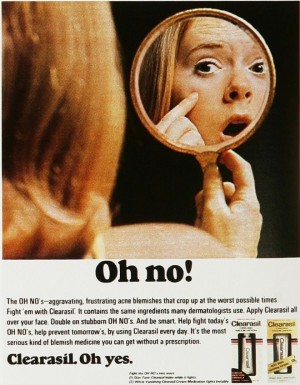
It started the summer that I turned twelve. It started on my face, just a few red bumps across the bridge of my nose. I poked at them and they sort of hurt. At first I wondered if the bumps were a sort of rash or allergic reaction, but after a week or so I realized what they were. Zits.

I wasn’t too bothered by them in the beginning, really. In fact, I was sort of excited, because they were yet another sign that I was almost a teenager. On my cousin they’d looked strangely tough and grown up, and I hope that they would give me the same air of hardboiled adolescence. Mostly I just thought that they were normal, and that I would eventually grow out of them.

As the summer progressed, though, the bumps spread across my face, down my neck and over my back and chest. Huge patches of skin were angry and red; whiteheads started to appear, and I was mortified by the fact that I had to walk around with what seemed like enormous pus-filled lumps on my face.

I was even more mortified when my father pulled me aside and said that he’d noticed that I had blemishes and offered to send me to the doctor about them. In retrospect, I know that this was because he’d been teased as a teenager about his own pimply skin, but at the time I just wanted the floor to open up and swallow me whole, then maybe regurgitate me in ten years’ time as a gorgeous twenty-something with a flawless complexion.

Our family doctor referred me to a dermatologist, whose treatments were the closest thing to torture that I’ve ever experienced. I would lie on a table under a magnifying glass with an enormous, burning light on it, and he would peer through the glass at my face. He had a funny metal instrument with a tiny sharp hoop at one end, and he would use that to pop my pimples. The light hurt my eyes, but closing them and having every fresh flash of pain come as a surprise was somehow worse. If I looked like I might start crying, he would tell me harshly that if I cried I would fill the open sores with bacteria.  So I would lie there, blood and pus running down my faces and my head aching from the bright light, trying desperately not to cry.

Once the doctor was finished shredding my skin, he would pour iodine over my face. The burning seemed unbearable, except that I had to sit there and bear it. As I waited for the stinging to subside, the doctor, his voice oozing condescension, would say,

“There now. That wasn’t so bad, was it?”

Afterwards they would put goggles on me stick me in a sort of tanning booth, because ultraviolet light was supposed to cure acne.

I only went to a handful of these treatments – five, maybe ten at the outside. Eventually I just refused to go back. I figured that being a social pariah was less painful than having my face cut open and doused with what felt like acid on a bi-weekly basis.

Just to be clear, I really was a social pariah that year. And the year after. And the year after that, right up until the end of high school. Some of the cruelty was fairly subtle – innocent-seeming questions about how often I washed my face, or wonderings aloud about how much chocolate I must eat, with pointed glances at my waist-band. Most of the jokes about my skin were openly mean, and the kids who made them faced few consequences. One girl said that it was no wonder that no one wanted to kiss me, because what if one my zits popped in the mouth of the boy unlucky enough to be making out with me? A boy in my class said that I was lucky because I didn’t have to spend money on whiteout; if I ever made a mistake I could just pop one of my zits and use the pus to correct what I’d written. Both of these remarks were made in front of teachers; in both cases the teachers just laughed along with everyone else.

I tried everything – creams that made my skin even more greasy, gels that burned when applied them, pills that made me feel queasy and light-headed for hours after I took them. I tried caking foundation an inch thick onto my skin, because it was easier to be teased for wearing too much makeup than for being Medusa’s twin sister. I tried lying for hours in the sun, suffering sunburn after sunburn, because I thought that there really might be something to that ultraviolet light idea.

Mostly I just tried pretending that it wasn’t happening.

When little kids would ask me what was wrong with my face and if I was contagious, I would just smile like they’d said something incredibly adorable. When people at school said mean things, I would laugh harder than everyone just to prove that I could take a joke. When adults gave me unasked-for advice, I would pretend that this didn’t translate in my head to, you are the ugliest person in the world.

Because that was what I felt like: the ugliest person in the world. When boys were nice to me or complimented me or wanted to date me, I wondered what the catch was. Did they want me to do their English homework or introduce them to my cute friend? Would they go back to their friends and laugh  about me later? Was someone recording our conversation, like on candid camera?

It never occurred to me that anyone might ever want to touch me; I didn’t even want to touch me.

Sometimes I’m still surprised that people can hug me or kiss me or place their hand on my face without recoiling in horror. Because, as much as my skin has cleared since I was a teenager, it’s still what is politely referred to as acne-prone. I still get those angry red bumps; I still wear more makeup than I probably should. It’s like a bad joke – I used to think that my acne would disappear once I was a grownup, but now I just get zits on my wrinkles.

Fuck. Me.

I guess the point that I want to drive home here is that I really feel like my skin will never be good, and that is fucked up. Why do we have to refer to acne as “problem skin” or “bad skin”? My skin isn’t bad or a problem; it’s just my skin, and I’m fucking tired of being made to feel like I should be ashamed of it. I’m sick of the fact that the only time I ever see someone in the media with acne, they’re there to tell me how not to have acne.

I can turn on my television and see people from all different kinds of ethnic backgrounds. I can find television shows with characters from all the major religions; I can find shows with characters of several different sexual orientations. There are television shows with trans characters. There are television shows with disabled characters.

There are never any people on my television or in magazines or even in cute, independent, deliberately not-Hollwood movies who look like me, with angry red skin and patches of whiteheads and that greasy sheen that you get because the Exxon Valdez has crashed on your face your oil glands are working overtime. I just want to see one person who doesn’t have beautiful, flawless skin because at thirty one I’m so fucking tired of hating my body. I just want to feel normal.

I just want to stop flinching every time someone leans in to hug me. I don’t really feel like that’s a lot to ask.

clearasil_vintage-e1347470643252

A Few Truths About Love

22 Aug

The truth about love is that there is a part of you that honestly believes that giving away all of your love will – no, must – result in receiving some kind of equal love back. If you didn’t believe this, your love would be impossible. How else could you justify all of the heartsick tears, the sleepless nights, the work and play that you’ve neglected?

The truth about love is that it’s not a physics equation. There is no law of conservation of love. Love can be created; love can be destroyed. The love that you put out into the world will not last forever, ricocheting between atoms, shifting shape as needed. A thoughtless heart can stop your love cold.

The truth about love is that someone can love you very much and still be careless or hurtful. Love is not a charm that protects you. Love is not magic. Love is not inherently good.

The truth about love is that your faith in it is misplaced; love is not a god or a system of belief or an altar at which you should kneel down and sacrifice. Love is a wild, dangerous force – exhilarating, yes, but also destructive. Loving someone else is like standing at the edge of the water in the middle of a hurricane; the waves that smash against the shore are mesmerizingly beautiful, but the threat of drowning is very real.

The truth about love is that it is a slippery beast. A slippery beast with teeth like razor blades.

The truth about love is that it is so bound up with regret that it seems impossible to separate the two. You regret the words you said, which you didn’t realize would come out so badly. You regret how vulnerable you let yourself be, how you cracked open your chest to reveal your still-beating heart. You regret all the chances you gave, the forgiveness you bled so freely. You regret the time not spent together, the days you sat side by side on the couch both engrossed in your laptops. You regret the time wasted arguing or sulking or spent in a state of deliberate misunderstanding. You regret the beginning, because it could only ever lead to this. You regret the ending, because of everything you’ll never get back. You try so hard not to regret everything in between, but you do. You do.

The truth about love is that so many of us have a hard time differentiating between love and habit.

The truth about love is that it’s not a panacea or a cure-all. You can have all the love in the world and still be just as broken as ever. Being in love will not fix you; after the first flush of romance you will find that you are in exactly the same place, except that now you have to worry about dragging someone else down with you.

The truth about love is that we talk about it as if it’s something we’re somehow owed, but really, it’s not. People deserve to be treated with decency and respect. People deserve basic necessities like food, shelter and clean water. People deserve to feel safe. No one deserves love.

The truth about love is that you would do it all again.

Vintage Photos of Hurricanes and Their Aftermath (4)

Your Life As A Play

18 Aug

You think that if you get all the window dressing right then everything will be fine.

The floral-patterned dress, the beat up cowboy boots, the vintage leather jacket.

The carefully tousled hair, the oversized sunglasses, exactly the right shade of peachy-pink lipstick.

The golden tan, the throaty laugh, the full smile.

The way the sun hits you from behind, so that you’re sweetly backlit in the late summer afternoon haze.

The books on your shelf. The distressed furniture. The tacky knick knacks you wouldn’t have been caught dead with five years ago.

The antique china tea set your grandmother gave you.

The mint green bike you bought second hand.

The midcentury modern buffet you found on the street on garbage day.

The smart, funny, handsome husband.

The smart, funny, precocious child.

The off-beat, artsy career.

The morning yoga classes you teach, the playlists you create timed perfectly with the flow of poses, the warm, sympathetic tone to your voice.

The afternoons you spend in coffee shops drafting up your novel, your screenplay, your heartwrenching poem.

Everyone who looks at you is envious. You can feel it when they size you up. You can tell how much they covet your life, all of it, every tiny detail.

You’re so good with details.

You’re so good at so many things.

You lucky, lucky girl.

It’s like creating a set for a play, isn’t it? A play about a life you’d like to live. You think that if everything is placed just so then it must follow that you will be happy. If the print on the table cloth is exactly right, if the soft cotton quilt that your grandmother gave you is just tattered and faded enough, then you will break the spell. You will finally feel alive.

It doesn’t work that way. Your things are just things. Your hair, makeup and clothing are part of an elaborate, time-consuming disguise. Your husband and child are not as perfect as they seem, because no one is perfect, but the tantrums, the arguments, the dull drag of day-to-day life never make it on to your Instagram account. The print on the table cloth is just slightly wrong.

The window dressing is just window dressing. Your heart is the reality, and it cracks in a way that can never be repaired. You will always be you, no matter what your life looks like, no matter how many best-sellers you write, no matter how envious anyone else might be.

You will always be you, living in this particular skin, on this particular planet, at this particular time in history.

You will always be you.

Talk about a life sentence.

Talk about a life sentence.

Talk about a life sentence.

Alice Summers in Paris

How To Talk To Your Son About His Body

14 Aug

I loved this post on how to talk to your daughter about her body, and I wanted to create something similar for parents of boys. My friend Nathan and I put this list together, and would love to hear your input.

How to talk to your son about his body, step one: talk to your son about his body. Give him the vocabulary that he needs to communicate how he feels about himself.

Teach him that it’s normal to think about his appearance.

Teach him that it’s fine to want to be handsome or pretty.

Teach him that being a boy doesn’t take away his right to have feelings about his body.

If your son tells you that he is unhappy because he is too fat or too skinny, don’t dismiss him. Don’t tell him that boys don’t have to worry about stuff like that. Don’t tell him that he’s lucky that he’s not a girl, because then it would really be a problem.

Listen to him – really listen – and keep your opinions about his appearance to yourself. Don’t tell him that you’ll help him lose weight. Don’t tell him that he’ll bulk up when he gets older. Just listen, and encourage him to explain how and why he feels that way.

If your son is older, talk to him about male bodies in the media. Ask him what he thinks of the storefronts for Hollister or Abercrombie and Fitch; ask him if he thinks that images represent how he thinks men should look. Talk about the fact that Photoshop is used to alter images of boys as well as those of girls.

Don’t make jokes about your son’s weight. In fact, don’t make any comments about his weight. Don’t talk about how funny it is that he was so skinny as a little kid and now he’s not. Don’t poke him in the side and tell him that his ribs stick out. Don’t sigh enviously over how thin he is.

Don’t assume that you can talk about your son’s body any differently than you talk about your daughter’s.

If you notice that your son is gaining or losing weight, remember that these can be signs of depression. Without asking leading questions or otherwise being obvious about it, try to get some insight into how your son is feeling. Be sensitive to the fact that if you’ve noticed a change in your son’s weight, chances are good that he’s very much aware of it and may feel ashamed or embarrassed.

If you notice that your son is rapidly losing weight, seems to be trying to limit what he eats, or is otherwise occupied with the idea that he is fat, remember that eating disorders are on the rise among teenage boys. If you suspect that your son might have an eating disorder, don’t try to “fix” him by telling him that his body is fine and he has nothing to worry about. Eating disorders are serious, and if you have are concerned that your son might have one, you should contact your pediatrician immediately.

Don’t comment on other men’s bodies – neither positively nor negatively. Don’t communicate an idealized version of masculine beauty, and don’t run other men down. And for the love of God don’t make jokes about hair loss, or say that you don’t find bald men attractive. Don’t make jokes about short men. Don’t make jokes about body hair. Don’t make jokes about penis size. Seriously. Those things aren’t funny.

Don’t make negative comments about your own body. Don’t let him overhear you calling yourself fat, or saying that you should go on a diet. He will learn to love and accept his body by watching how you treat yours. Always remember that he will take his cues on body acceptance from you.

Teach your son to be kind to himself.

Teach him to be kind to other people.

Teach your son that his body is good for all kinds of things – dancing, sports, digging in the dirt, yoga, gymnastics, figure skating, or even just sitting quietly and thinking.

Teach him to move his body in lots of different ways, from lifting big rocks to spinning pirouettes, because those things are fun and they feel good. Teach him to stretch and touch his toes because this will help keep his muscles flexible and elastic. Teach him to do cartwheels because there is no greater expression of joy. Teach him to lie in a patch of sunlight and dive into a good book.

Don’t teach your son about “good” foods and “bad” foods, because food shouldn’t be subject to moral judgment. Instead, teach him about foods that will fill him up and give him energy versus foods that will leave him feeling unsatisfied and cranky an hour later. Teach him that candy and desserts are great, but that they won’t give him the drive he needs to get through the day.

Teach your son to cook. Teach him to cook anything and everything – scrambled eggs, macaroni and cheese, tooth-achingly rich chocolate cake. Teach him how to sauté vegetables and whisk egg whites.

Prove to your son that he doesn’t need a woman to cook for him.

Prove to him that there is no such thing as a “girly” interest or hobby.

Teach your son that people come in all different shapes and sizes. Teach him that there is no one specific way that he, as a boy, should look or act – his appearance and his interests are perfect because he is perfect. But teach him, too, that there is nothing bad or shameful about feeling uncomfortable with his body. Teach him that there is nothing wrong with wanting to talk about his body, or wanting to find ways to feel happier in his body.

Teach him that you’re there to listen.

Teach him that he’s not alone.

4378158841_c247bd3a0d

What It’s Like To Be A Writer Who Is Also A Woman

12 Aug

You will always be a woman first and a writer second.

When people refer to you, they will call you a “woman writer,” or “feminist writer,” or some other variation on that theme. There will always be some kind of qualifier added.

When your works are published, they will be included in women’s anthologies, or perhaps taught in women’s studies classes, or shelved in the “chick lit” sections of bookstores. This will feel simultaneously empowering and isolating. You know that this fact will guarantee that large segments of the population will choose never to read your work based solely on these classifications.

It will be thought that only other women can relate to your writing. When discussed by literary critics, your books will be described as works that all women should read; no one will ever call them works that everyone should read.

When a man says flattering things about your writing, you will always be left wondering whether it is your work that interests him, or the fact that you are young, conventionally attractive and female. Most frequently it will be the former, but still, you can never shake off the fear that you are not so much talented as you are naïve and pretty. You often feel as if you are only valuable in so much as men desire to fuck you.

Speaking of men desiring to fuck you, you must be very careful when interacting with male readers of your work, especially if those men are also writers. If you are married or in a committed relationship, mention this up front. Watch every word you say and make certain that none of them could ever be misconstrued as flirtatious. Do not ever behave in a way that might lead you to be accused of leading a man on – especially in situations where the man is in a position to promote your work. Remember that all of your motives will always be suspect.

Speaking of men, the first attributes used when describing you will be your relationships or lack thereof.

If you are married and/or have children, these things will become the focal point of any brief biographical sketch made of your life. Any other accomplishments must take a back seat to the fact that you have managed to find someone to put a ring on it and then convinced them to procreate with you. Your name will always be preceded by something like wife-and-mother-of-two, as if those titles are more important than any other that you might earn in this life.

If you are unmarried, you will be pitied. If you don’t have children, you will be pitied. People will wonder aloud what is wrong with you; it will be thought that your devotion to your career has left you lonely and barren. Your appearance will be dissected, your life choices examined as if under a microscope; perhaps the idea of medical infertility might be discussed. Anyone and everyone will have a theory about why and how you failed to produce children.

If you write about yourself, about your life and your feelings, your writing will be called confessional. The word will be said with a sneer; it is not meant as a compliment.

If you write about issues larger than yourself, your work will always be touted as a feminist perspective or a woman’s perspective on the subject; you can never have a thought or opinion without it being viewed by the rest of the world as being coloured by your gender.

If you write about the discrimination and inequality that women face, and don’t immediately follow up with a list of double standards imposed on men, you will be accused of misandry. If you discuss violence against women without adding in that yes, sometimes women can be violent towards men, you will be accused of misrepresenting the facts. If you don’t qualify every discussion about women’s issues with the fact that, yes, men have issues specific to them, then you don’t believe in equality.

You will find yourself inhabiting a scarcity mindset. If another woman achieves fame or success by writing on the same subjects as you, you will assume that all praise and recognition have been used up. Having grown up fed on a media diet of cartoons, books, video games and sitcoms featuring only one or two token female characters, you will truly believe that there is room for only one woman at the top of any given field. This will lead to intense feelings of jealousy any time another woman succeeds; this will lead to the desire to tear other women and their work down, in order to make room for yourself. Should you experience any kind of success, you will find yourself the target of the same type of fear and envy. You will become the subject of take downs by other women who see you as an obstacle standing in their way.

You will quickly learn that being seen as someone who embraces the middle ground, someone who constantly qualifies all of their beliefs with statements like, but I can understand the other side of the argument, will be greatly beneficial to your popularity as a writer. Seeing issues as black and white will earn you the label of “extremist,” and cause others to distance themselves from your work. As a woman, you will constantly need to tone it down, bite your tongue, and above all else present yourself as being sweet and unthreatening. Otherwise you will not be taken seriously.

You will quickly learn that constantly equivocating will lead others, especially women, to dismiss you as wishy washy. You will be accused of backtracking. Men will tell you that they do not enjoy your writing because it is lacking in bombast and ego. You have to come across as firm, uncompromising, certain in your beliefs. You have to approach writing with a take-no-prisoners mentality. Otherwise you will not be taken seriously.

You will quickly learn that when you challenge the glaring inequalities in the old boys’ club of the literary world, you will be branded as angry. People will insinuate, or outright say, that any obstacles that you might face are evidence of your lack of talent and commitment, rather than a systemic and deeply ingrained misogyny. You will be called paranoid and crazy, accused of engaging in victimology; no one will want to acknowledge how very sad and frustrated it makes you that you have to work twice as hard to be considered half as good.

You will quickly learn that you cannot ever, ever win.

woman_typing_vintage

Ten Lies Depression Tells You

7 Aug

1. You are a bad person who deserves bad things.

2. You are unhappy because you are lazy or lacking in willpower. Happiness is a choice, a choice that you have failed to make. Somehow, somewhere over the course of your lifetime, when faced with some metaphysical fork in the road, you chose the wrong path. You brought this curse down on yourself.

3. Your sadness is the baseline by which the rest of your life should be measured. This sadnesss is your norm, and any other emotions, especially positive ones, are exceptions to the rule. Yes of course there will be good times, of course there will be flashes of joy; you will certainly, on occasion, experience the pleasure of a good book or a ripe juicy peach,  However, those experiences will be few and far between. Your bad days will always outnumber the good.

4. Your family and friends do not love you. Your family are people who feel obligated to spend time with you because as luck would have it you share a similar genetic makeup. Your friends are people that you somehow tricked into thinking that you, as a person, have some kind of value, and now they don’t know how to extricate themselves from your pathetic, needy grasp. No one spends time with you because they enjoy it; they do it out of a sense of duty, a feeling of pity. Whenever you leave a room everyone breathes a sigh of relief.

5. Your family and friends do not want to hear about how sad you are. No matter how sympathetic they may seem, no matter how sincerely they might ask how you are feeling, remember that it’s all an act. The more that you open yourself up to them, the more you pour your heart out, the more resentful of you they become. Do not fall into the trap of sharing your feelings; do not give into the temptation to draw back the curtain and, like a tawdry magician, reveal your grotesque sadness. Your sadness is a choice, remember? This burden is yours to bear alone.

6. Your friends and family deserve better than you. Everyone deserves better than you

7. In order to make up for your unhappiness, it is your responsibility to make sure that everyone around you is happy. If you can manage to maintain a near-constant veneer of kindness, helpfulness and sincere interest in others, then that will make your presence more tolerable. Your amiability, though entirely inadequate, is the best apology that you can make for your existence.

8. Everything is your fault.

If you plan a picnic and it rains, it’s your fault. You should have been more thorough when you checked the weather. You should have learned to be an amateur meteorologist so that you could better read the clouds. You should have packed a canopy. If you go out for dinner, for your once-in-a-blue-moon, hire-a-babysitter-and-wear-a-nice-dress date and the food or service or conversation is anything less than exceptional, it’s your fault. You should have read more restaurant reviews, should have asked friends for more recommendations, should have prepared cue cards with talking points. If someone is unkind to you, it’s your fault. You should have smiled more, been more gracious, tried harder to be whatever it was that they needed in that moment.

Everything is your fault.

9. There is no cure for your sadness, no effective treatment, no way of managing your symptoms. There are, of course, doctors and pills and various therapies that help other people, but you’ve tried all these things and they don’t work for you. Nothing will ever work for you.

10. You will feel this way forever.

trona-fullmoon-1