
If there is one thing that drives me absolutely bananas, it’s people spreading misinformation via social media under the guise of “educating”. I’ve seen this happen in several ways – through infographics that twist data in ways that support a conclusion that is ultimately false, or else through “meaningful” quotes falsely attributed to various celebrities, or by cobbling together a few actual facts with statements that are patently untrue to create something that seems plausible on the surface but is, in fact, full of crap.
Yesterday, the official Facebook page of (noted misogynist and eugenics enthusiast) Richard Dawkins’ Foundation for Reason and Science shared the following image to their 637,000 fans:

Neither Reasonable Nor Scientific
Naturally, their fans lapped this shit up; after all, this is the kind of thing they absolutely live for. Religious people! Being hypocritical! And crazy! And wrong! The 2,000+ comments were chock-full of smug remarks about how naïve and stupid Christians were, accompanied by pats on the back for all the atheists who smart enough to see through all the religious bullshit and understand how the evil church had slyly appropriated all kinds of pagan traditions.
And you know what? That’s fine, I guess. I’m all for questioning religion and examining the sociological, historical and anthropological reasons that help explain the hows and whys of our lives today. I’m actually super fascinated by that kind of stuff, even if I do think that there’s a way to discuss it without making yourself sound smarter and more enlightened than the people around you.
But you guys? The image above is rife with misinformation. RIFE, I say.
Let’s start from the top:
This is Ishtar …
Okay, great. So far things are fairly accurate. The relief pictured here, known as the Burney Relief (also called the Queen of the Night relief) is widely considered to be an Ancient Babylonian representation of Ishtar (although some scholars believe that the woman depicted might be Lilitu or Ereshkigal). This relief is currently housed in the British Museum in London, but originates from southern Iraq and is nearly 4,000 years old.
… pronounced Easter.
Actually, in modern English we pronounce it the way it looks. A case could be made for pronouncing it Eesh-tar, but I have yet to come across a credible source that gives the original pronunciation as Easter.
Easter is originally the celebration of Ishtar, the Assyrian and Babylonian goddess of fertility and sex.
Ishtar was the goddess of love, war and sex. These days, thanks to Herodotus, she is especially associated with sacred prostitution* (also known as temple prostitution), which, in the religions of the Ancient Near East, allegedly took on the form of every woman having to, at some point in her life, go to the temple of Ishtar and have sex with the first stranger who offered her money. Once a woman entered the temple of Ishtar for the purpose of sacred prostitution, she was not allowed to leave until she’d done the deed. I can’t imagine that sacred prostitution sex was ever very good sex, but hey, what do I know? Probably some people were pretty into it – I mean, if you can imagine it, someone’s made porn about it, right?
Anyway, the point I am trying to make here is that, yes, Ishtar was associated with fertility and sex. However, her symbols were the lion, the gate and the eight-pointed star; I can’t find any evidence of eggs or rabbits symbolically belonging to her. And Easter has nothing to do with her.
Most scholars believe that Easter gets its name from Eostre or Ostara**, a Germanic pagan goddess. English and German are two of the very few languages that use some variation of the word Easter (or, in German, Ostern) as a name for this holiday. Most other European languages use one form or another of the Latin name for Easter, Pascha, which is derived from the Hebrew Pesach, meaning Passover. In French it’s Pâques, in Italian it’s Pasqua, in Dutch it’s Pasen, in Danish it’s Paaske, in Bulgarian it’s Paskha, and so on and so forth.
In the Christian Bible, Jesus returned to Jerusalem from his forty days in the desert just before Passover. In fact, in the Gospel according to John, Jesus was killed on the day before the first night of Passover, at the time when lambs were traditionally slaughtered for the Passover feast (because Jesus was the Lamb of God, etc. – SYMBOLISM, Y’ALL). There are a few differing accounts of when Jesus actually died, but most Christian texts, philosophers and scholars agree that it was around the time of Passover. Easter is still celebrated the week after Passover, which is why it’s a different day each year, because the Jewish calendar is lunar rather than solar.
Her symbols (like the egg and the bunny) were and still are fertility and sex symbols (or did you actually think eggs and bunnies had anything to do with the resurrection?).
Actually, according to Jacob Grimm’s Deutsche Mythologie, which he wrote after journeying across Germany and recording its oral mythological traditions, the idea of resurrection was part and parcel of celebrating the goddess Ostara:
“Ostara, Eástre seems therefore to have been the divinity of the radiant dawn, of upspringing light, a spectacle that brings joy and blessing, whose meaning could be easily adapted by the resurrection-day of the christian’s God. Bonfires were lighted at Easter and according to popular belief of long standing, the moment the sun rises on Easter Sunday morning, he gives three joyful leaps, he dances for joy … Water drawn on the Easter morning is, like that at Christmas, holy and healing … here also heathen notions seems to have grafted themselves on great christian festivals. Maidens clothed in white, who at Easter, at the season of returning spring, show themselves in clefts of the rock and on mountains, are suggestive of the ancient goddess.”
Spring is a sort of resurrection after all, with the land coming back to life after lying dead and bare during the winter months. To say that ancient peoples thought otherwise is foolish, naïve and downright uninformed. Many, many pagan celebrations centre around the return of light and the rebirth of the land; these ideas are not new themes in the slightest.
And yes, rabbits and eggs are fertility symbols, and they are, in fact, associated with Eostre.
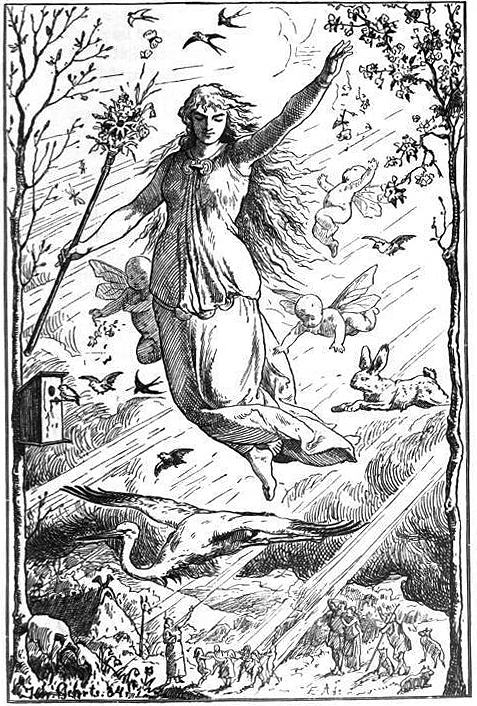
Ostara by Johannes Gehrts
After Constantine decided to Christianize the Empire, Easter was changed to represent Jesus.
Hey! Guess what language Constantine, the Roman Emperor, spoke? Not English, that’s for sure! In fact, when he was alive, English didn’t even exist yet. He would have spoken Latin or Ancient Greek, so would likely have referred to Easter as Pascha or Πάσχα.
But at its roots Easter (which is pronounced Ishtar) was all about celebrating fertility and sex.
Look. Here’s the thing. Our Western Easter traditions incorporate a lot of elements from a bunch of different religious backgrounds. You can’t really say that it’s just about resurrection, or just about spring, or just about fertility and sex. You can’t pick one thread out of a tapestry and say, “Hey, now this particular strand is what this tapestry’s really about.” It doesn’t work that way; very few things in life do.
The fact is that the Ancient Romans were smart when it came to conquering. In their pagan days, they would absorb gods and goddesses from every religion they encountered into their own pantheon; when the Roman Empire became Christian, the Roman Catholic Church continued to do the same thing, in a manner of speaking.
And do you know why that worked so well? Because adaptability is a really, really good trait to have in terms of survival of the fittest (something I wish the present-day Catholic Church would remember). Scratch the surface of just about any Christian holiday, and you’ll find pagan elements, if not a downright pagan theme, underneath.
Know what else? Most Christians know this. Or, at least, most of the Christians that I’m friends with (which is, admittedly, a fairly small sampling). They know that Jesus wasn’t really born on December 25th, and they know that there were never any actual snakes in Ireland, and they know that rabbits and eggs are fertility symbols. But they don’t care, because they realize that religions evolve and change and that that’s actually a good thing, not a bad thing. The fact that many Christian saints are just re-imagined pagan gods and goddesses doesn’t alter their faith one iota; because faith isn’t about reason or sense, it’s about belief.
Look, go ahead and debate religion. Go ahead and tell Christians why what they believe is wrong. That’s totally fine and, in fact, I encourage it. A little debate and critical thinking are good for everyone. But do it intelligently. Get to know the Bible, so you actually know what you’re disagreeing with when you form an argument. Brush up on your theology so that you can explain why it’s so wrong. And have some compassion, for Christ’s sake – be polite and respectful when you enter into a debate, even when the person you’re debating with loses their cool. You want to prove that you’re better, more enlightened than Christians? Great, do it by remaining rational and level-headed in the face of someone who’s willing to stoop to personal attacks. To behave otherwise is to be just as bad as the people you’re debating.
Anyway, I hope you guys have a fantastic long weekend, no matter how you spend it. If your holiday involves chocolate, then I hope you enjoy that. If not, just enjoy the extra day or two off work and the (hopefully) warm weather. No matter what you believe in, I think that we can all agree that the end of winter and the rebirth of spring is worth celebrating.
And also? Richard Dawkins? You need to fact-check yourself before you fact-wreck yourself. Spreading this kind of misinformation to your foundation’s 637,000 fans is just plain irresponsible, especially coming from someone like you. Get with the program, buddy.
ETA: The post now seems to be removed from The Richard Dawkins’ Foundation for Science and Reason’s FB page. Thanks Richard!
ETA Part Deux: Oh. It looks like it was deleted from their timeline but not the photo album. Welp.
*It should be noted that the only actual historical evidence that we have of sacred prostitution comes from Herodotus (I’ve included an excerpt from Herodotus’ Histories below) and no one is really sure how accurate it is. Herodotus is known for making shit up, like giant ants for example. But it makes for an amazing story and people still make the association between Ishtar and sacred prostitution, so I decided to mention it here.
The foulest Babylonian custom is that which compels every woman of the land to sit in the temple of Aphrodite and have intercourse with some stranger once in her life. Many women who are rich and proud and disdain to mingle with the rest, drive to the temple in covered carriages drawn by teams, and stand there with a great retinue of attendants. But most sit down in the sacred plot of Aphrodite, with crowns of cord on their heads; there is a great multitude of women coming and going; passages marked by line run every way through the crowd, by which the men pass and make their choice. Once a woman has taken her place there, she does not go away to her home before some stranger has cast money into her lap, and had intercourse with her outside the temple; but while he casts the money, he must say, “I invite you in the name of Mylitta” (that is the Assyrian name for Aphrodite). It does not matter what sum the money is; the woman will never refuse, for that would be a sin, the money being by this act made sacred. So she follows the first man who casts it and rejects no one. After their intercourse, having discharged her sacred duty to the goddess, she goes away to her home; and thereafter there is no bribe however great that will get her. So then the women that are fair and tall are soon free to depart, but the uncomely have long to wait because they cannot fulfil the law; for some of them remain for three years, or four. There is a custom like this in some parts of Cyprus.
That crack about ugly women was totally unnecessary, Herodotus. I am just saying.
**The first written reference we have for Eostre dates back to the 7th century AD and can be found in Venerable Bede’s Temporum Ratione, in a passage explaining that April was often referred to as Eostremonth:
“Eosturmonath” has a name which is now translated “Paschal month”, and which was once called after a goddess of theirs named Eostre, in whose honor feasts were celebrated in that month.
Jacob Grimm said that he found further evidence of Eostre and her associations with Easter, eggs and rabbits when researching his Deutsches Mythologie, although he was unable to discover any written records about her.
 The Belle Jar
Reblogged this on Your god is a fraud.
Am from Aruba. And for easter people party and walk half naked on the beach.For me this fertility and sex thing, makes a lot of sense. Some pick up story the Christians take up just like osiris and the resurrection with jesus and the resurrection. This is one messed up world when it comes to history.
Here is the other parts you missed.
Ishtar, (Semiramis, widow of Nimrod, mother of Tammuz) came to be represented as the bare breasted pagan fertility goddess of the east. The original pagan festival of “Easter” was a sex orgy that celebrated the return of life via the fertility of Ishtar’s conception of Tammuz. Worshipers of the Babylonian religion celebrated the conception of Tammuz on the first Sunday after the Full Moon that followed the Spring Equinox. They celebrated it by baking cakes to Ishtar, getting drunk, engaging in sex orgies and prostitution in the temple of Ishtar. Women were required to celebrate the conception of Tammuz by lying down in the temple and having sex with whoever entered. The man was required to leave her money. Babies were sacrificed in the honor of these pagan gods and their blood was consumed by the worshipers. The priest of Easter would sacrifice infants (human babies) and take the eggs of Easter/Ishtar, as symbols of fertility, and die them in the blood of the sacrificed infants (human babies). The Easter eggs would hatch on December 25th (nine months later), the same day her son Tammuz the reincarnate sun-god would be born.
This is where the practice of coloring “easter eggs” came from. Many babies would be born around Dec 25 from the sex orgies that began on the feast of Ishtar in the Spring and many of these babies would be sacrificed the following Easter/Ishtar feast .
Or we could not copy/paste from a wikibooks entry based on anti-Catholic conspiracy literature based on dubious knowledge of the world of the ancient Middle East.
The closest thing to child sacrifice to the Assyrian and Babylonian goddess Ishtar was the practice of sacrifice to Phoenician goddess Tanit. They’re both tied to Astarte, who was worshiped in different forms throughout Mesopotamia, but Phoenicia was in the far west of this region while Assyria and Babylon were on the east. The cultures are similar, but not all the practices are the same throughout and there’s nothing I’ve found that cites, specifically, the used of human child sacrifice to Ishtar under the name of Ishtar aside from sources that cite the dubious Mr. Hislop.
Source, please?
Could someone tell me what bunnys and eggs have to do with the resurrection, please??
Eggs are a symbol and source of new life. The moon appears to some to have an image of a rabbit on its face & rabbits have the same gestational period as one lunar cycle. Easter is a lunar festival celebrating life. I can’t cite references, but if I were a pre-scientific guy, I’d be impressed with all these coincidences.
Some sort of references are always preferable. Coincidences often are just coincidences. The only culture I am aware of that sees a rabbit on the moon are east Asian, Chinese and Japanese mostly. And note that Buddhists, Taoists, Confucianists and Shintoists don’t celebrate Easter. Just saying.
Eggs became associated with the holiday because during Lent Christians originally did not eat any eggs, dairy or meat (Orthodox Christians still observe this practice). On Pascha the fast is broken and people ate a lot of meat as part of the celebration. Of course, chickens still laid eggs throughout Lent, and they could be saved (they stay good for over a month without refrigeration if properly stored) so they became one of the first things eaten. This is still the custom in the Middle East and Eastern Europe. Most likely this is forgotten in western countries because they have made Lent easy, or gotten rid of it completely. Protestants got rid of Lent and then couldn’t remember why they did some things so they invented explanations like “It must be pagan!” As for bunnies that one I do not know, but I do know it originally came from part of Germany recently and wasn’t a big thing until the past century or so.
Article on this subject (its a Christian site, but it has academic sources listed that can be trusted to be accurate):http://www.christianitytoday.com/ch/bytopic/holidays/fastlenteastereggs.html?start=1
Thank you!
Hello, I’m wondering if you could point me to the academic literature that supports your stance. I’d like to find out more before obviously forming any position.
Reblogged this on Learning.
I’m really disappointed in each and every one of you. All of this academic posturing and theological/sociological gobbledygook, and not once has the 1987 Warren Beatty/Dustin Hoffman debacle that was Ishtar been mentioned. Now, please accept my challenge and work this infamous box office flop into the conversation in a subversive, poignant, or sarcastic way. And…go.
Reblogged this on Provocative, Yet Controversial.
Reblogged this on Mirror Universe and commented:
“Jesus said unto her, I am the resurrection, and the life: he that believeth in me, though he were dead, yet shall he live: And whosoever liveth and believeth in me shall never die. Believest thou this? (John 11:25-26)”
Smart article. That said, I do not believe most Christians know this. Sourceplease?k
What he said, what she said…. this is the problem, what did God say
Colossians 2:8
See to it that no one takes you captive by philosophy and empty deceit, according to HUMAN TRADITION, according to the elemental spirits of the world, and not according to Christ.
2 Timothy 4:2-4
Preach the word; be ready in season and out of season; reprove, rebuke, and exhort, with complete patience and teaching. For the time is coming when people will not endure sound teaching, but having itching ears they will accumulate for themselves teachers to suit their own passions, and will turn away from listening to the truth and wander off into MYTHS.
2 Thessalonians 2:14-15
To this he called you through our gospel, so that you may obtain the glory of our Lord Jesus Christ. So then, brothers, stand firm and hold to the TRADITIONS that you were taught by us, either by our spoken word or by our letter.
Matthew 15:6
He need not honor his father.’ So for the sake of YOUR TRADITION you have made void the word of God.
1 Corinthians 11:1-2
Be IMITATORS of ME, as I am of Christ. Now I commend you because you remember me in everything and MAINTAIN the TRADITIONS even as…. I ….(NOT MEN) delivered them to you.
Matthew 15:3
He answered them, “And why do you break the commandment of God for the sake of YOUR TRADITION.
2 Thessalonians 3:6
Now we command you, brothers, in the name of our Lord Jesus Christ, that you keep away from any brother who is walking in IDLENESS and not in accord with the TRADITION that you received from US.
1 Timothy 1:4
Nor to devote themselves to MYTHS and endless GENEALOGIES, which promote speculations rather than the stewardship from God that is by faith.
1 Timothy 4:7
Have nothing to do with irreverent, silly MYTHS. Rather train yourself for godliness;
Amen. Thanks for clarifying the whole discussion with biblical truth.
Interesting information.
Although – I don’t think you have the correct Foundation for Reason and Science page (there are two). 637,000 fans seemed low, so I looked and the page you’re referring to also has a description taken from Wikipedia. I doubt it’s the official page. The other page has well over a million fans and a much more credable information section.
Perhaps I’m wrong, but it looks like you just did the same incorrect internet “fact” posting that you’re adamantly against (well, so am I).
Interesting information.
Although – I don’t think you have the correct Foundation for Reason and Science page (there are two). 637,000 fans seemed low, so I looked at the page you’re referring to – it also has a description taken from Wikipedia. I doubt it’s the official page. The other page has well over a million fans and a much more credable information section.
Perhaps I’m wrong, but it looks like you just did the same incorrect internet “fact” posting that you’re adamantly against (well, so am I).
One thing you fail to acknowledge is a word historians embrace–archetype. For example…Mars/Aries. Zeus/Jupiter. Lucifer/Set/Prometheus/Venus. There are many cultures that had gods and goddesses with identical. Now when you get into the solstices and equinoxes of celebration it’s understood that they are one and the same.
Historians do not embrace the term archetype. That is the province of Jung(a psychologist) and Frazier, and a lot of pantheists.
Nope, no historian ’embraces’ that it is neo-pagan goobledeegook.
The interesting thing about this is that I remember some Jehovah’s Witnesses telling me the same thing about Easter eggs and the bunny being a fertility symbol, as their justification for not celebrating holidays. Great for calling out Herodotus. No, I am sure he did not have his own biases.
All that you really shared is that the Christian faith is all about lies and trickery. Why would you and your friend even what to be a part of that unless you are about tricking people also. The christian faith is down right evil like every than else in the world that is rule by the devil in person who is the man of sin.
Reblogged this on Author page for K. A. Lange.
One correction which does not change your argument: Jesus did not “return to Jerusalem from his 40 days in the desert” before Passover. His 40 days in the desert came after his baptism, at the beginning of his ministry. He then spent somewhere between one and three years in Galilee before traveling to Jerusalem to celebrate Passover, at which time he was crucified.
a pegan holiday and was celibate long before jesus ever happend I say do moreresearch before post this shit xmas is alsoa pegan holiday just like most we celibrate today fuck christins and cathlics and their made up shit and shame on them for disobaying the 10 conmandement and turn someoneelses religon in to their own I fact anyong who goes to cherch is disobeying the 10 conmandement thall shall not build a temple to worship me in.
Pagan, not pegan. It’s Christians and Catholics. Oy, Mozilla, Chrome and Opera have built in spell checkers. If you are going to be pedantic, at least get the religions spelled right.
Also, go to the period store and buy some.
You are being far too kind. Most of the comments and replies about this blog-post have rarely risen above the level of drivel; I am singling out joker’s
“a pegan holiday and was celibate long before jesus ever happend I say do moreresearch before post this shit xmas is alsoa pegan holiday just like most we celibrate today fuck christins and cathlics and their made up shit and shame on them for disobaying the 10 conmandement and turn someoneelses religon in to their […]”
only because it is the best example of bad spelling, bad grammar, complete lack of understanding of punctuation misinformation, ad resorting scatology and profanity when running out of actual things to write that I have seen in a long time. It only fails to claim expert knowledge of several ancient languages and cultures separated by a millennium or so, and thousands of miles, by someone who’s command of English is somewhere near Grade 2, to qualify for best ever.
Now, with that off my chest, let me make some general observations. For the self-described atheists, wizards, witches, neo-pagans, druids, etc., who seem to have made it their mission to convert “Christians” or “believers” to their way of thinking by telling them (often incorrectly or at best incompletely) that some of their practices have roots outside Christianity, just give it up, this is NOT news. Nor does it matter. Christian festivals celebrate events in the life of a particular person, who Christians believe revealed God in a special and unique way. What the festival is called, or what date it is on that is of significance in ancient religions has nothing to do with the event it commemorates.
The suggestion that Jesus did not exist is risible; there are no scholars of 1st c. CE of any significance that would argue that (except perhaps to note that the man we call Jesus (in English!) would find that name strange, and would not have been known by that name by his friends and contemporaries.) So suggest that there is no evidence to be found for the existence of Jesus outside the biblical texts ignores for one, the large number of texts about Jesus that did not make it into the biblical canon for various reasons. For another, it makes the rather extraordinary claim that the biblical texts are not evidence, while other text, that do not mention Jesus, are evidence. For the fairly large number of texts about Jesus (the development of which can have been extensively studies by critical scholars, a considerable number of which have no skin in the game of “proving” his existence, the consensus is that they are about a real person, who had an extraordinary effect on those he touched, and as happens in those cases, the subsequent stories about him take on legendary qualities. The arguments are NOT about Jesus’ existence, they are about who he was. And in the stories in the biblical canon, he makes remarkably few claims about himself; most of the claims of divinity, and how that divinity existed in a fully human being, do not come from Jesus, but from subsequent thought about him by some fairly bright people. (It also is amusing that those who reject the biblical texts as evidence are all too willing to accept any number of other texts that happen to suit their own vies as evidence; cf. confirmation bias!)
And that brings me to the constant claim made by many commentators that the people who thought and wrote about Jesus and his meaning over the next two centuries (that would be the Western and Eastern Fathers, ante and post-Nicene, Augustine, Aquinas, etc. and down to the 19th and 20th c theologians the likes of Karl Barth) are stupid, and/or deluded, and/or insane, and or malicious simply won’t wash. It also suggests that those making these claims have never read any of these. Undoubtedly, you can find a goodly number of wacko nut-jobs writing about what they suppose is Christianity and laying down what Christians believe and are to do. But, theology is an academic discipline, and in respectable circles is played to the usual academic rules; accepted research methodology, peer review, publication in journals with reasonably wide circulation (not just to your own little group of believers), discussion and acceptance by other scholars with accepted credentials. To put it more simply, if you want to accept the Westboro Baptist Church (members south of 30) version as Christianity, that’s ok, for you, just don’t assume and act like every other one of the 2 billion or so Christians on this world thinks the same thing.
Frankly, most of what is being attacked as Christianity in these posts bears very little resemblance to the real thing. First, there is no such thing as “Christianity” that has a particular set of doctrines and world view. There never has been, and probably never will be. What there is a general agreement on between groups calling themselves Christian is that there was this person called Jesus (except that was not his name 😉 ) who lived about 2000 years ago, who was (in a way we still debate even about the most fundamental details) both human and divine, and who taught a new way of looking at and relating to God. And I have no problem with the debate; theology has been defined as “faith seeking understanding” and as such theological debate, even between people who differ profoundly, increases understanding, if not of Jesus and God, then of each other. (And I would include inter-faith debate in this as well.)
And yes, Christianity (or, perhaps more correctly, people claiming the name of Christians) has been responsible for any number of evil acts in history, and so have other religions, and non-religions. To suggest that Christians (or people of religious faith) are always bad, and that non-believers (atheists) are always good is to publically confess ignorance of history. More picky, and theologically, I would argue that being Christian means above all to follow the teachings of Jesus (and you don’t even have to believe he is divine to do so) – don’t repay evil with evil, turn the other cheek, go the extra mile, love others as you love yourself – and that therefore those who commit evil in the name of God/Christ are not REALLY Christians, even if they are high Church officials. (I suspect that dog won’t hunt, but, I wanted to say it nevertheless.)
But, often civil and political conflicts are cast in religious terms. For example, Northern Ireland, where the conflict is often described as between Protestants (Ulster unionists) and Catholics (properly ROMAN Catholics because there are others, but in other terms, Irish nationalists). But, it is equally correct to make this out to be a political battle between ethnic Irish (who by accident of history are mostly Roman Catholic) and the descendants of English invaders (who were mostly [Anglican] Protestants). Then it becomes “we were here first, you took us over, and now we want you out!”. Canadians particularly may want to think about this – it describes Quebec separatism, but we have never cast it in religious terms.)
Finally (finally!), people, this is a debate about religions, which is about very deep parts of what it means to be human. Could we cut out ad hominem attacks, imputing motives, and going to the wall about things that matter nothing. And, cut out the s-word, f-word, and any other swearing . If you can’t make your point without those, your point is probably not worth making.
Maybe for stuff like this we need a modified Godwin’s law; anybody who uses f—- or s—- is immediately disqualified and blocked from further participation.
And finally finally; Wikipedia is not an acceptable source! If whatever you are getting there does not cite a reference, treat it as opinion. If it cites a reference, check it out; I know it is difficult to accept, but, people have been known to make stuff up! And if the sourced exists, consider its standing; just because someone wrote it and published it, doesn’t make it true!
Feel better? 😀 I didn’t want to go off, to deeply, on his grammar or spelling, because well I’m not the most sterling example. Thank the Gods for built in spell checks.
By the way, pet peeve. If Christianity is capitalized, as is Baptist, would you kindly mind capitalizing Pagan? I know the grammar rules don’t, but it’s kind of an insult. As wacky as the Pagans are(and we are varied, anything from Asatru to various flavors of Pantheism), we aren’t really less. Grumbles, even if dealing with a wide majority of them, leaves me wanting to throw firm pillows at their head as a wake up call.
I believe btw, that Jesus name back then would have been Yeshua. Yeshua was a popular name at the time. (ala history channel) He was named after Joshua(due that brought down the walls of Jericho Joshua).
As for the whole Christians stole x from the Pagans… Yeah sorry, but Pagans are still working on that mindset. Looks askance at pillows. Sighs heavily.
Ok; point taken, and henceforth I will capitalize Pagan when referring to a group of believers of that persuasion. As for Pagan wackiness, I will leave that to you; I have enough issues with Anglican wackiness in my own particular persuasion.
And yes, Yeshua (ben Yousuf) was probably the name of Jesus by which he was known, as much as we can infer from Hebrew spelling of the time, which did not have vowels. As for how Jesus (for lack of a better name) would have pronounced it, that’s anybody’s guess.
I confess I don’t know much about Pagans, but then, I don’t know much about Ethiopian Orthodox who are assumed to be part of my tribe, but am always willing to learn. In the end, I am not willing to go to the exclusionary corners (I am totally right, you are totally screwed up!) – instead, I tend towards the Buddhist notion that God (or whatever you call a supreme being or beings) is indescribably; if you are describing it, it is not God or whatever). Nor does it worry me much who stole what from whom; religion is a part of the world of ideas, and that is always happening in that world.
And I can always fall back on the notion that it is really not worth arguing about (unless you insist on a supreme being that insists that you get it “right” even though the same supreme being gave you incomplete information), because soon you will KNOW.
Well said mini-thread here. In my opinion, most irrevrence towards cosmic beliefs come someone who felt their intelligence was insulted. Otherwise it’s probably one who felt screwed over somehow by those believing in those cosmic beliefs, or maybe in my case, a by-product of growing up and feeling lead on as a kid into believing things that the older I get sound more and more like just children’s stories. And of course, someone’s parents could habe been exrremist enough to really harm them in the name of religious beliefs
What about we forget about it and enjoy our chocolate on peace?
As a Christian, I acknowledge that many of our current Christian traditions are drawn from pagan sources, and that the symbols and tokens have been adopted as our own. This is not a surprise, as you have said. I applaud your appeal to ‘be polite and respectful when you enter into a debate’. There is a way to disagree with people’s opinions or belief systems without making them feel devalued or stupid. This can be challenging at times and people on both sides of the argument struggle with this now and then.
On a side note, interestingly the Bible does refer to a ‘shrine prostitute’, or actually a lady who disguised herself as one to deceive and ensnare her father-in-law. Have a read of Genesis 38 – http://www.biblegateway.com/passage/?search=genesis+38&version=NIV
Nice piece, thank you. Can you take on Zeitgeist next, please?
A lot of people have already done that:
http://zeitgeistchallenge.com/?page_id=11
http://www.kingdavid8.com/_full_article.php?id=fe54916c-64bc-11e1-8f66-6067e33f8f11
Hmm.. I have never seen any evidence that richard Dawkins is a misogynist, which is someone who hates women. Gynophobic maybe but still unproven on the evidence. Perhaps walk your talk a bit more?
Talked to my own daughter on Easter Sunday about theology. I never miss an opportunity to lecture my children on any subject underneath the sun. I explained to her one of the virtues of being Protestant, since the Reformation, is the ability to think critically and use historical sources and textual criticism, something that is sadly lacking in many modern American Protestant churches. My own great love in life is astronomy, and the history of astronomy, ancient astronomy, is a blazing passion. So I explained to daughter (With pictures! I can’t talk without a pencil being in my hands.) about the vernal equinox, where vernal means ‘green’.
The vernal spring equinox used to occur when the constellation Orion the Hunter rose with the sun. (About 3,000 B.C.) Orion the Hunter was called the god Osiris in ancient Egypt, he was painted green in art. The Eye of Osiris, that well known Egyptian eye motif, translates (literally) as ‘the green’, and as ‘he is risen’. You’ll remember Osiris rose from the dead, bringing the promise of eternal life to his followers. Later, precession of the equinoxes caused the vernal spring equinox to occur in Taurus the Bull, called Bacchus ‘the bull-faced god’, also called Iacchus, Adonis, Dionysus, and so on. Adonis was famously wounded in the ‘thigh’, and bled to death, only to be resurrected. Taurus the Bull, in the epics of Gilgamesh loses a thigh, which is torn off by Gilgamesh, he throws it at Ishtar. There was a constellation called The Thigh of the Bull in ancient sky maps. The vernal spring equinox then moved into Aries the Ram, and Jason and the Golden Fleece is the story of the skin of that ram, which could heal disease and resurrect the dead. That ram, or lamb, died and was hung on a tree, you’ll remember. The vernal spring equinox for a very short time then popped in to the constellation Perseus, shown holding the head of the Gorgon. Perseus, called the Persian, was also called Mithras the Persian, and temples devoted to him in Rome taught that he would lead followers to the resurrection. Interestingly, he was supposed to lead them upwards through the 7 layers of the sky, through the 7 heavens of the 7 known planets of the day, until they reached the highest god, Saturn. But time doesn’t stand still ! And neither does the sky. That lamb died, and the cult of Mithras perished, and the vernal spring equinox, starting about 60 B.C. or so became Pisces the Fish. I pointed out to my daughter that the word nailed above the head of Jesus during the crucifixion was Icthus, the Fish. (In the original Greek.)
Really, I should get a fish bumper sticker for my car.
Manilius the 1st century B.C. astronomer tells us the place of Ishtar, or Venus, or Aphrodite in the sky, her constellation was the constellation of the spring equinox, which used to be Taurus the Bull, but as you know became Aries the Ram, Perseus (barely), and now the Fish. My kids got eggs and chocolate bunnies for Easter. (I took a ten percent tithe, my share of the loot.) Since this is the season of the goddess of love and fertility, eggs and bunnies seem very appropriate.
Thanks so much for the person pointing out that eoster was a germanic word for vernal, or spring equinox. The holiday of Ishtar was a time of year as well as a constellation (shifting over time), a planet, and a goddess or god. Thanks to Dr. E.C. Krupp of the Griffith observatory for information on constellation Orion the Hunter as Osiris. Ishtar in some versions of the epics of Gilgamesh is also called Inanna, depending on the culture. Thanks to Barbara Watterson for her book “Gods of Egypt” for translation of the symbol called the Eye of Osiris.
An additional thought. The constellation Aries the Ram, before moving up into the position of Aphrodite (Greek), or Venus (Roman), was in the place of Athena, goddess of Wisdom. The city of Athens was named after her. On the breastplate of Athena was the head of the Gorgon. You’ll remember that next to Aries the Ram is constellations Perseus and the Gorgon. Often in star stories constellations which are close together are clustered together in story and art. Each of the 12 constellations of the zodiac were assigned to one of the 12 gods of Olympus. Manilius gives these as: (Greek first, then Roman.) 1) Aries the Ram-Athena, Minerva, 2) Taurus the Bull-Aphrodite, Venus, 3) Gemini the Twins-Apollo, Helios, 4) Cancer the Crab-Hermes, Mercury, 5) Leo the Lion-Zeus, Jupiter, 6) Virgo the Virgin-Demeter, Ceres, 7) Libra the Scales-Hephaestus,Vulcan. 8) Scorpius the Scorpion-Ares,Mars, 9) Sagittarius the Archer-Artemis, Diana, 10) Capricornus the Goat fish-Hestia,Vesta, 11) Aquarius the Waterbearer-Hera,Juno, 12) Pisces the Fish-Poseidon, Neptune
Splitting hares? See http://www.gurukalehuru.com (Thanks for writing the blog, though. You’ve sparked a very interesting conversation.)
I trust my instincts, and many of the very strident posts I see coming from the Richard Dawkins Institute For Reason And Science set off mental alarm bells and so I am leery about putting much stock in them. That being said, for me this article sets off those same mental alarm bells. “Noted misogynist and eugenics enthusiast?” “And other truths I have to tell you?” Really?
Thanks you. The way you explained everything was great. I’m Catholic and feel people sometimes just yell at each other on why they are wrong. The more I learn about my religion the more I feel that somethings are change for the better or to control it’s followers. But my faith in God has never changed. Again thank you for your info.
Trying to figure out: what is your point? The above diatribe is just as annoying as atheist and Christian apologists.
I’m trying to figure out the following: What exactly is your point? The above diatribe is every bit as annoying (and lame) as any atheist or Christian apologists’. Brava, Captain Obvious (on all counts)
muito bom !
You failed to mention where the name for the holiday comes from. http://en.wikipedia.org/wiki/Ēostre
Ēostre is a pagan goddess. Have you done your research to be able to make the claims that you have? Are you a historian? Names of gods change when populations migrate. Is it not possible that that Ēostre was once Ishtar? I am no historian either but you have taken huge leaps in assuming you know what you are talking about and you all the proof you have is internet research. I commend your emphasis on skepticism but you have erred in that you set yourself above that same skepticism. Please consider and reply. Your post is making waaaaaay too many christians unnecessarily smug.
It’s a totally valid hypothesis, but it doesn’t look like this is the case. There’s no indication that the relevant populations had anything to do with each other. Ishtar was worshipped by Babylonians, Akkadians, etc. around 1800 BCE, whereas Eostre can be traced back to, at the earliest, about two millenia after that. Eostre’s name seems to come from the Germanic word for “dawn.” Germanic languages are completely unrelated to the Semitic languages that Ishtar’s worshippers spoke, which presumably would have been the source of Ishtar’s name.
Moreover, if Ishtar had been imported to northern Europe through migration or trade, you’d probably see other goddesses with Ishtar-like names in other populations in between these two regions. Paying attention to those similarities is how linguists and historians often track pre-historic migrations. But as far as I know, you don’t see this phenomenon with Ishtar/Eostre.
The similarity in the names is what linguists would call a “false cognate” – two words that seem similar enough that people assume they must be related, but on inspection of their respective etymologies are clearly only coincidentally similar.
I honestly don’t see how debunking the “Ishtar = Easter” meme should make Christians “smug.” Either way, the English word for Easter and many of the traditions surrounding it are Pagan in origin. It’s just a question of which Pagan goddess lent her name to the celebration.
How do you know that I, Ishtar, am not a part of that “tapestry” as well? I was a deity long before the deity Ēostre and long before the deity Jesus Christ. Are you an expert historian? How can you be so sure of the “facts,” as you like to say. You should know that the victor brings their gods and seldom allows others to stay. The victor also always writes the history they choose. You should therefore conclude that history is not an area where we can consider anything to be facts, but rather versions of perspectives.
Reblogged this on moirenike on… and commented:
An intelligent discussion about the Ishtar, Easter argument. I prefer a well researched argument.
When I first saw the OP on facebook, the take-away I got was that Easter was a mish-mash of many different religions and that Christian claims to ownership of the holiday were misguided at best. That seems to still hold true. I appreciate your delineation of the facts here.
Of all the many things I would like to say about this rather amusing piece, I only have the moment to ask this question. Since when is a Greek Goddess a Babylonian one? There is quite a large difference between the pantheons.
Dear Loki, take a look at the Pantheons again. Ishtar is a Babylonian Goddess. You will see her in Gilgamesh. You will not see her in the tales of Zeus, Hera, or Persephone decent into Hades.
Greece was influenced by Assyria – evidence of this is the similarity in cosmogony, the likeness of Heracles to Gilgamesh at various points, and – in the present case – the similarities between Ishtar OTOH, & Aphrodite & Artemis OTO. It’s a matter of a very prominent Mesopotamian goddess – she appears to have had more temples than any other deity – having an an effect upon a culture that was well within Assyria’s sphere of influence: Ishtar came to be very important indeed in Assyria.
Whole books have been written on the subject, like “The East Face of Helicon: West Asiatic Elements in Greek Poetry and Myth”. I’ve not read it, but if it’s anything like as good as the author’s book “Indo-European Poetry and Myth”, then it will be very solid academically, and a very good read
.
What Sinfjotli said. Plus to point out that the Greeks, in my estimation at least, were the laziest cultural interpreters of the Ancient world. They traveled, they got to know the locals, and whenever they saw a religious practice or figure they simply said, “oh, this one is vaguely similar to our deity X. Ah, we don’t understand their babble-language, we’ll just call her Aphrodite/Athena/Whatever.” They rarely tried to differentiate deities. They were like that scene in Being John Malkovich: “Hellas Hellas Hellas Hellas…” That was their world. 🙂
.
I think Easter and the Easter-egg came from the Egyptian Isis.
In Egyptian Isis was called Ast or Est, from which we derive Ester or Easter (referring to a star or the heavens). And remember that Isis-Est was a fertility goddess, as much as she was the Queen of Heaven.
And the Easter-egg came from the spelling, because Est was spelt with the easter-egg glyph.
Ralph
I liked your comment, I’m fed up with this Ishtar = Easter thing….yours sounds linguistically more likely and also especially in terms of symbolism too. Thanks for shedding some more light on the subject.
Thanks, Penny.
In addition, it is highly likely that the cult of Ast or Est (Isis) spread far and wide. She became Est-ther, Asht-oreth, Isht-ar (Asht-ar), Aphrodite, Venus and then the Madonna and Child (Isis and Horus).
Like many things, the foundation and root of theology is to be found in Egypt. “Out of Egypt I have called my Son”
Ralph
See the books:
King Jesus
Jesus, King of Edessa.
There are some remarkable identities between the descriptions of midle east deities and northern european. Thor and baal are both the main deity, both thunder hurlers, both fight snake like sea monster,and both have the same sacred tree, oak. I would dare say that thor is a phoenician export to europe as t doesnt follow the indo european root for the main deity, which is jupiter(jovi)-zeus-shiva.
Likely exported by early Celtic shaman, whom of which provided and shared in many Norse ideologies, and even can be found and traced back to early eastern civilizations.
what is the Easter of Acts 12:4? What was celebrated/observed here?
BIBLE (1) TOPICAL INDEX (11)
1 Bible results for “Easter.” Showing results 1-1.
Suggested result
Acts 12:4 [Full Chapter]
And when he had apprehended him, he put him in prison, and delivered him to four quaternions of soldiers to keep him; intending after Easter to bring him forth to the people.
Bible search results
this is KJV and the “Acts” clearly occurred prior to the murder of Christ. Something was being practiced…..
It is probably the same Easter. The “he” being referred to here was clearly not Jesus from the preceding text. The actual actions in Acts all happened after Christ died, but of course the ritual of Easter was celebrated at the time of Christ. Easter as the pagan holiday of fertility- birth.
If you take a look here http://www.blueletterbible.org/lang/lexicon/lexicon.cfm?Strongs=G3957&t=KJV you will see that the word translated Easter in this text is actually “pascha” from which we get “pascal” as in “light the pascal candle”. This is in keeping with the point of the author of this article.
The same word is translated as Passover 28 times in the new testament and only once as Easter.
The “something being practiced” was the God-appointed feast of Passover, given as a reminder of the freeing from slavery in Egypt and the keeping of a prophecy to do so, while also serving as a prophecy that God would provide “himself”, a lamb. A prophecy which was fulfilled at the crucifixion of messiah.
The controversy of keeping the Passover at the appointed time was an early source of disputation between Christians, especially those in Rome and Alexandria. If you have a bit of a Google about the “Quartodeciman controversy” you will find some more accurate information on the topic.
The quotes from the early “church fathers” can easily be tested if you install the excellent, free, e-sword application and download the searchable, free, e-books of their writings.
This is a fair, well balanced article. Respect.
Christianising pagan gods is a past practice of the early Catholic Religion which is a false religion with billions of followers.
Lets move on to the real meaning of Christian.
You MUST have the Holy Spirit in you before you are a Christian. Christian means Christ in you. All true believers in Jesus were baptized into his name and filled with the Holy Ghost. Christ in you is your hope of glory.
This my friends is the true meaning of being a Christian. You MUST be reborn into the body of Christ of which He is the head of the body. If you are not in the body of Christ then you are not His and you have no relationship with Him.
The death and the resurrection made all this possible. Christ Jesus made away for us to get back into a relationship again with God. Being in the body of Christ makes you a son of God. You are the Elect, you are the chosen, you are a in the royal priesthood. You have His family name and you are then entitled to the family inheritance. You will receive eternal life.
Once you receive the true status of a Christian you still must endure unto the end and be not decieved by the deciever. Hold fast unto your salvation — it is a journey — a commitment and a challenge. Christians must be strong — weak Christains will fall away.
Happy Resurrection Day — forget about the word Easter – it’s misleading. Focus only on Christ and the fact that He sits on th eright hand of the Father. All power and authority in heaven and in earth are now His.
Satan was defeated when Jesus went to the cross and became a sacrifice for the sin of the world. What is the sin of the world? DEATH is the sin of the world. Once Adam fell he became separated from God and doomed to die. Because of one man Adam, sin entered into the world. Because of one man Christ salvation came into the world.
All the old testament saints were trapped in Paradise until Christ freed them at His resuurection. He took the keys of hell and of death from Satan. Satan has no more power over mankind if they choose to believe in Christ and complete the salvation process.
This is the purpose of the resurrection. SALVATION
you’re full of ‘hops’ about the Catholic church, for sure.
Wonderfully succinct…..I salute you, my brother, and I will meet you at Home
But Christ didn’t rise on Sunday. He was already gone before the dawn of Sunday. So how does that make Mary going to the tomb Resurrection Sunday?
Trapped in Paradise? Can you see what you’ve written? Reality is not a violent soccer game between God and Satan for soul-points. Is your God not all-powerful? How can there be any opposition to one who is omnipotent? Clearly, you are unclear on the terminology. Who is the tmpter in the Garden of Eden, if it is not an all-wise, all-seeing God who PLACED the tree in the Gardne, and then forbade his ‘children’ from partaking thereof? Thats what is known colloguially as a Mind Fuck. Besides, didn’t he know in advance they would choose as they did? Where is his famous all-seeingness?
Everyone is a child of God, because God fathered everyone and created everything. Period.. Earth mothered you. That’s what makes us all siblings. Common parentage. No abstrusely conceived, ornately-designed, complicated, confusing and intricately woven insurance policy can change the fact that YOU ARE AS GOD MADE YOU. Whatever you believe. Whatever you have covered over it with.The wielders of guilt & shame are known by their tools. Religion is the ultimate manipulator The proselytizers are often–not always–well-intentioned, but they are badly taken in by the Fear Mongers. Fear is a contagion. All have Christ within them–whether they know it or not. It is not a choice, anymore than having DNA is a choice. The latter makes you human, and temporal. The former makes you divine and immortal.
Greek writers had this fun habit of subsuming foreign gods under the name of the gods they used… In some cases, they believed that the deity that they knew as, Aphrodite, say, was the same deity that babylonians referred to as Ishtar, say. Other times, you can treat it a bit more like a short hand for “Ishtar, who in many respects is similar to our Aphrodite”
There’s an interesting discussion about how at least some greeks understood the correspondence between some of their deities and some of the Egyptian ones.
Fullmoon after Spring-equinox: Because of the springequinox’s position in the EAST of the ‘Circle of Existence’ (e.g. Celtic Crosswheel, Lakota-&Cherokee Hoop of Life), this was also called the ‘Moon of the EAST’; …the christian EASTERN is always at the weekend (fri-, satur- &sunday) after this fullmoon, and it still contents some of the signification of the old celtic celebration — postponed, as usual (see e.g. christmas and winter-solstice) from the original date; that was mindmanipulation during the “colonisation” of celtic Europe by the roman empire with 1600 years of inquisition: de-paganisation, de-rooting from Nature and the Earth, etc..
That’s past now, we must learn from the fault, and go forward together; “god’s” new name for the next aeon is ‘Oneness-spirit’, a non-personal, purely psycho-logic ‘state of being’, meaning the conscious connection with the “cosmic spirit/ mind”.
All christian feasts are distorted and postponed Celtic celebrations of their spiritual lunar calendar (Mabon, Lughnasad, Beltane etc.), but still contain much of the original true meaning.
In the Celtic circle of life (celtic crosswheel), Autumn-equinox was in the West, Wintersolstice was in the North, and Springequinox in the East (German: Osten], from there the name Ostern, very probably literally translated in English, East and Eastern.
The celtic celebrations were embedded in the nature-given rhythms, thus spring&summer [the bright season] was the time of the “external work” on the fields and in the village [extroverted season], and autumn&winter, called the ‘dark season’, were recognized as the introverted season: it was more cold, the daylight shorter, it snowed at that time in Europe, the people remained in their homes — it was seen as the natural time for the internal work: to recapitulate and to put in order the psycho-logic things in&between the people of the community – so the time for the spiritual rituals [spi-ritual].
Autumn [the 1st part of the dark season] was full of introspective rituals (to the spirit connecting ceremonies, purificational&cleaning rituals, and also solitary-retreats of some days for to recapitulate), in which the people reflected the passed year on attitudes&behaviours which had been egocentric [to see oneself in the center] or egoistic [to want to have anything].
From winter-solstice to spring then [2nd part of the dark season] was prepared with the results of that work the “spiritual seed” (or spiritual egg) for the next year [bright season], with the intention to develop more altruistic, less egoistic&-centric behaviour&attitudes, in a way that peace&teamspirit among the humans were fostered.
What matters the dates, most celtic celebrations relate to moon AND sun (e.g. 2nd newmoon after autumn-equinox, 1st fullmoon after springequinox, etc.), some also to certain star-positions, casually also in combination with a moonphase after.
A month (correctly a moonth) started with the new-moon.
Most celtic tribes saw the end of a year at autumn-equinox, and the begin of the year at the 1st new-moon after (life starts with fertilization&pregnancy, assigned to autumn&winter; springtime represents birth, summer growth&life), what makes the single years “elastic”: they have every year another length, as it is natural and usual in lunar calendars; …some solar years (from e.g. a-equinox to a-equinox), to which the lunar calendars always do refer, contain 13 (new)moonths, others only 12.
The time inbetween an autumn-equinox and the 1st newmoon after (could be 1 day, could be 27 days) was seen as a sort of “zero-days”; those referred to the un-understandibility of the Mother “in the dark of human’s intellect’s capacity to understand” (what the christian church distorted to the dark mother): Her mystery, the nothingness, which could not be understood with the intellect.
So, during the years with only 12 newmoons from autumn-equinox to autumn-equinox, the “zero-time” was more long, during the years with 13 newmoons more short.
Basically, as already indicated, the Celts parted the year in 2 halfs, the BRIGHT and the DARK season. But in the circle of life (celtic cross, circle partitioned in 4 quarters), that already results in 4 points, also simbolizing the solstices&equinoxes, the 4 seasons, the 4 directions, the partition of a single day in morning, midday, evening and night, and many other assignments: E.g. the Springequinox as as also the morning are assigned to the East, the Wintersolstice, and also midnight, the moon, and reflection/wisdom, to the north. The sun to the south. Etc., there are thousand of assignments.
During the dark season (autumn&winter), the mainattention was given to the newmoon, but with the start of the bright season at spring-equinox, the premiss changed from darkness to light [from the yin- to the yang-energy], and the mainattention was given to the fullmoons.
The Celts did not follow the antagonistic conception of absolutizing good and bad, or black and white — to them, anything was good and bad at the same time, these were 2 sides of the same coin. They had no pairs of gods representing a good force and an evil force. The darkness was the (for the human intellect in the dark laying, not comprehensible) source from which the things came at light, thus it was the in-comprehensible mother from which all birthed.
Thus they did not see the newmoon as evil and the fullmoon as good, it was only to look at the dark and see appear the things, and with fullmoon, one changed the view-angle and focussed on the single things — by the years, a balanced view on both aspects was naturally cultivated.
With springtime, the yearly introspective and preparational work (all rituals, exercises and ceremonies) from autumn&winter came to an end, the people had prepared their spiritual seed/ egg for the next year, and the village knew that they face now the bright season, the work in the external fields – until to the next autumn with its harvest-time.
The time between the spring-equinox and the next fullmoon was depending of the length of the “zero-time” in autumn, different every year (between zero to 27days).
For the people, these days (between springequinox and 1st fullmoon) were the time to finish now the work at their spiritual seed for this year, and at the point they were now with their transcendation-work, to make the last polishing: At the 1st fullmoon after springequinox, this “spiritual seed” was planted in form of spoken prayers in the sky [distorted christian meaning: Jesus goes into the sky], and also in form of a “be-prayed” egg in the Earth under a tree [from which the christian habit with the painted (perfected) easter-eggs in the garden]:
Sky is air, and represents on the spiritual level also the human’s mind, intellect [see e.g. also the Tarot, Swords, air, thinking].
The correct view is that the sky, human’s mind, has to reflect the Earth, or more exact: the correctly alligned way of life on Earth. Human’s mind has to be adapted to the conditions of the Earth and the Nature (nature including the sun, moon and the stars).
The goal was finally on a practical level not to exaggerate in nothing, to develop humility and compassion, to foster a type of respectful oneness-spirit-mind in the people, not only limited to the humans themselves, but including all beings [altruistic and holistic attitude], thus also the beingnesses of the spiritual level of existence, like the of the already mentioned beingness of the nothingness, or the of the darkness, or the of the light.
So, what was done at the 1st fullmoon after the springequinox in a big celebration, that was that the people put prayers for the whole into the “sky” (the mind-space): less egoistic and egocentric intentions, more heartful intentions, more sage intentions, wiser intentions, altruistic intentions, oneness-spirited intentions.
For oneself, they “planted” their over the last autumn&winter prepared “spiritual seed” for the coming bright season, that happened in form of a during the night with that energy beprayed egg. An egg was given to all participators of that ceremony, and charged that night with all th energies that one had developed while the meditations of autumn&winter, and then “planted” in the nature, under a tree, a rock or akin appropriate place.
The “fruits” of this seed were then “harvested” with the harvest-feast of autumn-equinox in special ceremonies&exercises, in which one reflected in the circle of the village the positive contributions that one had given to the whole community during the year — the personal raising compared to the year before.
This way, year for year, the harmony of the villages was fostered and grew.
From where comes the idea to paint and hide eggs – already by themselves a symbol of the birth, also assigned to the East – becomes clear now (in the past, they were, charged with the personal prayers, put in the morning of the ceremony in little holes under a tree); the easter-rabbit is taken from the germanic wintergoddess Skadi, which was also represented in one of her aspects as white rabbit.
The version with a germanic springtime-goddess with name Ostara is from the Brothers Grimm of the 18th century, based on the church-historian “Venerable Bede” [672-735], an anglosaxon Benedictine monk, who mentions in his textes as root of the word “Eastern” an alledgedly germanic goddess with the name of “Eostrae”.
Christian Eastern has also nothing to do with Ishtar. Jesus and the old testament may have their roots in elder myths from the palestinian corner and india, but the practical rituals of today’s catholic church are from the celtic culture. in the Celtic culture, where the “sex&fertility”-rituals are in autumn (sex is before the pregnancy, pregnancy is winter).
It calls Eastern because in the circle of life (celtic cross-wheel), spring-equinox is in the east, and it is the East-(Full)Moon-ritual, “the planting of the spiritual seed that was prepared&perfected over the autumn&winter”. In the precise fullmoonnight after spring-equinox, it was done with a during the night beprayed or charged egg, “planted” under a tree (from there the painted/ perfected egg tradition in the garden), that also symbolized birth. This way, the people every year became better.
However:
I wish us all a fine celebration for the next fullmoon, and a peaceful, joyful, beautiful, loveful, conscious and also protected spring&summer, may our spiritual seed give good fruits being good medicine for our sisters&brothers, children, elders, ancestors, Mother Earth, and also for ourselves. May every breath be a ceremony, a celebration of existence and love&thankfulness for the life. May our steps, our acts and our words, our thoughts and our emotions always be medicine for the whole.
You got your information from Llewellyn didn’t you?
Better source, bit outdated, but still a better source than whatever tripe you got off of Llewellyn
religion is not about reason or sense? 1 John 4:1
“Dear friends, do not believe every spirit, but test the spirits to see whether they are from God, because many false prophets have gone out into the world.” would you not need reason or sense for that?
2 Corinthians 13:5 “Keep testing whether you are in the faith; keep proving what you yourselves are.” or perhaps that? you make it seem like it does not matter what you believe but the bibles message is very pointed about how to worship god. I am just saying that you should give the bible a lot more thought then a pretty piece of furniture or jewelery. rather its a way of living. that is why early Christians were killed in masses and oppressed. because the bible is true. would you be interested in learning about what it teaches?
Best–as in most informative–reply in here. Thanks!
Sorry Haran. You have gone to lengths trying to prove that Easter is Holy Etc. etc… The truth is the Lord Jesus Christ rose up and it is signified by Resurrection not Easter and what was shared by Umas was absolutely correct. I challenge anyone to disprove what I write here. What has buuny got to do with Resurrection and what has eggs got to do with resurrection? Easter is a pgan festival and as Christian we should celebrate Passover because Jesus became the Passover Lamb for us. My namesake King was drunk with power so much so he mixed up everything as he did to the birth of Christ. Do you know Christ was never born in December but in September. Constantine made a mockery of Christ birth as he did for HIS death and resurrection
You forget that Christianity was not only practiced in the Roman Empire. Christians outside of Rome, who were Christian before the Roman Empire and were not influenced by it, still celebrate all their holidays on the same dates as ‘Roman’ Christians. Ethiopians, Armenians and most importantly of all the Assyrian Church of the East have Christmas, Pascha, etc all at the same times yet Constantine could never have controlled them or told them what to do. They disagree with the ‘Roman’ western Christians on a lot of things but they have never disputed Christmas, Pascha, etc.
About time that someone noted this.
[Minor quibble – which Roman Empire? If you are writing about the one that occupied most of the Mediterranean coastlands in much of 1 century BCE and a few centuries after, that was well established by the time Jesus lived; in fact much of the confusion of his disciples was that they thought that he was going to overthrow that empire, and occupy the throne of David, and rule over a restored Israel. If you are referring to the Holy Roman Empire, that didn’t begin to exist until 800 CE, when Karl der Grosse (Charlemagne) was crowned as its 1st Emperor.]
However, your basic point is correct. Christianity very quickly spread into non-Roman occupied lands in parts of Asia and North Africa, and developed independently of Rome. And yes, they agree on Pascha (Easter) (Christmas is a different issue, as it arrived considerably later in the churches’ (all of them) calendars.) Nevertheless, at the present time, there is disagreement among churches on the dating of both Christmas and Easter. In the case of Christmas churches that run their liturgical calendar on the (older) Julian calendar have Christmas in early January, 6 or 7 (and that will continue to slip), while churches that date their liturgical year on the Gregorian calendar celebrate it on December 25. As for Pascha (Easter), the calculation of “the 1st Sunday after the 1st full moon after the vernal equinox” is generally correct, except that some of the Orthodox Churches add the additional requirement that Easter has to come after the Jewish Passover can make their Easter as much as a month later than that of the Western churches.
But all of that quibbling over dates (and names) that has preoccupied so many people posting on this post misses the basic point. The dates and names are, for all but fundamentalist Christians (a very small minority) adiaphoral = things indifferent, and not important. What matters and is important is WHAT is being celebrated. When you scrape off the shepherds, angelic choirs, wise men and camels, and all the Hallmark card accretions, what Christians celebrate is that God gave enough of a damn about humanity to become human as a helpless baby, and to live as one of humanity, as a model of what it is to be human. And Easter celebrates that God cared so much that this human Jesus, fully human and fully divine, died a very nasty human death, and after 3 days became present again to his disciples in a way that was both seemingly human, and yet also not. All of the theology about incarnation and resurrection comes from centuries of reflection and deep thought about the meaning of what the followers of Jesus experience and reported.
In the end, that is what Christians celebrate in Christmas and Easter, and believe happened at Christmas and Easter. Those who think that by demonstrating that the word Easter (in English, and cognately in German, only!) is derived from the name of an ancient goddess, and that Christmas’ date got picked because it was near the winter solstice, they can persuade Christian to abandon their faith obviously have no clue about what Christianity is really about.
there were no Christians until john the baptist started prophesying about Jesus and baptizing people. that was in 28 or 29 ce. well in to the establishment of the roman empire.
” what Christians celebrate is that God gave enough of a damn about humanity to become human as a helpless baby, and to live as one of humanity, as a model of what it is to be human. And Easter celebrates that God cared so much that this human Jesus, fully human and fully divine, died a very nasty human death, and after 3 days became present again to his disciples in a way that was both seemingly human, and yet also not”
And I should care about that because…?
No, Jesus was born on October, the 17th perhaps
Actually, Easter and the Easter-egg came from the Egyptian Isis.
In Egyptian Isis was called Ast or Est, from which we derive Ester or Easter (referring to a star or the heavens). And remember that Isis-Est was a fertility goddess, as much as she was the Queen of Heaven.
And the Easter-egg came from the spelling, because Est was spelt with the easter-egg glyph. So yes, there are associations with fertility in the symbology of Est (Isis). Oh, and Ishtar (Isht-ar) came from the Egyptian Est (Isis), and not the other way around.
Ralph
Thanks, Penny Simpson (see comment a few posts above).
.
Just to clarify this point, Easter is from the Germanic ast-ron meaning ‘dawn’ and a goddess of that name – who was derived from Ast or Est (the Egyptian Isis).
It was on the dawn of the spring equinox that the stellar observations for the Precession of the Equinox were made, which determined the Great Month we are in. In AD 10 the Great Month of Aries (lamb) ended and the Great Month of Pisces (fish) began. That is why Jesus was born as a Lamb of God (Aries) but became a Fisher on Men (Pisces). Judaism and Nazarene Christianity were all astrological, but the Church covered this up.
Est (Isis) was the Queen of Heaven, and so it was at the spring equinox that the priesthood looked to the East at Easter, the festival of Est or Isis, and determined the Astrological Age (the Great Month). See Matthew 24:3 (below) – but this verse actually says ‘end of the age’ and not ‘end of the world’. (Gr: aion, meaning ‘age’)
You might say astrology has nothing to do with Judaism, but you would be wrong. This is the Hamat Teverya zodiac from a synagogue on the shores of the Sea of Galilee, dating from the 1st or 3rd century AD.

Note that the head of the central Jesus-Helios figure points at the conjunction of Aries and Pisces (or AD 10). Note also that Jesus-Helios is holding a blue spherical Earth in his gravitational grip. The astronomical knowledge of this era was astounding.
Originally, astrology was the most central element of Judaism and early Nazarene Christianity – which is why the disciples were asking Jesus about the precession of the equinox (the Great Ages or Great Months) in Math 24:3
Quote:
“And as he sat upon the mount of Olives, the disciples came unto him privately, saying, Tell us, when shall these things be? and what shall be the sign of thy coming, and of the end of the Age?” Math 24:3
In reality, the disciples wanted to know which sign (Great Month) of the precessional zodiac would be dominant at Jesus’ birth and which would be dominant when that Great Month ended. The answer was Aries (lamb) for the birth and Aquarius (water carrier) at the end of Pisces (in about AD 2500).
See Luke 22:10. The ‘house’ where the water bearer would go, was an astrological house, not a domestic house.
Ralph Ellis
See “Cleopatra to Christ” or “King Jesus”
The 1st century Hamat Teverya zodiac from Tiberias.
Thinking about it …. it is more likely that ‘Easter’ was derived from Esther, the Jewish Queen of Persia and the Queen of the Stars. Clearly, Esther was an incarnation of Est, the Egyptian Isis. And we know that the Jews venerated Isis as the Queen of Heaven (Queen of the Stars), as that is the central debate in the Book of Jeremiah.
No, Esther was a Jewish woman, not an incarnation of Isis. http://jwa.org/encyclopedia/article/esther-midrash-and-aggadah
http://www.jewfaq.org/holiday9.htm
http://www.jewishencyclopedia.com/articles/5872-esther
Really like that amplification using astrological knowledge of the time, makes a lot of sense! Judao-hebreu tradition has a lot in it. I never saw/realised that Esther could be incarnation of Est either (pardon the play on words!). There is so much lost knowledge and too many people willing to just shovel/smusch it all together rather than unpick it and really see how it was all interconnected. Once again, many thanks for your insights. Penny S
Actually the Egyptians called her something *S*T. They didn’t write vowels (*), so it could’ve been Asat, Osot, Asot, Eset, Iset or any of the other several dozen other combinations of vowels (remember, other languages have different vowels) possible. For convenience, Egyptolists have settled on “Aset” – Ast and Est aren’t even ‘contenders’ for the pronunciation of the name.
>>Aotan
>>Actually the Egyptians called her something *S*T.
Nonsense.
Both Ast (Isis) and Asar (Osiris) were sometimes spelt with the reed glyph, so we know that the throne glyph was pronounced with an Anglicised ‘Y’ or ‘Ee’. And while pedants will say that the reed glyph is not a vowel, it is still pronounced as an ‘Y’ or ‘Ee’.
So Ast was pronounced Yst, Ist or Eest, from which the Greeks derived Isis (with a prefixed ‘I’).
Ralph
when the Israelite adopted pagan gods and started worshiping them, god abandoned them and let the nations run over them. when it got really bad he allowed Babylon to eliminate Jerusalem. when the Israelites worshiped only Jehovah and according to the way he instructed them they were blessed with peace security and their own land which no one could take from them because god protected them. since it is also noted in the bible that god dose not change, would it be perfectly reasonable to conclude that god today hates the idols and images Christians have adopted from pagan roots such as the cross, Easter bunny and the Christmas tree?
Easter is called Pâques. Coming from the Greek pascha in hebrew pessach which is Passover in english.
Catholicism has never used the English in the bible days, there is NO way you can use a pagan god and say “ho, the sound is the same so it comes from there” and all your other explanations are plain rubbish.
>>Damien.
You are comparing apples and pairs – Pessach has nothing to do with Easter (apart from the date). You argument is like saying Christmas and Yule-tide are the same word. Nu-uh.
The Germanic and English word for Easter quite obviously has a different lineage from Pessach and Passover. As you can see, the English language does know the word ‘Passover’, and it is not the same word as ‘Easter’.
Easter came from Esther, who was an incarnation of Isis, who was called Est.
Ralph
The word Easter comes from the Germanic Goddess Eostre. Easter the holiday comes from the Jewish holiday Pesach.
face palm. Quit reading ancient alien type bad sources
Ralph >>>
What I am saying is not a scream, just saying that in a friendly way Easter is a Christian thing therefore you cannot use the English etymology to explain it, the Isis stuff has nothing to do with it, let me drop a new theory then:
Easter as in east, where the sun is reborn everyday therefore Christ is reborn as the sun does at the east >>> Easter , problem solved.
🙂
>>Moonwolf
>>The word Easter comes from the Germanic Goddess Eostre.
>>Easter the holiday comes from the Jewish holiday Pesach.
In which case, you have not discovered the etymology for ‘Easter’, which is what we are looking for ! **facepalm **
Please don’t talk about etymology, as you clearly don’t know what it means. You also show a shocking lack of understanding about the culture of Jews, and Egyptians. You are trying to fit this stuff into a niche that it doesn’t belong and doing an injustice to both.
It’s already been established that Easter is a Germanic, English word for the holiday that became the Christian Pesach. The root word didn’t come from Isis, who Aoton already told you, you didn’t pronounce right. It didn’t come from Ishtar, as has been demonstrated by the article and many commenter’s.
>>Damien
>>Easter as in east, where the sun is reborn everyday therefore
>>Christ is reborn as the sun does at the was = Easter.
You are getting there, slowly.
Jesus was born under the Eastern Star (the Judaic Star Prophesy).
The Eastern Star = Venus.
Venus = Aphrodite
Aphrodite = Ashtoreth
Ashtoreth = Ast (Est, or Isis).
As I say, you are getting there.
And the Etymology is Egypto-Aramaic, not English.
Ralph
>>Damien
>>Easter as in east, where the sun is reborn everyday therefore
>>Christ is reborn as the sun does at the was = Easter.
All you need to know, is that it was Mary who was Isis, not Jesus (wrong sex and all that).
Ralph
>>Moonwolf
>>The root word didn’t come from Isis, who Aoton already
>>told you, you didn’t pronounce right.
Except that Aoton got the Egyptian pronunciation completely wrong because he/she did not realize that Asar and Ast can be spelt with a reed glyph, which denotes ‘Y’ or ‘Ee’.
Thus we have the original pronunciation for Isis, and it is either Eest or Yist from whom we derive Easter and the Easter-egg (because her name is spelt with the egg-glyph).
I think you are 4 km east of Giza (in de-nile).
Ralph
http://isiopolis.com/2011/11/07/how-do-you-pronounce-isis-egyptian-name/
And according to this, which she sources, your pronouncing it wrong. I’m not the one in the nile delta of denial. here.
>>Moonwolf
>>And according to this, your pronouncing it wrong.
Firstly, it is not .
.
Secondly, this Isadora backs up everything I said. The leading prefix is the reed-glyph ‘Ee’, giving Eest (Isis).
And you can forget the second ‘e’ in her Eeset, because all the subsidiary spellings do not use this so-called “Egyptologist’s spacer” (if in doubt, they add an ‘e’ spacer).
Thus we have:
Eest …… which became Ast. Thence:
Ashtoreth, …… and:
Eeshtar (Ishtar)
Notice any secondary ‘e’ here? No. We do not see Ashetoreth or Ishetar.
.
So thank you for finding a fairly well written article that backs up what I said. The original pronunciation for Isis was Eest or Ist, with a subsidiary and less popular pronunciation of Ast.
(Ast with a glottal stop, which I cannot pronounce, no matter how hard I try).
Cheers,
Ralph
Ashtorethis Caananite, and has a different pronunciation. Not to mention, the Goddesses have a markedly different feeling.http://tessdawson.blogspot.com/2012/08/oh-my-goddess-es-identities-of-inanna.html
Athiratu, feels different then Asherah, I can tell you. Athiratu is Caananite with all that culture. She is more Queen there. Asherah is more Hebrew, and feels like a matriarch Jewish woman and a lot more approachable.(my UPG backed up by William Devers Did God have a wife book, he shows that the Hebrews viewed her differently)
This is how Innana was viewed.
http://www.templeofsumer.org/share3f.html
They are not Isis.
You are disrespecting those cultures and you need to knock it off. None of those cultures are Germanic either. Eostre would definately feel a lot different than those Goddess, who at least have somewhat of a similar background. Eostre has a different culture. Eostre comes from the Germanic culture where women were not afraid to pick up a sword and kick butt.
You didn’t read the writing then did you. The pronounciation was not what you are saying. The writer clearly said it was “Ees-Ees.” pinches nose. She also goes on to show with greek and coptic.
Also, Isis was a later version of the Goddess. Aset was the original, but even that is debatable.http://qednofretaset.wordpress.com/2013/12/23/isis-and-aset/ Whereas this devotee disagrees. http://isiopolis.com/2012/01/21/are-isis-iset-the-same-goddess/
You are ignoring the cultures and the myths. It’s disrespectful as hell. Isis is not the darn easter egg for crying out loud.
ANd to top it all off, you made me cite Tess Dawson. GROWLS
>>Moonwolf
>>And according to this, your pronouncing it wrong.
Firstly, it is { you’re } and not { your }.
.
Secondly, this Isadora backs up everything I said. The leading prefix is the reed-glyph ‘Ee’, giving Eest (Isis).
And you can forget the second ‘e’ in her Eeset, because all the subsidiary spellings do not use this so-called “Egyptologist’s spacer” (if in doubt, they add an ‘e’ spacer).
Thus we have:
Eest …… which became Ast. Thence:
Ashtoreth, …… and:
Eeshtar (Ishtar)
Notice any secondary ‘e’ here? No. We do not see Ashetoreth or Ishetar.
.
So thank you for finding a fairly well written article that backs up what I said. The original pronunciation for Isis was Eest or Ist, with a subsidiary and less popular pronunciation of Ast.
(Ast with a glottal stop, which I cannot pronounce, no matter how hard I try).
Cheers,
Ralph
>>Moonwolf
>>No, Esther was a Jewish woman, not an incarnation of Isis.
I don’t think you understand.
The Jews worshipped many deities, and one of the prime goddesses of Israel was the Queen of Heaven. But the QofH is a well-known name for Isis, who was the QofH and therefore the Queen of the Stars.
The following is an account of the exiles from Jerusalem, who refused to stop worshipping the QofH (i.e. Isis):
Quote:
But we will certainly do whatsoever thing goeth forth out of our own mouth, to burn incense unto the Queen of Heaven, and to pour out drink offerings unto her, as we have done, we, and our fathers, our kings, and our princes, in the cities of Judah, and in the streets of Jerusalem: for then had we plenty of victuals, and were well, and saw no evil. But since we left off to burn incense to the Queen of Heaven, and to pour out drink offerings unto her, we have wanted all things, and have been consumed by the sword and by the famine. Jeremiah 44:17-18
The Queen of Sheba was also an incarnation of Isis, because in Egyptian ‘Malka Sheba’ means Queen of the Stars, or Isis.
The Christians also worshipped Isis and Horus, but they just called them “Madonna and Child” instead:

So Queen Esther (Princess of Israel and Queen of Persia) was indeed an incarnation of Isis, just as all the Israelite queens were. And we have a good idea that this is true because her name was not Esther.
She was actually called Hadassah, and thus Esther was merely a title. So her name was really Hadassah Esther, or Hadassah Est, or Hadassah Isis.
.
If you want to understand Judaism and Christianity, you have look to Egypt. It is all there – all of it.
Ralph
Isis is not Ishtar, those are two seperate Goddesses. The Queen of Heaven that the Jews supposedly worshipped if you read William Dever, would be Asherah, not Ishtar.
If you want to understand Egypt, than I suggest you actually look at Egyptology. If you can’t go to the Archaeologists, than at least read the Kemetics.
>>Moonwolf
Egyptologists and archaeologists will not read the Tanakh, so what would they know about it?
0.0 Seriously????? They do read it, in the Greek, Hebrew, Coptic and various other languages that they take.
>>Moonwolf
>>They do read it, in the Greek, Hebrew, Coptic
Nonsense. I have debated this subject with many historians, and their knowledge and understanding of the Tanakh and Talmud is the square root of zero.
One even said that Moses did not marry a Nubian princess. Derrrrrr.
People like Bill Dever are not qualified to debate the historicity of the Old or New Testaments.
Ralph
Yeah no. Dever has quoted several Jewish sources when writing his books. He has been able to show his logic without name calling.
idiot and Moron are words you have resorted to. Then you follow up, with he isn’t qualified to debate the old or new testaments. smh. Not only is he more qualified, he cites his sources, which you have yet to do. He isn’t trying to shove a marble in a small dice sized hole and saying, seee seeee it fits my overly mistranslated holy book. If you have to force the logic to make it fit your preconceived notion, than you really should stop making it fit and try to actually perceive what the message is.
Don’t even try to argue the Bible hasn’t been mistranslated.
>>Moonwolf
>>Not only is he more qualified, he cites his sources, which
>>you have yet to do.
Here is a historian – Bill Dever – who has ignored the greatest and most prolific historian in Jewish history — Josephus Flavius. And Dever does not even bother to inform his readers that he is deliberately refusing to use the greatest source for Judaean history. (Josephus Flavius – a historian who says that the Jews were the Hyksos pharaohs of Egypt.)
You only have a few choices here. Either Dever is:
a. Deliberately deceiving his readers, for some unknown religio-political purpose.
b. An idiot who has not read ‘Antiquities of the Jews’.
So which is it – is Dever a deceiver or an idiot? You tell me. My experience with other archaeologists would suggest the latter, but I would be interested to know which applies.
Ralph
That historian has issues. One, he wrote in a time where you couldn’t say the whole truth about your politicians until either they were dead or another party was in power, so anything you wrote was tinged with public relations.
He wasn’t there to witness the stuff. It was second or third hand, or flat out heresay and rumor mongering.
Seriously I shouldn’t have to spell that out, it’s common sense to anyone who loves history.
Dever is a humanist who has more respect for Christian apologists than he does for revisionist liberals. You on the other hand have a giant axe to grind. So far you aren’t making yourself more intelligent. But do continue on, trying to bash his character.
>>Moonwolf
>>Josephus has issues.
Now you are just being obtuse. We all know that Josephus was often writing spin.
However, to write that the Jews were actually Egyptians is hardly orthodox Judaic spin. And this did not benefit his Roman patrons either. Likewise Josephus’ assertion that Abraham had an army at least 30,000 strong.
Where Josephus strays from the orthodox Judaic script in this manner, is where we can begin to see elements of pure historical truth shining through, for these assertions were certainly of no benefit to himself of the Judaic community.
Ralph
So because Josephus deviates from the Orthodox Jews, it must have a ring of truth? Because historians discount it, they must be grinding a political axe.
Ok bub. Let me see if I get the ancient Bible right. Abraham, the guy who was going to sacrifice his son Issac until God relented. He had an army of 30 thousand strong???? This Abraham who was a nomadic Shepard? Pray tell, how the hell is he going to feed that many men(ignoring his family and their families?) and continue to feed them for a long while, because they certainly didn’t hit Caanan or the cities for a bit..
Go read up on military logistics and come back when you get a clue on why that is very hard to do. Especially in an arid environment, like the middle east happens to be.
Jewish people who live in cultures outside of Israel have two names…a Hebrew name and a name that reflects where they actually live. Sometimes the Hebrew and local names are the same, or maybe have the same meaning, but not necessarily. Hadassah was the Hebrew name, and Esther was her Persian name. This is still normal practice.
>>Moonwolf
>>No, Esther was a Jewish woman, not an incarnation of Isis.
I don’t think you understand – No2.
Please do bear in mind that the Israelites came from Egypt, and so much of their theology was originally Egyptian. Including the Israelite veneration of the astrological zodiac.
Indeed, if you look closely at the text of the Torah, it is likely that many of the patriarchs were Hyksos pharaohs of Egypt. And this is not as crazy as it sounds. Josephus Flavius, Judaism’s greatest historian, said exactly this – that the Israelites were the Hyksos pharaohs. And if you look at the records, this does seem likely:
Yacob was probably Pharaoh Yacoba.
Abraham was probably Pharaoh Mam-Aybre.
Ram was probably Pharaoh Ramesses.
Amminadab was probably Pharaoh Amen-Nesbanebdjed.
Nahshon was probably Pharaoh Nemneshu.
Salmon was probably Pharaoh Siamun.
Boaz was probably Pharaoh B-uasorkon.
Obed was probably Pharaoh Amenem-Opet.
And Zion was probably Zoan, the capital city of the Hyksos pharaohs (or Tanis).
etc: etc:
Ralph Ellis
Please see: Solomon, Pharaoh of Egypt.
Yeah, no. I think you would need to go see better sources. William Dever has written quite a bit on the Jews.
>>Moonwolf
>> William Dever has written quite a bit on the Jews.
Yeah, but Denver is an idiot of the first order.
Here is a professor who has never noticed that:-
Josephus Flavius says that the Israelites were the Hyksos.
The history of the Hyksos is the same as the Israelites.
The Exodus of the Hyksos is the same as the Israelites.
** The Hyksos–Israelite Exodus **
Both were known as shepherds.
Both wore earrings and curly side-locks of hair
Both had kings called Jacoba or Yakoba.
Both were involved in a war with the Theban Egyptians.
Both experienced storms and darkness (Tempest stele)
Both experienced an ashfall.
Both say that 250,000 or 500,000 were ejected from Egypt on a great exodus.
Both set off from Pi Ramesse (Avaris).
Both travelled to Jerusalem.
Both destroyed Jericho.
So how has Bill Dever never noticed these similarities, even after Josephus Flavius pointed at them and claimed they were one and the same?? As I say, Dever is an idiot.
Ralph
Not academic
https://groups.yahoo.com/neo/groups/EncEg_Hyksos/conversations/topics/75
More academic oriented
http://www.thescienceforum.com/pseudoscience/14214-why-there-no-evidence-exodus.html
Everything I have seen so far, in regards to your theory, is from questionable sources.
>>Moonwolf
Oh, brilliant.
So you cite a blog discussion, that says that Bill Dever cannot find evidence for the Exodus in the 13th – 12th centuries BC.
Well he would not would he ?!? The stupid pratt is looking in the wrong era.
Josephus Flavius clearly states that the Exodus happened in the 16th century BC (i.e.: it was the Hyksos Exodus, from Pi Ramesse to Jerusalem). And there is PLENTY of evidence for the Hyksos Exodus.
As I said before, Bill Dever is an idiot, and there is no point quoting idiots as evidence.
Ralph
Lest ye forget (get it? L est?) There have always been 12 tribes and perhaps even 13 if one counts Dinah which brings us the story of a Rabbi and His 13 apostles if you count Mary Magdelene? And Ishtar? She likes her children burnt to a crisp.
there were 13 tribes. the levites were the 13th tribe but they were not given a land inheritance like the others were. they were bestowed as the temple priests and no other blood line could ever replace the levite priesthood.
Here is what is said about Easter in http://incmedia.org/content/easter/ and more about christianity in
http://incmedia.org/content/category/shows/english-shows/preaching-shows/truth-uncovered/
>>Moonwolf
>>The pronounciation was not what you are saying.
>>The writer clearly said it was “Ees-Ees.”
“Ees-Ees” (i.e.: Isis) is the Greek transliteration of Eest, with a standard Greek ‘es’ suffix. Nothing to do with the Egyptian pronunciation.
If you don’t know that, you are not worth debating with.
Ralph
You forgot to write, “Bam!” at the end…
Seriously, nice piece.