
If there is one thing that drives me absolutely bananas, it’s people spreading misinformation via social media under the guise of “educating”. I’ve seen this happen in several ways – through infographics that twist data in ways that support a conclusion that is ultimately false, or else through “meaningful” quotes falsely attributed to various celebrities, or by cobbling together a few actual facts with statements that are patently untrue to create something that seems plausible on the surface but is, in fact, full of crap.
Yesterday, the official Facebook page of (noted misogynist and eugenics enthusiast) Richard Dawkins’ Foundation for Reason and Science shared the following image to their 637,000 fans:

Neither Reasonable Nor Scientific
Naturally, their fans lapped this shit up; after all, this is the kind of thing they absolutely live for. Religious people! Being hypocritical! And crazy! And wrong! The 2,000+ comments were chock-full of smug remarks about how naïve and stupid Christians were, accompanied by pats on the back for all the atheists who smart enough to see through all the religious bullshit and understand how the evil church had slyly appropriated all kinds of pagan traditions.
And you know what? That’s fine, I guess. I’m all for questioning religion and examining the sociological, historical and anthropological reasons that help explain the hows and whys of our lives today. I’m actually super fascinated by that kind of stuff, even if I do think that there’s a way to discuss it without making yourself sound smarter and more enlightened than the people around you.
But you guys? The image above is rife with misinformation. RIFE, I say.
Let’s start from the top:
This is Ishtar …
Okay, great. So far things are fairly accurate. The relief pictured here, known as the Burney Relief (also called the Queen of the Night relief) is widely considered to be an Ancient Babylonian representation of Ishtar (although some scholars believe that the woman depicted might be Lilitu or Ereshkigal). This relief is currently housed in the British Museum in London, but originates from southern Iraq and is nearly 4,000 years old.
… pronounced Easter.
Actually, in modern English we pronounce it the way it looks. A case could be made for pronouncing it Eesh-tar, but I have yet to come across a credible source that gives the original pronunciation as Easter.
Easter is originally the celebration of Ishtar, the Assyrian and Babylonian goddess of fertility and sex.
Ishtar was the goddess of love, war and sex. These days, thanks to Herodotus, she is especially associated with sacred prostitution* (also known as temple prostitution), which, in the religions of the Ancient Near East, allegedly took on the form of every woman having to, at some point in her life, go to the temple of Ishtar and have sex with the first stranger who offered her money. Once a woman entered the temple of Ishtar for the purpose of sacred prostitution, she was not allowed to leave until she’d done the deed. I can’t imagine that sacred prostitution sex was ever very good sex, but hey, what do I know? Probably some people were pretty into it – I mean, if you can imagine it, someone’s made porn about it, right?
Anyway, the point I am trying to make here is that, yes, Ishtar was associated with fertility and sex. However, her symbols were the lion, the gate and the eight-pointed star; I can’t find any evidence of eggs or rabbits symbolically belonging to her. And Easter has nothing to do with her.
Most scholars believe that Easter gets its name from Eostre or Ostara**, a Germanic pagan goddess. English and German are two of the very few languages that use some variation of the word Easter (or, in German, Ostern) as a name for this holiday. Most other European languages use one form or another of the Latin name for Easter, Pascha, which is derived from the Hebrew Pesach, meaning Passover. In French it’s Pâques, in Italian it’s Pasqua, in Dutch it’s Pasen, in Danish it’s Paaske, in Bulgarian it’s Paskha, and so on and so forth.
In the Christian Bible, Jesus returned to Jerusalem from his forty days in the desert just before Passover. In fact, in the Gospel according to John, Jesus was killed on the day before the first night of Passover, at the time when lambs were traditionally slaughtered for the Passover feast (because Jesus was the Lamb of God, etc. – SYMBOLISM, Y’ALL). There are a few differing accounts of when Jesus actually died, but most Christian texts, philosophers and scholars agree that it was around the time of Passover. Easter is still celebrated the week after Passover, which is why it’s a different day each year, because the Jewish calendar is lunar rather than solar.
Her symbols (like the egg and the bunny) were and still are fertility and sex symbols (or did you actually think eggs and bunnies had anything to do with the resurrection?).
Actually, according to Jacob Grimm’s Deutsche Mythologie, which he wrote after journeying across Germany and recording its oral mythological traditions, the idea of resurrection was part and parcel of celebrating the goddess Ostara:
“Ostara, Eástre seems therefore to have been the divinity of the radiant dawn, of upspringing light, a spectacle that brings joy and blessing, whose meaning could be easily adapted by the resurrection-day of the christian’s God. Bonfires were lighted at Easter and according to popular belief of long standing, the moment the sun rises on Easter Sunday morning, he gives three joyful leaps, he dances for joy … Water drawn on the Easter morning is, like that at Christmas, holy and healing … here also heathen notions seems to have grafted themselves on great christian festivals. Maidens clothed in white, who at Easter, at the season of returning spring, show themselves in clefts of the rock and on mountains, are suggestive of the ancient goddess.”
Spring is a sort of resurrection after all, with the land coming back to life after lying dead and bare during the winter months. To say that ancient peoples thought otherwise is foolish, naïve and downright uninformed. Many, many pagan celebrations centre around the return of light and the rebirth of the land; these ideas are not new themes in the slightest.
And yes, rabbits and eggs are fertility symbols, and they are, in fact, associated with Eostre.
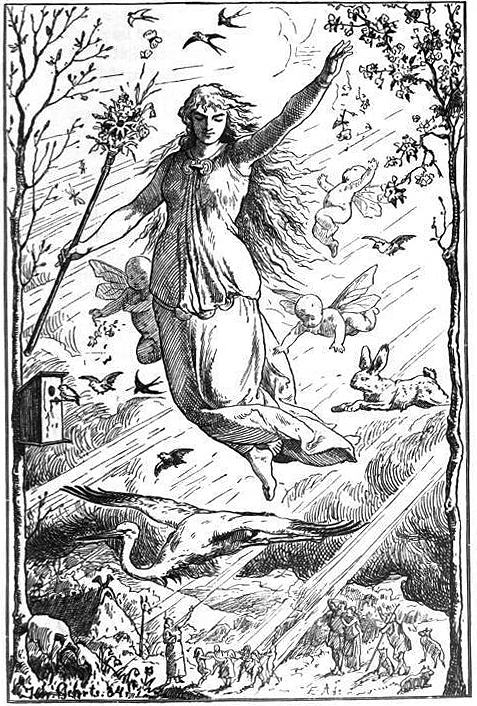
Ostara by Johannes Gehrts
After Constantine decided to Christianize the Empire, Easter was changed to represent Jesus.
Hey! Guess what language Constantine, the Roman Emperor, spoke? Not English, that’s for sure! In fact, when he was alive, English didn’t even exist yet. He would have spoken Latin or Ancient Greek, so would likely have referred to Easter as Pascha or Πάσχα.
But at its roots Easter (which is pronounced Ishtar) was all about celebrating fertility and sex.
Look. Here’s the thing. Our Western Easter traditions incorporate a lot of elements from a bunch of different religious backgrounds. You can’t really say that it’s just about resurrection, or just about spring, or just about fertility and sex. You can’t pick one thread out of a tapestry and say, “Hey, now this particular strand is what this tapestry’s really about.” It doesn’t work that way; very few things in life do.
The fact is that the Ancient Romans were smart when it came to conquering. In their pagan days, they would absorb gods and goddesses from every religion they encountered into their own pantheon; when the Roman Empire became Christian, the Roman Catholic Church continued to do the same thing, in a manner of speaking.
And do you know why that worked so well? Because adaptability is a really, really good trait to have in terms of survival of the fittest (something I wish the present-day Catholic Church would remember). Scratch the surface of just about any Christian holiday, and you’ll find pagan elements, if not a downright pagan theme, underneath.
Know what else? Most Christians know this. Or, at least, most of the Christians that I’m friends with (which is, admittedly, a fairly small sampling). They know that Jesus wasn’t really born on December 25th, and they know that there were never any actual snakes in Ireland, and they know that rabbits and eggs are fertility symbols. But they don’t care, because they realize that religions evolve and change and that that’s actually a good thing, not a bad thing. The fact that many Christian saints are just re-imagined pagan gods and goddesses doesn’t alter their faith one iota; because faith isn’t about reason or sense, it’s about belief.
Look, go ahead and debate religion. Go ahead and tell Christians why what they believe is wrong. That’s totally fine and, in fact, I encourage it. A little debate and critical thinking are good for everyone. But do it intelligently. Get to know the Bible, so you actually know what you’re disagreeing with when you form an argument. Brush up on your theology so that you can explain why it’s so wrong. And have some compassion, for Christ’s sake – be polite and respectful when you enter into a debate, even when the person you’re debating with loses their cool. You want to prove that you’re better, more enlightened than Christians? Great, do it by remaining rational and level-headed in the face of someone who’s willing to stoop to personal attacks. To behave otherwise is to be just as bad as the people you’re debating.
Anyway, I hope you guys have a fantastic long weekend, no matter how you spend it. If your holiday involves chocolate, then I hope you enjoy that. If not, just enjoy the extra day or two off work and the (hopefully) warm weather. No matter what you believe in, I think that we can all agree that the end of winter and the rebirth of spring is worth celebrating.
And also? Richard Dawkins? You need to fact-check yourself before you fact-wreck yourself. Spreading this kind of misinformation to your foundation’s 637,000 fans is just plain irresponsible, especially coming from someone like you. Get with the program, buddy.
ETA: The post now seems to be removed from The Richard Dawkins’ Foundation for Science and Reason’s FB page. Thanks Richard!
ETA Part Deux: Oh. It looks like it was deleted from their timeline but not the photo album. Welp.
*It should be noted that the only actual historical evidence that we have of sacred prostitution comes from Herodotus (I’ve included an excerpt from Herodotus’ Histories below) and no one is really sure how accurate it is. Herodotus is known for making shit up, like giant ants for example. But it makes for an amazing story and people still make the association between Ishtar and sacred prostitution, so I decided to mention it here.
The foulest Babylonian custom is that which compels every woman of the land to sit in the temple of Aphrodite and have intercourse with some stranger once in her life. Many women who are rich and proud and disdain to mingle with the rest, drive to the temple in covered carriages drawn by teams, and stand there with a great retinue of attendants. But most sit down in the sacred plot of Aphrodite, with crowns of cord on their heads; there is a great multitude of women coming and going; passages marked by line run every way through the crowd, by which the men pass and make their choice. Once a woman has taken her place there, she does not go away to her home before some stranger has cast money into her lap, and had intercourse with her outside the temple; but while he casts the money, he must say, “I invite you in the name of Mylitta” (that is the Assyrian name for Aphrodite). It does not matter what sum the money is; the woman will never refuse, for that would be a sin, the money being by this act made sacred. So she follows the first man who casts it and rejects no one. After their intercourse, having discharged her sacred duty to the goddess, she goes away to her home; and thereafter there is no bribe however great that will get her. So then the women that are fair and tall are soon free to depart, but the uncomely have long to wait because they cannot fulfil the law; for some of them remain for three years, or four. There is a custom like this in some parts of Cyprus.
That crack about ugly women was totally unnecessary, Herodotus. I am just saying.
**The first written reference we have for Eostre dates back to the 7th century AD and can be found in Venerable Bede’s Temporum Ratione, in a passage explaining that April was often referred to as Eostremonth:
“Eosturmonath” has a name which is now translated “Paschal month”, and which was once called after a goddess of theirs named Eostre, in whose honor feasts were celebrated in that month.
Jacob Grimm said that he found further evidence of Eostre and her associations with Easter, eggs and rabbits when researching his Deutsches Mythologie, although he was unable to discover any written records about her.
 The Belle Jar
Reblogged this on Beacon of Aquarius.
I totally endorse these (article) remarks.
The “Easter Egg” is originally an “Auster Egg”, and it comes from the South. Has absolutely no relation with oriental mythology nor Ishtar who is moreover erroneously equated with Aphrodite alias Venus, whereas Ishtar is in fact the well-known Persephone in European mythological tradition.
The Egg end the rabbits [hares] have nothing to do with fertility. The egg symbolizes the Sun taken south during the winter season hence the Easter is the day of passing it over [Pasque] to the Nerthus < Nerth North.
Whereas Hares symbolize the universal Joy of this event [check out the meaning of the word “hare” in Albanian lang.]
(feel free to befriend me on Facebook)
Reblogged this on Mama Hen Strikes Again and commented:
I would love to state I’m reblogging this for the sake of refuting misinformation, but the fact is, I didn’t fact-check it in the same way most people probably never fact-checked the original “Ishtar” post. Even if it’s not true, makes you think twice about blind belief, eh?
“noted misogynist and eugenics enthusiast Richard Dawkins” … This is a personal attack and based on the reference link, it is neither rational nor level headed.
The Jewish calendar is technically a hybrid solar-lunar calendar – it has lunar months, but “leap months” are periodically added to ensure overall synchronicity with the solar year to keep season-related holidays in their proper times. This ensures that, for example, Passover, which is supposed to be a spring harvest-time holiday, doesn’t end up dropping back into the winter.
It is what it is!
None of what was added is valid. Simple point Babylonian culture predates Greek and Roman culture by quite a bit of time. Traditions get copied by new cultures all the time. the guy who wrote this bases his references on imperfect data. Ishtar Eostara don’t even come from the same cultural age. Even if you don’t want to take that into account and you want to believe this article it doesn’t necessarily disprove the original. An argument could be made that Jesus isn’t the son of god because the Jewish religion say’s he’s not. The analogy here is that opinions can vary without either point of view needing to be wrong (just different). If enough of the information about Ishtar was presented correctly and enough people find value/accept/believe it then it’s true anyway (that’s the nature of religion.
In the end the original point was to show how a modern religion (Chrisitanity) usurped a polytheistic tradition. The rest of the references were to show proof that the traditions of Easter predate the modern holiday. The article refuting it agrees yet states it’s culturally misrepresented (not wrong).
If you want the truth, go check the timeline for when these deities were prevalent. I’d be willing to bet money that Babylon came before Rome. I mention this because the second article mentions references to Constantine. Do your own homework and then you will know.
It’s not wrong, it’s just factually challenged … er, I mean “culturally misrepresented” … LOL
Hi Belle! (love the Sylvia Plath reference)
I wholly agree with your point of view, and I’m equally irritated by crusading atheists. Like you, I’m a Deist; though not of the Christian variety. I’m not ante or contra, and I respect anyone who has made a connection with Divinity through faith. I also appreciate you seeing the historical validity in cultures absorbing aspects of older religions into their modern expression. Trying to use the historical record as an excuse to nit-pick others choice of faith is merely an indicator if insecurity with one’s own beliefs, but then, what can you expect from someone who’se made a religion out of science-fiction?
Real science has long since disproven all the HG Wellsian assumptions that enlightenment thinkers based their hopes upon. An excellent example is the mess that is Darwinism. Not a single jot of scientific evidence in both the original and neo-Darwinist theorising, and yet they still call it valid science! Louis Pasteur, (a real scientist, and not an amateur naturalist like Darwin) scientifically disproved the concept of spontaneous generation five years after the the publication of the Origin of Species. The cause of the effect he was theorising discredited, but this was blithely ignored. I can carry on in this vein, but why bother? The facts are there for anyone who wants to research them.
Atheist materialists are terrified with the notion of God, as it implies the existence of something greater than man. This is something the poor self-deluded egoists refuse to countenance. The same with the reality of spirit, as this implies something they cannot measure with their physical senses. They would rather theorise existance as a garbage dump that popped out of nowhere, so that they can crown man as king over it. How pathetic. We, who have faith in and experience of a greater reality are so much the richer for it. I wish you, and all Christians, a wonderfull and fulfilling experience of this great old festival, and may your children have all the chocolate bunnies and easter eggs their tummies can bear.
Blessings
Pieter.
“But you guys? The image above is rife with misinformation. RIFE, I say.”
Wow you refuted some text on an image. You’re so enlightened. There’s this other meme called “advice dog”, that I think you could get quite a few articles out of.
So ahh… what the fuck are you talking about again? Something about Richard Dawkins ad like.. something?
You may have something completely intelligent to say here, but you completely failed to convey it. Your 3rd grade teacher told you to state your thesis at the beginning of your article for a fucking reason.
Also citing the same person over and over again does not count as a citation.
All you semi-literate, simple minded, religious, societal trash that comment about this artical being a good read are doing nothing but promoting misinformation. The topic of discussion that this article is against is completely true. All christian holidays are complete ripoffs of ideas that predate christianity, they weren’t true when pagan christians stole them and they still aren’t true idiots. Time to wake up.
Belive in what you want to belive in
Who gives a fuck. Go and eat some chocolate
As you said: you should check yourself before wreck yourself. The Biggest mistake is that some people think , they are smarter and more enlightened than all the others..
Look this up on Christiananswers.net they confirm this holiday started as a pegan holiday and the bunnies and the eggs are symbols of Ishtar you Christian biggots are so sure your religion is right you deny history dumbasses
(Y)
Only that Constantin was not rome catholic but eastern orthodox, the eldest form of christianity – from which r catholic church separated much later
Remember The Feast of Esther.
Religion (re-legion) twisted everything .
They even made the Messiah Yahushua – the Son of Yahuweh look like “Jesus”/ Zeus!!!
Calling the Savior/redeemer/Messiah as Zeus(satan) is Blaspheme to the Heavenly Father!
The scary thing is that people believe without THINKING what they believe and whom they worship.
First followers of Yahushua did not celebrate Easter( goddess of sex), they celebrated Passover!
They celebrated passover because they were radical Jews. smh. Babylon, the Hittites the Assyrians were gone by the time of Jesus.(the son of Zeus would be Hercules. Jesus acts nothing like the Greek Hercules). The Pagan Gods encountered would be the Roman Pantheon, Greek, Egyptian and Caananite.
Chill out
Thank you for this article, it’s good to know I’m not the only one going “bananas” over this issue.
Some very VERY accurate truths here in this post. It sucks that people know these things but still chose to celebrate them anyway because it is “tradition” not coming to an accurate knowledge of the bible in which they say they believe in. There is a difference between true Christian and Christendom.
Not named after Eostre either. And there’s no evidence she has any connection to bunnies or eggs – mostly because there is literally only one reference to her in history. Please read the following exhaustive look at the subject:
http://cavalorn.livejournal.com/502368.html
I think the bottom line here is that Christian traditions related to Easter have much of their origins in pagan and old religion traditions – and that’s not being disputed. And, as Krissy pointed out in her comment, the virgin birth/resurrection of gods mythos is also way older than the Christ mythos. So, there doesn’t really seem to be an argument here.
What does seem to be going on is that believers are pissed at non-believers who dare point that out, and non-believers are pissed with believers for trying to assert that their tradition is above all else. It’s really a case of intolerance on both sides.
I myself appreciate the reconciliatory sentiment at the end of this post. Internally, most people sense a happiness, joy, and relief with the break of Spring. The dead days are over and new life has come. In the end, that’s what it’s all about. 😉
*It should be noted that the only actual historical evidence that we have of sacred prostitution comes from Herodotus (I’ve included an excerpt from Herodotus’ Histories below) and no one is really sure how accurate it is. Herodotus is known for making shit up, like giant ants for example. But it makes for an amazing story and people still make the association between Ishtar and sacred prostitution, so I decided to mention it here.” Therefore you’re commentary has been internally invalidated. By the authors own admission, it spreads misinformation and is unreliable. Furthermore, “The fact is that the Ancient Romans were smart when it came to conquering. In their pagan days, they would absorb gods and goddesses from every religion they encountered into their own pantheon; when the Roman Empire became Christian, the Roman Catholic Church continued to do the same thing, in a manner of speaking.” Speaking of tapestrys being handplucked for a particular theme. Oh and as for “read your bible and become knowledgeable about the chrisitian” religion…go read an anthropological textbook. Maybe we can convert you while you’re reading and subjugating your own beliefs with an imaginary biblical world that again is by your own admission a conglomeration of beliefs meant to over run the existing local spirituality with a vision created by the Victors in order to remain at the top of the financial hierarchy. A religious dogma that has been responsible for some of the most brutal persecutions and violations to social knowledge in the modern world. The crusades. The witch hunts. The Dark ages and its destruction of the opposing ideoogies. Humanists vs Calvinists. Catholics vs protestants. The death of the Maya, religious persecution and recently recognized genocide forced on the Native american cultures, child molestation and a culture of protecting the abusers. TO the author of this article: fact check yourself before YOU wreck yourself and go find some other weak minded lamb in need of an inflexible, dogmatic, patchwork of conveniences and endlessly reimagined and retranslated ideology that provides people with a framework to be reasonable and every excuse based on that “religious belief system” to act in every way against it. A religion that allows the perpetrator of acts against their faith to be forgiven for a PRICE$ to be paid to THE RICHEST STILL EXISTING CITY STATE IN THE MODERN WORLD. Because hey you know stains on your soul can be removed with enough money. Maybe you should go visit your local religious brothel and accept “the body of your christ” down your throat while genuflecting in front of some creepy misogynistic old dude in a gown know for molesting little vulnerable children in the name of god.
The Maya died out long before Christianity ever came, and due to their own misfortunes. I think you mean the Incans, who quite frankly were also a highly warring tribe and the Aztecs. Considering how all of those South American empires practiced human sacrifice and on the scale they did, painting them as some sort of victim seems a bit much.
Also, dude, hit the enter button once in a while. It makes reading your stuff easier.
Actually Christian holidays did take all original indigenous celebrations globally starting in the Middle East & Europe first & then spreading globally. Not only did they take them over they threatened to kill anyone who did not convert to their religion. ~ so yes this Goddess of fertility is found all over the world celebrated in the Spring time. Every holiday Christians celebrate first was a local traditional celebration. Look up how many people have died due to the genocide this religion perpetuated including the 150 million people exterminated across the Western Hemisphere in the first 200 years time ~ the largest genocide ever happened in Native America. I respect all religions just get your historical facts straight.
Good article. I guess taking a little bit of facts and carefully arranging them into an article is of value sometimes … the debate for truth continues … anyone have a time machine kicking around?
You are way wrong! Do your homework!
Brilliant article, I had to follow up after reading the picture. Thanks!
If you believe in fairy tales like religious fanatics do, you are holding humanity back.
“Christian saints” you say… It would be more proper to say Catholic saints, while also keeping in mind that Catholics are not following true Christianity. I am Christian and I do not celebrate Christmas or Easter. I observe the true Sabbath day on Saturday (beginning Friday at sundown, ending Saturday at sundown). It’s important to keep in mind that a day begins in darkness as well (this fact goes back to the first day of creation, which was absent of light until God created it [ref. Genesis 1]). I observe the original feast days of our God, YHWH, the God of Abraham, Israel, etc, the same feast days that His Son Jesus Christ (Yeshua Ha’mashiach) observed: Passover, Unleavened Bread, First Fruits, Shavuot/Pentecost, Yom Teruah (Feast of Trumpets), Yom Kippur (Day of Atonement), and Sukkoth (Tabernacles). Some of these span over multiple days. Jesus died on Passover, being resurrected three days later (marking it on this past Friday). There is a prophetic importance to this timing. Without reading your entire bible and letting the bible interpret itself, the average Christian is lost in the dark, not understanding the significant of these feast days and their prophetic value. Jesus did say that his people will be destroyed to their lack of knowledge too (Hosea 4:6). The fact is that true Christianity does not have any pagan elements at all. It is the pagan influences that have infiltrated the church over time that has created these strange off-shoots of “Christianity”. If one does real research with sources linked to credible, reputable historical resources, looking beyond random internet articles and YouTube videos (some can be somewhat accurate, most are not), we can find the truth through a deeper investigation. Satan has a history of creating counterfeit versions of what God created in attempt to receive worship in his quest to steal away the throne of God. Christianity today is in bad shape. In the not so distant future there will be the great apostasy combined with the great coming deception.
Very welcome article, although I do wonder: is there (EES THAR? :P) any possibility of an identity at some level between the German goddess and the near-Eastern Ishtar? The gods of all these local pagan traditions were often understood as being equivalent, and compelling surprises are often found when comparing the etymology and mythology of the vast Indo-European world. A particular connotation that had me furrow my brow here: wouldn’t those Germanic words seem to be cognate with the word East? The eastern goddess? Sheer speculation, but it is suggestive.
Connections can only plausibly be made when there is some kind of cultural and/or temporal connection between the two things. That is something people often leave out – they assume the past is all one area and era and “Ishtar=Easter” then sounds really plausible. But Ishtar was a Babylonian goddess who was essentially forgotten about by the first century (their empire had fallen to the Persians 600 years prior). Then 1300 years later “Oestre” (how it was originally spelled) shows up in England 6000 miles away in one sentence with no description, attributes or anything to tell us what people thought about her. Its not really compelling at all when you consider all that.
“An egg of wondrous size is said to have fallen from heaven into the river Euphrates. The fishes rolled it to the bank, where the doves having settled upon it, and hatched it, out came Venus, who afterwards was called the Syrian goddess ” http:// books.google.com/books? id=GooEAAAAQAAJ&pg=PA156& lpg=PA156&dq=Astarte+egg&sourc e=bl&ots=8-uPcioIo2&sig=-ebKfd-Teir58_haaVXhD8jFIYI&hl=en&sa =X&ei=7PdTU6qAFIqwyAS98IHYCw&v ed=0CCQQ6AEwCw First egg connection I saw was in reading out the babylonian starmap.. the website is diffrent now though.. but look into the babylonian pisces constellation.. egg!!
You can find a passage in the book “The Two Babylons” by the 19th century Rev. Alexander Hislop. He uses the same quotation by the 1st century author Hyginus, and many many other references, in order to link Easter to its Pagan sources, of which, sadly for the Belle Jar, Ishtar is one.
Not really since the writings of a 19th century reverend with no credentials or education (he was a member of the Free Church whose ordination process is basically deciding you are a minister) and a motive to discredit Catholicism is not something any historian or linguist is even going to even a minute’s attention to.
Reblogged this on Red Scripts and commented:
So good!
Reblogged this on nicichiarasa.
In fairness to Aristotle, he didn’t make up the giant ants. He just confused them for marmosets (unless you’re just unconvinced by the argument: http://en.wikipedia.org/wiki/Gold-digging_ant).
“The fact that many Christian saints are just re-imagined pagan gods and goddesses” – say whatnow? I’m pretty sure this was rectified in the 1960’s with the large decanonization which is associated with Vatican II (though was not really a part of Vatican II). You were doing SO WELL here… what happened?
Uh, yep. St. George, for example, one of THE most popular of all Christian saints of all 3 branches of the Church (patron saint of England, yo! And of Republic of Georgia. And of the Ethiopian Church), has no actual historical living counterpart. He is the Christianized form of the Mounted Warrior figure, who originated in the horse-cultures of the Asian steppes. He represents the soul of the warrior who conquers death (the dragon or whatever), and his steed upon which he rides to the celestial realm of the sun god. Pagan figure through and through. Still part of the canon. For example. 🙂
katkaresecs, you are a fool like many who know nothing about Easter, Christianity of St Gerorge. I have been to Syria myself and have been to where St George Lived, I have seen his house and church and everyone including the muslims acknowledge him and his history and what he did. Stop spreading shit and stop believing crap, everyone simply wants to copy and paste things on the internet without actually giving any thought or proper research into things, this is how people like base their opinion on.
Look how skeptical people are now, do you think people would have fallen for bullshit back in those days, does anybody actually stop and think, don’t you know there’s so many evil cunning people constantly trying to discredit the Bible or Christ. Yes the catholic church is not a real Christian church and many Christians are not perfect but that does not make Christianity imperfect.
Some else above was saying that the Christian Saints were pagans, how stupid is that, these people were ONLY recognised by the church for living a holy christian way of life, nothing to do with paganism.
Rita Rita Rita. Yes, there is a church from the 5th century that is the oldest known church dedicated to St. George, that claims to be in his hometown. Except this one is in Jordan. I have no doubt there’s one in Syria also. There are very likely others in Ethiopia, Georgia, Libya, and other places. Exactly like how you will find relics, finger bones, skulls, or other physical remains of any one saint housed in shrines in France, Greece, Italy, Tunisia, Egypt, Russia, etc. St. George’s head is stored in 3 different shrines, in fact! Amazing! Of course even Muslims believe this: St. George means a lot to them too.
He’s a popular saint for a good reason: because the meaning of his life speaks to a very deep feeling among all humans. This does not at all discredit the Christian faith to say that St. George was never a ‘real’ person (and scholars agree on this because there is no evidence that he was, despite several traditional stories about him–none of these stories can be confirmed, however, and they contradict each other) or that his iconography comes from non-Christian sources. It was very smart of the Church Fathers to adopt him as one of their own, as it made the Church more understandable and more appealing to common people.
I cut and pasted nothing, thank you very much. I’ve done considerable research on St. George, his icons, the numerous different traditions and stories of his life and deeds. I wrote one of my three undergraduate theses on St. George. So, stick that in your fuming pipe and smoke it, please.
Finally, it’s quite hilarious that you accuse me of trying to discredit the Church and the Bible (which never once mentions any single thing about St. George, by the way, so if I had wanted to “discredit the Bible” this would have been a good way to do it. Notice that I did not, because I’m not even interested in that), and then turn around and make the absolutely ridiculous claim that the Catholic Church “is not a real Christian church”!!! At that point, I knew that anything you had to say about anything was not to be taken the slightest bit seriously. Please come back later when you learn how to understand what other people say, and when you have something meaningful to say instead of mere drivel. Thank you, come again!
That relief pictured I have always associated with Ereshkigal, I am a pagan but this has always annoyed me. Ostara/Eostre has nothing to do with Ishtar or Lilith for that matter. Ishtar has nothing to do with Easter, your Ostara reference is correct. Even with Christian and Jewish mythos being incorporated, I’m glad someone posted this.
Me too, I dislike it when everyone attributes just about everything to some pagan deity or ancient goddess. It’s a convenient tidy-up of lost history and myth. Mary Magdalene suddenly equals being a Christian reincarnation of THE ancient goddess, just for acceptability’s sake.One goddess left! Where did all the others go?
Thank your for your article. I too saw that image posted around Fbook and it got my goat too. With regards to Easter though there are a few things I’d like to add. There are a number of questions one should ask about the relationship with so called ‘Eostra’. Firstly is the Venerable Bede’s piece of writing you quote a reliable historical statement? The Venerable Bede spent much of his time trying to promote Christian conversion amongst the various people in Britain at that time and his writing can clearly be seen to have an agenda with regards to his reportage of ‘heathen’s. Also, if this was as commonplace (even though he does say it has died out by his time of writing) as he states why are there absolutely no references to it in ANY literature ANYWHERE in ANYTHING before or since? There also seem to be no references in any art or sculpture in or any archaeological artefacts. Doesn’t that seem odd? Actually in your article you say this is the first reference to Eostra… in fact this is the ONLY written reference. In other words, apart from this highly questionable source there are no references to Eostra relating to Easter anywhere thus far. If there is any other EVIDENCE that our ancestors spent most of April in deference to eggs, rabbits and goddesses of which there’s no evidence of, I’m all eyes and ears but I really do wish people would question their sources and particularly if it turns up on the flippin’ web. I have no bones with myth making or with people who chose to worship or channel gods or goddesses and their attributes in all their wonderful mythological forms but I don’t like the re-writing of history. History needs evidence. Not perfect but its all we have.
oh lord…i am an archaeologist. like, actual archaeologist. working on a phd in it (with a side helping of science studies), and only reading this because i am burned out from modelling a ruined city for 12 hours. you seem to not understand how “EVIDENCE” works. or time for that matter. 1500 years have passed since Eostre would have been worshiped. textual evidence is incredibly fragmentary at that reach, and most of the “EVIDENCE” for the “facts” that you know comes from sources that are just as unreliable as you make Bede out to be because people didn’t think about knowledge or facts in the same way. barely anyone could write script at this point (especially in Britain and northern Germany, from whence the Angles and the Saxons haled), and there isn’t any definitive way of saying that an artifact was associated with a goddess of a particular name. there is however linguistic evidence supporting Bede’s claim, which is often the best we can do.
in other words, most of what you think you know about history and the evidence used to create it seems to be nonsense, so please stop being so condescending about how history and evidence works.
Not sure why you are so demanding that there has to be a written reference to Eostre other than Bede’s, the monks he lived with in Jarrow must have got knowledge of the cult of Eostre from somewhere, he didn’t just make it up. Folk at the time may not have written it down, and or it has yet to be found written down somewhere.
I think you need to do better research.
The language you speak originated in India (Sanskrit) and came to Europe via Iran and Iraq. Along with that language came culture and religion.
If you search, you will find images of relief carvings/statues of Ishtar next to a rabbit.
Of course, the early Germanic peoples did not use the word Ishtar – the French word “Chemise” is not identical to the Punjabi word “Kamise,” but they BOTH mean shirt.
I think you are of the school that believes that ‘civilisation’ came to Europe via the Roman Empire and before that most Northern Europeans were walking around in animal skins, wielding clubs and living in caves. Where I live in Great Britain, we know that Joseph of Arimathea (Yeshua Ben David/Jesus’ uncle on his mother’s side), a trader in lead and tin came here to purchase lead and that our lead was found in Pompeii! That was BEFORE Britain was invaded by Rome!
Like it or not, the early Germanic peoples (and you) owe a lot to the spread of language, culture and religion from the Middle East and you have to bear in mind that it changed as it moved!
Indo-European languages did not come from India or Sanskrit, they came from somewhere around Ukraine. The “out of India” theory is one that Indians came up with (and one only Indian linguists/historians support, no other actual historians/linguists outside India has ever supported the notion) for a number of reasons. 1, They think, based on their religion, that every bit of humanity and civilization came from India. 2, They also think anything other than “out of India” is meant to show how the British are superior, which it is not (which is ridiculous anyway, since the British linguists that discovered the interrelationships never claimed an “out of Britain” or even “out of western Europe.”). 3, They also think the idea that their language coming from outside India was meant to undermine their identity or sovereignty, so they will never accept it (except South Indians, who speak Dravidian languages and have always known that Sanskrit/Pakrit speakers came from somewhere else originally).
Also your “chemise” example is not a good one. It did not come from India to Europe, it came from Latin and was introduced to India recently by the Portuguese (who speak a language descended from Latin). The native Indian word for shirt is kurta.
Thank you.
To back up what Aoton wrote: Sanskrit is an Indo-European language, it is true. But it itself is an evolution of an earlier IE tongue that entered the Indus River civilization ca. 2-3000 BCE with IE speaking people from the north, presumably around Ukraine but possibly a little further east. Sanskrit, as well as modern Indian languages like Hindi and Urdu (sorry, Pakistan for that one!), are languages from what linguists call the “sentum” branch of IE–the eastern branch whose word for “thousand” begins with an “s-” sound, and is differentiated from the “centum” branch, the western, typified by Latin whose “thousand” begins with a “k-” sound. Linguists are able to trace the spread of the west/east IE tongues by phonological differences like this. The distant ancestor of German derives from one of the “centum” IE dialects. Actually, your example of ‘chemise/kamise’ might be just as good an example of this phoneme shift!
Anyway, I believe that “Ishtar” is not even an IE-language word to begin with, but a Semitic language one, which makes a derivation to “Easter” even more unlikely. Since English was not a language until the Middle Ages, and Angles, much less other Germanic speaking tribes, had very very little direct contact with the Middle East, if any.
You are right, however, that the pre-Roman people of Europe were by no means “uncivilized” cavemen. The people living in modern Denmark had pretty sophisticated metallurgy skills, and of course the poetic talents of the ancient northern Europeans is quite spectacular!
god no please stop. 1) ishtar was akkadian. that’s a semitic language that has been dead for almost three thousand years. 2) we do not speak a language that comes from india. we speak a language that is related to a *hypothetical* language that we call indo-european sanskrit is also related to this language. english in wo way comes from sanskrit,3) indo-european, such as it was, certainly did not originate in “india” as india did not exist at the time. in any case, it most likely originated near the black sea. that is a *long* way from india. 4) it’s incredibly unlikely that the language spread wholesale with culture or religion. these things almost never come packaged like that. 5) there is not some direct line of descent from the middle east to europe. culture doesn’t work like that. people don’t work like that. please stop.
Easter is not tied to the Jewish calendar. Look at the Wikipedia page. It’s lunar based so it coincidentally falls around passover, but it’s also based on civil calendars.
I do not regard a democratically defined knowledge source such as Wikipedia to be an ultimate authority on the truth. It turns out that neither does Wikipedia, that’s why they provide references to sources. This is so that you can find out for yourself and not formulate your own confirmation biases like other people on this thread.
Now let’s clarify your prose shall we?
Which one of the following statements is incorrect?
The Wikipedia Page is based on the Lunar Calendar.
The Jewish year is based on a Lunar calendar
The Christian Paschal celebrations are based on a lunar calendar with an adjustment on the civil calendar to ensure that the resurrection always follows the Pesach.
The Christ was eating the Pesach supper on the evening before he was crucified.
The Pesach supper contains elements that foretold His coming that is why he broke the Matzot saying this is my body which was brken for you, this is my body that has been pierced for you.
It is in understanding the elements of the Passover that we understand the elements of the crucifixion and the communion.
Thank you Keith. Glad you spoke up
Nobody is disputing that the Easter holiday and Passover holiday are religiously linked. But the timing of the Easter holiday is not calculated with reference to the Jewish calendar. If you don’t like Wikipedia as a source you can always click on one of their many citations on this point, like this one:
http://aa.usno.navy.mil/faq/docs/easter.php
The complex calculation for the timing of Easter isn’t entirely lunar. It’s designed to approximate the Jewish calendar and thus cause Easter to usually fall sometime around Passover, but that doesn’t always work, as anyone who actually paid attention to the timing of Passover from year to year could tell you.
Nobody is disputing that the Easter holiday and Passover holiday are religiously linked. But the timing of the Easter holiday is not calculated with reference to the Jewish calendar. If you don’t like Wikipedia as a source you can always click on one of their many citations on this point, like this one:
http://aa.usno.navy.mil/faq/docs/easter.php
The complex calculation for the timing of Easter isn’t entirely lunar. It’s designed to approximate the Jewish calendar and cause Easter to usually fall sometime around Passover, but that doesn’t always work, as anyone who actually pays attention to the timing of Passover from year to year could tell you.
Thanks. I was about to comment on this, as well. This year, for instance, Easter fell during Passover.
Thus Easter can even come along before Passover (as in 2017).
The whole idea of adjusting the Julian calendar to Gregorian came because Easter was falling before Pesach. So, according to your info perhaps we need another calendar adjustment?
Great info as a witch I new some if the info thank you
https://ca.answers.yahoo.com/question/index?qid=20080318090751AAKKtuE
http://www.ldolphin.org/ishtar.html
http://www.theguardian.com/commentisfree/belief/2010/apr/03/easter-pagan-symbolism
http://mystery-babylon.org/easter.html
Dude find some academic sources.
Right. Because the original post was just FULL of academic sources.
Eh, there’s one problem I have with this posting: there’s no concrete evidence (nor any strong evidence at all) that Eostre was a Goddess. It’s – as far as I’ve been able to find in the linguistic research – mostly the old Germanic word for spring and the Vernal Equinox, with its original Old High German meaning being “to shine.” It was a big festival which the Christian missionaries adapted to the practice of celebrating Easter (which was the first Christian holiday unique to the faith, not carried over from Judaism) because they could not eradicate the animistic practice. (Shockingly, Wikipedia was a great source for this. It’s heavily cited from various historical and linguistic sources.)
On the other hand, there’s pretty good evidence for Eos, the Greek goddess of the dawn, whose name derives from the same source as the Germanic Ostara and the English Eostre.