
If there is one thing that drives me absolutely bananas, it’s people spreading misinformation via social media under the guise of “educating”. I’ve seen this happen in several ways – through infographics that twist data in ways that support a conclusion that is ultimately false, or else through “meaningful” quotes falsely attributed to various celebrities, or by cobbling together a few actual facts with statements that are patently untrue to create something that seems plausible on the surface but is, in fact, full of crap.
Yesterday, the official Facebook page of (noted misogynist and eugenics enthusiast) Richard Dawkins’ Foundation for Reason and Science shared the following image to their 637,000 fans:

Neither Reasonable Nor Scientific
Naturally, their fans lapped this shit up; after all, this is the kind of thing they absolutely live for. Religious people! Being hypocritical! And crazy! And wrong! The 2,000+ comments were chock-full of smug remarks about how naïve and stupid Christians were, accompanied by pats on the back for all the atheists who smart enough to see through all the religious bullshit and understand how the evil church had slyly appropriated all kinds of pagan traditions.
And you know what? That’s fine, I guess. I’m all for questioning religion and examining the sociological, historical and anthropological reasons that help explain the hows and whys of our lives today. I’m actually super fascinated by that kind of stuff, even if I do think that there’s a way to discuss it without making yourself sound smarter and more enlightened than the people around you.
But you guys? The image above is rife with misinformation. RIFE, I say.
Let’s start from the top:
This is Ishtar …
Okay, great. So far things are fairly accurate. The relief pictured here, known as the Burney Relief (also called the Queen of the Night relief) is widely considered to be an Ancient Babylonian representation of Ishtar (although some scholars believe that the woman depicted might be Lilitu or Ereshkigal). This relief is currently housed in the British Museum in London, but originates from southern Iraq and is nearly 4,000 years old.
… pronounced Easter.
Actually, in modern English we pronounce it the way it looks. A case could be made for pronouncing it Eesh-tar, but I have yet to come across a credible source that gives the original pronunciation as Easter.
Easter is originally the celebration of Ishtar, the Assyrian and Babylonian goddess of fertility and sex.
Ishtar was the goddess of love, war and sex. These days, thanks to Herodotus, she is especially associated with sacred prostitution* (also known as temple prostitution), which, in the religions of the Ancient Near East, allegedly took on the form of every woman having to, at some point in her life, go to the temple of Ishtar and have sex with the first stranger who offered her money. Once a woman entered the temple of Ishtar for the purpose of sacred prostitution, she was not allowed to leave until she’d done the deed. I can’t imagine that sacred prostitution sex was ever very good sex, but hey, what do I know? Probably some people were pretty into it – I mean, if you can imagine it, someone’s made porn about it, right?
Anyway, the point I am trying to make here is that, yes, Ishtar was associated with fertility and sex. However, her symbols were the lion, the gate and the eight-pointed star; I can’t find any evidence of eggs or rabbits symbolically belonging to her. And Easter has nothing to do with her.
Most scholars believe that Easter gets its name from Eostre or Ostara**, a Germanic pagan goddess. English and German are two of the very few languages that use some variation of the word Easter (or, in German, Ostern) as a name for this holiday. Most other European languages use one form or another of the Latin name for Easter, Pascha, which is derived from the Hebrew Pesach, meaning Passover. In French it’s Pâques, in Italian it’s Pasqua, in Dutch it’s Pasen, in Danish it’s Paaske, in Bulgarian it’s Paskha, and so on and so forth.
In the Christian Bible, Jesus returned to Jerusalem from his forty days in the desert just before Passover. In fact, in the Gospel according to John, Jesus was killed on the day before the first night of Passover, at the time when lambs were traditionally slaughtered for the Passover feast (because Jesus was the Lamb of God, etc. – SYMBOLISM, Y’ALL). There are a few differing accounts of when Jesus actually died, but most Christian texts, philosophers and scholars agree that it was around the time of Passover. Easter is still celebrated the week after Passover, which is why it’s a different day each year, because the Jewish calendar is lunar rather than solar.
Her symbols (like the egg and the bunny) were and still are fertility and sex symbols (or did you actually think eggs and bunnies had anything to do with the resurrection?).
Actually, according to Jacob Grimm’s Deutsche Mythologie, which he wrote after journeying across Germany and recording its oral mythological traditions, the idea of resurrection was part and parcel of celebrating the goddess Ostara:
“Ostara, Eástre seems therefore to have been the divinity of the radiant dawn, of upspringing light, a spectacle that brings joy and blessing, whose meaning could be easily adapted by the resurrection-day of the christian’s God. Bonfires were lighted at Easter and according to popular belief of long standing, the moment the sun rises on Easter Sunday morning, he gives three joyful leaps, he dances for joy … Water drawn on the Easter morning is, like that at Christmas, holy and healing … here also heathen notions seems to have grafted themselves on great christian festivals. Maidens clothed in white, who at Easter, at the season of returning spring, show themselves in clefts of the rock and on mountains, are suggestive of the ancient goddess.”
Spring is a sort of resurrection after all, with the land coming back to life after lying dead and bare during the winter months. To say that ancient peoples thought otherwise is foolish, naïve and downright uninformed. Many, many pagan celebrations centre around the return of light and the rebirth of the land; these ideas are not new themes in the slightest.
And yes, rabbits and eggs are fertility symbols, and they are, in fact, associated with Eostre.
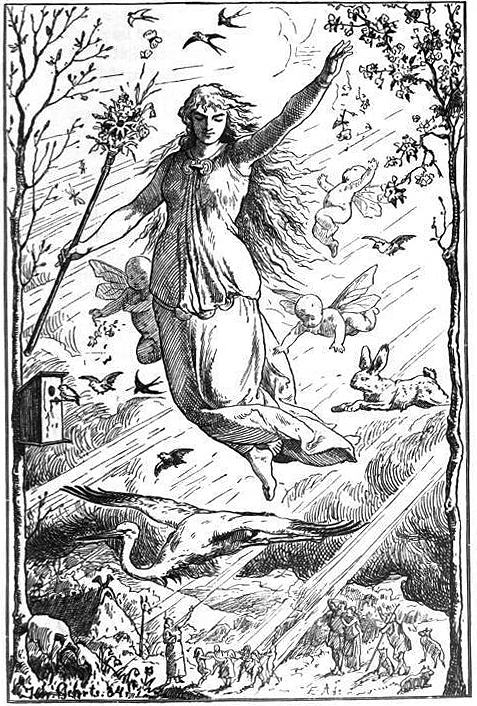
Ostara by Johannes Gehrts
After Constantine decided to Christianize the Empire, Easter was changed to represent Jesus.
Hey! Guess what language Constantine, the Roman Emperor, spoke? Not English, that’s for sure! In fact, when he was alive, English didn’t even exist yet. He would have spoken Latin or Ancient Greek, so would likely have referred to Easter as Pascha or Πάσχα.
But at its roots Easter (which is pronounced Ishtar) was all about celebrating fertility and sex.
Look. Here’s the thing. Our Western Easter traditions incorporate a lot of elements from a bunch of different religious backgrounds. You can’t really say that it’s just about resurrection, or just about spring, or just about fertility and sex. You can’t pick one thread out of a tapestry and say, “Hey, now this particular strand is what this tapestry’s really about.” It doesn’t work that way; very few things in life do.
The fact is that the Ancient Romans were smart when it came to conquering. In their pagan days, they would absorb gods and goddesses from every religion they encountered into their own pantheon; when the Roman Empire became Christian, the Roman Catholic Church continued to do the same thing, in a manner of speaking.
And do you know why that worked so well? Because adaptability is a really, really good trait to have in terms of survival of the fittest (something I wish the present-day Catholic Church would remember). Scratch the surface of just about any Christian holiday, and you’ll find pagan elements, if not a downright pagan theme, underneath.
Know what else? Most Christians know this. Or, at least, most of the Christians that I’m friends with (which is, admittedly, a fairly small sampling). They know that Jesus wasn’t really born on December 25th, and they know that there were never any actual snakes in Ireland, and they know that rabbits and eggs are fertility symbols. But they don’t care, because they realize that religions evolve and change and that that’s actually a good thing, not a bad thing. The fact that many Christian saints are just re-imagined pagan gods and goddesses doesn’t alter their faith one iota; because faith isn’t about reason or sense, it’s about belief.
Look, go ahead and debate religion. Go ahead and tell Christians why what they believe is wrong. That’s totally fine and, in fact, I encourage it. A little debate and critical thinking are good for everyone. But do it intelligently. Get to know the Bible, so you actually know what you’re disagreeing with when you form an argument. Brush up on your theology so that you can explain why it’s so wrong. And have some compassion, for Christ’s sake – be polite and respectful when you enter into a debate, even when the person you’re debating with loses their cool. You want to prove that you’re better, more enlightened than Christians? Great, do it by remaining rational and level-headed in the face of someone who’s willing to stoop to personal attacks. To behave otherwise is to be just as bad as the people you’re debating.
Anyway, I hope you guys have a fantastic long weekend, no matter how you spend it. If your holiday involves chocolate, then I hope you enjoy that. If not, just enjoy the extra day or two off work and the (hopefully) warm weather. No matter what you believe in, I think that we can all agree that the end of winter and the rebirth of spring is worth celebrating.
And also? Richard Dawkins? You need to fact-check yourself before you fact-wreck yourself. Spreading this kind of misinformation to your foundation’s 637,000 fans is just plain irresponsible, especially coming from someone like you. Get with the program, buddy.
ETA: The post now seems to be removed from The Richard Dawkins’ Foundation for Science and Reason’s FB page. Thanks Richard!
ETA Part Deux: Oh. It looks like it was deleted from their timeline but not the photo album. Welp.
*It should be noted that the only actual historical evidence that we have of sacred prostitution comes from Herodotus (I’ve included an excerpt from Herodotus’ Histories below) and no one is really sure how accurate it is. Herodotus is known for making shit up, like giant ants for example. But it makes for an amazing story and people still make the association between Ishtar and sacred prostitution, so I decided to mention it here.
The foulest Babylonian custom is that which compels every woman of the land to sit in the temple of Aphrodite and have intercourse with some stranger once in her life. Many women who are rich and proud and disdain to mingle with the rest, drive to the temple in covered carriages drawn by teams, and stand there with a great retinue of attendants. But most sit down in the sacred plot of Aphrodite, with crowns of cord on their heads; there is a great multitude of women coming and going; passages marked by line run every way through the crowd, by which the men pass and make their choice. Once a woman has taken her place there, she does not go away to her home before some stranger has cast money into her lap, and had intercourse with her outside the temple; but while he casts the money, he must say, “I invite you in the name of Mylitta” (that is the Assyrian name for Aphrodite). It does not matter what sum the money is; the woman will never refuse, for that would be a sin, the money being by this act made sacred. So she follows the first man who casts it and rejects no one. After their intercourse, having discharged her sacred duty to the goddess, she goes away to her home; and thereafter there is no bribe however great that will get her. So then the women that are fair and tall are soon free to depart, but the uncomely have long to wait because they cannot fulfil the law; for some of them remain for three years, or four. There is a custom like this in some parts of Cyprus.
That crack about ugly women was totally unnecessary, Herodotus. I am just saying.
**The first written reference we have for Eostre dates back to the 7th century AD and can be found in Venerable Bede’s Temporum Ratione, in a passage explaining that April was often referred to as Eostremonth:
“Eosturmonath” has a name which is now translated “Paschal month”, and which was once called after a goddess of theirs named Eostre, in whose honor feasts were celebrated in that month.
Jacob Grimm said that he found further evidence of Eostre and her associations with Easter, eggs and rabbits when researching his Deutsches Mythologie, although he was unable to discover any written records about her.
 The Belle Jar
The FB page posted it AGAIN this year, so once again I find myself linking to your article. Thanks for writing it, it’s very much needed.
Great! And one MORE thing: Rabbits and hares are not found in Mesopotamia.
And camels weren’t in Jerusalem when Jesus was supposedly born.
Are you taking about the wise men? Firstly, the Bible never mentions camels, so scratch that. In fact it never mentions a donkey carrying Mary to Bethlehem either. Also, the wise men came from afar…most likely Asia Minor, where there were camels, and camels were a great animal to travel long distances with.
Actually there are plenty of hares and rabbits in southern mesopotamia. Saw many in the countryside there just 2 years ago.
Reblogged this on Shirley's Place.
Not really sure why I as a Catholic would care any more about this crap than about the “Gospel of Thomas.” Jesus Christ is God but amazingly became man and died, then rose again. Not exactly sure why the label is so important that unbelievers are driven to croak this drivel every Spring.
Because people that believe everything they hear without any kind of critical thinking fall for it. I hear of people giving up Christianity all the time because of some completely hocus claims like this. And once people do it they don’t even want to hear the truth, they’ll spout the “Krishna was crucified, Horus was crucified, Jesus is a copycat myth” bullshit to the end (and though I was even a follower of Krishna and can tell you point blankly there is nothing remotely similar to anything in the Bible in the ‘Krishna canon’, and have a degree in religious studies, they don’t care – ignorance reigns).
Crucifying was a fairly common method of execution ; Jesus wasn’t special on that regard. Many people turn from Christianity BECAUSE they become more educated about Christianity. Your statement, that it’s due to ignorance, is pretty ignorant. I was an unquestioning Catholic; it was when I studied theology, and read the whole Bible, that I can to my present belief system.
It was, but the thing is Horus, Dionysius, Krishna, etc and all the others often cited weren’t crucified in their mythos and there is not even anything that could be interpreted that way (Krishna doesn’t even die at all, Dionysius gets immolated by titans). There’s nothing ignorant about what I say, I didn’t say every person is ignorant just most of the people I’ve heard talk about it.
Are you a christian or an atheist?
“I hear of people giving up Christianity all the time because of some completely hocus claims like this.”
Haha people giving up their pathetic life of lies and hocus claims because of hocus claims? Cowards like you have no business forming opinions due to not being able to accept reality. Never comment on anything, ever again. This whole article is the only misinformation here, the picture and writings are correct. Wake up idiot.
I’m not Christian or Atheist, actually I am a pagan and I have a BA in religious studies and have also extensively studied linguistics and history. The only idiot are those who assume everything they hear or think is right.
I like how everyone is now a scholar on Proto-Indo-European religion, languages and their sources. I also like how your post makes numerous assumptions stated as facts. Its very similar to the meme you discuss.
I couldn’t agree more! Plus, the term “meme,” now common, was first coined by the much-maligned Richard Dawkins… Look it up.
It’s all myth and fable anyway. If there was a real god he might do well to make himself known and clear up any of the misinformation. Strangely, he was to be found everywhere in iron-age middle-east. But not a miracle seen lately? Even virgin birth’s were apparently common at the time. Not so much now though!
Thanks. a good read and very reasonable.
Only reasonable to morons, good job promoting this horribly, misinformed piece of trash. The picture and writings are correct.
http://www.academia.edu/2360254/Temple_Sacred_Prostitution_in_Ancient_Mesopotamia_Revisited
If you dig through this http://templeofsumer.org/Temple_of_Sumer.html You will find out some stuff on Temple Prostitution. http://www.templeofsumer.org/share3f.html
Sadly, this is nothing more than opinion against opinion…where are your sources of reference? And in the last 100 years people barely get facts straight about events occurred, what makes anyone think that thousands of years ago, nothing that actually happened has been retold true?
A couple of minor corrections, just to get into the spirit….
Constantine did not try to Christianize the Roman Empire. He is often blamed for that, but it was actually his successors who did most of it – particularly Theodosius I some 50 years after Constantine. Constantine was the first Emperor to convert to Christianity, and he issued the Edict of Milan, which made religious tolerance the law of the Empire. All religions, including Christianity, were to be practiced freely.
On a minor note, while Constantine certainly spoke Latin, his native language was Greek. It’s not entirely clear therefore what he called Easter, though it certainly was something other than “Easter”.
whole lot of writing to justify not being able to see the forrest for the trees
Super minor thing, but the FB page for RDF isn’t managed by Dawkins, he has little oversight on it. Wish the same was true about his twitter.
You said, “Easter is still celebrated the week after Passover, which is why it’s a different day each year, because the Jewish calendar is lunar rather than solar.”
You should add that Easter is always celebrated on a sunday which further complicates the choice of Easter dates each year.
Don’t fixate on the Goddess part of Ishtar. She was human first who proclaimed herself a diety. Trace who she really was by name in the bible as well as her husband. He comes from a very well known blood line. Once you have have that you will see it is in scripture exactly who they were, what happened to him and who hey gave birth to, how he died and… Well i don’t want to spoil the rest. Sorry all, it goes back further then you all have researched but once you, you can accept the new “truth” or the old origin.
Don’t fixate on the Goddess part of Ishtar. She was human first who proclaimed herself a deity. Trace who she really was by name in the bible as well as her husband. He comes from a very well known blood line. Once you have have that you will see it is in scripture exactly who they were, what happened to him and who hey gave birth to, how he died and… Well i don’t want to spoil the rest. Sorry all, it goes back further then you all have researched but once you have, you can accept the new “truth” or the old origin.
WE ARE MASTERS OF (SELF) DECEPTION
I just got unto Facebook and encountered a post with the picture and statement shown at the beginning of your “message of clarification” regarding Ishtar and Easter. Thank you. As one who has explored different religions and belief systems it can sometimes be difficult to separate fact (some use the word truth) from fiction. What I have discovered is something very unique to humans – we are “Masters of Deception”, especially “Self Deception”. I know of no other creature on this planet that practices “Self Deception”. With a multitude of religious and political ideologies in our world, it becomes obvious. These “Ideologies” usually state they are the right one and the rest are “false”. They play the “semantics” game. What I see is nothing more than individuals using deception to attain power and control over the lives of others – the “power trip”. All this does is diminish humanity. We live in a world full of illusion and deception. I am a “Free Spirit”. I make no decisions out of fear (false evidence appearing real). Humanities perception of truth is always changing, for the only constant in life is change (evolution). Truth appears to be nothing more than an individual’s perception of what is “real”. Enjoy your illusion, but do not expect me to share yours, for no two people ever see life exactly the same.
you will find soon that a leaf that flows with the wind gets taken for a ride to a place it does not always want to be. you tell yourself others are believing in illusions and you make decisions not out of fear but out of your own judgements of what’s right and wrong, etc… and yet you do what everyone else does… put yourself somehow above others, as if you have discovered the truth and everyone else is living in a lie. but you are correct in your assumption that no two people see life the same way.. for example, i’m red-green deficient, hence i see life much differently than a person who isn’t. in your life, you ought to worry less about what is real and what is false, and worry more about what you do with the knowledge you have. you can use it for destruction or for edification. are you part of humanity or just an observer?
And now you’re telling someone what they “ought” to do, and the cycle of superiority complexes continues.
False evidence appearing real sounds like evolution to me. But if that’s what you choose to believe then your following exactly what your accusing others of, a belief in your own illusion and being that an individuals perception is what is real to them then therefore what you believe isn’t anymore of a truth than even the most religious of zealots. No matter what the relion or belief.
thank you for this article! Very well written. I know of a book you might enjoy that is called “the Lady of the Hare” by John Layard. Mainly it is a book about the healing power of dreams, but it has a big section on the Hare from cultures all over the world as well as back into classical antiquity. If you don’t already have it, I think you would enjoy it.
First off, thank you for writing this. i’m sure many people have had the same conflict. however, i also looked into this study and have some qualms of my own about your study into this moon worship of diana. i won’t go into as much detail as you have since you already did it here. but i will just make some comments or corrections if you don’t mind. if you do, just delete my comment then. again, i’ll only comment on the first few sections you wrote…
Ishtar is the name, however, when the name easter came about, it was a mistransliteration or phonetic error. for example, in german, you can pronounce “ich” like “ish” or “ik”. if you are ego-centric in the western tongue, then easter and ishtar are totally not the same thing… however, speaking with a persian friend of mine, they would pronounce the word “easter” as “ishtar” if phonetically transliterated into their farci (remember aramiac languages written are “phonetic” scribbles). looking further into the origins of the word “easter”, you can go into the astronomical and astrological distinctions of the eastern sky, etc etc… but that has nothing to do with it. therefore, Easter is Ishtar. since your commentary on this as you wrote “Actually, in modern English we pronounce it the way it looks. A case could be made for pronouncing it Eesh-tar, but I have yet to come across a credible source that gives the original pronunciation as Easter.” since you admit you don’t know, i am adding my comment for you so you may take it or leave it.
i understand you are very passionate about your commentary here, and i’m sure you do a great service to humanity somehow with this too… but if you are going to be serious, i’d leave out the vulgarities… from a professional stand point, as i’m sure you agree, vulgarity is the verbal espression of a degraded/depraved mind. just replace your vulgarities with proper english words. it’ll make for a more professional tone. then again, my grammar and “non-capitalization” isn’t so professional either.. though i am only commenting and not presenting.
as for the other sections of your commentary… i’ll leave that for others to actually research. i am hoping all those who actually replied to your commentary here actually aren’t just yes-men and go with what you wrote. if so, i guess they can continue believing in wikipedia as a reputable source… even though it’s not always. think for yourselves, people.
A good article! I saw this sometime ago and thought it was dubious. Gratitude!
John, you are right when you say ” What I see is nothing more than individuals using deception to attain power and control over the lives of others – the “power trip”. ”
That’s PRECISELY what Christianity has been doing since its inception. ALL religion is a power trip (control the weak and the masses) through deception (false gods/dieties that are all man-made illusions).
Look, I don’t care if people are religious or not – Christian or Flying Spagetti Monster, doesn’t matter. Each to their own. But what I DO mind is when a religion tries to FORCE their beliefs onto others, by changing or trying to control our SECULAR laws. It’s not on. Believe what you want, but don’t FORCE me or anyone else to believe it.
Amen. Everyone is free to believe in whatever they like, but they are NOT free to push those believes (which are not constituted on real world facts) onto people who do not share their believes. Or believes at all, like me.
I want to know, not to guess / believe.
Thanks for publishing a direct approach to respecting and examining all types of thought or beliefs or science or whatever cup of tea one enjoys. I believe our problem is not feeling “understood” or respected for the personal beliefs we all form, regardless of right and wrong. Human spirit is undeniable when you see the passion people hold for such menial parts of a bigger story (threads in a tapestry, I loved it). Please, my worldly and digital community, remember that we are entitled to our beliefs, but more importantly, we are charged with giving the same respect to everyone else, regardless of our judgement that seems almost automatic. I hope you all have a great spring, this winter was harsh and we could use some renewal and fresh newness.
For what it is worth, from a Christian who intentionally seeks to root out those pagan roots from practice, not only was this an extremely balanced presentation, it was more irenic than I often get from professing Christians when I point out the pagan roots and raise the question as to why we keep them. Thanks! win
Ishtar is in the tapestry of Easter tradition and culture, it’s all grist to the Oestre mill.
Thanks for this, I spent all morning looking through my books on ANE. As a student of ANE I was a little surprised about Ishtar/Easter connection. I searched, I couldn’t find any connection, I know Christians are gullible and are easily fooled, but the Messianics take the cake really, with their Christmas and Easter phobia.
I’m all for rooting out paganism, but please, please spread informed, well researched, well written information.
Being a Christian gets a little embarrassing sometimes 😦
There is common ground between the english name of the semitic festival of Passover, that is “Easter” (from Old English “Ēostre”), and the name of an ancient Germanic goddess “*Austrō” (whence versions of “east”, as in “Austria” and “Ostrogoths”), also “Ēostre” in Old English!
This goddess constitutes a personification of the Dawn, and had been revered by all of the Arian nations (currently also called “Indoeuropeans”), including the Greeks, who called her “Eos” (Ηώς, Έως, Αύως). A reconstruction of her name, as revered by the original people that spoke an arioeuropean language (back in their urheimat (which included eastern Anatolia, Armenia, west Kurdistan, North Syria, >10.000 BCE), is Hausōs (*h₂ewsṓs-, *h₂ausōs-). http://en.wikipedia.org/wiki/Hausos
Easter/Passover/Paskha/Paschal/Pesah/Pesakh/Peysekh/Paysakh/Paysokh/פֶּסַח originally is a Jewish/Israelite/Samaritan festival. It could hold some resemblance to the Hausōs cult though (albeit remote!), as South Syria (including Palestine, Transjordan, Lebanon, Sinai, south Syria etc) which is the urheimat of the Afroasian Language Group (also called “Hamitic & Semitic”), actually borders the original lands of the Arians.
These made clear, it must be stated that on the other hand any connection of the word “Easter” with “Ishtar” is totally absurd! Ishtar had been a very important goddess as ancient as the Eos/Έως/Αύως/Hausōs/*Austrō/Ēostre. But she was originally revered by the people who spoke afroasian lanuages! She is the mighty irresistible Attargatis/ʻAthtart/Astarte/Asherah/Ashtoret/Ishtar/Aphrodite/Uni-Astre, but she has nothing to do with ..bunnies!
Can’t find or don’t want to find? Stop twisting facts to prove a false point. http://www.lasttrumpetministries.org/tracts/tract1.html
The “post” may be missing from the Hawkin’s FB page…but the picture is still in the album, and still being widely shared. https://www.facebook.com/photo.php?fbid=10151521973955155&set=a.496176595154.294030.8798180154&type=1&theater
Yesterday, the official Facebook page of (noted misogynist and eugenics enthusiast) Richard Dawkins’ Foundation for Reason and Science shared the following image to their 637,000 fans: You can’t be serious. Noted misogynist and eugenics enthusiast. Really? Sophomoric.
Very good and balanced article (but a long read always tends to be better and more balanced than an infogram).
But why do you get mad? It makes the article a lot less powerful.
And hey, we all know that Dawkins is a fundamentalist believer in the great Nothing – even most atheists I know do.
I like the rant. I like the edge. This person did the research. I’m not reading ‘anger’ into this at all. More like, disgruntled.
I like the edge too. Thanks for writing this, Bell Jar.
Hate to burst your bubble, Belle Jar, but the photo is still up on Dawkins’ FB page at the time of writing.
A cursory glance around the internet will show you how migration from what we now call Iraq (was Babylon, etc) up into what we now call Germany, Scandinavia, Holland, etc as well as into India and Eastern Europe can be tracked via archaeogenetics. Anglo-Saxons invaded Britain in around the 6th century, and theirs was an Indo-European language (ergo, at least some of their ancestors would have come from Middle East), so Ishtar and her Spring holiday would have come with them. About 100 years later, as you point out, the Venerable Bede started to write stuff down for the first time, including the first written reference to Eostre. English is a bit of a mash-up, having (now barely discernable) Celtic roots (another branch of Indo-European languages), then influenced mainly by Latin (Roman colonization for the first 4 centuries AD), Anglo-Saxon, Norse, Latin again and French (Norman invasion), then yet more Latin and Greek (imported as science evolved). Arguably, that is what makes it so compact, expressive and the most widely spoken and taught language in the world. The spelling gets a bit weird, but with so many influences, that’s not so surprising.
As to corruption of phenomes over time, that’s unbelievably common and adds nothing to your argument. Can you say Hapisburgh? It’s a town in Suffolk, UK, and it’s pronounced “Hays-bu-ru”. Note common root from Germanic languages “burg” but pronounced differently… and what on earth happened to the “Hapis” part? It’s not too much of a stretch for a “sh” to become an “s”, is it? Finally, we probably still call it Easter rather than further corruptions of Passion/Passover/Pascha/etc because, although our language got a hefty second inoculation of Latin after 1066, the Norman invaders were actually Vikings who had been exiled out of Southern England some time before. The clue is in the name… “Nor-Man” or North Man, so they’d have had little inclination towards changing the name of their favourite Spring Break to anything else. Hence why Germans, Brits (and their former colonies) use a different name for the same thing. Interestingly, Hindi, Bosnian, Croatian, Georgian, (also, bizarrely, Yiddish) and several others have variations on the theme of Easter, lending further weight to the migration argument above. (Hindi might have more to do with 19th century British colonization, though.) Romanian falls between both stools, calling it “Pasti”… kind of half and half. It’s not a matter of how the word was pronounced 4000 years ago – it’s all to do with how that changed over time.
Finally the symbology… eggs are obvious for a Spring Festival, but how about rabbits? Ever heard the expression “F*** like bunnies”? Tells you all you need to know, I think. The ancient peoples, although by today’s standards woefully ignorant and superstitious, could still observe them breeding like… well, like rabbits! Natural, perhaps, for them to attribute fecundity, re-birth, new life with the furry little creatures, no? It doesn’t matter that you cannot find any reference to rabbits as far the Ishtar of ancient Babylonian mythology is concerned. What matters is how the descendants of the Indo-European migrants viewed things a couple of thousand years later.
And to reiterate what someone else said… you ask everyone to be polite and respectful late in the article, but spend almost the entirety of it being dismissive, rude and patronizing. And, as I’ve just pointed out, amazingly ignorant about the origins and history of the English language, as well as trying to view the ancient world through “enlightened” 21st century spectacles.
Oops – typo… that should be “phonemes”, not “phenomes” at the start of the 3rd para. Brain going faster than fingers, or something.
It’s not based on Ishtar, but you are right about the migration thing:
Old English Ēostre continues into modern English as Easter and derives from Proto-Germanic *austrōn meaning ‘dawn’, itself a descendent of the Proto-Indo-European root *aus-, meaning ‘to shine’ (modern English east also derives from this root).[1]
The goddess name Ēostre is therefore linguistically cognate with numerous other dawn goddesses attested among Indo-European language-speaking peoples. These cognates lead to the reconstruction of a Proto-Indo-European dawn goddess; the Encyclopedia of Indo-European Culture details that “a Proto-Indo-European goddess of the dawn is supported both by the evidence of cognate names and the similarity of mythic representation of the dawn goddess among various [Indo-European] groups” and that “all of this evidence permits us to posit a [Proto-Indo-European] *haéusōs ‘goddess of dawn’ who was characterized as a “reluctant” bringer of light for which she is punished. In three of the [Indo-European] stocks, Baltic, Greek and Indo-Iranian, the existence of a [Proto-Indo-European] ‘goddess of the dawn’ is given additional linguistic support in that she is designated the ‘daughter of heaven'”[2]
[1] Watkins 2006 [2000]: 2021.
[2] Mallory & Adams (1997:148–149).
(from wikipedia.com)
“A cursory glance around the internet will show you how migration from what we now call Iraq (was Babylon, etc) up into what we now call Germany, Scandinavia, Holland, etc as well as into India and Eastern Europe can be tracked via archaeogenetics. Anglo-Saxons invaded Britain in around the 6th century, and theirs was an Indo-European language (ergo, at least some of their ancestors would have come from Middle East), so Ishtar and her Spring holiday would have come with them.”
Ishtar/Inanna/Astarte is an early Semitic fertility goddess. Eostre is the later Germanic version of the early Indo-European goddess Hausos, who is originally goddess of the dawn. Hausos and Ishtar are not the same goddess; they have nothing to do with one another. The name Easter/Ostern/Ostara/Eostre/Hausos is etymologically unrelated to the name Ishtar/Inanna/Astarte. The central claim of the post is correct. Your cursory glance around the internet has led you astray.
“And to reiterate what someone else said… you ask everyone to be polite and respectful late in the article, but spend almost the entirety of it being dismissive, rude and patronizing. And, as I’ve just pointed out, amazingly ignorant about the origins and history of the English language, as well as trying to view the ancient world through “enlightened” 21st century spectacles.”
While you’re absolutely right, truth is, I found it a bit refreshing. Personally, I’ve grown tired of the very behavior the author bemoans, especially by people who worship Dawkins as though his word is infallible (which, when you think about it, is incredibly ironic). This kind of behavior is just as rampant (especially on sites like Reddit’s r/atheism subreddit) as some of the close-minded bigotry and hatemongering you can find on some pro-religion web forums. Both are just further examples that too few people actually think for themselves (like doing independent research) when it comes to forming their opinions; they’ll wield whatever tired, hyperbolic garbage they come across as “proof,” so long as it confirms their way of thinking (confirmation bias at its absolute most annoying).
However, you are right in that the author probably should tone it down a tad if she’s going to finish the article on that point.
Brilliant.
Sorry, but no the great majority of linguists who work with Indo-European languages agree that the most likely area where proto-IE arose was somewhere between the modern Ukraine and somewhat east of the Caspian and Aral seas. The proto-IE speakers branched off into eastward and westward migrations, Sanskrit being one version of the eastern branch and Latin being a representative of the western branch. The IE language that eventually became Germanic and, eventually, English stems from the western branches. Linguists have figured out very precise rules for tracing language migration and phonemic shift (I love that typo, btw 🙂 ) that is more reliable than archaeogenetics, and demonstrates that the ancestor of Germanic followed a route similar to pre-Celtic: across the steppes of Central Asia through what’s now Russia. It might even have gone eastward again before swinging back around, but it did not come north through Iraq.
Assyrian and the language of Babylonia, a dialect of Akkadian, were both Semitic languages, related to modern Hebrew and Arabic and…modern Assyrian! The IE languages that DID pass through the Middle East were Avestan, the ancient Iranian tongue, and languages like Hittite, Phyrgian, and possibly Illyrian, thought to be the ancestor of modern Albanian. None of those languages are still spoken however. So, your migration theory is quite off, and is not accepted by those who spend their lives studying these things. Babylonians were not Indo-European, and Germanic entered Europe with the Goths, Vandals, and other tribes arriving from the northern routes.
Apparently, according to the author of this pompous nonsense, no one in the germanic areas where the Eostre myth originated had access to or ever met with any traders, travelers or anyone else from outside the region they lived in and there has never in history a story told by one civilization that was heard or picked up by another and incorporated or used to expand their belief system. I hope that is still true today so no one will have to suffer the embarrassment of reading more armchair anthropology like this that does nothing more than express an opinion dressed up to look like it might have some factual basis when it so transparently has none unless you believe the number of words used give it greater gravitas than just a couple of paragraphs might.
Really, you want to throw anthropology in this? Ok so where in the Germanic peoples does Ishtar fit? Hmmm…. Ok so they were traders, and at what period of time? Oh that’s right, when they started trading extensively would be about the time that the middle east was Islamic.
http://www.templeofsumer.org/share3f.html Here some Sumerian Recons. Now do tell, how the hell that personality of a Goddess somehow fits Eostre? Who may or may not have been a Germanic Goddess of spring.
While I”m at it, cite some academic sources for this merging of the cultures? Where in the recent time period, has any academic said that Ishtar is Eostre?
I have no problems with going after the issue of sound of the word Easter and Istar, its is a weak connection. Could you tell me how the link you posted about Dawkins and eugenics makes him eugenics enthusiast? Seems like a very weak argument on your part.
Constantine spoke Greek more than Latin by the way….
yes but he didn’t speak english as she was saying… and most of today’s christians miss that point
Reblogged this on Grandson of Sam.
Love! this my pet hate is the assumption that Christians are somehow unaware of their ancestry or that they are somehow stealing by continuing to celebrate the way their ancestors did as if their history and culture ceased to belong to them too.
“Mesopotamian religion is thought to be the world oldest religion and has had an influence biblical mythology that is today found in Judaism, Christianity, Islam and Mandeanism was possibly originally based upon earlier Mesopotamian myths, in particular the Creation Myth, the Garden of Eden, The Great Flood, Tower of Babel and figures such as Nimrod and Lilith (the Assyrian Lilitu). In addition the story of Moses’ origins shares a similarity with that of Sargon of Akkad, and the Ten Commandments mirror Assyrian-Babylonian legal codes to some degree” —- http://en.wikipedia.org/wiki/Ancient_Mesopotamian_religion
It no coincidence that Christian beliefs share common mythology with other more ancient beliefs. I think that most religions ( if not all of them) which originated in Europe and the Middle East are are derived from Mesopotamian polytheistic beliefs. Cultures who are not shut off from the rest of the world share ideas, beliefs, stories, myths. Pagan celebrations and gods/goddesses are based around universal ideas like birth, death, rebirth, winter, summer, light and darkness. Ishtar is just a copy of Mesopotamian goddess Inann, in Greece they called her Astarte. Hebrews called her Ashtoret or Ashtoreth, in Phoenician she is Ashtart. Astarte in Egypt. She is a powerful goddess who was worshipped by millions of people. You better believe she had her own day. To play her down as just a prostitute is an insult to women everywhere.
Easter is a day that is honered by nearly all of contemporary Christianity and is used to celebrate the resurrection of Jesus Christ.
The holiday often involves a church service at sunrise, a feast which includes an “Easter Ham”, decorated eggs and stories about rabbits.
Those who love truth learn to ask questions, and many questions must be asked regarding the holiday of Easter.
Is it truly the day when Jesus arose from the dead? Where did all of the strange customs come from, which have nothing to do with the resurrection of our Saviour?
The purpose of this tract is to help answer those questions, and to help those who seek truth to draw their own conclusions.
The first thing we must understand is that professing Christians were not the only ones who celebrated a festival called “Easter.”
“Ishtar”, which is pronounced “Easter” was a day that commemorated the resurrection of one of their gods that they called “Tammuz”, who was believed to be the only begotten son of the moon-goddess and the sun-god.
In those ancient times, there was a man named Nimrod, who was the grandson of one of Noah’s son named Ham.
Ham had a son named Cush who married a woman named Semiramis.Cush and Semiramis then had a son named him “Nimrod.”
After the death of his father, Nimrod married his own mother and became a powerful King.
The Bible tells of of this man, Nimrod, in Genesis 10:8-10 as follows: “And Cush begat Nimrod: he began to be a mighty one in the earth. He was a mighty hunter before the Lord: wherefore it is said, even as Nimrod the mighty hunter before the Lord. And the beginning of his kingdom was Babel, and Erech, and Accad,and Calneh, in the land of Shinar.”
Nimrod became a god-man to the people and Semiramis, his wife and mother, became the powerful Queen of ancient Babylon.
Nimrod was eventually killed by an enemy, and his body was cut in pieces and sent to various parts of his kingdom.
Semiramis had all of the parts gathered, except for one part that could not be found.
That missing part was his reproductive organ. Semiramis claimed that Nimrod could not come back to life without it and told the people of Babylon that Nimrod had ascended to the sun and was now to be called “Baal”, the sun god.
Queen Semiramis also proclaimed that Baal would be present on earth in the form of a flame, whether candle or lamp, when used in worship.
Semiramis was creating a mystery religion, and with the help of Satan, she set herself up as a goddess.
Semiramis claimed that she was immaculately conceived.
She taught that the moon was a goddess that went through a 28 day cycle and ovulated when full.
She further claimed that she came down from the moon in a giant moon egg that fell into the Euphrates River.
This was to have happened at the time of the first full moon after the spring equinox.
Semiramis became known as “Ishtar” which is pronounced “Easter”, and her moon egg became known as “Ishtar’s” egg.”
Ishtar soon became pregnant and claimed that it was the rays of the sun-god Baal that caused her to conceive.
The son that she brought forth was named Tammuz.
Tammuz was noted to be especially fond of rabbits, and they became sacred in the ancient religion, because Tammuz was believed to be the son of the sun-god, Baal. Tammuz, like his supposed father, became a hunter.
The day came when Tammuz was killed by a wild pig.
Queen Ishtar told the people that Tammuz was now ascended to his father, Baal, and that the two of them would be with the worshippers in the sacred candle or lamp flame as Father, Son and Spirit.
Ishtar, who was now worshipped as the “Mother of God and Queen of Heaven”, continued to build her mystery religion.
The queen told the worshippers that when Tammuz was killed by the wild pig, some of his blood fell on the stump of an evergreen tree, and the stump grew into a full new tree overnight. This made the evergreen tree sacred by the blood of Tammuz.
She also proclaimed a forty day period of time of sorrow each year prior to the anniversary of the death of Tammuz.
During this time, no meat was to be eaten.
Worshippers were to meditate upon the sacred mysteries of Baal and Tammuz, and to make the sign of the “T” in front of their hearts as they worshipped.
They also ate sacred cakes with the marking of a “T” or cross on the top.
Every year, on the first Sunday after the first full moon after the spring equinox, a celebration was made.
It was Ishtar’s Sunday and was celebrated with rabbits and eggs.
Ishtar also proclaimed that because Tammuz was killed by a pig, that a pig must be eaten on that Sunday.
By now, the readers of this tract should have made the connection that paganism has infiltrated the contemporary “Christian” churches, and further study indicates that this paganism came in by way of the Roman Catholic System.
The truth is that Easter has nothing whatsoever to do with the resurrection of our Lord Jesus Christ.
We also know that Easter can be as much as three weeks away from the Passover, because the pagan holiday is always set as the first Sunday after the first full moon after the spring equinox.
Some have wondered why the word “Easter” is in the the King James Bible.
It is because Acts, chapter 12, tells us that it was the evil King Herod, who was planning to celebrate Easter, and not the Christians.
The true Passover and pagan Easter sometimes coincide, but in some years, they are a great distance apart.
So much more could be said, and we have much more information for you, if you are a seeker of the truth.
We know that the Bible tells us in John 4:24, “God is a Spirit: and they that worship him must worship him in spirit and in truth.”
The truth is that the forty days of Lent, eggs, rabbits,hot cross buns and the Easter ham have everything to do with the ancient pagan religion of Mystery Babylon.These are all antichrist activities!
Satan is a master deceiver, and has filled the lives of well-meaning, professing Christians with idolatry.
These things bring the wrath of God upon children of disobedience, who try to make pagan customs of Baal worship Christian.
You must answer for your activities and for what you teach your children.
These customs of Easter honor Baal, who is also Satan, and is still worshipped as the “Rising Sun” and his house is the “House of the Rising Sun.”
How many churches have “sunrise services” on Ishtar’s day and face the rising sun in the East?
How many will use colored eggs and rabbit stories, as they did in ancient Babylon.
These things are no joke, any more than Judgement day is a joke.
I pray to God that this tract will cause you to search for more truth.
We will be glad to help you by providing more information and by praying for you.
These are the last days, and it is time to repent, come out and be separate.
Hun, I”m glad you found Jesus. But instead of looking in the Bible for answers about Babylonian, Hittite and or Sumerian mythology, looking at your local archaeologist may be better.
Why did they make the sign of a T when they didn’t use the Latin alphabet yet?
so, the moral of the story is… don’t be a nimrod.
So, christians know that their religion makes it up as it goes along so, the athiests have to stop feeling smug??? What a long and pointless blog.
Hello, interesting read. Could you please share more info on your pamphlet? Thank you.
Well my sister or brother in spirit, since December 25th has been now agreed is NOT the day Christ was born quite probably EASTER was not the day of his “resurrection”, nor, of course was Good Friday the day he was “crucified”.. I was raised Catholic & am now at great peace as a Wiccan. I find NO fault with other religions/practices, but “judge not”! I ask that others accord those who choose alternative practices the same courtesy. In fact, Shamanism has been most closely linked to Wiccan, whether one chooses to believe this or not! Blessed Be!
How dare you say that “paganism has infiltrated the contemporary “Christian” churches” Christians/Catholics stole the pagan feasts and celebrations and made them about Jesus. When Jesus told them outright to not celebrate the heathen holidays, honor the celebrations of your God (meaning only Jewish, Old Testament celebrations.) Jesus wasn’t starting a new religion he was here to enforce his father’s (God’s) rules and prior instructions. Ironically, today, all of my church going friends fear that I and my family will be going to hell for not attending church services and having the “traditional” Easter celebrations for my children. Where I beg to differ. I believe that there may have been a man named Jesus long ago who was very smart when it came to the Hebrew Bible, but he wasn’t teaching a whole new religion. He was adding information and wisdom to that which already existed. We celebrate Easter, just in our own way, thank you.
Oh cut it out. They didn’t “steal” anything. They just did what the Romans did. smh. Oh and btw, it’s not like the ancient Pagans didn’t ‘steal’ stuff they found shiny and incorporate it either. So the victim routine, needs to stop.
And then how does Dawkins suppose easter got its name in other languages, older languages, such as in French it is Pacques. Good article, thanks for posting. It is true that people tend to post idiotic bite-sized content that is very misleading. Happy Pacques!
What is the actual pernoucuation in that language. And who was the invading persons after change of religion. I’m sure there may be a communication error in a mix of language.
Actually Copts just call Easter “Pascha,” “Pa-Khonsu” isn’t even anything in Coptic. Also Ishtar/etc was never associated with the dawn or the sun… It all sounds so compelling because people make this stuff up and people who have never seen the primary sources just assume it is true.
Easter Around the World
Easter is “Pessach” in Hebrew, “Pascha” in Greek, “Pachons” in Latin and “Pa-Khonsu” in Egyptian, “Khonsu” being an epithet for the sun god Horus. In Anglo-Saxon, Easter or Eostre is goddess of the dawn, corresponding to Ishtar, Astarte, Astoreth and Isis. The word “Easter” shares the same root with “east” and “eastern,” the direction of the rising sun.
There is no word for Easter in Hebrew. Pesach means Passover. Incidentally, there is no word in Hebrew for the Chinese New Year, either. Any attempt to make Pesach mean Easter has been done retroactively.
I love your website! especially the separation of Ishtar and Eostre, wonderful stuff.
And much as I am a fan of Richard Dawkins, I like seeing his rampant sweeping polemics picked and prodded at, well done yous.
Christianity may have absorbed pagan holidays and symbols but that’s not the same as absorbing a way of life, it nearly wiped out animist beliefs and practices and it took nearly 1000 years to do so in Europe by some interpretations of history. We all know of the brutality that was used to accomplish this. Christian extremists still attempt to oppress. I’m glad to see someone call out Dawkins if his info is wrong but this article is full of uninformed bias. I have no problem with live and let live Christians of today but I do have a problem with a denial of history.
Relax. What you have been told isn’t true.
If you are referring to Druidism, when you talk of Animism, the damage was done by the Romans, who saw Druidism as a dissident political movement, especially after Boudicca’s uprising.
So you can stop feeling resentful against today’s Christians. They had absolutely nothing to do with any offences against animists, real or imagined.
Thanx for this very informative information. I would welcome any more info from you on these subjects.
Reblogged this on hocuspocus13.
So explain why your “so smart” to realize Christian holidays. are adaptive and come from pagan roots and that is fine… so why do christains still get there panties so and wodded up over Halloween? Why is it ok to take pagan traditions and plaster jesus all over them and you claim your evolved but halloween which has also evolved to just a fun night for kids is soooo evil. I mean if your so smart and your religion is so well adjusted and adapted after all.
Look up All Saints and All Souls.
And work on your grammar.
Why do you think “Christians still get there (sic) panties in a wad over Halloween?” Many of us could care less. . . Perhaps even most.
THANK YOU! I have seen the graphic in question at the top of your post make the rounds a few times over the past couple of years and the plethora of inaccuracies in it drove me nuts from the beginning. There are plenty of interesting, true stories to share. Why people make up this drivel and try to peddle it as fact I will never understand.
Reblogged this on OurPantheons and commented:
Listen to reason folks! Fact check things before you share them.
Although the meme in question is a little miss leading to people that have not done any research on the subject at hand. The comparisons in Egyptian, Greek / Roman and Christian mythologies with Babylonian mythology. Real show how much all these religions have ideas derived from Babylonian mythology.
Good, and credible article. I agree about politeness, but then the same should be said for those dealing with people who agree with Richard Dawkins, a figure somewhat culturally misunderstood in USA. In Europe we don’t really refer to people as ‘atheists,’ as it is the norm. I certainly agree with your reasoning about Easter. And agree with your assessment about Christian beliefs, but it does mean they can ‘move the goalposts’ all the time during a discussion.
Interesting point – Atheism being the norm in Europe. I’m a European living in America, and here you are assumed to be Christian until you shockingly point out otherwise, with a whole flora of negative connotations and falsely attached definitions to follow. I wish religion would stop overriding accurate history however. As soon as you point out historical fact that doesn’t agree with specific American Christian beliefs, you’re dismissed as spewing conspiracy theories. It’s quite frustrating, and why it’s important to keep correcting the ignorant minds of the uneducated populace of this “great” nation.
“don’t really refer to people as ‘atheists, since it is the norm.” Strange, since it seems that the majority of people identified with some form of faith in a widely published census.
The majority of people where. In what widely published census. Strange you think you can get away with with such a half-arsed answer. You should do better than that.
http://www.ons.gov.uk/ons/rel/census/2011-census/detailed-characteristics-for-local-authorities-in-england-and-wales/sty-religion.html
Is that what you were looking for, Gunn’s Cabin Fever?
Yes, but to say that Spring was a time of fertility and the land returning from the “death” of winter is also inaccurate. It’s true here in UK, but in the Med it’s the other way round. Winter is the time of the rains and the crops growing, May or so brings heat and drought and everything growing but not irrigated dries up and hibernates til the rains of autumn. All the yearly “death and rebirth” myths of Southern Europe and the Levant are of the God dying in Spring and reborn in Autumn.
That’s interesting Trianda, and support Easter as a Nordic tradition even more.
‘Easter is still celebrated the week after Passover, which is why it’s a different day each year, because the Jewish calendar is lunar rather than solar.’
Sort of. The relationship between Easter and Passover should be constant, but every year it’s different. Easter is celebrated on a day chosen by a system developed by the Catholic Church. They attempted to match Passover, but you can tell that they messed it up. I suppose the Catholics couldn’t possibly demean themselves to ask the Jews how to calculate when Passover occurred, so they just guessed.
Actually modern Jews use a different way of calculating Passover than ancient Jews, that is the main reason it doesn’t match up. The only people who still use the original way are the Oriental and Eastern Orthodox churches.
Ah, another expert on modern Jews… Passover begins on the 15th day of the month of Nisan. It always has and still does. Since it is a lunar calendar, that date on the Jewish calendar is always a full moon. For a good explanation of the dates for Easter for various sects of Christianity, go to Christianity.about.com.
Easter, co-opted from Eostre/Ostara, is scheduled on the first Sunday (that’s the Christian part) after the first full moon after the vernal equinox. That’s why its date varies so widely from year to year. Very simple, really.
Moreover, Easter is *never* celebrated the week after Passover. It’s *usually* celebrated *during* Passover (and sometimes it’s a month away from Passover because the calendars don’t match, as noted).
Reblogged this on Counting White People and commented:
Positively, the best part for me was “Constantine spoke Latin. English didn’t even exist yet.”
Thanks for taking the time to write this up. Not mentioned in this blog, but important to the dialog, is the fact that the Ishtar/Easter nonsense was started by a looney English preacher by the name of Alexander Hilsop. That’s kind of funny when you consider that the source of the present day internet pic is the Dawkins Foundation.
I was wondering who came up with the original “incorrect” correction. thanks!
The catholic church has always used tradition as a tool to attract members. As in thevcase of substituting one god for another or for a saint. This is evident in the wsy the Aztec gods were substituted with catholic saints and Christmas was celebrated at one time as the birthday of Appollo.
In Polish language Easter is Wielkanoc what means Great Night. It has nothing to do with isthar.
Apollo’s birthday is May 24, Christmas has never been celebrated at that time.
Where would the record of Apollo’s birthdate be? I don’t know enough about Greek or Roman mythology (but Apollo was in both, right?), so I’m not challenging you; just wondering.
There’s no reply button under your comment so I’ll reply to myself. The festival was called Thargelia. http://www.britannica.com/EBchecked/topic/590044/Thargelia
It is also a really complicated subject because every city in ancient Greece had their own calendar (different new year dates, different month names, different festivals) and of course it changed over time (and people think there was some kind of simple universal pagan culture that fits on bullet point lists!) Some cities would not even have a day celebrating the birthday of Apollo while if you lived on Delos it would probably be the most important holiday.
Apollo was adopted directly from the Greeks by the Romans so they only had the “Greek” idea of him, they had no native Apollo (which constrasts with other Gods: They did believe in Jupiter, Minerva, Neptune, etc before ever equating them with Zeus, Athena and Poseidon).
I am not an expert on Greek and Roman gods either but the point is that December 24 was celebrated as being the birthday of a pagan god. For all I know it could have been Mars the god of war.
And by the way wikipidia has the goddess in the posted picture listed as Lilith, first wife of Adam.
You are thinking of Saturn or Sol Invictus who are commonly claimed to be the origin of this but here’s a good scholarly article that addresses that:
http://chronicon.net/blog/christmas/sol-invictus-evidently-not-a-precursor-to-christmas/
everything
Dec 25th is the date of the birth of Mithras. He was the God of the Roman Centurions.http://ancienthistory.about.com/od/holidaysfestivals/a/solsticeceleb_4.htm
In general, this is very good stuff, separating the wheat from the chaff. But you didn’t check your own assertions closely enough. You say, “In the Christian Bible, Jesus returned to Jerusalem from his forty days in the desert just before Passover.” It doesn’t say that in the Bible. The synoptic Gospel accounts have Jesus’ 40 days fast in the desert t the beginning of his ministry, just after his baptism, when he encounters Satan and his temptations. This is a year or three before the end of his ministry, which is happens in Jerusalem at Holy Week. it is the Christian Church which has conflated the desert period, commemorated in the period of Lent, with the holy Week. In the Bible they are separate. Now the original Holy week did coincide with Passover, but it had nothing to do with the desert. The synoptic accounts say Jesus did some soul-searching and praying on his way to Jerusalem before the end, but it was not 40 days in the desert.