
If there is one thing that drives me absolutely bananas, it’s people spreading misinformation via social media under the guise of “educating”. I’ve seen this happen in several ways – through infographics that twist data in ways that support a conclusion that is ultimately false, or else through “meaningful” quotes falsely attributed to various celebrities, or by cobbling together a few actual facts with statements that are patently untrue to create something that seems plausible on the surface but is, in fact, full of crap.
Yesterday, the official Facebook page of (noted misogynist and eugenics enthusiast) Richard Dawkins’ Foundation for Reason and Science shared the following image to their 637,000 fans:

Neither Reasonable Nor Scientific
Naturally, their fans lapped this shit up; after all, this is the kind of thing they absolutely live for. Religious people! Being hypocritical! And crazy! And wrong! The 2,000+ comments were chock-full of smug remarks about how naïve and stupid Christians were, accompanied by pats on the back for all the atheists who smart enough to see through all the religious bullshit and understand how the evil church had slyly appropriated all kinds of pagan traditions.
And you know what? That’s fine, I guess. I’m all for questioning religion and examining the sociological, historical and anthropological reasons that help explain the hows and whys of our lives today. I’m actually super fascinated by that kind of stuff, even if I do think that there’s a way to discuss it without making yourself sound smarter and more enlightened than the people around you.
But you guys? The image above is rife with misinformation. RIFE, I say.
Let’s start from the top:
This is Ishtar …
Okay, great. So far things are fairly accurate. The relief pictured here, known as the Burney Relief (also called the Queen of the Night relief) is widely considered to be an Ancient Babylonian representation of Ishtar (although some scholars believe that the woman depicted might be Lilitu or Ereshkigal). This relief is currently housed in the British Museum in London, but originates from southern Iraq and is nearly 4,000 years old.
… pronounced Easter.
Actually, in modern English we pronounce it the way it looks. A case could be made for pronouncing it Eesh-tar, but I have yet to come across a credible source that gives the original pronunciation as Easter.
Easter is originally the celebration of Ishtar, the Assyrian and Babylonian goddess of fertility and sex.
Ishtar was the goddess of love, war and sex. These days, thanks to Herodotus, she is especially associated with sacred prostitution* (also known as temple prostitution), which, in the religions of the Ancient Near East, allegedly took on the form of every woman having to, at some point in her life, go to the temple of Ishtar and have sex with the first stranger who offered her money. Once a woman entered the temple of Ishtar for the purpose of sacred prostitution, she was not allowed to leave until she’d done the deed. I can’t imagine that sacred prostitution sex was ever very good sex, but hey, what do I know? Probably some people were pretty into it – I mean, if you can imagine it, someone’s made porn about it, right?
Anyway, the point I am trying to make here is that, yes, Ishtar was associated with fertility and sex. However, her symbols were the lion, the gate and the eight-pointed star; I can’t find any evidence of eggs or rabbits symbolically belonging to her. And Easter has nothing to do with her.
Most scholars believe that Easter gets its name from Eostre or Ostara**, a Germanic pagan goddess. English and German are two of the very few languages that use some variation of the word Easter (or, in German, Ostern) as a name for this holiday. Most other European languages use one form or another of the Latin name for Easter, Pascha, which is derived from the Hebrew Pesach, meaning Passover. In French it’s Pâques, in Italian it’s Pasqua, in Dutch it’s Pasen, in Danish it’s Paaske, in Bulgarian it’s Paskha, and so on and so forth.
In the Christian Bible, Jesus returned to Jerusalem from his forty days in the desert just before Passover. In fact, in the Gospel according to John, Jesus was killed on the day before the first night of Passover, at the time when lambs were traditionally slaughtered for the Passover feast (because Jesus was the Lamb of God, etc. – SYMBOLISM, Y’ALL). There are a few differing accounts of when Jesus actually died, but most Christian texts, philosophers and scholars agree that it was around the time of Passover. Easter is still celebrated the week after Passover, which is why it’s a different day each year, because the Jewish calendar is lunar rather than solar.
Her symbols (like the egg and the bunny) were and still are fertility and sex symbols (or did you actually think eggs and bunnies had anything to do with the resurrection?).
Actually, according to Jacob Grimm’s Deutsche Mythologie, which he wrote after journeying across Germany and recording its oral mythological traditions, the idea of resurrection was part and parcel of celebrating the goddess Ostara:
“Ostara, Eástre seems therefore to have been the divinity of the radiant dawn, of upspringing light, a spectacle that brings joy and blessing, whose meaning could be easily adapted by the resurrection-day of the christian’s God. Bonfires were lighted at Easter and according to popular belief of long standing, the moment the sun rises on Easter Sunday morning, he gives three joyful leaps, he dances for joy … Water drawn on the Easter morning is, like that at Christmas, holy and healing … here also heathen notions seems to have grafted themselves on great christian festivals. Maidens clothed in white, who at Easter, at the season of returning spring, show themselves in clefts of the rock and on mountains, are suggestive of the ancient goddess.”
Spring is a sort of resurrection after all, with the land coming back to life after lying dead and bare during the winter months. To say that ancient peoples thought otherwise is foolish, naïve and downright uninformed. Many, many pagan celebrations centre around the return of light and the rebirth of the land; these ideas are not new themes in the slightest.
And yes, rabbits and eggs are fertility symbols, and they are, in fact, associated with Eostre.
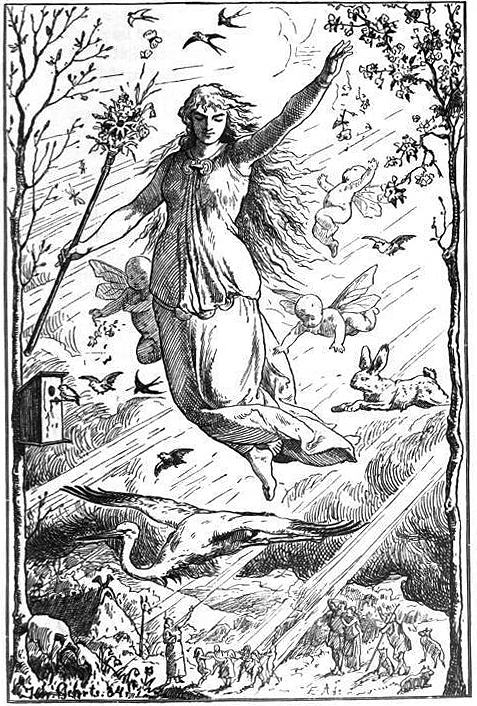
Ostara by Johannes Gehrts
After Constantine decided to Christianize the Empire, Easter was changed to represent Jesus.
Hey! Guess what language Constantine, the Roman Emperor, spoke? Not English, that’s for sure! In fact, when he was alive, English didn’t even exist yet. He would have spoken Latin or Ancient Greek, so would likely have referred to Easter as Pascha or Πάσχα.
But at its roots Easter (which is pronounced Ishtar) was all about celebrating fertility and sex.
Look. Here’s the thing. Our Western Easter traditions incorporate a lot of elements from a bunch of different religious backgrounds. You can’t really say that it’s just about resurrection, or just about spring, or just about fertility and sex. You can’t pick one thread out of a tapestry and say, “Hey, now this particular strand is what this tapestry’s really about.” It doesn’t work that way; very few things in life do.
The fact is that the Ancient Romans were smart when it came to conquering. In their pagan days, they would absorb gods and goddesses from every religion they encountered into their own pantheon; when the Roman Empire became Christian, the Roman Catholic Church continued to do the same thing, in a manner of speaking.
And do you know why that worked so well? Because adaptability is a really, really good trait to have in terms of survival of the fittest (something I wish the present-day Catholic Church would remember). Scratch the surface of just about any Christian holiday, and you’ll find pagan elements, if not a downright pagan theme, underneath.
Know what else? Most Christians know this. Or, at least, most of the Christians that I’m friends with (which is, admittedly, a fairly small sampling). They know that Jesus wasn’t really born on December 25th, and they know that there were never any actual snakes in Ireland, and they know that rabbits and eggs are fertility symbols. But they don’t care, because they realize that religions evolve and change and that that’s actually a good thing, not a bad thing. The fact that many Christian saints are just re-imagined pagan gods and goddesses doesn’t alter their faith one iota; because faith isn’t about reason or sense, it’s about belief.
Look, go ahead and debate religion. Go ahead and tell Christians why what they believe is wrong. That’s totally fine and, in fact, I encourage it. A little debate and critical thinking are good for everyone. But do it intelligently. Get to know the Bible, so you actually know what you’re disagreeing with when you form an argument. Brush up on your theology so that you can explain why it’s so wrong. And have some compassion, for Christ’s sake – be polite and respectful when you enter into a debate, even when the person you’re debating with loses their cool. You want to prove that you’re better, more enlightened than Christians? Great, do it by remaining rational and level-headed in the face of someone who’s willing to stoop to personal attacks. To behave otherwise is to be just as bad as the people you’re debating.
Anyway, I hope you guys have a fantastic long weekend, no matter how you spend it. If your holiday involves chocolate, then I hope you enjoy that. If not, just enjoy the extra day or two off work and the (hopefully) warm weather. No matter what you believe in, I think that we can all agree that the end of winter and the rebirth of spring is worth celebrating.
And also? Richard Dawkins? You need to fact-check yourself before you fact-wreck yourself. Spreading this kind of misinformation to your foundation’s 637,000 fans is just plain irresponsible, especially coming from someone like you. Get with the program, buddy.
ETA: The post now seems to be removed from The Richard Dawkins’ Foundation for Science and Reason’s FB page. Thanks Richard!
ETA Part Deux: Oh. It looks like it was deleted from their timeline but not the photo album. Welp.
*It should be noted that the only actual historical evidence that we have of sacred prostitution comes from Herodotus (I’ve included an excerpt from Herodotus’ Histories below) and no one is really sure how accurate it is. Herodotus is known for making shit up, like giant ants for example. But it makes for an amazing story and people still make the association between Ishtar and sacred prostitution, so I decided to mention it here.
The foulest Babylonian custom is that which compels every woman of the land to sit in the temple of Aphrodite and have intercourse with some stranger once in her life. Many women who are rich and proud and disdain to mingle with the rest, drive to the temple in covered carriages drawn by teams, and stand there with a great retinue of attendants. But most sit down in the sacred plot of Aphrodite, with crowns of cord on their heads; there is a great multitude of women coming and going; passages marked by line run every way through the crowd, by which the men pass and make their choice. Once a woman has taken her place there, she does not go away to her home before some stranger has cast money into her lap, and had intercourse with her outside the temple; but while he casts the money, he must say, “I invite you in the name of Mylitta” (that is the Assyrian name for Aphrodite). It does not matter what sum the money is; the woman will never refuse, for that would be a sin, the money being by this act made sacred. So she follows the first man who casts it and rejects no one. After their intercourse, having discharged her sacred duty to the goddess, she goes away to her home; and thereafter there is no bribe however great that will get her. So then the women that are fair and tall are soon free to depart, but the uncomely have long to wait because they cannot fulfil the law; for some of them remain for three years, or four. There is a custom like this in some parts of Cyprus.
That crack about ugly women was totally unnecessary, Herodotus. I am just saying.
**The first written reference we have for Eostre dates back to the 7th century AD and can be found in Venerable Bede’s Temporum Ratione, in a passage explaining that April was often referred to as Eostremonth:
“Eosturmonath” has a name which is now translated “Paschal month”, and which was once called after a goddess of theirs named Eostre, in whose honor feasts were celebrated in that month.
Jacob Grimm said that he found further evidence of Eostre and her associations with Easter, eggs and rabbits when researching his Deutsches Mythologie, although he was unable to discover any written records about her.
 The Belle Jar
I’ve addressed this several times on my Facebook. Thanks for taking the time to cover it on your blog.
Here’s a fun one. I was trying to figure out where this whole Easter/Ishtar thing came from,since it is flooding the internet full force this years and I had never heard it before. An acquaintance of mine, who was espousing this view, quoted a text that made these assertion, and cited Grover Stevens as a source. Grover Stevens, the late Christian Evangelical. And then I found this: http://www.lasttrumpetministries.org/tracts/tract1.html So this nonsense originated with Christians who wanted to justify no celebrating “pagan” holidays.
Ishat was not a fertility goddess.
Although I enjoyed this article, and applaud your recognition that the Burney Relief is not Ishtar, I must inform you that Ishtar was emphatically NOT a goddess of fertility. Fertility was not an issue in ancient Mesopotamia. In fact, the original flood story in cuneiform was about controlling the human population rather than sin. Sacred prostitution itself is a post-Darwin notion of Victorian anthropology, in particular, of Sir James Frazer, and has no basis in historical reality. There was no sacred prostitution in antiquity. Not even Herodotus describes such an institution. If you are interested in the many articles I have written about these subjects, please go to Academia.edu for my published articles. Search under Julia Assante PhD. I am a scholar of the ancient Near East (Columbia U) who draws on cuneiform texts, archaeology and art.
Thank you for posting this. I am a practitioner of the pre- Christian Anglo Saxon Heathen religion, and I am glad that someone has spoken out against the perversion of our traditions. Your blog is excellent, please keep up the good work and fight the good fight.
I would not be so hard on Mr. Dawkins. Here is a story I heard from Father Charlie,an informative rambler: In Jewish tradition, the Prostitute was a very high up important member of the Temple as important as the Pharasees and Sadusees(excuse my spelling). All young men approaching man hood were brought to the Temple to learn the art of intimacy with a Woman. The Prostitute would instruct the young men how to have a “Spiritual Orgasm” with a woman,which I understant is good for a hundred thousand miles. After and only after the spiritual orgasm was attained would the Prostitute instruct the young man into having a physical orgasm with a woman. Actually this was all part of his Barmitzfa.
I’m sorry, but you are writing pure balderdash. There was no sacred prostitution in antiquity, a fact that has been proven over and over again by me and many others. The translation of sacred prostitute for the term qadesha is a mistranslation that appeared for the first time in scripture in 1925, after Sir James Frazer’s abridged edition of the Golden Bough. In this work, Frazer invents sacred prostitution and fertility cults for the ancient Near East. Herodotus’s account of Babylonian prostitution at the temple is pure fiction. It is what we scholars call orientalizing. There is no evidence in primary sources for any of this.
TMI and just the right side of losing one’s cool, grasping often at rational argument to steady the boat.
As I’m not the first commenter to point out, the Ostara / hare connection is a bit dubious to say the least. http://www.guardian.co.uk/commentisfree/belief/2011/apr/23/easter-pagan-roots
The Facebook meme wound me up no end (atheist with pantheist leanings) but correcting misinformation with more misinformation doesn’t really work for me. Maybe print an “edited to add” at the end of the post?
But goodness, yes, Richard Dawkins’ insufferable smugness, his racism, and his sexism make him such an embarrassing spokesperson for atheists like me!
You’re wrong, it’s not more misinformation. She quoted Jacob Grimm’s vast pan Germanic folk study where he noted a connection between Ostara and hares. It’s time to stop discounting Grimm as anything less than he was, which was a pioneer in the field of folklore.
Grimm didn’t ‘note a connection between Ostara and hares’. For one thing, the association between Ostara and hares does not begin with Grimm in 1835 but with Adolf Holzmann in 1874. (Your confusion may lie in the fact that Holzmann also wrote a book called Deutsche Mythologie.)
For another, Ostara was entirely Grimm’s speculation. Call it a reconstruction if you want to be more charitable, but the fact is that Grimm never found any primary evidence for Ostara at all, oral or otherwise.
For some reason, the notion is going around this year that Grimm actually met individuals who had oral traditions of Ostara. Whoever came up with that idea clearly hasn’t actually read any of Grimm’s work. Grimm never once claimed to have encountered *direct* evidence of Ostara, which is how come he had to hypothesise her in the first place.
If you want to do some fact checking of your own, I refer you to Grimm’s Teutonic Mythology, Volume I, pages 290-291. Please, as one pagan to another, go and read the primary sources.
Perhaps more people need to research things before they make comments, Adrian, Adolf Holzmann’s “Deutsche Mythologie” was a reprint of the original by B.G. Teubner.
Mea culpa. I was working from the Folk-Lore article: http://en.wikisource.org/wiki/Folk-Lore/Volume_3/The_Easter_Hare
‘In Holtzmann’s German Mythology she is also referred to as the goddess of Dawn. “The Easter Hare is unintelligible to me”, he adds, “but probably the hare was the sacred animal of Ostara.”‘
In my enthusiasm I committed a schoolboy error and treated Holzmann as the author of the volume. Whoops. That’ll teach me.
Atheist with pantheist leaning? You sound fascinating, and I’m not being sarcastic, I promise, as I’m a panentheist myself 😉
this is absolutely hilarious. You have no real argument. It was a bunch of “well it could be this/that” What this post was about was, for the most part, accurate. The people laughing at the christians know that most christians do not know the truth behind how their religions accepted those holidays. Hell I have talked to many people about the way I want to celebrate these holidays and they look at me like I am completely crazy and when I explain it to them they put their nose up in the air. When it comes down to it there is this idea that if you are christian you are following THE path and they need to realize that they are following a blind faith that teaches love on the outside but on the inside teaches judgment and ignorance. People post this sort of background to show more people that there is more to religion than they know. There is nothing wrong with them exploring and teaching what they have learned.
lol and these posts are bringing up more facts than he did
Not all Christians are blindly following their faith. Intolerance and unwillingness to understand can be found in most athiests as well. People have reasons for what they do, labeling a person as backward or ignorant because they do not share your beliefs is jest a teeeny bit arrogant. We are in the midst of a 1000 yr old conflict – as old as the Crusades, for which both sides fought for what they believed was right. Will the historians correctly portray what is happening in our era? I doubt it. They cant even get the 50’s right – the era I grew up in. lol. Be well.
Thanks for a good post. Another bit of relevant information: The idea that ‘Easter’=’Ishtar’ appears to originate with 19th century anti-Catholic zealot Alexander Hislop, as part of his larger project of arguing that Catholicism is a direct continuation of ancient Near Eastern paganism. Until recently, the only people repeating the “Easter=Ishtar” story were Protestant fundamentalists hoping to depaganize Easter by getting rid of the eggs, etc. It’s only been much more recently that people on the secular left, neo-Pagans, etc, have started repeating it too. I think you are correct that many of them think they are poking fun at Christian fundamentalism in doing so, but really they are repeating an idea that has a 100-year history of being pushed by the right-wing fringe of Protestantism.
The one connection that he didn’t make is that it is entirely possible the the Germanic goddess Ostara/Eostra’s name might very well be a corruption of Ishtar/Astarte, as most European pantheons have origins in the early Mesopotamian/Sumerian/Babylonian/Akkadian pantheon.
Eostre and Ishtar belong to separate language families, the former Indo-European, the latter Semitic. They are also separated by three and a half thousand miles of distance and approximately one thousand years of history.
Eostre (if she existed) is far more likely to have been a linguistic descendant of the Proto-Indo-European dawn goddess, whose reconstructed name is Hausos.
CAN YOU PROVE YOUR THEORY?
most of teh eopean pantheons actually are from the indo europens..
not from the mesopotainians ,because they had a different pantheon of GOds & Goddess
Ishtar being one of them
It’s “entirely possible” that we’re all brains in vats… The point is, there is no reason to believe that ‘Easter’ derives from ‘Ishtar’. (Or for that matter, that most European pantheons have origins in Mesopotamian/etc. pantheons.) Speaking as a linguist, in order to accept this claim, I would want to see a detailed proposal of how the word ‘Easter’ developed from ‘Ishtar’, through a series of specific sound changes which we already know to have operated in English and its ancestor languages — sound changes that we see have operated regularly across the vocabulary, not something sporadic and irregular, introduced for no other reason than to support the ‘Easter’ < 'Ishtar' derivation. (P.S. Linguists haven't described changes in the form of a word as "corruption" in decades.)
Yes, and this has been maddening for other pagans who attempt to connect to an ancestral cultural heritage through reviving indigenous pagan religion. We have been addressing this head on as well. http://thenortherngrove.wordpress.com/2013/03/30/cultural-appropriation-ishtar-eostre-and-easter/
‘He conducted a massive survey of German oral tradition and found that the goddess Ostara (German form of Eostre) was found ALL AROUND German speaking areas!’ – this is totally false. Grimm never claimed any such thing. His reconstruction of Ostara is speculative. Again, please go and read the source material.
‘These, plus votive inscriptions along the Rhine prove that Eostre/Ostara was, indeed, worhshipped in both England and continental Germany prior to conversion.’ – No, they don’t. The votive inscriptions, as Dr Shaw himself quite clearly states, are to ‘a group of minor goddesses with a related name’, namely the Matronae Austriahenae. They certainly strengthen the case for Bede’s account being accurate, but they are not what you are making them out to be.
I know you mean well, but many of us pagan folk do actually care about the history as well as the spirit, and you aren’t helping when you don’t check the facts thoroughly. It also doesn’t help that you seem to see the largely pagan-led debunking of modern Easter fakelore as some sort of attack from outside by ‘those who feel threatened’.
You don’t seem to acknowledge the very real threat described by Steve Roud in The English Year:
‘The real danger is from a far more virulent virus – the idea that all customs, indeed all superstitions, nursery rhymes, and anything that smacks of ‘folksiness’ are direct survivals of ancient pagan fertility rites, and are concerned with the appeasement of gods and spirits. Although the suggestion of an ancient origin for our folklore was the central tenet of the Victorian and Edwardian pioneers of folklore collection, this notion has only become generally known in the last forty years or so, and has taken hold with astonishing rapidity; the majority of the population now carry the virus in some form or other, while some are very badly infected. The problem here is not simply that these theories are unsupported by any evidence, but that their blanket similarity destroys any individuality. All customs will soon end up with the same story.’
Reblogged this on Digital Enchiridion and commented:
I don’t typically re-blog others’ posts, but this has been going around lately and I like how they’ve worded it.
It might be useful to temporarily discount religion as a source of the word Easter, in order to speculate the underlying connotations of the word, by looking at the etymology of words with oestr- as their Latin root. Oestrogen is one such word.
According to the OED oestrogen is a substance which “initiates certain bodily changes associated with the menstrual or œstrous cycle”.
Now, the oestrous cycle is the “the cyclic series of changes preceding, including, and following œstrus that takes place in most female mammals and involves esp. the reproductive and endocrine systems.” The oestrus to which this refers is a “vehement bodily appetite or passion” or the sexual “rut or heat of female mammals” during ovulation.
Now we have a feasible connection: eggs = ovulation; rabbits = sexual heat in female mammals.
So it seems reasonably obvious to me that Easter has something to do with reproduction and particularly the fervent sexual frenzy toward that very end.
It might be “reasonably obvious” to you that ” Easter has something to do with reproduction”, but only because you haven’t checked the etymology and simply accepted the original blog’s false folk-etymology. “Easter” comes from a root meaning “dawn”, and is completely unrelated to Oestrus which traces back to a root meaning a “gadfly”. They are completely unrelated (at least as far back as scholars have managed to trace them), but people seem to love making spurious connections based on the similar sound.
The whole bunnies and eggs thing isn’t just a fertility symbol. The goddess Eostre was believed to transform into a hare (not a rabbit), however many people did not understand the difference. At that time, it was not understood that there were ground-nesting birds, but it was known that hares created a dip to hide in – putting 2 and 2 together to make 5, the people of the time concluded hares laid eggs. This gives you the explanation for the “Easter Bunny” and the eggs – it si not just a fertility symbol, but actually reflects the beliefs at the time, which has been suitably dressed up to look ridiculous so as to ease the forced transition from Paganism into Christianity.
Agreed.
It’s possible that they understood about the birds and bunnies, but thought it made a good joke/metaphor/symbol/thing to tell their kids, similar to how we have lots of movies affirming the ‘reality’ of Santa Claus, even though adults don’t actually believe this. 🙂
No, Eostre was not believed to transform into a hare. That’s a modern myth; there’s no historical provenance for it. The only evidence we have for Eostre is Bede, who mentions nothing about hares, nor eggs for that matter.
It was Holzmann in 1874 who first made the speculative guess that ‘the hare was probably the sacred animal of Ostara’, and subsequent writers left out the ‘probably’ part. By around 1945, the notion had taken root that Eostre and hares were definitely connected, in the absence of any evidence.
Oh the irony. You begin a screed against misinformation on social media with your own misinformation
Richard Dawkins is a noted evolutionary biologist and atheist. He is not a noted misogynist or eugenics enthusiast, although some in the blogsphere have falsely accused him of these things.
Its seems like your agenda has more to do with attacking Dawkins and atheism than correcting misinformation on social media
FAIL
Agreed.
Thank you. I was going to say exactly the same thing. Dawkins stands, above all, for basing conclusions upon verifiable evidence. I’ve seen absolutely no evidence anywhere that would lead me to conclude he is “misogynist” (quite the opposite — there are many speeches, interviews, and pieces of writing which place him firmly in the camp of supporting equal rights for women) or any kind of “eugenics enthusiast.” This makes this whole post suspect to me.
Sorry, he does not stand for such things. He does so only when he talks about biology. When he starts talking out of his field, he is clearly not well read, This is where he ventures into diverse fields such as anthropology and philosophy…and it is where he fails miserably. The language used to describe him is certainly hyperbolic, however it is clear he is apart of the Anglo-American tradition of thinking, which completely lacks thinking about cultural sensitivity, surrounding issues like Orientalism. In other words, he is on the level of the first year student in university the moment he talks about anything other than biology. I am sure he is not intentionally being racist, etc. Due to his arrogance – acting as if he thought of many things outside of the field of biology for the first time – he ends up saying things that are outrageous.
If you find a poster referring to Dawkins as a “misogynist”, you likely have a misguided A+ apologist on your hands who cared more about being incensed at the supposed insensitivity of the infamous ‘Dear Muslima’, rather than being honest about the clarity of it as a metaphor for precisely the mentality it was addressing.
Agreed. I noticed that immediately.
Thank you. I was unimpressed with the links and Dawkins quotes used to justify the labeling of Dawkins as mysogenist. To my mind, the ad hominim is more a black mark against this author than against Dawkins.
I was thinking just that also voodoo 🙂 plus this blog smacks of the smugness that some of us atheists are accused of! I can’t help it if i am a happy smiley atheist content with myself!
Frankly, I’m not surprised that social media and the Internet in general take bits and pieces of factual information and mix it with utter BS. The folks involved in religion and politics have done this for years to support various viewpoints that suit their particular flavor of belief. Why would the Internet transform human nature?
Reblogged this on Lady Imbrium's Holocron and commented:
Nicely done!
Yes, but religion is still a pile of shit though. Punching holes through what atheists have said doesn’t make any difference. You might as well come up with the story Dawkins did – you are not going to get any more truth from the Bible.
Why would you believe religion is a pile of shit? Sounds a bit intolerant as it lumps 75% or more of humanity [including the Dalai Lama] into some sort of mindless riff raff. One tends to believe what one was taught as a child – for this you would fault others, without examining your own presumptions?
One of the things I have learned through my studies is that there is historical truth behind most of the mythologies and religions we have today. Of the Hebrew religion and the later Christian religion are based upon the Sumerian religion; the first religion. Historically, you can track the events of the Old Testament after the book of Exodus (as well as the events of Exodus to an extent). Unfortunately, though, most theological scholars have discounted the historical nature of the documents in their care for too long.
With that said, attempting to say that all of anything is something you believe, or all of a certain mindset are the same likens to ignorance. I am a Christian and I have looked into the historical references of the Bible. Likewise, I have studied other religions and believe that most come from a common source. It is this source I seek to find. Does that make me someone who is simply studying “a pile of shit?”
Thanks so much. I love historical stuff and sometimes don’t have the time to fact check things like this. If a friend of mine hadn’t put this on his Facebook page I probably would have gone around forever like an idiot thinking Easter was about Ishtar. Thank you.
It doesn’t matter really to me where easter or christmas came from. If Christians would just go back to what its supposed to be, celebrating Passover and First Fruits, on the real days the Bible sets, there would be no problems. Doing this also honors Yeshua for what He has done.
Great article, and it also goes along with my thoughts on the use of the word “god”; as in those who say that Allah is the Muslim’s “god”. God is a word of Germanic origin and was therefore never used in the bible or by Jesus. Jesus would have referred to, El, Allah or Abba since he mostly spoke in Aramaic. He might even have used Theos when speaking to a Greek, but never the word “god”.
Babba meaning Father ? or in our modern english as a baby would say papa !
What a dumb, you dumbass dumber!
Where you learn the idiom from? Jesus in Muslim idiomatic’s called Isa AS, ain’t no Allah. Allah means for The God. While Jesus/Isa AS is just an ordinary man, so couldn’t compare to God/Allah!
http://en.wikipedia.org/wiki/Jesus_in_Islam
http://en.wikipedia.org/wiki/Allah
I think we all understand quite well that Jesus and everyone else of his era woult have used English words. Where anywhere at all has anyone besides yourself felt the need to point out what you did?
Good article.
There has been speculation that Ostara is a germanic rendering of Ishtar, conveying the idea that idea of OStara traveled from ancient Babylon.
Fact is, no one will ever really know.
No I’m not religious but here is what they have to say with references as well.
http://christiananswers.net/q-eden/edn-t020.html
Please do not confuse the above website with anything resembling mainline Christianity. Their “answers” are based in an extreme biblical literalism. This point of view, that everything found in the Bible MUST be literally true and factual is actually held by a very small subset of Christians, and was lampooned by a number of those early scholars the Church calls “Fathers”, most notably St. Augustine.
Of course our days of the week are named after the Germanic gods Tiw, Woden, Thor, and Frigga, and the Roman god Saturn, not to mention the Sun and the Moon. And our some of our months are named after pagan gods too, namely the Roman Janus, Mars, Maia, and {indirectly) Juno, plus Julius Caesar and his adopted son Caesar Augustus, deified by the Roman Senate. It’s also interesting that, the Angles and Saxons being the best known mariners in northwestern Europe in the centuries before the Vikings, the words for the directions in French (nord, est, sud, and ouest), and Spanish, I think come from Anglo-Saxon, not Latin. So does the word for “boat” in French (le bateau) and German (das Boot).
Interestingly after accusing Richard Dawkins of fabrication, there is more than enough fabrication of your own to make up for it.
MOst ancient cultures had a fertility God. Ashteroth being the babylonian name of the goddess, who Easter and Christmas festivals belong to. Each culture had their own names for this goddess Ishtar being one of them… while that is not pronounced Easter, it is the derivation of the word.
Easter and Passover do not always fall the same time, because they are based on different calendars. The last 2 years they have fallen during each other, but not for many years before that.
There are other written mentions of temple sex, for instance when the bible tells the israelites how not to behave, temple prostitution is forbidden. It is mentioned in many occasions about how both the israelties and the other cultures were using this as a form of ‘worship’, but it was horrifying to Yahweh. So the author you mentioned is not the only source.
It is also very easy to discover that Jesus died on the 14th day of the Jewish month nisan, although christian writers have become very confused by the traditions– i.e. Ashteroths festival, and most of them think Good friday and Easter Sunday have something to do with it. Constantine did a lot of changing of days. he was a worshipper of the sun god, and moved the sabbath from saturday, to the day of the week that all his people already were celebrating their holy day. He removed passover in the way it was supposed to be celebrated, and linked it up with the days of Ashteroths festivals. What he called it, and what language he used is slightly irrelevant. The truth is that Friday-Sunday have nothing to do with Jesus or passover.
Amen this is the truth not what this Author of confusion put up. Passover was on Abib 14th a Tuesday night. Jesus was in the grave three nights and three days. Wednesday night, Thursday, Thursday night, Friday, Friday night, Saturday, that makes 3 nights and three days. For we all know he was put in the tomb at sunset so the count starts at sunset and it ends at sunset. He was not resurrected on a Sunday but at sunset on Saturday which by Hebrew calendar. The Sabbath that was starting soon after Christ crucifixion was the First day and Holy day of Days of Unleavened Bread.
Nice to hear someone pass this knowledge forward without the need to condescend people less informed.
Ashteroth was not Babylonian at all but Hebrew and NOT associated with fertility. And you are wrong again too to assume that fertility, that is human fertility, was an issue serious enough to assign a special divinity to it. The truth is, the civilizations like ancient Mesopotamia and Egypt tried to keep reproduction down. The notion of fertility cults is largely in invention of Victorian anthropology. It was influenced by Darwin’s claims that reproduction was an essential biological drive for the survival of a species.
Please see my other comments addressing your misinformation about Ashteroth (not Babylonian at all, for instance) and sacred prostitution,
I *was* going to make some kind of objection to the rude depiction of respondents to the initial Facebook image, but I’ve been distracted by the dreadful, eye-watering font selection of the blog post itself. Could you use a higher-contrast font than cobwebby-thin gray letters on white? I thank you, and my headache thanks you.
I agree with your first line. I thought it was very rude and sarcastic.
jacob grimm nor his brother ever journeyd germany. there fairytales are bought from women and a couple of men who visited the grimms and told the stories. 10 percent is original and 90 percent was written by the grimms at the end. just so u dont get mixed up with things
Tak, you’re wrong. The Grimm’s Fairytales was a separate project from Grimm’s Teutonic Mythology, where he explores Ostara
The Grim brother did travel in Germany to collect oral traditions. They especially explored what is called the Maerchen Strasse, a route of about 300 km, from which many of our modern fairy tales originated. At the top of Maerchen Strasse the town of Hamlin still thrives.
There are many Grimm fairy tales written in sanskrit hundreds of years older than the Grimm brothers……..
The comment on ugly women was totally necessary; he was trying to show how horrible this practice is, and, (If it did in fact exist), he is also mentioning what a problem it is for ugly women being treated worse then pretty women since they have to stay there longer.
Now, the original reason for my comment… you DO know that “Jesus” did not exist, right? Your small section about Jesus does not automatically imply that he existed, but it makes no effort to say that “in the myth” or “the bible and supporting documents say that”, etc. There is no record of any man wandering and doing any of the things Jesus was supposed to have done. See “The Christ Conspiracy” by Acharya S. She is an archaeologist.
Jesus did exist but most of what is believed about him is just the cover story invented by him and his disciples to conceal from the Romans and their Jewish puppet governors of Palestine the fact that he survived the crucifixion and went on to lead a new sect of Essene Judaism. Reread the book of Acts and say to yourself, “There are NO zombies!” See “Jesus The Man” by Prof. Barbara Thiering. She is a palaeographer and a world authority on the Dead Sea Scrolls.
That’s nice but neither bible nor any “left out parts” of that bible would have any bearing on whether or not the things written there are true… one pretty obvious falsity is in there called “a tyrannical man who calls himself God exists,” so obviously the mere fact something is written in that book is very far from making it true.
The historicity of Jesus/Yeshua cannot be refuted. The letters of Paul, the only authentic documents of the first generation Christian movement (not all of the letters are authentic though) establish beyond doubt that Yeshua did exist. Paul personally knew his brother James, who had control over the movement after Yeshua, and the apostle Peter, as well as several others mentioned in the gospels who were sent out on well-organized missionary expeditions. Paul had huge problems with James and was often called back to Jerusalem to account for his preaching. The biggest problem was that Paul allowed Greek Christians to remain uncircumsized, meaning that the male community did not mark their bodies with the sign of the covenant with Yahweh,
There is also mention of Jesus in the works of Josephus, a first century Jewish historian, but that is a later interpolation. Josephus, however, does mention that John the Baptist was a powerful figure in his time. Baptist cults survived long after Yeshua and apparently did not convert to “Christianity.” James would never have referred to this revisionist movement as Christian, by the way. That was a Pauline invention.
Read the book befitting say shit. If you’re not gonna read the book, don’t say shit. You are most likely speaking of the forged documents or of one (or two) of the many random, unremarkable people who were doing some of the travels to form the myth.
Paul also knew Jesus personally, after he met the resuscitated Jesus on his way to exile in Damascus. Paul also officiated at Jesus’ divorce from Mary Magdalene.
Acharya S is not an archaeologist, but a liberal arts major who spent a year studying in Athens. Her writings are full of problems and generally discounted by archaeologists and historians of religion alike, which is why she couches them in the conspiratorial language of “revealing hidden secrets that They don’t want you to know”.
Moreover, the very crux of her argument is fallacious. Various religious figures being ascribed the same or similar characteristics has no bearing on whether they are based on historical figures. Jesus, Buddha, Zoroaster, Muhammad: all have been heavily mythologized but all probably existed. Wheat from chaff, people.
The book is written in language so professional it takes 4x your normal reading time to understand? What are you talking about “conspiratorial language”? That doesn’t exist there, and she talks about things she found HERSELF. Sounds like you must be talking about some other writings she did and not this book… go read even the first three pages of the the book and you will see that Jesus was not a historical figure (or at least not one person), or if for some reason you don’t see that (if you’re brainwashed by Christianity, for example), you will at least see that she does not use “conspiratorial language” or whatever.
The original graphic may have disappeared from the Dawkins Foundation website, but not before it gained traction among Jehovah’s Witnesses, who of course immediately latch onto anything that feeds their notions that any Christian celebration or custom that might even remotely be connected to anything “pagan” must not be tolerated.
Thank you for this well thought out article. As a Pagan, it does matter to me which Pagan goddess Easter traditions are based on, although it seems to be a moot point with many atheists and Christians.
Sorry, but you are completely off base. Easter being Ishtar is not incorrect.
Most stories and traditions are passed on and shared throughout religions, “The Ishtar Egg” (yes they were a symbol of hers) – became the easter egg. Kinda the same as the story of Noah’s ark following the Gilgamesh flood tale point by point and in the same order. Here’s a good reference for stronger information:
http://www.yahweh.com/htmls/11-2010-PW/Easter.html
I’m sorry, but the notion that Ishtar is associated with eggs is ridiculous. Eggs are not in any iconography associated with her, nor in any cuneiform texts associated with her. Lions, yes. Weapons, yes. Even sweet cream and date-sweetened beer. Certainly honey. But eggs. no.
From what I can see on here, there is very little fact and a lot of conjecture about Easter and where it came from. The point is of course that it is not a Christian Holiday. You all seem to agree with the dreaded Dawkins on that one. Nothing like a bunch of misogynist, sexist intellectuals having a fable fest.
Reblogged this on renna shesso / spirit-smithing and commented:
Richard Dawkins is not my go-to guy for goddess lore.
you know hes a sexist,I’m just scared that people following him might be doomed to a intolerant Scientology like belief system in the near future. Mob mentality and fanboysim is a sad thing causes a person not to use their own mind or do their own research.
“Any man who reads too much and uses his own brain too little falls into lazy habits of thinking.”
– Albert Einstein.
BTW, re: “Easter is still celebrated the week after Passover”. Not accurate. The Jewish calender is based on the cycles of the moon, and Passover is positioned accordingly in the calendar each year. Roman Catholic Easter is celebrated on “the first Sunday after the first full moon after the Vernal Eqinox” (so very pagan). Since the moon is involved in both, they may sometimes seem more related to each other that they really are. While you’re checking those facts…
There are references to what may be temple prostitutes in the Code of Hammurabi. See paragraphs 110, 127, 178, 179
In the Epic of Gilgamesh, it is a “harlot from the temple” or a “priestess form the temple of love” or “temple hierodule” (depending on the translation one consults) who tames Enkidu..She is also described as a “child of pleasure”. This suggests a permanent priestess rather than a temporary temple-servant, but there is clearly more here than meets the eye.
http://www.ancienttexts.org/library/mesopotamian/gilgamesh/tab1.htm
Click to access eog.pdf
http://www.angelfire.com/tx/gatestobabylon/temple1.html
There is nothing in the Hammurabi Codex about sacred prostitution. Even the Gilgamesh Epic, especially the editions that are available to the lay public, have many mistranslations. The word former scholars translated as prostitute, kar.kid (a Sumerian word, in, for instance, the Hammurabi Codex) and harimtu, the Akkadian equivalent, does not mean prostitute. It means instead an independent woman without patriarchal status–she is not the wife of a man, not the daughter of a man, but a single woman living on her own. As such, her sexual life was not regulated by law unless it interfered with a man’s household. Please see Academia.edu for my article, The kar.kid/harimtu, Prostitute or Single Woman (85 pages) that addresses each instance these words appear in cuneiform texts.
I have replied to this idea that the Hammurabi Codex references prostitution. It does not. It references the kar.kid, a Sumerian term for a woman without patriarchal status. Some Assyriologists (specialists in cuneiform languages), have wrongly concluded that the kar.kid is a prostitute. kar.kid in the later Akkadian, is harimtu.
Thanks for the info….actually though YOUR tone is incredibly smug.
I run a Facebook page that explores pagan history and culture of Northern Europe. We’ve been campaigning not only for the historical validity of the cult of Eostre (naysayers are either unaware of half of the evidence or they discount it due to personal prejudice), and now this ridiculous Ishtar nonsense. It is something we take seriously as we place high value on history, culture, and heritage. Also, for many of us, this is part of our own religion, so we demand the same level of cultural respect given to any other culture or belief system. So we were thrilled to see this post, and of course we shared it with our near 10,000 FB fans. This issue was so important it spurred the launch of my groups own blog just so we could lay out our take on it too :-).
why so angry?
Actually the Eostre rabbit thing is pretty dubious as well.
http://cavalorn.livejournal.com/585924.html
If you believe that Jesus rose from the dead after 3 days and ascended into heaven on our behalf so we (believers) could have eternal life there as well, you really could care less some days as to who disbelieves it; no matter what time of year it is being disbelieved. and I love to hear all the pagan stories. so it should stand to Reason that non believers should have a soft spot for all the Biblical stories.. except for some very aggressive proselytizing over the past 1000 years or so. sorry about that, but lets not miss out on hearing each others stories and believing what rings true within ourselves. anyway, fertility is kind of going out of style with over population going full tilt..
Fertility is for more than humans. Fertility is about the garden, the forest and about the eternal recycling, regenerating life of Earth. I find it very interesting how humans are so self focused. Our prayers and rituals began as and still, (as I feel should be)……more than opportunities to ask for favor from the unseen , but rather a time where we honor the Mystery and beauty of life’s cycles (for all beings)..a time where we give our song, dance , tears and laughter to the land that sustains us.
In a time where corporations like Monsanto are killing our seeds, we need more awareness about fertility , fertility for the Earths sake, not for just humans.
Rituals of building soil and saving heirloom seeds, rituals to celebrate them and pass this knowledge to our children.
This is what I will do for my community this coming Beltane & all seasonal celebrations and have for over a decade….
The truth is all this is rooted in our relationship to the Earth, our source of life via the fertility of the fields and the forest.
Each people, for each land, in each time…there has always been a way of using words, sound vibrations, to say the same thing. For we all follow the path of moon and sun and seasons which affect out food source and thus our ability to live.
Seek the Truth. The truth is simple.
Happy Spring!
The season is what dictates the symbols not the changing dialects, tonal inflections and anthropomorphic leanings of civilizations past.
SYMBOLS:
Humans have honored the seasons, for that is what sustains us.
At Spring equinox ( Easter time ):
Birds have started laying eggs
Bunnies have come out of thier dens
Just as at Imbolc:
the sheep are giving birth , which means milk
In a time with out factory farms and convenvinent stores I can assure you this is a time to celebrate.
Beltane we are planting our gardens, the forest and land are thriving with life…bees pollinating fruit tree
The list goes on……..every spoke of the solar wheel marks a time in our relationship to the land..our base of survival..the reason we can sing and dance …and love
So I say this in the essence of awareness, that if a region has birds and/ or bunnies ..then spring is when you would be really glad to to see them ….winter has ended and the fertility of the land has returned, and thus they are the symbols of the season.
The season is what dictates the symbols not the changing dialects, tonal inflections and anthropomorphic leanings of civilizations past.
Reblogged this on myatheistlife and commented:
And a slightly different point of view on the Easter holiday. In the end, it’s not a Christian holiday, they are just borrowing it because they couldn’t get any support for their ideas without ‘borrowing’ the holiday. Enjoy
I think you want to fact-check the calendar stuff. For the first 300 years of Christianity–the local Christian priest would saunter down the road to the home of the local rabbi–and ask THEM when to celebrate Easter (yes, Pascha). I rather think we should go back to that practice actually. It kind of tickles my fancy that Christians might have to get permission from the Jewish rabbis to celebrate our most important holy day–and then cleebrate it with the Jews.
http://yi4c.com/2013/03/28/easter-ishtar-or-resurrection-sunday/ << Have a look at this then.
Hmm Ishtar=sex goddess. Eostre= sex Goddess. do you think that the root word for Eostre and eostress the fertility cycle of mammals are the same for no reason oh yes a fertility goddess and then there is astarte =sex goddess of the Phoenicians, Ashtaroth another name for Ishtar =sex goddess also celebrated by sexual activity. lots of ancient Phoenician statuary with rabbits and eggs Eostre also celebrated with Hares and eggs. obvious fertility symbols. I think it is pretty clear that Easter traditions have more to do with pagan fertility symbols then scripture , but if you can come up with a chapter and verse that has the apostles dying eggs or bunnies i might buy your position
Eostre is the Saxon Goddess of reincarnation,not Sex!
Eostre
by Swain Wodening
Eostre is a very obscure Goddess, and uniquely Anglo-Saxon Pagan. She is not mentioned at all in the Norse corpus and only fleetingly in the Old English by Bede in De Temporum Rationale. Her material is so scant that some scholars have speculated she was not a Goddess at all, but that Eostre was merely a name for the holiday. Her name is connected for words for “east” and “shining.” It is therefore related to the Greek godname Eos, Goddess of the dawn in their pantheon. Finding place names indicating her worship are difficult due to this relation to the word east. Her name survived in the German name of the Christian holy tide as Ostara, therefore if she was a Goddess, she was worshipped there as well.
In order to understand anything about the Goddess Eostre (or the Goddess or Goddesses worshiped at that time) we must draw on the traditions associated with the holy tide. Grimm in his Teutonic Mythology maintained that “Ostara, Eástre, was goddess of the growing light of spring.” The date of the holy tide would make this a reasonable conclusion. Holy water in the form of the dew or water collected from brooks was gathered at this time. Washing with it was said to restore youth. Beautiful maidens in sheer white were said to seen frolicking in the country side. Also according to Grimm, the white maiden of Osterrode, was said to appear with a large batch of keys at her belt, and stride to the brook to collect water on Easter morning. Cross buns were of course baked and eaten. While this could be a Christian addition, that cakes were often use in Heathen rites is apparent in any survey of the lore. And the cross may be symbolic of the rune Gebo or the buns may represent the sun wheel. Easter eggs seem to go fairly far back in both English and continental celebrations, and of course symbolize the beginning of new life. The hare also known for its fertility appears fairly early in Easter celebrations. Bonfires and vigils also seemed to play a role in many Easter rites.
Based on this Eostre would appear to be a Goddess of purity (the holy water), youth and beauty (the young maidens), as well as one of new life beginnings. Kveldulf Gundarsson feels she may be the same as the Norse Goddess Iðun. They would appear to have a lot in common, except apples do not seem to play a role in spring ritual celebrations in the lore, and are seen more often connected to Harvest. The likelihood they are the same Goddess would therefore seem to be slim, but none the less both may be a type of youthful Goddess associated with new life.
So you see that the goddess Eostre has nothing to do with sex…Since there are other Goddesses who have this connection….
So your dubious fake linguistic connection is more valid than someone else’s and you deride people for wanting to say Christian traditions have Ancient Middle Eastern pagan origins but argue that they have Ancient European origins? This post lacks references, refers to traditions in Middle Eastern religions (all of them? Herodotus only mentions the Babylonians). Why did non-German speaking Constantine name the holiday after Oester, not Ishtar? And the tone is extremely condescending. Can you not just present facts without the ego?
Okay, I just saw this pop up in my reader because someone reblogged it. I haven’t yet checked to see who you are or what else you write.
But I. Love. This.
For one thing, I was just getting ready to write this exact post. So you’ve made my life a little easier. But more importantly, it’s this fantastic approach that impresses me: avoiding emotional appeals and demonstrating an understanding of both sides and deconstructing each argument with equal clarity. Definitely going to follow.
YES!!! Thank you!! This has been driving me crazy since I first saw this appear on Facebook. The deeper I dug, the more fabrication I found that had absolutely no scholarly evidence or lore to back up such claims. Well done 🙂
Well, is it okay to just say Happy Easter and leave it at that. Bunnies, eggs, Jesus or fertility goddesses. Just have a good day and look stuff up rather than accepting what was transcribed onto the internet.
Reblogged this on Journeying to the Goddess and commented:
This graphic on Facebook has been driving me crazy all week – thanks to The Belle Jar for putting this together to address the mis- and disinformation being put out there that has absolutely no scholarly evidence or lore to back those claims up.
There are few other historical sources about sacred prostitution.
In the Epic of Gilgamesh, there is a mention of what it seems to be a ritual similar of those described by Herodotus (Tablet VI) but there’s not so many details about it.
Otherwise, the Bible mention that there were sacred prostitutes in the Temple of Jerusalem before Josias made his religious reforms around 622 BC (2 Kings 23,7). This is not in Mesopotamia, but if was present in Jerusalem, and considering that there was a larger common culture in the A.N.E., there is a chance that Herodotus was right at some points.
The biblical reference to sacred prostitution is an incorrect translation of the word qedesha, a cognate for the Akkadian word qadishtu (I read cuneiform). Formerly, the qadishtu was regarded by scholars as a prostitute. I have shown that the qadishtu had nothing to do with prostitution, either cultic or secular. She was a woman of a status independent from men, and often a midwife by profession. The translation of sacred prostitution appeared for the first time in the English Bible in 1925, after the publication of Sir James Frazer’s Gold Bough. It was really Frazer, not Herodotus, who invented and elaborated the idea of sacred prostitution and fertility cults for the ancient world. There is not one shred of evidence for this. If you are interested in more, please see my articles in Academia.edu or get Stephanie Budin’s book on the myth of sacred prostitution. For the qadishtu in particular, you can look up Joan Westenholz’s article on that.
This is a silly post where the low hanging fruit of Dawkins’ hyperbole is picked off as if it matters or means anything. Dawkins likes to talk in absolutes so it is easy to nit pick his briefer statements. However, that does not mean there is no connection between Istar and Eostre or Ostara. The mere assertion in this blog that there is no connection is no more credibile than what Dawkins does in overstating the connection with his exaggerations..
Umm, yeah, nice article and all, but as it turns out, this was a bunch of sound and fury signifying nothing. The reason the post that served as inspiration for this article was taken down was because The Richard Dawkins Foundation for Reason and Science had their Facebook page hacked by a self-proclaimed Muslim looking to discredit it… Same for the ‘Sexy Atheists’ Facebook page. Swing and a big fat miss, but let’s not let that get in the way of playing gotcha for people with whom we’ve a personal beef.
Here’s to rushing to judgement!