
If there is one thing that drives me absolutely bananas, it’s people spreading misinformation via social media under the guise of “educating”. I’ve seen this happen in several ways – through infographics that twist data in ways that support a conclusion that is ultimately false, or else through “meaningful” quotes falsely attributed to various celebrities, or by cobbling together a few actual facts with statements that are patently untrue to create something that seems plausible on the surface but is, in fact, full of crap.
Yesterday, the official Facebook page of (noted misogynist and eugenics enthusiast) Richard Dawkins’ Foundation for Reason and Science shared the following image to their 637,000 fans:

Neither Reasonable Nor Scientific
Naturally, their fans lapped this shit up; after all, this is the kind of thing they absolutely live for. Religious people! Being hypocritical! And crazy! And wrong! The 2,000+ comments were chock-full of smug remarks about how naïve and stupid Christians were, accompanied by pats on the back for all the atheists who smart enough to see through all the religious bullshit and understand how the evil church had slyly appropriated all kinds of pagan traditions.
And you know what? That’s fine, I guess. I’m all for questioning religion and examining the sociological, historical and anthropological reasons that help explain the hows and whys of our lives today. I’m actually super fascinated by that kind of stuff, even if I do think that there’s a way to discuss it without making yourself sound smarter and more enlightened than the people around you.
But you guys? The image above is rife with misinformation. RIFE, I say.
Let’s start from the top:
This is Ishtar …
Okay, great. So far things are fairly accurate. The relief pictured here, known as the Burney Relief (also called the Queen of the Night relief) is widely considered to be an Ancient Babylonian representation of Ishtar (although some scholars believe that the woman depicted might be Lilitu or Ereshkigal). This relief is currently housed in the British Museum in London, but originates from southern Iraq and is nearly 4,000 years old.
… pronounced Easter.
Actually, in modern English we pronounce it the way it looks. A case could be made for pronouncing it Eesh-tar, but I have yet to come across a credible source that gives the original pronunciation as Easter.
Easter is originally the celebration of Ishtar, the Assyrian and Babylonian goddess of fertility and sex.
Ishtar was the goddess of love, war and sex. These days, thanks to Herodotus, she is especially associated with sacred prostitution* (also known as temple prostitution), which, in the religions of the Ancient Near East, allegedly took on the form of every woman having to, at some point in her life, go to the temple of Ishtar and have sex with the first stranger who offered her money. Once a woman entered the temple of Ishtar for the purpose of sacred prostitution, she was not allowed to leave until she’d done the deed. I can’t imagine that sacred prostitution sex was ever very good sex, but hey, what do I know? Probably some people were pretty into it – I mean, if you can imagine it, someone’s made porn about it, right?
Anyway, the point I am trying to make here is that, yes, Ishtar was associated with fertility and sex. However, her symbols were the lion, the gate and the eight-pointed star; I can’t find any evidence of eggs or rabbits symbolically belonging to her. And Easter has nothing to do with her.
Most scholars believe that Easter gets its name from Eostre or Ostara**, a Germanic pagan goddess. English and German are two of the very few languages that use some variation of the word Easter (or, in German, Ostern) as a name for this holiday. Most other European languages use one form or another of the Latin name for Easter, Pascha, which is derived from the Hebrew Pesach, meaning Passover. In French it’s Pâques, in Italian it’s Pasqua, in Dutch it’s Pasen, in Danish it’s Paaske, in Bulgarian it’s Paskha, and so on and so forth.
In the Christian Bible, Jesus returned to Jerusalem from his forty days in the desert just before Passover. In fact, in the Gospel according to John, Jesus was killed on the day before the first night of Passover, at the time when lambs were traditionally slaughtered for the Passover feast (because Jesus was the Lamb of God, etc. – SYMBOLISM, Y’ALL). There are a few differing accounts of when Jesus actually died, but most Christian texts, philosophers and scholars agree that it was around the time of Passover. Easter is still celebrated the week after Passover, which is why it’s a different day each year, because the Jewish calendar is lunar rather than solar.
Her symbols (like the egg and the bunny) were and still are fertility and sex symbols (or did you actually think eggs and bunnies had anything to do with the resurrection?).
Actually, according to Jacob Grimm’s Deutsche Mythologie, which he wrote after journeying across Germany and recording its oral mythological traditions, the idea of resurrection was part and parcel of celebrating the goddess Ostara:
“Ostara, Eástre seems therefore to have been the divinity of the radiant dawn, of upspringing light, a spectacle that brings joy and blessing, whose meaning could be easily adapted by the resurrection-day of the christian’s God. Bonfires were lighted at Easter and according to popular belief of long standing, the moment the sun rises on Easter Sunday morning, he gives three joyful leaps, he dances for joy … Water drawn on the Easter morning is, like that at Christmas, holy and healing … here also heathen notions seems to have grafted themselves on great christian festivals. Maidens clothed in white, who at Easter, at the season of returning spring, show themselves in clefts of the rock and on mountains, are suggestive of the ancient goddess.”
Spring is a sort of resurrection after all, with the land coming back to life after lying dead and bare during the winter months. To say that ancient peoples thought otherwise is foolish, naïve and downright uninformed. Many, many pagan celebrations centre around the return of light and the rebirth of the land; these ideas are not new themes in the slightest.
And yes, rabbits and eggs are fertility symbols, and they are, in fact, associated with Eostre.
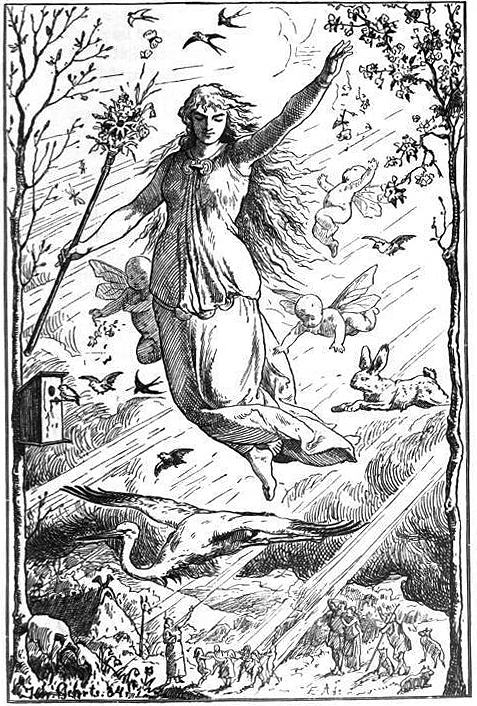
Ostara by Johannes Gehrts
After Constantine decided to Christianize the Empire, Easter was changed to represent Jesus.
Hey! Guess what language Constantine, the Roman Emperor, spoke? Not English, that’s for sure! In fact, when he was alive, English didn’t even exist yet. He would have spoken Latin or Ancient Greek, so would likely have referred to Easter as Pascha or Πάσχα.
But at its roots Easter (which is pronounced Ishtar) was all about celebrating fertility and sex.
Look. Here’s the thing. Our Western Easter traditions incorporate a lot of elements from a bunch of different religious backgrounds. You can’t really say that it’s just about resurrection, or just about spring, or just about fertility and sex. You can’t pick one thread out of a tapestry and say, “Hey, now this particular strand is what this tapestry’s really about.” It doesn’t work that way; very few things in life do.
The fact is that the Ancient Romans were smart when it came to conquering. In their pagan days, they would absorb gods and goddesses from every religion they encountered into their own pantheon; when the Roman Empire became Christian, the Roman Catholic Church continued to do the same thing, in a manner of speaking.
And do you know why that worked so well? Because adaptability is a really, really good trait to have in terms of survival of the fittest (something I wish the present-day Catholic Church would remember). Scratch the surface of just about any Christian holiday, and you’ll find pagan elements, if not a downright pagan theme, underneath.
Know what else? Most Christians know this. Or, at least, most of the Christians that I’m friends with (which is, admittedly, a fairly small sampling). They know that Jesus wasn’t really born on December 25th, and they know that there were never any actual snakes in Ireland, and they know that rabbits and eggs are fertility symbols. But they don’t care, because they realize that religions evolve and change and that that’s actually a good thing, not a bad thing. The fact that many Christian saints are just re-imagined pagan gods and goddesses doesn’t alter their faith one iota; because faith isn’t about reason or sense, it’s about belief.
Look, go ahead and debate religion. Go ahead and tell Christians why what they believe is wrong. That’s totally fine and, in fact, I encourage it. A little debate and critical thinking are good for everyone. But do it intelligently. Get to know the Bible, so you actually know what you’re disagreeing with when you form an argument. Brush up on your theology so that you can explain why it’s so wrong. And have some compassion, for Christ’s sake – be polite and respectful when you enter into a debate, even when the person you’re debating with loses their cool. You want to prove that you’re better, more enlightened than Christians? Great, do it by remaining rational and level-headed in the face of someone who’s willing to stoop to personal attacks. To behave otherwise is to be just as bad as the people you’re debating.
Anyway, I hope you guys have a fantastic long weekend, no matter how you spend it. If your holiday involves chocolate, then I hope you enjoy that. If not, just enjoy the extra day or two off work and the (hopefully) warm weather. No matter what you believe in, I think that we can all agree that the end of winter and the rebirth of spring is worth celebrating.
And also? Richard Dawkins? You need to fact-check yourself before you fact-wreck yourself. Spreading this kind of misinformation to your foundation’s 637,000 fans is just plain irresponsible, especially coming from someone like you. Get with the program, buddy.
ETA: The post now seems to be removed from The Richard Dawkins’ Foundation for Science and Reason’s FB page. Thanks Richard!
ETA Part Deux: Oh. It looks like it was deleted from their timeline but not the photo album. Welp.
*It should be noted that the only actual historical evidence that we have of sacred prostitution comes from Herodotus (I’ve included an excerpt from Herodotus’ Histories below) and no one is really sure how accurate it is. Herodotus is known for making shit up, like giant ants for example. But it makes for an amazing story and people still make the association between Ishtar and sacred prostitution, so I decided to mention it here.
The foulest Babylonian custom is that which compels every woman of the land to sit in the temple of Aphrodite and have intercourse with some stranger once in her life. Many women who are rich and proud and disdain to mingle with the rest, drive to the temple in covered carriages drawn by teams, and stand there with a great retinue of attendants. But most sit down in the sacred plot of Aphrodite, with crowns of cord on their heads; there is a great multitude of women coming and going; passages marked by line run every way through the crowd, by which the men pass and make their choice. Once a woman has taken her place there, she does not go away to her home before some stranger has cast money into her lap, and had intercourse with her outside the temple; but while he casts the money, he must say, “I invite you in the name of Mylitta” (that is the Assyrian name for Aphrodite). It does not matter what sum the money is; the woman will never refuse, for that would be a sin, the money being by this act made sacred. So she follows the first man who casts it and rejects no one. After their intercourse, having discharged her sacred duty to the goddess, she goes away to her home; and thereafter there is no bribe however great that will get her. So then the women that are fair and tall are soon free to depart, but the uncomely have long to wait because they cannot fulfil the law; for some of them remain for three years, or four. There is a custom like this in some parts of Cyprus.
That crack about ugly women was totally unnecessary, Herodotus. I am just saying.
**The first written reference we have for Eostre dates back to the 7th century AD and can be found in Venerable Bede’s Temporum Ratione, in a passage explaining that April was often referred to as Eostremonth:
“Eosturmonath” has a name which is now translated “Paschal month”, and which was once called after a goddess of theirs named Eostre, in whose honor feasts were celebrated in that month.
Jacob Grimm said that he found further evidence of Eostre and her associations with Easter, eggs and rabbits when researching his Deutsches Mythologie, although he was unable to discover any written records about her.
 The Belle Jar
Thank you!! Would have written this myself but didn’t have time.
The web is handy, yet riddled with a lot of misinformation so I find myself off to visit my library friends once in awhile. There are some good facts you have shared here.
Thank you for this article. Lazy half-baked, and downright made-up etymology really annoys me, whether it’s Ishtar=Easter or Osiris=El-Asar-us=Lazarus, etc.
For a well-researched article, with citations, exploding alleged sacred prostitution in the ancient Near East, take a look at:
http://tessdawson.blogspot.com/2011/04/orgies-r-us-sex-lies-and-prostitutes-in.html
Also a comic that gives a pretty good idea of Herodotus: http://www.harkavagrant.com/index.php?id=30
so where does the word East come from or Oost or estrogen ?
The word ‘estrogen’ didn’t even exist until the second half of the last millenium. It derives from the Latin oestrus, meaning ‘frenzy’, a term which has been used to signify a state of sexual desire since Plato’s time. A female animal that is ‘in oestrus’ is thus in season.
Oestro-gen, or estrogen, is thus ‘that which generates the state of oestrus’, just as hydrogen is that which generates water, a mutagen generates mutations, and so on.
There is zero connection to Easter, which is (in English-speaking countries, at least) derived from the name of an Anglo-Saxon lunar month, Eosturmonath. The month was in turn named after a Goddess, Eostre, at least by Bede’s account.
Reblogged this on Sihathor's Open-Air Temple and commented:
Lazy, made-up etymologies and misinformation annoy me, whether it’s Isis-Mery=Mary or Osiris/El-Asar-Us= Lazarus, or in this case, the Easter=Ishtar meme.
I’ve been wanting to write this article myself for a few days now, but lacked the time… thanks for writing it for me, and adding pretty pictures too!
This religion is changes so many times and you have so many versions of the bible that you will never know the truth. You have the choice of choosing a version, but who says its the correct one? All the holidays are becoming a commercial thing just to sell products, symbols etc
Love this piece! I’ve just starting reading your blog and I’m loving it so far. This actually kind of inspired my latest blog post about people sharing this sort of this on Facebook! Nice to see there are more people out there that don’t believe everything they read.
If my education in Medieval Studies and memory serve me as correctly as I believe they do, Bede’s “Ecclesiastical History of the English People” is our only Early Medieval source that mentions the Goddess Eostre. And Bede does not mention anything about Eostre being associated with eggs or bunnies. Eggs and bunnies being associated with Eostre/Ostara is a Modern convention — I don’t think an *improper* one (I’d say the association is fitting), just not an historical one (as far as we know).
Before the time of Christianity’s arrival in England, Easter was celebrated (as a different celebration), although not so much as a ‘getting it on’ time. That was May day, traditionally the day when the young villigers would go out into the forest and stick a phallic Maypole in the ground and dance around it naked until they felt the urge. That was our Spring fertility rite.
You are correct in saying Easter has nothing to do with Ishtar. We didn’t even use the word ‘Easter’ hundreds of years ago, English was quite different. The bunny and egg were druidic pagan symbols of ‘getting it on’ that got merged with Christianity when around 48/49 A.D Christianity arrived on English shores. Christians transposed their religion and celebrations onto the traditional native English ones, which was clever really. Over time the English forgot their native faith.
Christmas trees have no real place in Christianity either, they are pagan symbols of the hope of life. It just so happens that some of them fit in well with Christianity.
As for Richard Dawkins, he just likes to stir the pot for some book sales.
Hello there! I really enjoyed this post, although I think it’s important to point out that any connection between Eostre and Easter is just as dubious as a connection between Ishtar and Eostre. There’s very little evidence beyond a reference made by St. Bede that anyone ever worshiped a goddess named Eostre, and no evidence that the Anglo-Saxons of the British Isles ever had a major festival during the time that became March and April. Ronald Hutton’s “The Stations of the Sun” is the go-to source for all this, but here’s a handy abbreviated account: http://hot-dogma.com/2013/03/29/why-do-we-call-it-easter-a-seasonal-slap-fight/
I agree, an enjoyable post. It is, however, great evidence of how very easy it is to fall into the trap of self-righteous certainty. You might also enjoy this series of articles on the revival of the probably-never-was goddess, Eostre. Of such stuff are myths made, at an ever-increasing pace!
http://cavalorn.livejournal.com/502368.html?thread=7943520
Yes, it’s certainly not true that “most scholars” agree that it’s from Oestre. Most scholars think that was a bit of uninformed folk-etymology on Bede’s part, and that it is ultimately from Sanscrit “uṣas” and related forms, which also are the root of the word “east”.
Actually, the evidence for Easter bunnies and eggs is there, and quite plausible. Here is the article I wrote about this. http://hearthmoonblog.com/eostre-and-the-egg/ And do you really want to throw out all of Bede? Really? Hutton is wrong about so many many things. Real “Trials of the Moon” (you can get it on Amazon) before you go quoting Hutton.
I would also like to point out that the common misconception is that Constantine made Christianity the state religion of the Roman Empire. That is incorrect; Constantine legalized various cult religions that were not recognized by the Empire at the time, including Christianity. It’s not until the following century after his death that Christianity became the sole official religion of the Empire. Also, scholars note that Constantine continued in his role as Pontificus Maximus, practicing sacrifices to various gods/goddesses in the Roman Pantheon throughout his reign. Scholars are starting to believe that he was given a forced deathbed conversion when he was too weak to protest at the end of his life. NB – I was an educator at the Getty Villa in Malibu, CA, and have spent years studying this time period.
You make a compelling statement and your page is esthetically appealing. However, while your tone is appropriate at the beginning of your article, you reveal your own egocentricity as you go along. You generalize all Atheists and Christians to the extent that you are promoting your own brand of misinformation about them.
Thanks for this blog. You’re spot on with this article, although I do wonder where the misogynist/eugenics comment comes from.
Google Rebecca Watson. He was an utter sneering, dismissive, condescending POS to her.
I did Google the Dawkins-Rebecca Watson and read about the incident in question. So Dawkins said something stupid and insensitive on the comments section of PZ Meyers blogroll and Rebecca Watson took offense. (He did clarify his position.) But for this blogger to label him a misogynist (still don’t know where the eugenics comment comes from) seems rather unfair. I’ve read at least ten Dawkins books, and I’ve seen many videos of him as well. I’m sure he has his faults, but I’ve never seen evidence that he hates women or is in favor of eugenics. This blogger wrote a good piece here, but her credibility is seriously undermined by that one throwaway comment in my opinion.
Have I stumbled upon a chick vendetta here?
Yeah I’ll definitely trust the opinions of someone who just used the phrase “chick vendetta” to tell me whether someone is misogynistic or not…
Dawkins is actually pretty famous for being an extreme misogynist – I’m sure that if you’re genuinely interested in knowing more, information about it would be very easy to find through a basic google search. If you’re looking for a direct reference, off the top of my head I would suggest searching for posts about Dawkins on Shakesville.
It is well known that Indo-European peoples likely created much of their pantheon from proto-goddesses, (of which at least one of the main root stems comes from Sumeria.) Ostara is very likely a later derivation of Ishtar/Inanna. The Hittites are a great example of incorporation of neighboring god traditions – by the end of their empire they had 1000+ gods in their tradition. It is really not a stretch that as Indo-Europeans kept migrating west, that they kept their gods in some linguistically-related form.
There is also a well known traditional story of Inanna/Ishtar going to the underworld (Ereskigal’s realm), through 7 levels/trials, being torn apart and put back together again. The Babylonian priesthood reenacted this story in their ascension of 7-level ziggurats. The story of Demeter & Persephone somewhat mimics this prototype myth and is most definitely related to Spring and renewal.
Your lack of depth of knowledge of mythology is the only thing on display here, not a successful debunking of misinfo or attempt at critical thinking.
Agree !
Also.. interestingly enough, the Yezidi people, who have a tradition that carries some elements of ancient Mesopotamian religion from 7000 yrs ago.. guess what they do around this time of year. Paint colored eggs! Hah.
“The fact that many Christian saints are just re-imagined pagan gods and goddesses doesn’t alter their faith one iota; because faith isn’t about reason or sense, it’s about belief.”
Apparently you’ve never heard of St. Thomas Aquinas… or read anything by historians like Dr. Thomas E. Woods Jr.
were there pagans in Ireland that were done in by the christians?
Reblogged this on Under Two Trees and commented:
Jesus Son of Iao, thank you for writing about this!
Either way, whoever you want to attribute it to, we sure as hell shouldn’t be celebrating it at the end of Summer down here in the southern hemisphere…..
Well there is still an entire caste of women in India who are cursed with temple prostitution. Everybody is all so smart and know so much. Whatever. There are more things in heaven and earth than are dreamt of in all your philosophies, Horatio. Yeah, google the hell out of it. Read some books. Channel someone.
I grant that as far as I know you got the facts right.
You accuse the atheists of snide comments, and then you riddle this w/ plenty of your own.
This should have taken about 1/5 as many words as you used. Maybe try being a comedian. Oh an Easter is still ridiculous
No – not snide comments: snide *and wrong* comments.
So you reply with more? WHEN WILL THE SNIDE END *weeping*
The eggs and bunnies are understandable for a spring equinox festival if you know the cycles of nature and seasonal biology, which formed a significant and integral part of ancient seasonal customs. Chicken start their annual laying cycle with the lengthening of days after the winter solstice and hit peak egg production early February (Imbolc, also lambing season) through to early summer. The first baby chicks of the year will often be hatching around the spring equinox, also the first rabbit kittens for the new productive cycle are often born around this time. We are so far removed from our agrarian ancestors, numbed and dumbed by supermarket culture, and have lost our daily connection to the natural world, it’s rhythms and cycles, and thus to the relationships of theses traditional seasonal symbols and their significance.
While studying much Greek and Roman history one possible theory for the temple prostitutes which resonated with reason was that they were provided for soldiers returning from war. It is an initiation of ‘warriors’ back into the community. It was held in the temple because it was seen as a sacred, not temporal, rite. The men transitioned back from killers and conquerors back into being respectable community members as husbands, fathers and neighbours.
We have 2 ancient homonymous goddesses about 1500 miles apart. They share many attributes. Much knowledge of Ishtar was lost in the fire in Alexandria, along with the other precursors to christianity. So it is not out of the question that eggs were part of her fertility rights or even that these were the same goddess carried from an even further ancient time, but it is all speculation.
Thanks for the research, although why it is important which pre-christian fertility goddess Easter comes from when people are mostly just surprised that it is pagan origins in the first place escapes me at the moment.
It’s actually pretty unlikely that there would have been anything about Ishtar in the Library at Alexandria, since it was a library of Greeks texts, collected by Greeks, for use of Greeks.
Actually they also had Hebrew, Aramaic, Latin, Egyptian, and what not text there. They also had active translation facilities to make all that delicious knowledge available to everyone.
This is true, but we don’t have to mourn Alexandria’s library because of lost information on Ishtar. We have tons of it, and all original. Right out of the ground in Iraq.
You are right, there was probably little about her in Alexandria. On the other hand, we have tons of material on Ishtar/Inanna in cuneiform clay and stone tablets and iconography. NONE OF IT has anything to do with fertility.
One of the pillars of Christianity is proselytization. The thing that bugs me–a card carrying atheist –about Dawkins is how completely he sets aside his fundamental belief in science when it comes to religion. Something present in almost every human culture on record might just have a reason to be there. I’m not suggesting that the foundational concepts are true–but that it might –one might say–reasonably be hypothesized that there might be functional purpose for it. If one were to make the same supposition about as common a biological constant–like oxygen exchange as a requirement for animal life–it would be ridiculous to say “it is unimportant.” Christianity is about spreading their words and values to the world. It’s part of being a revealed religion. So it should be no surprise that a religion that is designed to be spread would take on the characteristics of the religions it replaced. Rome-Roman Catholicism; the spare fatalism of lutheranism in northern europe; the simplistic fundamentalism and of American protestantism, the parochialism of Anglicanism, the vocal and mystical strains of Irish christianity. It adapts to the trappings of the culture–but people should be on guard against thinking that there will be adaptation of the fundamentals. It is after all based on a book that is supposed to be inerrant and cannot be amended.
Christmas trees have no real place in Christianity either, they are pagan symbols of the hope of life. It just so happens that some of them fit in well with Christianity.
As for Richard Dawkins, he just likes to stir the pot for some book sales.
Forget the negative people who posted before, good post!
I do wish that you hadn’t reduced the idea of religion not being about rationality etc and attributing it to ‘belief’- for some it is the mere challenge, for others it is about the mystery, for some it is remembering any number of virtues, for some it is the reminder of sanctity and cost and consequences of life, in many ways other than negative ‘ramifications’ etc. It’s easy today to become distracted by the ideology that religion has become, but some Atheism, and you yourself is not much better. We forget that religion was actually the high point of ethics, debate, thought, medicine, law, architecture, calculus, philosophy, art, and even cooking. Pythagoras’ entire mathematical theories were motivated out of religious belief- simply discussing theology in its high forms will lead you into serious philosophy- much of its error is not its intelligence, but it’s inability to draw back to the Socratic- apply it usefully to human life- something Jesus never failed at. Some of our most brilliant minds were Christians, Abelard, Erasmus, Pascal, Aquinas, Augustine, Scotus, Descartes, de Chardin- though some of them have led us into very unfortunate territory in understanding ourselves, this is not the universal case, and some were largely necessary for us to work out our humanity at key moments even despite their errors- and being a complex place, knowledge, without even some of these men’s errors, still came with indispensable accuracy – it’s almost impossible to shut up fundamentalists without Augustine and Aquinas on politics etc, And this doesn’t touch upon those scientific pioneers in science who did devoutly believe, and were motivated by their beliefs to go out and discover.
Otherwise I’m glad for this article you have written, I’ve been blocked by many an atheist sight for simply pointing out that the way they use biblical content is the same way Christian ideologues use it- cut and paste without any context or outside corroboration, which isn’t a rejection of religion it’s a rejection of reality by conceding it to people with a harmful agenda and using it to fuel their own. There’s alot of good prompt here, while I’ve been aware of temple prostitution I’ve never really thought about why it was practiced- however, while you’ve criticised Herodotus, I do believe the emphasis of those seen to be pretty and discharged and those seen to be comely to perhaps be material to the point esp in more unfeeling ancient cultures- permanent offerings to the gods- thinning the ‘un-preffered’ breed culling etc. After some time they must have either starved or become temple staff- harsh, but all the more reason to point out the forces that have civilised our religions, and why other belief systems have died.
No: religion isn’t about belief and the author didn’t claim that. Christianity is about belief, and from its historical body count, it’s clear what a bad idea that is.
One thing that gets left out of the conversation is that the early Christians didn’t call it Easter, nor were there eggs or bunnies. They celebrated the resurrection of Christ. Nothing more. That’s what I am doing this weekend.
2 corrections not mentioned in the replies and an observation:
1) Only Easter Orthodox Christians celebrate Easter on the Sunday after Passover, as you mention. Catholics and Protestants put it on the first Sunday, after the full moon, after the Vernal Equinox.
2) I have never heard anyone accuse Herodotus of invention. He often reports without critique, and perhaps makes inferences from reported details (although not having his notes, we can never be sure). But invention out of whole cloth? No.
While the Dawkins article required your critique, it seems to me you are also somewhat guilty of the smugness of which you accuse him. I’ve always though it’s vulgar “to be right in a triumphant fashion” (splendid phrase of Jorge Luis Borges).
Thank you Geo- those statements needed to be made- and especially your last comment about the last “‘..vulgar to be right in a triumphant fashion” -just adolescent
one-up-man-ship I’d say.
I am a longtime high priest of a Neo-Pagan and Wiccan church yadda yadda yadda (not our official name or deity of course) and I am utterly thrilled and delighted with your little essay about Ishtar (does not equal sign here) Eostre, and your general denunciation of believing all the nonsense one reads on the Internet, and in favor of doing actual research.
But I am upset at your snideness at Herodotus. He has certainly been accused (from the beginning!) of making stuff up, but in fact an awful lot of his lies (even the giant ants and gold) have checked out, eventually. And he often says, “This is what they told me; I didn’t see it myself and it’s mighty unlikely.” But those things often turned out to be true, too. Don’t try to outthink Herodotus! Wiser than the Internet and many times as accurate.
*Groan*
Fighting misinformation with misinformation, I see.
Good job… Pot, please meet kettle.
*slow clap*
hi, i live in Iran, and i’m having the same problem here. that was a very nice writing, andseemed very familiar to me, as if i’ve written it myself 🙂
good luck and keep up the good work!
“And also? Richard Dawkins? You need to fact-check yourself before you fact-wreck yourself.”
I really doubt he makes all the posts on his fan page. Likely some unpaid intern.
Other than that, awesome article.
Hi, you definitely made my day.:) Thanks for this article.
“faith isn’t about reason or sense, it’s about belief.”
So faith has nothing to do with being reasonable or sensible? you shoulda stopped there.
Thank you! Yes, I received the same image and thought “What??!” I went over much the same ground as you a year ago, when writing a poem about Easter. Very interesting, and nonetheless still a wonderful cultural muddle that shows no-one knows their roots anyway! I’m off to eggs and bunnies. In three bounds.
Christians talk like everything they say is just and has been proven but let’s really cut the crap by using common sense. First of all, Jesus, since you insist on that name…didn’t exist in those times because the letter j didn’t exist. He has never heard the name Jesus or Christian before. And the truth about the man has been a mystery since man started giving his own man made stories and ideologies which leaves us with history (his story). The pictures of this man, the last supper and everything is a false. There is no other source from which Easter came from but Ishtar! Just like Christmas, the bible Christians believe talks about the heathens (jeremiah 10) but Christians will find some way to debate truth with falsehood and spooky stories. The stories of Ishtar and Nimrod are the same as Jesus and Mary. Wht about the ancient king of Sumer?
History shows us that the Roman church slaughtered a lot of people in the name of the religion you all preach about. A religion that has enslaved, murdered and raped the people of god! The bible is full of symbols one has to research in order for half of the truth. And it then contradicts its own self! What do trees and Santa have to do with the birth of Christ, who wasn’t born in the winter? Eggs and a rabbit? Christians thank and worship Jesus when the bible clearly says, “worship no one but god”. He is not god! There is not an ounce of information that proves these holidays come from some other source besides Babylon. Christians can only talk good but cannot prove wht they believe in. Only come up with some brainwashed ideology of what they want it to be. This isn’t even the tip of the iceberg. Whatever I decide to speak on will be supported with facts. You spoke about facts but put your own twisted believe on where they come from. I have one question…when you pray to god, or Jesus, who do you picture? The one you have seen on pictures all of your life I’m sure, a white man! The bible does not describe him as white but that is the picture we all were forced to see. A lie! Nothing you can say can justify why all of these depictions are false. They are because that god and the true living god are not the same. The world will partake in her sins America! America is trying to make the world partake in her sins! Christianity is new, so what makes it right?
Those people are all on point with the talk about the ancient people of Sumer
>There is no other source from which Easter came from but Ishtar!
Okay, drag out that “common sense” you mention, and explain to me why the word “Easter” which is only used in English and German (“Oster”), would derive from a far more ancient and very distant Mesopotamian goddess name. You know that most old/middle English people probably barely knew what Mesopotamia was, right, much less be so interested in their goddesses as to use their names for holidays? Lol your common sense may be common, but has no sense. And maybe learn to focus on one topic at a time and respond to the points actually made in the article (ah but then you’re more evangelical about atheism than most evangelical Christians I’ve known are about Christianity, and you can’t go three minutes without trying to disprove Christianity, can you?)
I don’t have the least clue where my great great great great great great great great great great great great great great grandmother in the maternal line lived. I still carry the same mitochondrial DNA. The Anglo-Saxons didn’t have to know anything about Mesopotamia to have Mesopotamian influences in their language. The same influence was there in the word “East” too, also associated with dawn or new light.
Of course, it’s probably a blunder to think that the celebration and the word are in any way connected. They’re probably about as connected as holly and decorated trees are to the etymology of “Christmas”.
Reblogged this on A Heathen's Path.
Ok so essentially your point is “Their entire premise is correct but they used the wrong pagan goddess?” LOL I wouldn’t exactly call that “rife” with misinformation. Based on your introductory paragraph I was waiting for something that actually disproved their point vs. just saying they inserted the wrong pagan deity’s name.
i’m a fan of Dawkin’s evolutionary studies and debates, but the claim of eugenics and misogyny is unfounded. libelous even.
I am not a great fan of Dawkins’ approach but even I have not found him misogynist. Whence has this claim come?
That Ishtar post on FB was driving me nuts. Here’s a clue, if it is unsourced its value is that of the electrons which make up the image (not much). And by unsourced I mean not provided with a checkable reference to a reputable source – which is to say, someone in an appropriate field of study (e.g., Richard Dawkins isn’t an archaeologist, linguist, historian, or comparitive religions scholar).
Actually, Easter isn’t necessarily celebrated the week after Passover. The date of Easter used to be attached to the date of Passover, but that was changed in 325 C.E.. Easter Sunday is now calculated by making it the first Sunday after the first full moon after the Spring Equinox.
More or less. There are problems with the calculations that the Church used to set the date of Easter, which are discussed here:
http://www.cbc.ca/news/technology/story/2013/03/28/hamilton-easter-moon.html
Easter should come from pagan idols or celebration of north-european people. The actual name is Pascha (Pascoa) from hebrew Passeah as you mentioned. Nothing related to babilon gods or goddess.
Thanks for this post. I too share your irritation towards these sort of “memes” that are spreading so easily in the social media. Still, I must point out, that although I also share your irritation towards Richard Dawkins, making an off handed remark about him being “well known eugenics enthusiastic” is just silly and not true. Misagonystic, unfortunately yes (like almost every other priviledged middle-aged white male), but pro-eugenics? I think nothing can be further the truth. Anyway, when writing a post about getting your facts right, then the writer should also get the facts right, right? But thanks anyway, it was a good reading.