Tag Archives: theo

Motherhood (or, a few things that I’m ashamed to admit)

3 Nov

Sometimes I wonder if I was meant to have kids.

Don’t get me wrong, I love Theo. I really, really love him. He is the greatest. I mostly can’t imagine what my life would be like without him. So let’s be really clear on all that stuff right now.

But sometimes I just wonder if I’m really cut out to be a mother. Like, I think I might just have the wrong personality for it?

It’s not that I think that I’m a bad mother; I think that I’m a loving, attentive parent. When Theo’s around, I spend my time interacting with him, reading and playing and doing puzzles. We sing songs and give each other high fives and plan our imaginary trip to France (or at least, Theo points out France on the globe and yells out Mimi! Mimi!, the name of the French teenager who used to babysit him, while I tell him how great the shopping and dining are). It’s fun, I guess, but I’m just not sure I really get enough joy out of all this. I mean, I am supposed to enjoy it, right? Not just endure it?

I do enjoy some of it, of course. But a lot of it is mind-numbingly boring. Are mothers supposed to find their kids boring? Jesus, I mean, I sound pretty awful here, don’t I?

In many ways, this age is a lot easier than when Theo was an infant. But when he was pre-verbal, I could at least pretend that we were interested in the same things. Lecturing him about feminist rhetoric or telling him long, complicated stories about my favourite historical figures would earn me the same look of wide-eyed interest as reading Goodnight, Moon or singing him the alphabet song. As long as I kept up that sing-song baby voice, or used funny accents, I was golden. The Second Sex, in case you were wondering, sounds great when you alternate between a crisp upper class British dialect and a slow southern drawl. Now that Theo is talking, though, he has definite opinions on what he does and doesn’t like. For instance, he’s really into tractors; unfortunately for me, he’s not so much into Henry VIII.

I tell myself that it will get better. It’ll be easier when he’s older, when I can really teach him about the things I love, like history and science and bad 80s sitcoms. I like that kind of thing; even now, I love taking him places where he can learn something new. For example, he’s probably the only 21-month-old who can point out the lute at the local museum. As soon as he sees it, his eyes light up and he starts shrieking, lute! lute! like a maniac. We talk about how the lute is a lot like Matt’s guitar, and how people used to use it to make music; he seems to understand, and my heart swells when I realize how many new things I help him learn on a daily basis. I think I’m good at that kind of thing, you know? I mean, lute-splaining in particular but also teaching things in general.

Much of the rest of parenting I just find to be grinding and dull, and I feel like I spend a lot of my time alternating between trying to find ways to keep Theo entertained and following him around saying, no, no, no, stop as he attempts to destroy my house. Mealtimes and diaper changes often turn into a power struggle, and by the time they’re over I nearly always feel like a total pushover, and then wonder whether or not my tendency to give in way to easily will result in my kid being a spoiled brat. When I’m home alone with Theo, more often than not I’m counting down the minutes until Matt walks through the door. On weekends, when my friends are making all kinds of fun plans, I’m envious of their freedom and spontaneity. When Monday rolls around, I’m thrilled to be able to pack him off to daycare, and I celebrate by having a quiet coffee all by myself.

One thing I hear a lot about mothers who have nannies for very young children, especially live-in nannies, is, why did she even have kids if she doesn’t want to raise them herself?

I wonder what they would say about me if they knew the truth.

I always thought that I wanted more than one kid, but now I’m not so sure. I’m not sure I ever want to be pregnant again, and I dread the possible recurrence of postpartum depression. And to be honest, I found having an infant really fucking hard all on its own; I honestly can’t imagine what it would be like to have an infant and a toddler. I get tired just thinking about it. I know friends who have done it, friends with two or even three young children, and they make it seem easy. When I look at them, though, I think, better you than me, buddy.

I guess I might just be too selfish to be a mother, or maybe too lazy. It’s possible that I value my quiet personal time way too highly; it’s possible that I flat out don’t have enough patience or endurance for this type of thing. Whatever it is, it’s something that’s wrong with me, not with Theo.

I love Theo with all of my heart. I love him so much, often more than I ever thought possible.

I just don’t always love how he’s changed my life.

On Childbirth And Bodily Autonomy

29 Oct

A friend of mine recently gave birth. She’d planned on have a natural, drug-free childbirth, but instead wound up having an emergency c-section. After 30 hours of labour, her son’s head still wouldn’t (or couldn’t) engage, and his heart rate started to plummet frighteningly low. After a few minutes of discussing their options with her midwife and the on-call OB, they decided that a caesarean was her best option.

Her son was born not long after that, a whopping 9 pounds 5 ounces, with a full head of dark hair. He was beautiful and healthy, but instead of feeling as if she’d made a decision that could potentially have saved his life, she felt as though it had been her fault that she’d had to have a c-section. She thought that if she’d just somehow tried harder, or prepared better, she could have had the birth she’d wanted.

I talked to her a few days after her son’s birth, and, of course, asked how she was feeling. “I feel like I failed,” she said, sounding as if she was about to cry. “My son is only a few days old and I’ve already failed him.”

I knew what she meant, because I’d been there. When I’d found out that I would have to have a caesarean, I also, irrationally, had felt as if it was my fault, as if I was already failing my son. I still feel weird about my son’s birth, even now, nearly two years later, or rather I feel like other people are weird about it. I can’t tell you how many times I’ve had someone ask about my childbirth experience, only to shut down the whole conversation when I tell them I had a planned c-section. I often get the sense that other people think that I haven’t really given birth, or that I’ve taken the easy way out.

If you don’t have kids and/or haven’t spent a billion hours on the internet debating all things baby, you might be wondering why natural childbirth is such a big deal. Why does anyone even care?

For starters, giving birth without drugs or interventions means that you and your child will not have to experience the side effects of sedation or the potential harm from invasive procedures. Babies born naturally are more alert, which will make bonding and breastfeeding easier. Plus, not having an epidural means that you can get up and walk around during labour, or find the position that works best for you when it’s time to push. Without drugs, the mother’s recovery will be faster, and she can often leave the hospital the same day, if she wants to. And, of course, there’s the persistent idea that childbirth is more of a “real” experience if you are able to feel every sensation associated with it.

Many people advocate for natural births these days; even the nurse who taught our prenatal class was pretty anti-epidural. Part of this comes as a backlash against the medical model of childbirth, which, not that long ago, saw women in labour being put into a Twilight Sleep, a drug-induced state in which women were conscious but not lucid, and, though these women still experienced pain, were not able to remember it afterwards. In many ways, natural childbirth is an attempt to reassert control over our own bodies; to tell the doctors (most of whom were and are still men) that pregnancy is not a disease, and should not be pathologized. Another part of  the desire for drug-free childbirth comes from the assumption that “natural” is better, or from the idea that our bodies are designed to give birth without the aid of drugs or interventions.

Unfortunately, it’s hard to have a natural birth, and I don’t just mean the physical pain and exertion associated with drug-free childbirth. Hospitals make many people anxious, and trying to give birth while surrounded by beeping machines and scary-looking medical equipment is challenging, to put it mildly. On top of that, you have a regular rotation of people coming in and out of your room, wanting to check how far you’ve dilated, what your heart rate is, what the baby’s heart rate is, and a whole laundry list of other stuff. So giving birth in a hospital setting isn’t exactly conducive to that whole Mother Earth Goddess ideal that many of us hold.

So why not give birth at home? Good question. The answers range from being worried about not making it to the hospital in time if there are complications to not want to have to be bothered cleaning up the mess afterwards, and everything in between. One response that I hear very frequently form Ontario women is that they weren’t able to find a midwife; this was my experience as well.

When I had my first prenatal visit with my family doctor, I was eight weeks pregnant. She asked if I’d thought about how I wanted to give birth, and I told her that I wanted a midwife rather than an OB. She looked at me like I was crazy, and said that there was no way I would be able to find a midwife this far into my pregnancy. But I’m only eight weeks! I said. Technically I’ve only been pregnant for six weeks, if you take into account the fact that the first two weeks of  a 40 week pregnancy happen before a woman ovulates.

My doctor just shrugged and said that there weren’t enough midwives in Ontario, then asked what hospital I wanted to deliver at. When I told her, she frowned and said, Oh, I don’t know if we’ll be able to get you into Mount Sinai this far into your pregnancy. I honestly thought that she was exaggerating, but it took three referrals before we were able to find an OB at Mount Sinai who was still taking patients for my due date.

That was how I learned how insanely competitive giving birth is in Toronto.

There are 540 registered midwives in Ontario, serving a total population of 12,851,821. 1 in 10 births in this province are attended by midwives; 4 out of 10 pregnant women in Ontario would like a midwife but can’t get one. That obviously makes having a midwife-assisted birth in general, and a home birth in particular, pretty challenging. Which, as I said above, can make having a natural birth difficult or even impossible.

That being said, you would think that the natural birth community would be pretty understanding of the fact that most women still end up using the medical model of childbirth. While I would say that the majority of us are pretty chill no matter how your kid comes into the world, there seem to be a lot of people passing judgment on how women give birth.

It’s bad enough that some proponents of natural childbirth make women feel as if they’ve “failed” if they end up having unplanned interventions, but that’s nothing compared to their treatment of women who know ahead of time that they want an epidural, or those who choose to have a planned c-section. The funny thing is that these are often the same women who are very pro-choice and will throw around the phrase “my body, my choice”.

Well, is it our choice, or isn’t it?

It’s different, they’ll argue, when there’s a wanted child involved. It’s not your body anymore. You need to act in the child’s best interests. They’ll send you scary news articles, like this one, which references a study showing that children born before 37 weeks are 5 times as likely to have autism. That particular article is one that someone sent me when they found out I was going to have a planned c-section at 36 weeks; when I told her that the article had upset me, she said that she wasn’t trying to be mean, just giving me the “facts”.

Here are the facts: if I had had a natural childbirth, my son could have died. If my pregnancy had progressed past 36 weeks, my doctor felt that there was a good chance that my water would break, which could have lead to an umbilical cord prolapse, which would have meant death or brain damage to my son.

The thing is, no matter whether or not you are carrying a child, it’s still your body. You still have bodily autonomy. I’m not saying pregnant women should go out and do lines of coke chased by vodka shots, but I do think that we need to allow women to make choices regarding childbirth without judging them.

The argument that I hear most from people decrying women who choose the medical model of childbirth is that they’re selfish. They want an epidural because it’s easier for them. They want a c-section because they don’t want to have to go through labour. They’re planning to be induced at 39 weeks because they want to skip out on the last week of pregnancy. If these are thoughts that you enjoy thinking, here’s something I really, really want you to keep in mind: you do not know the whole story.

You don’t know why someone wants an epidural, I mean, not really. You don’t know why they might want a c-section. Sure, they might give you a reason, but what they tell you may not necessarily be the whole truth. They might have a medical condition that indicates a c-section, or they might be a survivor of sexual abuse and feel triggered by the idea of a vaginal birth. Or they might just not want to have a natural birth, and that’s okay too. Know why? Because bodily autonomy, that’s why.

The thing that frustrates me the most about this judgmental behaviour is how purely anti-woman it is. It stems from the idea that most women aren’t capable of making decisions regarding how they want to give birth. It assumes that a woman who chooses to have a planned c-section hasn’t done her research, has been brainwashed by the medical establishment, or is uneducated when it comes to birth options. It plays into the idea that women are irrational, thoughtless and downright selfish. It promotes the idea that, being left to our own devices, we will make choices that are harmful to us and our children.

These are the same ideas that lead to the body policing that many pregnant women have to endure. We’re told to eat more, but not gain too much weight. We’re cautioned not to exercise too hard, but also to stay fit and healthy. We have people watching every bite we eat, and I even know someone who was denied service at Starbucks because the barista didn’t think that she should have caffeine. When are we going to let women be responsible for their own bodies?

Look, I’m all for natural childbirth. That was what I wanted when I was pregnant with Theo, and if I ever have another child, I would like to try for an unmedicated VBAC. But that’s my choice, based on research that I’ve done and what I’ve heard from friends. If another woman makes a different choice, then I’m sure as hell not going to tell her she’s wrong. Your child’s birth is one of the most important days in your life (I mean, probably, right?), so why would you want to make someone feel bad about how theirs went down? Shouldn’t we be celebrating the fact that we all went through hell, in one way or another, to bring our children into this world?

I think a big part of the problem is that we still haven’t really figured this childbirth stuff out. We still don’t know what works best for us, both as individuals and as a society. The medical model of childbirth has seen the infant mortality rate decline 90% in the last hundred years, and the maternal mortality rate has declined by 99% in that time. On the other hand, within that medical model women still feel as if they are being bullied into interventions and procedures that they don’t want, and often come out of childbirth feeling as if they were coerced into accepting “help” that they felt they didn’t need.

I don’t know what the answer is, I really don’t. More midwives, for a start. Better education about birth options and the possible complications of interventions would also be good. Above all, though, I think we need to put more trust in women. I think we need to allow women to make more of their own choices, and we need to believe that they are capable of making the right choices, not just for themselves, but for their children.

I Hate Hallowe’en

12 Oct

I have a confession to make. It’s not a super-secret-feelings confession, or a oh-my-god-politics-feminism-whatever confession, or anything cool like that. It’s this: I hate Hallowe’en.

Everyone I know loves Hallowe’en. They start planning their costumes weeks, even months in advance. They have parties and events lined up for October 31st, and often begin celebrating several days before. They glory in the chance to be someone else, to go out and see friends, to gorge on candy, and above all to have fun.

Meanwhile, back at the ranch, I’m sitting alone, uncostumed and super jealous.

I can’t remember the last time I had fun on Hallowe’en. Maybe it was sometime in university? Maybe high school? Maybe kindergarten? Who can say, really. I haven’t even bothered dressing up for the last few years. When someone starts to tell me about their awesome costume ideas, I just glower at them. When they tell me about all the fun parties they’ll be attending, I pointedly say that I have plans to stay home and do my nails. I am the Hallowe’en equivalent of a grinch, whatever that might be.

Part of the problem is that I’m not sure how to do Hallowe’en as an adult. I guess I’m just not sure what the point of the holiday is? I mean, yeah, you get the chance to be someone you’re not, which sounds great, in theory, but never seems to work well for me in practice. My costumes always end up being half-assed, uncomfortable and too obscure, so that I spend the whole day adjusting my hair/dress/tights/whatever and explaining over and over who or what I’m supposed to be. Parties always end up being too big and filled with people I barely know or don’t know at all, which is kind of a social nightmare for me.

On top of all that, I have some kind of Hallowe’en curse that means that something shitty always happens on Hallowe’en. The most memorable one was the year my ex-boyfriend kissed me on the dance floor at a bar and, when I asked for an explanation, promptly fled. Being the rational person I am, I followed him. This resulted in me running around Halifax’s North End at midnight dressed as Jackie O., yelling that he would have to talk to me eventually so he might as well just turn around and get it over with.

I hate Hallowe’en.

This year, Matt and I have been talking about doing costumes again, but really, what’s the point? We’re not doing anything on the 31st other than taking Theo out trick-or-treating and then stealing all his candy afterwards. Matt will dress up for work because they have some kind of contest, but I will probably just bundle my grinchy self up in a giant sweater and when people ask me who I’m supposed to be, I’ll yell that I’m dressed as an exhausted yoga teacher/mother/writer who can’t get her shit together.

All joking aside, I feel like this is something that I can (and should) overcome, possibly with copious amounts of booze and candy corn. I’m hopeful that having a kid will remind me of why I used to love Hallowe’en so much – I really want to start enjoying it again, I swear. I want to be out there having just as much fun as the rest of you, but I think I need help.

For those of you who love Hallowe’en (so, basically all of you) – what do you get out of it? Why do you dress up? Any tips on how to stop being such a killjoy and start getting into the spirit of things? Most importantly: what the hell should I dress up as?

Dressed up as Frida Kahlo in 2006, which is the last time I bothered thinking up a Hallowe’en costume

Bullying Part III (or, all hail Margaret Atwood)

10 Oct

This will be the final instalment of my totally unplanned Bullying Trilogy (seriously, it started out with me just wanting to talk about clothes).

After I made my last post talking about how I was bullied in my teens, my friend Audra asked if I’d read this 2011 article from New York Times, Bullying As True Drama. In fact, I had read it when it first came out and hadn’t really given it much thought. Re-reading it, though, I found myself nodding and muttering, yes, yes, yes under my breath.

So much of this article hits home for me. This part, for instance:

Many teenagers who are bullied can’t emotionally afford to identify as victims, and young people who bully others rarely see themselves as perpetrators. For a teenager to recognize herself or himself in the adult language of bullying carries social and psychological costs. It requires acknowledging oneself as either powerless or abusive.

Or this:

While teenagers denounced bullying, they — especially girls — would describe a host of interpersonal conflicts playing out in their lives as “drama.”

At first, we thought drama was simply an umbrella term, referring to varying forms of bullying, joking around, minor skirmishes between friends, breakups and makeups, and gossip. We thought teenagers viewed bullying as a form of drama. But we realized the two are quite distinct. Drama was not a show for us, but rather a protective mechanism for them.

And especially this:

“Teenagers want to see themselves as in control of their own lives; their reputations are important. Admitting that they’re being bullied, or worse, that they are bullies, slots them into a narrative that’s disempowering and makes them feel weak and childish.”

Like I said in my last post, bullies can smell a victim. The minute that you admit to yourself or to others that you’re being victimized, then I guarantee you that, barring serious intervention, the bullying will get worse. To make matters even more difficult, many kids (and adults) don’t realize that they’re bullies; this behaviour is so ingrained in our culture that it seems downright normal. I’m certain that most of the kids inflicting “drama” on others have, at some point, been on the receiving end of “drama”. To them, it’s an unpleasant but ultimately unavoidable part of life.

We also need to realize that the ways in which bullying happens have changed; it often occurs online, or through texting; it’s not always public. This, then, is where I think David Dickson, chairman of the Bullying Prevention Initiative of California, really misses the mark with definition of bullying as happening, “typically in a social setting in front of other people“. That definition certainly doesn’t hold true today; in fact, I’m not sure that it’s ever been accurate.

One of the best literary instances of bullying that I can think of is the torment that Elaine Risley goes through at the hands of her so-called “best friends” in Margaret Atwood’s Cat’s Eye. Though all three of her friends are party to the bullying, few outside of that group know what’s happening. In fact, Elaine is pretty clear about the fact, were she to tell anyone about being bullied, she would feel as though she were breaking some kind of sacred code:

“Whatever is going on is going on in secret, among the four of us only. Secrecy is important… to violate it would be the greatest, the irreparable sin.”

A few adults in Elaine’s life seem to have some inclination as to what’s going on; she hears the mother of one of her friends saying that she deserves to be bullied because she’s a “heathen”, and, several years after the bullying occurs, Elaine’s mother makes a vague reference to the girls giving Elaine a “bad time”. Those instances aside, none of the grown-ups seem to know or understand the severity of what’s happening. The three girls are at Elaine’s school, and one of them is even in her class, but none of the teachers seem to notice that anything is amiss with their relationship; even her peers see only a group of “best friends” and nothing more.

Based on all the above, I wouldn’t say that Elaine’s bullying is public; in fact, her tormentors are very careful to maintain the façade of friendship that they’ve built up. Does that mean that it’s not bullying?  Elaine is certainly emotionally, mentally and physically scarred by what she’s going through; not only are her self-confidence and happiness eroded to the point of non-existence, she also begins experiencing symptoms of severe anxiety such as fevers, stomach aches and tendencies of self-harm (among other things, she begins biting her fingers, and pulling patches of skin off her lips and the soles of her feet).

Another important thing to note is that, much like the girls mentioned in the Times article, neither Elaine, her friends, nor the adults in her life ever use the term bullying. Instead, they use euphemisms like giving her a hard time. At one point Elaine’s mother even tells her not to let the other girls push her around, and not to be spineless, as if that’s any kind of helpful advice. So the message that Elaine receives both from her “friends” and the adults in her life is that the way she’s being treated is her own fault.

This, then, helps explain why, when the balance of power shifts between Elaine and her “friend” Cordelia,  Elaine begins to bully her back. While Cordelia spent most of grade school bullying Elaine, Elaine turns around and spends much of high school treating Cordelia equally terribly. In her mind, though, she’s not a bully; she can’t be, because, in Elaine’s eyes and the eyes of the world, her “friends” from elementary school weren’t bullies either.

At one point, when things are at their worst, Elaine’s mother says to her,

I wish I knew what to do.

And that, that right there, is often the hardest pill for both adults and teenagers to swallow – the fact that when bullying or “drama” occurs, the adults involved often just don’t know what to do.

I’m going to go out on a limb here and guess that part of the reason teens started using the term “drama” to sort of re-brand bullying was the realization that, possibly for the first time in their lives, the adults around them had no clue how to stop them from hurting. So the term “drama” isn’t just a protective mechanism for the kids themselves; it’s also their way of protecting their parents and teachers, a way of reassuring them that it’s okay that they have no idea how to help because it’s nothing, just drama, and their help isn’t needed.

Matt and I were both bullied when we were younger, and because of that we’ve talked extensively about what we would do if Theo was ever bullied. I would like to say that we’ve come up with an awesome plan but, really, we haven’t. If things were ever to get really bad and Theo were to express a desire to change schools, Matt would prefer to go ahead and do that, whereas I would rather that he learn to work things through with his peers rather than running away. Of course, Matt doesn’t know what he would do if things were equally bad at Theo’s new school, and I have no idea how Theo is supposed to learn to rationally work things through with a bunch of hormonally-crazed teenagers.

I think, though, that at the end of the day that Times article has it right; instead of focussing on the “negative framing” of bullying, we need to work towards teaching our kids what healthy peer relationships look like and how to be good digital citizens. We need to teach our kids empathy and the ability to recognize when “drama” has gone too far. We need to find ways to empower our kids instead of making them feel weak or victimized.

I know, I know, this is a lot of talk without a lot of substance to back it up, but hey – I’ve hopefully got a few more years to figure it out. And while I’m teaching Theo how to be a smart, confident, independent person, I’ve got him to teach me how to be a thoughtful, wise and effective parent. So far, I think we’re both doing a pretty okay job.

Failure Is Easy (And Sometimes Success Fucking Sucks)

4 Oct

I did a teaching demo today for the owners of a local yoga studio. It was an amazing opportunity – their space is beautiful, they have a ton of teachers that I love and respect on their schedule, and it’s walking distance from my house. I’ve known the two owners for nearly a year, and they’re wonderful women – both are amazing instructors who have a quiet, gentle presence that would put anyone at ease.

Needless to say, I was fucking petrified.

I started out by nervously giggling my way through a short interview, and then spent a few minutes fumbling around with the audio system, trying to get my music to play and hoping that the trembling in my hands wasn’t obvious. I’d planned and reviewed the sequence that I was going to teach, so fortunately I didn’t forget it or anything, but my voice had gone strangely squeaky, and I could tell that my breathing was shallow. After a few minutes, though, I hit my stride and started to feel more confident. After all, I teach several times a week, right? I know how to do this.

Right?

Afterwards, they smiled at me, and told me what a lovely teaching voice and style I had, mentioned that I’d given excellent cues and had clearly been well-trained, and finally said that I had a beautiful practice.

Even a three-year-old could have heard this but coming a mile away.

But, one of them said gently, we noticed that you didn’t look at us. Do you ever walk around the room while you teach? Do you ever offer adjustments?

I do, I do, I stammered, I mean, maybe not as many adjustments as some other teachers, but I can do them. I mean, we learned how to. And I can walk around the room while I teach. We did focus on that in our training. Walking, that is, around the room, and not just demonstrating the poses to the students. It was something my teachers talked a lot about.

It must have been hard to teach to us, said the other, it was probably overwhelming to teach to the two owners of the studio.

I was totally nervous, I said. Didn’t you hear my voice shaking?

It was the sort of thing I knew I shouldn’t have said even before I said it, but then it came out anyway.

They talked to me a bit longer about the importance of connecting with your students, of having a relationship with them, and of maintaining an awareness of what’s happening in the room at all times. I said a few thing that probably sounded like feeble excuses. They thanked me for coming in, said that they had no immediate spots available on the schedule, but would keep me in mind for the future. I thanked them a little too profusely for having me in to demo for them (because it’s an honour to even be asked, right?) and then rushed out the door.

I don’t know which reaction to criticism is worse: to tell yourself that what other people see is wrong, that they just don’t understand what you’re trying to do, that they’re the ones with the ones with the problem, not you, or to do what I did, which was to tell myself that I’d flat out failed.

The thing is, they were right. I didn’t look at them while I was teaching. I probably don’t connect with and engage with my students enough. I do need to get up off the mat and walk around the room more often.

I could have said to myself that I would work harder, that I would take workshops on how to give adjustments, that I would get better and be the best teacher possible. The problem with that line of thought is that it seemed overwhelming and exhausting. I was tired just thinking about it.

It was easier to tell myself that I’d failed, that I was a bad teacher, that I should just give up and move on. It was easier to blame myself for not being prepared enough, for not thinking to look at them often enough, or even for scheduling a demo like this before I felt fully confident in my skills.

Failure is easy. Failure means that I get to give up, relax, not be so hard on myself. Failure means that I get to spend more time at home with my husband and son, and less time improving myself. Failure, somehow, means less anxiety.

Success, on the other hand, can be totally scary. With every success comes the idea that you need to build on it, keep the momentum going, continue to grow bigger and better every day. And success, of course, makes every little failure seem all the more bitter.

Every time I write something on here that elicits a reaction from people, that ends up being passed around on Facebook, or generates a lot of comments, I feel like my next post has to be even better. And then if I go a few days without posting anything that gets a big response, I feel like I’ve lost it, whatever it is: the ability to write, maybe, or to communicate effectively, to touch people.

A few things, though:

1. Every post I write doesn’t have to win the Nobel Fucking Prize for Bloggers

2. I am still just getting started as a writer who is writing things for other people, and not just scrawling messy feelings in my diary.

3. I am still a novice teacher; I just graduated in June for Pete’s sake

4. Who the hell is Pete, anyway? Is it Peter like the apostle Peter, the one who became the first Pope?

5. I really hate that dude.

I am a good teacher; I am also a good writer. I have innate talent in both of those areas (I mean, if I do say so myself). BUT (did you see that but coming?), innate talent will only get you so far. The rest of the way to success is hard fucking work. It’s hard work, and the road is never smooth – every time I succeed, it will likely be followed by a few failures, and it will be a while before I get to the point where I feel like everything is settling down and working out the way I want to. Maybe I never will. See? Fucking scary.

People like to say that failure is not an option, except that it totally is. I could totally pack up my yoga mat and go home. And I could justify that decision a million ways: teaching was wearing me out (true!), I felt like I wasn’t seeing my family enough (also true!), I wasn’t sure how to improve or move forward (double true!). Failing would be easy.

But I don’t want to fail.

I don’t want that to be the lesson that I teach Theo.

I don’t want that to be the lesson that I teach myself.

So if you’ll excuse me, I will take my lovely voice, my excellent cues and my beautiful practice and go work on learning how to properly walk around the room. It’s going to suck at first, and I’ll probably screw it up the first few times I try it, but I’ll ride that out and see it through until I get better. And I will get better, because I am a smart lady who can figure this shit out.

My child, even though I am a stupid misogynist and it’s totally my fault women can’t be priests, I will pray for you.

A Few Meditations On Being a Feminist Parent

25 Sep

My kid has a tractor obsession. Like, he goes bananas any time he sees one of the damn things. This bit of information will, hopefully, help explain why I found myself at the International Plowing Match And Expo on Friday with Theo and my mother.

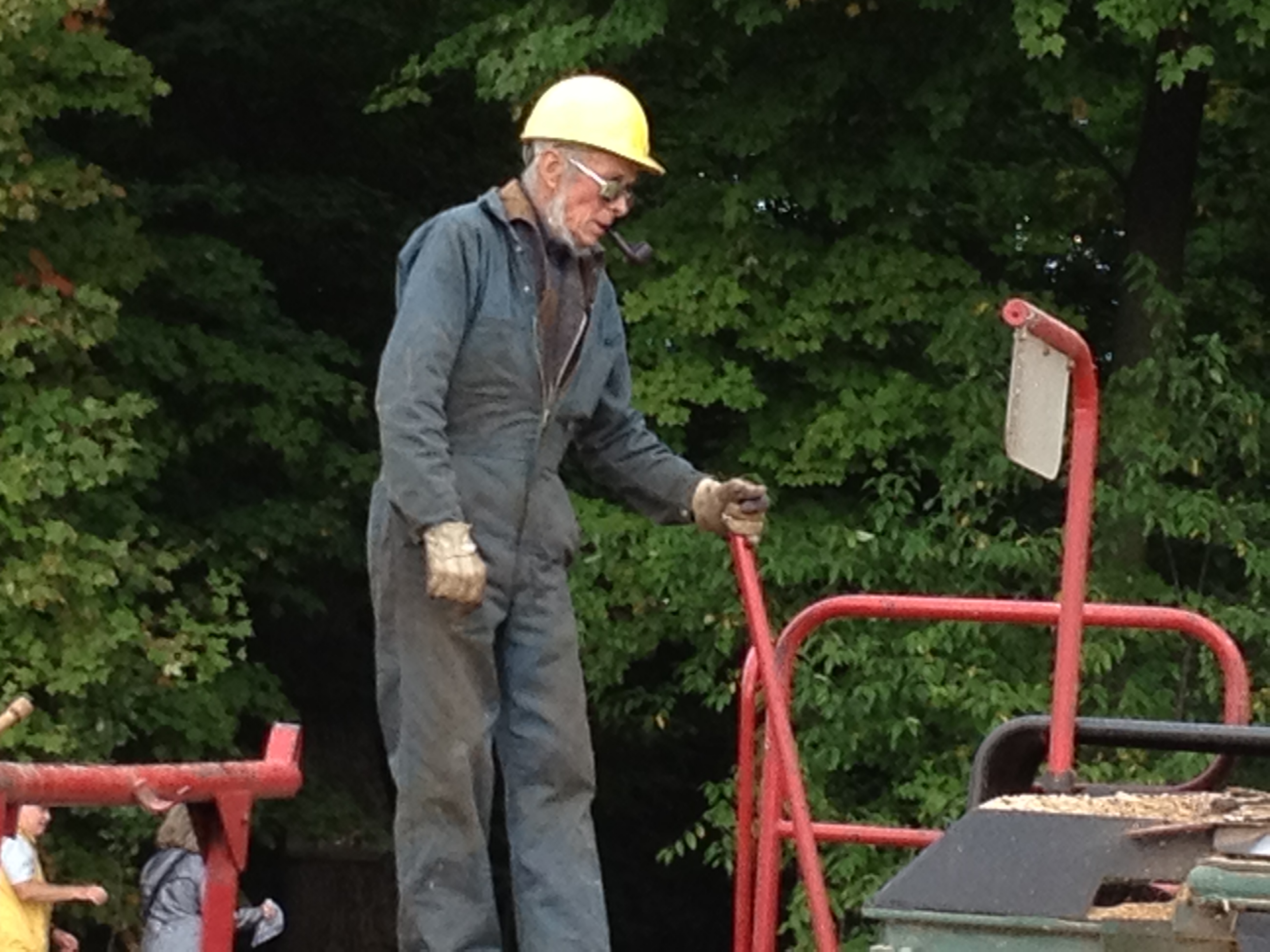
The plowing match was held not far from where I grew up in Kitchener, Ontario, and was filled with men who looked like this:

The pipe is my FAVOURITE PART

It was basically a whole day of mingling with old white farmer dudes, watching people use old-timey plows and admiring farming equipment. In a way, it was oddly comforting, or at least comfortingly familiar – I feel like a lot of my Kitchener childhood was spent around old white farmer dudes, so seeing their mutton chop beards and dingy overalls definitely gave me the warm glow of home.

Anyway, Theo basically had the time of his life. There were so many dang tractors at the show; there was even a tractor square dance. I kid you not. I bought Theo a toy tractor, which he promptly named Go and hasn’t put down since.

That night, after we got back to Toronto, I went over to my friend Caitlin’s place to help her pack for an upcoming move. Afterwards, I texted Matt to let him know that I was on my way home, and asked how Theo was doing.

The response I received was less than encouraging:

Bad. He just threw up.

Theo spent the rest of the night throwing up, and part of Saturday. Weirdly, he seemed totally fine in between bouts of vomiting – he would get ‘er done without much fuss, then run off and go about his business. He was fine all day Sunday, so we brought him to daycare this morning.

Unfortunately, Theo-the-puke-machine turned into Theo-the-poop-machine this afternoon. Which means that one of us has to stay home with him tomorrow.

So here’s where things get tricky: as Theo’s mother, and the person who has been his primary caregiver for, oh, pretty much his entire life, I feel like I should be the one to stay home. But I won’t be, because, as a person who has recently joined Elizabeth Wurtzel’s Club Of Serious Grown Ups And For-Real Feminists, I have to, you know, go to work. Matt’s job is in some ways more flexible than mine, and it was easier for him, in this particular instance, to take the time off.

This made me feel guilty. Because, really, doesn’t a sick baby need their mother most of all?

I’ve been feeling a lot of guilt lately. Granted, we’re only about two and half weeks into Theo’s daycare career, but I’m frustrated that I’m having so much trouble ironing out the bugs in our schedules. The hardest part is that I feel like I barely see him.

In a perfect world, I would only have to work two evenings a week, and would be able to pick him up mid-afternoon most days. In the real world, I’ve had to jump at a few subbing opportunities that have come my way (the first rule for new yoga teachers being Make Yourself Available), and I often find myself coming home before going to pick my kid up so that I can get a bit of housework done before Hurricane Theo returns.

I guess that what it boils down to is, what’s most important to me right now: being with my kid every moment that I’m not managing the studio, or trying to balance my Theo time with my building my career as a yoga teacher time? More and more often, I’m finding that building my career is winning out.

Why? Well, I spent the first nineteen months of Theo’s life devoting the vast majority of my time and energy to his well-being. I’m glad that I did, because that was what worked best for me and my family. But now that Theo is older, and really beginning to assert himself as his own person, daycare seems to be a really good fit for him. He’s excited to go, and he often talks about his friends there: Ella, Anand and Eliana have all come up recently in conversation. Oh, and my favourite, Jonah, which Theo pronounces “Gonad”.

It’s not that Theo and I didn’t have fun when we were home together, but I’ve realized something: this is a tough age for me. I don’t mean that Theo is difficult to be around, or that he’s throwing terrible tantrums (not yet, anyway), but I often find myself unsure of what he needs from me as a mother these days. When he was a tiny baby, it was easy to know what he wanted: me, and plenty of it. When he’s older, and we’re able to have proper conversations, I think I’ll find that easier, too. But this stage, this in-between I-need-you-but-don’t-need-you stage, is tough.

I have a hard time knowing when to inundate him with talking and singing and general in-your-faceness, and when to just let him play quietly. I feel like I spend so much of our time together chasing him away from things he’s not supposed to be touching, and trying to convince him to do whatever it is I want him to do. Maybe I’m kidding myself, but I think that being in daycare for a good chunk of the day makes him more eager to listen to me when he does get home. And instead of spending my time half-assing my way through housework while he desperately tries to get my attention (or dragging myself through it late at night, after he’s gone to bed), I can get it done quickly and easily while he’s not there.

And then there’s the whole work thing: these early days are important for networking, and I need to build a reputation as someone who is eager to work, and able to pick up classes on short notice. I’m creating a foundation for what will hopefully be a solid career. This is something that will, someday, benefit not just me, but Theo, and Matt, and any of our future kids too.

And, finally, it’s becoming increasingly important for Theo to learn that it’s not just mom who’s the solution to all of his problems. As Matt spends more and more time with him, Theo is learning that his father can be just as much of a source of tenderness and comfort as his mother can. He is learning that the world is much bigger than just one person and her boobs, and that people other than mama can be relied on to fulfill his wants and needs. The more time he spends apart from me, the better Theo is becoming at communicating just what those wants and needs are.

You guys, Theo is growing up.

I guess that what I ultimately want to say here is that being a feminist parent is about balance: learning to balance your kid’s needs with your own, and figuring out how that will shape your life. It’s about realizing that you, as a mother, do not need to be the be-all-end-all of your child’s life. You can learn to share the responsibility. You can figure out when to step back and say, I’m going to focus on myself for, like, five minutes and my kid will be just fine.

Most of all, it’s about accepting the fact that you have needs, too, and your kid does not always trump those needs, no matter what some magazine or parenting blog or conservative politician wants you to think.

Now, if only I could beef up Theo’s immune system and get him to stop bringing home these daycare bugs, I would be totally set.

Shameless

23 Sep

On Thursday my piece about girl culture was featured as a guest post on Shameless Magazine’s website.

My response was as follows:

1. Stare blankly at computer screen, totally dumbstruck

2. Run around in circles, yipping excitedly

3. Run down to the store below my studio and tell the two dudes who are working

4. Try to explain to said dudes why I am so excited

5. Send my mother the following email:
MOM MOM LOOK I AM A REAL WRITER CHECK IT OUT
xoxo
Annabelle

6. Receive this in response:

Congratulations. Great Job! Of course you are a real writer. I always knew you were a writer. Love, Mom

7. Go home. Realize that I am really, truly happy. Decide not to do anything about being happy, but instead just sit there and experience it.

8. Put on a pretty dress

9. Pick up Theo from daycare and take him to the park

10. Try not to think about the future

When I say, try not to think about the future, what I mean is: I will try not to stress at this moment about what and where I will be published next. I will try not to worry about writing something amazing, about being The Best I Can Be. I will take this for what it is: pure and unadulterated awesomeness.

Image

Image

Image

This is good. This is good. This is good.

20 books that I hope Theo reads when he’s older, part II

17 Sep

If you liked the first post in this series, maybe you will like this one! Then again, maybe not. There are no guarantees in this life.

So, welcome to part two! Let’s check out the next five books. And again, keep in mind that these are books that I haven’t read in 20+ years, so what I’m giving you is the dominant impression they’ve left on me after all this time.
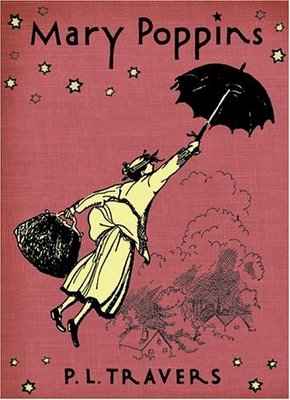
6. Mary Poppins by P.L. Travers, 1934

First of all, the Mary Poppins books (this one is actually the first in a series) are pretty different from the movie. For one thing, there are FOUR kids in the family, not two, and the book is set in the 1930s, not the early 1900s.

Another thing: Mary is a total badass bitch in the books. She isn’t kind or loving, or, you know, nannyish. She’s actually totally domineering and strict, and she’s, like, really, really full of herself. Like, she can’t pass a shop window without looking at her reflection and thinking about how great she is.

Needless to say, the kids adore her.

Of course, Mary Poppins has the same magical abilities in the books as she did in the movie. Unlike in the movie, she totally pretends that she doesn’t take the kids out on awesome adventures. Whenever the kids are all like, hey remember that time we did that cool thing, she’s all, I’M SURE I DON’T KNOW WHAT YOU’RE TALKING ABOUT. She’s ballsy, is what I’m trying to get at here.

There is one line in the book that basically sums Mary up perfectly:

There was something strange and extraordinary about her – something that was frightening and at the same time most exciting.”

And she is kind of scary in the books, which I love. I’m a firm believer in the idea that kids need to encounter frightening things (within safe contexts) in order to learn how to deal with fear. So high five, Scary Mary!
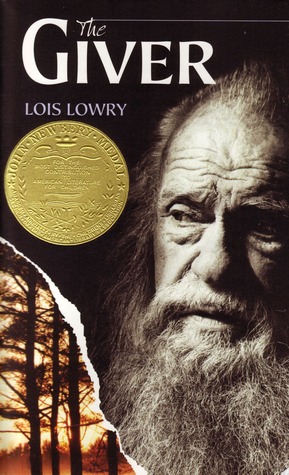
7. The Giver, by Lois Lowry

So! This is the first dystopian book that I ever read. I like to think that encountering this book in my younger and more impressionable years helped set me up for a lifetime of loving this genre.

This book is so creepy, you guys. So creepy. Okay, so it’s the future and the world is totally devoid of anything that might make life tricky, including but not limited to: religion, culture, war, colour, climate, socioeconomic circumstances, and any and all choice, including who your life partner is and what you do for a living.

Oh, and also there is no sex. Nobody has sex in the future. They take pills to repress their sexual urges, and babies are born from women who are assigned the role of “birth mothers”. I’m assuming that these women are artificially inseminated, but what do I know? Maybe there are some crazy, behind-the-scenes orgies happening.

Anyway, the interesting thing about this book is that there were a lot of things about the dystopian world that appealed to me. I mean, everybody seemed pretty happy, right? Pretty content with their lives. And, possibly because so much is provided by the state (food, clothing, etc.) and there is no socioeconomic gap, there doesn’t seem to be any bullying or cruelty between people. I mean, sure, we find out later that part of the reason for this is that if you’re too different, you get released (i.e. euthanized), but still.

Then there’s the whole being assigned your career at the age of 11. Okay, kind of crazy, but also kind of cool? I mean, who hasn’t felt overwhelmed by the fact of having to decide what you are going to do for the rest of your life? I know that when I was in my teens and trying to figure out what I wanted to take at university, and what high school courses I would need to get myself there, the choice seemed incredibly daunting. And in The Giver, it’s not like the career assignments are totally random – the kids are carefully observed by a committee for years before they’re assigned their job. Plus, free education and training!

But then, of course, you start realizing what these people have given up in order to have their safe, happy society. They’ve given up on everything that makes life really good. They’ve given up anything that gives life meaning. And they’ve totally, totally given up feelings, which, while that concept occasionally seems appealing to me, is basically what makes us human. Oh yeah, and there’s also that whole euthanizing-anyone-who-doesn’t-fit-in-and-also-old-people thing. I mean, that part also sucks.

Writing this whole thing out has made me realize that The Giver is kind of a Brave New World junior, which is amazing. It’s a great book to get kids thinking critically, and a good way to introduce them to the whole dystopian genre. What I really hope that Theo takes away from this is that being different is a good thing, feelings are scary but awesome, and the fact that getting rid of all the bad things in the world would likely mean giving up a lot of the good things, too.

Oh, and that killing people just because they’re old is a bad idea. I also hope he learns that.
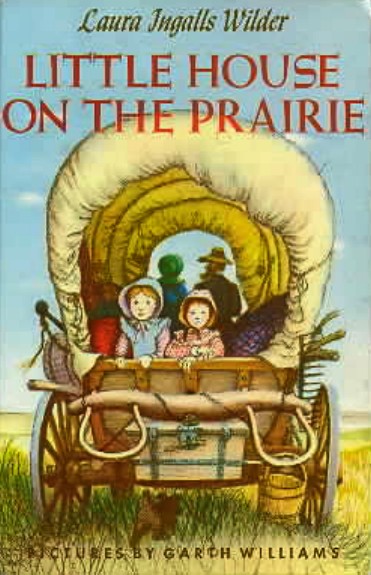
8. The Little House Books, by Laura Ingalls Wilder

These books are the best. The best. I re-read them around the time that Theo was born, and they are just as compelling and entertaining as I remember them being when I was a kid. Possibly even more so now that I understand more about their historical and political context.

There is so much to love in these books. First of all, there’s Laura herself, a smart, adventurous, resourceful girl who often chafes at society’s narrow definition of what women should and shouldn’t do. She spends a lot of time in her younger years being compared unfavourably to her older sister Mary (Mary was blond-haired, blue-eyed and well-behaved, whereas Laura was something of a hellion and, in her own words, “dumpy as a French horse” – whatever that means), but Laura is clearly the cooler of the two.

Then there’s her family, and the description of their daily life from their early days of living in a cabin in the Wisconsin woods, to their eventual permanent home on the South Dakota prairies. I used to daydream about what it would be like to live like that, because when I was seven or eight it seemed super lovely and romantic.

In reality, it was a really fucking hard life. Imagine being stuck on the bleak prairies and seeing only your immediate family for months at a time. Imagine moving there with only a few supplies, having to build your own house and then trying to live off the land for long enough that the government will give it to you for free. Somehow, it doesn’t really hold the same appeal for me that it once did. I guess the Ingalls family liked, it though – they kept at it, and in the end they persevered.

And, somehow, Laura made a lot of it sound like fun.

Finally, there’s all kinds of neat, historical stuff in here. Some of it is totally random and weird – like, in the first book, when they butcher the pig (which is basically like Christmas for them), Pa Ingalls blows up the pig’s bladder like a balloon and gives it to Laura to play with. Some of it offers a historical perspective that I’d never considered before, like when Laura is terrified  to ride on a train because they’re so dangerous. Most of the stuff about their daily life is just downright fascinating.

It’s too bad that this series has been relegated to the land of “girls books”, because, other than the fact that the protagonist is a girl, there’s nothing especially girl-specific about them. I really hope that doesn’t stop Theo from reading and enjoying them.

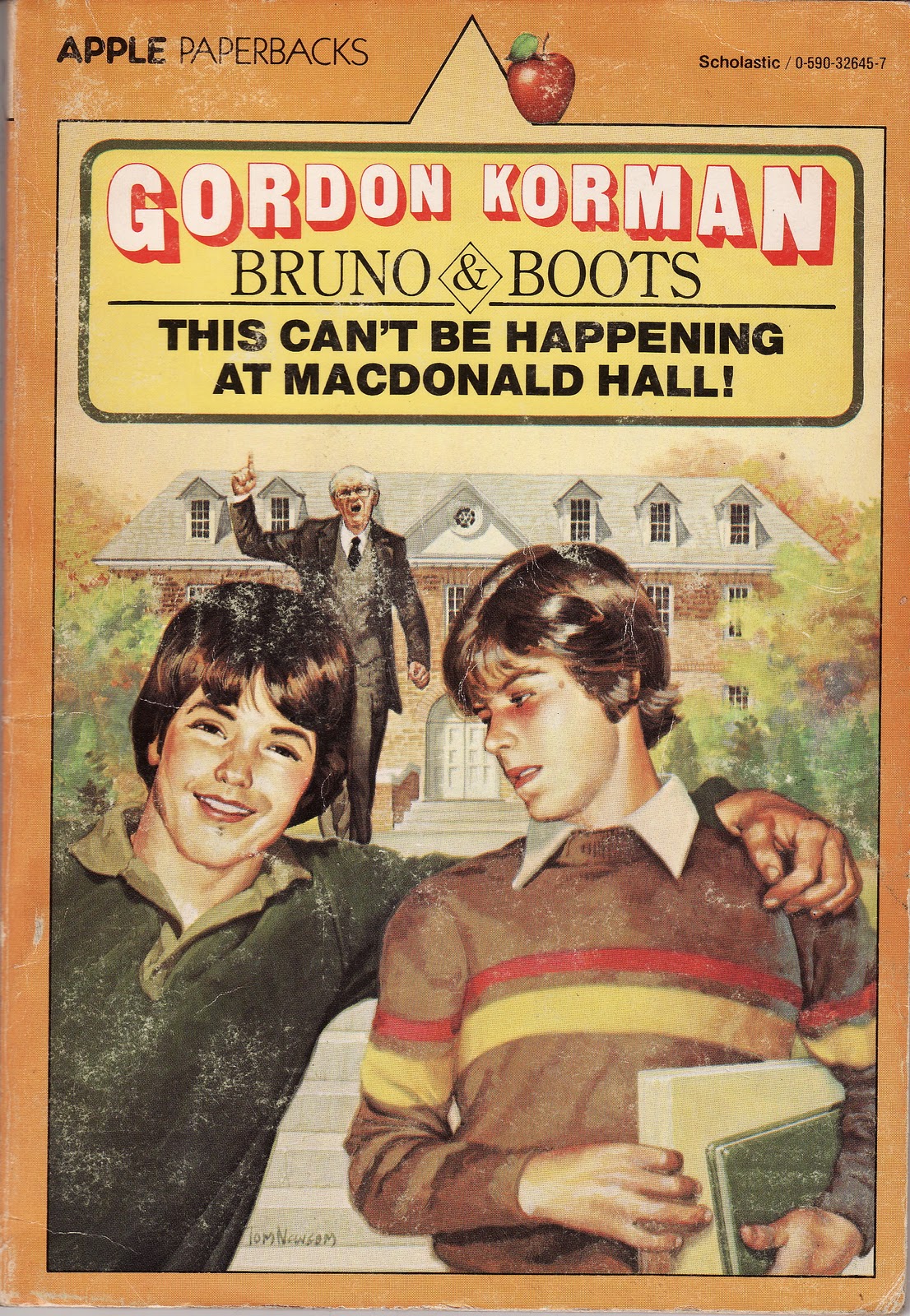
9. The Bruno and Boots books by Gordon Korman

This is a series about a bunch of boys at a private boarding school in southern Ontario. Specifically, it’s about Bruno Walton, his roommate Melvin “Boots” O’Neal and their many, many shenanigans.

I’m a sucker for boarding school stories, possibly because I spent several of my formative years reading any and all boarding school books by Enid Blyton. Except that while all of Blyton’s protagonists were boring and moral, the boys at McDonald Hall (and the girls Miss Scrimmage’s Finishing School for Young Ladies across the highway) are hilarious, awesome and always up to something.

Also, one of the books features a girl playing football on the boys’ team. So, you know, FEMINISM.

10. The Secret Garden, by Frances Hodgson Burnett

Let’s be honest: Mary Lennox is a spoiled, privileged bitch who doesn’t even know how to dress herself. But also she’s kind of awesome?

Mary has kind of a shitty childhood in India before her parents die. Sure, she gets just about anything she asks for, but she spends basically zero time with her parents, whose main goal in life is to pretend that they don’t have a kid. Anyway, then there’s a cholera epidemic (leading to a nightmare-inspiring scene in which Mary is the only person left alive in a house where people have become ill/left town so quickly that they’ve literally left their dinner on the table), Mary is orphaned and sent to live with her uncle in England.

Things are kind of terrible in England at first, but then Mary learns how to put her own damn clothes on, starts exploring the great outdoors and befriends her maid Martha’s brother Dickon. Mary discovers the so-called Secret Garden, which has been locked up since her aunt died, and discovers the magic of Growing Things. Oh and her bitchiness totally fixes her hypochondriac cousin and her depressed uncle. Score one for bitchy girls!

I dunno, you guys. This book is just so lovely. Like, check this out:

“One of the strange things about living in the world is that it is only now and then one is quite sure one is going to live forever and ever and ever. One knows it sometimes when one gets up at the tender solemn dawn-time and goes out and stands out and throws one’s head far back and looks up and up and watches the pale sky slowly changing and flushing and marvelous unknown things happening until the East almost makes one cry out and one’s heart stands still at the strange unchanging majesty of the rising of the sun–which has been happening every morning for thousands and thousands and thousands of years. One knows it then for a moment or so. And one knows it sometimes when one stands by oneself in a wood at sunset and the mysterious deep gold stillness slanting through and under the branches seems to be saying slowly again and again something one cannot quite hear, however much one tries. Then sometimes the immense quiet of the dark blue at night with the millions of stars waiting and watching makes one sure; and sometimes a sound of far-off music makes it true; and sometimes a look in someone’s eyes.”

Ugh. You guys. My heart. I am such a sucker for Victorian prose about nature.

This is another book that’s usually considered a girlish book, but you know what? For one thing, I don’t care about that stuff, and for another, TWO of the damn protagonists are boys. I hope Theo reads and loves this one as well.

Anyway, that’s all for now. Stay tuned for part 3 of 4! I’m sure I’ll get to it. Someday.

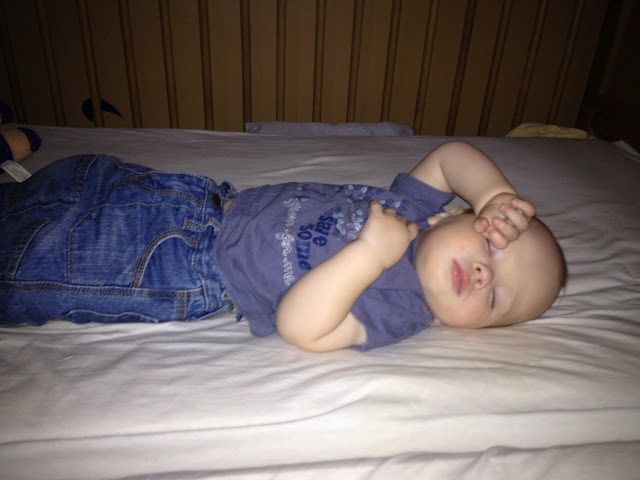
Ugh. Sleep.

15 Sep

When you have a kid, you soon realize that one of the most frequent (and bizarre) questions you get from family, friends and strangers is: is she a good baby? 

Like, what are you going to say? No? She’s a really shitty baby? I wish I could send her back? We’ve been in touch with some adoption agencies? I hope the next one turns out better?

After the good baby question, the next thing that will inevitably come out of that person’s mouth is: is she a good sleeper? Because for some reason all babies are judged based on their ability to sleep.

My son is a terrible sleeper. He has many sterling qualities, but sleeping well is not among them. At 19 months he still wakes up multiple times a night. I would give you an average of how many, but I’m too exhausted to count.

I’ve discovered that sleep is a really tough subject to discuss with other parents, for several reasons:

1. They all have sleep strategies that they want to share with you.

2. They assume that you have tried zero sleep strategies on your own.

3. They make you feel like having a kid who doesn’t sleep through the night is some kind of horrible failure on your part.

That last one? The one where I am made to feel like a terrible parent and a failure? I am being dead serious right there. I can’t tell you how many times I’ve mentioned to other parents that Theo doesn’t sleep through the night, only to be met with an expression that would best be described as total and complete horror. From the looks on their faces, you would think I’d just confessed that he regularly swills gin and plays with knives. Which, I mean, that is totally inaccurate, because we only sometimes let him have gin.

It sucks, because not only do I feel like I am getting grief from other parents for having a sleepless kid, but also being this tired all the time makes me want to stab things. Matt likes to tell this story about how, in the first week of Theo’s life, he was so exhausted that he started hallucinating. At one point he turned to me and said, I understand now why sleep deprivation is an effective torture technique.

Theo was a fledgling insomniac even in those early days. He grunted and wriggled around in his sleep, and he absolutely would not sleep in a crib. When I tell people that we co-sleep with him, they often assume that it’s because I’m some kind of attachment parenting hippie. I mean, I am an attachment parenting hippie, but really, the decision to share our bed with our kid was born out of the fact that we couldn’t figure out how to get him to sleep, and we were desperate.

Since then, we’ve tried a few different types of sleep training. Some we’ve had moderate success with, some we’ve been too tired to implement properly or regularly, and some have just flat-out not worked for us.

One thing that’s helped recently, though, is re-evaluating what my expectations are for Theo’s sleep. Part of that comes from the fact that I’ve struggled with insomnia since my early teens; if, at 30, I can’t remember the last time that I slept through the night, why am I expecting my kid to be able to? Theo got Matt’s blue eyes, adorable nose and laid-back personality – it only makes sense that some of my genes would start showing up sometime. I can only hope that he also got my killer fashion sense.

Thinking all this doesn’t make me any less tired, but it does make me feel a little more sympathetic towards him. Because the thing is, I know what it’s like to not be able to sleep. I know how rough that is. There are nights when I, a highly verbal and fairly capable adult, still cry from frustration because I can’t seem to turn off my brain. Given that, I don’t know why I would expect my sleepless toddler to just be able to roll over and start sawing logs.

I know from experience that I can’t force myself to sleep, and, the fact is, I can’t force Theo either.

So where does that leave us? Mostly it leaves me with a sense of it is what is is, which is oddly comforting. We’ll keep trying different strategies to get him to sleep through the night, for sure, but I’m going to try to stop feeling bad about it. He’s a sentient human being, wholly separate from myself, who, while able to know his own wants, totally lacks any ability to be reasoned with – at this point, if he doesn’t want to sleep, it probably isn’t going to happen. And it probably isn’t my fault.

Maybe this is a good parenting lesson for me. Because sometimes, my kid is going to want (or not want) to do something, and I’m not always going to have perfect control over the situation. I’m not saying that I’m going to give into him, but I am saying that maybe I need to be more flexible. Maybe I need to learn to look for a different approach to any given issue, or work to find a compromise. Hopefully, rather than seeing me as someone who is trying to impose her authoritarian will on him, Theo will come to see me as someone who is trying her damnedest to understand him, and only has his best interests at heart.

Because that’s the parenting dream, isn’t it? To have your kids respect and obey you without resenting you. To have them understand that sometimes you have to do things that they won’t like because, for whatever reason, it’s good for them. Is that even possible? I’m not sure.

If all else fails, we’ll just blow his whole college fund on therapy and sleeping pills.

On fear and change

8 Sep

A few years ago, I had a somewhat serious cycling accident. I mean, not super serious; I didn’t die, wind up in a coma, or sustain a massive head injury. Still, it was bad enough that it caused a major disruption in my life.

I had just started the ASL Interpreter program at George Brown College, and, on my fourth day of classes, I was running late. I am normally an insanely wary cyclist, especially when it comes to streetcar tracks, but that day all I could focus on was getting to school on time.

It happened at Church and Adelaide. I was preparing to make a left, and, in the process of moving into the turning lane, was looking back over my shoulder to make sure that there were no cars behind me. Suddenly, I felt the sickening sensation of my front tire leaving the pavement and sliding over the metal of the streetcar tracks.

I tried to correct myself before my wheel went into the groove, but I couldn’t, and I felt a shuddering thunk as my front tire fell into the track. I tried to stop, but I had too much speed and momentum. My back wheel slid out to the right, and I felt my bike jackknife beneath me.

I am going to fall, I realized. In the middle of traffic. I might die.

There was absolutely nothing that I could do.

Weirdly, my memory is a total blank from from the time I realized that I was going to fall until the moment when I was suddenly sitting on the hot, late-summer pavement, watching my bike’s wheels spin impotently in the air. I didn’t lose consciousness or anything like that; I guess my mind just kind of shut down, unable to process what was happening.

By the time I came back to myself, a crowd had started to gather. Two people convinced me to get out of the middle of the road (for some reason I actually needed to be talked into this), and helped me over to the curb, while another called an ambulance. A third wheeled my bike to a side street and locked it there, leaving me with a map of where to find it once I was able to come get it. Two women waited with me until the paramedics came.

At the hospital I found out that I’d fractured my tibial plateau (part of the knee joint), and needed both a bone graft and a metal plate. Because I wasn’t technically emergency surgery, I had to wait until a slot opened up for me, which took three days. During that time I wasn’t allowed food or water from midnight until 8 am, just in case an operating room became available. I had to share a hospital room with three other people; I had to listen to a doctor and a group of interns tell a woman that she was going to die. They closed the curtains around my bed for that, but that did little to shut out the sound.

Recovering from surgery was hell (although I did quickly develop a fondness for strong painkillers). I couldn’t bear weight on my leg  for two months, and then when I could, I had to have physiotherapy to re-learn how to walk. I was in constant pain, and so, so tired; everything seemed like such an enormous effort. Getting dressed and leaving the house was too much for me some days. I mostly couldn’t do anything except lie on the couch, read trashy books and pop pills. School was out of the question, so I dropped out. The whole life that I’d mapped out for myself, the one that was supposed to rescue me from the drudgery of working retail, crumbled.

But, somehow, none of that was as bad as that one, single moment on my bike when I’d realized that I was definitely, for sure, not kidding going to fall. The scariest part of that was not the idea that I might die, but the fact that I had no idea what was going to happen.

Often change, especially change that comes about as a result of a decision that I’ve made, brings me back to that same panicky fear. To extend the metaphor, I am that same careful cyclist in my life, always trying to make the best choices – obeying stop signs, signalling when I change lanes, trying to stay aware of the traffic around me. But really, any choice could result in a terrible fall – I could be doing everything right, and still end up lying in the road, unable to walk.

How can I ever be sure of not falling? How can I be sure that going back to work is the right choice for our family? What if I can’t succeed as a yoga teacher? What if daycare ends up being totally wrong for Theo? When I try to answer any of these questions, I come back to that same terrifying response: I have no idea what’s going to happen. Sure, I can make assumptions, based on research that I’ve done or past experiences, based one what I know about myself and other people. But I can’t know for sure, and that is fucking scary.

On bad days, even little decisions can seem overwhelming – whether or not to publish a blog post, what to have for lunch, what to do in the evening after Theo goes to bed. Each one carries with it the potential of regret – what if I hurt or offend someone with my writing? Or what if it’s no good, or not ready to post? What if I take one bite of my food and realize that it’s not what I really wanted? What if I’m spending too much time online, and not enough with Matt?

Some days it seems like everything has the potential for disaster, or at least disappointment.

So what’s the answer? Try to plan out my life to the point where I feel like I have little or no need to make choices? Hide in my house and try to mitigate the likelihood of fear and disappointment? Tell myself to just get over it and stop caring so much already?

I guess that the best that I can do is continue to take measured, studied leaps and do my best not to fall. To try to take risks when necessary, and even sometimes when not necessary. And most of all, to remember that falling is not the end of the world, and that everyone falls sometimes.

At the end of the day, I just have to hope that every fall is as lucky as the one I had that day at the corner of Church and Adelaide. I have to hope that I am always so fortunate as to have a crowd to help me to safety, and then a team of people to put me back together. I also have to realize that even if there is no one there to help me, I am capable of helping myself.

Tonight is a rough night. My mind is all snarled up with fear and uncertainty and self-doubt. These past few weeks have been one, long preparation to leap, and, having now jumped, I’m still not sure if I can see the place where I’m supposed to land.

I promise I’ll let you know if and when I get to the other side.

Yes, this is actually me.