This morning I misunderstood something my friend Audra said, and ended up saying something that I shouldn’t have.
She very gently pointed out what I’d done, and I apologized.
Over. And over. And over.
By the end, I wasn’t even apologizing for what I’d said; I was apologizing for annoying her, for always being wrong, and for just plain being myself. This, amid protestations from her that it was fine, that she wasn’t upset, that she hadn’t communicated clearly in the first place.
Finally, I said, “I’m just awful, and I’m overwhelmed, and I’m not doing enough to help myself because I don’t know how.”
All of that was true, even if I hadn’t meant for it to come out like that.
She asked if I wanted to go to the hospital. I balked and asked why. I didn’t see any reason to go to the hospital – I was fine, just having a bad day. Well, a string of bad days, really. Maybe a bad month. But certainly nothing more than that!
“I think it’s a perfectly reasonable thing to do in a crisis, love,” she said. “I feel like you’ve been in a crisis for a bit now.”
But how can I be in a crisis when I seem perfectly fine to everyone else? How can things be that bad if no one else has noticed?
What does a crisis even look like?
When I asked Audra, she said, “Like, I feel like you’ve got the brain equivalent to not being able to breathe, you know?”
Yes. That is exactly what it’s like right now.
Maybe a crisis looks like weeks and weeks or maybe even years of not sleeping.
Maybe a crisis looks like letting my son watch Fraggle Rock after dinner so that I can pass out on the couch behind him, because I can’t stay awake for one more second.
Maybe a crisis looks like waking up shaking and sweating at night and not knowing why.
Maybe a crisis looks like not being able to focus on any one task long enough to complete it.
Maybe a crisis looks like not allowing myself to eat, or have fun, or relax until I’ve finished my work as a pathetic attempt to motivate myself, and the beating myself up when I can’t get anything done.
Maybe a crisis looks like never being good enough, never being smart enough, never having enough hours in the day.
Maybe it looks like my hands shaking as I try to make a cup of tea.
Maybe it looks like crying alone at my desk for no discernible reason.
Maybe it looks like taking everything way too personally.
Maybe a crisis is all of these things taken together; maybe its more than the sum of its parts.
Maybe this is a crisis.
I don’t know how to get out of this. I’m trying all of solutions that I know, like medication, therapy and yoga, and none of them seem to be doing much good. I feel like I’m doing my best, but I’m not sure how to proceed if it turns out that my best isn’t good enough.
I’m scared.
To be honest, I’m not even sure why I’m writing about this publicly. Maybe because it’s easier than talking about it face to face with anyone; maybe I’m hoping someone else will tell me that they’ve been here, and that’ll make me feel less alone, or make me feel like I’ll be able to come out the other side mostly unscathed. Sometimes it feels like talking about my depression on here was like opening a Pandora’s Box, and now I just can’t stop. Often I worry that I’m being awful and attention-seeking. I tell myself that I’m helping combat stigma, but is that true? Or do I have other motives in place?
Is all this negative self-talk part and parcel of my depression? Or am I just being rationally critical of myself? After years of living like this, how do I untangle my actual self from the disease? Or is it just a part of me, part of my personality now?
It’s taking every ounce of my self-will not to apologize for writing this, for annoying you, for being a bad person. Even writing that is a sort of apology; it’s a compromise that I’ve made with myself, a way of showing you how bad I am without actually saying the words I’m sorry.
Is there even any point in getting help? Sometimes it seems like the hope that things will get better is even harder than the depression itself; not only do I feel rotten, but I also have to deal with the disappointment of each successive doctor, medication and therapy not working.
I am not a winter person. Given my choice of the seasons, I’ll pick summer every time. I love the heat, and I even love the humidity. I like it when stepping out my front door feels like walking into an oven. I like the sun, the warmth, and the long evenings that are perfect for picnicking or taking your kid to the park or drinking sangria on patios with friends. I love lying in the grass and reading for hours on end. I love summer.
Winter is a tough time for me. It’s not just the fact that it’s so cold that, after coming in from a long walk, I have to stand in a scalding hot shower for fifteen minutes until I feel warm. It’s not just the fact that my muscles ache because the cold makes me tense up, makes me walk around hunched over in a desperate effort not to freeze to death. It’s not even the fact that it’s already too cold for me, and I know that it’s going to get colder still. It’s more than that, and it’s subtler than that. It’s the light, both the dim, chilly quality it assumes this time of year, and its waning quantity, meaning that we only get to see the sun for a few paltry hours every day. Even though we’re past the solstice and, logically, I know that the days will be getting longer from now until midsummer, it still, somehow, feels as if the days are growing shorter and darker as we head into January.
These days I feel as if I’ve lost the capacity for joy. I’ll catch myself mid-laugh and realize that I’m faking it, and I’m faking it so well that I’ve nearly got myself convinced. In the same way that it’s sometimes hard for me to believe that spring will ever come again, it’s also hard to believe that anything will ever make me feel good or happy again. I have these thoughts, like, hey, maybe at the beginning of my life I was handed out a finite number of good experiences and now, in the winter of my 30th year, I’ve somehow managed to spend the last one.
Part of it might be the fact that everyone seems to be making their year-end posts, tallying up all their successes and bundling them together into one neat little blog post package. I thought about doing one of those, but I know that I won’t. Every new year always seems to me to be like a fresh, white sheet of notebook paper, but by December 31st it’s so marked up, so wrinkled and worn, so covered with revisions and smudges and holes where I rubbed the eraser too hard that I can’t make sense of it anymore.Rather than dig through my year to find material for a year-in-review post, I just want to throw the whole thing out, baby, bathwater and all. As 2013 approaches, 2012 is still too close to give me the perspective I would need, and all my hurts and failures feel too fresh for me to be able to dissect them. Even my successes seem slippery and hard to pinpoint. The other day, as I was watching the hundreds of comments going up on the article I wrote for the Good Men Project, I messaged my friend Audra and said, “Is this what success is supposed to feel like? Because I feel awful.”
Sometimes succeeding feels just as bad, just as anxiety-inducing, as failure does.
Mostly I just want everything to be over. I don’t mean that I want to die or anything like that, but just that I’m so tired of trying to guess what’s coming next. I’m so tired of trying to figure out what to do next, how to take my next step, or which direction I need to go. I want all of my experiences to be over and done with so that I can sift through them and sort them into boxes labelled “good things” and “bad things.” Then, once I’ve done that, I’ll be able to sit back, write a life-in-review post, and judge whether, when looking at the big picture, the scale tips more towards happy or sad.
I’m so tired. So goddamn tired. The worst part is that I can’t even begin to imagine when I won’t feel like this. Maybe next year? Or maybe when Theo’s in grade school? High school? When he moves out? I can’t help but feel like it’s partly my fault, or even mostly my fault, for not sleep-training him, for breastfeeding for so long, maybe even for choosing to have a kid in the first place. I love my son, but I don’t think I can function like this for much longer. Then again, what would not functioning even look like? Will my legs just give out one day, my knees buckling under my weight, and I’ll have to lie on the ground until I’m rested enough to get up again? How do these things work?
If you asked me what I needed in order to feel better, what it would take to make me feel happy, I wouldn’t even be able to tell you. That’s what’s hardest about all of this: feeling as if it’s whatever it is that’s going to save you is totally beyond your control. If there is something that can save you. If that something, should it exist, ever manages to find you.
Sometimes I think that all of the little things that happen throughout my day, the meals, the conversations, the rote interactions, are nothing more than activities designed to get me from one minute to the next until I can finally lie down in my bed at night and sleep (or not). When seen this way, a life is nothing more than a string of days, days made up of pointless experiences meant to propel you through time. I mean, of course my experiences aren’t meaningless. Or maybe they are. I’m not sure.
I’m trying to think of some kind of life lesson to put in here, some kind of moral to this story, but I’m coming up totally dry. Maybe you can try to find your own moral, because sifting back through this mess of feelings seems like so much work. Everything seems like so much work, to be honest. I feel as if I’ve been sucked totally dry of any and all will or ambition or desire.
The winter here is beautiful. The snow, and the quiet, and the bare trees are beautiful. There’s a hush this time of year that you never feel in the summer, and I know I would miss it if I never felt it again. I don’t hate winter, and I don’t even necessarily need for it to be over, like, right now. I don’t even think I would like to live somewhere that was hot and sunny all year long. I just need something to pin my hopes on, something to look forward to, something to hold out for. I need something to focus on when everything seems so dark and cold that I don’t think I can stand it for one minute longer.
I just need to know for certain that spring is going to come.
In case you were wondering what it’s like to fly on an airplane with me, it’s pretty much like this:
“This should be open because it’s civil rights.”
I am terrified of flying. Seriously. Even just glancing up and seeing an airplane in the sky as I’m happily going about my daily business makes me feel queasy. Whenever we go to the airport to pick up or drop off a friend or family member, I think, Better you than me, buddy. I’ve taken the train all the way east to Halifax and all the way west to Edmonton because I refuse to fly. Friends will suggest taking a vacation together to some exotic locale, and I just laugh. If they want to go on vacation with me somewhere exciting, then they’ll have to sit in a dirty, smelly bus to New York or wherever for hours on end; they sure as hell aren’t going to manage to drag me anywhere with palm trees.
I don’t really know where my fear of flying came from. There was actually a time when I loved everything about air travel – from walking along the airport gangway (I don’t know why, but this part always seemed very exciting), to the thrill of the moment when you feel the airplane lift into the air, to the tiny over-packaged meals that taste like reconstituted cardboard. For a kid who spent four gruelling days every summer driving from Ontario to Nova Scotia and then back again, flying seemed like nothing short of a luxury.
All of my flying experiences were positive until the winter of my second year at university, when I was flying from Halifax into Ottawa. Everything was lovely and normal until we hit some kind of air pocket or something and the plane suddenly dropped like the dead weight it was. The actual drop was over pretty quickly and the flight continued as if nothing had happened, but I couldn’t help feeling shaken. To make matters worse, the girl beside me began crying hysterically, saying that her father was in the air force and she’d flown a million times and had never experienced anything like this and we were all going to die. Helpful, right?
Anyway, we landed without further incident, and other than spending a few hours feeling very grateful to be back on solid ground, I didn’t think much about what had happened for the rest of my holidays.
Then, on my way back to Halifax, I realized that two of my close friends were on the same flight. I began to think about how sad it would be if our plane went down and we all died together; how our group of friends would mourn us, maybe even build a memorial. Then I started to think, Aren’t we descending a little quickly? We’re not even over Nova Scotia yet!
Embarrassingly, it didn’t take much for me to go from wondering why we were starting our descent so early to, Oh God, we’re all going to die.
I’ve been afraid of flying ever since.
The last time that I was on an airplane was when we flew to Paris for our honeymoon in 2009. I managed to convince myself to get on that plane by telling myself three things:
1. I needed to fucking suck it up if I ever wanted to visit parts of the world that weren’t accessible by Via Rail.
2. God would not let Matt and I die on our honeymoon.
3. If we did die, at least it would be romantic. We would be forever remembered as the couple who died in a plane crash while on their honeymoon. Also, we would probably die happy. Right?
I prepared for this trip by doing two things: going to my (prescription-happy doctor) for a bottle full of Ativan, and watching Mayday marathons. Mayday, for the uninitiated, is a documentary show about airline disasters. I figured that it would be helpful to know some of the things that could potentially go wrong during a flight; plus, once I knew enough about airline disasters, it seemed possible that I might be able to avert them. For instance, I learned from Mayday’s episode about Aeroflot Flight 593 that you should never let children fly a commercial airplane. If I were on a plane and saw that happening, I could be like, You guys, this is a bad idea. Total hero material, right here!
A few minutes before we boarded our flight in Montreal, I popped a pill. They were the sublingual type, meaning that they melt under your tongue and enter your bloodstream faster. Once we found our seats on the plane, I took another pill because I still felt anxious. As we began preparing for takeoff I took yet another pill because, although I felt woozy, I definitely still felt anxious. Shortly after our plane lifted off the ground, the safety video began playing on the tiny video screens on the backs of the seats in front of us. Something was wrong, though; the video kept re-starting, and finally the screen just went black.
I started to cry.
A kindly flight attendant noticed my distress and came over. The following is a basic approximation of the conversation we had:
Kindly Flight Attendant: What’s wrong?
Me: I’m sorry, I’m just a really nervous flier! And right now I’m freaked out because the safety video isn’t working.
Kindly Flight Attendant: Oh, don’t worry! Those things have nothing to do with flying the plane. They’re not connected to the engine or anything like that! Plus, the entertainment system is kind of flaky. In fact, some days it doesn’t work at all!
Me: Well what about Swissair Flight 111? That went down because the entertainment system overheated and caused a fire. HOW DO I KNOW THAT’S NOT WHAT’S HAPPENING HERE?
Kindly Flight Attendant: …
Kindly Flight Attendant just walked away and didn’t say another word to me for the whole trip.
Naturally, after that encounter, I had to take another pill.
After that, I fell asleep, and didn’t wake up until we were flying over the UK. We started our descent, which is weirdly the least frightening part of flying for me – it means that we’re either going to be landing soon, or else it won’t be long until we die a fiery death. Whichever way the dice land, at least the anticipation is over!
Once we landed, I was still feeling a little out of it, so I decided to get a coffee. As the guy at the airport cafe poured my drink, Matt noticed me dumping fistfuls of change into their tip jar. He politely yet firmly asked me what the hell I was doing. I told him that I was giving them our Canadian change, because we wouldn’t need it anymore. Because we weren’t in Canada anymore. Duh.
I guess the Ativan might have had more of an effect on me than I’d thought.
We ended up spending a wonderful week in Paris once I’d gotten over my drugged state. I ate my weight in croissants, drank a lot of cheap but delicious wine, and basically decided that Paris was my favourite city of all time. I am an obsessive planner when it comes to travelling, so even though we only had seven days in the City of Lights, I created such an air-tight itinerary that we got to see pretty much everything we wanted to. I also made it my mission to take pictures of every single statue of Joan of Arc that I could find (because Joan of Arc is the best, obviously).
Joan and I – a romance for the ages
Of course, the only bad thing about taking a trip to Paris was that we had to come home at the end of it. Which meant that I had to get on a plane again.
No big deal, I said to myself. I’ll just take a bunch of Ativan and pass out again.
And that’s what I did.
Or, rather, that’s what I thought I did.
It wasn’t until a few weeks after our trip that Matt mentioned a show that we’d watched together on the plane. I patiently explained to him that I’d never watched that show with him; I’d watched it with a friend in Halifax earlier that year. He kept insisting that we’d watched it on the plane, which kind of freaked me out, because I’d obviously just married a dude who a) had hallucinations or b) thought it was hilarious to lie so obviously and conspicuously to me.
After another few minutes of arguing, I finally said, There’s no way that we watched that show on the plane. I slept the whole way on both flights.
Matt looked at me like I’d grown a third arm.
No, you didn’t, he said, you were awake for the entire flight back.
Even as I kept insisting that he was wrong, I began to feel a wave of horror wash over me.
I hadn’t slept on the way home. I’d been awake the whole time. I had absolutely no memory of this.
I began interrogating Matt with a Spanish Inquisition level of intensity. What had I said to him? How had I acted? Had I seemed like myself? Did I take off my clothes or do anything else embarrassing? Could he give me a play-by-play of the entire eight hour flight?
His answers were less than comforting. For example, he told me that I’d been talking to the woman next to me for a good chunk of the flight. Naturally, I asked what I’d been saying to the woman. Matt just shrugged and said, I don’t know, you were speaking French.
I WAS SPEAKING FRENCH IN THE MIDDLE OF AN ATIVAN BLACKOUT. I WAS TALKING TO STRANGERS IN FRENCH AND NO ONE HAS ANY IDEA WHAT WAS SAID.
Horrifying.
I begged Matt to tell me that I’d at least stayed in my seat the entire flight and not bothered anyone other than the Francophone woman next to me. I really needed to know that he’d kept an eye on my altered-state self the whole time.
He thought about it, then said that at some point I’d gotten up to go to the bathroom.
Did you follow me? I asked him, hopefully, desperately.
He just rolled his eyes.
The thing is, for all he knows, the minute I was out of his sight I started taking off my clothes and/or making out with the flight attendant. It’s possible! Literally ANYTHING is possible.
I told him that if we ever flew again, it would be his job to follow me everywhere, up to and including into the tiny airplane bathroom.
Of course, when I said that, I had no intention of ever flying again anyway.
You guys, having a phobia of flying sucks. Like, it sucks badly. First of all, every single person that you know feels the need to tell you that more people die in car accidents than in airplane crashes. Every time someone says that to me, I’m like, Whoa, really? You are the first person to ever mention that to me! Thank you! I’m cured!
No, but seriously, the next person to tell me that will get – well, they’ll probably just get a dirty look, but what I want to do is way worse than that.
I know that my fear of flying isn’t logical. If it was logical, I would probably be over it by now. I would just talk myself out of it. I am the master of talking myself out of things. You should see how well I talked myself out of cleaning the bathroom the other day. I did it in like five minutes! So that’s really not the problem here.
Logically, I know how safe airplanes are. I know how unlikely it is for anything to go wrong on an airplane, thanks to my sister-in-law, I even sort of know how they fly (hint: it’s not by magic). But even though my mind knows all those things, it has made an executive decision not to give a shit about facts and to go on being afraid. Thanks, mind. Thanks a bunch.
I hate not being able to fly. I hate that there are so many places that I might never visit because of my stupid malfunctioning brain. I hate that anytime I go someplace far away it takes me fifty years to get there, whereas it would take the average, flying-capable person an hour. I feel like I’m missing out on so much, and I don’t know what to do about it.
I guess I could do the Ativan thing again, although the idea doesn’t thrill me. It’s not so much the blackouts that scare me (well, they might scare me a little), but the fact that a lot of my anxiety happened in the weeks leading up to our flight. Also, in spite of all the drugs I took, I still felt pretty scared on the plane.
Another issue is that now I have Theo. I can’t imagine flying with Theo and Matt; not only would I be totally useless as a parent, but for Matt it would be like dealing with TWO toddlers.
Basically, what I really need is for someone to just knock me out anytime I have to fly, like B.A. Baracus on the A-Team:
If that means that I have to wear a lot of gold jewelry and say “I pity the fool”, well, that’s a price I’m willing to pay.
In all seriousness, what I probably actually need to do is start taking short flights with people who are super chill about flying. People who will hold my hand and tell me that everything is fine and/or tell me to shut up about dying already. I need someone who is willing to put up with my bullshit for at least an hour, probably longer when you factor in the trip to the airport, checking in, going through security and waiting for the flight to board.
I guess that what I am saying here is that I am now accepting applications from people who are willing to put up with my bullshit for a minimum of four hours. COULD THIS BE YOU? Apply within!
p.s. I’m not willing to share my Ativan, even if you’re brave enough to fly with me. I will need the entire contents of my pill bottle, and possibly more.
Today is the feast of Saint Catherine, a fact which really means nothing to me now that I’m a bonafide adult living in a secular, anglophone world. When I was a kid attending French Catholic school, though, St. Catherine’s Day was one of my red-letter days. Back then, every month seemed to have a holiday or feast day; these little celebrations and diversions helped us make it through the long school year. For anglo kids, the big November holiday was probably Remembrance Day, but for those of us at École Cardinal Léger, November 11th was always overshadowed by November 25th. This was true for one reason and one reason only: candy. Lots of candy.
Saint Catherine of Alexandria is mostly famous for the terrible way she died. Born to the (pagan) king and queen of Alexandria, Catherine converted to Christianity at the age of 14. The reason for her conversion was a mystical vision in which the Virgin Mary gave Catherine to Jesus as a wife, and the two of them joined together in a holy union – I mean, you know, the usual. Catherine went on to convert hundreds of pagans to Christianity which, naturally, angered the Roman emperor at the time, Maxentius. Maxentius, a big fan of persecuting Christians, decided that the solution to his problem was to marry Catherine. When she refused (because she was already married to Jesus, duh), he tried to break her on the wheel. God, naturally, destroyed said wheel, so Maxentius just beheaded Catherine instead. I’m unsure as to how God could destroy the wheel but still allow her to be beheaded, but, um, I guess he works in mysterious ways?
Naturally, you want to know what the hell this all has to do with candy.
Relax. I’m getting to that.
The key to our modern celebration of Saint Catherine’s Day is Marguerite Bourgeouys, a nun who came to Canada in the 1600s. Marguerite opened a public school for girls in Montreal in 1658 (yay!), which marked the beginning of public schooling in Montreal (double yay!). She then decided that the First Nations children should also attend her school (problematic?) and began to devise ways by which she could lure them to her schoolhouse (definitely problematic). Her solution was to make taffy and then leave a trail of said taffy all the way from the local First Nations settlement to her schoolhouse (SUPER PROBLEMATIC). Oh, and apparently she made this taffy on St. Catherine’s Day, and young French Canadians have been doing so ever since.
I mean, at least her intentions were good? That has to count for something, right?
Marguerite Bourgeoys and her First Nations friends: 99 Problematics
Anyway, Marguerite Bourgeoys is a saint now, so at least she’s got that going for her.
My sister was born on November 24th, 1988. I remember the day of her birth pretty clearly; my mother came into my room early in the morning to tell me that she was going to the hospital to be induced, and then my principal pulled me out of class around noon with the news that I was now a big sister. My principal let me sit in her office and make my mother a card, probably assuming that I would produce the standard “YAY BABY” Hallmark-type fare. I, naturally, had other ideas in mind. Most likely influenced by the fact that Christmas was only a month away, I ended up drawing my mother as the Virgin Mary and my new sister as the Baby Jesus. Being a student at a Catholic school, I, of course, had heard the term virgin thrown around. However, being only six years old, I had no idea what it meant. I thought that “virgin” was synonymous with “good person”, which helps explain why, on my card, I wrote, Maman, tu es une vierge [Mama, you are a virgin]. I think I remember indulgent smiles from the grown ups at my school; at any rate, they didn’t immediately seize my card and burn it, so it couldn’t have been too blasphemous.
That night, I went to visit my mother in the hospital. There was an earthquake while we were there; a small one, but big enough that it made the glass tremble on my mother’s bedside table and the tacky framed prints sway on the wall. My parents laughed, and joked that it was an omen portending that my sister would accomplish great things. That one remark was a watershed moment in my life; for the first time, I experienced that complicated, emotionally charged state that we call sibling rivalry. What did they mean that she would accomplish great things? Had they said the same thing about me at my birth? What had my omens been?
I asked if there had been an earthquake the night I was born. No, my parents said. How about a full moon? A thunderstorm? Anything? My parents just rolled their eyes and laughed. Meanwhile, I glared at my fat, red, wrinkled nemesis.
The next night, when my father brought me back to the hospital for another visit, I proudly announced that we’d celebrated St. Catherine’s Day at school by making candy. My parents, who hadn’t yet come up with a name for my sister, gave each other this look like, WHOA, ARE YOU THINKING WHAT I’M THINKING? WE ARE FOR SURE GENIUSES.
Needless to say, they named her Catherine.
Catherine, which I thought was probably the bossiest name I’d ever heard.
Catherine, the perfect name for someone who would accomplish great things.
As if to rub salt in the wounds, my parents insisted on telling everyone that my sister’s name had been my idea. Whenever they said this in my presence, I would yell, THAT’S A DAMN LIE, I WANTED TO NAME HER SOPHIE, and then, naturally, immediately get sent to my room. I spent a lot of time in my room after my sister’s birth, mostly because I couldn’t understand how my parents could equate my casually mentioning a name in their presence with suggesting it as the word that we would ever use when referring to my new sibling. In retrospect, I’m sure that my parents were trying to help me adapt to having a sister after spending more than half a decade as an only child; at the time it just seemed like they were wilfully ignoring everything I had to say.
When Catherine started school, her teachers went out of their way to make St. Catherine’s Day a big deal for her. They would make her a paper crown, and spend the day treating her like a princess. At the end of the festivities, she would bring home a bigger pile of candy than anyone else.
Did I have a special saint’s day that gave my the chance to wear a crown and bring home an exceptionally large pile of candy?
No. No, I did not.
Probably because I wasn’t destined to do great things.
Throughout Catherine’s early years, I found various ways to torment her. I stuck clothespins in her hair. I called her ridiculous names. I made faces at her at the dinner table. Nothing I did was overly terrible, but then, it didn’t need to be; Catherine threw tantrums as if she had a calling for it. Catherine screamed and kicked as if it was her vocation; she once had a legendary meltdown over the fact that her toast was cut vertically instead of diagonally. This meant that it was both easy and satisfying to provoke her.
When I entered my teen years, my mother developed a fascination with mediums and psychics. She began having her tarot cards read on a regular basis.
“The psychic says that Catherine is the Queen of Pentacles,” she told me once in the car, as she was driving me to a dance class.
Naturally, I was more interested in what she’d had to say about me.
“Oh, she says, you’re boy-crazy,” my mother replied dismissively, “as if I didn’t already know that. But she says that Catherine is the Queen of Pentacles.”
“What does that even mean?” I asked
“I don’t know, but I’d better not hear you making fun of her for it,” my mother said in her most threatening tones.
Why would I make fun of her for it? I knew exactly what it meant. It meant that she was destined to do great things, while I was destined to be a pathetic, boy-crazy teenager forever.
Catherine and I continued to have an adversarial relationship throughout the rest of my time in high school, and my first few years of university. I can clearly remember bringing Matt home to meet my family for the first time, and whining to my mother about how Catherine was being rude to him. I don’t remember what she was being rude about, mind you, just that I didn’t like the way she talked to him. Catherine told me constantly that I was old and boring, and that my music sucked. While I was nearly always single and lonely, Catherine had a steady stream of boyfriends from the time she was 13. Instead of abating, our rivalry seemed to be heating up. On top of all that, I was deeply embarrassed by that I was jealous of someone who was six years younger than me.
This continued on for several years, until, sometime in my early twenties, we had a fight. Like, a big fight. I don’t even remember what it was about, I just remember yelling, even screaming at her. I was furious. Beyond furious. Somehow, having run out of things that actually had to do with what we were fighting about, I got around to the anger and jealousy that I’d been harbouring all these years.
“You don’t even like me,” I yelled at her. “Why do you even bother talking to me? You don’t have anything to talk to me about! You think you’re better than me! You think you’re going to do great things!”
At this point, Catherine burst into tears, which, if you knew her, you would know how highly unusual that is.
“What do you mean I don’t like you?” she wailed. “I love you! You’re my big sister! I look up to you for everything!”
That stopped me dead in my tracks. How could it possibly be that my sister, my destined-for-great-things, Queen-of-Pentacles sister could ever look up to me, failure that I was, for anything?
That night was a turning point in our relationship. We’ve been close ever since; she even lived with us for a few months this year. Now that she’s back living three hours away, I miss her, even though we talk all the time.
I hope she had a good birthday.
I hope she knows how proud I am of her.
I hope that this year she continues to do great things.
I hope that she had some candy today, in honour of St.Catherine.
Catherine with her cat, Chairman Mao
Happy birthday, little sister.
p.s. Here is a recipe for St. Catherine’s Day Taffy, if you want to try making it yourself.
A few years ago, when we still lived on the east coast, Matt and I drove to Prince Edward Island for a long weekend. We booked a room in what was maybe the coziest bed and breakfast of all time, and in spite of the raw, grey November weather we were ridiculously excited by the chance to explore and get lost in a city that wasn’t our own.
Matt was still a student back then, and I was making minimum wage working retail, so little getaways like this were few and far between. This meant that I’d planned for our three day mini-break with the same focus and attention to detail that others might apply to a two weeks tour of Europe. I bought a guide book and filled it with highlighter marks and post-it notes. I spent hours poring over travel websites, trying to plan our every little detail of our trip. I talked to (at?) Matt endlessly about the things I wanted to see, trying to convince him to use the highlighter and post-it notes with as much enthusiasm as I did. My excitement grew to such a level that I was basically banned from mentioning the words “Anne of Green Gables” or “Gilbert Blythe” in his presence.
One place that I knew I definitely wanted to visit was the All Souls’ Chapel, which is attached to Charlottetown’s St. Peter’s Cathedral. All Souls’ Chapel is designated National Historic Site and, I learned from my guidebook, a good example of the High Victorian Gothic style of architecture. I especially wanted to see the interior of the chapel, whose walls feature sixteen paintings by local artist Robert Harris. The only problem was that the chapel was only open during services, and the only service held in the chapel was evensong. We decided to sneak into the back and ogle the artwork during Saturday’s evening service before heading downtown for a romantic dinner.
Late Saturday afternoon, Matt and I fell asleep on our room’s giant, king-sized bed. We woke up to find that it was dark outside, and realized with a start that it was nearly time for evensong. We thought that if we hurried we might still be able to make it. We were wrong, a fact that we realized as soon as we stepped into the chapel’s entryway and heard someone chanting inside.
We peeked in through the door, and before us lay one of the loveliest, heart-in-your-throat sights I’ve ever seen. The room was lit by just a few candles, leaving most of the chapel still in darkness. The flames flickered and occasionally grew strangely, eerily tall in the close chapel air, throwing grotesque, menacing shadows on the painted walls. In the middle of this little cave of light stood an old priest, his long robes faded to a greenish-black and his collar slightly wilted. He was all alone, this priest; no one else had come to evensong. Still, though, he stood in front of the lectern and recited from the huge crumbling book that sat there, repeating the same words he must have said on a near-daily basis for years and years and years. They were nice words, too – the text of the Anglican evensong is strikingly, intricately beautiful, a sort of poetry, in a way.
I thought about this man who, in spite of his lack of parishioners, went on with his service and turned it into a private communion between himself and his god. I wondered what he thought of the words that he was sending out into the darkness, and what personal meaning they might hold for him. I watched this man, who, unaware that he was being watched, slowly wended his way through the service, speaking at length to a god who never seemed to answer him. I thought to myself, this is what faith looks like.
I grew up in a pretty secular household. My mother usually dragged us to the local United Church on Sundays, but that was more boring than it was religious. I spent my time there sprawling out on the shiny wooden pews, making up stories about pictures in the stained glass windows and harassing my mother with whispered demands to know when Sunday School would start. Sunday School meant a craft, a game, a snack, and little else. Oh sure, we would read Bible stories, but they didn’t seem to me to be much different from Grimm’s fairytales, or the stories found in my giant Hans Christian Andersen book. Meanwhile, my father, an avowed atheist, would stay home to sit in the basement and burn incense while listening to classical music on vinyl.
I went to a Catholic school, so I did receive some religious instruction there, but because I was Protestant, no one really thought that it was necessary to indoctrinate me. I was often left out of things, either because my teachers didn’t think it was appropriate that I be included, or because they thought I didn’t care. I was curious, though – and to be fair, who wouldn’t be when your classmates’ religion means that the girls get to dress up in lacy white dresses and partake in a secret ceremony to which you are not invited? After my class did their first communion, they got to eat the strange, flat, holy bread and drink real wine – meanwhile, in the United Church, there was no special initiation ceremony, and our communion was nothing but regular bread and boring old grape juice. School made the Catholic religion seem mysterious, fascinating and a little dangerous, whereas my time at the United Church had taught me that that institution was the opposite of all those things.
Super secret confession time: I have a thing about churches – a dark, guilty, secular thing. I love churches, especially old ones, especially Catholic ones. The right kind of church makes me feel quiet and awed and sort of holy. Maybe it’s because I love history, or maybe it’s the antiquated architecture. Maybe it’s because I’m a sucker for symbolism and ritual, or maybe it’s my love of Latin. Maybe I’m a closet Catholic. Whatever it is, it made me drag Matt into church after church when we went to Paris; it made me stand in the middle of Sacré Coeur Basilica, eyes closed and totally blissed out, listening to a choir of nuns chanting, well, I’m not quite sure what, but whatever it was, it was beautiful.
If I were Catholic (which I’m not), I would basically be the worst Catholic ever. I’m pro-choice, I use birth control, I had sex before marriage, and I think men and women are equal. I hate the Catholic church’s backward stance on pretty much everything, and I can’t stand the Pope (although, much like Kate Beaton, I have a great deal of fondness for JPII):
You know what’s terrible, though? Even though I know that the Catholic church is awful, even though unspeakable things have been done in its name and its leaders have been complicit in terrible crimes, I still love a lot of things about it. I love the singing, and the smell of the incense. I love the big old stone churches with their colourful windows and dark, mildewy corners. I love the priest’s fancy outfits, and the slow procession down the aisle at the beginning and end of every mass. I love going into an empty church and lighting a candle for the sick, or sad, or deceased. I love the tacky religious statuary. I love communion, even though one of my grade school teachers told me that if a Protestant eats a host that’s been blessed by a priest, it will burn a hole in their tongue. I love the idea of midnight mass, of staying up with a group of strangers until way past my bedtime; there’s something so ancient and lovely about staying awake with a group of people, waiting together amidst wreaths and bows and candles and music to make sure that Christmas Day is, in fact, going to come.
The thing is, if I’m a bad Catholic, then I’m an even worse atheist. Even though I know, logically, that there’s nothing out there, that science and evolution explain life on this planet, not some faraway magical spirit with a beard and a white robe, I still sort of believe. Even though I know that religion is awful and whatever good there is in the world comes from people, not from some godly presence, I still sort of believe. I’ve tried really hard not to believe. I’ve dabbled in other religions; like most people, I had a pagan phase in high school which involved chanting nonsense in the woods and spelling magic with a k. My childhood best friend was Jewish, and I tried my hand at that, too. But I still, embarrassingly, kept coming back to the Catholic church.
Why is this? I mean, the fact is that I disagree with their stance on, well, just about everything. Public religious displays make me deeply uncomfortable, and people who try to preach at me annoy the crap out of me. Once, a few years ago, Matt and I went with his mother to a Good Friday service at the Catholic church in Keswick, and they did this bizarre thing where they brought out a giant crucifix and made everyone line up and take turns kissing it. People were looking at Jesus and sobbing, I kid you not. I wanted to yell out, SPOILER ALERT BUT GUESS WHAT YOU GUYS HE GETS RESURRECTED THREE DAYS LATER. It was ridiculous. But still, I sort of believe.
We had Theo baptized in the Catholic church, and my reasons for this were pretty lame. I wanted an excuse to dress him in a frilly white dress and throw a big party for our family; I guess we could have had a special Baby Transvestite celebration, but a baptism seemed like something my grandmother was more likely to understand. I also know that he will likely go to Catholic school, and I don’t want him to feel left out like I was. Another thing is that in a weird way I think that it’s important to raise a kid with religion, so that they have something big to question later on, when they go through their philosophical existentialist phase in high school. Also, I sort of believe, so there’s that, too.
Sometimes I think about Graham Greene’s The End of the Affair, and how Sarah, the unfaithful wife, becomes strangely, almost unwillingly religious. There’s this really beautiful passage near the end of the book, and I’d be lying if I didn’t admit that it really resonates with me:
I believe there’s a God— I believe the whole bag of tricks, there’s nothing I don’t believe, they could subdivide the Trinity into a dozen parts and I’d believe. They could dig up reasons that proved Christ had been invented by Pilate to get himself promoted and I’d believe just the same. I’ve caught belief like a disease. I’ve fallen into belief like I fell in love.
Mostly I just wish that I believed in something, anything as much as that Anglican priest on Prince Edward Island did.
Plus, you know, Theo looks really, really good in a dress.
I’ve been thinking a lot about this blog, and why I have it, and what I want to get out of it.
A lot of what I’ve written here has been political. Much of it has been my own small attempt at affecting change, and there have been times that I’ve felt pretty positive about what I’ve done. Like the whole Gap Manifest Destiny debacle – I’m fairly certain that I helped mobilize the effort to have that t-shirt pulled. I feel like I did something good there, you know?
That sort of thing is what the internet is amazing for – it can help coalesce individuals into movements, or bring together like-minded people to fight for causes that they care about. It can be crucial for organizing protests, keeping people engaged, and giving minute-by-minute updates on what’s happening. The internet can be really fucking amazing. It can also be pretty terrible. There are times when interacting with people online feels like swimming in a giant sea of negativity. No matter what you have to say, no matter how nicely you say it, there are always fifty people ready to shout you down; there are always people who are more than happy to tell you how wrong (and ugly) you are. For the most part, those are people who are legitimately engaged in the discussion; don’t even get me started on the disgusting crap put out there by the trolls.
And yeah, before you say it, I know that I need to grow a thicker skin. I know that I need to just learn to ignore them, hold my head high and carry on about my business. And I’m trying, trust me, I’m really trying. You know what, though? It wears on you, it really does.
Part of my problem is that I’m a people-pleaser. I say yes way too often. I smile and nod a lot. I want to make sure that everyone is happy, all of the time. I have a hard time standing up for myself, and when I’m challenged on something I’ll often back down, concede defeat, or, most shamefully, burst into tears. I just want everybody to love me all of the time, even though I know that’s impossible, and even though I’m not willing to extend the same courtesy to everyone else.
I’m trying to be less of a doormat. I’m working on it, seriously. I want to be someone who stands up and fights for what’s right; I thought that having this blog would help me in that.
I wonder, though, if this is the right way to go about it. I mean, I’ve used this blog as a platform to be pretty damn vocal about what I believe in, and it seemed like that would be to the greater good. It seemed like I would be getting into the trenches, fighting the good fight. Really, though, what am I doing here?
Let’s be honest: most of the time I’m preaching to the choir. While I might occasionally educate some of you about some random fact, for the most part I’ve been trying to convince you guys of stuff that you already believe in. That’s not to say that there aren’t people who disagree with me – there are, for sure. But let’s be honest here: I’m not likely to change their minds, in the same way that people who are anti-abortion, or anti-caesarian, or prefer “equalist” to “feminist” are unlikely to change mine. And some of those who disagree with me are my friends and family; some of those are people I love.
Sometimes it feels like what I’m really doing here is alienating people that I care about, just because they believe in different things than I do.
Lately I feel really bogged down by everything. It seems like there’s so much going on in my life, and I can’t figure out how to get a handle on any of it. I feel like for every one thing that I accomplish, there are ten more things still left to be done. I feel like the things I write here are half-baked, badly considered and not well thought out; my only excuse for that is how little time I have to devote to researching and writing my posts. I wish I could say so much more, go so much more in-depth, but I just don’t have time. I’m doing what I can with what I’ve got, though. In fact, it seems like my motto these days is, I’m doing the best I can. I say it to the people I work with, I say it to Matt, and, above all, I say it to myself. I say it as if it will somehow get me off the hook for all the things I’ve left undone, all the things I’ve half-assed or bailed on or otherwise not given my all.
You know what, though? That’s just a bad excuse for not doing all the things that I’m supposed to do. It’s really no one else’s problem that I’m doing the best that I can, and it’s definitely no one’s problem but mine that my best just isn’t cutting it. Either I get my shit done, or I don’t. Either I succeed, or I fail. Or, to quote Yoda, “Do, or do not. There is no try.” Black and white, here, people.
I’m trying to come up with some kind of brilliant ending to this post, or a beautifully constructed sentence that will wrap everything up in a perfect cohesive bow, but I’m drawing a total blank. I don’t even know why I’m posting this – is it in the name of honesty? Or do I want you all to pat me on the back and tell me I’m doing a good job? I don’t really have the energy to try to untangle what my motives are. If I’m being honest, I would probably say that it’s a combination of the two, with a good dash of wanting to know that it’s possible to create some kind of change in the world.
I guess I just really need to know that I’m not running myself ragged for nothing. When I say that, I’m talking about more than just this blog – I’m talking about working and teaching and trying to keep my apartment somewhat clean and, most of all, being the mother that Theo needs. I need to know that all this shit I’m doing is going to be worth something someday, you know?
I’m just so burned out right now that I can’t see how anything I do could ever be worth anything.
Abandoned Halifax Infirmary – photo by Angela Carlsen
Don’t get me wrong, I love Theo. I really, really love him. He is the greatest. I mostly can’t imagine what my life would be like without him. So let’s be really clear on all that stuff right now.
But sometimes I just wonder if I’m really cut out to be a mother. Like, I think I might just have the wrong personality for it?
It’s not that I think that I’m a bad mother; I think that I’m a loving, attentive parent. When Theo’s around, I spend my time interacting with him, reading and playing and doing puzzles. We sing songs and give each other high fives and plan our imaginary trip to France (or at least, Theo points out France on the globe and yells out Mimi! Mimi!, the name of the French teenager who used to babysit him, while I tell him how great the shopping and dining are). It’s fun, I guess, but I’m just not sure I really get enough joy out of all this. I mean, I am supposed to enjoy it, right? Not just endure it?
I do enjoy some of it, of course. But a lot of it is mind-numbingly boring. Are mothers supposed to find their kids boring? Jesus, I mean, I sound pretty awful here, don’t I?
In many ways, this age is a lot easier than when Theo was an infant. But when he was pre-verbal, I could at least pretend that we were interested in the same things. Lecturing him about feminist rhetoric or telling him long, complicated stories about my favourite historical figures would earn me the same look of wide-eyed interest as reading Goodnight, Moon or singing him the alphabet song. As long as I kept up that sing-song baby voice, or used funny accents, I was golden. The Second Sex, in case you were wondering, sounds great when you alternate between a crisp upper class British dialect and a slow southern drawl. Now that Theo is talking, though, he has definite opinions on what he does and doesn’t like. For instance, he’s really into tractors; unfortunately for me, he’s not so much into Henry VIII.
I tell myself that it will get better. It’ll be easier when he’s older, when I can really teach him about the things I love, like history and science and bad 80s sitcoms. I like that kind of thing; even now, I love taking him places where he can learn something new. For example, he’s probably the only 21-month-old who can point out the lute at the local museum. As soon as he sees it, his eyes light up and he starts shrieking, lute! lute! like a maniac. We talk about how the lute is a lot like Matt’s guitar, and how people used to use it to make music; he seems to understand, and my heart swells when I realize how many new things I help him learn on a daily basis. I think I’m good at that kind of thing, you know? I mean, lute-splaining in particular but also teaching things in general.
Much of the rest of parenting I just find to be grinding and dull, and I feel like I spend a lot of my time alternating between trying to find ways to keep Theo entertained and following him around saying, no, no, no, stop as he attempts to destroy my house. Mealtimes and diaper changes often turn into a power struggle, and by the time they’re over I nearly always feel like a total pushover, and then wonder whether or not my tendency to give in way to easily will result in my kid being a spoiled brat. When I’m home alone with Theo, more often than not I’m counting down the minutes until Matt walks through the door. On weekends, when my friends are making all kinds of fun plans, I’m envious of their freedom and spontaneity. When Monday rolls around, I’m thrilled to be able to pack him off to daycare, and I celebrate by having a quiet coffee all by myself.
One thing I hear a lot about mothers who have nannies for very young children, especially live-in nannies, is, why did she even have kids if she doesn’t want to raise them herself?
I wonder what they would say about me if they knew the truth.
I always thought that I wanted more than one kid, but now I’m not so sure. I’m not sure I ever want to be pregnant again, and I dread the possible recurrence of postpartum depression. And to be honest, I found having an infant really fucking hard all on its own; I honestly can’t imagine what it would be like to have an infant and a toddler. I get tired just thinking about it. I know friends who have done it, friends with two or even three young children, and they make it seem easy. When I look at them, though, I think, better you than me, buddy.
I guess I might just be too selfish to be a mother, or maybe too lazy. It’s possible that I value my quiet personal time way too highly; it’s possible that I flat out don’t have enough patience or endurance for this type of thing. Whatever it is, it’s something that’s wrong with me, not with Theo.
I love Theo with all of my heart. I love him so much, often more than I ever thought possible.
I just don’t always love how he’s changed my life.
I have a confession to make. It’s not a super-secret-feelings confession, or a oh-my-god-politics-feminism-whatever confession, or anything cool like that. It’s this: I hate Hallowe’en.
Everyone I know loves Hallowe’en. They start planning their costumes weeks, even months in advance. They have parties and events lined up for October 31st, and often begin celebrating several days before. They glory in the chance to be someone else, to go out and see friends, to gorge on candy, and above all to have fun.
Meanwhile, back at the ranch, I’m sitting alone, uncostumed and super jealous.
I can’t remember the last time I had fun on Hallowe’en. Maybe it was sometime in university? Maybe high school? Maybe kindergarten? Who can say, really. I haven’t even bothered dressing up for the last few years. When someone starts to tell me about their awesome costume ideas, I just glower at them. When they tell me about all the fun parties they’ll be attending, I pointedly say that I have plans to stay home and do my nails. I am the Hallowe’en equivalent of a grinch, whatever that might be.
Part of the problem is that I’m not sure how to do Hallowe’en as an adult. I guess I’m just not sure what the point of the holiday is? I mean, yeah, you get the chance to be someone you’re not, which sounds great, in theory, but never seems to work well for me in practice. My costumes always end up being half-assed, uncomfortable and too obscure, so that I spend the whole day adjusting my hair/dress/tights/whatever and explaining over and over who or what I’m supposed to be. Parties always end up being too big and filled with people I barely know or don’t know at all, which is kind of a social nightmare for me.
On top of all that, I have some kind of Hallowe’en curse that means that something shitty always happens on Hallowe’en. The most memorable one was the year my ex-boyfriend kissed me on the dance floor at a bar and, when I asked for an explanation, promptly fled. Being the rational person I am, I followed him. This resulted in me running around Halifax’s North End at midnight dressed as Jackie O., yelling that he would have to talk to me eventually so he might as well just turn around and get it over with.
I hate Hallowe’en.
This year, Matt and I have been talking about doing costumes again, but really, what’s the point? We’re not doing anything on the 31st other than taking Theo out trick-or-treating and then stealing all his candy afterwards. Matt will dress up for work because they have some kind of contest, but I will probably just bundle my grinchy self up in a giant sweater and when people ask me who I’m supposed to be, I’ll yell that I’m dressed as an exhausted yoga teacher/mother/writer who can’t get her shit together.
All joking aside, I feel like this is something that I can (and should) overcome, possibly with copious amounts of booze and candy corn. I’m hopeful that having a kid will remind me of why I used to love Hallowe’en so much – I really want to start enjoying it again, I swear. I want to be out there having just as much fun as the rest of you, but I think I need help.
For those of you who love Hallowe’en (so, basically all of you) – what do you get out of it? Why do you dress up? Any tips on how to stop being such a killjoy and start getting into the spirit of things? Most importantly: what the hell should I dress up as?
Dressed up as Frida Kahlo in 2006, which is the last time I bothered thinking up a Hallowe’en costume
I’ve written on here about some of the less-than fun stuff I went through as a teenager, but I think that last night was the first time that I’ve ever publicly referred to it as bullying. And now I kind of want to talk about it?
A little bit of background:
I’d had the same group of friends throughout most of elementary school. The five of us had been pretty tight, spending every recess and lunch hour together, pairing up for science projects and book reports. On the weekends we would force our parents to shuttle us around the city for various playdates and sleepovers. I’d known them for so long that I couldn’t imagine ever not being friends with them.
Then, one mid-day recess in seventh grade, my friends told me they had to talk to me.
We sat in a circle on the schoolyard pavement, near the edge of where the grassy field began. It must have been October or November, because I remember that the sky was grey and there was a chill in the air. My friends started out by saying that they’d been talking about me, and had realized that they collectively found me annoying. They told me that they’d come to the decision that they didn’t want to hang around with me anymore, and asked me to stop joining them at lunch and recess. I tried to argue with them, then tried to bargain, but it was pointless; their collective mind was made up.
Basically, they broke up with me.
What had already been a difficult year went from tough-but-manageable to downright miserable. Even before I was de-friended, I was already being picked on by my classmates for my bad skin, the way I dressed, and the nerdy things I liked. Now, not only was that all still happening, but I suddenly had no one to protect me, and no one to tell me that I wasn’t an ugly pathetic loser.
As the year went on, the kids who made fun of me became braver, making more and more publicly humiliating comments about me. One kid said that I didn’t need to use whiteout, because I could just use the pus from my pimples – the teacher laughed at that along with everyone else. Another kid wondered aloud why my clothes were so terrible, since my father was a lawyer and could almost certainly afford something better than ill-fitting sweatshirts and track pants. Boys from my class prank-called me in the evenings, pretending to ask me out – then repeating everything I’d said on the phone the next day to the rest of my class.
I didn’t tell my parents what was happening because I was embarrassed, although they must have noticed that I wasn’t being invited to my friends’ houses anymore. I didn’t want them to know how much of an outcast I’d become at school, because it seemed like it was mostly my own fault for being unlikeable. Anyway, I reasoned, even if they did know, what could they do?
When I started high school, I chose a school that almost none of my classmates were going to. The only person from my class who was coming with me was the girl I’d become close with in 8th grade, so that was fine. I figured that this was the perfect chance to start over. No one at this huge new school knew me, or knew my past; I would walk through those front doors in September as whoever I wanted to be.
I didn’t get to start over, though. Does anyone ever really get a fresh start? I still had all the problems that had led to being teased in the first place: bad skin, the wrong clothes, and geeky interests. Even worse, the last two years had left me with zero self-confidence, which meant that I was constantly second-guessing myself. Because of this I had a hard time making friends, and when I did I was clingy and jealous. I was even more of a mess when it came to boys. Boy, was I ever.
Bullies can smell a victim, and I was soon back to being the butt of the joke. I went to an arts high school where I majored in dance, and the girls in my dance class were saccharine sweet to my face (most of the time), but made fun of me as soon as my back was turned. By the end of the year I was so tired of it that I transferred out of dance class and instead majored in visual art, where I was surrounded by pretentious art school kids, stoners and comic book nerds – on the whole, a much nicer group.
I don’t mean to make it sound like I was totally friendless. I mean, yeah, I had people that I hung out with – a pretty big group of friends, actually. But even within that group I was teased. Early high school was pretty much just as shitty as late grade school.
My later high school years were better, and the same goes for university. I moved out east for school, made some great friends, and became the stunningly self-confident adult you see before you today. Things are mostly totally fine now. I am mostly fine now.
What’s strange is that now I’m friends on Facebook with a lot of the people who made me miserable (maybe some of you are reading this now – hi guys! kind of awkward! sorry!). We’ve never talked about or even acknowledged what happened; after half a lifetime of not knowing these people, we mostly just “like” each others’ statuses and comment on photos of each others’ kids. Initially, I felt awkward having them back in my life, mostly because I worried that they were still judging me and still finding me wanting, but now we’ve settled into a sort of comfortable camaraderie, reminiscing about our collective school days as if we’ve been friends all along.
Maybe they’ve forgotten what happened, or maybe it just never seemed like a big deal. Maybe they feel bad. Maybe I’m the one with the problem. Maybe they were right, and I am a pathetic loser. Maybe they were dealing with their own stuff at the time and didn’t realize how much it sucked for me. Most likely it’s a combination of most of the above.
I find that when I talk about what happened, I use a lot of euphemisms; I’ll say that I went through a tough time when I was younger, or else that I had a bad year the year I turned 12, or any other number of variations on the same thing. I’ve been hesitant to use the word “bullying” when talking about my own circumstances, for a couple of reasons:
1. Was I even bullied? I mean, yes, I was teased, but does that count as bullying? When does it cross the line from normal kid behaviour to bullying? Or is bullying so pervasive in our culture that it now seems normal?
2. Weirdly, I feel anxious about what the people who are my friends now will think of the fact that I was such a loser. There’s a part of me that thinks that they’ll start to reconsider our friendship, start to notice all of the less-than-stellar components of my personality.
3. Saying that I was bullied is admitting that I also became a bully later in high school. I made fun of people, talked behind their backs, told secrets. I was even party to making a girl cry in 11th grade chemistry class. I was mean, and I liked being mean.
I do think that it’s important to start a dialogue about this, especially in reference to the first point. In the wake of Jennifer Livingston’s on-air response to an email criticizing her weight, in which she refers to the man who sent her the email as a bully, there has been a lot of discussion about what qualifies as bullying, and whether or not it was the appropriate word to use in that instance. David Dickson, chairman of the Bullying Prevention Initiative of California, says, “Bullying, normally, is what someone, in a very mean spirited way, continually and on a repeated basis, does to another person, typically in a social setting in front of other people…It was a stupid letter he wrote, but he commented privately.”
Now, I’m not an expert on bullying, and none of the definitions that I’ve found online have really been satisfactory, but it seems wrong to ignore this entire discussion just because what happened doesn’t fit Dickson’s fairly narrow definition of what bullying is. Whether or not the letter sent to Livingston was public, it was certainly hurtful and unnecessary, especially considering that she’s likely spent a lifetime of facing comments like that. Also, it sucks to have a so-called bullying expert be so condescending and dismissive, especially when bullying in our culture is so often dismissed as kids just being kids (or, in this case, fat ladies just being too sensitive).
Maybe Dickson wouldn’t consider what I went through to be bullying. I mean, sure, it was public, and it was often mean-spirited, but maybe it wasn’t very mean-spirited, or maybe it wasn’t repeated or continual enough. Maybe it was just teenagers being dicks to each other, and I’m just an oversensitive lady-type. Usually writing things out here makes them clearer (and hey, it’s cheaper than therapy), but this time it just makes them seem murkier and more confused. Was I the one with the problem? Were they the ones with the problem? Was I undeserving of friends? Am I still?
What I do know is this: I’m tired of pretending that nothing happened, and I’m tired of feeling like I did something wrong and have something to hide. I’m tired of waiting for all of my friends to discover that once-upon-a-time I wasn’t cool, and then to high-tail it out of my life – so take that, brain, a pre-emptive admission of uncoolness. Most of all, I wouldn’t want any other kid to feel as shitty as I did.
So yeah. Can we talk about this?
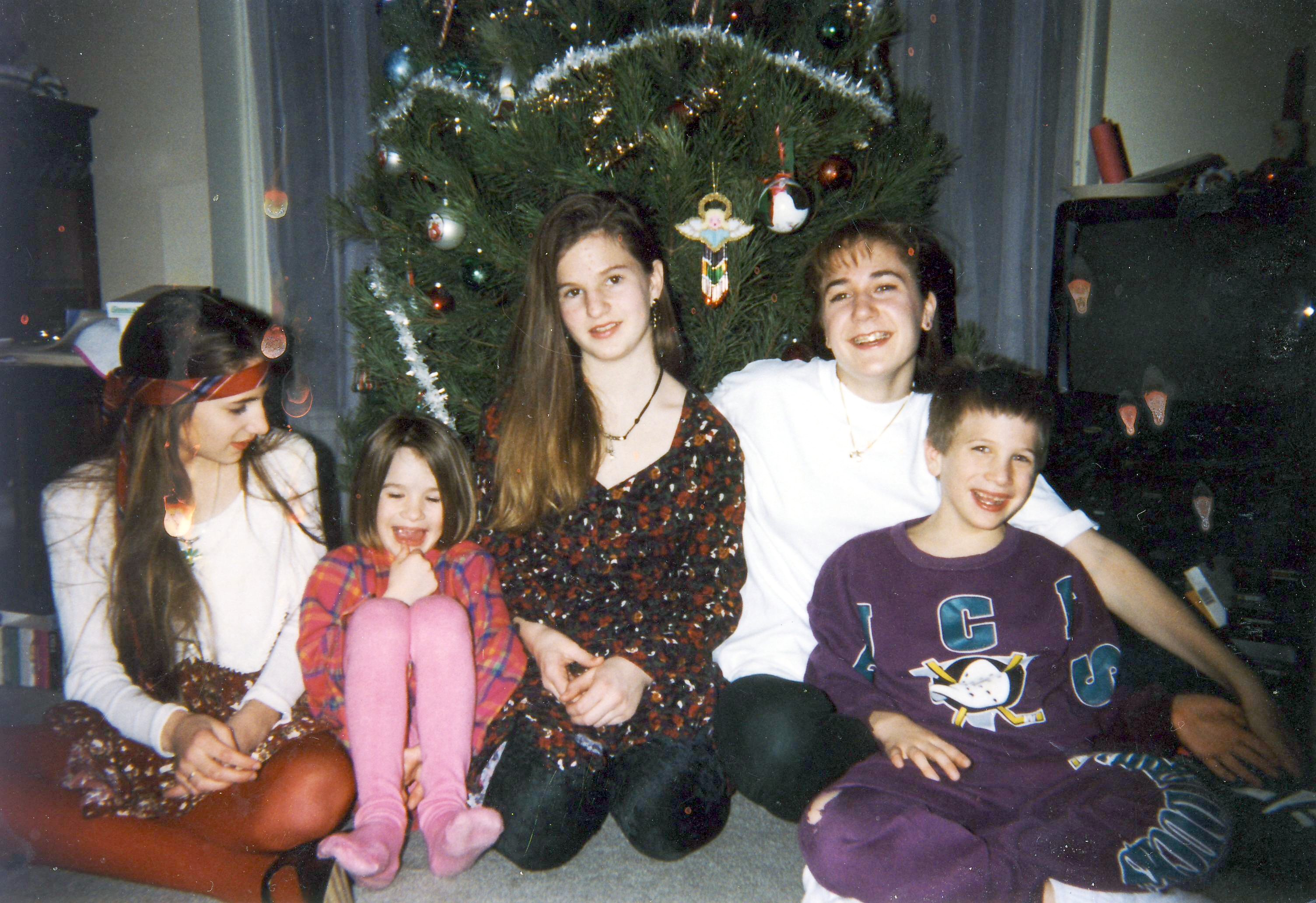
Me at age thirteen, centre, with my cousins and sister.
I did a teaching demo today for the owners of a local yoga studio. It was an amazing opportunity – their space is beautiful, they have a ton of teachers that I love and respect on their schedule, and it’s walking distance from my house. I’ve known the two owners for nearly a year, and they’re wonderful women – both are amazing instructors who have a quiet, gentle presence that would put anyone at ease.
Needless to say, I was fucking petrified.
I started out by nervously giggling my way through a short interview, and then spent a few minutes fumbling around with the audio system, trying to get my music to play and hoping that the trembling in my hands wasn’t obvious. I’d planned and reviewed the sequence that I was going to teach, so fortunately I didn’t forget it or anything, but my voice had gone strangely squeaky, and I could tell that my breathing was shallow. After a few minutes, though, I hit my stride and started to feel more confident. After all, I teach several times a week, right? I know how to do this.
Right?
Afterwards, they smiled at me, and told me what a lovely teaching voice and style I had, mentioned that I’d given excellent cues and had clearly been well-trained, and finally said that I had a beautiful practice.
Even a three-year-old could have heard this but coming a mile away.
But, one of them said gently, we noticed that you didn’t look at us. Do you ever walk around the room while you teach? Do you ever offer adjustments?
I do, I do, I stammered, I mean, maybe not as many adjustments as some other teachers, but I can do them. I mean, we learned how to. And I can walk around the room while I teach. We did focus on that in our training. Walking, that is, around the room, and not just demonstrating the poses to the students. It was something my teachers talked a lot about.
It must have been hard to teach to us, said the other, it was probably overwhelming to teach to the two owners of the studio.
I was totally nervous, I said. Didn’t you hear my voice shaking?
It was the sort of thing I knew I shouldn’t have said even before I said it, but then it came out anyway.
They talked to me a bit longer about the importance of connecting with your students, of having a relationship with them, and of maintaining an awareness of what’s happening in the room at all times. I said a few thing that probably sounded like feeble excuses. They thanked me for coming in, said that they had no immediate spots available on the schedule, but would keep me in mind for the future. I thanked them a little too profusely for having me in to demo for them (because it’s an honour to even be asked, right?) and then rushed out the door.
I don’t know which reaction to criticism is worse: to tell yourself that what other people see is wrong, that they just don’t understand what you’re trying to do, that they’re the ones with the ones with the problem, not you, or to do what I did, which was to tell myself that I’d flat out failed.
The thing is, they were right. I didn’t look at them while I was teaching. I probably don’t connect with and engage with my students enough. I do need to get up off the mat and walk around the room more often.
I could have said to myself that I would work harder, that I would take workshops on how to give adjustments, that I would get better and be the best teacher possible. The problem with that line of thought is that it seemed overwhelming and exhausting. I was tired just thinking about it.
It was easier to tell myself that I’d failed, that I was a bad teacher, that I should just give up and move on. It was easier to blame myself for not being prepared enough, for not thinking to look at them often enough, or even for scheduling a demo like this before I felt fully confident in my skills.
Failure is easy. Failure means that I get to give up, relax, not be so hard on myself. Failure means that I get to spend more time at home with my husband and son, and less time improving myself. Failure, somehow, means less anxiety.
Success, on the other hand, can be totally scary. With every success comes the idea that you need to build on it, keep the momentum going, continue to grow bigger and better every day. And success, of course, makes every little failure seem all the more bitter.
Every time I write something on here that elicits a reaction from people, that ends up being passed around on Facebook, or generates a lot of comments, I feel like my next post has to be even better. And then if I go a few days without posting anything that gets a big response, I feel like I’ve lost it, whatever it is: the ability to write, maybe, or to communicate effectively, to touch people.
A few things, though:
1. Every post I write doesn’t have to win the Nobel Fucking Prize for Bloggers
2. I am still just getting started as a writer who is writing things for other people, and not just scrawling messy feelings in my diary.
3. I am still a novice teacher; I just graduated in June for Pete’s sake
4. Who the hell is Pete, anyway? Is it Peter like the apostle Peter, the one who became the first Pope?
5. I really hate that dude.
I am a good teacher; I am also a good writer. I have innate talent in both of those areas (I mean, if I do say so myself). BUT (did you see that but coming?), innate talent will only get you so far. The rest of the way to success is hard fucking work. It’s hard work, and the road is never smooth – every time I succeed, it will likely be followed by a few failures, and it will be a while before I get to the point where I feel like everything is settling down and working out the way I want to. Maybe I never will. See? Fucking scary.
People like to say that failure is not an option, except that it totally is. I could totally pack up my yoga mat and go home. And I could justify that decision a million ways: teaching was wearing me out (true!), I felt like I wasn’t seeing my family enough (also true!), I wasn’t sure how to improve or move forward (double true!). Failing would be easy.
But I don’t want to fail.
I don’t want that to be the lesson that I teach Theo.
I don’t want that to be the lesson that I teach myself.
So if you’ll excuse me, I will take my lovely voice, my excellent cues and my beautiful practice and go work on learning how to properly walk around the room. It’s going to suck at first, and I’ll probably screw it up the first few times I try it, but I’ll ride that out and see it through until I get better. And I will get better, because I am a smart lady who can figure this shit out.
My child, even though I am a stupid misogynist and it’s totally my fault women can’t be priests, I will pray for you.











 The Belle Jar