Tag Archives: down with the patriarchy

I Am Not Your Wife, Sister or Daughter

18 Mar

I don’t have to tell you that Steubenville is all over the news.

I don’t have to tell you that it’s a fucking joke that Trent Mays and Ma’lik Richmond, the two teenagers convicted of raping a sixteen year old girl, were only sentenced to a combined three years in juvenile prison. Each will serve a year for the rape itself; Mays will serve an additional year for “illegal use of a minor in nudity-oriented material.”

I probably don’t even have to tell you that the media treatment of this trial has been a perfect, if utterly sickening, example of rape culture, with its focus on how difficult and painful this event has been for the rapists who raped a sixteen year old girl then bragged about it on social media.

And I almost certainly don’t have to tell you that the world is full of seemingly nice, normal people who want to go to bat for the convicted rapists. I’m quite sure that you already know about the victim-blaming that’s been happening since this case first came to light. You know about the fact that people have actually come out and said that the real lesson to be learned here is that we need to be more careful with social media (i.e. go ahead and rape but make sure you don’t get caught). You already know that people seem to think that being a sports star and having a good academic record should somehow make up for the fact that you are a rapist.

I don’t have to tell you any of that because it’s all par for the course.

What I do want to tell you is that you need to stop using the “wives, sisters, daughters” argument when you are talking to people defending the Steubenville rapists. Or any rapists. Or anyone who commits any kind of crime, violent or otherwise, against a woman.

In case you’re unfamiliar with this line of rhetoric, it’s the one that goes like this:

You should stop defending the rapists and start caring about the victim. Imagine if she was your sister, or your daughter, or your wife. Imagine how badly you would feel if this happened to a woman that you cared about.

Framing the issue this way for rape apologists can seem useful. I totally get that. It feels like you’re humanizing the victim and making the event more relatable, more sympathetic to the person you’re arguing with.

You know what, though? Saying these things is not helpful; in fact, it’s not even helping to humanize the victim. What you are actually doing is perpetuating rape culture by advancing the idea that a woman is only valuable in so much as she is loved or valued by a man.

The Steubenville rape victim was certainly someone’s daughter. She may have been someone’s sister. Someday she might even be someone’s wife. But these are not the reasons why raping her was wrong. This rape, and any rape, was wrong because women are people. Women are people, rape is wrong, and no one should ever be raped. End of story.

The “wives, sisters, daughters” line of argument comes up all the fucking time. President Obama even used it in his State of the Union address this year, saying,

“We know our economy is stronger when our wives, mothers, and daughters can live their lives free from discrimination in the workplace, and free from the fear of domestic violence.”

This device, which Obama has used on more than one occasion, is reductive as hell. It defines women by their relationships to other people, rather than as people themselves. It says that women are only important when they are married to, have given birth to, or have been fathered by other people. It says that women are only important because of who they belong to.

Women are not possessions.

Women are people.

I seriously cannot believe that I have to say this in 2013.

On top of all of this, I want you to think of a few other implications this rhetorical device has. For one thing, what does it say about the women who aren’t anyone’s wife, mother or daughter? What does it say about the kids who are stuck in the foster system, the kids who are shuffled from one set of foster parents to another or else living in a group home? What does it say about the little girls whose mothers surrender them, willingly or not, to the state? What does it say about the people who turn their back on their biological families for one reason or another?

That they deserve to be raped? That they are not worthy of protection? That they are not deserving of sympathy, empathy or love?

And when we frame all women as being someone’s wife, mother or daughter, what are we teaching young girls?

We are teaching them that in order to have the law on their side, they need to be loved by men. That they need to make themselves attractive and appealing to men in order to be worthy of protection. That their lives and their bodily integrity are valueless except for how they relate to the men they know.

The truth is that I am someone’s wife. I am also someone’s mother. I am someone’s daughter, and someone’s sister. But those are not the things that define me, or make me valuable in this world. Those are not the reasons that I should be able to live a life free from rape, sexual assault or any kind of violent crime.

I have value because I am a person. Full stop. End of argument. This isn’t even a discussion that we should be having.

So please, let’s start teaching that fact to the young women in our lives. Teach them that you love, honour and value them because of who they are. Teach them that they should expect to be treated with integrity because it’s a basic human right. Teach them that they do not deserve to be raped because no one ever, ever, ever deserves to be raped.

Above all, teach them that they are people, too.
449850811_o

An International Women’s Day Alphabet

8 Mar

A is for Austen, the Regency hellion

B is for Boudica, who raised a rebellion

C is Cleopatra, fierce Queen of the Nile

D is Diana, whose voice does beguile

E is for Ella, breaking down barriers

F is for Franklin, who made DNA merrier

G is Gloriana, anything but conventional

H is for hooks (lower case is intentional)

I is Isadora, who loved modern dance

J is Jo March, who wrote and wore pants

K is for Kennedy, who understood duty

L is Lamarr, who mixed science with beauty

M is MacPhail, political and proud

N is for Nellie, strident and loud

O is for Olave, keen about guiding

P is for Parker, whose wit was so biting

Q is Quvenzhané, who lights up the screen

R is for Rosa, who sat like a queen

S is Suu Kyi, the political prisoner

T is for Tubman, slavery abolitioner

U is Uhura, who kicked ass in space,

V is Victoria, who kept a stern face

W is Wollstonecraft, vindicator of rights

X is Xiang Jingyu, who fought the good fight

Y is Yousafzai, who refused to be rattled

Z is Zoë Washburne, ready for battle

We Can All Do It by Soirart

We Can All Do It by Soirart

On Race and Feminism

3 Mar

In the online fallout of The Onion’s vile tweet about Quvenzhané Wallis, one fact has become abundantly, dismayingly clear:

White feminists have a hard time talking about race.

And we have a hard time talking about the fact that we have a hard time talking about race.

Jessica Luther has a fantastic post up over on Shakesville about the lack of white feminists decrying what happened to Quvenzhané. And while I think that what she wrote is perfect and spot on and everyone should go read it right now, what I find truly fascinating is the weird backlash that she’s received from other white feminists.

It was the same backlash I saw on Twitter the other day when @graceishuman called out white feminists for not defending Quvenzhané.

That backlash? A whole bunch of white feminists explaining why they, personally, chose not to write about it. And I’m sure that they had some spectacularly good reasons (I’m not even being sarcastic), but that’s not what this about. Not by a long shot.

I have actually never seen so many people miss the point of something all at the same time.

What this is about is the lack of intersectionality in feminism. Specifically, it’s about the fact the women of colour do not feel that they are represented or heard within the feminist movement. As Kirsten West Savali wrote for Clutch, it can feel like the feminist movement encourages women of colour to,

” … shrug off our Blackness for the greater feminist good; the end result being a contemporary plantation tableau defined by Ole Miss and Mammie slaying the patriarchal dragon while the issues of racism and classism are hidden behind the veil of  “progress.”  And while this scenario is about as feel-good as The Help, expanding white privilege — feminist or otherwise — is not equality.”

So how the fuck did it ever get to this?

Is it because we (white feminists) feel that racism is an entirely separate issue from feminism? 

Most white feminists that I know would answer that no, of course it’s not, in the same way that homophobia, fatphobia and transphobia are not separate issues either. They would readily admit that women of colour experience misogyny in ways that white women do not. They would say that of course they care about racism.

But these same women, in their own writing, mainly stick to topics that specifically affect them or women like them. They very rarely address issues that are faced only (or mostly) by women of colour. They almost never talk about racism within the feminist movement. Which is funny, considering the racist history of our movement; shouldn’t this be something that we still talk about, all the time?

Is it because we worry that we’ll be co-opting women of colour when we speak out against something like what happened to Quvenzhané? Is it because we’re worried about making a misstep, about somehow accidentally being racist in our fight against racism? 

I would wager that the answer to this is yes, yes and yes. I’ve heard this same argument from several women as explanation of why they didn’t speak out against The Onion, or why they primarily focussed on the misogynist aspect of The Onion’s tweet and not the racist aspect. White feminists mentioned again and a again that they felt that women of colour should take the lead in this discussion, the rationalization being that white women speaking for others’ experiences was, in itself, a racist act.

And yeah, I guess if you’re a white feminist speaking for women of colour, that’s racist, but that doesn’t mean that you can’t call out racism when you see it. Like, fuck, I don’t want men speaking for me, but I sure as hell do want them to stand up against sexism. We complain so often about having to educate men with regards to feminism, and yet we (white feminists) do so little to educate ourselves when it comes to racial issues.

We make comments like, Well, I don’t even know what to call them, like do you say black or Black or women of colour or Women of Colour or minority or non-white or what? I don’t want to accidentally say the wrong thing.

We make comments like, They can write about the issues they face, and I can write about the issues I face. What’s wrong with that?

We make comments like, I thought we were all in this together.

For a group of people who are so hell-bent on (rightfully) pointing out male privilege, we sure as hell don’t like to be reminded of our white privilege, do we?

Which brings me to my next point …

Is it because we don’t want to admit that, as white women, while we do face a lot of overt and insidiously subtle misogyny in our day-to-day life, we face less barriers than women of colour do?

Privilege is comfortable. Privilege is easy. Privilege is invisible and difficult to quantify, facts that make us comfortable ignoring the fact that we benefit from it.

Privilege lead to write a post the other day that I felt was clever and insightful but, as others pointed out, was in several ways flawed and problematic.

I have a lot of privilege, white privilege, cis-privilege, thin-privilege, but it’s easier for me to talk about the privilege that I don’t have. I suspect that the same is true for many other women.

Being reminded of privilege makes people defensive – especially when those same people are complaining about the oppression that they face as women. There’s a tendency within feminism to want to gloss over racial issues and say, Well, first let’s fight against the problems that ALL women face, and THEN we can talk about racism, and I think that feels okay to a lot of us because in a fucked up way it feels like equality. In reality, though, it’s not equality at all – it’s asking women of colour to do work that will especially benefit white women, and then having those white women turn around and refuse to address the additional challenges faced by non-white women.

I think that another issue at play is that it can be hard to view yourself as both the oppressed and the oppressor. But the fact is that we do participate in the oppression of others, and our reluctance to examine that is pretty fucked up. Like, white feminists are perfectly articulate about how privilege works when they’re talking about male privilege, but they seem to plead ignorance pretty quickly when they’re reminded of the privilege that’s associated with their skin tone.

So what do we do about all of this?

Well, first of all, we fucking sit up and pay attention when women of colour tell us that they feel that we dropped the ball on this one. Because you know what?

A) They know what they’re talking about, and

B) They’re right

And then, after we admit that we fucked up, we talk about it. We talk about race until we’re blue in the face. Because pretending that this isn’t happening isn’t doing anyone any favours, and continuing to ignore the racial issues within the feminist movement is only going to serve to further divide us.

Finally, we need to change how things are structured in order to see real equality. We need to give more platforms to women of colour. We need to be more willing to listen to what they have to say. We need to be willing to be called out on our racism. Most of all, though, we need to let women of colour lead the way and let THEM tell us what they want and need in order to do that.

Because reaching down and giving a boost to someone who has less privilege than you do is what real fucking equality looks like.

And to those of you who aren’t interested in doing that, I would ask that you please stop using the word equality. You’re not interested in equality; you’re only interested in benefitting yourself.

I don’t want to just benefit myself. I want my actions to benefit everyone. And right now, I especially want my actions to benefit this kid:

Quvenzhane-wallis-beasts

It’s Okay To Feel Weird About Your Pregnant Body

23 Feb

Dear Fug Girls,

I like you. I like you a lot. I’ve been reading your site for, like, probably ten years now. I remember the days when Jessica wrote X-Files recaps for Television Without Pity (and those were some good days!). So, suffice to say I’m a pretty big fan.

And, as a fan, I want to tell you that what you wrote yesterday about Kim Kardashian wasn’t cool. Like, really not cool.

I get that hearing women talking about their weight can be stressful, maybe even triggering, and that one of the ways to deal with that is through humour, but I don’t think that it’s ever okay to make fun of a woman for being uncomfortable about her body. Because you know what? Everything in the freaking world is conspiring to make her feel uncomfortable about her body, and mocking her is not helping.

Look, pregnancy sucks. I mean, in some ways it’s kinda neat, but in a lot of ways it sucks big time. Your body, which has probably remained fairly static for most of your adult life, is suddenly taken over by a parasite and starts expanding in all kinds of weird ways. And suddenly, it’s not your body anymore. I mean, it is, but it’s totally unfamiliar to you, and also its housing a weird tiny thing that kicks and squirms a bunch. I spent a lot of my pregnancy feeling like the dude in Alien, to be honest, although thankfully I gave birth to an actual human being who was surgically removed from my abdomen rather than bursting out in a totally badass, metal way.

Anyway, what I’m trying to get at here is that even though I’m a thin woman, and even though my pregnancy weight looked perfectly fine on me, I still felt uncomfortable gaining weight. And I am not someone whose appearance is routinely picked apart by tabloids. I am not someone who felt obligated to prove that she’s “bikini ready” at six weeks postpartum. So if pregnancy made me feel weird about my body, I can only imagine how hard this must be for Kim Kardashian.

I’ll be honest: I don’t know a whole lot about Kim. I know that she’s with Kanye West, and I know that she’s done a bunch of reality shows, and I know that people love to hate her. I know that people like to make comments about how she’s famous for “nothing” (which is a hilarious criticism, because if anyone offered to let me be famous for nothing, I’d be like, “sign me up, bro” – who wouldn’t want to get tons of money for doing nothing?), although the number of times I see her out promoting stuff make me have a hard time believing that she really does nothing. I know that she’s a woman of colour who’s got hips and boobs, and I know that she’s already endured tons of criticism about her size from the media, long before she ever got pregnant. I know that she’s a woman, and as such she’s going to be scrutinized and mocked and ridiculed far more than her male counterparts.

At the end of the day, I’m just not really interested in shaming anyone for their feelings. Especially when those feelings have totally valid roots in the way our media and culture treat women. If Kim Kardashian wants to talk about how gaining weight while pregnant is upsetting, then more power to her. I’ll be happy to tell her a thousand times that she looks fantastic no matter what. Because there’s absolutely no good that can come from telling someone that their feelings are wrong, or bad, or stupid.

Anyway, that’s all I’ve got. I hope you guys will consider this the next time you post about someone’s weight gain. I mean, as much as I know that making fun of the way people dress is your gig (and usually it’s a pretty funny gig!), maybe you’ll be able to be a bit more empathetic the next time something like this comes up.

Sincerely,

Annabelle

p.s. The pants were pretty ugly, though, I’ll give you that

p.p.s. Say hi to the Mulder and Scully action figures for me! I hope they’re locked in an eternal embrace now that they’re retired from TWOP

p.p.p.s. I kinda hope these crazy kids make it, not gonna lie

kim-kardashian-kanye-west


ETA: Go Fug Yourself put an addendum on their post, which is pretty awesome:

** I may need to clarify that I am not trying to say that pregnant women can’t be thrown off by the changes in their bodies. But there is a difference between that and denial. To me, wearing those pants doesn’t say, “I am feeling awkward about my changing form.” Rather, that garment, to me, is a fingers-in-ears scream of, “LA LA LA NOTHING IS
CHANGING AT ALL.” My point was, don’t let denial get in the way of biological necessity — and also, those trousers are odious. But the former is dipping into armchair psychoanalysis, so I apologize if I overstepped…

Shrevolution! Or, I Hate Valentine’s Day

14 Feb

I’m just going to go ahead and put this out there: I’m not exactly the world’s biggest fan of Valentine’s Day.

I mean, it’s fine when you’re a little kid. You make sure to wear something red or pink, tell your parents how much you love them, and draw hearts all over every-fucking-thing. Everyone in your class gives you a card, your gorge yourself on chocolate, then spend the afternoon in a sugar-fuelled frenzy and throw up all over your babysitter’s carpet. End of story.

Then you hit puberty, and Valentine’s Day becomes this huge, looming thing. Like, it’s the only day where you can truly prove just how much you love (or, at least, want to fuck) another person. You can be in a happy committed relationship for every other day of the year, but if you happen to be single on Valentine’s Day, then you, my friend, are the most pathetic person in the world. Or at least you’re made to feel like you are.

My dislike for Valentine’s Day has slowly evolved over the years. In grade school I thought it was fine, maybe even sort of fun, and in high school I endured it, handing out ironic valentines to friends and crushes alike (go ahead, ask me how well that worked in the dating department). By university, though, I was ready to declare open season on V-Day.

I decided that the modern-day, grown-up version of Valentine’s Day was nothing less than a capitalist nightmare, chock-full of obligations to spend money: on flowers, on dinner, on chocolates, on jewellery, on sexy lingerie. There were other, insinuated obligations, too. For example, women were expected to pay for all the attention and money lavished on them by putting out, whether they wanted to or not. I even once had a male friend say to me, “If I buy my girlfriend flowers for Valentine’s Day, she basically has to have sex with me, right?”

Uh, no, dude. She doesn’t.

And, I mean, seriously, out of all the thinly-Christianized pagan celebrations to take hold this side of the Atlantic, how did crappy old Valentine’s Day manage to make it onto that list? Why can’t we celebrate May Day and dance around may poles? How come we don’t do anything for St. John’s Eve, a.k.a. Midsummer? I would way rather build some bad-ass bonfires in June than hand out ugly, mass-produced cards in February.

All of this was part of the reason why my roommates and I decided to throw an Anti-Valentine’s-Day party during second year. My mother had put a package of pink, heart-shaped Post-It notes in my stocking that Christmas, so we used those to decorate our apartment, scrawling things like, “LOVE IS AN ILLUSION” and “FUCK YOU” on them. You know, the usual romantic stuff.

Aside from the fact that a girl that no one liked and no one would admit to inviting ended up vomiting red wine all over our bathroom, the party was a resounding success.

The next year, my friends and I celebrated Valentine’s Day a little differently. Our plans started innocently enough: we were going to go eat greasy, delicious, non-romantic food and then go somewhere for drinks. There were four of us, two of whom had boyfriends, and all we really wanted was a quiet, Galentine’s night out.

Once we got to the pub, things went downhill fast.

A few drinks into the evening, the ranting began. And, naturally, the more we drank, the more belligerent we became.

“Fuck Valentine’s Day!” said one of my friends, “People think it’s all about women, but really it’s all about dicks getting some action.”

“Yeah, fuck dicks,” said another. “I mean, don’t actually fuck them, but also, fuck them.”

“Valentine’s Day should be for clits, not dicks! Dudes should be obligated to prove that they can perform proper oral sex before taking a woman out for V-Day,” said someone else. “Clit not dick! Clit not dick!”

Clit Not Dick ended up becoming our mantra for the evening. We repeated it frequently and loudly. We decided that we were going to start a revolution based on our new slogan, one that would free women everywhere from the oppressive shackles of Valentine’s Day. We began approaching romantic-looking couples at other tables to ask if they’d hear the good news about Clit Not Dick. We harassed the band with demands for songs by Veruca Salt, Hole, and, strangely, Counting Crows (they actually did end up playing Mr. Jones, probably just to make us go away).

This was back in the days when you could still smoke in bars, so we started chain-smoking to go along with our drinking. Soon our ashtray was overflowing, and our table was surrounded by a blue haze. We decided that we should pact that night, the four of us, to continue spreading word of the revolution. We touched the glowing tips of our cigarettes together and called it a cigarette pact because, we said, cigarettes don’t lie.

Later, we spilled out onto the street and, arm in arm, began marching down Spring Garden Road singing We Shall Overcome. Whenever we saw a girl getting into a car with a guy, we would run over and try to convince her that she didn’t need him, she only needed herself! We proselytized about the revolution to everybody, shouting CLIT NOT DICK at random intervals.

We found a phone booth and somehow managed to cram all four of us into it. We dialled the tips line for the local newspaper and left them a long, rambling message about capitalism, the revolution, and how Valentine’s Day oppressed women, and, naturally, clit not dick. We finished up by saying that we expected to see something about this in the next day’s paper.

“GET ON IT,” my friend yelled into the phone before hanging up.

One of my friends was so drunk when she got home that she was slurring her words. She tried to tell her boyfriend It’s the revolution! but apparently it came out sounding like Shrevolution! 

Naturally, once the rest of us heard that word, we adopted it as the new name for our movement.

The next year we held another Shrevolution, but the year after that I met Matt, and everything changed.

I learned to love Valentine’s Day and everything that went with it.

PSYCH. I still hate Valentine’s Day. Matt, who is kind of into it, has had to accept that I’m just not a very romantic person. I mean, don’t get me wrong, we’ve tried to celebrate it, if only because it seemed to mean something to Matt. But I think he realized pretty early on that it wasn’t my thing – the fact that for our first Valentine’s Day together he gave me a red silk pillow with I Love You embroidered on it and I gave him a swiss army knife may have helped tip him off – and now we’re pretty low-key about it.

But tonight, the Shrevolution will ride again. A bunch of my old Halifax friends are now living in Toronto, and three of us are going out to the Drake tonight to eat fancy, romantic food and get trashed on overpriced cocktails. Because as much as I might laugh at my younger self for some of my ridiculous Shrevolution antics, I can’t say that I entirely disagree with her thoughts on V-Day: that it’s too commercial, too capitalist, and there’s too much obligation to spend money that you might not have. Also the fact that you should celebrate your love for someone every day, not just spend one day a year in the back corner of a third-rate restaurant because that was the only place you could get a reservation, exchanging cheesy Hallmark cards and crappy gifts. Because you know what? Love fucking deserves better than that.

So while you are sitting there trying to whisper sweet nothings in your lover’s ear over the din of everyone else trying to do the same, I will be laughing raucously, swearing like a sailor, and yelling rude things.

Happy Shrevolution, you guys!

awesome_antivalentines_day_cards_640_02

Feminism and Abortion

27 Jan

I like to think that there aren’t a lot of hard and fast rules when it comes to feminism. I think you can be married and have kids and be feminist. I think you can be single and childless and be feminist. I think you can be a stay-at-home mom and be feminist. I think you can be a working mother and be feminist. I think you can breastfeed and be feminist. I think you can formula-feed and be feminist. I think you can wear cute dresses and pretty pink lipstick and a giant fucking bow in your hair and be feminist. I think you can wear jeans and combat boots and cut your hair real short and be feminist. I think you can be a woman and be feminist. I think you can be a dude and be feminist.

I don’t, however, think that you can be anti-choice and be feminist.

This week marks the 40th anniversary of Roe vs. Wade, the landmark decision by the United States Supreme court to legalize abortion (up until then, the only legal abortions in America were those done in cases of rape or incest).

In the 40 years since Roe vs. Wade, the abortion issue has only grown more contentious. There are many people who are still vocal supporters of the pro-choice movement, but there are also many people who don’t support a woman’s right to bodily autonomy.

And you know what? I wish I could say that I understood, but I don’t.

I don’t understand why you would try to enact a ban on abortions when banning abortion does not actually affect the abortion rate.

I don’t understand why you would try to create legislature that is almost certainly going to be dangerous to the health of women, sometimes even leading to their deaths.

I don’t understand why you would spend your time preaching at women about dead babies, telling them at what gestational age they develop fingers and toes and referring to abortion as “murder”, rather than using your time to promote access to things like birth control and sex education.

And I really, really don’t understand how and why Ross Douthat thinks he can convince women that they can be anti-choice and feminist.

I think that part of the problem is that Douthat doesn’t seem to understand what the feminist movement and the abortion debate are all about. And you know what? Far be it for me to elect myself the Boss of Explaining Feminism and The Pro-Choice Movement to Ross Douthat, but I guess someone has to do it, so here goes.

Douthat begins by complaining that Nellie Gray, a former-WAC-corporal-turned-bureaucrat-turned-lawyer who helped establish the March for Life, the annual rally against Roe vs. Wade, is not a “case study for students of second-wave feminism.” This, Douthat argues, is because “cultural stereotypes” cause us to believe that the anti-choice movement has a more “complicated relationship” to women’s advancement than all those Liberal left-wingers want us to believe.

I bet you are wondering how on earth banning women from exercising their reproductive rights is anything more than a reverse of all the hard-won equality that feminism has fought for. I know that I sure am! Let’s see what Ross Douthat has to say.

First of all, Douthat wants you to understand that one of the “stereotypes” about the anti-choice movement, the idea that they are trying to reinforce traditional gender roles by forcing women to have children and stay out of the work force, just isn’t true! He notes that,

Jon Shields of Claremont McKenna College pointed out last year, pro-life sentiment has been steady over the last four decades even as opposition to women in the work force (or the military, or the White House) has largely collapsed. Most anti-abortion Americans today are also gender egalitarians: indeed, Shields notes, pro-life attitudes toward women’s professional advancement have converged so quickly with pro-choice attitudes that “the average moderately pro-life citizen is a stronger supporter of gender equality than even the typical strongly pro-choice citizen was in the early 1980s.” Among the younger generation, any “divide over women’s roles nearly disappears entirely.”

Translation: the anti-choice movement totally gives you permission to work outside of the home! And wear pants! And vote! They support all kinds of radical choices for women!

I mean, except whether or not to have kids once you’re already pregnant.

You’re totally allowed to be in control of your own body right up until that one, single, solitary sperm encounters that one single, solitary egg – after that moment, you’re up baby creek without a paddle.

Douthat then goes on to assert that,

The pro-life cause has proved unexpectedly resilient, in other words, not because millions of Americans are nostalgists for a world of stricter gender norms, but because they have convinced themselves that the opportunities the feminist revolution won for women can be sustained without unrestricted access to abortion.”

What he actually means is that SOME of the opportunities the feminist revolution won for women can be sustained without unrestricted access to abortion. You know, all the opportunities that don’t involve a woman’s right to choose whether she has kids or not.

And before you jump in to tell me that if a woman doesn’t want to have kids, she should just use birth control, let me tell you that that’s not how it works. Even with all sex education in the world, even with easy access to birth control, women are still going to have unplanned pregnancies.

Sex education is easily forgotten in the heat of the moment. Birth control fails. We all know that no form of birth control is 100% effective, except for abstinence.

Please, go ahead and raise your hand if you think that preaching abstinence is going to work.

Lindsey Graham, you can put your hand down right now.

Douthat finishes his article by saying that,

For its part, if the pro-life movement wants not only to endure but to triumph, then it needs … [to offer] … realist’s explanation of how, in policy and culture, the feminist revolution could be reformed without being repealed.

Ross Douthat, let me explain this to you using small words, so that you will understand:

If you are trying to take choices away from women, that is not feminist. If you want to enact policy that will quite certainly lead to women’s deaths, that is not feminist. If you think that you, as a man, get to have any say over what happens to women’s bodies, that is really not fucking feminist.

Got it?

Good.

And you know what? If you really, truly believe that life begins at conception, why not work to fund research and raise awareness regarding miscarriage and infertility? One in four pregnancies ends in miscarriage, and those are only the pregnancies that women know about. It’s actually estimated that 50-75% of all embryos fail to implant due to genetic problems, hormone imbalances and other factors – if you really want to save unborn babies, why not go that route? You’d be saving way more “lives” that way than by banning abortion.

And let’s not even talk about all the ways in which you don’t help the children you’ve “saved” from being aborted. You know, the children born to mothers struggling to make ends meet, the children who don’t have access to healthcare, the children who don’t get enough to eat on a daily basis. Those children.

The thing is, Ross Douthat, you and I both know that this isn’t about saving unborn children. This isn’t about the fact that you believe that abortion is murder. This is about controlling women, plain and simple. This is about you thinking that you can use the rhetoric of the feminist movement to somehow trick women into agreeing with your anti-choice stance.

So please refrain from ever using the word “feminist” in conjunction with the anti-choice movement ever again.

p.s. Also, please never use the term “mansplaining” ever again.

p.p.s. No one says “chauvinist” anymore. Just sayin’

p.p.p.s. I don’t like you.

prochoice-300x225

I Am At Least Three Times As Ugly As Jessica Valenti

15 Jan

Today the website Return Of Kings (which I had never heard of, but I’m sure is super important and relevant) published their list of The 9 Ugliest Feminists in America.

My first thought was: What, they couldn’t find one more ugly feminist in order to round it out to an even ten?

My second thought was: I wonder which pictures of me they chose for their post?

Everyone knows that I am at least the third ugliest feminist in North America.

For example, I am way uglier than Jessica Valenti. Like, this is your ugly picture of her?

jessica-3

Bitch, please.

You want ugly? Let me show you ugly.

ugly

Hey, at least my kid is cute, right?

Science has proven that I am at least three times as ugly as Jessica Valenti. Here is a graph demonstrating our comparative ugliness:

flowchart


You know that there is some real fucking science involved when there is a GRAPH. Science is awesome.

Imagine my surprise and embarrassment, then, when I realized that I’d been overlooked for this, the definitive list of ugly feminists. Me. The one with the bad skin, hooked nose and squinty eyes. The one who was voted ugliest in class by a group of 12 year old girls. The one who is eternally on the receiving end of remarks like, well, at least you’re smart.

All right, all right, I know what you’re probably thinking.

“But Annabelle,” you might say, “These women are all famous feminists. Sure, you’ve had a few posts go viral, but you’re nowhere on the same level of recognition as, say, Hanna Rosin.”

And you know what? That would be a fair criticism to make if this was a list of the  nine ugliest famous feminists in America. But it’s not. It’s just a list of the nine ugliest feminists. And I am deeply, deeply hurt that I wasn’t included. Because, seriously, what is my point in life if I’m not grossing out the men’s rights activists with my Medusa-like face?

So, come on, Return of Kings, let me know what I can do to put myself in the running for next year’s list. Should I gain weight? You seem pretty fatphobic, so that could be a winning strategy. Should I lose weight? That might seem strange to some, but I think that if I could get to the point where men consider me “scary skinny” (as the tabloids say), I might have an advantage over more average-sized women. Should I wear more makeup and have you accuse me of looking like a whore? Or should I wear no makeup  and let you mock my face as-is? Should I dress badly so that you can make fun of my fashion sense? Or should I dress well so that you can laugh and laugh about how those silly feminists want to be taken seriously and look good?

Come on, guys, throw a girl a bone here!

In all seriousness, though, the funniest thing about your whole post isn’t your pathetic attempt at making “she’s-so-ugly” jokes – it’s the fact that you seem to think that any of these women care about whether you find them attractive or not. Sadly, most of them don’t even know you exist. They write off your comments and tweets and posts as trolling, and, honestly, don’t even give you a second thought. Sorry. I know the truth hurts. Someone has to say it, though, right?

But hey, I gotta thank you for helping me show that feminism is still relevant and necessary. Because as long as there are still douchebags like you out there publishing crap like this, it’s easy to prove why we still need to fight for women’s rights and equality. Your list has actually done more to help the feminist movement than hurt it. So please, keep on posting stuff like this and making my job easier.

Seriously, though, don’t forget me in 2014!!!

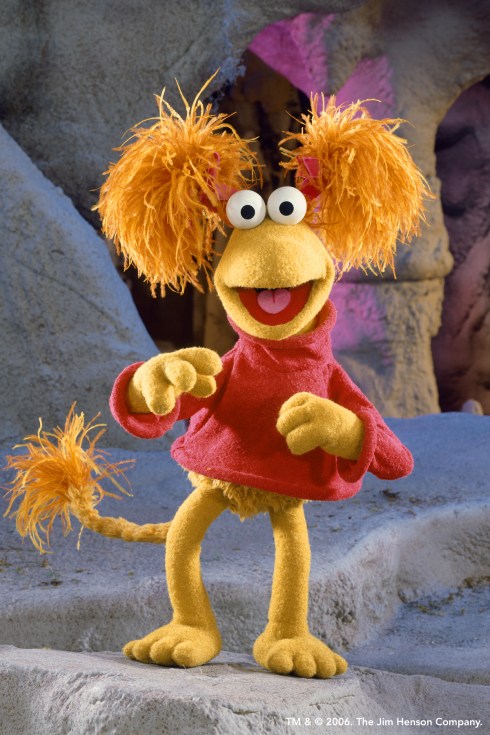
Red Fraggle is a Feminist Icon

13 Dec

It wasn’t until I learned that I was pregnant with Theo that I suddenly realized how very little I knew about, well, babies. I mean, in theory they’re great, but in practice they’re kind of terrifying. Like, I was going to be responsible for what now? I could barely even take care of myself, never mind another person, and one who was tiny, helpless and incontinent at that.

Being the book-o-phile that I am, my solution was to immediately run out and buy a ton of books about pregnancy, childbirth and parenting. I also went online and joined a bunch of mommy communities, which were, um, interesting. After sifting through all of the information available to us, Matt and I began to try to come up with the Best Plan Possible for raising our kid. Because, you know, that’s totally a thing that’s going to work out.

Babies just love plans, and are definitely going to turn out exactly the way you want them to.

Sorry, I’ll wait until your done laughing your fool head off before I continue.

One of the things that Matt and I decided was that we were going to follow the AAP’s guidelines and not expose our children to any television under the age of two. That wouldn’t be overly challenging, we figured; after all, we barely watched television ourselves, and surely it would be easy to watch what little we did after our bundle of joy went to bed. Anyway, we thought, what benefit was there in letting our children watch television? Especially when the world around them was so fascinating? Surely we would be happy to engage and entertain our children at all times. Surely we would never, ever want a short, say, half-hour break from them.

Of course, one of the first things you do when you become a parent is break all of your own rules. You quickly learn that there aren’t very many hard and fast rules, and the few that do exist weren’t created by you. Sure, it’s great to be consistent and back your words up with actions, but when you become a parent you learn how valuable flexibility can be. It’s easy to be an expert on childrearing when it’s all still theoretical; once you have an actual, physical, screaming baby, it’s often advantageous to revisit your policies and re-evaluate what your priorities are.

All of this is to say that we totally caved on the no TV thing.

When Theo was fourteen or fifteen months old, we started watching short YouTube clips of Fraggle Rock at bedtime. It was nice to spend 10 minutes every evening curled up together on our big bed, watching nostalgic television by lamplight. Afterwards, we would talk about what we’d just watched, and then I would nurse Theo to sleep. It was a pretty great way to end the day.

In the course of revisiting one of my favourite childhood shows, I realized something: Fraggle Rock was pretty fucking progressive with regards to gender roles.

I also realized that Red Fraggle was probably my first real feminist icon.

When it came to strong female role models, I was actually a pretty lucky kid. I had my mother, who was and continues to be a kick-ass inspiration, a woman who always worked outside the house, raised three kids on her own after my father left, and recently purchased her first home after spending year and years saving up for a downpayment. I had my grandmother, a women who also worked outside the home for her entire adult life, and who once took her employer to court because he wouldn’t allow women to wear pants in the workplace. I had my aunt, an Egyptologist who travelled to the Middle East for archeological digs. I had my great-aunt who, as a missionary to Niger in the 1960s, dedicated her life to educating girls. I definitely wasn’t lacking for real-life women to look up to and be inspired by.

But I wasn’t able to relate to those women and their accomplishments in the same way that I could relate to an adorable red-headed muppet who was about the same size I was and dealt with a lot of the same issues I did.

Red Fraggle is just awesome. She’s smart, funny, opinionated, competitive and likes to be in charge. She speaks her mind, like, frequently, and the other Fraggles almost always listen to what she has to say (even if they don’t ultimately agree with her). She’s adventurous, athletic and generally pretty fearless. She doesn’t wear pink (except for her hair ribbons). Oh, and she’s sarcastic. So delightfully sarcastic.

She also has some of the best lines spoken by a female character in a children’s show, like, ever. The following is from season one, episode fifteen, ‘I Don’t Care’:

Red: Hey Mokey! They gave me somebody else’s lines for this scene!

Mokey; Uh, let’s see, you say, I know my prince will come and rescue me.

Red: Who needs a prince? I can rescue me!

Mokey: And then you say, hark, I think I hear the hoofbeats of his fiery charger.

Red: Oh good grief.

[a brief interlude of dialogue between Mokey and Boober]

Red: But I don’t have to be rescued, Mokey! I can climb on this trellis! Better yet, I’ll swing on this vine. Why don’t we call it the Tale of the Triumphant Princess?

What’s great is that Red has no issue being a princess, she just wants to be a princess who can take care of herself. She’s totally fine with being feminine and girly, but she doesn’t want to have to rely on anyone else. Instead of waiting around to be rescued, she wants to take charge of her own destiny – a pretty admirable trait.

Red challenges traditional gender roles, both openly and tacitly. One of the best things about Fraggle Rock is that the other characters are totally fine with her behaviour. Sure, she can be abrasive and obnoxious at times, and yeah, she has a hard time admitting when she’s wrong, but these aren’t presented as being character flaws because she’s female; they’re presented as being negative traits because of the impact they have on herself and other people.

Oh, and in case you were wondering, Red is the best swimmer in Fraggle Rock. Better than any of the boys, even.

The neat thing about this show is that it’s not just Red who challenges gender roles; it’s Boober and Wembley too. It’s presented as being totally fine for Boober, a male Fraggle, to prefer to stay home all day washing socks and cooking. It’s also fine for Wembley to “wemble”, i.e. waiver with indecisiveness. That last one is especially interesting because a lot of Wembley’s “wembling” comes from a place of not wanting to pick sides when his friends argue and, ultimately, not wanting to hurt anyone’s feelings. It’s pretty rare for a male character to be shown as being so openly emotional. Rare, but awesome.

Mokey and Gobo, the two remaining Fraggles in the main cast of characters, are more typical of their genders: Mokey, a wispy poet who wears long flowing robes and speaks in a vague, dreamy voice is the sort of den mother of Fraggle Rock, and Gobo, bold, adventurous and a natural leader, spends his days exploring the rock and coming up with escapades for his friends. They participate in breaking down gender barriers, though, by letting their friends be who they are and encouraging them to do the things they love. They never ask Red, Boober or Wembley to behave in a certain way because of their gender; they only ask that each of them treats the others with respect.

Anyway, I guess it’s clear that we’ve totally, unapologetically broken our rules about television. We still don’t watch much of it; mostly just Fraggle Rock and Mister Dressup (okay, and sometimes Jay-Z videos, but only because Theo specifically asks for them). Children’s television, especially newer shows, are still pretty much a foreign country to me, one that I’m sure I will someday have to explore. Until then, I’m happy with my Fraggles and the lessons they’re teaching my son. For example, swimming before breakfast is great, music and dancing are a necessity, and boys and girls are totally, happily equal.

Sounds like utopia to me.

Red

National Day of Remembrance and Action on Violence Against Women

7 Dec

When I was a kid, my mother had a button that looked exactly like this:

399036_s

I couldn’t find a very large image of this button, but in case you’re wondering, around the edge it reads: “In commemoration of the 14 women killed in Montreal, December 6th, 1989 and all women who have suffered from violence.”

Every year, after my mother retired her Remembrance Day poppy sometime in mid-November, she would break out her rose button and pin it to the lapel of her coat. As a small child, I remember coveting the button, because I liked the picture on it. When I was older, it made me uncomfortable; I didn’t like that my mother wore a pin to commemorate a mass murder, and the look on her face and the tone in her voice when she explained the story behind it frightened me. Strangely, the story itself didn’t frighten me; it seemed too remote, totally removed from my day-to-day life. It was a freak accident; a tragedy, yes, but nothing that could ever happen to a person like me.

Later still, when I was a teenager and irritated by everything my mother did, I found the button obnoxious and sanctimonious. I’d grown up hearing my mother referring to herself as a feminist, a term that I refused to apply to myself. It seemed to me that most boys hated feminists and, when I was a lonely high school student with low self-esteem, the last thing I wanted was to do something that would cause the boys I knew to reject me even more. When they made jokes about women, jokes whose real punchlines were how stupid and pathetic women were, I laughed. Sometimes I joked back, making fun of the way girls dressed, of how many guys they slept with, how idiotic and shallow they were. Sure, I was a girl, but I was on their side – I wasn’t one of those girls. Never mind the fact that I probably would have given my eyeteeth to be cool enough to be one of those girls.

Back in those days, whenever late fall rolled around and my mother broke out her shabby, rusting rose button, I would roll my eyes. He was crazy, I would tell my mother. Like, mentally ill. It had nothing to do with women, he was just nuts. What if he’d killed only Dutch people? Would we have national day of remembrance and action on violence against Dutch people?

When I was a teenager, I thought that feminism was pointless at best, and a way of angering and alienating people at worst. It hadn’t yet occurred to me that sometimes angering and alienating people was a good thing; that there might be situations in which I wanted people to feel negatively about me and the things that I said. At the time, I couldn’t imagine not wanting to please every body, just like I couldn’t imagine anyone wanting to kill me simply because I was a girl.

Now I know differently.

I’m not saying that anyone’s out to get me specifically, because as far as I know, they’re not. It probably helps that I come off as fairly non-threatening – I’m a small, mousy white woman who doesn’t work in a male-dominated field. I’m a shy, quiet woman who pretty much totally followed the status quo – I finished high school, went to university, then married a nice guy and had a kid before I turned 30. Probably the most threatening thing I do is blog (extensively) about women’s reproductive rights, but that hasn’t generated any death threats or anything.

But there are still people who hate me because of my gender. I mean, maybe not openly, maybe not obviously, but they do. We live in a culture of casual misogyny. A culture where over 600 First Nations women are missing or have been murdered in Canada, only to have our government do nothing about it. A culture where female sex workers are treated as objects instead of people. A culture where women are told to be less angry when they talk about the events of December 6th. A culture where women are constantly being ridiculed, judged and set up in competition against each other. A culture where my sister, an avid World of Warcraft player, has been asked repeatedly to turn on her webcam and show other players her breasts in order to “prove” that she’s a woman.

When Marc Lépine went to the École Polytechnique 23 years ago today, he entered the school with the intention of killing feminists. Feminists, he said in his suicide note, had ruined his life. Lépine had applied to the École Polytechnique in both 1986 and 1989 but had been rejected both times because he lacked the CEGEP courses necessary for admission. In Lépine’s mind, however, he wasn’t admitted to the school because women had taken too many of the available spaces. Women, he thought, had taken everything important, and left nothing for him.

Lépine killed 14 women just because they were studying engineering. Lépine killed 14 women for daring to want careers in a male-dominated field. Lépine killed 14 women for being women.

I was seven years old when École Polytechnique Massacre happened. I want to think that the world has changed since then, but really, has it? Women are still the butt of the joke. Women are still lacking in positions of power. Women are still being told that they need to compete against each other. There is still a persistent bias against women in the worlds of math and science. If there’s anything that can be learned from the latest American election, it’s that there are still men who hate women. A lot of men. Powerful men.

I don’t know if my mother still has her rose button. Probably not – I haven’t seen it in several years, and the last time I did, it was looking pretty beat up. I wish she did, though, and I wish that she lend it to me. These days, I would wear it with pride.

Rape Jokes and The Oatmeal

5 Dec

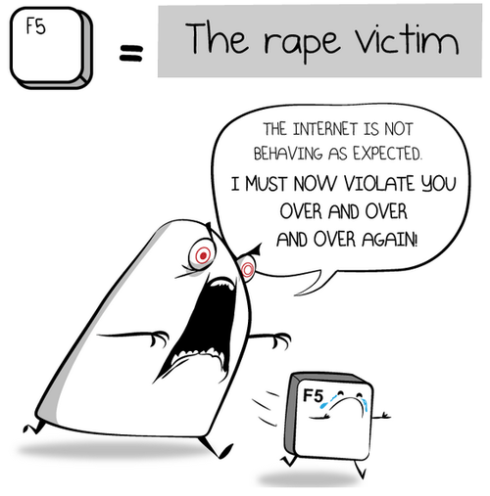
Yesterday, Matthew Inman from The Oatmeal wrote a comic about the “delicate relationship” that he has with his keyboard.  This was the final panel of the comic:

rape-f5rape

The comic in its entirety was about how he feels and behaves towards the various keys in his keyboard. This panel specifically was about trying to get a webpage to load when you have a slow connection, with the joke centering around Matt “raping” his F5 key in order to make the page load faster. Yes, it’s a rape joke. No, I’m not surprised. Yes, it’s supposed to be funny. No, no one would ever  actually “rape” a computer key. Yes, in spite of all that, I’m still grossed out. Now that all that is out of the way, can we talk about how terrible this is? Because it’s terrible. Really, really terrible.

The panel above is the type of joke that normalizes and trivializes rape. Instead of showing rape as an act of sexual violence that will haunt someone for the rest of their life, it’s hilariously portrayed as pushing your F5 key one too many times. What it tells readers is that rape is no big deal, that it’s just this thing that happens. It tells readers that rape is not a powerful word, but instead is a term you can use to describe any kind of forceful action. It tells readers that rape is normal, and even worse it tells rapists that rape is normal. The problem with jokes like this is that not only do they make rape victims deeply uncomfortable, they make rapists feel comfortable.

And I mean, you know what? As far as rape jokes go, this one isn’t that bad. I mean, not really. It’s not graphic, and it’s not even describing a plausible situation since, again, computer keys can’t be raped. If we didn’t live and participate in rape culture, this joke on its own wouldn’t be that big of a deal. But you know what? If we didn’t live in a culture where rape was constantly aided and abetted, a culture where rape is so normalized that we think nothing of making light of it, a culture where rape victims are frequently hushed up, dismissed or outright disbelieved, this comic would never have been made. This comic is a product of rape culture and it perpetuates rape culture. The message that this comment sent out to The Oatmeal’s nearly 800,000 Facebook fans (and the myriad other readers who follow the comic on Twitter or directly on The Oatmeal’s website) is that rape is no big deal.

It is a big deal, though. And when some readers of the Oatmeal told Matt Inman that rape jokes are a big deal, this was his response:

XekGY

I mean, first of all, it seems bizarre to blame Daniel Tosh for this backlash. Just because Daniel Tosh was called out for making a rape joke doesn’t mean that he was the first to do so, or that he invented rape culture. This joke wouldn’t have been funny before Daniel Tosh, and it sure as hell isn’t funny now.

Second of all, it’s really great that Matt Inman donated money to a battered women’s group. But that doesn’t give him license to say whatever he wants. It’s not like making a one-time donation gives him some kind of immunity to ever being called out on misogynistic shit that promotes rape culture. That’s not how it works.

Third of all, this isn’t censorship, and I hope that Matt Inman never lives in a place where true censorship exists. Freedom of speech means that you can say whatever you want, sure, but it also means that I get to call you out when you’re being a dick. You get to make jokes, and I get to tell you when they’re offensive. We are both afforded the privilege of freedom of speech. And you know what? I’m not even offended by this comic; I’m not going to give anyone that satisfaction. See, Matt Inman wants to believe that he’s done something so cool, so edgy, that regular, Family Circus-reading folk will be “offended”. Well, I’m not. I’m contemptuous of this comic, and I’m contemptuous of you, Matt Inman. Every time you make a joke like this, I think less and less of you. So no, you’re not being censored; you’re just hearing the reactions of people who aren’t on board with what you did.

I’m sure that there are people who will accuse me of being so wrapped up in feminism, so focussed on seeing misogyny wherever I look, that I’m just not able to recognize humour anymore. There are people who probably want to tell me that nothing is so sacred that you can’t joke about it, that “censoring” comics is the worst possible thing you can do, and that if I don’t “let” people make rape jokes then I’m some kind of fascist.

First of all, anyone who would think that should look up the definition of “fascist”.

Second of all, I don’t think that all rape jokes are bad. In fact, I even think that some of them are funny. The thing is, in order for a rape joke to be funny, it needs to do two things:

1. Not make rape victims the butt of the joke

2. Challenge the status quo, i.e. rape culture

Below is a video by Louis C.K. in which he makes a joke about rape that’s funny. If you are a comic, or aspire to be one, you might want to take notes:

See, what he’s doing in this joke is challenging the idea that rape is sexy or desirable. He’s challenging the idea that some men would leap at the chance to take a woman without her consent, while she is repeatedly telling them no, just because she’s giving out some kind of vibe. He’s challenging a culture that persistently insists that women don’t know what they want, that they play hard to get, that they lie and manipulate and shouldn’t be taken at their word.

That is a joke that challenges the way we think in a humourous way. That is what comedy should do.

Matt Inman did, thankfully, end up removing the rape joke panel, and tweeted the following earlier today:

It’s not the greatest apology, but at least it’s an apology, you know? I wish that he hadn’t included the “if”, because obviously people were upset, no ifs about it; it would have been better had he just flat-out apologized for the fact that people were hurt and upset. However, this apology is better than nothing, and it’s waaaay better than artists who continue to defend themselves after they’ve been called out for inappropriate behaviour. So I guess there’s that.

Sometimes stuff like this feels so relentless, like there’s no way to fight against it because you’ll just never win. Working to bring down rape culture feels overwhelming, because it’s literally everywhere. How do you fight nearly every movie you’ve ever seen, every book you’ve read, every casually misogynistic word that’s ever been spoken to you? Where do you even start?

Every once in a while, though, you do get someone who reconsiders what they’ve done and issues an apology, and that feels like it’s maybe the beginning of something. And like I said, maybe it’s not a great apology, but hopefully it will start people thinking. Maybe this will get fans of The Oatmeal really considering what that rape joke really meant, and why it wasn’t funny.

I think that if even one person who laughed at that comic sits back, thinks hard and changes his opinion, then this fight is worth it. If this post gets even one person to change their minds about how they view rape, and especially rape jokes, then I’ll be happy. Hell, even if this post does nothing more than get people who agree with me to start a conversation about this, then I’m good. The fact is that talking about this stuff, getting it out into the open and engaging people about it, is a huge first step to changing the status quo.

And I really, really want to change the status quo.