Tag Archives: down with the patriarchy

On Babies and Gender

21 Jan

When I was pregnant with Theo I was, like most expectant parents, very much a blind idealist about what raising children in general and my child in particular were going to be like. Oh, I wasn’t going to be one of those parents, plunking their kids down in front of the television, feeding them sugary food, giving into their tantrums. I was going to be always alert and engaged, loving but firm, and naturally I would feed my child nothing but the homemade goodness that I, Betty Crocker aspirant that I am, would whip up from raw, organic ingredients. My kid would sleep through the night. My kid would never cry on a crowded bus. My kid would be perfect.

My kid would be raised without all of the gender baggage that my peers and I had grown up with.

I had (and continue to have, I suppose) such an incredibly specific hangup about the word gender and the way that it’s tossed around in relation to babies and small children, especially with regards to the mid-pregnancy anatomy ultrasound. This ultrasound, for those of you not in the know, happens at about twenty weeks gestation and is meant to look for any fetal anatomical issues. In reality, most people look forward to it as the first chance that they get to find out their baby’s sex. Except they don’t say sex. They say gender. They speak excitedly about learning what gender their child is, and then plan out cute gender reveal parties to spring on their unsuspecting families. They start picking out pink or blue coming home outfits, and plan their nursery decoration scheme around the idea of either boy or girl. They talk about sex and gender as if the two words are synonymous, and either can somehow be discovered by a cursory look at someone’s naked body.

I seriously cannot emphasize this point enough: sex does not equal gender.

You cannot learn an unborn fetal gender through an ultrasound. Gender is a social construct that has nothing to do with a person’s genitalia and everything to do with certain ideas that are programmed into us about how a person should dress and act based on certain physical characteristics. And for that matter, you can’t even tell fetal sex based on an ultrasound – the only way to know the particular arrangement of X and Y chromosomes of any given person is through a DNA test, which in the case of an unborn baby would typically mean amniocentesis. Ultrasounds cannot reveal gender. So whenever people refer to their anatomy scan as a their “gender scan,” I feel like I want to tear my own hair out.

It was even worse when I was pregnant, probably because I was a member of several online parenting communities and wound up wading through all kinds of baby ridiculousness every time I went online (although, now that I have an actual kid and not just an ideal baby in my head, I may, admittedly, no longer find all of the posts to be so terrible after all). I was part of a small but rabid group of people who felt the need to comment and correct every single time someone conflated sex with gender. We were well-intentioned but oh-so-smug, and for almost all of us the birth of our children proved us to be hypocrites. It’s incredibly easy to talk a good game about raising children without gender; in practice it’s much, much harder.

The gendering of my son began the moment the doctor exclaimed, “it’s a boy!” Though I had no more way of knowing my child’s gender five minutes after his birth than I had five minutes before, I would be lying if I said that I hadn’t felt expectations and anxieties forming around those three little words. Our child, who had been referred to during my pregnancy as Pele or “it,” immediately became a he. My husband and I gave him a traditionally male name (Theodore) and the hospital wrapped him in a blue receiving blanket. Although I’d bought only gender-neutral clothing before Theo was born, I quickly fell into the trap of the (insanely adorable) Baby Boy section at Baby Gap. Soon he was wearing tiny sweater-vests and button down shirts, a mini-version of a corporate executive in a high-stakes job. I thought he looked equal parts adorable and hilarious.

Still, pronouns and pint-sized business-wear aside, I’ve tried to keep Theo’s life pretty gender-free. My mother had given me all the beautiful little caps and sweaters she’d knitted for me when I was a baby, and I often dressed him in those, complete with all the ribbon and rosette detailing. In the summer, I put him in onesies and leg warmers because it was easier to change his diaper that way. My grandmother sent me a pink sleeper with butterflies and kittens on it, and I dressed him in that. People would often stop me on the street to tell me how sweet my daughter looked; I wouldn’t bother to correct them, but if I dropped a “he” or “him” into the conversation they would become confused or sometimes even upset, apologizing profusely for guessing the wrong gender. I would just laugh it off and say that it was basically impossible to tell if a baby was a girl or a boy, but I felt uneasy about the whole thing. Their language and their entire attitude often changed once they realized that Theo was my son and not my daughter. I couldn’t understand why – after all, he was the exact same baby that they’d been cooing over five minutes before.

I guess I’ve spent the last three years trying, in ways big and small, to deconstruct gender for Theo. I’ve given him trucks and trains to play with, yes, but also dolls and a kitchen set. I switch up the pronouns in books so that it’s not just boys doing boy things and girls doing girl things all the time. He still wears sweater vests and cardigans and dress shirts, but he also wears leggings and skinny jeans, and I always try to find him clothing in brighter colours whenever possible. He has long hair because he doesn’t want to get it cut, and I have no real interest in forcing the issue because he should be able to have his hair whatever length makes him happy. What’s funny is that though I’m conscious of how I teach my son about gender, I don’t think of him as a boy, really – I just think of him as Theo, his own individual person with his own likes and dislikes. I mean, yes, I call him a boy, but I try pretty hard not to attach any specific meaning to the word boy. So I was surprised, and a little excited when, after posting his recent birthday letter, a handful of people began leaving comments about what a wonderful relationship I seemed with my daughter, while others mentioned how sweet my son was.

I thought, I might actually be doing something right.

Because when I went back and re-read what I’d written, I realized that, because it was written in the second person, there was no way of telling Theo’s gender. And looking through the list of his likes and dislikes, nothing seemed to especially indicate traditionally male or female interests. That, coupled with the picture of him in a yellow cardigan, long hair and skinny jeans, gave people the idea that he could be anything. Not definitely a boy. Not definitively a girl. His very own person, whoever that is.

I might actually be doing something right.

I recognize that it’s going to be hard-going to keep up even a semblance of this sort of gender neutrality as Theo gets older, especially once he starts school. Eventually he will realize that the world has sorted almost everything into two neat little boxes: boy things and girl things. He may no longer want to play with dolls. He may no longer play at cooking or cleaning. He may ask me to stop switching pronouns in books, may no longer want to wear skinny jeans. Or he may not stop doing any of those things, an act of gender defiance that carries the very real threat of teasing or bullying by his peers. This last fact is why I don’t push too hard to erase all ideas of gender from Theo’s head – because I know that unless I’m willing to stay home full-time, homeschool him, and only allow him to be around like-minded people, he’s going to have to interact with folks who are frightened, and might even become violent, over the idea of someone not fitting neatly into the gender binary.

And it’s not that I want Theo to fit in at all costs; I just want him to be safe.

It’s important for me to remind myself that Theo is a person in his own right, and not just an extension of myself or else some kind of social experiment. I have to weigh the benefits of my idealism and good intentions against the possible real-world consequences that he might face, especially in places like the classroom or the schoolyard or the school bus, places where I am not there to protect or explain. There’s so much that I want to him to understand about gender and how it functions in our society, but I worry that if I explain it too soon or too quickly, he might repeat what I say to his friends and end up ostracized as the weird kid. And while I believe that what I say is the truth, I know that it’s a truth that so many other people don’t believe in. To say that gender is a social construct does not mean that it does not play an oppressive role in society; just because something was invented by people does not mean it can’t be used to hurt others. So I don’t want to make this his fight, at least not until he’s old enough to know that it is a fight, sometimes a dangerous one.

Mostly, though, I just want my kid to be himself. I want him to like whatever he likes, and dress however he wants to dress. I want him to be fully comfortable expressing who he is in whatever way he needs to. I want to be able to mitigate the idea that he can’t do or like certain things because they’re girl things. I want him to know that all toys and all games and all jobs and all clothing are for anyone, no matter what they’ve got between their legs. I want him to know that whether he’s a boy or a girl or anything else that he happens to be, that I will love him just as fiercely as I do now.

Because I love this person so, so much.

1009811_10153102823530215_194166681_n

On Women, Religion and York University

10 Jan

When I first heard about the student at York University who asked to be excused from a group project for religious reasons, I wasn’t quite sure what to make of it. I’m still not, to be perfectly honest.

The student, whose name is being withheld for privacy reasons, enrolled in an online sociology course. After learning that he would have to participate in an in-person student-run focus group as part of the course, he sent the following email to his professor, J Paul Grayson:

“One of the main reasons that I have chosen internet courses to complete my BA is due to my firm religious beliefs. It will not be possible for me to meet in public with a group of women (the majority of my group) to complete some of these tasks.”

Grayson forwarded the email to his faculty’s dean and the director of the school’s Centre for Human Rights, expecting that the student (who the university is referring to as Mr. X when speaking with the media) would have his request denied. Grayson was shocked when the student’s request was permitted, with the reasoning being that students who studied abroad were given the same accommodation when it came to in-person meetings.

Grayson’s response was as follows:

“York is a secular university. It is not a Protestant, Catholic, Jewish, or Moslem university. In our policy documents and (hopefully) in our classes we cling to the secular idea that all should be treated equally, independent of, for example, their religion or sex or race.

Treating Mr. X equally would mean that, like other students, he is expected to interact with female students in his group.”

Although the the dean ruled that an exception should be made in the case of Mr. X, Grayson and the other professors in his department passed a motion refusing any student accommodations if they marginalize another student, a faculty member or a teaching assistant.

The student, whose religion has not been disclosed, did end up participating in the group project, and writing Professor Grayson that,

“I cannot expect that everything will perfectly suit what I would consider an ideal situation. I will respect the final decision, and do my best to accommodate it. I thank you for the way you have handled this request, and I look forward to continuing in this course.”

In spite of this fact, Grayson may wind up facing disciplinary action for disregarding the dean’s ruling and creating a new departmental policy.

Now.

Before I get into the meat of this issue, I have to admit that there are a few things about the story that strike me as being odd.

First of all, I honestly can’t think of a major religion that forbids men from meeting in public with a group of women. Even the most orthodox sects of Christianity, Judaism and Islam that I am aware of do not have such restrictions. And seriously, if this restriction existed, how would you even function in the world? How would you go to the grocery store or the bank or even leave your house if you cannot share a public space with women? And while I understand that it would be possible to set up a religious community where total public avoidance of women would, technically, be possible, it seems odd that someone from such a community would seek an education at a secular university.

It also seems strange that someone with such strict religious beliefs would be so quick to set them aside and participate in the group project once they realized that they were not going to get their way. Surely if your religious sect was so adamant about you not meeting publicly with women, you would fight even just a little bit harder to avoid that?

A third point that seems worth mentioning is that most organized religions (especially Judeo-Christian religions) do not restrict the activities of men; rather, they tend to marginalize and even oppress women. This isn’t to say that all religions everywhere are anti-woman, but rather that in most major religions the interests of men are typically elevated above those of women.

Maybe I’m much too cynical, but I honestly can’t help wondering if Mr. X, a student enrolled in a sociology course at a secular university, decided to organize his own sociological experiment – both to see how far he could push student accommodations made for religious reasons, and to stir up the media. It’s pretty easy to put the feminist blogosphere into a frenzy (and this is said by someone who participates heavily in the feminist blogosphere), and I could definitely see someone getting their kicks that way. If that’s the case, then Mr. X has wasted York University’s time and money, as well as putting a professor’s career in jeopardy.

But let’s assume that this isn’t some sort of hoax. Let’s assume that a student is making a legitimate, religious-based request to not have to work with women. Let’s assume that Mr. X’s religion, whatever religion that might be, actually does forbid him from meeting women in public.

Actually, you know what? Regardless of whether the student’s request is legitimate, let’s talk about the fact that certain people quite high up in the university’s food chain were willing to grant the accommodation that the student was seeking. Even if this was some kind of covert sociological study, let’s talk about how quickly York University was willing to throw Mr. X’s female classmates under the bus in order to make life easier for him. A secular university – I seriously cannot stress that point enough – was more than willing to make an exception based on a religious belief that women were ultimately so different from men that the two genders could not interact in public.

I wonder how differently the university would have reacted had Mr. X’s email read something like this:

“One of the main reasons that I have chosen internet courses to complete my BA is due to my firm religious beliefs. It will not be possible for me to meet in public with a group of homosexuals (the majority of my group) to complete some of these tasks.”

Or this:

“One of the main reasons that I have chosen internet courses to complete my BA is due to my firm religious beliefs. It will not be possible for me to meet in public with a group of Muslims (the majority of my group) to complete some of these tasks.”

Would they have been so quick to accommodate the student and cite religious freedom in either of those cases? I’m going to wager that they probably wouldn’t. So why is it any different where women are concerned?

Let’s consider, too, what the end result of such requests could be. One potential outcome could be the creation of male-only academic spaces – as if the dearth of women in academics isn’t already a problem. Another could be the physical separation of men and women in the classroom, perhaps divided by a curtain the way it’s done in certain orthodox synagogues. Whatever we can imagine, it would certainly be a step backwards for our nominally secular country.

Objectively, it will be fascinating to see how this plays out, both in the long and short terms. I’m interested to learn what, if any, consequences Grayson will face for his actions. I’m also interested to see what other religious accommodations will be requested after this incident, and which of those will be granted. Most of all, I’m interested in seeing what impact this will have in the long run on women in academics. Because I can’t imagine that this case bodes well for the rights of women in higher learning.

PJT-YorkStrike-6.jpg

Do We Have To Be Offended By Everything

9 Jan

You are a smart person and you pride yourself on your critical thinking abilities and general good taste.

You read or hear or watch something and find yourself smiling, nodding in agreement, maybe even laughing out loud. This, whatever this happens to be, is genius. Whoever created it somehow articulated exactly what you’ve been thinking but have never been able to put into words. Nothing has ever been more perfect.

You share what you’ve just read, heard or watched with your friends, expecting that they’ll be just as blown away by the insight and hilarity as you were. And some people do get it, so you high five to celebrate your mutual intelligence and awesomeness. But then a few of your friends start to voice misgivings, and then someone comes right out and says it:

This isn’t cool.

Here’s the thing – you’re not a bad person. In fact, you would typically describe yourself as kind-hearted, open-minded and even downright liberal.  You support marriage equality, you think that the patriarchy is a Real Thing, you’re against oppression and intolerance of any kind, and you use terms like social justicewhite privilege and problematic. You are a good person. So if you think that what you shared was cool, and so many other people that you like and respect thought it was cool, then it stands to reason that it must be cool. And rather than second-guessing yourself or taking a fresh look at the video or blog post or whatever it was you shared, you let your knee-jerk self-righteousness and fear take over. Because, let’s be honest – as much as you believe that you’re in the right right, you are also afraid. Afraid that you are what you purport to hate, or at the very least unconsciously participating in a system that you hate.

And so you begin to loudly dismiss and belittle the other person’s concerns.

“Calm down, it’s just a joke.”

“You’re taking this too seriously.”

“You’re reading something into this that just isn’t there.”

“Honestly, do we have to be offended by everything now?”

“You are way too sensitive.”

“I have a black/gay/trans*/female friend, and they don’t think this is racist/homophobic/transphobic/sexist.”

You might even throw in a word or two about censorship, if you’re in the right mood.

Because of course you must be in the right. If there was any problem with the content in question, you would have been the first to see it. If the joke was offensive, you wouldn’t have laughed. If this was something likely to hurt another person, you wouldn’t have shared it.

You are a good person.

So if someone is offended, that’s their problem, not yours. Maybe they’re too sensitive, or else maybe they’re just trying to show off somehow or cause a ruckus when there doesn’t need to be one. Chances are that they don’t even really feel hurt or upset; they have some other ulterior motive for their reaction. Or maybe they just don’t get it. Maybe they don’t understand satire, or maybe the joke went right over their head.

Whatever the case is, there is no possible chance that you could be wrong.

And yet.

What if you are wrong?

And what if your defensiveness has effectively shut down an opportunity to learn something?

And what if you genuinely did hurt someone?

Because the thing is, typically if someone is telling you that something isn’t cool, they’re not doing it out of a spirit of malice or a desire to police the things that you enjoy. They’re not trying to ruin all your fun. They’re telling you that this, whatever this is, could at best hurt someone’s feelings and at worst promote a dangerous and potentially violent world view.

Our experiences obviously vary a great deal from person to person, and the lens through which we view things can very much depend on factors like race, gender, sexuality and class. So something that might strike one person as harmless has the potential to affect someone else in a very different way. And I get that it’s hard to get outside of our own heads sometimes, and it’s hard to admit that we might be wrong, and it’s especially fucking hard to examine our own privilege and the way that privilege colours our perception, but seriously – how else do you expect to learn and grow as a person?

Take a moment right now to ask yourself what you are truly saying when you tell someone that they are too easily offended. That you value your ability to post rape jokes on Facebook more than you do their friendship? That the right to free speech is a one way street, open only to you and those agree with you? That you don’t care about something so long as it doesn’t directly affect you?

So I guess it all boils down to what kind of person you want to be – do you want to be someone who is caring and compassionate, someone who takes others’ feelings into consideration? Or do you want to be someone who is always right? Because there’s no way that you can be both.

Life is an ongoing exercise in empathy. As a human being, your job should be constantly learning how to make your own way in this world while causing as little harm as possible.  Which is why I’m ultimately baffled when people wonder aloud if they’re supposed to look at everything critically and worry about its potential to harm others. Because yes. Yes, that is exactly what you are supposed to do.

And while you may laugh at the ridiculousness of what some people find offensive, the fact is that one day you are going to stumble across something and it’s going to hurt you. When that day comes, you are going to want someone to listen to you and try to understand where you’re coming from. So you know what? You be that person. You be that person right now, and you listen to others, and you exercise empathy. Because one day you’re going to be on the other side of the calm-down-it’s-just-a-joke argument, and when that time comes you are going to bitterly regret every single instance in which you downplayed or ignored what someone else was trying to tell you.

Empathy 2

Virginity Is A Social Construct

19 Dec

Jezebel published a piece today with the title “Nearly 1% Of Women Claim They Were Virgins When They Gave Birth,” and, because this is Jezebel we’re talking about here, they used this as an opportunity to shame and belittle the women who say that they became pregnant while still virgins. And just so we all understand what author Erin Gloria Ryan means by virgins, she writes that they are women who,

“… were unpenetrated by the peen of a man when they became pregnant.”

She further explains,

“This doesn’t include women who became pregnant via in vitro fertilization or artificial insemination; these are women who gave birth the old fashioned way and were like *shrug! SERIOUSLY GUYS I DON’T EVEN KNOW HOW THIS HAPPENED!”

Then (incorrectly) asserts,

“Getting pregnant without sex is virtually scientifically impossible, yet dozens of women in the study (who were teens when the research began) swear up and down that their babies happened sans man. This is the biological equivalent of claiming that your glass of drinking water spontaneously began boiling itself without the presence of heat. I mean, maybe it’s Unsolved Mysteries-possible, but it’s highly doubtful that 0.8% of all glasses of water boil themselves. Come on.”

Also, just so that we’re really super clear on how Jezebel views these women, the article was posted to their Facebook page with the following header:

Nearly 1% of women insist they were virgins when they gave birth, which means that nearly 1% of women are delusional.

Oh, Jezebel. Jezebel. I know all the cool kids have already said it, but damn. You sure do suck at feminism.

First of all, it is definitely scientifically possible to become pregnant without having penetrative vaginal sex. It’s unlikely to happen, but it’s possible – all you need is for a someone to ejaculate on or in close proximity to the vagina, or else have some other thing with sperm on it – a finger, say, or a sex toy – penetrate the vagina. Yes, these are unlikely ways in which to become pregnant, but they’re not within the same realm as water spontaneously boiling.

Second of all, can we not have this discussion without calling women stupid or crazy or just flat out accuse them of lying?

Third of all, can we please stop talking about virginity as if it is a real, measurable thing?

Virginity is not a thing. Not really. It is a social construct meant to make people, especially women, feel badly about their sexuality and sexual experience. It is a way of policing other people’s bodies and passing judgment on how they use them. It is, at its very core, a way of controlling and subjugating women.

One problem with the idea of virginity is that there’s no hard and fast way of deciding who’s a virgin and who isn’t. Many people would define loss of virginity in a very heteronormative sense – a sexual act where the penis penetrates the vagina. But does that mean, then, that a queer woman who has only ever been with other women is a virgin? Is a gay man, who has only ever had anal sex, a virgin? Most people, when pressed, would agree that no, those folks aren’t really virgins, even if they’ve never had penis-in-vagina-style intercourse. The flip side of this is that many rape victims don’t feel as if they have lost their virginity even if they’ve had penetrative intercourse forced on them. They consider themselves to be virgins because they don’t consider what happened to them to be sex. So taking all of that into consideration, how do we then define virginity?

Some people have said that performing any sexual act constitutes losing one’s virginity, but that seems like much too broad of a definition. Kids start experimenting with sexual play and experimentation at a fairly young age, so does it then follow that anyone who’s kissed someone of the opposite sex or shown them their genitals has de facto lost their virginity? I’m not sure that this idea makes any more sense than saying that virginity can only be lost through one very specific sexual act.

Another problem is that there is literally no way of knowing if someone is a virgin or not. Oh, people will tell you that you can check if a woman’s hymen is broken, but that’s not a reliable indicator at all. A hymen can be broken without any kind of sexual intercourse, through sports or through some kind of injury. Not all women are born with hymens. Not all hymens tear during penetrative sex. And yet we’ve all been sold this idea of torn flesh and blood on sheets as some kind of definite rite of passage for women. This idea – that you can somehow tell if a woman has been sexually active – has contributed to the oppression and subjugation of women for pretty much all of recorded history. It’s given men a way to control women, to make them ashamed of their bodies their sexuality. It’s led to a double standard where it’s fine – even encouraged – for boys to gain sexual experience, but women who are sexually active before marriage or have sex with too many people are considered to be slutty or damaged goods.

Finally, why is virginity so damn important to us? We don’t have nouns for who or what we were before we hit any other life milestones – there’s no term to refer to a person before they can walk or talk or read and write – all of which I would argue are more important achievements than getting laid – and yet it’s the sex that we focus on. Why do we put so much more weight on this one small facet of human life than we do on any of the others? Why are we still making a big deal out of who is a virgin and who isn’t?

This is the discussion that we should be having – not about whether women are lying or delusional about their virginity, but about why we still use this damaging term. We need to talk about why the idea of virginity continues to hold such sway over our cultural consciousness, and why so-called feminist websites a perpetuating the thought that virginity is a tangible, definable thing. Most of all, we need to figure out a better way to talk to kids about their bodies and their sexuality, because the way that we’re doing it now clearly isn’t working.

Even Mary agrees - virginity is bullshit

Even Mary agrees – virginity is bullshit

The Consolidated List of Stuff That Isn’t Feminist

9 Dec

As Charlotte Raven helpfully pointed out in the Feminist Times this morning, wearing high heels is not feminist. Nor, apparenty, is staying in an abusive relationship. After reading her piece, I hope that both shoe aficionados and domestic violence victims see how badly they’ve been fucking up and either shape up or ship out, because the feminist movement isn’t interested in the likes of them. I would also like to thank Ms. Raven for being brave enough to say what no one else was women to say – namely, that women who like fancy footwear and who just sit there and let their partners abuse them are failing all women everywhere and just need to find another way to get their kicks other than Louboutins and men who make them fear for their lives.

If I have one criticism of Raven’s piece, it’s just she didn’t go far enough. Sure, high heels are anti-feminist, but so are a lot of things! What we really need is a handy-dandy guide put together by a privileged white woman telling us exactly how to be as feminist as possible. Since Raven has failed us in this regard, it’s obviously necessary for someone to step in and correct this failing. Please allow me, a privileged and lily-white member of the feminist tribe, to be of service.

Feminists Do Not:

1. Wear makeup

2. Wear short skirts. Or any skirts. Or leggings. Or tights. Or tight jeans. Or a bra (note: bandeaus and cute lacy camisoles are fine).

3. Wear saucy shirts that reveal any of the following: cleavage, midriff, shoulders, elbows, collarbone, neck, wrists

4. Shave any part of their body (eyebrow maintenance is, however, strongly encouraged)

5. Get married, even if it’s to another woman. Seriously. Take a close look at the tradition of marriage and tell me WHICH part of that, exactly, is feminist? Is it the part where your father gives you away as if you’re a piece of property, or the part where you promise to love, honour and obey your husband? And don’t tell me that your marriage is different – it’s still promoting an institution that has been and continues to be oppressive to women. Be in a “committed” relationship all you want, but leave marriage out of it unless you want your feminist card revoked.

6. Take their partner’s name – this is basically like stamping “I am my husband’s property” on your forehead. I don’t care that it’s tradition, or that you think it’s nice, or you’re doing it for the kids – it doesn’t matter what argument you come up with, it’s still patriarchal bullshit.

7. Watch network television, except to criticize it (self-explanatory)

8. Let men hold doors, give compliments or pay for dinner. If a man you know tries this, offer him a swift kick in the groin.

9. Have children, unless they have access to a hospital-grade breast pump and a staff of round-the-clock nannies and nurses so that they don’t have to miss more than a few days of work at their high-power jobs.

10. Stay home with their children. Who ends up paying for your cushy suburban life of trips to the library and ice cream cones in the park? A man, that’s who. Feminists are self-reliant – if you think that a man funding your stay-at-home mommy life is empowering to women, you need to sit in the corner, read the Feminine Mystique, and think about what you’ve done.

11. Make jokes, laugh, or otherwise display a sense of humour. Duh.

12. Watch sports. They’re nothing but a masturbatory homage to heteronormative patriarchal ideals. Do you think it’s a coincidence that most sports feature BALLS of some sort? Well, think again. And let’s not even get into the phallic imagery of baseball bats, hockey sticks and golf clubs.

13. Watch ballet. You think high heels classify as self-harm? Check out the damage toe shoes do to feet.

14. Listen to Beyoncé, try to emulate Beyoncé, or even think about Beyoncé. And while we’re on the subject, let’s just be clear about one thing – Beyoncé is categorically not a feminist. How is this even up for discussion? She’s broken basically every rule on this list so far. SHE CALLED HER LAST TOUR THE MRS. CARTER WORLD SHOW TOUR. When the revolution happens, Beyoncé albums will be the first to be burned.

15. Let women of colour speak, unless it’s to toe the same old white feminist line that fails to address many of their most pressing problems. Real feminists know that intersectionality can only be addressed once all white women everywhere are equal.

16. Treat their children in any way that reinforces the gender binary. In the future, the terms “girl” and “boy” will be done away with and everyone will wear sexless onesies with snaps at the crotch. FEMINIST UTOPIA.

17. Diet, or otherwise try to lose weight. If you feel uncomfortable in your body, it’s your own damn fault for buying into patriarchal ideas about how women should look.

18. Smile, unless you’re smiling in anticipation while scheduling your next abortion.

19. Watch or enjoy anything even remotely problematic. See: everything in mainstream culture so far. I don’t care that the Gilmore Girls was your favourite show when you were a kid and you and your mother watched it together when she was dying and it gives you nothing but good feelings – that shit is PROBLEMATIC.

20. Experience any emotion other than rage. There is so much to be outraged about that I cannot fathom how you could feel anything else, unless it’s joy over the aforementioned abortion.

Real talk, though: a lot of the stuff on this list genuinely does not fall within the parameters of what would be considered feminist or egalitarian in a perfect world. In that world, I wouldn’t feel that in order to be attractive and respected I had to slather makeup on my face, shave my armpits, or dress a certain way. In a perfect world women wouldn’t find it romantic to ditch their own last name in favour of a man’s. In a perfect world we would all hold doors for each other, and acts of politeness would not have sexist undertones. But you know what? We do not live in that world.

Yes, we do things that buy into or even promote patriarchal beauty standards. Yes, we sometimes uphold traditions that have been oppressive to women. Yes, we sometimes enjoy stuff that could and maybe should be considered problematic. We’re only human, after all, and we all grew up being brainwashed by the same ideas about how women should look, dress and act. If I hadn’t grown up in a world that told me that removing all of my body hair was considered sexy, would I reach that conclusion on my own? If I didn’t live in a culture that prized a traditionally misogynist ceremony of lifelong commitment as super romantic and de rigueur for all women everywhere, would I have gotten married? The answer to both of those questions is: probably not! But nothing exists in a vacuum, not even feminism. Especially not feminism. And it’s not that we shouldn’t talk about these things – things like why we might get married or take our partner’s name or want our body to look a certain way. We definitely should talk about these things – and we should also talk about why we choose to do them.

We all do things that could be considered anti-feminist. We all compromise sometimes. We give in on some things, and fight tooth and nail on others. We pick our battles and learn to hold two opposing truths at the same time. We let ourselves feel pretty in high heels and makeup while still remembering that this is mainly because men have made us believe that these things make us pretty. We enjoy movies and books that don’t pass the Bechdel test and maybe say some not-so-great things about women, while acknowledging that media representation of women needs to be so much better than it is. We call our children “girl” or “boy” even while accepting that gender is a social construct. We do these things, and it doesn’t mean that we can’t call ourselves feminists.

If I were to make a real list of things that feminists don’t do, there would only be one item on that list: tell people how to be feminists. Because when an individual begins dictating what a movement looks like, then it stops being about what’s in the best interests of women everywhere (spoiler alert: very few things are in the best interests of all women everywhere) and becomes about that person’s biases and opinions. And that? Is pretty unfeminist.

Definitely Not A Feminist

Definitely Not A Feminist

On Learning To Love My Nose

2 Nov

I’ve been thinking a lot about this interview with Lisa Kudrow about the nose job she got when she was in high school.

My first thought is that I want to go back in time and hug teenaged Lisa Kudrow. I want to tell her that it sounds like she made the best choice possible given the options she had. But I also want to tell her that it sucks big time that society presented her with so few options, that it’s unbelievably shitty for a young girl to think that her only chance not to feel hideous is to surgically alter her face.

Most of all, I want to tell her that I get it, because I’ve been there. And if surgery had seemed like a viable option when I was fifteen, I probably would have jumped at the chance. But it wasn’t, so I just had to live with how my nose looked, and eventually I learned to like it. I’m not entirely sure, though, that telling a fifteen year old to suck it up and wait it out until they feel loveable is the best way to go.

I hated my nose for a long time. A long, long time. It’s large and pointy, and, as my friend Steve once helpfully remarked, it’s hooked, like an eagle’s beak. It’s what, on a man, would be called “strong” or “aquiline” – on a petite woman, it looks out of place, or so I thought. My sister once told me that my squinty eyes and prominent nose gave me a rat-like appearance. A friend once avoided the question of whether I had an ugly nose by telling me that I have a nice personality. The first time I saw Cyrano de Bergerac I cried, because I thought I would have to spend the rest of my life composing eloquent love letters for friends who wanted to date the dudes that I liked. I hated my nose.

For a really long time, I would only let people take pictures of me from head-on; I avoided shots of my profile at all costs. I looked up makeup techniques that would somehow minimize the appearance of my nose. I kept my hair long so that I could tilt my head and let my hair fall forward, covering my face. I thought about getting a nose job. My grandmother once told me to get a nose job. Or rather, she said, “Annie, you only live once, and you only get one body. If surgery will make you feel happier living in the body you’ve been given, then more power to you.”

Not long after that conversation, my cousin, whose nose resembled mine, really did get a nose job. I worried that when I saw her I would feel envious, but I didn’t. I just felt sad.

Mostly I feel sad that we live in a world where there is such a narrow definition of beauty for women. I feel sad that I scrutinize every photograph of me that goes online, because I don’t want people to think that I’m “ugly.” I feel sad that when I put on makeup it seems more like painting on a mask, one that will hide or at least distract people from my actual face. I feel sad that I’ve spent most of my adult life feeling so goddamn unattractive.

I have, somewhat pathetically, tried to remedy this situation by getting outside validation for my appearance, but that’s a double-edge sword, isn’t it? Relying on people other than myself to make me feel attractive is foolish and misguided at best. First of all, doing that puts a lot of pressure on my friends and family to constantly reassure me that yes, I am pretty, and no, I’m not ugly. I mean, it’s fine to like compliments and everything, but requiring them as some sort of clause in our friendship contract isn’t cool. Second of all, feeling that I need an outside source to provide me with self-esteem just isn’t sustainable. Third of all, when I feel bad about my appearance, it doesn’t matter how many compliments you lob at me, I’m just not going to believe them.

Part of the problem is the format in which I tend to look for validation; usually it’s by posting pictures of myself on Facebook or Twitter. But it’s well within my power to make sure that those pictures don’t necessarily contain what I think is the truth. That doesn’t mean that I edit or doctor these photographs in any way, but I do tend to do things like take pictures in full sunlight, so that my face is completely washed out, or hold the camera above my head, so that it’s a more “flattering” angle. I’ll also often take twenty or more pictures of myself in a row and then delete most of them for being too ugly. And if most of my selfies are ugly, if the vast majority of pictures of myself make me cringe, then doesn’t that mean that the select few that make it to a public platform are really lies? So even the pictures where I think I look good somehow end up making me feel bad.

Look at it this way: yes, I can take photographs and look at these images that I’ve created and recognize that the subject is, in fact, attractive in a mostly conventional way. But that doesn’t mean that I can recognize that I, myself, am attractive in a mostly conventional way; it only means that I know how to use things like angles and lighting and sneaky makeup tricks in order to produce a static version of myself that I find palatable. And then I can take these photographs and post them to social media sites and receive positive feedback on them, but again, that doesn’t so much make me feel attractive as it makes me feel like a liar and a manipulator.

I always worry when meeting someone offline for the first time about how they will react to my appearance. I worry that they will think that I’ve misrepresented myself, made myself seem prettier, my skin smoother, my nose less prominent.

I always worry that when friends who know me in real life see the pictures that I post online, they just roll their eyes at how unlike me these photographs are.

I always worry that I’m never, ever going to learn to love how I look.

I am learning, though, albeit slowly. Over the past year or two my nose has gone from being this huge blemish on my face to being something about myself that I like a lot. It’s different, and it makes my face more interesting. It gives me character, makes me appear somehow both dignified and a bit oddball. It just plain looks kinda good.

I wish it hadn’t taken me twenty some-odd years to learn to love my nose, though. Nobody should have to feel that badly about themselves for that long. And though it would be easy to blame the kids who teased me or grownups who rolled their eyes and told me to get over it, the problem is so much bigger than that. The problem is that we only ever see women who fit one specific model of beauty in the media. The problem is that we put way too much emphasis on women’s appearance, and not enough on their thoughts or character or actions. The problem is that we criticize people for posting selfies “for attention,” but don’t ever talk about why those people might want, maybe even need, positive attention paid to their looks. The problem is that there are so many problems and I don’t even know how to start solving them.

Here’s my first, faltering step at trying to find some kind of solution. A picture of my nose, in all of its enormous, pointy glory:

IMG_4180

Miraculously enough for me, I don’t hate it.

High Tech Panties Won’t Stop Rape

28 Oct

There is currently an Indiegogo campaign created by AR Wear for a line that they call Anti-Rape Clothing. These garments, which include a pair of boy-cut brief-style panties, running shorts, leggings and “travelling shorts,” are allegedly designed and built to be unremovable except by the owner, who has some sort of key to release the locking mechanism on the waistband. Basically they act as a chastity belt, although of course we are not supposed to think of them as chastity belts. AR Wear wants us to believe that this is some sort of modern innovation, and not just a contemporary twist on an outdated garment meant to oppress and subjugate women. In fact, AR Wear wants us to believe that the opposite is true – that their anti-rape wear will actually empower women and offer them some sort of freedom that they might have been lacking.

Let’s get a few things straight:

Perpetuating the myth that rape is preventable or avoidable by anyone other than the rapist is not empowering.

Giving society one more reason to blame rape victims for their rape is not empowering.

Continuing to embrace the idea that rape has something to do with what kind of clothing you are wearing (or not wearing) is not empowering.

Nothing about this product is empowering, except maybe for rapists.

There is already a long list of things that women shouldn’t do if they don’t want to be raped – they shouldn’t wear revealing clothing, shouldn’t go out at night alone, shouldn’t drink, shouldn’t talk to strangers, shouldn’t trust men, any men, not even men they know. Really, the end game of all rape prevention advice is that women should stay at home, alone, in a locked house, but even that scheme isn’t 100% foolproof. There is no actual way for a woman to prevent being raped.

And yes, I’ve heard all the rhetoric about mitigating risks and being more careful, most of which boils down to telling women not to do one or all of the things listed above. One analogy that people often use is the seatbelt metaphor – that you wouldn’t drive without wearing a seatbelt, even if you are a good driver. The idea is that we all make choices every day to make our lives safer, and telling women not to indulge in risky behaviour like wearing a cute dress or going for a run alone is no different than telling someone to put on their seatbelt when they get in their car.

Except that car accidents are accidents. People don’t rear-end you on purpose. You don’t drive into a fence on purpose. You don’t skid off the road on purpose. These are things that happen by accident. Rape is not in any way comparable to a car crash. Rape is a violent crime committed by a rapist. Rape is done with the intention to rape.

I feel like I shouldn’t even have to say this, but I’ll say it anyway:

Rape is not an accident that happens to you because you didn’t take enough precautions or because you weren’t paying close enough attention. Rape is a deliberate choice for violence and harm made by another person.

AR Wear’s Anti-Rape clothing does little more than offer society one more reason to blame rape victims for their rape. It gives people the chance to say, “Well, if only she’d been wearing those special panties, this wouldn’t have happened.” This falls in line with the same old victim-blaming mentality of, “If only she’d been dressed differently, if only she hadn’t been drinking, if only she’d screamed or kicked or fought harder.” It’s all part of the same culture that still puts the responsibility on women not to be raped. It’s the same culture that says, “Of course rape is wrong, and of course what he did was terrible, but.”

There should never, ever be a but.

It also bears mentioning that idea behind this clothing operates off the assumption that most rapists are strangers, who attack women in dark alleys late at night, when actually the opposite is true – most rapists are acquaintances with, or even romantic partners of, the victim. So what would happen if a woman did have AR Wear’s Anti-Rape clothing on, removed said clothing of her own volition, and then was raped? It would be so unbelievably easy for a judge to rule that it couldn’t possibly have been rape, because the victim chose to take off her own protective clothing.

And what happens if a would-be rapist becomes frustrated trying to remove the Anti-Rape panties? Doesn’t it seem likely that rather than stopping a rapist cold, it might incite them to other forms of violence?

This clothing does not make women less vulnerable to the threat of rape. Not really. It just seeks to make a profit off of a deep and very legitimate fear that almost every woman has. And the reality of the situation is that this product does not, as the Indiegogo campaign claims, give women “more power to control the outcome of a sexual assault.” It is unbelievably damaging and ignorant to say that victims of sexual assault could have had more power to control the outcome of what happened to them. This is victim-blaming, pure and simple.

The only person who has the power to control the outcome of rape is the rapist.

The only person who can prevent rape is the rapist.

The only person responsible for rape is the rapist.

I don’t know how many more times this has to be said until it is properly understood.

AR Wear's Anti-Rape Clothing

AR Wear’s Anti-Rape Clothing

An Open Letter to David Gilmour

25 Sep

Dear David Gilmour,

As a woman writer I’d like to say thank you.

No, honestly, thank you.

Thank you for being privileged enough, culturally tone-deaf enough, and even just plain stupid enough to say that you don’t love women writers enough to teach their works in your class. Thank you for saying what so many other male professors think but are afraid to admit. Thank you for opening up this huge fucking can of worms that most people are happy enough to pretend doesn’t even exist.

Seriously, thank you for reminding me that, as a writer who happens to be female, I will always be a woman first and a writer second.

Oh and thank you especially for throwing in that little racial comment about how you also don’t love Chinese writers, because you might as well shit all the beds while you’re at it, right?

But thank you. Thank you for proving how very unequal the world is when it comes to female writers and queer writers and trans writers and any writer whose skin isn’t lily-fucking-white. Thank you for pulling back the curtain and showing the dark, misogynist, racist underbelly of academia. Because when people like you pull shit like this, everyone is finally forced to pull their collective heads out of the sand and accept how very biased the academic world is.

Look, I’m not here to tell you what literature you should love or not love. None of us can help which writers resonate with us while others, though we can admit that they are technically proficient, brilliant with language, and certainly not without talent, fail to move us. We like who we like. I get that.

What I don’t get is how very little self-reflection there seems to be in your discussion of which writers you love and why. Have you ever wondered why you might possess such a bias against female writers, Canadian writers, and (apparently) Chinese writers? Have you considered what influence your own professors and their prejudices have had on you and how they have warped your perspective and taste? Have you thought about the fact that your own relative privilege means that without serious thought and introspection it’s going to be a real fucking challenge for you to understand the context and nuance of writers who don’t fit the mold of cis-gender white male?

And maybe what I really want to know is if you were ever up for that particular challenge, and if the answer to that question is yes, then I need to know when the fuck you got so literarily lazy that you could no longer stretch yourself enough to inhabit a skin that didn’t resemble your own. Because that’s what the best literature does, right? It takes us completely outside of ourselves and forces us to view the world from a completely different perspective. If done well enough, that experience changes us. Hopefully it makes us better people. I don’t understand how you could ever become a better person if you only ever read books with protagonists whose take on the world is, ultimately, not so very unlike your own.

I also want to tell you that as a professor, your first responsibility is to your students, not yourself. Like a good book, a good professor should change a student. The best teachers that I’ve had in my life have been the ones who’ve taken me out of myself and made me see the world in an entirely different way. Passion for what you teach is, of course, incredibly important and can’t be discounted, but so, too, is the ability to extend yourself beyond your own petty likes and dislikes in order to give your students a well-rounded view of literature. How can you possibly be doing that when every year you devote all of your time to re-hashing all of your favourite books? How can you open someone else’s eyes when you refuse to do anything but perpetuate your own biases? And honestly, if you can’t challenge yourself when it comes to how and what you read, how can you ever challenge anyone else?

Finally, I want to ask you how, as someone who is a writer who also happens to be female, I am supposed to process this. When you say that you “teach only the best,” what should I take away from that? Am I supposed to just sadly shake my head and assume that my vagina* prevents me from ever writing anything interesting or good? Am I supposed to laugh in a world-weary way and say, “well, that’s just one man’s opinion,” as if your opinion isn’t symptomatic of a much larger problem within academia? Or am I supposed to think that you are somehow trying to throw down the gauntlet, as if you could maybe bully women into writing something that you love?

Because the thing is, I’ve got my own fucking gauntlet to throw down.

I’ve got a dare for you, David Gilmour. I dare you – I fucking dare you – to spend six months reading nothing but writers who aren’t white cis males. Read female writers. Read Chinese writers. Read queer and trans and disabled writers. Read something that’s difficult for you to love, then take a deep breath and try harder to love it. Immerse yourself in worlds and thoughts and perspectives that are incredibly different from your own. Find a book that can change you and then let yourself be changed.

I’ll even put together a top-notch reading list, if you like.

In return, I will let you teach me to love one of the books on your curriculum. I live in Toronto; I can easily audit one of your classes. Prove to me that you’re a decent professor, and that the books that you teach will, in fact, change me the way that the best literature can and should.

I’m totally up for this if you are.

Sincerely,

Anne Thériault

Photo on 2013-09-25 at 4.18 PM

*Not all female writers have vaginas, and not all people with vaginas are female. However, since in my case my sex aligns with my societally-expected gender, and because I love the word vagina, I’m gonna run with this.

Intersectionality and Art

10 Sep

My friend Audra asked the following question on her Facebook a little over a week ago:

“Which do you think is worse: intentionally only ever buying art* made by women, or accidentally only ever buying art made by men?”

Now, just to clarify, I don’t think that either is worse, because I don’t think that either of those things are bad or wrong, necessarily. But I do think that it’s super important to look at how and why we consume media. I also think it’s necessary every once in a while to take a long hard look at the media choices we’re making, and ask ourselves whether or not we are making conscious decisions about the type of artists that we are supporting and promoting.

This point was driven home today as I took a short break from the enormous tome that is David Foster Wallace’s Infinite Jest (because what better time to tackle this beast than on a 60-hour train trip across Canada?) to read Dave Egger’s introduction to the book. In this brief five-page preface, Eggers manages to name-check the fourteen following artists:

Thomas Pynchon

Elmore Leonard

Jonathan Franzen

William Gaddis

Saul Bellow

William S. Burroughs

Fred Exley

Marcel Proust

Stephin Merritt

Howard Finster

Sufjan Stevens

Jack Kerouac

William T. Vollmann

Michael Apted

You’ll note two uniting features about everyone mentioned this list – they are all white, and they are all men.

Now, I don’t think that Dave Eggers only reads books by white dudes. In fact, I happen to know that Eggers both reads and promotes books by all kinds of non-white-dude writers. But I can’t help noticing that when he’s talking about the crème de la crème, when he’s mentioning the artists to whom he’s comparing a book that he claims will, ultimately, leave you a better person, they are all. white. men. Every single last one of them.

And I don’t think that the exclusivity of this list is intentional; I don’t think that Eggers really thinks that men are better writers than women, or that white folks are better writers than people of colour. But what I do think is that it’s really, really easy to fall into the trap of only consuming art made by white men. I mean, it’s the status quo, right? You go into a bookstore and almost all the featured books are by men (although, being in Canada, I have to admit that they pretty much always include at least one Atwood because it’s the law or whatever). Only four women have ever been nominated for an Academy Award for Best Director; only one has ever won. If you’ve ever been in a comic book store, you know how hard you often have to dig to find something by a woman, let alone a woman of colour.

And it’s like, sometimes I just feel invisible, you know? I mean, I’m really just starting out and I haven’t even published my first book and in spite of that I have a fairly decent online following and I am super grateful for that and I’m luckier than a whole lot of people, but. BUT. I feel like I’m always going to be excluded when it comes to these types of lists. I’m never going to be allowed into the Old Boys’ Club (because then it wouldn’t be a boys’ club, duh), or if I am permitted to join in every once in a blue moon, I’ll be treated as a pet, a sweet little thing, a curiosity, and never, ever as a serious writer. And this exclusion won’t be malicious, and it won’t be intentional; it’ll just be because my name (or any other woman’s name) will never be the first (or even fourteenth) to spring to mind when a man is coming up with a list of his all-time favourite, greatest, most influential writers.

And that sucks.

So let’s take a moment to share our favourite not-white-dude artists, and maybe (hopefully) we’ll all come away with some new and exciting books, movies, paintings, sculptures, songs, television shows, etc, to check out.

Here’s my list:

Persepolis by Marjane Satrapi

persepolis-1

Haim:

Margaux Williamson, Teenager Hamlet

margauxwilliamson_TEENAGERHAMLET_600g

The Romance Reader by Pearl Abraham

n337594

Ginger & Rosa, written and directed by Sally Potter

* Any form of art or media, be it literature, visual art, film, music, television, etc.

Slut-shaming, Suicide, and Mrs. Hall

6 Sep

Most of you have probably already seen Kim Hall’s post FYI (if you’re a teenage girl). Both the original and the many, many brilliant take-downs written in response have been circulating social media this week, so it’s been pretty hard to avoid. If by some chance you’ve managed to miss out on all the fun, I highly encourage you to take a moment to go read Mrs. Hall’s open letter to all girls everywhere. It sure is something.

A lot of really smart folks have written some incredible posts touching on Mrs. Hall’s contribution to societal problems like slut-shaming, rape culture and body image issues. I don’t have anything new or brilliant to say on those topics, but I do want to talk about an aspect of Mrs. Hall’s message that hasn’t really been touched on yet: the very real link between the ideas that she’s putting forward and the recent rise in cyber-bullying, online slut-shaming and teenage suicide.

When I read Mrs. Hall’s letter, the first people that I thought of were Amanda Todd, Retaeh Parsons, Audrie Pott, Cherice Morales. In each of these cases, photographs of the girls that showed them either in various states of undress, or else showed them being sexually assaulted, or in some instances both at the same time, were circulated on social media. In each of these cases, the girls became social pariahs. In each of these cases, the girls committed suicide after enduring bullying and slut-shaming both online and offline.

I am not saying that Mrs. Hall is consciously suggesting that her children should shame or bully their classmates, especially those who have been sexually assaulted. If you asked her, I’m sure that she would tell you that those ideas are so far from what she intended to communicate as to be almost laughable. But still. Slut-shaming, ostracizing and bullying are the end-game of everything she is teaching her children.

When she writes:

And now – big bummer – we have to block your posts. Because, the reason we have these (sometimes awkward) family conversations around the table is that we care about our sons, just as we know your parents care about you.”

And:

And so, in our house, there are no second chances with pics like that, ladies. We have a zero tolerance policy.  I know, so lame. But, if you want to stay friendly with our sons online, you’ll have to keep your clothes on, and your posts decent.  If you post a sexy selfie (we all know the kind), or an inappropriate YouTube video – even once – it’s curtains.

What she is really telling her children is that girls who do not conform to her particular ideas of “modesty” are bad. She is telling them that the girls who post sexy selfies are worth less than the girls who cover up. She is telling them that the girls who pose with an “extra-arched back” and a “sultry pout” are not good enough to associate with her children. Worst of all, Mrs. Hall is telling her sons and daughter that it is fine – in fact, actively encouraged  in their household – to shun and ostracize these girls.

By saying that these teenage girls do not respect themselves, Mrs. Hall is teaching her kids that they are undeserving of anyone’s love or respect.

And that’s a pretty fucking toxic message.

If you think that this is too much of a reach, think about it this way: when Mrs. Hall and her family sit around their dining room table and critique the selfies posted online by her sons’ female friends and Mrs. Hall announces that yet another girl needs to be blocked because she’s showing too much skin, what her children learn is that the way that those girls are behaving is shameful and they deserve to be shamed in a way that makes them face real-life consequences. And when a Hall boy goes to school and tells his friend that he’s not allowed to hang out with so-and-so because her pictures are too slutty, and that friend tells a friend, and that friend tells a friend – well, it’s not hard to imagine what those real-life consequences will be.

And, of course, in high school, as in the Hall household, there are very rarely second chances.

When Mrs. Hall advises her son’s female friends to, “take down the closed-door bedroom selfies that makes it too easy for friends to see you in only one dimension,” I can’t help but wonder how many dimensions her sons and her sons’ friends saw those girls in before they heard those comments. Probably they saw them in the same way that they saw all their other female friends: as girls who were funny, girls who were smart, girls who were good at sports or art or music. Probably the Hall boys saw them as brilliant, well-rounded individuals, each contributing in their own interesting way to their lives. Probably they saw them as people.

But now?

Well, now they likely only see them in, as Mrs. Hall says, one dimension. That dimension being, of course, their physical bodies. Mrs. Hall has successfully reduced these girls to little more than pretty, shiny, skin-baring objects. And it’s pretty fucking easy to treat an object badly. It’s pretty easy to treat it cruelly, sub-humanly, even, because objects don’t have feelings. Objects don’t have thoughts. Objects exist only for the pleasure of others.

Objects are not people.

And so I worry about those girls, the girls that have already been branded as impure and immodest. I worry about the other girls that her sons will meet and, armed with their mother’s opinion, brand on their own. I worry for them because of the teasing and humiliation that they might have to endure; I worry about them because of the ways that the Hall boys and their friends might other, might even dehumanize these girls. I worry that when these girls tell adults about how they are being treated, they will be made to feel as if it is entirely their own fault, as if they were asking for it. I worry that they will start to think that, as Mrs. Hall said, there are no second chances. I worry that these girls will feel like their worlds are closing in on them, that one stray picture has ruined everything forever, that there is no way out of the mess that they believe they’ve created.

I worry for these girls’ lives.

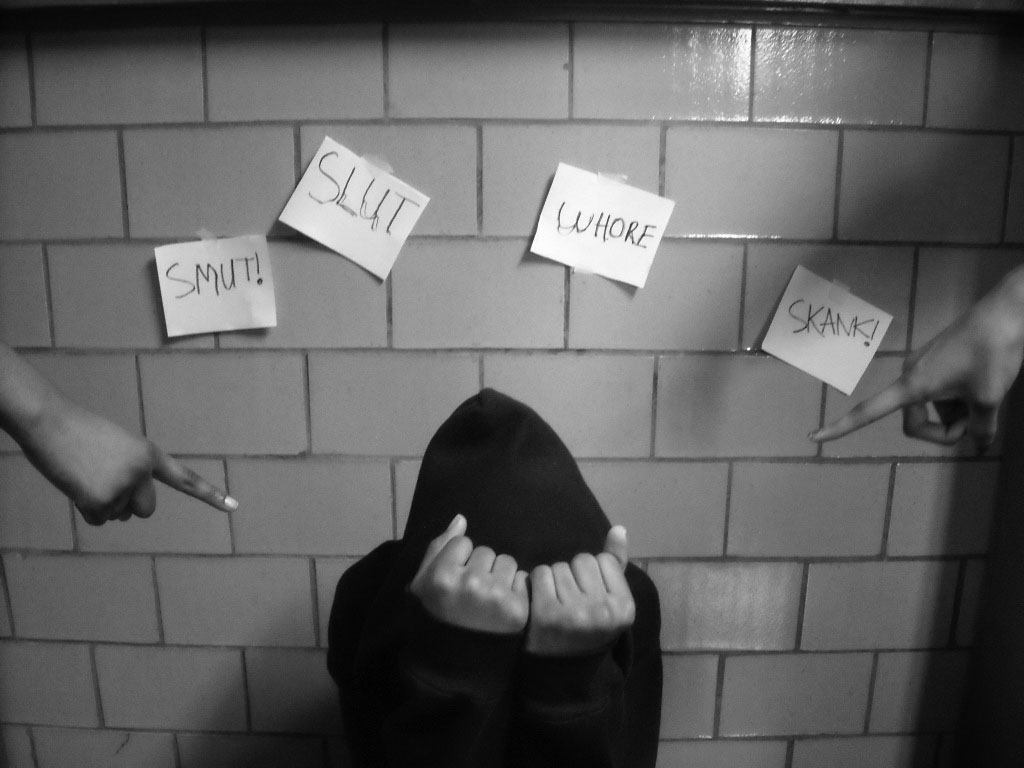
slut