
If there is one thing that drives me absolutely bananas, it’s people spreading misinformation via social media under the guise of “educating”. I’ve seen this happen in several ways – through infographics that twist data in ways that support a conclusion that is ultimately false, or else through “meaningful” quotes falsely attributed to various celebrities, or by cobbling together a few actual facts with statements that are patently untrue to create something that seems plausible on the surface but is, in fact, full of crap.
Yesterday, the official Facebook page of (noted misogynist and eugenics enthusiast) Richard Dawkins’ Foundation for Reason and Science shared the following image to their 637,000 fans:

Neither Reasonable Nor Scientific
Naturally, their fans lapped this shit up; after all, this is the kind of thing they absolutely live for. Religious people! Being hypocritical! And crazy! And wrong! The 2,000+ comments were chock-full of smug remarks about how naïve and stupid Christians were, accompanied by pats on the back for all the atheists who smart enough to see through all the religious bullshit and understand how the evil church had slyly appropriated all kinds of pagan traditions.
And you know what? That’s fine, I guess. I’m all for questioning religion and examining the sociological, historical and anthropological reasons that help explain the hows and whys of our lives today. I’m actually super fascinated by that kind of stuff, even if I do think that there’s a way to discuss it without making yourself sound smarter and more enlightened than the people around you.
But you guys? The image above is rife with misinformation. RIFE, I say.
Let’s start from the top:
This is Ishtar …
Okay, great. So far things are fairly accurate. The relief pictured here, known as the Burney Relief (also called the Queen of the Night relief) is widely considered to be an Ancient Babylonian representation of Ishtar (although some scholars believe that the woman depicted might be Lilitu or Ereshkigal). This relief is currently housed in the British Museum in London, but originates from southern Iraq and is nearly 4,000 years old.
… pronounced Easter.
Actually, in modern English we pronounce it the way it looks. A case could be made for pronouncing it Eesh-tar, but I have yet to come across a credible source that gives the original pronunciation as Easter.
Easter is originally the celebration of Ishtar, the Assyrian and Babylonian goddess of fertility and sex.
Ishtar was the goddess of love, war and sex. These days, thanks to Herodotus, she is especially associated with sacred prostitution* (also known as temple prostitution), which, in the religions of the Ancient Near East, allegedly took on the form of every woman having to, at some point in her life, go to the temple of Ishtar and have sex with the first stranger who offered her money. Once a woman entered the temple of Ishtar for the purpose of sacred prostitution, she was not allowed to leave until she’d done the deed. I can’t imagine that sacred prostitution sex was ever very good sex, but hey, what do I know? Probably some people were pretty into it – I mean, if you can imagine it, someone’s made porn about it, right?
Anyway, the point I am trying to make here is that, yes, Ishtar was associated with fertility and sex. However, her symbols were the lion, the gate and the eight-pointed star; I can’t find any evidence of eggs or rabbits symbolically belonging to her. And Easter has nothing to do with her.
Most scholars believe that Easter gets its name from Eostre or Ostara**, a Germanic pagan goddess. English and German are two of the very few languages that use some variation of the word Easter (or, in German, Ostern) as a name for this holiday. Most other European languages use one form or another of the Latin name for Easter, Pascha, which is derived from the Hebrew Pesach, meaning Passover. In French it’s Pâques, in Italian it’s Pasqua, in Dutch it’s Pasen, in Danish it’s Paaske, in Bulgarian it’s Paskha, and so on and so forth.
In the Christian Bible, Jesus returned to Jerusalem from his forty days in the desert just before Passover. In fact, in the Gospel according to John, Jesus was killed on the day before the first night of Passover, at the time when lambs were traditionally slaughtered for the Passover feast (because Jesus was the Lamb of God, etc. – SYMBOLISM, Y’ALL). There are a few differing accounts of when Jesus actually died, but most Christian texts, philosophers and scholars agree that it was around the time of Passover. Easter is still celebrated the week after Passover, which is why it’s a different day each year, because the Jewish calendar is lunar rather than solar.
Her symbols (like the egg and the bunny) were and still are fertility and sex symbols (or did you actually think eggs and bunnies had anything to do with the resurrection?).
Actually, according to Jacob Grimm’s Deutsche Mythologie, which he wrote after journeying across Germany and recording its oral mythological traditions, the idea of resurrection was part and parcel of celebrating the goddess Ostara:
“Ostara, Eástre seems therefore to have been the divinity of the radiant dawn, of upspringing light, a spectacle that brings joy and blessing, whose meaning could be easily adapted by the resurrection-day of the christian’s God. Bonfires were lighted at Easter and according to popular belief of long standing, the moment the sun rises on Easter Sunday morning, he gives three joyful leaps, he dances for joy … Water drawn on the Easter morning is, like that at Christmas, holy and healing … here also heathen notions seems to have grafted themselves on great christian festivals. Maidens clothed in white, who at Easter, at the season of returning spring, show themselves in clefts of the rock and on mountains, are suggestive of the ancient goddess.”
Spring is a sort of resurrection after all, with the land coming back to life after lying dead and bare during the winter months. To say that ancient peoples thought otherwise is foolish, naïve and downright uninformed. Many, many pagan celebrations centre around the return of light and the rebirth of the land; these ideas are not new themes in the slightest.
And yes, rabbits and eggs are fertility symbols, and they are, in fact, associated with Eostre.
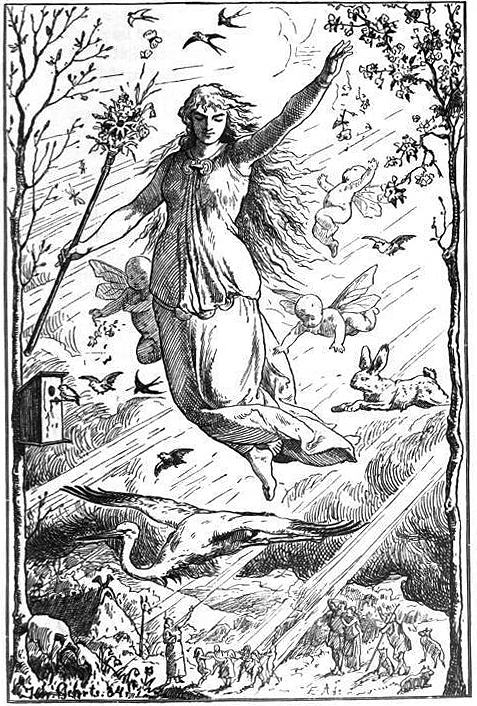
Ostara by Johannes Gehrts
After Constantine decided to Christianize the Empire, Easter was changed to represent Jesus.
Hey! Guess what language Constantine, the Roman Emperor, spoke? Not English, that’s for sure! In fact, when he was alive, English didn’t even exist yet. He would have spoken Latin or Ancient Greek, so would likely have referred to Easter as Pascha or Πάσχα.
But at its roots Easter (which is pronounced Ishtar) was all about celebrating fertility and sex.
Look. Here’s the thing. Our Western Easter traditions incorporate a lot of elements from a bunch of different religious backgrounds. You can’t really say that it’s just about resurrection, or just about spring, or just about fertility and sex. You can’t pick one thread out of a tapestry and say, “Hey, now this particular strand is what this tapestry’s really about.” It doesn’t work that way; very few things in life do.
The fact is that the Ancient Romans were smart when it came to conquering. In their pagan days, they would absorb gods and goddesses from every religion they encountered into their own pantheon; when the Roman Empire became Christian, the Roman Catholic Church continued to do the same thing, in a manner of speaking.
And do you know why that worked so well? Because adaptability is a really, really good trait to have in terms of survival of the fittest (something I wish the present-day Catholic Church would remember). Scratch the surface of just about any Christian holiday, and you’ll find pagan elements, if not a downright pagan theme, underneath.
Know what else? Most Christians know this. Or, at least, most of the Christians that I’m friends with (which is, admittedly, a fairly small sampling). They know that Jesus wasn’t really born on December 25th, and they know that there were never any actual snakes in Ireland, and they know that rabbits and eggs are fertility symbols. But they don’t care, because they realize that religions evolve and change and that that’s actually a good thing, not a bad thing. The fact that many Christian saints are just re-imagined pagan gods and goddesses doesn’t alter their faith one iota; because faith isn’t about reason or sense, it’s about belief.
Look, go ahead and debate religion. Go ahead and tell Christians why what they believe is wrong. That’s totally fine and, in fact, I encourage it. A little debate and critical thinking are good for everyone. But do it intelligently. Get to know the Bible, so you actually know what you’re disagreeing with when you form an argument. Brush up on your theology so that you can explain why it’s so wrong. And have some compassion, for Christ’s sake – be polite and respectful when you enter into a debate, even when the person you’re debating with loses their cool. You want to prove that you’re better, more enlightened than Christians? Great, do it by remaining rational and level-headed in the face of someone who’s willing to stoop to personal attacks. To behave otherwise is to be just as bad as the people you’re debating.
Anyway, I hope you guys have a fantastic long weekend, no matter how you spend it. If your holiday involves chocolate, then I hope you enjoy that. If not, just enjoy the extra day or two off work and the (hopefully) warm weather. No matter what you believe in, I think that we can all agree that the end of winter and the rebirth of spring is worth celebrating.
And also? Richard Dawkins? You need to fact-check yourself before you fact-wreck yourself. Spreading this kind of misinformation to your foundation’s 637,000 fans is just plain irresponsible, especially coming from someone like you. Get with the program, buddy.
ETA: The post now seems to be removed from The Richard Dawkins’ Foundation for Science and Reason’s FB page. Thanks Richard!
ETA Part Deux: Oh. It looks like it was deleted from their timeline but not the photo album. Welp.
*It should be noted that the only actual historical evidence that we have of sacred prostitution comes from Herodotus (I’ve included an excerpt from Herodotus’ Histories below) and no one is really sure how accurate it is. Herodotus is known for making shit up, like giant ants for example. But it makes for an amazing story and people still make the association between Ishtar and sacred prostitution, so I decided to mention it here.
The foulest Babylonian custom is that which compels every woman of the land to sit in the temple of Aphrodite and have intercourse with some stranger once in her life. Many women who are rich and proud and disdain to mingle with the rest, drive to the temple in covered carriages drawn by teams, and stand there with a great retinue of attendants. But most sit down in the sacred plot of Aphrodite, with crowns of cord on their heads; there is a great multitude of women coming and going; passages marked by line run every way through the crowd, by which the men pass and make their choice. Once a woman has taken her place there, she does not go away to her home before some stranger has cast money into her lap, and had intercourse with her outside the temple; but while he casts the money, he must say, “I invite you in the name of Mylitta” (that is the Assyrian name for Aphrodite). It does not matter what sum the money is; the woman will never refuse, for that would be a sin, the money being by this act made sacred. So she follows the first man who casts it and rejects no one. After their intercourse, having discharged her sacred duty to the goddess, she goes away to her home; and thereafter there is no bribe however great that will get her. So then the women that are fair and tall are soon free to depart, but the uncomely have long to wait because they cannot fulfil the law; for some of them remain for three years, or four. There is a custom like this in some parts of Cyprus.
That crack about ugly women was totally unnecessary, Herodotus. I am just saying.
**The first written reference we have for Eostre dates back to the 7th century AD and can be found in Venerable Bede’s Temporum Ratione, in a passage explaining that April was often referred to as Eostremonth:
“Eosturmonath” has a name which is now translated “Paschal month”, and which was once called after a goddess of theirs named Eostre, in whose honor feasts were celebrated in that month.
Jacob Grimm said that he found further evidence of Eostre and her associations with Easter, eggs and rabbits when researching his Deutsches Mythologie, although he was unable to discover any written records about her.
 The Belle Jar
Whatever the case, it is a pagan celebration which has nothing to do with Jesus, Christians and the Bible – see http://en.wikipedia.org/wiki/Easter#Non-observing_Christian_groups. In fact, the only observance that Jesus commanded his followers to do is the remembrance of his *death* and NOT his resurrection. The reason: it is by his death which earned us the prospect of forgiveness, and NOT his resurrection. See 1 Co 11:26 – “…keep proclaiming the death of the Lord…”. So does it really matter whether a pagan festival is named or not after another pagan deity in the context of Christianity? Not at all. The fact that Easter is named after Eostre and not after Ishtar doesn’t make it any less pagan.
You say “pagan” like it is a bad thing!
Actually matters a LOT to PAGANS, and to anthropologists as well. Truth is truth.
Of course it matters. It’s called truth… But you seem to only think in the context of Christian vs. Pagan. So maybe it doesn’t matter to you since you’re promoting a religion that owed its very existence to the multitude of “pagan” cultures that came before it.
NOT whatever the case. Facts matter. Are you suggesting the debunking of one myth is so important that we can make up fiction about it? I can’t go there. I’d rather prove my side of an argument wrong 1000 time than win by lying once. We all know both Christmas and Easter are pagan holidays adopted by Christians. But even that is only important because it’s TRUE!
This is more of a rant and contains no factual information. It is more denialism than anything else.
You would think him conquering death would mean that death should not be the focus but the light of life that is Jesus Christ and so that means his resurrection.
Agreed!!
read the bible, without the resurrection the cross becomes just another execution.
Excatly! Also, I wonder if Ostara could be a Germanic version of Ishtar. The names of the goddesses are quite similar, and people have frequently adopted gods from other cultures in the past.
Whoooooooooosh.
That’s the sound of you missing the point.
You mean it’s a pagan celebration that has nothing to do with the bible. That doesn’t change the fact that, at the very least, it has become a Christian festival to mark and celebrate the resurrection of Jesus. However directly it derives from pagan origins—which, if this article has done anything, it is show that that’s a more complex issue than just tossing out the name Ishtar with a “see?”—doesn’t matter, as it was clearly intentionally developed for Christian celebratory purposes. Most people wouldn’t take a puritanical view of the matter, with the majority of Christians worldwide not falling into the non-observing groups.
The reason it does matter, between Eostre and Ishtar, is two-fold. 1: the meme itself presents itself as an educational corrective. “You think this, but the truth is this! See?! You had it wrong all along!” This is a dangerously arrogant tone to take when you’re correct, let alone when you’re wrong, and there’s general value in correcting the misinformation of the meme, and specific value in calling attention to the erroneous nature of that type of meme. By presenting itself as educational, it warrants scrutiny and should hold itself up to a higher standard. 2: The etymological origins of Easter show a pagan origin, however, the Christian community outside of germanic (including English) communities, do not use a term with that same origin. Rather, there’s is etymologically based on passover, which is also part of the governing logic of the holiday. Which is to say, specifically, that you can’t paint the entire tradition with one broad stroke. It’s also particularly interesting, since the holiday initially developed before its interaction with that pagan tradition, and so the questions start pushing more towards questions of what parts originate where, and how far has the germanic/english parts taken from Eostre spread to the other communities? Though, since the documentation of Eostre is beyond minimal, people should be slow to make any claims regarding those questions (something sceptics of religion should be supporting anyway, as that is a basic premise they rely on when criticizing the lack of historical support for various religious traditions and claims). So, yes, it can make it more or less pagan.
Since when is someone’s resurrection equal to Springtime and all its sexual reproduction, litters full of babies and flowers blooming? They seem vastly different. One can say they are coincidental. You cannot honestly say identical.
If Jesus was gettin’ busy with some young thang, then you can claim identity. But, alas, he simply survived a crucifixion.
Seems to me you are crucifying fact, aka, “crucifiction”.
Since “springtime” has always coincided with the spring equinox… It has absolutely nothing to do with effects here on Earth, flowers and litters of small mammals and such, and everything to do with stars.
New life, matey. New life.
Woodhugger, death and resurrection has Frequently been the way stories of ‘Gods’ were set up, very understandably, as parallels for the seasons and for the harvested crops (as they ‘die and are reborn’ .. listen to John Barleycorn). Persephone is probably one of the most known today, going to the underworld for 6months of the year, getting 6 pomegranate seeds before her return to life in the spring..
“Since when is someone`s resurrection equal to Springtime and all its sexual reproduction….” you ask? Well since very ancient times…. let me explain…. The passion of Ishtar was celebrated every spring in ancient times (well before Jesus)…. the rite consisted of a young man playing the role of Tammuz (Ishtar’s lover/husband) who would be anointed by a young woman playing the role of Ishtar. She would anoint his feet with oil, then he would be taken to a cave where he would stay for 3 days (pretending to be dead) then he would “rise” again and come out of the cave where “Ishtar” would be waiting. This rite would happen every spring symbolizing the end of winter and the coming of renewed light and fertility (spring). After this rite supposedly there would be festivities and “free love” among the adults,,, this was all done every year in the spring, sound familiar?
ye shure he wore a wooden ccane he walked the talkie
The origins of the word “easter” can be easily checked online http://www.etymonline.com/index.php?term=Easter
The sources for the claims of the word Easter being in limited English use are also easily checked with most translations of the Bible having a variant of Passover. The Geneva bible (1599) has “passover”, Luthers’ 1545 translation uses “Ostern”, Tyndale (1525-1530) has “ester”, the Latin Vulgate (405) has “pascha”.
http://www.blueletterbible.org/
Although I don’t agree with all of the assumptions the author has made in this article I have to admit that it is, overall, a well balanced and fair article.
To many of the strange objections of “stealing” traditions here: Nowhere in the Bible does it say eating chocolate or eggs is a sin so that does not exclude Christians from doing that. Christianity does not prescribe your culture or cultural practices except where those things are clearly sinful and ungodly.
There’s an awful lot of adhominem being flung about here. Also many people are making hasty generalisations (or generalizations if you are a pedant about US/UK spelling), not to mention the pedantry!! Sadly it does not contribute to the discussion but detracts.
If someone mispells or mistypes a word, one who harps on about that like a school yard bully displays their lack of intellect and capability to understand the information at hand. Or more likely it is that they understood, but the lack of character leads that person to latch onto a pedantic error and become a troll.
Acts 15:29
and your argument is merely based on different translations of that one bible verse?
“In reality, the ancient world abounded with traditions, prophecies, fables and myths of miraculous conceptions and births, long before the Christian era, and the virgin-mother motif is common enough in pre-Christian cultures to demonstrate its unoriginality and non-historicity within Christianity. In early Christian times, Mary herself was believed to have been born of a virgin, which, if taken literally, would represent a virgin birth prior to Christ, rendering his own nativity unoriginal and mundane, rather than miraculous and divine. One source of Mary’s immaculate conception was Christian writer and Saint, John of Damascus, who asserted that Mary’s parents were “filled and purified by the Holy Ghost, and freed from sexual concupiscence.” Concerning this matter, the Catholic Encyclopedia (“Immaculate Conception”) states that “even the human element” of Mary’s origin, “the material of which she was formed, was pure and holy.” In other words, Roman Catholic doctrine dictates that, like Jesus, “the Blessed Virgin Mary” was “conceived without sin.” (Hackwood, 17) In order to maintain the “uniqueness” of Christ’s virgin birth, however, this contention regarding Mary is not taken seriously. What it proves, nonetheless, is that fabulous Christian claims are based on pious speculation, not historical fact, speculation by the faithful that changes from era to era, depending on the need.
As it turns out, if true, the Virgin Mary is, like Jesus Christ, a mythical character, founded upon older goddesses. Following on the heels of goddesses such as Aphrodite, Astarte, Cybele, Demeter, Hathor, Inanna, Ishtar and Isis, Mary is “both virgin and mother, and, like many of them, she gives birth to a half-human, half-divine child, who dies and is reborn.”
Regarding the Great Mother Goddess, upon whom Mary is based and whose names are legion, in Forerunners and Rivals of Christianity, Francis Legge says:
“Her most prominent characteristics show her to be a personification of the Earth, the mother of all living, ever bringing forth and ever a virgin…”
In other words, even Mary is just another name for Ishtar…
The only problem is, Virgin born Saviours were rare, not commonplace. In fact, I oubt you could name one.
Certainly, but gods born of virgins aren’t. Sorry for the Wiki cite, but the information is accurate.https://en.wikipedia.org/wiki/Miraculous_births
Try looking up Horus.
Mithras. The Peacemaker (Haudenosaunee). That’s two, do I win a prize? 😉
Not only that, one of the earliest references I know of to a virgin born savior comes from a monotheistic religeon, namely Zoroastrianism, so you could as easily argue that polytheists ripped off the monotheists as the other way around.
How about Mary? Dumbass.
Mithras is the most common one. Really all you had to do was Google.
https://en.m.wikipedia.org/wiki/Mithras_in_comparison_with_other_belief_systems
So the basic story is that God saw all the wickedness in the world and therefore impregnated an incarnate version of himself in the womb of a worthy mortal woman, right? Except the God was Vishnu, not Jehovah, the worthy woman was Devaki, not Mary, and the son was Krishna, not Jesus. Or there is Sonnona Codom of the ancient Siamese religion.
Revisiting this since my email is filling up with notifications now that it is Easter again…
Just off the top of my head, Dionysus… Krishna…Zoroaster…Mithras….
All predate “Jesus”.
Let’s see… just off the top of my head there was Mithras, Zoroaster, Dionysus, Krishna… just to name a few that pre-dated “Jesus”
it is supposed to be rare. Because God is rare when it comes to humans. In human form. 🙂
You make the common error of confusing “virgin birth” with “immaculate conception”. The Catholic doctrine of “immaculate conception” is a reference to their belief that Mary was sinless – nothing to do with virgin briths at all.
I’m not confusing anything. Throughout the years, “Mary” has been “interpreted” to be everything from the new Eve to an eternal virgin, even though Jesus had brothers and sisters as well as half brothers. It makes absolutely no difference at all. It is a fairy tale to begin with! She could be a fire breathing dragon if one were so inclined.
The etymology and culture of Easter are definitely from the Egyptian Isis, who was called Aest or Eest (with the Egyptian feminine ‘t’ suffix).
With Est (Isis) and Easter:
They were both identified with fertility.
They were both identified with an egg
… … (the name for Isis uses the egg-glyph).
They were both identified with a star (Venus).
Isis (East or Ast) became Astar-te, Ashtar-oth, Ishtar, Aphrodite and Venus – the Eastern Star of Eastar or Easter. With the veneration of these fertility goddesses being at the Vernal Equinox (ie: Easter).
R
Don’t fall for the catholic deception.. Jesus Christ is the only truth. It is not a metaphor based on pagan religions, like catholicism and worldly religions. The KJV Bible teaches us all of the truth, and we shouldn’t be following the traditions of men based on pagan rituals, like Easter eggs, santa claus, halloween… it’s all worldly, it’s all based on paganism, and it’s what true born-again Christians stay away from… because we are called to be separate from this world.
“Be ye not unequally yoked together with unbelievers.” – 2 Corinthians 6:14
“Beware lest any man spoil you through philosophy and vain deceit, after the tradition of men, after the rudiments of the world, and not after Christ.” – Colossians 2:8
“Love not the world, neither the things that are in the world. If any man love the world, the love of the Father is not in him.” – 1John 2:15
The KJV and ALL versions of the bible were written by MEN, so it might be THEIR truth, but everyone has one.
There’s ahistorical things like the meme then there’s ahistorical nonsense like this post.
It’s actually historically illiterate sola Scriptura Protestants such as yourself who help spawn these types of historically illiterate memes.
Except the New Testament was compiled and edited completely by those Catholics you say are so untrustworthy. Oops. Yup, the faith you base you life on has a serious chain of custody problem with the scripture it is entirely based on.
This is a sick way to think
The Catholic Church IS Christian….it is the root of the Christian religion….why would you debate when you dont even know your own religion’s history???
But doesn’t such absolutism, ‘…is the only truth’ … create the fertile ground for leading to conflict with those of opposing views/beliefs? It’s what we see with the jihadists in Iraq and Syria now, theirs is the only truth, and they’re trying to brutally suppress, enslave or wipe out anyone who thinks otherwise…you say the KJV Bible is the only truth, but I remember a time when those who didn’t believe in it or even know about it, like the indigenous tribes of the Americas, were enslaved and/or put to the sword for being pagans or simply deemed soulless, by the colonising Christians. Believe what you will, you have every right to, but I think trying to claim one’s beliefs are superior or more valid than others is a pathway to conflict.
So is the KJV “true” because of the 150,000 translational errors it contains or is it true simply by virtue of being written in English? Cause that’s about all it has going for it… The Bible is conceptually wrong, it is contextually wrong, it is chronologically wrong, it is geographically wrong and it is historically wrong. Moses is attributed to writing about his own death. He also disagrees with himself from one sentence to the next pretty often. Maybe he did write it, but if so, his schizophrenia comes shining through. Thessalonians and Galatians were conjured up based on a handful of broken papyrus fragments that were attributed to Paul 150 years later and recreated based on what they obviously used to say, word for word. In Acts, Luke records that Peter and John were both common, uneducated, illiterate men. Yet, the Gospel of John contains 21 chapters he couldn’t have written and Peter is attributed with writing 8 chapters of the Bible.
“But they don’t care, because they realize that religions evolve and change and that that’s actually a good thing, not a bad thing.”
No actually that’s a bad thing, because it just proves religion is all made up and adapted to manipulate and fool people into thinking it’s true.
Except that the fairy tales of D M Murdock belong in the fantasy section right next to Chariots of the Gods or books about the Illumanati. Most legitimate historians agree Jesus was a historical figure (since multiple sources both Christian and Non discuss him despite the out right lies told by some atheists and other people with a massive personal bias). To claim he was based on previous gods is a giant leap of logic that depends on ignoring the folk lore of those gods to shoe horn what you want to believe about Christ into their roles. Please consult a book on actual classical mythology, egyptology or a Religious studies 101 level college course if you really think Zeitgeist, Religulous or anything Murdock/Achairya wrote is in any way accurate.
Except you’ve missed the point completely. There can still be a historical person of Jesud who was crucified by the Romans, and whom a personality cult developed around which embellished on his life by overlaying pre existing mythology onto him.
Ok, here you go: https://www.youtube.com/watch?v=WUYRoYl7i6U&list=PL4naFnx6XW29xnavWbu5bnXTBGk_K2AhU&index=1
can you please name one of these “multiple sources both Christian and Non discuss” christ? and they have to be sources that are contemporary with christ: they can’t be a reference from several hundred years later because that doesn’t prove your point. I’m seriously curious. I am an atheist.. but not an ideologue – but I’m not convinced Christ was a true historical figure… might have been, but the bible isn’t a historical book (as any legitimate historian will attest). Further, as I understand it, the only historian that was remotely contemporary to jesus to possibly reference him was Josephus.. and I think his reference to christ was still 100 years (give or take) after Jesus supposedly died. So, what are these “multiple sources both Christian and Non discuss him”.. .and they have to be relatively contemporary to jesus or they’re meaningless. For example, did the roman’s keep crucifixion logs?
Aphrodite is not born of a virgin nor is she “both virgin and mother”. In alternating versions of the story she is either the daughter of Zeus or a being born from sea foam that flows from the severed genitals of Uranus. Furthermore she’s isn’t remotely virginal. Her mythology is filled with not just sex but outright adultery as she cheats on Hephaestus with Ares, a union which produces several offspring. I cannot find a single reference to her having any offspring without a consort certainly none that she had prior to losing her virginity.
Demeter is also not virginal. She has multiple mythological consorts.
Mind you in Greek mythology they’re quite explicit when one of the goddesses, nymphs or other heroines is a virgin. Two explicitly virgin goddesses, Athena and Artemis are noticeably childless.
I don’t know who wrote that crap but they have a gross ignorance of classical mythology.
what about horus?the Egyptian solar deity Horus, who was said to have been born of a virgin on “December 25th”
You misunderstand the doctrine of the immaculate conception. It does not imply that Saints Joachim and Ana did not conceive their daughter Mary without sex.
As for your Damascene quote. I think you need to look up the definition of “concupiscence”. It doesn’t mean that he thought Mary was conceived without sex.
Chris, this is a gross oversimplification of matters. If you were to look at early Christian beliefs (hell, just Christian beliefs now across the various formulations, denominations, and traditions of various christianities), you would see that there is very little value in trying to tie Mary to this chain in such a way. The Immaculate Conception, for instance, is not, as part of dogma or orthodoxy, seen as a virgin birth. Not to mention, you can still have sex while being free from sexual concupiscence. I’m not sure who the Hackwood quote is in regards to (what the source actually is), but it doesn’t really matter. The point is, it’s just expressing that there were a multitude of opinions on the matter, because, like you stated, this isn’t based on historical fact, but cultural conjecture, theological theory, and exegetical work. The trinity concept wasn’t settled as dogma for centuries, and there are still non-trinitarian communities that most Christians probably wouldn’t recognize as such. Not all forms of Christian theology believe Jesus was divine, born of a Virgin, or was a sacrificial atonement for mankind.
Following this particular rabbit hole doesn’t show how Christianity clearly has pagan roots, which you clumsily try to do with Mary here. But rather, it shows that it was an ever-growing community of people arguing with each other over what actually happened, what it means, why it matters, and developing those lines of thought intentionally in a culturally specific context. So, yes, obviously there are pagan connections (Christianity has, by some writers, been referred to as a paganized or Hellenized Judaism), but it’s much more complicated than that, and the connections are rarely that clear and direct. More interesting would be trying to figure out how the various arguments developed, to try to figure out where they were all coming from, which one’s won out, and, more importantly, how they were modified later on (religions are rarely static, and suggesting that since we call Easter Easter, and celebrate with painted eggs and the easter bunny, and that those are related to a Mesopotamian goddess named Ishtar, implies that the English name for the holiday and its general traditions haven’t changed for nearly 2000 years, which is a foolish thing to suggest).
A “gross oversimplification of matters”? Seriously?!?! It’s the equivilent of referring to Santa Claus as a “jolly, fat guy in a red suit” or Zeus as “the guy with the thunderbolt”. These are ALL mythical characters we’re discussing afterall. None of it even matters beyond breaking down the mythology into its components.
I completely disagree… We still use words like star, equinox, constellation, mother…. They have been around for thousands of years too. There haven’t been that many significant leaps in our language between Greek, Latin and then English. We may not know “his” or “His” name anymore since it wasn’t important enough to ever retain through the translations but regardless, the transition from “Ostere” or “Astarte” to “Easter” is no more convoluted than the transition from what could have possibly been “יֵשׁוּעַ” to “Iesous” to “Jesus”. Are you actually trying to reduce the issue down to your personal opinion on the longevity of nouns?
A “gross oversimplification of matters”? Seriously?!?! We’re talking about mythology, not evolution here. Does it matter if you refer to Santa Claus as a “jolly, fat guy in a red suit?” or Zeus as the “guy in a toga with a lighting bolt”? Of course not because they AREN’T REAL to begin with.
Sure “Santa” may be loosely based on a Turkish aristocrat that, according to legend, used to put money into the shoes of poor people and threw a bag of gold into a stocking but that doesn’t lend itself to any of the current mythology surrounding him either. In my humble opinion, I believe that even jolly ole’ Bishop Saint Nick was just one more ploy by the Catholic Church to convince the naive into thinking they were somehow charitable and good; not the bloodthirsty, power-hungry masochists they actually were. I especially appreciate that the Dutch have maintained the true spirit of Sinterklaas by refusing to replace his black, Moorish SLAVES with “Elves” in their yearly pageants and parades…
I’m a bit late on the Easter hoopla, but I’ll interject anyway.
I’m not sure why you work so hard to deconstruct a meme here. Your post does more to add* to it than detract.
Ishtar as the goddess of love, war and sex is perfectly compatible as the goddess behind the Easter holiday. As you point out, these god(ddess) archetypes evolve over time to suit cultural narratives.
So if you allow for cultural innovation, why go to such great lengths to harp on a meme which really is not meant to communicate much detail. This is a soundbite culture, so you can expect ignorance through lack of detail. That’s the way marketing works.
*pulling my hair out* Because it’s not TRUE! That’s why he’s working so hard. You can’t fix a lie with another lie. And he (Dawkins? Whoever made the original meme) could have just said the truth, as you pointed out. It’s frustrating.
You answer your hypothetical “why work so hard to deconstruct a meme” question in your last paragraph. You suggest it isn’t meant to communicate much detail, but it does still present itself as offering a corrective, and furthering of knowledge. Your passive acceptance of laziness and misinformation, which you label as “soundbite culture,” is disingenuous and malicious. It’s capable to be concise and correct, or to minimize detail but still be communicating the accurate information. This meme, memes like it, and even that Zeitgest film debacle, are all presenting completely ignorant ideas and incorrect information as knowledge. This is a serious problem and should be challenged when it occurs. Your last sentence is most telling: “That’s the way marketing works.” You’re exactly right. This garbage is, in truth, really lazy propaganda, but for what I can’t exactly tell. You don’t need to point out a supposedly pagan origin to Easter in order to convince people Christianity is wrong.
In reality, it’s a well known fact that Christianity absorbed pagan rituals in an effort to convert mass populations, so the meme ends up doing, from what I can tell, three things. 1: Reaffirming the ignorantly anti-Christian. These are the types who have a basically fundamental, uncritical approach to belief (religious or otherwise), and are dangerous due to the way they will accept anything as long as it parrots their general prejudices or comes from the right sources. Dogmatic types, doesn’t really matter what it says, they believe what they believe. 2: Enraging the ignorantly Christian. These are the types who have a basically fundamental, uncritical approach to belief (religious or otherwise), and are dangerous due to the way they will accept anything as long as it parrots their general prejudices or comes from the right sources. Dogmatic types, doesn’t really matter what it says, they believe what they believe. 3: Frustrates people who either demand some intellectual rigour or are generally a little critically minded, religious or otherwise. A non-religious scholar of religion would be just as frustrated with the misinformation as anyone else would be.
The laziness and intellectual dishonesty of making a connection between a goddess and a holiday where there is no proper connection doesn’t achieve any positive goals. So it should be reproached and corrected. There are many archetypes and figures that are similar to one another, but this doesn’t necessarily mean they inspire one another, or one is the origin of another. Without a proper historical connection being drawn between them, it’s garbage, and there simply isn’t enough of one between Ishtar and Easter to make such claims (which include downright falsehoods such as the pronunciation of the name, which really doesn’t matter since Easter is the English name of the holiday not the Greek or Roman, the symbols associated with her, etc.).
If you study the etymology, you will find that ‘Easter’ does have a historical linguistic connection to ‘Astaroth’, a word for a pagan idol of which ‘Ishtar’ is also a cognate. It is clearly scientific when you study the etymology and phonological conditioning processes of loan-words. Just like ‘Jesus’ and ‘Isa’ are cognates of ‘Yehshua’. Furthermore, the Easter celebration is not Biblical. It is nowhere to be found in the Bible and it is also inaccurate in terms of the exact timing of the crucifixion, death and resurrection. Christians should be celebrating Passover because it is all about Jesus’ sacrifice and resurrection. Here is a short movie that demonstrates the significance of Passover and its direct prophetic relationship with Jesus: https://youtu.be/7iGJeOqfvO4
Also, one should understand some historical linguistic terminology and what type of change they refer to in order to better realize how words can gain or lose sounds between languages: syncope, apocope, metathesis, prothesis, epenthesis/anaptyxis, excrescence, apheresis, fusion, vowel breaking, unpacking/fission, assimilation and dissimilation. I know all these words may seem daunting and tiresome, but their definitions are very simple to understand. There are more types of changes and linguistic terms labeling them, but these are the basics. If you want to learn more and see what I’m talking about, here’s a free PDF book for an introduction to Historical Linguistics: http://faculty.mu.edu.sa/public/uploads/1424720340.6709%5BLyle_Campbell%5D_Historical_Linguistics._An_Introdu%28BookZZ.org%29.pdf
It can only be considered to have a true etymological connection if you can demonstrate how it got from a Phoenician goddess to a northern European Christian holiday. Christians do, sort of, celebrate Passover–what we Anglos call ‘Easter’ is called some variant of the Hebrew Pesach in virtually every other part of Christiandom outside of English and Germanic speaking lands. It started being called after Pesach and cognates of it in the lands where Astaroth was also worshipped. So you’ll have a hard time showing an actual causal connection between Easter, which was used for the first time only in the early 16th century for the holiday, in Wycliffe’s Bible translation, and Ashtaroth or any other Mesopotamian goddess, since all their names and their worship had died out long before and their lands are separated by the “Easter” using zone by a thousand miles. Sure, we could play games with vowel shifts etc all according to linguistic rules all day long. We could show that any word in one language that sounds vaguely like a word in another language has an etymological connection. But unless you can show HOW it happened historically you don’t have a case. With all those peach-using Christians in the way, you don’t have a case.
I don’t think you have to look too hard to see the connection.
Isis was called Ast or Est in the Egyptian, and she was one of the most widely venerated goddesses in the Roman pantheon. It would seem obvious and likely that the Germanic fertility goddess called Eostre was derived from the Egyptian Ast or Est, because they were both fertility goddesses (Isis also became teh Greek Aphrodite).
The Germanic for April was Ostermonat, the month of Oster, the goddess Eostre. And the springtime festival of Oster was also named after the goddess Eostre. And the brothers Grimm traced the name Ostermonat back to the 8th century. And it was from Oster or Eostre that the English Easter was derived.
Ergo, ‘Easter’ was derived from Ast, Est or Isis.
This reply is actually to Rafellis, who also replied to this message. In regards to the goddess Isis “becoming” the Greek goddess Aphrodite, this is inaccurate. Although there were many influences from the East, Greece mainly took these influences from closer Phoenician cultures, and not from Egypt. The Greek pantheon remained a Greek invention, however many elements were assimilated, with its distinct mythology. At the height of the Roman Empire, in fact, Isis became a popular goddess across the empire in her own right (which included Greece), and was distinct from both Aphrodite and Venus. If a pantheon can be said to be copied, it is the Roman one, which heavily borrowed from Greek tradition.
That’s actually a pretty easy connection to make. At the time Christianity was getting a foothold in the Roman Empire, it was one of many competing faiths, many of which were older Faith’s from other parts of the empire which had recently come into vogue among Roman citizens – the Egyptian Cult of Isis being only one very prominent example.
Yeah.. But Isis wasn’t the Egyptian goddess of fertility. She was the goddess of wisdom and marriage. Hathor was the goddess of fertility.
But…but…how can Christians celebrate a JEWISH holiday??? Oh, the horror! :O (satire alert)
Except you’re completely wrong about the etymology. Easter does not have a historical linguistic connection to Astaroth. Astaroth itself comes from Astarte, which is the Hellenized counterpart to Ishtar. Astaroth appears in the bible as Ashtoreth, the female counterpart to Baal, and with it the Ishtar/Aphrodite connection.
Easter does not originate with that name, but rather that’s the name it gets in the English and Germanic communities. Etymology shows almost all other languages use a variant of pascha, which comes from, ultimately, the Greek pasah, “he passed over,” which is where passover functionally comes from. Not to mention it isn’t exactly clear when Easter becomes the completely dominant form. It would appear that some remnants of the pascha form trace as far into middle english/early modern english, with “pace eggs” being used as late as the 1600s.
Point is, your etymology is sloppy, and your claim that Christians should be celebrating passover is ironic, since if your etymology was better, you’d realize that it is a significant part of the organizing and originating logic of Easter. You also demonstrate a classic puritanical/fundamentalist strain of thinking, as if just because Easter isn’t in the bible it somehow shouldn’t be part of Christian practice. Religions are living socio-cultural formations, they change over time, in terms of tradition and exegesis. Not everything comes from the book. I’d also recommend not just tossing out a bunch of discipline specific terms, it doesn’t make it look like you know what you’re doing, it’s only when you demonstrate their use in an actual analysis that it helps you.
Ralfellis,
You’re writing nonsense. It doesn’t matter how Isis was pronounced in the Egyptian, because we’re talking about the Greek and Roman linguistic and social context. Furthermore, it is not obvious and likely that Eostre is derived from Isis just because they are both associated with fertility, many many figures and things are associated with fertility, this does not assume a relationship, regardless of whether you use the Egyptian pronunciation (which is Aset or Iset, not Est or Ast, where did you get those?). Additionally, Eostre is a later development of what has been linguistically reconstructed as Austro or Ausos, something to do with the dawn. Something Isis isn’t associated with. But, possibly much more interesting, there is general agreement that Aphrodite retains some of the characteristics of Hausos, a goddess of the dawn, which I understand to be an earlier form of Austro/Ausos. And this is why such claims shouldn’t be made so flippantly. It would appear that the timeline and influence chain is much more complex than the dismissive folk on this comments thread have suggested. All the while ignoring the point of central importance: Easter originated with a different name that derived from the Greek for “he passed over!” Meaning the holiday has an origin outside of Easter, and the entire etymological argument generally. It becomes another case of a Christian tradition adapting to take over a pagan one.
Again, to follow Jeff, you have to do more than point to words and letters and say “hey they look similar, therefore etymology!” You need to show an actual historical relation, an actual development.
Actually the link to eggs is that when the woman who did the deed got pregnant she had to give her child up to be sacrificed and then they would pour the blood of the infants on the eggs which is where we get the dying of the easter eggs. Cross refrence Tammuz and Semirammus.
The disconnect your having is that your not quite at he root yet all of the pagan beliefs have the same root so Ishatar is another name of semiramus and she supoosedly came from the moon in her egg and she set her son up as the reincarnation of Nimrod. You can easily verify these things. I think you will dismiss them because they don’t agree with your world view. I think that is a sad lack of objectivity but hey do what you want.
The extreme irony here, Aaron, is that your statement is mere the stance taken by the religious dogma faction that dismisses verified facts (historically & anthropologically) on this very topic because it doesn’t conform to their worldview.
You have to know the difference between causation & correlation (and that one doesn’t automatically confirm the other……..otherwise you can generate logical fallacies all day long as your “proof”). And you also have to look at data that has not been filtered through the lens of a singular religious dogma (look that multiple dogmatic views with a neutral mind…and you may be able to approximate some general themes).
Many ancient spiritualities have similar themes because they all came from human beings’ experiences with the natural world (and therefore share many similarities cross-culturally), but to assume that ALL of them worldwide are extensions of some random singular myth in the Biblical Old Testament (which is not anywhere even remotely near being original on the timeline of human spiritual systems…and just “happens” to be at odds with the fundamentalist Christian agenda) it clearly reveals a conviction to religious dogma/discrediting other religions as invalid and not a desire to truly know historical fact and educate others without prosthelytizing them based on half-truths.
Reblogged this on ~ Wicked Haven~ Blog.
I am publishing a book on mythology in the Bible and request permission to use the image comparing Horus and Jesus used by Ralph Ellis in an article posted on 3/4/2014.
If you grant permission, please indicate how you wish to be acknowledged
Thanks
Ben Barnard
ben.barnard01@gmail.com
Great article, being a christian this gives a clear understanding on the word Easter and the difference of ishtar. There’s a big debate about the word easter in the KJV bible is it clearly translated or not? This certainly clears it up and there are other sites I’ve read that state the same thing you did and how western Christianity will swallow anything
THANK YOU!!!!! I have seen this ridiculous article popping up everywhere. I would comment on the lack of fact checking every time. It really infuriates me when modern Pagans fail to do their due diligence.
Other than crying about certain statements they made, you still could not show that your religion is not in fact just another bastardized version of a pagan religion. So you had to revert back to faith. Please don’t think for yourself, just believe what you are told is right and truthful and follow it. Is that how faith works? Your own religion condems the fact that you contaminate it with pagan religions. Remember the golden calf? Try reading Exodus 32 and then let’s have a discussion based on how informed YOU are, since you sprung into action about misinformation without once referring to what the source of your religion has to say on the subject. Or are you saying evolution is a good thing because you are evolving away from expressed instructions in the bible and you prefer to move towards man-made and pagan contaminations of your religion?
I happen to be among the 637,000 fans of ‘noted misogynist’, Richard Dawkins. I enjoyed your write up. I saw the post last night and immediately Googled to confirm if the facts were true. That’s how I came across your link. I noticed that the post was indeed deleted. Everyone can make a mistake, even Richard Dawkins.
I think you blog to hear your own voice. This post is crap and Christian shit!
LOL … Uhm … Eostre or Ostara and other Germanic pagan gods and goddess … 🙂 Uhm … if you actually READ Herodotus … you’d find that the goddess is the same as every other fertility goddess, all going back to the days of Babylon, which … is where you find ISHTAR. The Cannanites called her “Astorte”. They got that from the Babylonians, who called her: Ishtar. Then there was the Greeks version, which was Aphrodite. Herodotus even says, NUMEROUS times in his histories: “The Babylonians called Aphrodite Ishtar”. Because it was the SAME Goddess. This is simple, basic paleo-transliteration. – A Lingual and Ancient Histories Student
The article above claims that the roman catholic empire’s celebration of easter is always the week after The Passover. This is a complete fallacy, on the gregorian sun calendar year of 2016 the easter celebration is on 03/27/2016; however on the Biblical lunar calendar The Passover begins at the end of Nisan 14 night-fall which corresponds to the sun calendar date of 04/22/2016. Essentially a month apart from each other with the easter celebration occuring earlier because of the spring equinox of the sun,,, this is sun worship! The easter was established in the 4th century by the first council of nicaea by the new formed catholic establishment, their celebrations are all based on sun-worship dates. And Yeshua was born at Sukkot, it’s in the Gospels of Luke & John! FACT!
When do we get to debate about the chocolate bunnies and malted robins eggs?
and fertile eggs and those amazing groves in high places and too many children so we will just give a few to Molech…
Except there’s a real debate over whether Oestra was a goddess or just the name for the festival that marks the beginning of Spring. The only reference to Oestra thats remotely contemporary to pagan Germany was Venerable Bede writing in the 8th century. Bede only mentions that oestramonth (april) was called that because of a celebration of the goddess of spring that happened then. No more details, no mention of eggs, no mention of rabbits. The first time the eggs and rabbits are mentioned is in the 19th century by the Grimms who claimed to have found oral traditions making the link. That’s not a lot to go on. So yes unquestionably Easter gets its name from Oestra everything else (including what Oestra was) is up for debate.
trying to make sense of human traditions upon human traditions?
Jesus Christ. The lamb of passover. Pretty straight forward stuff. 🙂 peace
Only criticism is this. “here also heathen notions seems to have grafted… Onto Christian religious festivals”
Other way around methinks
O, Luke. Now that is a strange thing to say considering the Bible is in fact plagiarized from much older religions. There is a line of the real religion throughout all ancient texts. But Christianity is a manipulated religion to control the masses. Go do a bit of research on how the Churches decided which texts they will include and exclude in the Bible. And how they manipulated concepts to fit in with their doctrine. Ever wondered why the Bible starts with a letter other than Aleph when all Hebrew ancient holy scriptures starts with the first letter of the Hebrew alphabet?
Except these pagan rituals are well documented to predate Christianity.
The things that most are talking about here are far older than the beginning of Christianity. This celebration was non existent then because there was no Bible and no organized church. All of that came later. Most of these goddesses are just other names for Astarte depending on the culture.
You are still an amazing writer Jon😀 As always a wealth of information to back it up.
Miss our occasional chats at the end of a work day. God bless
So your basically saying that yes it is a pagan ritual that was adopted by the Christians? Did you re-read your work? Your title contradicts your body of work..
The Roman Catholics – one of the original founders of the Christian religion took on the pagan ritual in order to facilitate more people to their cause. They were extremely clever people and they knew that mass conversion was unlikely to happen so they adopted festivals that belonged to other religions and then preached to the masses on these dates. In fact at Christmas time the Romans would offer free food to people who joined them in celebrating Jesus’ birthday which was actually another pagan festival. Why did you write this article when you are in fact contradicting your title and saying exactly what everyone (you doesn’t follow a particular religion) already knows? Is it to justify Christianity? I’m actually confused…
Thanks for the post OP. I identify as a Christian | believer in God. Recently came to fully believe in not celebrating our holidays not necessarily because of facts read but because I, myself, found them to not make sense. I also like you enjoy finding the origin of things and it is important to be open to learning from many source pools. I find sometimes Christians are unwilling to consider outside information in contradiction to what they had previously accepted and there are some who are willing and have come to an understanding of another view point whom stop in conclusion while it being they only know in part. Truth be told whatever we believe, Christian and other, we all have some idea we’ve already accepted and an introduction to a contradiction results in a fear of rejecting ourselves or God. See my belief is built on a foundation of relationship with God throughout time consisting of answered prayers that only an all-knowing being able to answer. If one were to debate in objective to change my core belief they would have to give a reason of how my prayer was answered by an all-knowing being, a being knowing even the future, not just debate scripture and history. If you offer aliens an explanation… By aliens I mean those creatures that exist in other planets with the big eyes and green bodies. That could be another explanation but I’m sure it’s as ridiculous to just believe in aliens and not a God. I’m sure the Bible speaks of how God feels of us requiring proof, requiring a sign. The point I’m trying to make is some things people will refuse to believe no matter what it is because if they can’t see it, it therefore doesn’t exist. If biblical prophecy is correct we’ll all one day join hands and combine our beliefs. Underneath we all can be assholes, lets not be. I’m enjoying the warmth and the earths coming back life. Have a good weekend all.
“Easter is celebrated a week after Passover” you say??? Passover is April 22nd this year but Easter ( or celebration of Ishtar ) is couple days away in March?? I stopped reading once you said that. The catholic church is the one who brought the unholy mix to please christians and the pagan world both. Christmas is no different. I celebrate Passover but will not celebrate dates that having nothing to do with God but were created to bring together the unholy and the holy. Most my family celebrates this stuff and it does not bother me but I just choose not to. I have my own short comings to focus on rather then judge some other folks.
That’s why Jehovah’s Witnesses don’t celebrate holidays(:
Interesting article. Thanks.
One minor point:
Not sure that personally attacking dawkins as a ‘known misogynist and eugenics supporter’ fits in with your ethos of not resorting to personal attacks while discussing these issues. No wonder it was removed.
Minor nitpick: Easter isn’t alway the week after Passover. It often is, but nowadays they run off of different calendars. Hence years like this one, when Passover (starts April 22nd) is almost a month after Easter (March 27th).
Unless you count the Orthodox Easter, perhaps, I’m not sure when that falls this year.
Thank you!
The author is biased and uninformed.
Maybe a deeper study of ancient Goddess religions might help.
Thank you thank you I’m so happy right now!! Accuracy in a world full of inaccuracies is such a blessing!
It’s all bullshit anyway, paganism or Christianity is based on lies and fairy tales ….. The Torah, Bible & Koran are all full of shit.
Great article. Plenty to think about. I love most the idea of letting people have their opinions without trashing others. Thank you for a voice of reason.
I am confused. Easter is not celebrated the week after Passover every year. Am I missing something? Sometimes Passover is before, sometimes after, sometimes it starts on the same weekend.
I haven’t read all the comments but I’ve read quite a few and I’m surprised that no-one, especially the author, has made the connection between Eostr as the goddess of the dawn, the new light and the East. The German word for East is Ost, as in Österreich, Austria, the Eastern state. The goddess from the East, where the sun rises, Easter, Eostr. That’s a much more likely connection than some of the dubious bollocks propounded above!
The only problem I have with this article is the way it says “most Christians understand that religion adopts older traditions and they’re ok with that “… WHAT ?!. Listen – If Christians I grew with were this reasoned and rational. ..I’d still be a Freaking Christian! But you wind up feeling like an alien in your own religion. Jesus would back slap most Christians. Don’t act like born agains Baptists. Catholics and a ton of others aren’t happily taking this mess literally and willing to shoot you for disagreeing!! Give me any eastern philosophy over this ANY day.
A good article, but there’s one minor detail that doesn’t really affect your argument but still bugs me: after Jesus had his forty days of fasting and temptation in the wilderness, he didn’t ‘return to Jerusalem,’ as you say – he returned to Galilee. The time of year isn’t mentioned. Where did you get this? I’m not hostile, just curious.
Great article! We can guess at best what truly happened in the past. I believe in my research I found that Christian leaders were often jealous of the Pagans and would take incorporate christisn celebrations when pagans did ( marketing strategy) such as Xmas and Easter which are both Pagan celebrations regardless which goddess you choose! I have observed over the years that many people conform their religion to their lifestyle!! LoL
Just an added comment. The celebration of the crucifixion and resurrection of Christ around Passover started well before Constantine’s time. There are references to this as early as the middle of the 2nd century AD and it is likely that it goes back even further. So Constantine didn’t “change” Easter to represent Jesus. The Council of Nicaea did establish the celebration of Easter to be on the first Sunday after the first full moon after the vernal equinox, but it was already about Jesus’ resurrection. Thus both the meaning and timing of the Christian Easter have nothing to do with Ishtar and the Babylonians.
Ok. You say Eastern is celebrated after Passover which should be the real Marker for the crucifixion and resurrection. Looked at my calendar and that doesn’t seem to be so true. So who has it right? The chosen children or you?
Acctually very good way way to look at it all i especially like the part about compassion seeing as passover celebrates the compassion of an angel of death killing first born children unless there was lambs blood painted on the door but hey what’s a little child murder amongst religious friends
I would have shared is but some of you language is not appropriate for this very Holy time.
You ain’t said nothing profound lmbo! Here I was waiting for you to reveal something new…You gotta be kidding me with this article.
Very thorough. Thankyou. I have learned something new.
Good write up. For myself its not about belief as knowing. Happy Easter.