Tag Archives: writing

My Life As A Tree

14 Jan

Have you ever seen a kudzu vine? They’re all over the south, their bright green leaves waving gently in the hot, humid air. At first you’ll think that they’re kind of pretty, but once you realize that they’re capable of, you’ll never look at them the same way again.

They’re an invasive species, the kudzu vines; native to Japan and China, they were introduced to America to help prevent roadside erosion. They spread quickly – statistics show that they’re taking over the American South East at a rate of 150,000 acres annually. Kudzu will grow nearly anywhere, on anything, and its advance seems impossible to stop.

Once kudzu starts to take over a field or a forest, it slowly but surely replaces all existing vegetation. It starves the trees and undergrowth by cutting them off from sunlight; once the kudzu has done its work, all that remains is a swath of green, leafy vines, still in the shape of the things they have killed.

kudzu

Sometimes I think that kudzu is the most accurate metaphor for depression that I can come up with. Not just because, at times, it feels like I’m overwhelmed with depression, suffocated and blinded  by it, but also because sometimes I wonder how much of my actual self has been choked off, starved to death. I wonder how much of the me under there is already dead.

Like a tree that’s been covered by kudzu, I don’t look very different from the person I was. I maintain the same shape, the same colour. Outwardly, I’m indistinguishable from someone who isn’t living with depression. And if there are subtle signs that something is wrong – a funny look in my eyes, or a slump to my shoulders – well, those things are easily written off or ignored. With enough effort, I can pass as a person who doesn’t long to spend her days sprawled out on the couch watching re-runs of M*A*S*H, eating chocolate and sobbing.

I am a person who used to be happy. I am a person who used to look forward to things. I am a person who used to laugh, frequently.

It’s not hard to see how much being depressed has altered my life.

What I really wonder, though, is how much of the self I used to be is still intact. When depression first claimed me, I thought that it would be a matter of a few pills and then I would be back to my old self. Now, after years of fighting what Winston Churchill referred to as his “black dog”, years of thinking of it a disease, a medical condition, something that I could recover from, I wonder if it’s possible that the depression is me.

Certainly my life, my choices and my very self have been warped and shaped by depression. At this point, it seems impossible to separate who I really am from all the grinding misery, sadness and negative self-talk that my brain has put me through. When I think about the bad decisions that I’ve made, the not-so-great life choices and the hurtful things that I’ve said, I wonder who or what I’m supposed to blame for them. It seems ridiculous to say that depression didn’t play a part in the fact that I chose to lie in bed, crying and reading trashy novels, instead of doing any homework for basically all of 11th and 12th grade. But it seems just as ridiculous to say that I, myself, the non-depressed, rationally-thinking person who lives somewhere inside of me had absolutely no control over the situation. Surely, at some point, that part must have lacked the will-power or the desire to do what it knew was right.

On especially bad days I begin to believe that I let myself become depressed. I believe that I didn’t fight hard enough or long enough or well enough and, through laziness or lack of discipline, allowed depression to consume me.

Blaming yourself for feeling bad is a slippery slope that never leads anywhere good.

I often think about getting well. Most days it’s the only thing I think about. The truth is, though, that I don’t even know what well is, or what it looks like, let alone how to get there. If I’m being honest with myself, the way that I’m living now feels normal, because it’s the same way that I’ve been living for over half my life. I don’t remember who I was before all this started, and I don’t remember what it was like not to feel like this. I don’t remember what it’s like to get up in the morning and not dread every single thing that has to happen to me before I can finally make it back to bed again.

Someone said to me recently, accusingly, that my problem is that I don’t want to put the necessary work into getting better. The funny thing is, they’re right. I don’t. I’m too tired to do any kind of work. It’s bad enough that I have to get up every day and drag myself through yoga and parenting and writing; I don’t want to have to do any extra work on top of that. Thinking about having to work in order to get well makes me feel exhausted before I’ve even started. Of course I want to get better, but maybe the truth is that I don’t have the energy to do that right now.

It doesn’t help that I don’t really know what people mean by work. Do they mean endless doctor’s appointments? If so, check. Therapy? Check. Medication? Check. Buying self-help books that I’ll never read? Double-check. And, I mean, it’s not like these things are totally useless (except maybe the books), but they’re not really fixing anything, either; mostly they just keep me afloat until the real help arrives. Except that I’m not sure what the real help is, or if it even exists.

The other night, as I was reading through decade-old journal entries, I was struck by how little I’ve changed. I mean, my circumstances have changed, certainly, but the sadness and fear and naked self-loathing I found scrawled on those pages haven’t. Not really. I might be better at hiding those things, better at handling myself in social situations, but truth is that I’m still just as miserable now as I was when I was twenty.

Ten years is a long time to be that miserable.

I also found a quote that I’d copied from Margaret Atwood’s short story, The Sin Eater, which seems just as fitting now as it did then. It’s part of a conversation between the narrator and her therapist, discussing coping skills for her emotional problems:

‘Think of it as a desert island,’ he said. ‘You’re stuck on it, now you have to decide how best to cope.’

‘Until rescued?’ I said.

‘Forget about the rescue,’ he said.

‘I can’t,’ I said.

I can’t forget about the rescue, either.

Because it’s not a nice desert island that I’m stuck on, not one of those tropical ones where you befriend the wild animals and make bras out of coconuts. My desert island is some craggy mass in the North Atlantic, maybe off the coast of Nova Scotia. It’s grey and miserable and wet here, and everything edible tastes like cardboard. It’s always cold, even in the middle of summer. The wild animals are mean, ugly and prone to biting.

The worst part, though, is that the mainland is so close that I can see everyone I used to know going about their daily business. I can even hear them as they talk about all the things that I used to care about. And I’ve tried to get back there. I’ve built boats, dozens of them, to try to cross that narrow strip of water; you can see them there, lined up on the shore of my island, with names like Zoloft and Psychiatry and Therapy painted on their prows.

Nobody ever taught me how to build a boat, though. My crafts are hopeful, but never seaworthy.

Can somebody please send me instructions on how to build a boat?

Dispatches From My 20 Year Old Self

12 Jan

Sometimes when I am too lazy to write a proper entry, I start going through my old diaries and plagiarize myself.

Ever wonder what my world-weary 20 year old self thought about parties, theatre types and love? Well wonder no more! Now you can get the full scoop on what an adorable fledgling misanthrope I was. Oh, and I was pretentious. SO pretentious.

The following was all written during second half of 2002, with the exception of the last entry, which dates from early 2003. I was in my second year at Dalhousie and sharing an apartment with two friends.

On parties, pretentiousness and my dislike of people:

“There seem to be a million people in my apartment. Parties. The last refuge of our socially deprived population [don’t ask me what that means, because I don’t know either – probably I wanted people to have ice cream socials or something instead]. Mixing, flirting, drinking, smoking – a million inane comments, a thousand little gestures to draw attention to the breasts, the crotch.

I enjoy it for a while, the thrill of contact, the first glance of an unknown man. But it doesn’t take me long to become tired of the whole ordeal. I’m holed up in my room now. I think that I could stay right here for a while quite happily. I have my thoughts for company. I don’t need all those pressing bodies, the sweating palms, the desperate faces. Maybe I should be a man.

I told M that I wouldn’t date him. Why? Because I don’t feel that way about him. Because I can’t forget that time last year when he pointed out every ugly aspect of my flawed body. Because I know that I wouldn’t be happy. Not just with him. With anyone. Humanity gets on my nerves.

I can hear everyone outside my door laughing, mingling. They don’t notice my absence, which is just as well. Sometimes invisibility is a gift.”

On my Medieval Philosophy professor:

“Dr. Hankey apparently told Ron that I am ‘very intelligent and sincere’. Meanwhile, I thought that he had a very low opinion of me and possibly did not know my name.”

Randomly, in the middle of a page:

“Idealism is dead”

On being backstage at a one-act play festival:

“God, the entire room is full of bitchy, pretentious theatre types. One girl is holding forth about how she absolutely has to dance to get the ‘demons’ out of herself. Another is talking about a wonderful ‘dark comedy’ that she’s written, and how no one really understands it. A third is talking about African dance, using terms like ‘earthy’ and ‘sensual’. I can’t stand it.

Maybe this is why I can’t be in this profession; the lack of ego. But that isn’t true, I do have an ego. Somehow, underneath it all, I seem to think that I’ve above all of them, above all of this. I hold them all in contempt. Does that actually make me worse than them? It’s like I’m proud for being humble. 

I’m just stupid, that’s what I am.”

On falling in love:

“There we sat in my dimly-lit room, talking by the light of my little pink paper lantern, and I wanted to know everything, everything about him. He told me that he was afraid that he wasn’t even alive anymore because of the way he just ignored stress, it was like he didn’t even feel it. He said that he’d been through so much in the past few years that he barely even registered feeling anything anymore. 

‘What have you been through?’ I wanted to ask. I wanted him to confess it all to me. But it wasn’t right for me to ask. Not yet.

Then we talked about a million other things: post-apocalyptic visions of the world, the Tunguska event, volcanoes, mass extinctions, a room with walls made entirely of drawers, Atlantis, colonizing the moon, the perfect mattress. I can’t recall all of it now. 

What the world will be like when religion completely dies out and man worships himself, if you were a Greek god which one would you be (me=Artemis, him=Apollo), how America can justify bombing everyone, how we’re coming to the end of an era. D was telling me his theory that we’re due for something big soon: the fall of an empire, nuclear winter, a great natural disaster that would put everything into perspective. Because we’ve grown so complacent over the past 50 years that it feels like we’re not even living, like we’re automatons just going through the motions of living, but not really doing it. 

We’d never really talked properly before, and we had so much to say to each other. It was incredible. I finally let him fall asleep around 4:30, even though I could have talked all night. I knew he was tired, though, and had to get up early to drive home. But even though he slept, I still couldn’t seem to fall asleep. I filched the flashlight from the pantry and read Graham Greene under the covers, listening to D breathing softly and shifting in his sleep every once in a while. So here I was, with this boy that I might possibly be falling in love with asleep on my floor, unable to sleep myself but instead listening to him breathe. 

It was a nice night.”

diary

What It’s Like to Live Here

9 Jan

You feel like Miss Havisham, trailing around in your shredded, filthy wedding dress, pacing through the same rooms over and over, past the mouldering wedding cake and the long-dead flowers. And as much as you want to blame someone else, you know that you’ve only yourself to blame – not for the fact that he jilted you (although of course you wonder), but because you can’t seem to move past this one defining point in time. Your whole life will be the moment you realized that he was never coming.

When you cross the street, safely, at the crosswalk, you think about what it would be like if the cars didn’t stop. You wonder what would happen if you were hit, what that point of contact would feel like. You don’t take any risks, because you don’t want to get hurt, and you certainly don’t want to die, but still you wonder. And the wondering scares you.

You lie down to take a nap and spend an hour trying to find the cool spot on your pillow.

You start to think that reincarnation might exist, because you don’t understand how you could have done enough in just one lifetime – half a lifetime, really – to make your synapses misfire this badly. You decide that you must have been a terrible person in a past life.

You pick up the phone. You pick up the phone. You pick up the phone.

You don’t call anyone after all.

People ask how you’re feeling, and you try to explain it, but you can’t. Everything you say seems totally unrelated to you the moment it leaves your lips. You wrestle with words, trying to figure out how to describe this place to someone who’s never been there, but all the petty little nouns and adjectives you’ve collected over the course of a lifetime choose this exact moment to fail you. You feel so frustrated that you want to break something.

You pick up the phone and dial the doctor’s number but there’s no answer. It’s just as well, because you had no idea what you were going to say anyway.

You feel like you’re in limbo, somewhere between the ledge you just jumped off of and the place where you’ll hit rock bottom. You wonder if there’s anything you can do other than flail your arms helplessly, or if you should just try to enjoy the free-fall.

Friends offer help, but you feel too embarrassed to accept it. You realize how ironic it is that that embarrasses you, but vomiting your feelings all over the internet somehow doesn’t.

You finally get angry because none of this is fair, even though you know that fair has nothing to do with it. And somehow anger is easier than anything else you’ve been feeling lately.

Your anger quickly burns out, and then you’re right back to where you started.

You repeat all of the above, ad nauseam, for what seems like forever.

In case you were wondering, that’s what it’s like to live here.

butterfly 2

(I am getting help, I promise – it’s just taking some time)

Is This A Crisis?

3 Jan

This morning I misunderstood something my friend Audra said, and ended up saying something that I shouldn’t have.

She very gently pointed out what I’d done, and I apologized.

Over. And over. And over.

By the end, I wasn’t even apologizing for what I’d said; I was apologizing for annoying her, for always being wrong, and for just plain being myself. This, amid protestations from her that it was fine, that she wasn’t upset, that she hadn’t communicated clearly in the first place.

Finally, I said, “I’m just awful, and I’m overwhelmed, and I’m not doing enough to help myself because I don’t know how.”

All of that was true, even if I hadn’t meant for it to come out like that.

She asked if I wanted to go to the hospital. I balked and asked why. I didn’t see any reason to go to the hospital – I was fine, just having a bad day. Well, a string of bad days, really. Maybe a bad month. But certainly nothing more than that!

“I think it’s a perfectly reasonable thing to do in a crisis, love,” she said. “I feel like you’ve been in a crisis for a bit now.”

But how can I be in a crisis when I seem perfectly fine to everyone else? How can things be that bad if no one else has noticed?

What does a crisis even look like?

When I asked Audra, she said, “Like, I feel like you’ve got the brain equivalent to not being able to breathe, you know?”

Yes. That is exactly what it’s like right now.

Maybe a crisis looks like weeks and weeks or maybe even years of not sleeping.

Maybe a crisis looks like letting my son watch Fraggle Rock after dinner so that I can pass out on the couch behind him, because I can’t stay awake for one more second.

Maybe a crisis looks like waking up shaking and sweating at night and not knowing why.

Maybe a crisis looks like not being able to focus on any one task long enough to complete it.

Maybe a crisis looks like not allowing myself to eat, or have fun, or relax until I’ve finished my work as a pathetic attempt to motivate myself, and the beating myself up when I can’t get anything done.

Maybe a crisis looks like never being good enough, never being smart enough, never having enough hours in the day.

Maybe it looks like my hands shaking as I try to make a cup of tea.

Maybe it looks like crying alone at my desk for no discernible reason.

Maybe it looks like taking everything way too personally.

Maybe a crisis is all of these things taken together; maybe its more than the sum of its parts.

Maybe this is a crisis.

I don’t know how to get out of this. I’m trying all of solutions that I know, like medication, therapy and yoga, and none of them seem to be doing much good. I feel like I’m doing my best, but I’m not sure how to proceed if it turns out that my best isn’t good enough.

I’m scared.

To be honest, I’m not even sure why I’m writing about this publicly. Maybe because it’s easier than talking about it face to face with anyone; maybe I’m hoping someone else will tell me that they’ve been here, and that’ll make me feel less alone, or make me feel like I’ll be able to come out the other side mostly unscathed. Sometimes it feels like talking about my depression on here was like opening a Pandora’s Box, and now I just can’t stop. Often I worry that I’m being awful and attention-seeking. I tell myself that I’m helping combat stigma, but is that true? Or do I have other motives in place?

Is all this negative self-talk part and parcel of my depression? Or am I just being rationally critical of myself? After years of living like this, how do I untangle my actual self from the disease? Or is it just a part of me, part of my personality now?

It’s taking every ounce of my self-will not to apologize for writing this, for annoying you, for being a bad person. Even writing that is a sort of apology; it’s a compromise that I’ve made with myself, a way of showing you how bad I am without actually saying the words I’m sorry.

Is there even any point in getting help? Sometimes it seems like the hope that things will get better is even harder than the depression itself; not only do I feel rotten, but I also have to deal with the disappointment of each successive doctor, medication and therapy not working.

I don’t know what to do.

But I think that this might be a crisis.

IMG_2493

Winter

30 Dec

I am not a winter person. Given my choice of the seasons, I’ll pick summer every time. I love the heat, and I even love the humidity. I like it when stepping out my front door feels like walking into an oven. I like the sun, the warmth, and the long evenings that are perfect for picnicking or taking your kid to the park or drinking sangria on patios with friends. I love lying in the grass and reading for hours on end. I love summer.

Winter is a tough time for me. It’s not just the fact that it’s so cold that, after coming in from a long walk, I have to stand in a scalding hot shower for fifteen minutes until I feel warm. It’s not just the fact that my muscles ache because the cold makes me tense up, makes me walk around hunched over in a desperate effort not to freeze to death. It’s not even the fact that it’s already too cold for me, and I know that it’s going to get colder still. It’s more than that, and it’s subtler than that. It’s the light, both the dim, chilly quality it assumes this time of year, and its waning quantity, meaning that we only get to see the sun for a few paltry hours every day. Even though we’re past the solstice and, logically, I know that the days will be getting longer from now until midsummer, it still, somehow, feels as if the days are growing shorter and darker as we head into January.

These days I feel as if I’ve lost the capacity for joy. I’ll catch myself mid-laugh and realize that I’m faking it, and I’m faking it so well that I’ve nearly got myself convinced. In the same way that it’s sometimes hard for me to believe that spring will ever come again, it’s also hard to believe that anything will ever make me feel good or happy again. I have these thoughts, like, hey, maybe at the beginning of my life I was handed out a finite number of good experiences and now, in the winter of my 30th year, I’ve somehow managed to spend the last one.

Part of it might be the fact that everyone seems to be making their year-end posts, tallying up all their successes and bundling them together into one neat little blog post package. I thought about doing one of those, but I know that I won’t. Every new year always seems to me to be like a fresh, white sheet of notebook paper, but by December 31st it’s so marked up, so wrinkled and worn, so covered with revisions and smudges and holes where I rubbed the eraser too hard that I can’t make sense of it anymore.Rather than dig through my year to find material for a year-in-review post, I just want to throw the whole thing out, baby, bathwater and all. As 2013 approaches, 2012 is still too close to give me the perspective I would need, and all my hurts and failures feel too fresh for me to be able to dissect them. Even my successes seem slippery and hard to pinpoint. The other day, as I was watching the hundreds of comments going up on the article I wrote for the Good Men Project, I messaged my friend Audra and said, “Is this what success is supposed to feel like? Because I feel awful.”

Sometimes succeeding feels just as bad, just as anxiety-inducing, as failure does.

Mostly I just want everything to be over. I don’t mean that I want to die or anything like that, but just that I’m so tired of trying to guess what’s coming next. I’m so tired of trying to figure out what to do next, how to take my next step, or which direction I need to go. I want all of my experiences to be over and done with so that I can sift through them and sort them into boxes labelled “good things” and “bad things.” Then, once I’ve done that, I’ll be able to sit back, write a life-in-review post, and judge whether, when looking at the big picture, the scale tips more towards happy or sad.

I’m so tired. So goddamn tired. The worst part is that I can’t even begin to imagine when I won’t feel like this. Maybe next year? Or maybe when Theo’s in grade school? High school? When he moves out? I can’t help but feel like it’s partly my fault, or even mostly my fault, for not sleep-training him, for breastfeeding for so long, maybe even for choosing to have a kid in the first place. I love my son, but I don’t think I can function like this for much longer. Then again, what would not functioning even look like? Will my legs just give out one day, my knees buckling under my weight, and I’ll have to lie on the ground until I’m rested enough to get up again? How do these things work?

If you asked me what I needed in order to feel better, what it would take to make me feel happy, I wouldn’t even be able to tell you. That’s what’s hardest about all of this: feeling as if it’s whatever it is that’s going to save you is totally beyond your control. If there is something that can save you. If that something, should it exist, ever manages to find you.

Sometimes I think that all of the little things that happen throughout my day, the meals, the conversations, the rote interactions, are nothing more than activities designed to get me from one minute to the next until I can finally lie down in my bed at night and sleep (or not). When seen this way, a life is nothing more than a string of days, days made up of pointless experiences meant to propel you through time. I mean, of course my experiences aren’t meaningless. Or maybe they are. I’m not sure.

I’m trying to think of some kind of life lesson to put in here, some kind of moral to this story, but I’m coming up totally dry. Maybe you can try to find your own moral, because sifting back through this mess of feelings seems like so much work. Everything seems like so much work, to be honest. I feel as if I’ve been sucked totally dry of any and all will or ambition or desire.

The winter here is beautiful. The snow, and the quiet, and the bare trees are beautiful. There’s a hush this time of year that you never feel in the summer, and I know I would miss it if I never felt it again. I don’t hate winter, and I don’t even necessarily need for it to be over, like, right now. I don’t even think I would like to live somewhere that was hot and sunny all year long. I just need something to pin my hopes on, something to look forward to, something to hold out for. I need something to focus on when everything seems so dark and cold that I don’t think I can stand it for one minute longer.

I just need to know for certain that spring is going to come.

IMG_2478

Home for Christmas

24 Dec

By the time I finished high school, I couldn’t wait to get the hell out of Dodge Kitchener. Actually, that’s a lie – I’d been planning my escape since sometime in my early teens; it’s just that in my final semester of secondary school, my need to leave and branch out on my own was becoming dire. Part of it was that I just plain hated Kitchener (sorry, fellow Kitchenerites – I’ve since revised my opinion somewhat!); I was a pretentious kid who read French existentialists and smutty Leonard Cohen books, and I saw myself as being too big, too smart for my provincial hometown. Part of it was that I was sure that people only thought of me as a loser geek because they were accustomed to doing so; I thought that if I moved somewhere where no one knew me, my new peers would be sure to recognize me for the super smart intellectual with a killer fashion sense and razor sharp wit that I was. But probably the biggest reason for wanting to leave Kitchener was my family.

As the oldest child in a single parent family whose siblings were 6 and 11 years younger than her, things were, well, less than stellar. For one thing, I did a lot of free babysitting duty, which made it hard to get an after school job and earn a few dollars for myself. This, in turn, made it hard to keep up with classmates whose families were better off than mine; my clothes weren’t as nice as theirs, I didn’t always get to go along on class trips, and in my last year of school, I couldn’t afford the $20 student card, which meant that I didn’t qualify for any of the student awards. Because my mother only had a certain number of sick days per year, and because little kids tend to spend a lot of time getting sick, I was often the one to stay home with my sisters when they were running a fever or had the flu. Worst of all, or so it seemed to me, I was perpetually stuck in little-kid land. Our family television was occupied with an endless loop of Barney, The Lion King and (worst of all) Mary Kate and Ashley Olsen; I wasn’t allowed to watch any of the shows that I wanted, because they were all “inappropriate” (like, whatever, the X-Files is clearly fine for all age groups), and even just suggesting that we could turn the television off and enjoy some peace and quiet was met with a chorus of screams and protests.

I mean, sure, none of this seems that bad in retrospect, and some of it even makes me sound downright whiny, but when I was 16 all of this stuff felt like a Big Deal.

So when it came time to apply to universities, I pinned all of my hopes on one way out on the east coast, nearly 1,500 miles away from my mother’s house. I received an early offer of acceptance, which I jubilantly waved in my mother’s face. When my sisters asked if they could come visit me, I smiled and said, sure, but secretly I was thinking, so long suckers. Freedom was so close that I could taste it.

In September of that year, I packed a huge rubbermaid container full of clothing and books and set out on my 36 hour train trip to Halifax. As I hunkered down in my seat, staring at the Eastern Ontario woods and listening to Tori Amos on my discman, I thought about the fact that no one on that train knew who I was. I was finally free to be whoever I wanted to be.

University life, of course, wasn’t exactly the dreamland I’d pictured it to be. For one thing, it turned out that, even stripped of all my history and baggage, I was still a loser geek. After a few years in Halifax I would find a way to make that work for me, but that first semester was tough, sometimes bordering on downright awful. For one thing, while none of the people I met had any preconceived notions about my nerdiness, the flip side of that was that they didn’t have any positive associations with me, either. Determined to prove that I was just as cool as they were, I became unbearable, trying to show how smart I was by loudly talking over people, attempting to make “interesting” and “daring” fashion choices while actually making a fool of myself, using alcohol to get over my shyness and then spending the rest of the night throwing up in my dorm room sink. By the time late November rolled around, it was pretty clear to me that I was failing miserably at convincing everyone that I was witty and cool. Worst of all, I was surrounded by people who thought that I was a huge loser 24/7. I realized that there was something to be said for having a family who was obligated to love me unconditionally to come home to every night.

I distinctly remember the moment that I realized how homesick I was. I had a part-time job working in a clothing store, and one evening, as I was folding t-shirts, I started crying when Judy Garland’s version of Have Yourself A Merry Little Christmas came on the radio. Although I tried to be discreet about wiping away my tears, my boss noticed that I was a snotty, sniffling mess and asked me what was wrong. “I miss my mom,” I howled, running towards the stock room to hide my shameful, babyish sobs. What the hell had happened to the hopeful, confident girl who had left Kitchener just a few months ago? I honestly didn’t know; the only thing that I was certain of was that I wanted to go home.

The day after I finished exams, I flew into Toronto’s Pearson airport, then from there took a bus to Kitchener. When my mother and sisters met me at the downtown bus station, I hugged them all tightly. I could tell by their faces how excited they were to see me, and I wondered how I could have ever left people who loved me so damn much.

Of course, a few weeks at home reminded me of all the little, irritating things that had driven me away in the first place, but when the new year rolled around and I left once again for Halifax, I had a better appreciation of all the good things I was leaving behind along with the bad.

My relationship with my mother and sisters has greatly improved over the last decade. Now I love coming home to visit; it’s hard to put into words the comfort of being around people who have had the same experiences as you, who speak the same family shorthand, who understand all the in-jokes. Of course, that also means that they probably know all, or at least most, of your excruciatingly embarrassing moments, but the further I get from my teenage years, the more those memories seem funny instead of painful. And, anyway, I know enough of my sisters’ embarrassing moments to give back as good as I get, which all part of how nature intended the family eco-system to stay in balance: everyone has dirt on everyone else, and dredging up your sister’s awkward past means that your own becomes fair game. This means that my family’s golden rule is, don’t dish it out unless you’re sure you can take it, and by “take it”, I mean, laugh at yourself.

Being home this year has reminded me of just how true the old adage about it taking a village to raise a child is. We’re pretty isolated, family-wise, in Toronto; getting some time to ourselves means a lot of planning and orchestration. We’re lucky to have several fantastic babysitters for Theo, but, of course, their fantastic-ness means that they’re in high demand, and it can be tricky to book time with them. And, of course, having to pay for someone to watch Theo whenever we want to go out to see a movie makes date night thrice as expensive as it used to be, so sometimes Matt-and-Anne time just isn’t financially feasible. Here, though, we can hand off Theo to his Gran and Aunties just about anytime we want, and they, of course, are delighted by the chance to spend time with the grandson/nephew that they rarely get to see. And Theo, of course, is downright thrilled to be around my mother and sisters. He loves his babysitters, of course, but there’s really no substitute for a grandmother, is there?

After a tough few months during which Matt and I were both pulling a lot of hours at work, coming home for Christmas this year feels a lot like it did in my freshman year. I thought we were doing fine on our own, I thought that we were free and independent and grown up, but being at my mother’s house has made me realize just how much I’ve missed my family.

theo_tree

Violent Crimes and Mental Illness

16 Dec

In the wake of the shooting at Sandy Hook Elementary School, there’s been a lot of talk about mental health. Comments like, “Now is the time to talk about mental illness!” and “We need mental healthcare reform NOW before this happens again!” are littering my Facebook and Twitter feeds. Many people, people that I care about and whose opinion I respect, want to use this tragedy as an opportunity to talk about how America’s mental healthcare system needs to change.

But you know what? Now is not the time to talk about that.

Don’t get me wrong, I am hugely in favour of mental healthcare reform, both here in Canada and in America. We need better access to mental health professionals, and shorter wait times to see the ones that are available. We need to end the system of patient abuse that occurs in group homes across the country. We need to make therapy and expensive medications more accessible to people who may not have a steady income. We need to increase the monthly payments to those who are too ill to work, because what they receive now from the government is not enough to live on.  We need to give people with mental illnesses the tools they need to advocate for themselves, and we need to work towards ending the stigma that comes with the term “mental illness”.

I do believe that talking about our mental healthcare system is something that we need to do, and badly.

What we don’t need to do is conflate mental illness with shooting 20 small children.

See, the thing is, mental illness is a pretty broad umbrella term that covers all kinds of things. Depression is a mental illness. So are anxiety, anorexia nervosa, bulimia, PTSD, bipolar disorder, schizophrenia, obsessive compulsive disorder, and many, many other things. And yes, some symptoms caused by some of those illnesses can cause violence, but, given the fact that 1 in 4 Americans suffer from a diagnosable mental illness in any given year, I think that we can safely say that most people who are mentally ill are not prone to going on shooting sprees. In fact, studies have shown that people living with mental illness are four times as likely to be the victim of violence.

It has recently been reported that Adam Lanza was, according to his brother Ryan, suffering from both Asperger’s syndrome (which is on the autism spectrum) and a personality disorder. However, according to the same report, the brothers hadn’t been in contact since 2010, and it is currently unknown whether Adam Lanza had received further diagnoses since then. But the term “mentally ill” was being tossed around for a while before Ryan Lanza’s statements were made public, and, from what I can see, there is still a lot of assumption going on about what Adam might or might not have suffered from.

I know that most of the people who want to talk about mental illness right now are good people. Like the rest of us, they’re trying to figure out what just happened and why, so that we can make sure that we never have to live through a tragedy like this again. I’m sure that these people think that it’s kinder, more humane to say that Adam Lanza was mentally ill, rather than just calling him a monster. Unfortunately, what they’re actually doing is making mental illness the scapegoat here. What they’re doing is adding to the stigma that surrounds mental illness.

At the end of the day, saying things like, “Now is the time to talk about mental illness,” is not going to help anything. It’s not going to make an event like this less likely to happen again. In fact, if anything, by continuing to spin the narrative that the mentally ill are violent killers, you are probably making it less likely for those with mental health issues to seek treatment. By making mental illness out to be this big, scary thing, you are making it more likely that friends and family will ignore any signs of problems in their loved ones out of fear and denial. By simplifying the gun control debate to something like, “Well, mentally ill people just shouldn’t have guns,” you are contributing to the idea that people with mental illnesses are scary, dangerous and cannot be trusted.

And although I don’t feel like it should need to be said, let me reiterate: yes, I want to talk about our mental healthcare system. Yes, I want to talk about mental illness. But I don’t want to talk about it today, not when all anyone can think of are those 20 children whose lives were lost. I don’t want to talk about it when the term “mentally ill” conjures up images of a young man storming into a school, armed to the teeth and ready to open fire on innocent people. Because while there are people whose illnesses cause them to be violent, and those people certainly do need a better healthcare system, the vast, vast majority of people who desperately need to see mental healthcare reform will never harm anyone.

I guess that what I really want to say here is that this hits home for me. I’ve been pretty open on here about living with depression and anxiety; I received my first diagnosis when I was 16, which means that I’ve been grappling with these illnesses for nearly half my life. These disorders are a part of me, and I try hard not to be ashamed of them.

So please keep in mind that when you talk about mental illness, about the tragedies it causes and the lives it takes, you are also talking about me.

PhrenologyPix

National Day of Remembrance and Action on Violence Against Women

7 Dec

When I was a kid, my mother had a button that looked exactly like this:

399036_s

I couldn’t find a very large image of this button, but in case you’re wondering, around the edge it reads: “In commemoration of the 14 women killed in Montreal, December 6th, 1989 and all women who have suffered from violence.”

Every year, after my mother retired her Remembrance Day poppy sometime in mid-November, she would break out her rose button and pin it to the lapel of her coat. As a small child, I remember coveting the button, because I liked the picture on it. When I was older, it made me uncomfortable; I didn’t like that my mother wore a pin to commemorate a mass murder, and the look on her face and the tone in her voice when she explained the story behind it frightened me. Strangely, the story itself didn’t frighten me; it seemed too remote, totally removed from my day-to-day life. It was a freak accident; a tragedy, yes, but nothing that could ever happen to a person like me.

Later still, when I was a teenager and irritated by everything my mother did, I found the button obnoxious and sanctimonious. I’d grown up hearing my mother referring to herself as a feminist, a term that I refused to apply to myself. It seemed to me that most boys hated feminists and, when I was a lonely high school student with low self-esteem, the last thing I wanted was to do something that would cause the boys I knew to reject me even more. When they made jokes about women, jokes whose real punchlines were how stupid and pathetic women were, I laughed. Sometimes I joked back, making fun of the way girls dressed, of how many guys they slept with, how idiotic and shallow they were. Sure, I was a girl, but I was on their side – I wasn’t one of those girls. Never mind the fact that I probably would have given my eyeteeth to be cool enough to be one of those girls.

Back in those days, whenever late fall rolled around and my mother broke out her shabby, rusting rose button, I would roll my eyes. He was crazy, I would tell my mother. Like, mentally ill. It had nothing to do with women, he was just nuts. What if he’d killed only Dutch people? Would we have national day of remembrance and action on violence against Dutch people?

When I was a teenager, I thought that feminism was pointless at best, and a way of angering and alienating people at worst. It hadn’t yet occurred to me that sometimes angering and alienating people was a good thing; that there might be situations in which I wanted people to feel negatively about me and the things that I said. At the time, I couldn’t imagine not wanting to please every body, just like I couldn’t imagine anyone wanting to kill me simply because I was a girl.

Now I know differently.

I’m not saying that anyone’s out to get me specifically, because as far as I know, they’re not. It probably helps that I come off as fairly non-threatening – I’m a small, mousy white woman who doesn’t work in a male-dominated field. I’m a shy, quiet woman who pretty much totally followed the status quo – I finished high school, went to university, then married a nice guy and had a kid before I turned 30. Probably the most threatening thing I do is blog (extensively) about women’s reproductive rights, but that hasn’t generated any death threats or anything.

But there are still people who hate me because of my gender. I mean, maybe not openly, maybe not obviously, but they do. We live in a culture of casual misogyny. A culture where over 600 First Nations women are missing or have been murdered in Canada, only to have our government do nothing about it. A culture where female sex workers are treated as objects instead of people. A culture where women are told to be less angry when they talk about the events of December 6th. A culture where women are constantly being ridiculed, judged and set up in competition against each other. A culture where my sister, an avid World of Warcraft player, has been asked repeatedly to turn on her webcam and show other players her breasts in order to “prove” that she’s a woman.

When Marc Lépine went to the École Polytechnique 23 years ago today, he entered the school with the intention of killing feminists. Feminists, he said in his suicide note, had ruined his life. Lépine had applied to the École Polytechnique in both 1986 and 1989 but had been rejected both times because he lacked the CEGEP courses necessary for admission. In Lépine’s mind, however, he wasn’t admitted to the school because women had taken too many of the available spaces. Women, he thought, had taken everything important, and left nothing for him.

Lépine killed 14 women just because they were studying engineering. Lépine killed 14 women for daring to want careers in a male-dominated field. Lépine killed 14 women for being women.

I was seven years old when École Polytechnique Massacre happened. I want to think that the world has changed since then, but really, has it? Women are still the butt of the joke. Women are still lacking in positions of power. Women are still being told that they need to compete against each other. There is still a persistent bias against women in the worlds of math and science. If there’s anything that can be learned from the latest American election, it’s that there are still men who hate women. A lot of men. Powerful men.

I don’t know if my mother still has her rose button. Probably not – I haven’t seen it in several years, and the last time I did, it was looking pretty beat up. I wish she did, though, and I wish that she lend it to me. These days, I would wear it with pride.

Rape Jokes and The Oatmeal

5 Dec

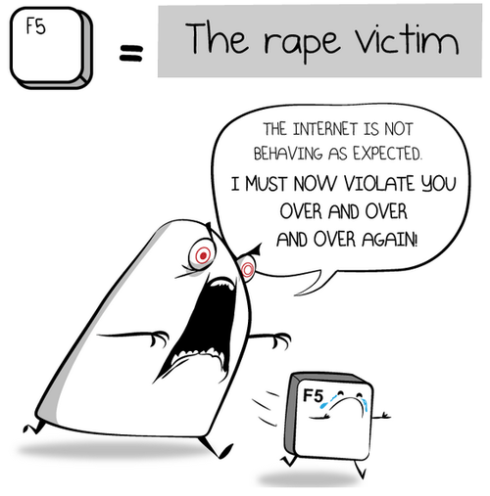
Yesterday, Matthew Inman from The Oatmeal wrote a comic about the “delicate relationship” that he has with his keyboard.  This was the final panel of the comic:

rape-f5rape

The comic in its entirety was about how he feels and behaves towards the various keys in his keyboard. This panel specifically was about trying to get a webpage to load when you have a slow connection, with the joke centering around Matt “raping” his F5 key in order to make the page load faster. Yes, it’s a rape joke. No, I’m not surprised. Yes, it’s supposed to be funny. No, no one would ever  actually “rape” a computer key. Yes, in spite of all that, I’m still grossed out. Now that all that is out of the way, can we talk about how terrible this is? Because it’s terrible. Really, really terrible.

The panel above is the type of joke that normalizes and trivializes rape. Instead of showing rape as an act of sexual violence that will haunt someone for the rest of their life, it’s hilariously portrayed as pushing your F5 key one too many times. What it tells readers is that rape is no big deal, that it’s just this thing that happens. It tells readers that rape is not a powerful word, but instead is a term you can use to describe any kind of forceful action. It tells readers that rape is normal, and even worse it tells rapists that rape is normal. The problem with jokes like this is that not only do they make rape victims deeply uncomfortable, they make rapists feel comfortable.

And I mean, you know what? As far as rape jokes go, this one isn’t that bad. I mean, not really. It’s not graphic, and it’s not even describing a plausible situation since, again, computer keys can’t be raped. If we didn’t live and participate in rape culture, this joke on its own wouldn’t be that big of a deal. But you know what? If we didn’t live in a culture where rape was constantly aided and abetted, a culture where rape is so normalized that we think nothing of making light of it, a culture where rape victims are frequently hushed up, dismissed or outright disbelieved, this comic would never have been made. This comic is a product of rape culture and it perpetuates rape culture. The message that this comment sent out to The Oatmeal’s nearly 800,000 Facebook fans (and the myriad other readers who follow the comic on Twitter or directly on The Oatmeal’s website) is that rape is no big deal.

It is a big deal, though. And when some readers of the Oatmeal told Matt Inman that rape jokes are a big deal, this was his response:

XekGY

I mean, first of all, it seems bizarre to blame Daniel Tosh for this backlash. Just because Daniel Tosh was called out for making a rape joke doesn’t mean that he was the first to do so, or that he invented rape culture. This joke wouldn’t have been funny before Daniel Tosh, and it sure as hell isn’t funny now.

Second of all, it’s really great that Matt Inman donated money to a battered women’s group. But that doesn’t give him license to say whatever he wants. It’s not like making a one-time donation gives him some kind of immunity to ever being called out on misogynistic shit that promotes rape culture. That’s not how it works.

Third of all, this isn’t censorship, and I hope that Matt Inman never lives in a place where true censorship exists. Freedom of speech means that you can say whatever you want, sure, but it also means that I get to call you out when you’re being a dick. You get to make jokes, and I get to tell you when they’re offensive. We are both afforded the privilege of freedom of speech. And you know what? I’m not even offended by this comic; I’m not going to give anyone that satisfaction. See, Matt Inman wants to believe that he’s done something so cool, so edgy, that regular, Family Circus-reading folk will be “offended”. Well, I’m not. I’m contemptuous of this comic, and I’m contemptuous of you, Matt Inman. Every time you make a joke like this, I think less and less of you. So no, you’re not being censored; you’re just hearing the reactions of people who aren’t on board with what you did.

I’m sure that there are people who will accuse me of being so wrapped up in feminism, so focussed on seeing misogyny wherever I look, that I’m just not able to recognize humour anymore. There are people who probably want to tell me that nothing is so sacred that you can’t joke about it, that “censoring” comics is the worst possible thing you can do, and that if I don’t “let” people make rape jokes then I’m some kind of fascist.

First of all, anyone who would think that should look up the definition of “fascist”.

Second of all, I don’t think that all rape jokes are bad. In fact, I even think that some of them are funny. The thing is, in order for a rape joke to be funny, it needs to do two things:

1. Not make rape victims the butt of the joke

2. Challenge the status quo, i.e. rape culture

Below is a video by Louis C.K. in which he makes a joke about rape that’s funny. If you are a comic, or aspire to be one, you might want to take notes:

See, what he’s doing in this joke is challenging the idea that rape is sexy or desirable. He’s challenging the idea that some men would leap at the chance to take a woman without her consent, while she is repeatedly telling them no, just because she’s giving out some kind of vibe. He’s challenging a culture that persistently insists that women don’t know what they want, that they play hard to get, that they lie and manipulate and shouldn’t be taken at their word.

That is a joke that challenges the way we think in a humourous way. That is what comedy should do.

Matt Inman did, thankfully, end up removing the rape joke panel, and tweeted the following earlier today:

It’s not the greatest apology, but at least it’s an apology, you know? I wish that he hadn’t included the “if”, because obviously people were upset, no ifs about it; it would have been better had he just flat-out apologized for the fact that people were hurt and upset. However, this apology is better than nothing, and it’s waaaay better than artists who continue to defend themselves after they’ve been called out for inappropriate behaviour. So I guess there’s that.

Sometimes stuff like this feels so relentless, like there’s no way to fight against it because you’ll just never win. Working to bring down rape culture feels overwhelming, because it’s literally everywhere. How do you fight nearly every movie you’ve ever seen, every book you’ve read, every casually misogynistic word that’s ever been spoken to you? Where do you even start?

Every once in a while, though, you do get someone who reconsiders what they’ve done and issues an apology, and that feels like it’s maybe the beginning of something. And like I said, maybe it’s not a great apology, but hopefully it will start people thinking. Maybe this will get fans of The Oatmeal really considering what that rape joke really meant, and why it wasn’t funny.

I think that if even one person who laughed at that comic sits back, thinks hard and changes his opinion, then this fight is worth it. If this post gets even one person to change their minds about how they view rape, and especially rape jokes, then I’ll be happy. Hell, even if this post does nothing more than get people who agree with me to start a conversation about this, then I’m good. The fact is that talking about this stuff, getting it out into the open and engaging people about it, is a huge first step to changing the status quo.

And I really, really want to change the status quo.

The Past Is A Foreign Country

2 Dec

In the beginning God created the heaven and the earth. And the earth was without form, and void; and darkness was upon the face of the deep, etc.

And then God created the Garden of Eden, and made a dude out of mud to be in charge of it. Then one day when this dude, Adam, was sleeping God took one of his ribs (ew) and from that rib magically made Adam a lady-friend, Eve. Then Adam and Eve lived in paradise for, like, three days, until Eve, the original third wave feminist (she embraces diversity, change and choice!), took some bad advice from a phallic symbol serpent and ruined everything.

And we’ve been nostalgic ever since.

Sometimes I think that nostalgia is the human condition. I mean, we’ve got a minimum of three major religions based on this yearning to get back to a past that none of us remember or even understand; the most we know about it is that Adam thought it was awesome. Then again, Adam also thought that wearing fig leaves was awesome, and was married to someone who was basically his clone (I mean, is that how it works? what with the rib and all? what’s the science here? anyone?). Anyway, what I’m trying to get at is that I’m not sure how reliable of a source he is.

I mean, here’s the thing: I am the queen of nostalgia. Ask anyone – I basically get nostalgic at the drop of a hat.

(Hey, remember that time you dropped a hat? How great that was? How much fun we had? Why don’t we ever have good times like that anymore?)

I don’t just moon over actual things that I’ve experienced either; I spent a good chunk of my childhood feeling nostalgic for just about any time in history, from the ancient world all the way up to The Great Depression (I blame a combination of having an aunt who is an egyptologist, reading excessive amounts of historical fiction, and watching Annie on VHS until the tape wore out). I used to drive my mother bananas by whining at her that I should have been born in the Victorian era (in response to which she would usually remind me of my fondness for indoor plumbing), and nearly every elementary school class photo shows me decked out in some kind of puffed-sleeve Anne of Green Gables floral-printed nightmare, grinning like a Cheshire Cat.

If there was a book at the public library with a picture of a girl in a laced-up bodice and peasant skirt, I’d read it. If there was a weirdo food mentioned in something I’d read (blanc mange, I am looking at you), I’d tried to find a recipe for it. After learning that people seriously believed in fairies until not that long ago, I began to (non-ironically) leave food in our backyard in case the fair folk were hungry for chocolate-covered graham crackers and milk. And you know what? To be honest, my adult self is not that different, although nowadays I would probably eat the cookies, fairies be damned.

What I’m trying to get at here is that I’m totally guilty of romanticizing the past. Totally! That being said, I don’t use that as an excuse to hate the present. I mean, I like flush toilets and computers and being able to vote and science-based medicine and all that good stuff. I am pretty down with modern life (although I am sad that I don’t get to wear bustles or hoop skirts). I guess what I am trying to say is that I am confused by people who think that living a middle-class existence in the western world is basically the worst, ever. I’ve heard women bemoaning the fact that feminism has ruined womanhood (is that even a word? my spellcheck thinks it’s a word), and the fact that women can now vote, own property and work after marriage is somehow preventing them from being stay-at-home mothers or housewives or whatever. I’ve heard people complaining about the “chemicals” in antibiotics, and saying that they only do homeopathic or herbal treatments – nothing “unnatural” or doctor-prescribed. I hear people talking wistfully about the days when science didn’t exist and everything was just natural and wholesome and wonderful.

People talk a lot about “authenticity” when it comes to objects and experiences. They don’t want Walmart to exist; they want everyone to buy things from farmer’s markets and local mom-and-pop pharmacies and department stores. They want to drive to Mennonite country to buy hand-made furniture and hand-dipped candles. They want to practice yoga at sunrise on a mountaintop with someone who has studied in India and can read their chakras. When they travel to South America, they don’t want to go on a guided tour; they want to see the unspoiled part of the rain forest, want to see the “real” locals who are unspoiled by contact with the west. We’re obsessed with our idea of what’s “real”; these days, people worship at the temple of the real.

Sometimes I think that our desire for authenticity has a lot to do with our love of nostalgia. We think that the people who came before us lived lives that were somehow more “real” than our own.

But you know what guys? The past is a foreign country, and so on, and so forth. We don’t know what it was like back then; all we can go by is what we’re told, or by deciphering what’s been left behind. We will never be able to understand how people felt or lived back then; their circumstances, though not totally alien to ours, are different enough that we will never fully be able to grasp their emotions, or beliefs, or the ins-and-outs of their daily lives. We just have to trust that yes, being a woman before feminism was a raw deal, and yes, modern medicine saves lives, and yes, science and modernity serve some kind of purpose. I’m not saying, let’s not be critical of society; what I’m saying is let’s keep pushing forward and trying to make things better instead of daydreaming about a past that we can never get back.

I’m not saying that Walmart is amazing, or that any of the things I mentioned up there are bad in and of themselves, just that it’s hard to have some kind of moral superiority about where you shop when there are kids who would probably starve if there weren’t discount stores where their parents could get a cheap meal. I’m also not saying that our society isn’t obsessed with consumerism, because we are; we’re consumerist as hell. But you know what? People in the past didn’t own less things because they were better than us; it was because they couldn’t afford them. If you want to live a life of simplicity where all you can afford is a mattress on the floor and one change of clothes, then by all means, please go ahead. However, don’t kid yourself that you’re being more “real” than the next person.

Sometimes I think that the appeal of history is that we know how all the stories end. We know who wins the Battle of Hastings, and whether or not Julius Caesar crosses the Rubicon, and whether or not the Titanic will ever reach New York (spoiler: it won’t). And yeah, a lot of history was scary and bloody and downright awful, but at least we know what happens. I mean, better the devil you know, right? Our modern lives terrify us because we don’t know how anything will end; sometimes it seems like we’re careening towards our own destruction, running full-tilt at things like global warming and nuclear war and widespread poverty and famine. I’ve got news for you, though: if these things terrify you, all the hand-dipped candles in the world aren’t going to save you. If you’re scared (and you probably should be), then get up and go do something, for God’s sake. Sitting at home wishing that you lived in Elizabethan England is going to accomplish exactly nothing.

I mean, except reminding you how awesome those giant ruffs were. Can we bring those back, please?

Bustles - the best, right? Baby got back, etc.

Bustles – the best, right? Baby got back, etc.