Tag Archives: theo

Family Pictures

8 Sep

A few months ago we purchased a family photo session with Diana Nazareth through Ethical Deal. I am a sucker for candid, natural light photography, and I love, love, love Diana’s work. At the end of August, we went out to the Brickworks for our session, and Diana just sent me the first image:

Image

I can’t even tell you how much I love this. I feel like this represents our little family so perfectly ❤

I can’t wait to see the rest of the pictures!

If This Isn’t Nice, I Don’t Know What Is

3 Sep

I teach a yoga class for my friends on Sunday afternoons. Usually I get three or four people, but today almost no one was able to make it. One friend was working, another was out of town, and a third was eating deep-friend bacon-wrapped Mars Bars at the Ex. You know, the usual Labour Day weekend stuff.

My friend Susan, however, did show up, but both of us were having a hard time getting up off the couches in the lobby and going into the actual studio. We stalled ourselves by talking about Richard III and Anne Boleyn. We promised ourselves that in five minutes we would get up. We even tried bribing ourselves with a short practice and a long savasana.

None of this worked. We just couldn’t be tricked into practicing.

Instead we hung out, discussed about my favourite vacation idea (The Dead Author Tour of New England – it is going to be amazing), critiqued the trailer for the new Anna Karenina movie (you guys, I can’t even), and talked about how difficult it is for both of us to take time off  – we both feel like we need to relax but then get stressed out over how much not-relaxing we end up doing.

Finally, Susan asked if I maybe wanted to go get a pedicure. I wasn’t super stoked on the idea, because I’d just painted my toenails a few days earlier, but agreed that we should do something. Something other than lolling around on couches, I mean. So we left and started walking north along Yonge street.

Trudging uphill in the humid, late-summer air, I suddenly realized what I wanted to do: I wanted to sit in the park, drink grownup drinks and read magazines.

Let’s do it, said Susan.

We sat in the park, we drank, we read excerpts of articles out loud to each other. We talked the way pre-adolescents do, about everything and nothing, mixing big, smart-sounding ideas with meaningless trivia.

At one point, embarrassed about confusing A Room With a View and A Room of One’s Own (don’t judge), I flopped back onto the grass and stared up into the leaves of the tree we were sitting under.

Whoa, I said, you have to see this tree.

Why, asked Susan, lying down beside me, have we been reading magazines like chumps when we could have been looking at this tree all along?

That was a fair question.

It was one of those moments where everything is absolutely perfect; a moment where you wouldn’t change a thing, not the colour of the sky, or the temperature of the air, or even the tiny ant crawling up your leg. It was a moment so good that I was already experiencing nostalgia for it, even while it was still happening.

It made Susan think of a quote from Vonnegut’s A Man Without A Country:

If this isn’t nice, I don’t know what is.”

It made me think of the part in the Stand By Me when Older Gordie Lachance, who’s narrating the movie, reflects back on Vern (played by an itty bitty Jerry O’Connell) saying, this is a really good time:

Vern didn’t just mean being off limits inside the junkyard, or fudging on our folks, or going on a hike up the railroad tracks to Harlow. He meant those things, but it seems to me now it was more and that we all knew it. Everything was there and around us. We knew exactly who we were and exactly where we were going. It was grand.”

Although I’m not sure that either Susan or I could say with any conviction that we know exactly who we are or exactly where we’re going, it did seem that the whole of what we were experiencing was greater than the sum of its parts. It was more than magazines and booze and the hazy, golden early September air around us – yes, it was all of those things, but it was also how easy happiness was in that moment.

I often feel as if I’m constantly chasing happiness, whatever happiness means, only to have doubt or fear or anxiety push it just out of reach. And yet, here I’d achieved it effortlessly. How did that happen?

Later (actually, a fair bit later than I’d originally intended), I walked home to my family. I opened our front door to find Matt and his brother Adam feeding Theo grapes. I mumbled an apology for my lateness, and Matt said, that’s okay.

He didn’t say it in a way that sounded angry or begrudging, even though I’d delayed everyone’s dinner by at least an hour. He said it in a way that meant, I don’t mind and I hope you had a good time.

After supper, as I did the dishes, I could hear Theo shrieking with laughter as he played with my brother-in-law in the other room. I thought, This is good. I am lucky.

And then, more than anything, I wanted to write this out. When things get hard again, as they inevitably will, I want to have this memory preserved somewhere outside of my head. I want it to be able to exist perfectly in and of itself without my mind distorting it. I want to have this here to remind myself that happiness is not only possible, but even, sometimes, easy.

I want to remember that I am lucky.

And if that’s not nice, I don’t know what is.

Oh, and also I found this amazing shirt at Book City. See? Lucky!

An open letter to Stephanie Fairyington (or, breastfeeding and feminism)

1 Sep

Dear Ms. Fairyington,

Before we start, can I just say that you have an awesome last name? Your last name is totally rad. It has the word fairy in it! I bet you hear that a lot. Anyway, just wanted to get that out before we move on to the more serious stuff.

So. This article that you wrote for the New York Observer, Time for Feminists to Stop Arguing About Breastfeeding and Fight for Better Formula – I just read it, and now I feel like I have a few things that I want to say to you.

First of all, I should probably give you some idea of where I’m coming from: I am a breastfeeding advocate, who is still nursing her 19 month old son, and I am a feminist. Oh, and I also run a yoga studio, which, as you pointed out in your article, would totally be a pumping-friendly environment if I was pumping. Which I’m not.

Second of all, I want to tell you how wholeheartedly I agree with the first part of your title. It is time for feminists to stop arguing about breastfeeding. Boy is it ever.

I’ll be totally honest with you – I do truly believe that breast milk is superior to formula. I would be thrilled if every woman chose to breastfeed, and was physically able to do so. I think breastfeeding is the best start in life that you can give a kid (well, that and a killer wardrobe), and I really wish that there was more in the way of education and resources dedicated to breastfeeding.

But I realize that some women are physically incapable of breastfeeding. Some women aren’t able to pump at work. Some women find the act of breastfeeding triggering due to past sexual assault. Sometimes formula is actually better for the baby’s health, in cases with severe health issues or allergies. And sometimes women just plain don’t want to.

As a feminist, I respect any choice that you make with regards to your body. If you want to terminate a pregnancy, I respect that. If you want to earn money as a sex worker, I respect that. If you don’t want to breastfeed, I respect that. Know why? Because I believe in bodily autonomy.

Which means that you should extend the same courtesy to me.

Which brings me to my second point, namely the fact that you believe that breastfeeding “stymies the progress of feminism“.

The first thing you mention in conjunction with this idea are some concerns you have with regards to the Latch On NYC initiative.

You begin by saying that,

Under the new rules, about two dozen hospitals will discourage new moms from formula-feeding by educating them on the benefits of breast milk … ”

This actually isn’t a new rule. According to this, it has been New York State law for the past three years that new mothers must be provided with accurate information regarding breastfeeding. So that actually has nothing to do with Latch On NYC, or Mayor Bloomberg.

You then go on to say,

” … [hospitals] will not provide formula unless medically indicated on the infant’s chart or requested by the mother. The rules will also prohibit formula freebies and ads in hospitals.”

I honestly fail to see how anyone could think this is a bad thing. Formula won’t be provided unless the mother asks for it – meaning that the staff can’t give the baby formula without the mother’s consent. Which does happen, believe it or not.

Furthermore, formula companies have no place advertising in hospitals or offering mothers free samples. Do you think that they do this out of the goodness of their heart, so that babies don’t starve? No, they’re looking for customers. I would think that you, as a future buyer of formula, would actually be happy that they will no longer be spending money on advertisements and freebies. Those “freebies” aren’t really free – they’re paid for by the company’s revenue, which comes from consumers like you.

Next, you say that,

The notion that “breast is best” simply because it’s natural sounds ringingly similar to the arguments made by pro-lifers and even contraception opponents, all of which begin with the same basic premise: women should be shackled to their corporeal destinies.”

There are many scientific studies proving that breast milk is nutritionally superior to and more biologically advantageous than formula. But that’s not the whole reason I decided to breastfeed.

I also decided to breastfeed because I’m cheap and lazy.

Breast milk is free and, living in Canada, I had a full year of maternity leave and thus was spared the cost of a breast pump. That being said, even a one-time investment in a breast pump is less expensive than buying can after can of formula.

And as much as I hate getting up in the middle of the night to nurse my son, I would hate even more having to get up and make him a bottle. Plus, I don’t have to do any of the sterilizing and cleaning of feeding supplies.

So please don’t think that all the pro-breastfeeding arguments boil down to “but it’s natural!”, because there’s so much more to it than that.

Next, you bring up the idea that breastfeeding is anti-feminist because,

A bottle positions men and women equally over the care of infants, while breastfeeding cements the notion that women are central to the process of nurturing children. Wasn’t feminism all about de-emphasizing our corporeality by arguing that our bodies should not define or limit our rights and responsibilities?”

No, my husband doesn’t breastfeed our son, but we do try to share our parenting duties equally. Yes, earlier on I was doing more work – all of the feedings were my responsibility of course (although we did decide that all of the diaper changes that happened when my husband was at home were his job). All of the gestating was also my job – shitty deal!

But, as my son grew older, my husband was able to take over more and more parenting duties. For example, he takes care of our entire nighttime routine – he’s usually the one to feed our son dinner, since I’m often working in the evening, and is always the one to give him his bath and put him to bed. It’s true that our roles in our son’s life remain somewhat different, but then “equal” does not mean “exactly the same”.

And, I’m sorry, but I thought that feminism was all about giving women choices – the choice to have children, or not to have children, the choice to breastfeed or formula feed, the choice to manage a yoga studio or be a children’s therapist who sees an exhausting number of clients. The point of feminism is that we work together to achieve equality, instead of tearing each other down over every little thing.

Finally, you complain that breastfeeding is holding women back because it reinforces women’s “parental centrality” and “undervalues fathers”. You say that this is holding women back in the work force. You also mention how difficult breastfeeding is because many workplaces aren’t equipped to deal with women who need to pump.

Wouldn’t a better idea be to work to change how society views motherhood, and to fight for better regulations regarding pumping at work? How is limiting women’s choices in any way, shape or form a feminist idea?

You write as if formula is somehow under attack when, in fact, it’s still the status quo. By 6 months of age, 52.8% of all infants are formula-fed. Trust me, you’re not a dying breed.

You write as if formula feeding doesn’t, in many ways, reinforce the patriarchy – for example, the idea that women shouldn’t expose themselves while feeding their child in public. Or how about the idea that a woman’s milk simply isn’t good enough or sufficient for a growing baby? In spite of the evidence to the contrary, this myth still persists. Or, my favourite, the fact that so many women and their partners want their breasts to remain exclusively sexual. If that’s not patriarchal conditioning, I don’t know what is.

And finally, I do agree with you that we should continue to work to improve formula, to try to make it more like breast milk. But I also think that we should continue to educate and encourage women when it comes to breastfeeding. Because, unlike you, many women go into parenthood wanting to breastfeed, and we should be offering them the support and resources they need to do that. I would hate to see a woman be forced to wean her child just because she lacked knowledge or support for her breastfeeding.

Anyway, I’m sure you’ll dismiss this whole letter as “nostalgia and conservative orthodoxy”, and that’s okay too. You can certainly believe whatever you want, just as you can do whatever you want with your own body. Just as I can do whatever I want with my body.

And that, Ms. Fairyington, is feminism.

Sincerely,

Annabelle

Multitasking!

Daycare (or, what the hell am I doing here?)

29 Aug

One of my (many and abundant) gifts is that I have a really, really great sense of direction. When we were in Paris a few years ago, I was able to navigate all the twisty-turny alleyways armed with only a small book of street maps and my wits. Although I couldn’t have told you which direction was north, I somehow always had an innate sense of where the Seine was, and would direct us accordingly.

The flip side of this is that feeling lost or disoriented is incredibly terrifying for me. This includes feeling lost and disoriented in a whoa what street am I on and how did I get here? way and also in a larger, more general whoa what the hell is happening in my life right now? sense.

Change is very disorienting for me. I am the kind of person who loves routine, who thrives on knowing what will happen next. I eat the same thing for breakfast every morning. I am not the kind of person you want to take with you on a spontaneous backpacking trip to the Amazon. I find it difficult and painful to break out of any routine, even one that is seriously not working for me. Letting go of a routine makes me feel unmoored, as if I’m sitting in an oarless, rudderless boat, watching the shoreline shrink as I drift out to sea. I usually experience a brief moment of breathless euphoria at my newfound freedom before total panic sets in.

All of this has been a very verbose way of leading up the fact that this morning, I registered Theo for daycare. Next week I am going back to work full time.

Let’s get a few things out of the way: I think that daycare is awesome. I went to daycare and loved it. I think that it will be hugely beneficial to Theo, in part because of the socialization it will offer him, and also because of the structure he will have there. Although this particular daycare costs a little more than we were hoping to pay, it came highly recommended by a friend, and everyone I’ve mentioned it to has something positive to say. I am really, really happy we got a spot there.

But I still feel panicked.

Partly it’s because I’m worried about how the change will impact Theo. Will he understand that I’m coming back at the end of the day? Will he think that I’ve abandoned him? Will he miss me unbearably?

Another thing that freaks me out is the fact that no one there will know Theo as well as I do. How will they be able to interpret his needs properly? How will they understand what he’s saying? Will they be able to learn to speak Theo?

I was talking about this last night with Scott, a super lovely, laid back philosopher/yogi who teaches at our studio. He had some really smart things to say, but when I tried to repeat them to Matt, I couldn’t get the words right. So I emailed Scott and asked him to remind me of what he’d said, and this is what he sent back to me:

What you said to me was that you were worried people would fail to be as a good a mother to Theo as you are.  That they would not be able to read his subtle gestures and give him what he needs when he needs it.

I said that that was exactly what he needs.

“The good-enough mother…starts off with an almost complete adaptation to her infant’s needs, and as time proceeds she adapts less and less completely, gradually, according to the infant’s growing ability to deal with her failure” (Winnicott, 1953)

Having all of his needs met in a relationship were no one is failing to provide for him as he demands actually turns out to be disadvantage, as Theo is coming to know who he is precisely through those failures.  These are not grand or abusive failures where he becomes scared to develop into his own self, but just the right kind of misattunement that will occur at a daycare where someone doesn’t know him as well as you. And when misattunement happens those caretakers will be able to support him and help make reparations with him.  This is what is actually so important: that his caregivers fail to meet his needs and yet in an environment of love they support him through that failure and help him realize that he is a unique person in relationship with others who can survive these failures of connection.

It is what used to happen in extended family care all the time and now must happen in daycare scenarios. It’s an important part of child development that Theo needs at this time. Sounds weird but you send your child off to an other who you expect will not do as a good job as you so that Theo can grow into the independent and capable person he needs to be.

Which was exactly what I needed to hear.

The third facet of my panic is all about me:

What if I don’t like working?

I will be managing a yoga studio (which I already do, but I will be putting in more hours), and trying to pick up some classes to teach to supplement our income. I’ve never done this as a full-time job before. Scratch that, I’ve never taught an actual class, for real money before – everything I’ve done so far has mostly been volunteer work or freebies for my friends. What if I hate teaching yoga as an actual job? What if I can’t find any classes to teach?

What if I fail?

Looking at it one way, I will paying twice the cost of the average university tuition in order to put Theo into daycare so that I can go work at a job that I’m not sure I will love, a decision that might leave both of us miserable. In this scenario, both of us are in the oarless, rudderless rowboat, heading slowly but surely for open water.

Looking at it in another way, maybe this is the only way (or, at least, the best way) for us to grow. We’ve spent a year and a half living in an almost totally symbiotic relationship; maybe now it’s time for us to break free of each other and begin to discover (or rediscover, in my case) who we are as unique individuals.

Maybe we will both love this new arrangement. Maybe he will flourish in daycare, and I will realize that I am finally doing work that I love and feel passionate about.

Perhaps this will give us the chance to develop the skills we need to make or find our own oars, or discover a way to get back to shore under our own power.

Or maybe we will learn to love living at sea and, instead of turning back to what is familiar to us, we will take our homemade oars and chart a course for adventure.

Image

Further Adventures in PPD (or, why I might be sort of grimacing in your baby shower pictures)

28 Aug

I mentioned in my last post that we went to a baby shower this past weekend. This is actually the first of several baby showers that I have to attend over the course of the next month.

In order to mentally prepare myself for this baby shower, I did what any normal person would do: I put blue streaks in my hair. I thought that this would make me feel punk-rock, like I was someone who was capable of kicking ass and taking names. Instead, it made me feel sort of mermaid-ish, or else like a devotee of the Drowned God – not necessarily bad things, but also not really what I was going for.

I find baby showers, and many things baby and pregnancy related to be fairly nerve-wracking. My reasons for this are twofold:

1. It brings back all the old whoa I am such a shitty mom feelings from Theo’s early days. I look at pregnant women and I think, I bet she is better at being pregnant than me. I bet she is one of those people who did all those fancy scientific things like figuring out when she was ovulating and how long her luteal phase is, and totally planned her pregnancy based on what astrological sign she wanted her kid to be. She probably did not go in a hot tub or sauna while totally unaware of her pregnancy, and I bet she didn’t do crazy things like rock climbing and hiking in the Rockies. She probably carefully counted the days from the time she had sex until she could take a pregnancy test, and then wrapped up the pee stick in a fancy bow and gave it to her husband and then they cried tears of joy while holding each other in the moonlight.

2. I am really, really, really fucking jealous of anyone who can take the occasional moment to sit back and enjoy their pregnancy, rather than wondering if the alcohol content of the de-alcoholized wine they used to make the stew they are having for dinner will have serious adverse effects on their baby. I am so jealous of women whose main concerns are how swollen their feet are, or if the nursery will be ready in time. I’m sorry, I know it’s petty, and it’s something I’m working on, but still: it’s there, it sucks, and I want to acknowledge it.

There is something in my brain that switches into bonkers PPD mode whenever people talk about things they’ve given up during their pregnancy, like caffeine, or sweets, or anything fun that I didn’t give up. I think, oh shit, I didn’t sacrifice enough. I am not a good enough mother.

A few months ago, I went into a full-on tearful rant at someone after they talked about choosing not to have ultrasounds because they think that they’re bad news for fetuses. What’s especially funny about that is that while pregnant I was already aware of the concerns some people have about prenatal scans, and I actually did a fair amount of research on it. In the end, I felt well-educated on the issue, and drew the conclusion that I would prefer to have ultrasounds. But when she started talking about the choice she’d made, it was like the logical part of my brain just shut down. It was like, sure, look at Theo, he is fine and healthy! But what if not having ultrasounds could have meant that he was even more fine and healthy?

So much of my PPD has been about what if?

So much of it has been dangerous lines of thinking, like, if only I can stop making mistakes and just do everything perfectly, I will stop feeling this way. It is my fault that I feel this way, because I can’t stop fucking up.

When people talk about these choices that they’ve made, what they are really trying to do is communicate to me how they feel about their pregnancy, and maybe have a dialogue about what it’s like to be a pregnant woman in an era where we are  faced with so many (often confusing) choices. But somehow all I hear is, you’ve failed as a mother.

So what’s the solution? I could do what I ended up doing this weekend, namely pleading a headache midway through the shower and escaping to my room to cry. Or I could just try to avoid anything baby or pregnancy related (hah). Or I could grit my teeth and smile, and then later feverishly google things like “possible effects of c-section on baby’s future cognitive development”. None of those things seem like particularly good options, though.

I guess the thing is that I have no idea what to do, other than keep on keeping on, taking one day at a time, and all those other trite clichés. It’s possible that I need to learn to ask for help more frequently, or else try to explain myself better to the people around me. Perhaps I should get this shirt, in hopes that it will deter people from telling me any pregnancy/baby stories that might set me off.

Maybe one lesson that I can take from this is that a lot of parenting is going to come with this feeling of, I have no idea what I’m doing, or, even more accurately, I feel totally unable to handle this but, somehow, I have to.

Anyway, any tips, advice or commiseration are truly appreciated.

Oh, and feel free to compliment my awesome hair:

Image

It may not be very punk, but it still looks pretty rad, no?

Home, or something like it

27 Aug

I am writing this in the car on the way back to Toronto (science! technology! the future! etc.), on our way home from a long weekend in Quebec. We were there for my cousin’s baby shower, and also to visit my grandmother and other assorted extended family.

My grandparents moved to Saint-Bruno in the early 50s, shortly after they married. Back then it was a tiny hamlet south of Montreal just beginning to experience post-war boom. Although the town itself has been around since the mid 1700s, most of the houses there fall squarely into the mid-century bungalow category. My grandmother says that when they first moved to Saint-Bruno, it was still remote enough from the bustle of big-city Montreal that the selection of furniture and appliances that they could order for delivery was seriously limited. She and her neighbours all had exactly the same couch from Sears, which was available in only three staid, somber colours.

My grandmother has lived in the same house for nearly sixty years. What I love the most about her house is that change happens there at a glacier’s pace; although rooms are occasionally rearranged, with furniture sometimes drifting from one room to another, and the downstairs bathroom has been refitted to accommodate my now-wheelchair-bound grandmother, so much else is exactly as I remember it from my childhood.

So many versions of me exist in this house – as a squalling infant, pushed up the rocky drive in an old metal pram by my mother; as a rambunctious toddler, staying with my grandparents for a few weeks while my parents prepare to move to Ontario. There’s me throughout my primary school years, all skinny tanned legs and long blond hair, my clear skin and self-confidence both shining with pre-pubescence.

I’m there as a sullen  teenager, resentful that I’ve been forced to leave my friends behind just so that I can visit my dull grandparents. I’m there as a self-absorbed early-twentysomething, convinced that a few years of university mean that I know more than everyone. I’m there in my rebellious phase, shocking (or so I think) in my low-cut tops and short skirts, bragging about boys and booze. I’m there with my first serious boyfriend, who then became my husband. I’m there pregnant. I’m there as a new mother.

I’m in the cool, dark basement playing school with my cousins; it’s the late 80s, and one of my imaginary classmates is named Charlie Sheen. I’m tearing around on a Christmas sugar high, unable to sit still long enough for holiday pictures. I’m sitting at the kids table during a family dinner, happy that I don’t have to endure adult conversation.

I’m eating breakfast with my grandfather at the oil-cloth covered kitchen table. I’m 19 years old and midway through my first year of university. He tells me that he has lung cancer. I don’t have the right words to say to him, so I just tell him that my mother already told me. We sit in silence for the rest of the meal.

I’m back four months later for his funeral.

I can’t turn a single corner in this house, can’t enter a room or pick up an object without encountering one or several shades of myself. It helps that this place has a sort of fairy tale quality to it; the hedge surrounding the backyard is easily ten feet high, giving off a sort of sleeping-beauty-enchanted-forest vibe, and the interior of the house is neatly preserved as if by magic in another era. Stepping through the door sometimes feels like traveling through time, although I don’t know whether I’m going back to my own childhood in the 80s and early 90s, or my mother’s, several decades earlier.

It’s not just the house either, it’s the town itself. Out for a walk with Theo, I pass the lake where we watched Saint-Jean-Baptiste day fireworks, the same lake where my sister once cut open her foot on a stray piece of glass. We pass Mount Bruno United Church, where my grandfather laid the cornerstone back in the 1960s. I am inside that church, simultaneously in the midst of being baptized, crying at my grandfather’s funeral, and singing in my cousin’s wedding.

Maybe it’s because I’ve lived a fairly uprooted life (by my calculations, I’d moved 13 times by the time I was 25), but having a house like this that has been there at every stage of my life seems positively extraordinary. Maybe if you’re someone whose parents still live in the same place where they grew up, this whole post seems bizarre and pointless, but bear with me here, there is a message in here somewhere.

I guess the thing is that I don’t really feel like I have a hometown. People ask me where I’m from, and I hesitate. Do they mean, where was I born? The answer to that would be Montreal, but since we only lived there for a few years, I can’t really think of it as my hometown, can I? If they mean where did you live the longest? or where did you grow up?, then the answer is Kitchener, but since I have no family left there, and since I spent so much time actively planning how I was going to escape southwestern Ontario, that doesn’t seem like the right answer either. Do they mean where do you live now? That would be Toronto, but I don’t really consider myself a Torontonian, for many reasons.

So maybe the answer is Saint-Bruno. Maybe that’s the place that I have the strongest ties to, or at least the most emotional ones.

We had such a lovely weekend. We played in the creek at the Parc du Ruisseau:

We ate tomatoes fresh from my grandfather’s garden

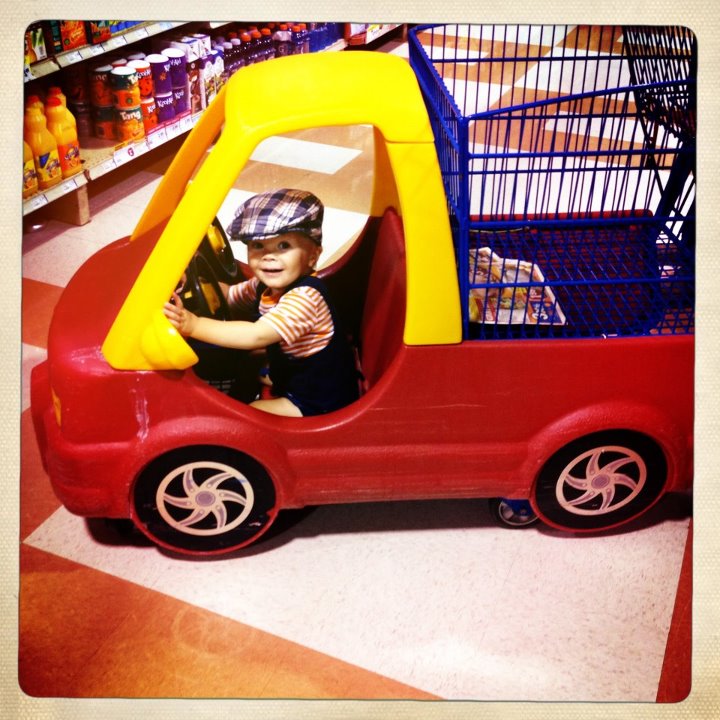
We discovered the WORLD’S MOST EXCITING SHOPPING CART:

Basically, everyone, especially Theo, had a total blast.

I hope that we can make it back there soon. I hope that we can visit often enough that Theo starts to understand why I feel the way I do about Saint-Bruno. And most of all, I hope that he has someplace, any place, in his life that is as secure and familiar and unchanging as my grandmother’s house is for me.

Optimism is better than despair (or, What Would Jack Do?)

23 Aug

A year ago today the rest of Canada and I woke up to learn that Jack Layton had died. A man who had worked tirelessly to better our country, who had spent his life fighting for equality for all Canadians, was gone. I was in shock. I didn’t know what to do.

My friend Mandi and I had a coffee date that morning, so I packed Theo up in his stroller and set out for her place in the east end. Did you hear about Jack? I whispered to her, as if it was some kind of secret. As if saying it out loud would make it true.

She lived around the corner from his office, and we had to walk by it to get to the coffee shop. I want to get some flowers, I told her, to leave in front of his office. But there were no flower shops nearby – just a few East Chinatown convenience stores. The only plant we could find was a little pot of stunted bamboo shoots.

He’ll like it, I said to Mandi, after all, his wife is Chinese.

We started giggling and couldn’t stop. It was easier than crying, or at the very least more socially appropriate.

That week I watched in awe as Torontonians came together to share their love for Jack. Our famously cold, unfriendly city began to bare its soul in chalk messages written all over Nathan Phillips Square. When thunderstorms washed away the chalk, the people came back and filled the square with writing all over again. I have rarely seen something more beautiful than that.

I think that what Jack would have loved most of all was the unity among the people of Toronto that week. All of us, from all walks of life, keenly felt his absence. Although many of us might not have realized what we’d had while he was still living, we suddenly realized how much we’d lost after his death.

Tonight I went back to Nathan Phillips Square for Dear Jack: A Celebration. Much like last year, there were chalk messages written everywhere, and there was a large orange-bedecked crowd milling around. Most of the evening was lovely; I enjoyed the performances (especially Raffi!), and it broke my heart in just the right way to hear Olivia Chow speak about Jack. But I was frustrated that some people chose to use tonight as a platform for their political ideologies.

One woman wrote “Dear Jack, Toronto apologizes for Rob Ford. At least you missed that!” And I thought, how is this a response to someone who asked for love, hope and optimism? Or, as my friend Melissa said, we have 364 days a year to trash Rob Ford – couldn’t we use today as a time to get together to mourn, love, and look towards the future?

I’m glad I went, though. Theo enjoyed running around and playing with the chalk, and I loved running into various friends, exchanging hugs and murmurs of I can’t believe it’s been a year.

We miss you, Jack. I miss you. Thank you for everything you did. Most of all, thank you for inspiring us to continue to fight to build a better country, for helping us to believe in a more loving and just world. I think that your true legacy is the group of people who are using what you’ve built as a starting point, and are now running headlong towards the future, spreading love, hope and optimism along the way.

I won’t let anyone tell me it can’t be done. I will change the world.

Postpartum depression (or, hey, let’s do some oversharing!)

22 Aug

I wanted to start this post off with something very dramatic like, when Theo was six weeks old, I was contemplating suicide. That has a nice ring to it, doesn’t it? Edgy, yet thoughtful. The problem is, it would be a lie – by the time Theo was six weeks old, I’d gone way past contemplation and was firmly into planning territory. It’s just that “planning” doesn’t have quite the same literary panache as “contemplating”, you know?

It would be pills, I decided: the percocets I had left over after my c-section, and some sleeping pills that’d been sitting around since before my pregnancy. I would have to do it while Matt was at work, but close enough to the end of the day that Theo wouldn’t have to be alone with his dead mother for too long. I would get some formula, I decided, and sterilize some bottles – that way Matt could feed him immediately, because Theo would likely be hungry by the time I was found. I would write a note, a good one.

Planning things out step by step like this made me feel better; it made it seem as if I had some kind of control over my life.

I didn’t want to die because I hated Theo. In fact, I loved him ferociously. I wanted to die because I knew that I was totally and utterly incapable as a mother. I wanted to die because I knew that if I lived, if I had to continue to be Theo’s primary caregiver, then I would continue to fuck things up horribly. I wanted to die because if I did, someone else would have to step in as his mother, and whoever it was would surely be more competent than me.

At that moment I sincerely believed that even random people I passed on the street were more qualified to raise my son than I was.

I tried to tell people how I felt, tried to convince them that I was an unfit parent, but no one seemed to believe me. They dismissed my worries as normal, and told me that every first-time mother felt the same way. I knew that what I was feeling was far from normal, but I didn’t know what to do about it. I thought about running away, packing a suitcase full of warm weather clothes and boarding a plane, but that seemed crazy. Suicide, however, seemed totally logical.

Although I’m referring to what I went through as postpartum depression, my anxiety and fear had been around for most of my pregnancy. Here I’d gone 27 years only having to take care of myself (and often doing a pretty poor job of it), and now suddenly I was 100% responsible for this tiny life inside of me. It seemed like that should be enough to drive anyone around the bend.

Was I eating enough, I wondered? Was I eating the right things? Did I need more iron? Was I getting enough omega 3 to ensure healthy brain development? I started carrying around a list of fish, rated from highest mercury content to lowest. I would whip this list out at restaurants and do a few quick calculations in my head – had I already ingested any potentially mercury-laced fish this week? How big of a portion could I have? It didn’t seem fair that Matt didn’t have to change his life at all while his son gestated, but I had to watch every bite that went into my mouth.

And then there was the alcohol. See, I hadn’t known I was pregnant for the first few weeks, and I’d had maybe two or three glasses of wine, total, in that time. Midway through my pregnancy I became convinced that my child was going to have fetal alcohol syndrome. I hadn’t even given birth yet, and I’d already ruined my child’s life. How could I be such a selfish, terrible person?

By the end of my pregnancy I’d become incredibly paranoid about everything, so it was almost with a sense of relief that I greeted the news that, at 34 weeks, I had to be hospitalized and put on bed rest. Here I would be in a place where I was eating a doctor-approved diet, where I would be hooked up to a big, clunky machine twice a day in order to monitor my son’s heart rate, and nurses were only the press of a button away. After months of fretting over taking care of myself and the baby, suddenly I could put myself in someone else’s hands.

And then Theo was born, at 36 weeks, via c-section. I’d thought that once he was out of me, once I could hold him in my arms and know for certain at any given moment that he was alive and well, things would be better. It wasn’t like that, though. I held him briefly in the operating room while they stitched me back up, but then they whisked him away, concerned about the grunting he was doing (a sign of laboured breathing, they said). Matt went with him, and my mother went off to call my grandmothers and aunts and uncles. I sat alone in the recovery room and waited, wanting only to hold my son.

They brought Theo back to me and let me try to nurse him, but he wouldn’t, or couldn’t. He started grunting again, so they took him away again, this time across the street to Sick Kids for an x-ray of his lungs. You need to prepare yourself for the fact that he might end up in the NICU, the nurse told me. I knew that wasn’t the end of the world, but still, it was scary. On top of that I’d read so many things about how the first few hours of a baby’s life are critical for bonding and creating a breastfeeding relationship – would missing this time with him have an effect on the bond we had?

The thing was, I was already having doubts about our mother-son bond, even that early in the game. When I’d been pregnant, I’d felt like Theo and I had intuitively understood each other. He would kick, and I would ascribe meaning to those kicks. I would rub his feet as they poked my ribs, and I felt like he just knew that my actions meant, baby, I love you. But once Theo was born, I realized that he was a total stranger. I didn’t know what he thought or wanted at all, and he didn’t give a shit about my feelings.

That first week things went from bad to worse. I couldn’t get Theo to latch, and every attempted nursing session was a nightmare. His weight dropped down to 4 lb 12 oz, which, while still within the range of normal, seemed frighteningly low. I felt like I’d failed at having the birth I wanted, had failed at properly bonding with my son, and was now failing at providing him with even the most basic necessities, like food. I couldn’t believe that they actually trusted me enough to let me take my kid home a few days after his birth.

There was something else, too. During my c-section, I heard my doctor say to his intern, look at this, here’s why he was breech. I asked him what he’d found, and he told me that I have a bicornuate uterus (like a cat! he said brightly). This means that instead of having one large chamber, my uterus has two smaller ones. Theo’s head had been stuck in one of the chambers and he’d been unable to flip into the proper position.

Of course, as soon as I could, I googled bicornuate uterus. Wikipedia had the following to say:

Pregnancies in a bicornuate uterus are usually considered high-risk and require extra monitoring because of association with poor reproduction potential.

A bicornuate uterus is associated with increased adverse reproductive outcomes like:

  • Recurrent pregnancy loss: the reproductive potential of a bicornuate uterus is usually measured by live birth rate (also called fetal survival rate).
  • Preterm birth: with a 15 to 25% rate of preterm delivery. The reason that a pregnancy may not reach full-term in a bicornuate uterus often happens when the baby begins to grow in either of the protrusions at the top. A short cervical length seems to be a good predicter of preterm delivery in women with a bicornuate uterus.
  • Malpresentation (breech birth or transverse presentation): a breech presentation occurs in 40-50% pregnancies with a partial bicornuate uterus and not at all (0%) in a complete bicornuate uterus.
  • Deformity: Offspring of mothers with a bicornuate uterus are at high risk for “deformities and disruptions” and “malformations.”

So here I’d been worrying about stupid things like omega 3 and iron while, deep in the dark recesses of my body, my own uterus was secretly working against me. This whole time I’d been afraid of the wrong thing – I was like France, setting up the Maginot Line, while all along the Germans were planning to attack from the opposite direction.

I was clearly (biologically, even) not meant to be anybody’s mother.

The first few weeks of Theo’s life were awful. I’d always been a bad sleeper, and now it was worse. Theo wriggled and grunted in his sleep, and it kept me awake. Every little sound that came out of him made all of my muscles tense up, making rest nearly impossible. Whenever I complained about how tired I was, people would say, sleep when the baby sleeps, as if that was some great revelation. As if it was something that I couldn’t come up with on my own. Breastfeeding continued to suck, and I began to dread feeding time. I would push it back by 5, 10 or 15 minutes, as if that made any difference. My days were lonely, boring and frustrating.

It was the carrier that finally pushed me over the edge. See, we live on the third floor and our building doesn’t have an elevator. I’m not strong enough to drag our stroller up and down the stairs. So, whenever we went out, I used a carrier for Theo. And whenever he fell asleep in the carrier, he grunted with every breath.

I asked everyone about the grunting – my mother, my sister-in-law, friends with kids. Everyone assured me that it seemed totally normal. Then, while obsessively googling “grunting” “breathing” and “baby carrier”, I found one lone site that said that grunting was a sign of laboured breathing (which I already knew), and prolonged grunting could mean that the baby’s blood oxygen level was low. Which could lead to many health complications, including brain damage.

The thing is, I’d known something was wrong. I’d known. I’d asked everyone and yes, they’d reassured me, but why hadn’t I trusted my own instincts? Because I stupidly and selfishly wanted to be able to leave the house, that’s why. If I was any kind of good mother, I would have stopped using the carrier as soon as he started grunting. I would have stayed home until Theo was old enough for the grunting to fix itself. But I wasn’t a good mother. I was a terrible mother. Not only that, but I was a clear danger to my child.

When I read that part about the brain damage, I handed my sleeping son to my visiting mother-in-law, went into the bedroom and cried for three hours. How could I ever undo this? How could it ever be fixed? It wasn’t as if I could just have a new kid and start fresh, having learned from my mistakes. A baby wasn’t like a paper that you could crumple up and toss in the garbage. I was stuck with my sad, damaged kid, and would be stuck with him for the rest of my life. He would be a constant reminder of what a terrible person I was.

If I’d been home alone at that moment, I likely would have killed myself then and there. But I wasn’t alone, so instead I confessed everything to my mother-in-law, hoping she would call the CAS and have Theo taken into protective custody (or, at the very least, have me arrested). Instead, she convinced me to go to the doctor.

And I did go to the doctor, and joined a program at Women’s College Hospital specifically for women with PPD, and I went on medication, and saw a therapist. All of that helped, but I think what helped the most was seeing Theo grow up and realize that no, in fact, he wassn’t brain damaged. He’s a totally normal, lovely, happy kid. And these days I’m mostly a totally normal, lovely, happy mom. And we have a pretty decent bond, I would say.

I still have my moments of fear and paranoia. I still occasionally freak out over little things (just ask Matt – I make him do all my baby-related googling now). I will probably always be a somewhat high-strung parent, but I can live with that.

What makes me sad is that I will never get those first few weeks of Theo’s life back. They will always exist for me in this cold, dark haze. I will never be able to think of Theo as a newborn without associating his early babyhood with that terrible time in my life. And that sucks. It sucks big time.

What also sucks is that I feel like I can’t talk about my experience with PPD. I often dance around the issue, saying “I had a tough time at the beginning,” or, “things were really hard for me”. I’ve never said, “being a new mother made me suicidal”. Well, not until now.

But I want to talk about it. I want to share my experience so that maybe someone else will think, hmmm, maybe I’m not bonkers and/or a terrible mother, maybe it’s my hormones. I want to feel like I’m not the only one who went through this, and I also want other women to feel like they’re not alone. I want them to know that things will get better, that they should talk to their doctor, or call a suicide hotline.

Most of all I want them to know that they are, in all likelihood, fantastic mothers.

Theo and I a few hours after his birth

For anyone who is in a state of mental health crisis, here is a link to the Mental Health Crisis line. You can also call Telehealth, if you’re in Ontario. If you are experiencing any kind of depression or are having suicidal thoughts, please, please call one of the numbers above, or else contact your doctor or local mental health crisis line.

Theo at 19 months (or, you guys, my baby is so old now)

18 Aug

Dear Theo,

You’re 19 months old today! I meant to write a post about you when you turned 18 months, but then July got a little crazy and by the time things settled down, you were almost not 18 months old anymore, so I apologize for that. Lucky for me you’re still illiterate, so hopefully you’ll never know about my little faux pas. That is, unless I post it to some kind of “web” that is “world wide” that never forgets anything you post on it ever. Oh wait. Well, maybe the internet won’t exist by the time you’re old enough to Google your own name.

You are a super rad kid. You are so full of mischievous energy that it’s hard to keep up with you sometimes (okay, most times). I love you so hard.

You’ve got an adventurous streak a mile wide. You’re totally happy to run off in any direction and just assume that a responsible adult will follow you. You are becoming more and more interested in testing boundaries, but you’re so funny and cheeky about it that it’s hard not to smile instead of correcting your behaviour.

You’re talking all the time now, and starting to put together a few small (as yet verbless) sentences. One of my favourite things is to ask you what your name is, because you will proudly point to yourself and say “baby!” I love going for walks with you, because you point out so many things to me – we have lengthy discussions about every fire hydrant, bus and tractor that we pass.

One amazing thing that has happened in the last few days is that you are starting to become interested in letters. Your favourite is the letter O – you point it out everywhere you see it and say “ooooooh”. When you see a D, you say “woof woof!” because D is for dog. I’m so excited that we’re jumping into this world of letters and words and reading. I hope you’ll love books as much as I do.

I love the names you make up for the people around you. I’m Mama and your father is Dada, of course, and then there’s Gaga (your grandmother), Nana (either our friend Nathalie, or Anna who works at the Early Years Centre), Mimi (Nathalie’s daughter Marine, who babysits you), and Gack (Jack Layton, who I have totally taught you to recognize). Now if only you would learn to pronounce Catherine and Claire, you would have a pair of very happy aunts.

You’re finally starting to become more interested in solids, although you still nurse quite a bit. You’re tall and a little on the skinny side, but you come by that honestly from your father. From me, you got your love of all things carbohydrate. Every time that we go to the store you demand that I buy you bread. That’s my boy!

You love reading, playing with your train set, playing “house” with your little people, and above all, you love any toy with wheels on it. You love music and dancing, and your two favourite songs are The Perpetual Self, Or What Would Saul Alinsky Do? by Sufjan Stevens and Call Me Maybe by Carly Rae Jepsen. You will specifically ask for each of these songs.

You love going to the park, donning your “yark” (shark) bathing suit and splashing around in the wave pool. You go to the park several times a week with Marine; now when I take you I feel like you’re a celebrity, because everyone there knows and loves you. You adore Mo, a little girl we often see at the park – when you catch sight of her you call out “Mooooooooohhhhh!”

You’ve definitely got a budding sense of humour, and you’re nearly always in a good mood. It’s very rare for you to cry, even if you fall and hurt yourself. You’re curious, crazy stubborn, and above all, you’re so much fun. I love you so much.

My little yark

The Gender Gap (or, what’s up with baby clothes, you guys?)

14 Aug

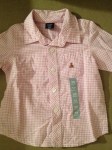
I bought this shirt for Theo today. I bought it for one reason, and one reason only: it’s pink, and it’s clearly labelled “baby boy”.

Can we just take a moment here to consider how amazing it is that Gap, a major retailer, has pink and lavender in their baby boy section?

Can we also take a moment to consider how incredibly depressing it is that, in my two years of shopping for baby clothing, this is the only time that I have ever seen pink or lavender in the boys’ department of any store? And trust me, there have been many stores; I’m, like, a shopping professional.

It’s not exactly a huge revelation to say that baby clothing is hyper gendered these days. Which sucks on several levels. Let’s work through those levels, starting from the most shallow and then digging a little deeper.

First of all, boy clothes are hella boring.

Boy clothing (even baby boy clothing) all tends to be depressingly similar. The major themes are: sports, cars/trucks/other machinery, “boy” animals (think dogs, snakes, bugs, sharks, etc.), rock music, and “cute” (read: stereotyped) sayings, like “mothers, lock up your daughters” and “strong like daddy”.

Not only that, but the colour scheme is always the same: navy blue, grey, brown and dark green.

ZZZZZzzzzzzzzzzzzzzzz

Oh wait, is this post still happening? Sorry, I got so bored thinking about boy clothes that I fell asleep.

Anyway. Moving on.

Secondly, have you ever wondered why baby clothing in particular is so gendered? I mean, it’s actually worse than clothing for preschool/school-aged children. Know why? Because all babies look the same.

I mean, obviously they don’t actually – some babies have dark skin, some babies have birth marks, some babies are Asian, some babies have a lazy eye, and so on. What I really mean is that babies don’t look like one gender or the other. Babies are basically totally androgynous.

So, how do you save someone from the horrible embarrassment of thinking that little Molly is actually a boy? You girl the shit out of her. Lace, bows, a giant flower headband for her hair – you coat her in layer after layer of femininity in a desperate attempt to prove to the world that she’s genetically XX, not XY.

People love making comments about babies’ genders. When I’ve been out and about with Theo, I have had so many people say to me, “oh, he looks like such a boy,” or “he’s got a really masculine face, doesn’t he?”

The funny thing is, when Theo was younger I dressed him in a lot of my old baby clothes, some of which were pretty damn feminine. A lot of people assumed that he was a girl, and cooed over how cute and ladylike his features were. WHO HAS A MASCULINE FACE NOW, EH, RANDOM STRANGERS THAT I MEET ON THE STREET?

So why is this all so important? I mean, why do I care how people dress their kids? Well, that brings me to my final point:

Society is made incredibly uncomfortable by anyone who doesn’t conform to gender norms. Especially boys.

This is one of the very few things that scare the shit out of me about raising a boy.

I read this excellent, intelligent and occasionally heartbreaking piece in the New York Times magazine this past weekend, and one paragraph in particular jumped out at me:

These days, flouting gender conventions extends even to baby naming: first names that were once unambiguously masculine are now given to girls. The shift, however, almost never goes the other way. That’s because girls gain status by moving into “boy” space, while boys are tainted by the slightest whiff of femininity. “There’s a lot more privilege to being a man in our society,” says Diane Ehrensaft, a psychologist at the University of California, San Francisco, who supports allowing children to be what she calls gender creative. “When a boy wants to act like a girl, it subconsciously shakes our foundation, because why would someone want to be the lesser gender?” Boys are up to seven times as likely as girls to be referred to gender clinics for psychological evaluations. Sometimes the boys’ violation is as mild as wanting a Barbie for Christmas. By comparison, most girls referred to gender clinics are far more extreme in their atypicality: they want boy names, boy pronouns and, sometimes, boy bodies.

I have rarely seen my thoughts on gender inequality so neatly distilled and pared down to one perfect sentence:

Girls gain status by moving into boy space, while boys are tainted by the slightest whiff of femininity.

YES. OH MY GOD YES.

It scares the shit out of me that there are people who would refer their son for a psychological evaluation because he asked for a Barbie doll. It frustrates me so much that we don’t have much in the way of support for kids who don’t fit neatly into the boxes marked “boy” and “girl (although obviously things are changing). And finally, it makes me incredibly sad to think that Theo will go through life with people constantly evaluating his masculinity, people who may resort to physical violence if they find him wanting.

I don’t know if Theo will ever question his gender, or want to engage in more traditionally feminine activities, or anything like that. I want him to grow up in a house where he can feel free to be who is, play with the toys he likes, dress the way he wants, and so on. I also want to protect him. I realize that these two desires may end up being mutually exclusive.

For now, I’ll offer him a variety of toys – trucks and trains, dolls and a kitchen set. I won’t narrow his world to only “boy” books and “boy” music and “boy” movies.

And, of course, I’ll dress him in pink checked shirts from the boys’ department at Baby Gap.