
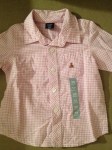

I bought this shirt for Theo today. I bought it for one reason, and one reason only: it’s pink, and it’s clearly labelled “baby boy”.
Can we just take a moment here to consider how amazing it is that Gap, a major retailer, has pink and lavender in their baby boy section?
Can we also take a moment to consider how incredibly depressing it is that, in my two years of shopping for baby clothing, this is the only time that I have ever seen pink or lavender in the boys’ department of any store? And trust me, there have been many stores; I’m, like, a shopping professional.
It’s not exactly a huge revelation to say that baby clothing is hyper gendered these days. Which sucks on several levels. Let’s work through those levels, starting from the most shallow and then digging a little deeper.
First of all, boy clothes are hella boring.
Boy clothing (even baby boy clothing) all tends to be depressingly similar. The major themes are: sports, cars/trucks/other machinery, “boy” animals (think dogs, snakes, bugs, sharks, etc.), rock music, and “cute” (read: stereotyped) sayings, like “mothers, lock up your daughters” and “strong like daddy”.
Not only that, but the colour scheme is always the same: navy blue, grey, brown and dark green.
ZZZZZzzzzzzzzzzzzzzzz
Oh wait, is this post still happening? Sorry, I got so bored thinking about boy clothes that I fell asleep.
Anyway. Moving on.
Secondly, have you ever wondered why baby clothing in particular is so gendered? I mean, it’s actually worse than clothing for preschool/school-aged children. Know why? Because all babies look the same.
I mean, obviously they don’t actually – some babies have dark skin, some babies have birth marks, some babies are Asian, some babies have a lazy eye, and so on. What I really mean is that babies don’t look like one gender or the other. Babies are basically totally androgynous.
So, how do you save someone from the horrible embarrassment of thinking that little Molly is actually a boy? You girl the shit out of her. Lace, bows, a giant flower headband for her hair – you coat her in layer after layer of femininity in a desperate attempt to prove to the world that she’s genetically XX, not XY.
People love making comments about babies’ genders. When I’ve been out and about with Theo, I have had so many people say to me, “oh, he looks like such a boy,” or “he’s got a really masculine face, doesn’t he?”
The funny thing is, when Theo was younger I dressed him in a lot of my old baby clothes, some of which were pretty damn feminine. A lot of people assumed that he was a girl, and cooed over how cute and ladylike his features were. WHO HAS A MASCULINE FACE NOW, EH, RANDOM STRANGERS THAT I MEET ON THE STREET?
So why is this all so important? I mean, why do I care how people dress their kids? Well, that brings me to my final point:
Society is made incredibly uncomfortable by anyone who doesn’t conform to gender norms. Especially boys.
This is one of the very few things that scare the shit out of me about raising a boy.
I read this excellent, intelligent and occasionally heartbreaking piece in the New York Times magazine this past weekend, and one paragraph in particular jumped out at me:
These days, flouting gender conventions extends even to baby naming: first names that were once unambiguously masculine are now given to girls. The shift, however, almost never goes the other way. That’s because girls gain status by moving into “boy” space, while boys are tainted by the slightest whiff of femininity. “There’s a lot more privilege to being a man in our society,” says Diane Ehrensaft, a psychologist at the University of California, San Francisco, who supports allowing children to be what she calls gender creative. “When a boy wants to act like a girl, it subconsciously shakes our foundation, because why would someone want to be the lesser gender?” Boys are up to seven times as likely as girls to be referred to gender clinics for psychological evaluations. Sometimes the boys’ violation is as mild as wanting a Barbie for Christmas. By comparison, most girls referred to gender clinics are far more extreme in their atypicality: they want boy names, boy pronouns and, sometimes, boy bodies.
I have rarely seen my thoughts on gender inequality so neatly distilled and pared down to one perfect sentence:
Girls gain status by moving into boy space, while boys are tainted by the slightest whiff of femininity.
YES. OH MY GOD YES.
It scares the shit out of me that there are people who would refer their son for a psychological evaluation because he asked for a Barbie doll. It frustrates me so much that we don’t have much in the way of support for kids who don’t fit neatly into the boxes marked “boy” and “girl (although obviously things are changing). And finally, it makes me incredibly sad to think that Theo will go through life with people constantly evaluating his masculinity, people who may resort to physical violence if they find him wanting.
I don’t know if Theo will ever question his gender, or want to engage in more traditionally feminine activities, or anything like that. I want him to grow up in a house where he can feel free to be who is, play with the toys he likes, dress the way he wants, and so on. I also want to protect him. I realize that these two desires may end up being mutually exclusive.
For now, I’ll offer him a variety of toys – trucks and trains, dolls and a kitchen set. I won’t narrow his world to only “boy” books and “boy” music and “boy” movies.
And, of course, I’ll dress him in pink checked shirts from the boys’ department at Baby Gap.

 The Belle Jar