Tag Archives: I like to rant

Manifest Destiny (or, whoa, Gap Inc, what the hell?)

14 Oct

Full disclosure: I like The Gap. Honestly, I do. Since Theo’s birth, I’ve spent a significant portion of my time (and income) in Gap Kids, cooing over pint-sized button-down shirts, cunning little sweater vests and pastel onesies with adorably clever graphics. I’ve even written here before about how impressed I was that they were selling pink and purple clothing in the boys’ department.

So imagine my surprise and dismay when I learned that they were selling men’s t-shirts with MANIFEST DESTINY written in bold letters across the chest.

Gap x GQ Mark McNairy Manifest T

This t-shirt is part of a collection called Gap x GQ, which The Gap says is “an exclusive menswear collection [created by] GQ’s best new designers”. The specific person responsible for the MANIFEST DESTINY shirt is Mark McNairy, an American fashion designer who is known for his past work for J.Press and Southwick, and who now has his own label, Mark McNairy New Amsterdam. While this might mean that Gap Inc themselves aren’t the ones who dreamed up this graphic, certainly a team of their own designers and quality control people would have had to approve it. You would think that somewhere in the design, review and manufacturing process, someone would have realized how glaringly racist this shirt is. You would think.

For those of you who don’t know what Manifest Destiny is, and why this shirt is so offensive, let’s have a brief history lesson.

The term Manifest Destiny was coined by journalist John L. O’Sullivan in 1845 as part of his campaign to encourage the annexation of Texas and Oregon County. His first use of the phrase, in the 1845 July-August issue of the Democratic Review, didn’t draw much attention, but the second time he used it, in a column published in the New York Morning News on December 27th, 1845, became extremely influential:

“And that claim is by the right of our manifest destiny to overspread and to possess the whole of the continent which Providence has given us for the development of the great experiment of liberty and federated self-government entrusted to us.”

Manifest Destiny became the smart, fancy-sounding name for a belief that had already been around for quite some time: namely, that white folks of European descent were destined to rule the entirety of North America. These people truly believed that it was God’s will that they colonize the new world and systematically destroy any civilizations that might already be occupying the lands they wanted.

Manifest Destiny and the philosophy behind it are responsible for a whole bunch of really terrible things. It was used to justify the Mexican-American War, the War of 1812, and, most appallingly,  the Indian Removal Act. Manifest Destiny was used to vindicate the myriad abuses suffered by people of colour at the hands of white North Americans. It’s the philosophy that lead to our continent-wide reservation system , not to mention the residential schools created for the Aboriginal peoples of Canada.

The effects of Manifest Destiny can still be felt, in the poverty and degradation suffered by American and Canadian people of colour, and in the deplorable conditions found on many reserves, both here and south of the border. The ideas behind manifest destiny still exist in our white western consciousness, as much as we might be loathe to admit it; they come up every time our (largely white) government asserts that it knows best when it comes to First Nations issues, or every time someone complains about how much freaking money has already been spent on Attawapiskat only to have their community still be in a state of crisis. Manifest Destiny is apparent every time someone chooses to be bigoted and wilfully ignorant about non-white immigrants, or tries to deny the far-reaching effects of racism; it’s apparent in the mindset of all the people who never take a moment to wonder why or how so many white people ended up owning so much fucking land.

Look, I don’t think that The Gap, or Mark McNairy, or GQ, or anyone involved here was trying to be offensive. My guess is that they thought that Manifest Destiny was a hip-sounding phrase, one that conveyed the idea of taking control over one’s own life or something like that. I’m certain (or at least hopeful) that Gap Inc. will end up pulling this shirt from their stores, issue a formal apology, and go through a brief, though sincere, period of mea culpa. As unbelievable as it is to me, I’m sure that those responsible for designing, approving and manufacturing this shirt did not understand the full scope of what its graphic meant.

And that, in a nutshell, is the main problem here.

The problem is that we want to forget; as white North Americans, we have everything to gain and nothing to lose by forgetting. We even ask that people of colour, especially, in this case, Aboriginal peoples, participate in our collective cultural amnesia. We tell them that we’ll never have the post-racial society that everyone wants until we stop bringing up the past, stop licking old wounds. We don’t want to feel guilty, especially as we often believe that we, the generation living now, are not responsible. After all, it wasn’t us drafting racist and genocidal laws calling for the relocation and often murder of an entire race of people; it wasn’t us sending thousands of First Nations kids to residential schools, where they would be subject to a dizzying array of abuses.

We don’t have blood on our hands; we’re good people. It’s not our fault that our ancestors were assholes, right?

What we often forget is that our privileged lives are built on the foundation of these grievous human rights abuses; we might not be our asshole ancestors, might even willingly speak out against the crimes they committed, but we’re still pretty fucking happy to reap the benefits of those crimes. We do have blood on our hands, whether we like it or not.

So maybe it’s not a bad thing that The Gap made this t-shirt; and maybe, rather than flinging vitriol at Gap Inc. and swearing to boycott their brand, we can all of us use this as an opportunity to start a dialogue about what Manifest Destiny really means, and the ways that we, as modern-day North Americans, can fight against its lasting effects. I would love if Gap Inc. would be the ones to start this dialogue; I would love for them to take this chance to talk about our racist heritage, and how our wilful blindness to the past lead them to allow for the design and creation of this shirt. That would be pretty cool, right?

I mean, almost as cool as the idea that God wants you to take over a whole fucking continent, destroying and degrading the civilizations that are already there, just because your skin is white.

Spirit of the Frontier by John Gast – possibly the graphic for The Gap’s next line of colonial shirts?

P.S. There is an online petition that you can sign asking that Gap Inc discontinue this t-shirt and issue a formal apology

Rape Culture (or, Roman Polanski, I can’t even)

11 Oct

There are few things in life that make as incredibly, blindly, need-to-punch-a-wall-right-now angry as Roman Polanski. Any mention of him makes my blood boil; even just having someone tell me about one of his movies leads to me shouting obscenities for a significant length of time. So imagine how I felt when I saw the following headline on Yahoo News:

Former teen who had sex with Polanski writing book

The article then goes on to say that,

Polanski … fled the country in 1978 on the eve of being sentenced for unlawful sexual intercourse with Geimer, 13 at the time

Let me just sit here a moment while your head explodes a little.

Let’s get a few things straight: Roman Polanski did not have “unlawful sexual intercourse” with a 13 year old girl – he raped her. The victim, Samantha Geimer, testified that the sex was not consensual; in fact, according to her testimony, she explicitly told him no. And you know what? Even if she hadn’t told him no, it would still have been rape. Even if Polanski hadn’t given her alcohol it would have been rape; even if he hadn’t drugged her it would have been rape; even if  she had said yes it would have been rape.

Know why? Because she, a vulnerable 13 year old girl faced with a millionaire film director in his 40s, was subject to an extreme imbalance of power. As Geimer said in her testimony,

We were alone and I didn’t know what else would happen if I made a scene. So I was just scared, and after giving some resistance, I figured well, I guess I’ll get to come home after this

She didn’t fucking know what else would happen if she made a scene. Here was a girl, who had been given champagne and qaaludes, who was faced with unwanted sexual advances from a man more than three times her age, a man who wouldn’t take no for an answer. She was afraid for her life.

What Polanski did was rape. I don’t care that he was later offered a plea bargain (because Geimer’s lawyer did not want her to have to endure a trial) that lessened his charges from rape by use of drugs, perversion, sodomy, lewd and lascivious act upon a child under 14, and furnishing a controlled substance to a minor to the much shorter and nicer-sounding unlawful sexual intercourse. I don’t care that the only thing Polanski plead guilty to was said charge of unlawful sexual intercourse. I just don’t care.

Let’s be really clear on one thing here:

Roman Polanski drugged and raped a 13 year old girl.

Roman Polanski raped a 13 year old, plead guilty to “unlawful sexual intercourse” and, when he realized that he was facing jail time, fled the country. He continued to make movies, continued to receive the financial backing and participation of major studios and A-list movie stars, married a woman 33 years his junior, and had two children. He has suffered basically zero consequences because of what he did.

This is what rape culture looks like.

Rape culture means that we refer to children who were raped by celebrities as “former teens” (what the fuck does that even mean?), and use terms like “unlawful sexual intercourse” instead of “rape” when describing what happened to them.

Rape culture means that Johnny Depp, Adrien Brody, Ewan McGregor, Pierce Brosnan, Kim Catrall, Jodie Foster, Kate Winslet, Helen Bonham Carter Walter Matthau, Harrison Ford, Kristin Scott Thomas, Sigourney Weaver and Ben Kingsley are, by appearing in and promoting Polanski’s films, all tacitly saying that they are just fine with the fact that he raped a 13 year old girl.

Rape culture means that a lengthy list of celebrities, many of whom I used to admire, have publicly defended Polanski.

Rape culture means that Whoopi Goldberg has gone on record saying that what happened wasn’t rape rape.

Rape culture means that so many people are willing to ignore what Polanski did because they just want to sit back and enjoy his movies without having to feel guilty.

Rape culture means that a young girl’s life was destroyed, while her rapist went on to win Oscars for his movies.

Rape culture means that we live in a world where celebrities, the media, and even our friends and family normalize, excuse and condone rape to the point where a rapist can continue to live a happy, normal life with very limited consequences.

Look, I’m not normally the type of person who can’t dissociate an artist from their art; I still love Picasso, even though he treated women terribly. Ditto for Ernest Hemingway. Truman Capote was pretty awful, especially to my girl Harper Lee, but I can still read Breakfast At Tiffany’s and love every word of it. I recognize that the art and beauty a person creates are separate from who they are.

But I will never, ever see a Polanski film. I will not in any way, shape, or form give my tacit support for what he did.

I will not knowingly participate in rape culture.

Samantha Geimer in 1977

Edited to add: A few people have brought up the 1969 murder of Polanski’s pregnant wife, Sharon Tate, and the fact that he is a Holocaust survivor.

A bit of clarification – I am aware of both those facts. I do not like the fact that people use them as an excuse for what he did. I am certain that Polanski was deeply, irreparably damaged by these events. That being said, he made a CHOICE to rape Samantha Geimer. He was conscious of his actions; he even underwent a court-ordered psychiatric evaluation after his arrest. I do not think his past can be used as an excuse or justification.

The Racist Roots of the Pro-Life Movement

2 Oct

Most people probably think of abortion as being a fairly modern convenience, and imagine that the pro-life movement has probably been around for quite some time. For one thing, people who are pro-life often cloak their message in the Biblical idea of thou shalt not kill, and, you know, the Bible has been around for like forever. With that in mind, it would totally make sense for anti-abortion sentiment to have been rampant and widespread for the last couple of hundred or even thousand years.

Except that it hasn’t been.

The roots of the modern pro-life movement can actually be found in late 19th century America. Laws criminalizing abortion in the United States didn’t begin appearing until the 1820s, and even then they were still fairly rare. In the 1860s (so, during and after the civil war), these laws became more common, and by 1900 abortion was illegal in every state.

Before that, abortion was totally legal up until the “quickening”, i.e. when the mother first feels the fetus move. This was partially because at the time, there was no definite way of knowing that a woman was pregnant until she felt fetal movement; of course there were other signs, such as lack of menstruation or things like morning sickness or breast tenderness, but any of those could be symptoms of conditions other than pregnancy. Because of that, the moment when a woman felt her baby “quicken” (which typically happens in the 4th, 5th or even 6th month pregnancy) was really the moment when society considered her to be pregnant. Before that, she was just a woman with an irregular or disrupted menstrual cycle.

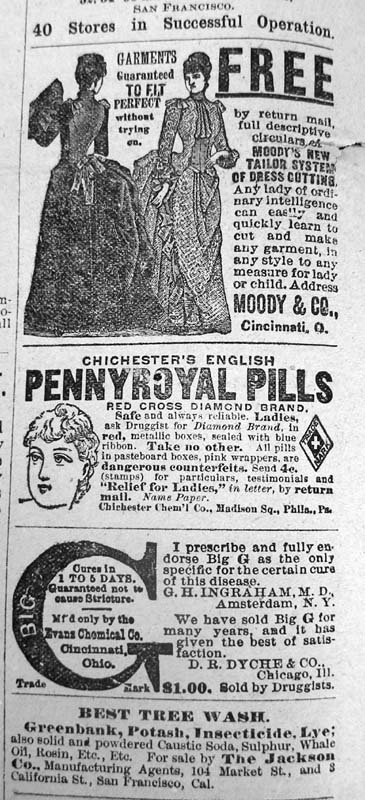
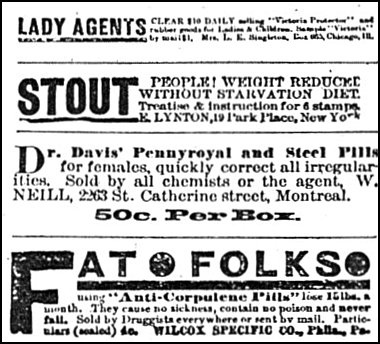
Which is why most advertisements for 19th century abortifacients looked like this:

Most patent medicines promised to do things like “correct irregularities”, or, even more abstractly, offering “relief for ladies”.

Abortion was actually one of the most common forms of birth control in 19th century America. Doctors estimated that there was one abortion for every five or six live births. In fact, the 1867 Richmond Medical Journal reported that,

“Among married persons so extensive has this practice become that people of high repute not only commit this crime, but do not even shun to speak boastingly among their intimates of the deed and the means of accomplishing it.” 

Abortion was so common that classy ladies were chatting up their friends about the best ways to do it.

Probably not what you would expect to hear at a Victorian tea party, right? Kind of amazing to picture, though:

Won’t you please pass the cucumber sandwiches, Priscilla? Oh and did I tell you about this absolutely smashing new way I’ve discovered of aborting unwanted fetuses?

Someone please invite me to that tea party.

So what the hell happened?

Well, people started worrying that if women were allowed to control their own fertility, bad things might happen. Like the end of society as we know it!

Let’s take a look at the historical context: the 1860s were obviously a very turbulent time, especially with regards to racial issues. The fact that there was such an increase in abortion legislation during and immediately after the civil war is quite telling. The aftermath of the war inspired a growing panic among white people that people of colour, who they were sadly no longer able to enslave, might try to take over “their” country. Maybe as payback for all those years of slavery? This panic paved the way for the idea of “race suicide”.

What, exactly, is race suicide, you might ask? I’ll just let my old friend Teddy Roosevelt explain it to you:

” …if the average family in which there are children contained but two children the nation as a whole would decrease in population so rapidly that in two or three generations it would very deservedly be on the point of extinction, so that the people who had acted on this base and selfish doctrine would be giving place to others with braver and more robust ideals. Nor would such a result be in any way regrettable; for a race that practised such doctrine–that is, a race that practised race suicide–would thereby conclusively show that it was unfit to exist, and that it had better give place to people who had not forgotten the primary laws of their being.”

(On American Motherhood, by Theodore Roosevelt, 1905)

That’s right – race suicide is the idea that white people will become “extinct” if they don’t have enough babies.

This fear, that people of colour would out-baby us, is where we find the actual origins of the pro-life movement. It didn’t come out of the idea that abortion was a sin, or the dogma of be fruitful and multiply, but rather the panicked notion that white people might not run the world anymore.

This racism still exists in the pro-life movement, although usually in more subtle ways. I’ve heard of white women requesting abortions and being asked, pleadingly, by medical professionals, if they know how wanted white babies are. And, of course, the pro-life movement is stunningly racist in other ways, for example when they posted this what-is-this-I-can’t-even billboard:

Look, I’m not saying that if you’re pro-life, you must be racist, or that everyone who hates abortion also hates people of colour. But what I am asking you to do is take a look at the history of the movement, educate yourself, and re-examine why you hold the beliefs you do.

I’m also asking you to admit that when it comes to anti-abortion sentiment, it’s not always about God or saving babies or whatever; it’s also about white people, and our xenophobia, and our desire to maintain our death grip on a society that we perceive as being only for us.

ETA: Sadly, the pro-choice movement has a pretty racist history as well. Stay tuned for the next in this series, The Racist History of the Pro-Choice Movement. Racism. It is why we can’t have nice things.

The Myth of the 39th Week Abortion

29 Sep

If you are a Canadian living in Canada (or even a Canadian living abroad, or maybe even a non-Canadian), you’ve probably been hearing a lot about Motion 312. I know I have!

In case you’ve been living under a rock and/or you’re not up on Canadian politics, here’s a section of the motion that should give you a good idea of what it’s about:

That a special committee of the House be appointed and directed to review the declaration in Subsection 223(1) of the Criminal Code of Canada which states that a child becomes a human being only at the moment of complete birth and to answer the questions hereinafter set forth;

 (i)            what medical evidence exists to demonstrate that a child is or is not a human being before the moment of complete birth?,
 
   (ii)            is the preponderance of medical evidence consistent with the declaration in Subsection 223(1) that a child is only a human being at the moment of complete birth?,
 
 (iii)            what are the legal impact and consequences of Subsection 223(1) on the fundamental human rights of a child before the moment of complete birth?,
 
 (iv)            what are the options available to Parliament in the exercise of its legislative authority in accordance with the Constitution and decisions of the Supreme Court of Canada to affirm, amend, or replace Subsection 223(1)?

You can read the full text of the motion here, on Conservative MP Stephen Woodworth’s website.

The Conservative government has been quick to point out that this is not a motion put forth to criminalize abortion, or even reopen the abortion debate. They want you to believe that they simply want to update the 400 year old definition of what a human being is.

The issue is that this motion could pave the way to giving personhood to fetuses, which would certainly cause legislation to be passed on when and how abortions can be performed.

Currently, abortion is not limited by law in Canada. This means that you can have an abortion at any point in your pregnancy, right up to the moment when you give birth. By ascribing personhood to a fetus, the Canadian government would begin moving towards criminalizing abortion. Because, of course, having status as a “person” would mean that the fetus would be protected by the Canadian Charter of Rights and Freedoms.

And on the surface, that seems pretty reasonable. I mean, a typical pregnancy can go to 40+ weeks, but we all know that a baby born earlier can often survive with little or no medical intervention. My son was born at 36 weeks and, other than a little time on the C-PAP machine (which was more likely needed because of my c-section than because of his premature birth), he was totally fine. I even have a friend whose daughter was born at 25 weeks gestation and, while she obviously needed a lot of medical aid in the beginning, she is now two years old and thriving.

So how, in good conscience, could we allow women the legal right to abort a fetus that could survive outside of the womb?

I’m here to tell you that we can, and we should.

When I was pregnant with Theo, I had my first ultrasound at 11 weeks gestation. I’d had some bleeding early on in my pregnancy, and, going into the ultrasound, I was terrified that they would find something wrong with him.

The minute the probe hit my belly, though, itty bitty Theo appeared on the screen. He was perfect; all blobby torso-head and stubby little limbs. When I saw him, I laughed with relief, and when I laughed, he jumped, waving his arms and legs in protest. We watched, mesmerized, as he wriggled around, his heart a flickering beat in the middle of his chest.

To me, in that moment, he went from being two-lines-on-a-pregnancy-test-morning-sickness-and-achy-breasts to being an actual little person. Seeing him on the screen made me fall in love with him.

And this is the problem: if my feelings could make me believe that a baby the size of a fig is a person, then someone can likely argue that any fetus, at any gestational age, is a person. If I, a staunchly pro-choice feminist can, under the right circumstances, believe that a fetus of 11 weeks gestation is a person, then it’s not impossible for our government to come to the same conclusion.

Yes, I understand that in M-312 they promise to examine “medical evidence” in order to decide whether or not a fetus is a “person” before birth, but really, you could find “medical evidence” to back up just about any claim.

Would they say that a fetus is a person once it can survive on its own, outside of the womb, without any medical aid? Because there is honestly no foolproof way to test this.

Would they say that a fetus is a person once it reaches viability  at 24 weeks? Because the truth is that only 50% of babies born at 24 weeks gestation will survive, and those that do live are likely to have a lifetime’s worth of medical complications. As well, dating ultrasounds are not very accurate, especially once a woman enters her second trimester. Without knowing the exact date of conception, no ultrasound tech could say for certain whether a fetus is 23 weeks or 24 weeks.

Would a fetus become a person at 20 weeks, the age at which some studies have said that they can feel pain?

Would a fetus be declared to be a person at 19 weeks, which is the gestational age at which, if a Canadian woman miscarries, she becomes eligible for maternity leave?

Would a fetus become a person when their heart starts to beat, when they start to grow limbs, or even from the very moment of conception?

You could find medical evidence for all of these claims, but there’s no way of empirically proving when a fetus turns into child, except for the moment of birth, when they begin to live independently of their mother’s body. So, ultimately, the decision would, at least in part, have to be based on the emotions of the committee appointed to decide when personhood begins.

Pro-life advocates would like you to believe that abortion is too common in this country, that people use abortion as a form of birth control, or that it’s wrong to abort a fetus because it could grow up to be the person who cures cancer. Most of all, they want you to believe that women in Canada are actually aborting fetuses at 39 weeks gestation via intact dilation and extraction (more often, and incorrectly, called partial birth abortion).

First of all, let’s look at the prevalence. In 2005, the last year for which this data is available, the abortion rate was 14.1 abortions for every 1,000 women – so, 1.41% of Canadian women had an abortion that year. You guys, that is not a very big number.

Of that number, only a tiny percentage – in 2010, it was something like 0.2 percent of the TOTAL NUMBER OF ABORTIONS – were performed after 21 weeks gestation. I am having a hard time finding actual government statistics for this, but I got that number from a pro-life site, so I doubt that they are underreporting.

Regarding the use of abortion as the only form of birth control – I have honestly never known anyone who has done this. Abortion is still a painful medical procedure, and it’s not something anyone wants to go through. My other issue with this line of thinking is that it’s a way of saying that some abortions are okay, but some are wrong. Like, if it’s your first abortion and it’s because the condom broke and you took the morning after pill and for some reason that didn’t work, then it’s fine to have an abortion. But if you’re not careful with your birth control and you’ve have multiple pregnancies terminated, then it’s wrong to abort. As this brilliant article says, there should be no hierarchy of abortions. On demand, without apology.

The any-fetus-could-grow-up-to-cure-cancer argument is one of my favourites, only because it totally ignores the fact that, if the woman does terminate her pregnancy, maybe she will be the one to go on to cure cancer. Maybe the financial burdens of having a child would have made university impossible for her, or maybe the mental distress of carrying an unwanted pregnancy would have meant that she wasn’t up to the task of higher education. Maybe raising a kid would mean that she couldn’t spend hours and hours in a lab looking at test tubes or whatever the fuck it is researchers do. We so often hear about the fetus could-have-beens, but no one ever talks about what greatness the mother could have gone on to achieve.

And, finally, the 39th week abortion. The great myth of the 39th week abortion. This myth exists because technically, legally even, it could happen. Yes, it could happen – but it doesn’t.

I challenge you to find me an incidence of a healthcare professional who provided an abortion at 30+ weeks, because I doubt you can. Even second trimester abortions are hard to obtain in Canada, and women often end up being sent to clinics in the States if they are over 20 weeks gestation. The vast majority of these women are choosing to terminate that late in their pregnancy because they’ve only just learned that the fetus is severely or fatally impaired, or that there’s a significant health risk to the mother, or both.

I promise you that no one gets to 39 weeks of pregnancy and is suddenly like, gee, I’ve been meaning to get this thing aborted, I guess I should stop putting it off!

Finally, criminalizing abortion won’t stop it from happening; history has proved this time and time again. What it will mean is that women will be forced to seek out unsafe abortions with possibly life-threatening consequences. Sadly, this is an indisputable fact.

I’ve never had an abortion, and I hope I never will. I would frankly be beyond horrified if a woman terminated her pregnancy at 39 weeks. I’m still glad, though, that it’s possible from a legal standpoint. I’m glad that there are no laws that say what a woman can or can’t do to her pregnant body, which, by the way, is still her body. Because once you start creating that legislation, no matter how well-meaning it is, it’s a slippery fucking slope. A slope that ends in the Handmaid’s Tale. Kidding. Well, mostly kidding.

The Oatmeal Is Actually Pretty Gross, You Guys

26 Sep

When I was a kid, I loved watermelon. Loved it. I couldn’t get enough of that shit.

Then one day, when I was five or six, I ate a bunch of that delicious summertime fruit, caught some kind of stomach bug, and ended up puking violent pink puke all night. Ever since then, I haven’t been able to stand the taste or smell of watermelon.

This is pretty much how I’m feeling about The Oatmeal right now.

A few days ago I wrote a post about The Oatmeal’s recent comic, My dog the paradox. I had some concerns regarding the misogynistic language he used in it, but I was pretty nice about it. I’m a pretty nice person, you guys.

I don’t feel so nice right now.

See, in my post about the dog comic, I was all, I’m disappointed, because I thought that The Oatmeal was smarter and better than this. I’ve since learned that apparently The Oatmeal is not better than this.

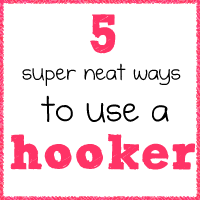
Apparently, not only did Matt from The Oatmeal write a comic about his dog, he also wrote an extremely hilarious comic called 5 Super Neat Ways To Use A Hooker. I know! So funny! I bet you’re laughing already, without even having clicked on the link!

Basically it’s a comic about how sex workers are objects, and you could use them in a variety of ways, such as to prop up couch forts, or act as bird feeders.

The whole thing is pretty fucking gross. The drawings, which show garishly made up women with blank stares and bodies hanging out of their clothing, make it even worse.

Don’t worry, though. Matt from The Oatmeal already knows that you’re angry. He knows that you’re offended. He just doesn’t care, because the problem isn’t him, it’s you.

In his contact section, he’s pretty open about the fact that he doesn’t give a shit about what you think. Not only that, but he definitely doesn’t want to hear anything negative from you about his comics:

Do not expect diplomacy. The Oatmeal is a one man operation, and this gives me the right to say horrible things to you if it pleases me. You may even have a valid point or fantastic insight, but this won’t stop me from calling you horrible names and claiming to have spent an evening or two with your mother. [hahaha, a YOUR MOM joke – those things are always hilarious!]

Do not email me because you are offended by: my hooker comic, eating horses, abortion, how Twilight works, or my usage of the word retard.

Do remember that this site is for fun, and to not take it too seriously. If you don’t understand satire don’t email me.

Um, Oatmeal Dude? I think you might be the one who doesn’t understand satire. Let’s have a look-see at how Merriam-Webster defines it, shall we?

1: a literary work holding up human vices and follies to ridicule or scorn

2: trenchant wit, irony, or sarcasm used to expose and discredit vice or folly

In what way is 5 Super Neat Ways To Use A Hooker holding up human vice and folly to ridicule or scorn? I’ve got news for you, buddy: it’s not. What it is doing is reinforcing the idea that sex workers aren’t people.

We live in a world where being a sex worker is the most dangerous occupation in North America, at least in terms the homicide rate. According to one statistic, the homicide rate for sex workers was estimated to be 204 per 100,000. Compare that to the next highest rate, which is for female liquor store employees and is 4 per 100,000 or the highest rate for men, which is 29 per 100,000 for male taxi drivers.

We live in a world where Robert Pickton confessed to murdering 49 women, most of them sex workers. A world where he disposed of their bodies in a variety of disgusting, inhuman ways, and then had the balls to initially plead not guilty.

We live in a world where, in a recent study done in San Francisco, 82% of the sex workers interviewed had been physically assaulted, 83% had been threatened with a weapon and 68% had been raped while employed as sex workers.

A huge part of this violence is because sex workers are viewed by society as things rather than people. Things to be used. Things that exist solely to fulfill men’s needs. Things to be mocked in an online comic.

But, you know, Matt from The Oatmeal is being totally satirical when he compares them to objects or animals, or when he draws their blank, expressionless faces and their sagging, doughy bodies.

I used to think The Oatmeal was smart and funny. I mean, it has a lot of comics about cats, and I am a total sucker for comics about cats! I also enjoyed the way it dissected pop culture, and some of the stuff it had to say about religion. I thought the dude who wrote it was pretty hilarious and cool.

Now, though, every time I think of The Oatmeal, I get that pukey watermelon feeling. I can’t ever look at it the same way, and it’s going to be hard not to yell THIS GUY HATES WOMEN when people try to share his comics with me.

You know what pisses me off the most? The fact that I was willing to give him the benefit of the doubt. The fact that I was all, well, I’m sure he didn’t mean to be a misogynist. Even if I’d just seen his hooker comic, I might have been able to continue to believe that he didn’t know any better, or that he didn’t understand. But no, his contact section clears that right up for me – he knows that what he’s saying is terrible, he just doesn’t give a fuck. He doesn’t give a fuck because it’s satire.

I’m so angry and disappointed. I’m so fucking tired of smart, funny things that are basically men-only spaces. I’m tired of feeling like I’m a persona non grata just because I have a vagina.

Man, misogyny. THIS IS WHY WE CAN’T HAVE NICE THINGS.

How The Oatmeal Turned Me Into A Humourless Feminist

23 Sep

There’s this comic from the Oatmeal that’s been making the rounds on my Facebook feed. It’s called My dog: the paradox, and it’s basically a sequence of short vignettes about how stupid and crazy (but ultimately loveable) this dude’s dog is.

Most of it is funny and cute, but the seventh panel really rubs me the wrong way. The image is of a woman (wearing a tank top, short skirt and heels) being confronted by a furiously barking dog. Said dog is being restrained by his frustrated-looking owner. The text is as follows:

He’s hostile towards people that I’d like to get to know better.

Woman: Aw, what a cute dog. Can I pet hi-

Dog: I’LL KILL YOU! MAKE-UP SLATHERED HORSEBEAST STILLETOS AND PERFUME LYING HORSEBEAST SLAGBUCKET

Let’s be clear about a few things here:

1. I know that Matt from the Oatmeal is trying to be funny

2. I know that this is not his opinion on women

3. I don’t think that he was trying to be cruel or malicious

4. I know that most of you will say that I’m overreacting (and maybe I am)

I can’t help it, though. I read stuff like the words written above, and my heart starts to beat a little faster. I start to feel a little nervous, maybe even a little panicky. That kind of language, used against any woman in any context, makes my hands go clammy.

The thing is, even though I get that this is supposed to be a joke, I can’t find it funny. I can’t find it funny, because that line of thinking up there? Isn’t actually that uncommon.

I know, I know, it’s not real life, and the whole damn comic is supposed to be about how stupid the damn dog is, anyway. I mean, right? Only a stupid, crazy dog would think things like that about a woman. Certainly no nice, rational human being would ever say stuff like that.

Except that I’ve known nice, rational human beings who have said stuff like that. Maybe not in those exact words, and maybe not with such vitriol, but certainly the idea behind the words was the same.

She’s wearing too much makeup

She dresses like a slut

If she gets raped, it’s her own fault

All women lie

All women play games

All women are crazy

We live in a culture of casual misogyny, you guys.

We live in a culture of casual misogyny, and when Matt from the Oatmeal writes out words like the ones above, he is contributing to it, even if he doesn’t mean to. Every time someone laughs at what he’s written, and maybe thinks they find a tiny grain of truth in it, they’re contributing to it. Every time someone dismisses another person’s concern and tells them that they’re overreacting, or don’t understand the humour, or just plain need to get over it, they’re contributing to it.

What I want you to remember is this: whenever you use words like this, even as a joke, you are helping to normalize it. You are helping to perpetuate the idea that it is okay, or even funny to talk about women this way.

If you still don’t see why this bothers me, try looking at it this way: imagine that instead of being a woman, the character in the comic is Jewish, or a person of colour. Imagine that instead of saying lying horsebeast slagbucket, the dog is saying, greedy hook-nosed kike, or lazy nappy-haired n-word, or any other type of hateful speech. Would you still be fine with it?

I’m not angry, and I’m not offended. Mostly I’m disappointed, because I thought that The Oatmeal was smarter and better than this. Mostly I’m tired, because my kid was up puking all goddamn night and instead of going to bed, I decided to just start writing this post, and then I couldn’t stop. Mostly I’m sad, because I dunno, everything kind of makes me sad sometimes.

When I was a teenager, I used to get so irritated with my mother, because she would dissect everything I found funny and explain to me why it was offensive and gross. And now I get it. God help me, I get it. I’ve finally turned into the humourless feminist my mother always wanted me to be.

Don’t worry, though – I still think poop jokes are hilarious.

The Myth of the Woman-Child

20 Sep

My good friend Audra Williams challenged me to blog about this piece on Tavi Gevinson. Then she posted this ridiculous article from Jezebel on Facebook, and I thought I would address both of them at once. I am killing two birds with one stone! Two ugly, judgmental, anti-feminist birds!

Both articles are concerned with the girlification of today’s women. Katrina Onstad, author of the Tavi Gevinson piece, bemoans the rise of “girl culture”, complaining that the word “girl” is “wispy and feminine, destined for head-patting and glass ceilings“. Jezebel’s Deborah Schoeneman, on the other hand, uses the term “woman-child” to describe those of us she feels aren’t acting our age. The hallmarks of a woman-child are, according to Schoeneman, many and varied. She writes that, “from sporting sparkly nail polish to religiously reading every bestselling young adult novel, these women seem to be reliving their teenage years with real gusto.” 

First of all, I didn’t realize that there were rules on how to be an adult female. Maybe there’s a handbook I’m missing? The handbook that, according to Schoeneman, would tell me to watch What To Expect When You’re Expecting instead of The Hunger Games, and advise me against using nail art. Because as a lady I should want to watch movies about other lady-types having babies instead of movies about smart, strong teenage girls kicking ass and taking names, I guess. Also I should have really boring nails.

The funny thing is that Schoeneman is totally selling me on the idea of becoming a woman-child. The way that she describes the beliefs and behaviours she dislikes actually make them sound more appealing than appalling. For instance:

“[The woman-child] truly believes that women are in it together and is all about helping her friends start businesses, meet guys and pick out a cute outfit for a big event. Competiveness among females in the workplace is perceived as totally 80s.” 

I am really confused about what world Schoeneman is living in where the above would be considered a bad thing. I guess she’s maybe concerned that so-called “women-children” are naive about the way things really work? Do I need to point out that we can end competitiveness in the workplace among women if all of us would just flat-out refuse to compete?

Schoeneman is also pretty concerned about the lack of rings on ladies’ fingers and buns in their ovens. She writes that:

“The woman-child will likely get married later than the increasing national average. Advances in fertility treatments like egg freezing have also added to their confidence that they can reproduce older and potentially prolong their own girlhood.”

And this is where she (hopefully) totally lost everyone who identifies as a feminist. Because what she’s advocating here is the same old song the patriarchy keeps singing: marry young, have babies, fulfill your biological destiny, etc. It doesn’t seem to occur to her that women might want to delay (or totally avoid) marriage and children for reasons that have nothing to do with an extended adolescence. It seems like for Schoeneman, as with so many other people, a husband and child are still the ultimate goal.

Schoeneman’s article, while outwardly angrier and more condescending, is ultimately easier to dismiss. It reads like the frustrated rant of someone who has not found adulthood to be the land of fancy dinner parties and Cartier bracelets, the way she always thought it would be. It reads like she’s someone who doesn’t see herself or her style reflected in some of the current trends, and has therefore decided that the trends themselves are at fault. It reads as if she’s upset that her female friends and acquaintances have continued to be themselves, rather than morphing into SERIOUS GROWNUPS at the stroke of midnight on their 21st birthdays.

At the end of the day, Schoeneman is the one with the problem, not the so-called women-children. If the way that her friends behave is an issue for her, then she needs to find new ones. Maybe some married friends with kids?

Onstad’s article is trickier for me to dissect, in part because it talks a lot about the dangers of nostalgia, and I am a total nostalgia machine.

First off, Onstad begins by complaining about the use of the word girl to describe grown women, writing that “…a roaring, shag-cut “woman” is a powerful agent“, whereas “girl” is “the word before the drunken grope“, as if those four little letters are somehow responsible for what she perceives to be the diminishment of feminism. As if the very word girl is somehow responsible for the “drunken gropes” and everything else we’re subject to.

Onstad uses this opening to segue into a sort of review of Tavi Gevinson’s Rookie Yearbook One, a collection of pieces (and “girlie ephemera” like stickers and a 45) that mostly come from Rookie, Gevinson’s online magazine. 16 year old Gevinson is, Onstad assures us, an actual girl (and thus, I guess, allowed to call herself that), and her magazine is aimed at teenagers.

Onstad begins by praising the honesty and authenticity of Rookie Yearbook One, and then starts veering towards the but that you’ve been sensing since the beginning of the article. Rooke Yearbook One is great and all, Onstad tells us, BUT it is totally, totally nostalgic for the 90s. Ah, the wonderful 90s, described by Onstad as, “the time when “slut” was lipsticked across bellies and Donita Sparks of the band L7 threw her tampon into the audience“. Those were good times, right?

Onstad then draws the following conclusion:

Perhaps this, then, is why a surprising chunk of Rookie’s girl culture is about the former passions of 30- and 40-somethings. The promise of that tough, smart, sexually confident ’90s “girl” never died, but it’s never quite been realized either. For women of a certain age, it’s intoxicating – and possibly narcissistic – to revisit the pop trappings of girlhood, and attempt to make sense of what happened.

And, you know, this is where it gets tough for me, because revisiting the trappings of my girlhood in an attempt to make sense of what happened is, like, my favourite thing to do. So there’s a part of me that wants to call Onstad up and be like, okay, you got me, guilty as charged.

But then I think, hang on. Let’s hold the metaphorical phone, Joan. First of all, Tavi Gevinson was only a tiny kid in the 90s, which makes it pretty damn hard for her to feel nostalgic about them. Like many (most?) teenagers, she probably feels dissatisfied with the current state of teenager affairs, and perhaps thinks that things were better (or at least more riot grrrrrl-y) 20 years ago. I went through a phase like that, too, except it involved me wearing tie-dye and listening to bands from the 60s (much to my mother’s amusement/dismay). It wasn’t that I was nostalgic for that time – how could I have been? – it was that I was struggling to figure out where I fit in the particular pop culture landscape that I inhabited.

As for those of us who lived through the 90s, it’s hard not to look back and think that yeah, badass ladies were having a moment back then. I don’t think that this is so much nostalgia, though, as it is a desire to figure out how to bring about a similar moment for the badass ladies of this decade. It’s not wallowing in narcissism and the pop trappings of girlhood, it’s a need to sift through the past, to sort the bad from the good so that we can figure out what needs to be discarded and what we can keep.

And yeah, I’ll admit, the idea that there’s a smart, savvy generation of girls eager to take up the mantle of badassery and fight the good fight is pretty damn intoxicating.

Finally, let’s take a look at the term “man-child”, the male cultural counterpart to the “woman-child”. A “man-child” is typically described as someone who is emotionally immature, often refusing to own up to his responsibilities. A “man-child” often lacks any sort of motivation, and prefers to avoid many of the milestones of adulthood. Now, contrast that to the descriptions above of the “woman-child” as someone who reads YA books and wears sparkly nail polish. A man is a “man-child” because of his total lack of maturity; a woman is called a “woman-child” based on her likes and interests alone.

So, basically what I’m saying here is, fuck the patriarchy, and fuck this anti-woman bullshit. A woman can like whatever she wants, can wear whatever she wants, etc. By believing that they should avoid certain cultural phenomena just because it’s perceived as being young or girlish, Schoeneman and Onstad are missing out on a lot of good stuff. By telling us that we should avoid these things as well, they are attempting to create an even narrower definition of how we, as women, should behave. And believing that the way forward is to put limits on what a woman can like, say, or do is, like, the least feminist thing ever.

So there.

“Hi, it’s me, Tavi. I am way cooler than you. I mean, in case you were wondering.”

An Open Letter to Nicola Kraus (or, another day, another angry-making article)

18 Sep

Dear Nicola Kraus,

So! I understand that you have discovered the one single method of parenting that works for everyone and you are proselytizing this fact via the Huffington Post. Well, that is good news! Please, tell me more!

No, but seriously: I find articles like yours incredibly difficult to read. Not only is the tone rude and condescending, but the content is full of assumptions and misinformation.

First of all, let’s talk about a few personal pet peeves that I have with regards discussions surrounding attachment parenting:

1. Dr. Sears did not come up with attachment theory. John Bowlby did. Doctor Sears may have popularized the idea and coined the phrase attachment parenting, but it’s a concept that’s been around since the 50s.

2. I bet that you actually practice attachment parenting, even if you don’t want to call it that. In fact, I guarantee it.

The basis of attachment theory is this, which comes from Bowlby’s seminal 1951 work, Maternal Care and Mental Health:

… the infant and young child should experience a warm, intimate, and continuous relationship with his mother (or permanent mother substitute) in which both find satisfaction and enjoyment.

Keep in mind that in the first half of the 20th century, women were getting a lot of not-so-great advice form doctors. They were told to put their babies on a schedule as soon as possible, feeding them only every three or four hours instead of whenever the baby was hungry. They were advised not to pick up their crying babies for fear of spoiling them, and there was also a pervasive belief that crying strengthened the lungs. I have a friend whose grandmother was instructed to wheel her infant son out into the garden every day and let him cry for half an hour. While her baby cried, she would sit at the table and weep because she hated it so much. But she still did it, because her doctor had told her to.

Attachment parenting, by contrast, suggests that you respond to your baby’s needs in an appropriate and timely fashion. Which, I am guessing, is probably something that you do.

Breastfeeding, cosleeping, babywearing, etc. are not necessary for attachment parenting. They’re tools that can help form a bond between parent and child, but they aren’t by any means required. Your friend Dr. Sears says the following:

AP is an approach, rather than a strict set of rules. It’s actually the style that many parents use instinctively. Parenting is too individual and baby too complex for there to be only one way. The important point is to get connected to your baby, and the baby B’s [his term for the set of tools mentioned above] of attachment parenting help. Once connected, stick with what is working and modify what is not. You will ultimately develop your own parenting style that helps parent and baby find a way to fit – the little word that so economically describes the relationship between parent and baby.

So even Doctor Sears says that you need to go with what’s best for you and your family.

I guess that what I really want to say with you is this: I’m happy that your kid is a great sleeper. I’m happy that you found a method that works for you. But what you should realize is: every child and every family is different.

For instance, my kid? My kid is 19 months and still sleeps in my bed, which I’m fine with. He didn’t end up there because I had romantic ideas about forming a bond with him. We have a crib for him. He hated it.

From just about day one, my son point-blank refused to sleep in his crib. He would fall asleep after nursing, I would swaddle him back up and gently (so gently) lie him down in his crib. Within ten minutes he would be screaming. I tried everything – waiting until he was deeply, deeply asleep to move him, putting him down when he was drowsy but still awake, keeping his spot in the crib warm with a heating pad – nothing worked.

On top of that, I was struggling with postpartum depression in the early months of his life, which was made much, much worse by my lack of sleep. Even if I had been comfortable with the idea of letting him cry it out (which I wasn’t), it would have meant several days of even less sleep. The idea of that would have made me cry, except that I already spent most of my time crying.

Once my son started sleeping in my bed, I found that it actually helped with my anxiety. For one thing, it was easy for me to check on him during the night to make sure that he was still breathing. It also made nighttime feeds easier – they were no longer this big production of getting him out of the crib, getting the nursing pillow in place, feeding him, then getting him back to sleep, putting him back in the crib, etc. Once he was in my bed I literally just had to roll over to nurse him and then roll back over once he was done.

The way that my husband and I parent isn’t for everyone. I get that. I try to be respectful of the way other people raise their children, and I think that by and large I’m pretty successful. As long as your kid is healthy, happy and well-fed, I think you’re doing a bang-up job. I would really appreciate it if you could extend me the same respect.

Oh, and by the way? When you let a 12-week-old cry it out, you are not teaching them to self-soothe, you’re teaching them that no one is coming to comfort them (and, by the way, there’s a world of difference between those two concepts). Science is behind me on this one. Science is awesome!

I totally agree with you on one thing, though – parenting is really fucking hard. The hardest part is that you have no idea what you’re doing, and you have to make important decisions on the fly while operating on little or no sleep. But the thing is, everyone is trying to do their best working with whatever they’re given. So why are you making people feel badly about the way they parent, when you already know that they’re doing their damnedest? How is your judgment and condescension helpful in any way? Just a few things you might want to think about.

Anyway, for the record, I don’t think that attachment parenting has made my kid clingy, or, you know, overly attached. In fact, I think the opposite is true: he’s so confident in our bond, so certain that I’ll be there to help him when he needs it, that he feels totally comfortable running off and doing his own thing. He’s happy to take off without looking back, because he just assumes that my husband or I will be close behind him. Because we always have been.

Sincerely,

Annabelle

p.s. You should maybe advise all of your sex-deprived friends to try getting it on in rooms other than the bedroom. The living room couch or the shower are two good suggestions. Tell them to be creative! If they really want to fuck, I’m sure they’ll find a way.

Theo, trying to claim the whole bed for himself

Vive Le Quebec Libre! (or, Anglo Privilege)

7 Sep

Yesterday morning, I woke up to find several posts on my Facebook feed about the recent provincial election in Quebec. Almost every post was disappointed and scolding in tone, admonishing La Belle Province as if they were a wayward child. Oh Quebec, the subtext seemed to say, why can’t you stop talking about separating and start behaving like a normal province? Why can’t you just be happy with everything we’ve already given you?

Full disclosure: I was born in Quebec and lived there for the first few years of my life. My parents were both born in Quebec. My mother’s (anglophone) family has lived there for several generations. My father’s family (who are anglophone, but come from a francophone background) moved there from the Maritimes in the mid-50s.

Fuller disclosure: I love Quebec, especially Montreal. I love the little frivolous things, like the buildings with outdoor wrought-iron staircases leading to second and third story apartments, and the giant Farine Five Roses sign that greets you as you pull into the train station. I love the people, and their laid-back attitude. I love how much they appreciate art and culture. I love the food.

I love the bigger things, too. In fact what I love most about Quebec are its socialist ideals and the fact that its people are willing to stand up and fight for what they believe in.

I would say that Quebec is easily the most-hated province, with Ontario coming in a close second. When I talk to people about Quebec, I often get negative reactions. The complaint that I hear most often is that the Quebecois are rude and want to make anglophones feel bad by refusing to speak English to them.

I hear this story a lot, actually. Usually, it’s an anglophone from a province other than Quebec traveling through there for whatever reason. They’re upset because they’re certain that every Quebecois is perfectly proficient in English but simply chooses not to speak it just to prove some kind of political point.

The funny thing is, while working in retail, I’ve heard these exact same people complain about francophone Quebecois visiting Ontario and refusing to speak English when shopping in their store. When I’ve suggested that these people greet the francophones in French, I receive blank stares. But I don’t speak French, they tell me.

So let’s break this down: it’s fine for you to go to another province and refuse to speak their language, and you expect to get service in your own mother tongue. However, when the Quebecois come to your province, they have to speak English, and they should expect to receive service only in English. It’s fine for you to speak zero French, but the Quebecois need to suck it up and speak English, right?

Here’s the thing: most francophes feel just as shy about their English as you do about your French. Here’s the other thing: I am calling total bullshit on your story. Whenever I go to Quebec, I speak French, in which I am fairly fluent. A good chunk of the time the person I am talking to will hear my accent and switch to English, either because they want to make me feel more comfortable or because they want the chance to practice their English.

If someone in Quebec is not speaking English to you, chances are that they just flat-out do not speak English.

The second complaint that I most often hear is that Quebec just wants more and more from the federal government and is never satisfied. I’ve heard people say that now that Quebec has French as its only official language and their culture is protected, why don’t they just stop? I mean, their rights are protected now, yes? This is like saying that women are totally equal to men and so feminism can end now, which is to say: totally untrue.

Francophones in Quebec had a pretty shitty deal up until the Quiet Revolution. They were kept oppressed by various premiers (but especially Duplessis) and (unsurprisingly) the Catholic church. English was (and, really, still is) the de-facto language of the federal government, and the majority of the ruling class in Quebec were anglophones. In order to get a good job in Quebec, it helped greatly to be perfectly fluent in English. It helped even more to have an anglophone surname.

Before the Quiet Revolution, unemployment for able-bodied francophone men was high, reaching 50% in some areas, but for the anglos it remained low. Although 80 percent of the Quebecois were francophone, they owned only 28.3% of the businesses in the province. The majority of those businesses were involved in manufacturing, but they accounted for only 15.4% of Quebec’s production. The anglos controlled everything else.

And then there was the threat against the francophone language and culture. Seems ridiculous, right? Except that it’s not. Let’s look at another francophone culture in Canada: the Acadians (i.e. my people!).

The vast majority of people with Acadian surnames are anglophones (myself included). Up until recently, it was often economically and culturally advantageous for the Acadians to assimilate, and many of them did. When my great-grandmother moved from rural Cape Breton to Halifax, she stopped speaking French altogether, even though it was her mother tongue. She didn’t teach her children to speak French, and would flat-out refuse to speak to her brothers and sisters in any language except English. For her, there seemed to be little advantage in passing her culture along to her children, and every advantage in having them grow up speaking only English. Towards the end of her life she began to regret her decision, but by then, of course, it was too late.

Unfortunately, this is a very common story.

So it’s not a totally unfounded fear that the Quebec language and culture could slowly and methodically be eroded by the anglophone majority in Canada. And it’s not like we have a federal government that is super supportive of them; it often seems like the Harper administration does its best to thwart Quebec at every turn.

And then there’s separatism. That’s the biggest one that people freak out over. I feel like a lot of this (not ALL of it, but a lot) stems from this idea that, hey, we’re Canada. We’re super nice. Why won’t Quebec love us even though we’re clearly the nicest nation on earth? If Quebec doesn’t recognize how awesome we are, then it must be because there’s something wrong with Quebec, right?

Canada, I’ve got two things to say to you:

1) As my mother would say, not everyone is going to like you and you just need to deal with it.

2) Maybe you aren’t as awesome as you think you are.

My mother (who was, don’t forget, an anglophone who grew up in pre and post Quiet Revolution Quebec) has always said that it’s easier to be an anglophone in Quebec than a francophone anywhere in the rest of Canada. You are far, far more likely to be able to find English services in Quebec than French services anywhere else. But you probably don’t see it that way because you have what I’ve decided to call Anglo Privilege.

Anglo Privilege may lead you to say any or all of the following:

“We won at the Plains of Abraham! Quebec needs to accept that!”

“They’re ruining their children’s lives by having them grow up speaking French – English is the leading business language of the REST of the WORLD.”

“Imagine how upset people would be if we had ENGLISH language laws in the rest of Canada!”

“They’re just threatening to separate because they want MORE from us!”

Buddy, I got news for you: they’re threatening to separate because they’re unhappy. The Parti Québécois keeps getting elected because the francophones in Quebec are concerned that the federal government and the rest of Canada do not have the best interests of their province and its people at heart. And every time you bitch about Quebec and how high maintenance they are and how they should just get over it already, you are reinforcing that view.

You guys, Quebec is awesome. They have socialized daycare, free post-secondary education (CEGEP), and, in addition to a one-year parental leave, they offer five weeks of leave to the partner of the person taking the parental leave. Plus they like to have demonstrations and riots! So many riots. All kidding aside, if it were possible for our family, I would move there in a heartbeat.

And so I say, Vive Le Québec Libre! And if you’re afraid of the possibility of Québec separating, then I would urge you to help build a Canada that contains a Québec Libre, whatever that term means to the people of Quebec. Surely this is something we can figure out if we work on it together? You know, like an actual, unified country would?

Okay, but really, shouldn’t it be Farine Cinq Roses? Where are the language police when you need them…

Ugly Acceptance Part II

31 Aug

See, I knew I would come to regret writing and posting a giant rant at one o’clock in the morning. Because now, reading back, and reading your awesome comments, I realize that there are a few things that I want to add, or explain.

First of all, my main point is that appearance-based compliments and insults are our go-to when it comes to women. I remember going through a really tough time in my early twenties and, when I went to the doctor to tell him how sad and hopeless I felt, he said, but you’ve got everything going for you – you’re young, attractive, and you’ve got your whole life ahead of you.

Er, what? How was that even a response to the problems that I was trying to fix?

When we want to make a woman feel good, we often tell her how pretty she is, how nice her hair is, or how well she’s dressed. And I don’t think that these things are bad in and of themselves, but I do think that this is indicative of how our society continues to view women. We consider a woman’s appearance to be her most important asset, plain and simple.

My friend L over at Life In Pint-Sized Form also posted about Ugly Acceptance, and I think she made a lot of really wonderful and succinct points. My favourite is this one:

” … the Ugly Acceptance movement … isn’t about accepting that you, personally, are ugly. It’s about accepting that beauty doesn’t fit into glossy little boxes with bows on the top.”

Yes, exactly. I’m not trying to say that you are ugly, what I’m saying is that all women, even incredibly beautiful celebrities, feel ugly sometimes. No woman can ever fully achieve the incredibly high standards for beauty that our society sets. And the thing is, I am tired of feeling like that is something that I need to achieve.

To go back to my original story about my trip to the doctor, imagine that same story but with a depressed young man in place of a young woman. Would that doctor ever try to comfort a sad, hopeless man by telling him that he was beautiful? Not bloody likely.

The next time you want to give someone a little pick-me-up, want to say something that will make them feel better, try to stay away from compliments about their appearance. Or, if you do really want to remind them that they’re pretty, add that they are also smart, and funny, and valuable to you as a friend. Praise their accomplishments and positive personality traits instead of their looks. Admire the things about them that they have control over, that they have done for themselves, instead of resorting to the old standard, but you’re bee-yoo-tee-ful.

For once, try to look beneath the surface, and see straight into that person’s heart (use your x-ray goggles for this). Chances are it’s beautiful, too.

See? So pretty.

See? So pretty.