Tag Archives: feminism!

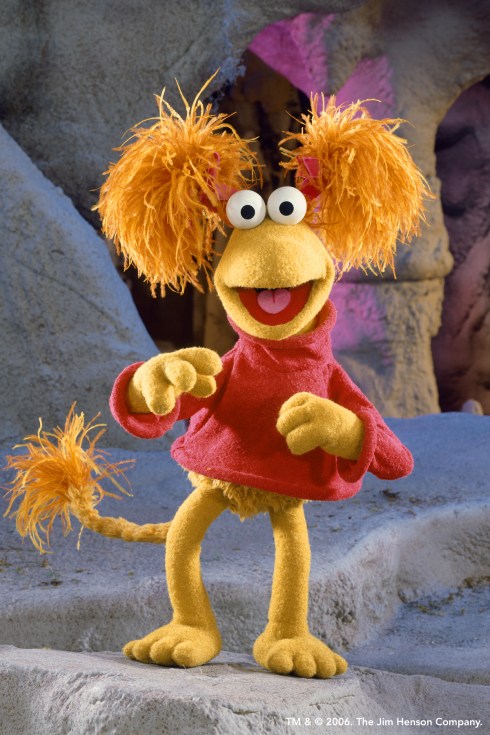
Red Fraggle is a Feminist Icon

13 Dec

It wasn’t until I learned that I was pregnant with Theo that I suddenly realized how very little I knew about, well, babies. I mean, in theory they’re great, but in practice they’re kind of terrifying. Like, I was going to be responsible for what now? I could barely even take care of myself, never mind another person, and one who was tiny, helpless and incontinent at that.

Being the book-o-phile that I am, my solution was to immediately run out and buy a ton of books about pregnancy, childbirth and parenting. I also went online and joined a bunch of mommy communities, which were, um, interesting. After sifting through all of the information available to us, Matt and I began to try to come up with the Best Plan Possible for raising our kid. Because, you know, that’s totally a thing that’s going to work out.

Babies just love plans, and are definitely going to turn out exactly the way you want them to.

Sorry, I’ll wait until your done laughing your fool head off before I continue.

One of the things that Matt and I decided was that we were going to follow the AAP’s guidelines and not expose our children to any television under the age of two. That wouldn’t be overly challenging, we figured; after all, we barely watched television ourselves, and surely it would be easy to watch what little we did after our bundle of joy went to bed. Anyway, we thought, what benefit was there in letting our children watch television? Especially when the world around them was so fascinating? Surely we would be happy to engage and entertain our children at all times. Surely we would never, ever want a short, say, half-hour break from them.

Of course, one of the first things you do when you become a parent is break all of your own rules. You quickly learn that there aren’t very many hard and fast rules, and the few that do exist weren’t created by you. Sure, it’s great to be consistent and back your words up with actions, but when you become a parent you learn how valuable flexibility can be. It’s easy to be an expert on childrearing when it’s all still theoretical; once you have an actual, physical, screaming baby, it’s often advantageous to revisit your policies and re-evaluate what your priorities are.

All of this is to say that we totally caved on the no TV thing.

When Theo was fourteen or fifteen months old, we started watching short YouTube clips of Fraggle Rock at bedtime. It was nice to spend 10 minutes every evening curled up together on our big bed, watching nostalgic television by lamplight. Afterwards, we would talk about what we’d just watched, and then I would nurse Theo to sleep. It was a pretty great way to end the day.

In the course of revisiting one of my favourite childhood shows, I realized something: Fraggle Rock was pretty fucking progressive with regards to gender roles.

I also realized that Red Fraggle was probably my first real feminist icon.

When it came to strong female role models, I was actually a pretty lucky kid. I had my mother, who was and continues to be a kick-ass inspiration, a woman who always worked outside the house, raised three kids on her own after my father left, and recently purchased her first home after spending year and years saving up for a downpayment. I had my grandmother, a women who also worked outside the home for her entire adult life, and who once took her employer to court because he wouldn’t allow women to wear pants in the workplace. I had my aunt, an Egyptologist who travelled to the Middle East for archeological digs. I had my great-aunt who, as a missionary to Niger in the 1960s, dedicated her life to educating girls. I definitely wasn’t lacking for real-life women to look up to and be inspired by.

But I wasn’t able to relate to those women and their accomplishments in the same way that I could relate to an adorable red-headed muppet who was about the same size I was and dealt with a lot of the same issues I did.

Red Fraggle is just awesome. She’s smart, funny, opinionated, competitive and likes to be in charge. She speaks her mind, like, frequently, and the other Fraggles almost always listen to what she has to say (even if they don’t ultimately agree with her). She’s adventurous, athletic and generally pretty fearless. She doesn’t wear pink (except for her hair ribbons). Oh, and she’s sarcastic. So delightfully sarcastic.

She also has some of the best lines spoken by a female character in a children’s show, like, ever. The following is from season one, episode fifteen, ‘I Don’t Care’:

Red: Hey Mokey! They gave me somebody else’s lines for this scene!

Mokey; Uh, let’s see, you say, I know my prince will come and rescue me.

Red: Who needs a prince? I can rescue me!

Mokey: And then you say, hark, I think I hear the hoofbeats of his fiery charger.

Red: Oh good grief.

[a brief interlude of dialogue between Mokey and Boober]

Red: But I don’t have to be rescued, Mokey! I can climb on this trellis! Better yet, I’ll swing on this vine. Why don’t we call it the Tale of the Triumphant Princess?

What’s great is that Red has no issue being a princess, she just wants to be a princess who can take care of herself. She’s totally fine with being feminine and girly, but she doesn’t want to have to rely on anyone else. Instead of waiting around to be rescued, she wants to take charge of her own destiny – a pretty admirable trait.

Red challenges traditional gender roles, both openly and tacitly. One of the best things about Fraggle Rock is that the other characters are totally fine with her behaviour. Sure, she can be abrasive and obnoxious at times, and yeah, she has a hard time admitting when she’s wrong, but these aren’t presented as being character flaws because she’s female; they’re presented as being negative traits because of the impact they have on herself and other people.

Oh, and in case you were wondering, Red is the best swimmer in Fraggle Rock. Better than any of the boys, even.

The neat thing about this show is that it’s not just Red who challenges gender roles; it’s Boober and Wembley too. It’s presented as being totally fine for Boober, a male Fraggle, to prefer to stay home all day washing socks and cooking. It’s also fine for Wembley to “wemble”, i.e. waiver with indecisiveness. That last one is especially interesting because a lot of Wembley’s “wembling” comes from a place of not wanting to pick sides when his friends argue and, ultimately, not wanting to hurt anyone’s feelings. It’s pretty rare for a male character to be shown as being so openly emotional. Rare, but awesome.

Mokey and Gobo, the two remaining Fraggles in the main cast of characters, are more typical of their genders: Mokey, a wispy poet who wears long flowing robes and speaks in a vague, dreamy voice is the sort of den mother of Fraggle Rock, and Gobo, bold, adventurous and a natural leader, spends his days exploring the rock and coming up with escapades for his friends. They participate in breaking down gender barriers, though, by letting their friends be who they are and encouraging them to do the things they love. They never ask Red, Boober or Wembley to behave in a certain way because of their gender; they only ask that each of them treats the others with respect.

Anyway, I guess it’s clear that we’ve totally, unapologetically broken our rules about television. We still don’t watch much of it; mostly just Fraggle Rock and Mister Dressup (okay, and sometimes Jay-Z videos, but only because Theo specifically asks for them). Children’s television, especially newer shows, are still pretty much a foreign country to me, one that I’m sure I will someday have to explore. Until then, I’m happy with my Fraggles and the lessons they’re teaching my son. For example, swimming before breakfast is great, music and dancing are a necessity, and boys and girls are totally, happily equal.

Sounds like utopia to me.
Red

“I’d Rather Risk Rape Than Quit Partying” – Rape Culture and The Good Men Project

11 Dec

I’m tired of blogging about rape culture.

No, honestly, I am. It gets exhausting after a while. It wears you down, you know? There’s just so much awfulness, so many rape apologists, and it takes a lot of energy to wade through it, dissect it, call it out and then deal with the backlash.

I’ve diagnosed myself with what Jezebel calls “rape fatigue“, a pretty accurate term for how I feel.

I wasn’t going to blog about anything serious this week. I was going to blog about cute things, funny things. I had a whole post planned out about how Red Fraggle is a feminist icon. It was going to be great, you guys.

And then The Good Men Project published a piece called “I’d Rather Risk Rape Than Quit Partying.”

And, well, here we are.

Let’s deconstruct this article, shall we?

We’ll start with the title:

I’d Rather Risk Rape Than Quit Partying

Let’s be clear: while the author does, later, admit that he would rather be raped than stop partying, that’s not what the bulk of this article is about. What he’s actually saying here is that he would rather risk raping someone than stop partying.

You might need a moment to digest that sentiment; I know I did.

Next, we have a caveat from the editors:

We at the Good Men Project do not endorse or support the author’s worldview, but it does speak to a very common experience that is often taken for granted and rarely talked about, except in vague and theoretical terms. We thank the author for being willing to speak openly about it, and share his struggle with his own experiences, though we want to make very clear that we do not agree with his conclusions.

You don’t agree with his conclusions, but you still published it, didn’t you? You’re still giving a voice to someone who is an admitted, unapologetic rapist. Whether or not you “agree with his conclusions”, you are still giving him your support by posting this to your site. You are adding another voice to rape culture.  You are normalizing rape. This is not okay.

Now on to the article itself:

When you party, when you move in party circles, you accept certain tradeoffs.

You accept that you’ll always be the bad guy in after-school specials and sitcoms about teenagers. You’re the bad kid who offers Buffy Summers a beer and gets her almost eaten by a snake demon. You accept that you won’t always be able to piece together everything that happened the next day. You’re forced to enjoy Katy Perry’s “Last Friday Night” not because you like Katy Perry but because you just plain recognize it.

You accept these tradeoffs because they come with amazing times. They come with glowing memories of an intensity entirely beyond the mundane, they come with crazy sex with amazing people, they come with living a few hours at a time in a world where anything, anything at all, can happen. I’ve moved from one party scene to another my whole adult life, because nobody wants to be that creepy old person or that inappropriately young person, but there are always plenty of people who won’t walk away from that incredible sense of liberation and possibility that you only find at the bottom of the bottle and a hot room full of crazy people.

Anonymous Writer is a hipper than me, has cooler friends, and goes to better parties. He’s a bad-ass who has lots of amazing sex and maintains a love-hate relationship with Katy Perry. He can only find “liberation and possibility” while drunk in a room full of strangers. Got it.

I swear to God, it is only after the fact that you start figuring out that one of the tradeoffs you’ve accepted is a certain amount of rape. The way crooked businesses accept paying fines for their infractions as the cost of doing business, you gradually, an inch at a time, realize that some of the stories you’ve heard, some of the stories you’ve lived, didn’t involve what they call good consent nowadays.

Yes, because rape is just a consequence of having a good time. Raping someone is just the price you have to pay in order to party hard like Anonymous Writer does.

And you know what? Lack of consent is lack of consent, no matter whether something happened twenty years ago or yesterday. I don’t care whether they didn’t call it “good consent” back in the dark ages; it’s still rape.

With what I’ve learned as an adult, I’m pretty sure I’m technically a rapist. Technically nothing. One woman told me herself.

Anonymous Writer is a rapist. Got it.

Our encounter was years before—I’d been in a drinking contest and she’d been drinking and flirting with me (yes, actually flirting) all evening.

She was actually flirting! You can take this rapist’s word for it!

As blurry and fucked-up as I was, I read her kiss of congratulation to me as a stronger signal than it was, and with friends hooting and cheering us on, I pressed her up against a wall and… well. Call it rape or call it a particularly harsh third base, I walked away with the impression that it had been consensual, if not really sensible. (She had a boyfriend at the time, but their boundaries were fuzzy.)

He was peer-pressured into pushing her up against a wall, either raping her or going to a “particularly harsh third base” (whatever that even means), but it’s fine because he thought it was consensual. Oh, and because her boundaries with her boyfriend were “fuzzy”. Got it.

Years later, she was in a recovery program—not for alcohol, ironically—and she got in touch with me during the part where she made peace with her past. She wanted to clarify that what had happened between us was without her consent, that it hurt her physically and emotionally, that it was, yes, rape.

Here is one story about a time she was drunk, which totally makes it ironic that she’s not in an alcohol recovery program. Also, being raped was probably her fault because she had substance abuse problems.

Oh, and by the way, she was raped. By Anonymous Writer.

We talk about who is and is not a rapist, like it’s an inextricable part of their identity. “I’m a Libra, a diabetic, and a rapist.” That doesn’t work, though. Evidently I walked around for years as a rapist, totally unaware. Nobody stuck that label on me, I certainly never applied it to myself, even now it only feels like it fits when I’m severely depressed. The label, the crime, simply coalesced for me one day, dragging years of backstory behind it.

Anonymous Writer isn’t a rapist, because he doesn’t feel like one.

I literally could not come up with a better way of summing up how rape culture works than that one, single sentence.

That is the damnable thing. We all cluck our tongues at those evil bastards who force themselves on girls—or guys—who are insensibly passed out. At the same time, we all acknowledge that a glass or two of wine helps pave the way for a lot of good times. And in the trackless, unmappable gray swamps in between, we cough and change the subject.

Consent is not trackless or unmappable. Consent is fucking consent. Deal with it.

In the real world, especially among experienced drinkers, being blackout drunk doesn’t necessarily look like being passed out on the floor, helpless prey for any passing predator. It can look like being drunk, but fully in control. It can look like being passionately excited. It can look like being a great dancer. It can look like being very sexually aggressive.

It’s not just booze, of course. Ecstasy makes everything incredibly tactile and you want to touch everyone. Weed makes some people insatiably horny. I had to fend off a young woman recently who was talking a mile a minute and sliding her hands inside my shirt, I was still together enough to tell she wasn’t all there, on what turned out to be a mixture of acid and cocaine. There is plenty of fun stuff out there, but mostly it’s booze. For the majority of people, it’s going to be drinking they have to watch out for.

If you’re not sure that someone can consent, don’t have sex with them. If someone is drunk and you’re not sure how drunk, don’t have sex with them. If someone is drunk, don’t have sex with them. There. I’ve made it easy for you.

A friend of mine once told me about a girl who he knew for a fact had only had two drinks. He didn’t know she was on prescription medication that amplified those two drinks beyond all measure. He thought she was just very horny when she wouldn’t leave him alone or take “Are you okay?” for an answer. It wasn’t until she kept calling him by the wrong name and couldn’t remember the right one that he realized she was not able to consent, and called a halt to things before they went any further. He says he had to dissuade her from pursuing things further, because she was really into it, apart from not knowing who he was or where she was.

“Can you imagine?” he tells me in horrified tones. “I was almost a rapist.”

How do I tell him that I was in a similar position and made a different call? How do I tell him that I am what he’s terrified he almost was?

Well, I guess Anonymous Writer doesn’t have to, because rape culture! He will never be prosecuted. He will never go to jail. He will never even have to admit under his own name that he’s a rapist.

Here’s the plain, awful fact: people can have more and better sex drunk than they can sober. Some of the best, most fulfilling relationships of my life have started out with joyously drunken sex. I’ve had amazing times, orgies sometimes, where it’s simultaneously true that everyone’s consenting and having fun, and that they wouldn’t be consenting and having fun if they were stone sober.

Here’s a plain, awful fact: Anonymous Writer is a rapist.

Here’s another plain, awful fact: you don’t have to have sex when you’re drunk, even if it feels really great. You don’t have to have orgies where you know that the participants would not be consenting if they were sober. You don’t have to rape, but you do. And then you make excuses for it.

Those aren’t the times that bother me. The ones that bother me are the ones where I got loaded, had some fun with a lady, and then she never wanted to contact me again. Messages go unanswered, social contact is dropped.

It doesn’t bother Anonymous Writer when he rapes someone, as long as they remain friends with him.

There are men, rape-apologist pieces of shit, who will tell you that women cry “rape” every time they have sex they later regret. I carry no brief for those assholes. What eats at me is that there’ve been cases, more than one and less than six, in my life where either explanation would seem plausible. If a woman had consensual sex with a guy because they were both drunk, and later she decided he was a loser and she regretted it, she might refuse to have further contact with him because, hey, awkward. But if a woman was raped by a man who thought she was still capable of consent when she was too far gone, she might refuse to have further contact with him because, hey, rapist.

Except, as far as we know, none of these women (other than the one mentioned above) have cried rape. So there was no need for that sentence. They either refused to answer Anonymous Writer’s calls because they regretted having sex with him, or because they felt violated. This has nothing to do with anyone crying rape.

And, by the way, Anonymous Writer, you did rape.

That’s not the worst part either.

Oh good.

It’s been pointed out to me that I’m using a lot of heteronormative language here, men/me as rapist, women as rape victims, and I honest to God don’t mean to do that. It’s just the linguistic habits I grew up with.

But there have been times I’ve cut off all contact with women after drunkenly fooling around with them, the same criterion that, in reverse, makes me suspect myself of rape.

There have been times of “I regret going to bed with her” and times of “I don’t recall going to bed with her.”

There’s been at least one time I was informed, days after the fact, by multiple eyewitnesses, that I’d had sex with a girl. This came as news to me, and explained a couple messages I’d gotten from her, a girl I generally had no interest in getting involved with.

It must be bad manners to admit to being a rapist and to also say one is a rape survivor, all in one article. I don’t know any set of social mores where that’s okay. I certainly don’t feel like a rape survivor, whatever that’s supposed to feel like. I just can’t quite find a workable standard where I’m one but not the other. I don’t say that as any kind of apology or justification for my actions or my mistakes. I’m just trying to state the facts nobody ever quite wants to state.

So the worst part isn’t that Anonymous Writer raped someone, it’s that he’s not sure whether or not he’s been raped, although he doesn’t feel as if he has been.

That’s the worst part here.

Some might think it’s monstrous of me to keep drinking, keep partying. But I have had so many good, positive, happy experiences because I took a chance and altered my state and connected with someone else sexually, it seems crazy to throw all that away. Do people who’ve been in car accidents give up driving?

Translation: I will continue to knowingly rape women, and here is a shitty metaphor about car accidents to explain why I’ve chosen to do this.

Translation: the conditions that lead to me raping women are too much fun to give up.

Translation: I live in a culture that will continue to forgive and excuse me for every rape I’ve committed.

When I sit down and think about it, it seems like I’ve accepted a certain amount of rape as the cost of doing business, and so have most of the people I know. And that seems like the most sick, fucked-up, broken solution to anything ever. And maybe finding it livable-with condemns us all to hell. I don’t know. I can’t even talk about it under my own name.

Fuck you.

* * *

I want to be thoughtful about this. I know that I should be. I should say that this man clearly has addiction issues and needs help. I should offer him my support, because he is also a rape victim. I should be kind, forgiving, generous. But I can’t. I can’t do any of those things to someone who is an unapologetic rapist, someone who is clear on the fact that he will rape again. Someone who views rape as a “trade-off” for having a good time.

Rape is not something inevitable that happens because you’re partying too hard, because you drink to excess, or because you’re having too much fun. Rape is a choice that this man makes. This man knows that his drinking and partying will lead to having sex with a partner who cannot consent, and yet continues to do so. This man is an unapologetic rapist.

I know that I talk a lot about rape culture, but you guys? This is rape culture right here. It’s articles like these that make men feel better about raping women. It’s articles like these that contribute to victim blaming (if a woman doesn’t want to be raped, she shouldn’t drink so much, right?) It’s articles like these that normalize rape, that make rape seem like a by-product of enjoying oneself, that make rape seem inevitable and uncontrollable.

This is rape culture. This is our culture.

tumblr_l1dvl9euhs1qbxsq7o1_500_large

National Day of Remembrance and Action on Violence Against Women

7 Dec

When I was a kid, my mother had a button that looked exactly like this:

399036_s

I couldn’t find a very large image of this button, but in case you’re wondering, around the edge it reads: “In commemoration of the 14 women killed in Montreal, December 6th, 1989 and all women who have suffered from violence.”

Every year, after my mother retired her Remembrance Day poppy sometime in mid-November, she would break out her rose button and pin it to the lapel of her coat. As a small child, I remember coveting the button, because I liked the picture on it. When I was older, it made me uncomfortable; I didn’t like that my mother wore a pin to commemorate a mass murder, and the look on her face and the tone in her voice when she explained the story behind it frightened me. Strangely, the story itself didn’t frighten me; it seemed too remote, totally removed from my day-to-day life. It was a freak accident; a tragedy, yes, but nothing that could ever happen to a person like me.

Later still, when I was a teenager and irritated by everything my mother did, I found the button obnoxious and sanctimonious. I’d grown up hearing my mother referring to herself as a feminist, a term that I refused to apply to myself. It seemed to me that most boys hated feminists and, when I was a lonely high school student with low self-esteem, the last thing I wanted was to do something that would cause the boys I knew to reject me even more. When they made jokes about women, jokes whose real punchlines were how stupid and pathetic women were, I laughed. Sometimes I joked back, making fun of the way girls dressed, of how many guys they slept with, how idiotic and shallow they were. Sure, I was a girl, but I was on their side – I wasn’t one of those girls. Never mind the fact that I probably would have given my eyeteeth to be cool enough to be one of those girls.

Back in those days, whenever late fall rolled around and my mother broke out her shabby, rusting rose button, I would roll my eyes. He was crazy, I would tell my mother. Like, mentally ill. It had nothing to do with women, he was just nuts. What if he’d killed only Dutch people? Would we have national day of remembrance and action on violence against Dutch people?

When I was a teenager, I thought that feminism was pointless at best, and a way of angering and alienating people at worst. It hadn’t yet occurred to me that sometimes angering and alienating people was a good thing; that there might be situations in which I wanted people to feel negatively about me and the things that I said. At the time, I couldn’t imagine not wanting to please every body, just like I couldn’t imagine anyone wanting to kill me simply because I was a girl.

Now I know differently.

I’m not saying that anyone’s out to get me specifically, because as far as I know, they’re not. It probably helps that I come off as fairly non-threatening – I’m a small, mousy white woman who doesn’t work in a male-dominated field. I’m a shy, quiet woman who pretty much totally followed the status quo – I finished high school, went to university, then married a nice guy and had a kid before I turned 30. Probably the most threatening thing I do is blog (extensively) about women’s reproductive rights, but that hasn’t generated any death threats or anything.

But there are still people who hate me because of my gender. I mean, maybe not openly, maybe not obviously, but they do. We live in a culture of casual misogyny. A culture where over 600 First Nations women are missing or have been murdered in Canada, only to have our government do nothing about it. A culture where female sex workers are treated as objects instead of people. A culture where women are told to be less angry when they talk about the events of December 6th. A culture where women are constantly being ridiculed, judged and set up in competition against each other. A culture where my sister, an avid World of Warcraft player, has been asked repeatedly to turn on her webcam and show other players her breasts in order to “prove” that she’s a woman.

When Marc Lépine went to the École Polytechnique 23 years ago today, he entered the school with the intention of killing feminists. Feminists, he said in his suicide note, had ruined his life. Lépine had applied to the École Polytechnique in both 1986 and 1989 but had been rejected both times because he lacked the CEGEP courses necessary for admission. In Lépine’s mind, however, he wasn’t admitted to the school because women had taken too many of the available spaces. Women, he thought, had taken everything important, and left nothing for him.

Lépine killed 14 women just because they were studying engineering. Lépine killed 14 women for daring to want careers in a male-dominated field. Lépine killed 14 women for being women.

I was seven years old when École Polytechnique Massacre happened. I want to think that the world has changed since then, but really, has it? Women are still the butt of the joke. Women are still lacking in positions of power. Women are still being told that they need to compete against each other. There is still a persistent bias against women in the worlds of math and science. If there’s anything that can be learned from the latest American election, it’s that there are still men who hate women. A lot of men. Powerful men.

I don’t know if my mother still has her rose button. Probably not – I haven’t seen it in several years, and the last time I did, it was looking pretty beat up. I wish she did, though, and I wish that she lend it to me. These days, I would wear it with pride.

Rape Jokes and The Oatmeal

5 Dec

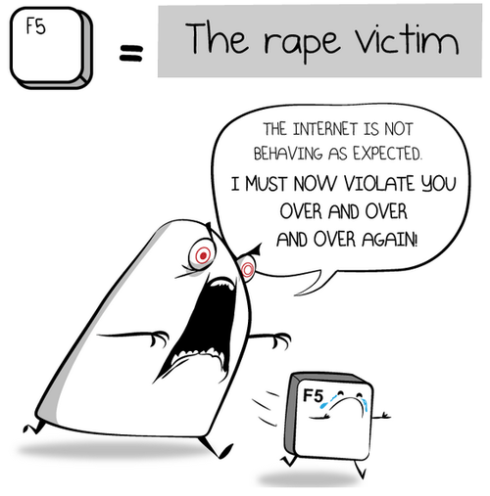
Yesterday, Matthew Inman from The Oatmeal wrote a comic about the “delicate relationship” that he has with his keyboard.  This was the final panel of the comic:

rape-f5rape

The comic in its entirety was about how he feels and behaves towards the various keys in his keyboard. This panel specifically was about trying to get a webpage to load when you have a slow connection, with the joke centering around Matt “raping” his F5 key in order to make the page load faster. Yes, it’s a rape joke. No, I’m not surprised. Yes, it’s supposed to be funny. No, no one would ever  actually “rape” a computer key. Yes, in spite of all that, I’m still grossed out. Now that all that is out of the way, can we talk about how terrible this is? Because it’s terrible. Really, really terrible.

The panel above is the type of joke that normalizes and trivializes rape. Instead of showing rape as an act of sexual violence that will haunt someone for the rest of their life, it’s hilariously portrayed as pushing your F5 key one too many times. What it tells readers is that rape is no big deal, that it’s just this thing that happens. It tells readers that rape is not a powerful word, but instead is a term you can use to describe any kind of forceful action. It tells readers that rape is normal, and even worse it tells rapists that rape is normal. The problem with jokes like this is that not only do they make rape victims deeply uncomfortable, they make rapists feel comfortable.

And I mean, you know what? As far as rape jokes go, this one isn’t that bad. I mean, not really. It’s not graphic, and it’s not even describing a plausible situation since, again, computer keys can’t be raped. If we didn’t live and participate in rape culture, this joke on its own wouldn’t be that big of a deal. But you know what? If we didn’t live in a culture where rape was constantly aided and abetted, a culture where rape is so normalized that we think nothing of making light of it, a culture where rape victims are frequently hushed up, dismissed or outright disbelieved, this comic would never have been made. This comic is a product of rape culture and it perpetuates rape culture. The message that this comment sent out to The Oatmeal’s nearly 800,000 Facebook fans (and the myriad other readers who follow the comic on Twitter or directly on The Oatmeal’s website) is that rape is no big deal.

It is a big deal, though. And when some readers of the Oatmeal told Matt Inman that rape jokes are a big deal, this was his response:

XekGY

I mean, first of all, it seems bizarre to blame Daniel Tosh for this backlash. Just because Daniel Tosh was called out for making a rape joke doesn’t mean that he was the first to do so, or that he invented rape culture. This joke wouldn’t have been funny before Daniel Tosh, and it sure as hell isn’t funny now.

Second of all, it’s really great that Matt Inman donated money to a battered women’s group. But that doesn’t give him license to say whatever he wants. It’s not like making a one-time donation gives him some kind of immunity to ever being called out on misogynistic shit that promotes rape culture. That’s not how it works.

Third of all, this isn’t censorship, and I hope that Matt Inman never lives in a place where true censorship exists. Freedom of speech means that you can say whatever you want, sure, but it also means that I get to call you out when you’re being a dick. You get to make jokes, and I get to tell you when they’re offensive. We are both afforded the privilege of freedom of speech. And you know what? I’m not even offended by this comic; I’m not going to give anyone that satisfaction. See, Matt Inman wants to believe that he’s done something so cool, so edgy, that regular, Family Circus-reading folk will be “offended”. Well, I’m not. I’m contemptuous of this comic, and I’m contemptuous of you, Matt Inman. Every time you make a joke like this, I think less and less of you. So no, you’re not being censored; you’re just hearing the reactions of people who aren’t on board with what you did.

I’m sure that there are people who will accuse me of being so wrapped up in feminism, so focussed on seeing misogyny wherever I look, that I’m just not able to recognize humour anymore. There are people who probably want to tell me that nothing is so sacred that you can’t joke about it, that “censoring” comics is the worst possible thing you can do, and that if I don’t “let” people make rape jokes then I’m some kind of fascist.

First of all, anyone who would think that should look up the definition of “fascist”.

Second of all, I don’t think that all rape jokes are bad. In fact, I even think that some of them are funny. The thing is, in order for a rape joke to be funny, it needs to do two things:

1. Not make rape victims the butt of the joke

2. Challenge the status quo, i.e. rape culture

Below is a video by Louis C.K. in which he makes a joke about rape that’s funny. If you are a comic, or aspire to be one, you might want to take notes:

See, what he’s doing in this joke is challenging the idea that rape is sexy or desirable. He’s challenging the idea that some men would leap at the chance to take a woman without her consent, while she is repeatedly telling them no, just because she’s giving out some kind of vibe. He’s challenging a culture that persistently insists that women don’t know what they want, that they play hard to get, that they lie and manipulate and shouldn’t be taken at their word.

That is a joke that challenges the way we think in a humourous way. That is what comedy should do.

Matt Inman did, thankfully, end up removing the rape joke panel, and tweeted the following earlier today:

It’s not the greatest apology, but at least it’s an apology, you know? I wish that he hadn’t included the “if”, because obviously people were upset, no ifs about it; it would have been better had he just flat-out apologized for the fact that people were hurt and upset. However, this apology is better than nothing, and it’s waaaay better than artists who continue to defend themselves after they’ve been called out for inappropriate behaviour. So I guess there’s that.

Sometimes stuff like this feels so relentless, like there’s no way to fight against it because you’ll just never win. Working to bring down rape culture feels overwhelming, because it’s literally everywhere. How do you fight nearly every movie you’ve ever seen, every book you’ve read, every casually misogynistic word that’s ever been spoken to you? Where do you even start?

Every once in a while, though, you do get someone who reconsiders what they’ve done and issues an apology, and that feels like it’s maybe the beginning of something. And like I said, maybe it’s not a great apology, but hopefully it will start people thinking. Maybe this will get fans of The Oatmeal really considering what that rape joke really meant, and why it wasn’t funny.

I think that if even one person who laughed at that comic sits back, thinks hard and changes his opinion, then this fight is worth it. If this post gets even one person to change their minds about how they view rape, and especially rape jokes, then I’ll be happy. Hell, even if this post does nothing more than get people who agree with me to start a conversation about this, then I’m good. The fact is that talking about this stuff, getting it out into the open and engaging people about it, is a huge first step to changing the status quo.

And I really, really want to change the status quo.

The Past Is A Foreign Country

2 Dec

In the beginning God created the heaven and the earth. And the earth was without form, and void; and darkness was upon the face of the deep, etc.

And then God created the Garden of Eden, and made a dude out of mud to be in charge of it. Then one day when this dude, Adam, was sleeping God took one of his ribs (ew) and from that rib magically made Adam a lady-friend, Eve. Then Adam and Eve lived in paradise for, like, three days, until Eve, the original third wave feminist (she embraces diversity, change and choice!), took some bad advice from a phallic symbol serpent and ruined everything.

And we’ve been nostalgic ever since.

Sometimes I think that nostalgia is the human condition. I mean, we’ve got a minimum of three major religions based on this yearning to get back to a past that none of us remember or even understand; the most we know about it is that Adam thought it was awesome. Then again, Adam also thought that wearing fig leaves was awesome, and was married to someone who was basically his clone (I mean, is that how it works? what with the rib and all? what’s the science here? anyone?). Anyway, what I’m trying to get at is that I’m not sure how reliable of a source he is.

I mean, here’s the thing: I am the queen of nostalgia. Ask anyone – I basically get nostalgic at the drop of a hat.

(Hey, remember that time you dropped a hat? How great that was? How much fun we had? Why don’t we ever have good times like that anymore?)

I don’t just moon over actual things that I’ve experienced either; I spent a good chunk of my childhood feeling nostalgic for just about any time in history, from the ancient world all the way up to The Great Depression (I blame a combination of having an aunt who is an egyptologist, reading excessive amounts of historical fiction, and watching Annie on VHS until the tape wore out). I used to drive my mother bananas by whining at her that I should have been born in the Victorian era (in response to which she would usually remind me of my fondness for indoor plumbing), and nearly every elementary school class photo shows me decked out in some kind of puffed-sleeve Anne of Green Gables floral-printed nightmare, grinning like a Cheshire Cat.

If there was a book at the public library with a picture of a girl in a laced-up bodice and peasant skirt, I’d read it. If there was a weirdo food mentioned in something I’d read (blanc mange, I am looking at you), I’d tried to find a recipe for it. After learning that people seriously believed in fairies until not that long ago, I began to (non-ironically) leave food in our backyard in case the fair folk were hungry for chocolate-covered graham crackers and milk. And you know what? To be honest, my adult self is not that different, although nowadays I would probably eat the cookies, fairies be damned.

What I’m trying to get at here is that I’m totally guilty of romanticizing the past. Totally! That being said, I don’t use that as an excuse to hate the present. I mean, I like flush toilets and computers and being able to vote and science-based medicine and all that good stuff. I am pretty down with modern life (although I am sad that I don’t get to wear bustles or hoop skirts). I guess what I am trying to say is that I am confused by people who think that living a middle-class existence in the western world is basically the worst, ever. I’ve heard women bemoaning the fact that feminism has ruined womanhood (is that even a word? my spellcheck thinks it’s a word), and the fact that women can now vote, own property and work after marriage is somehow preventing them from being stay-at-home mothers or housewives or whatever. I’ve heard people complaining about the “chemicals” in antibiotics, and saying that they only do homeopathic or herbal treatments – nothing “unnatural” or doctor-prescribed. I hear people talking wistfully about the days when science didn’t exist and everything was just natural and wholesome and wonderful.

People talk a lot about “authenticity” when it comes to objects and experiences. They don’t want Walmart to exist; they want everyone to buy things from farmer’s markets and local mom-and-pop pharmacies and department stores. They want to drive to Mennonite country to buy hand-made furniture and hand-dipped candles. They want to practice yoga at sunrise on a mountaintop with someone who has studied in India and can read their chakras. When they travel to South America, they don’t want to go on a guided tour; they want to see the unspoiled part of the rain forest, want to see the “real” locals who are unspoiled by contact with the west. We’re obsessed with our idea of what’s “real”; these days, people worship at the temple of the real.

Sometimes I think that our desire for authenticity has a lot to do with our love of nostalgia. We think that the people who came before us lived lives that were somehow more “real” than our own.

But you know what guys? The past is a foreign country, and so on, and so forth. We don’t know what it was like back then; all we can go by is what we’re told, or by deciphering what’s been left behind. We will never be able to understand how people felt or lived back then; their circumstances, though not totally alien to ours, are different enough that we will never fully be able to grasp their emotions, or beliefs, or the ins-and-outs of their daily lives. We just have to trust that yes, being a woman before feminism was a raw deal, and yes, modern medicine saves lives, and yes, science and modernity serve some kind of purpose. I’m not saying, let’s not be critical of society; what I’m saying is let’s keep pushing forward and trying to make things better instead of daydreaming about a past that we can never get back.

I’m not saying that Walmart is amazing, or that any of the things I mentioned up there are bad in and of themselves, just that it’s hard to have some kind of moral superiority about where you shop when there are kids who would probably starve if there weren’t discount stores where their parents could get a cheap meal. I’m also not saying that our society isn’t obsessed with consumerism, because we are; we’re consumerist as hell. But you know what? People in the past didn’t own less things because they were better than us; it was because they couldn’t afford them. If you want to live a life of simplicity where all you can afford is a mattress on the floor and one change of clothes, then by all means, please go ahead. However, don’t kid yourself that you’re being more “real” than the next person.

Sometimes I think that the appeal of history is that we know how all the stories end. We know who wins the Battle of Hastings, and whether or not Julius Caesar crosses the Rubicon, and whether or not the Titanic will ever reach New York (spoiler: it won’t). And yeah, a lot of history was scary and bloody and downright awful, but at least we know what happens. I mean, better the devil you know, right? Our modern lives terrify us because we don’t know how anything will end; sometimes it seems like we’re careening towards our own destruction, running full-tilt at things like global warming and nuclear war and widespread poverty and famine. I’ve got news for you, though: if these things terrify you, all the hand-dipped candles in the world aren’t going to save you. If you’re scared (and you probably should be), then get up and go do something, for God’s sake. Sitting at home wishing that you lived in Elizabethan England is going to accomplish exactly nothing.

I mean, except reminding you how awesome those giant ruffs were. Can we bring those back, please?

Bustles - the best, right? Baby got back, etc.

Bustles – the best, right? Baby got back, etc.

Female Feticide Is Not A Thing

29 Nov

I’ve been hearing a lot of talk about “female feticide” lately.

First of all, there was this Toronto Star article, published back in April, about the six GTA hospitals (all in areas with large South Asian populations) that won’t reveal the baby’s gender to parents because of fears of “female feticide”.

Then, there was Conservative MP Mark Marawa’s Motion 408, which reads as follows: “That the House condemn discrimination against females occurring through sex-selective pregnancy termination.” 

Most recently, I had the following image pop up on my Facebook feed:


Female feticide, or sex-selective pregnancy termination, is typically defined as an elective abortion performed after a pregnant woman has learned that her fetus is female. In cultures where males have higher status than females, and male children have more value than female children, it is becoming more and more common for women to terminate pregnancies based on the fetus’ gender. Two countries where this practice is especially prevalent are India and China; it’s estimated that the gender ratio in India for children under the age of six is currently 109.4 males to 100 females, and in China is around 106 males to 100 females (although in some provinces it goes as high as 130 to 100).

The fact that these abortions happen because girls have so little value in some cultures is abhorrent to me. The fact that a woman would terminate a pregnancy just because of the gender of the fetus both horrifies and sickens me. But you know what? Female feticide is not the problem, it’s just a symptom. The treatment of girls and women in certain cultures, and the underlying beliefs that lead to this treatment, are the problem.

There are so many things about the discourse surrounding female feticide that bother me; I even find the name itself problematic. I mean, first of all, let’s be super clear on one thing: FETICIDE IS NOT A THING. This is not a word people should use, unless they want to be seen as part of the pro-life movement. It doesn’t matter that it’s female fetuses being aborted; it’s still not called feticide. If a woman chooses to abort her fetus because prenatal testing has shown that is has some form of disability, do we call that “disabled feticide”? If a woman terminates her pregnancy because she can’t afford another child, do we call it “penurious feticide”? No. No we don’t. Why female feticide, then? Why do we target this one type of abortion as being so much more heinous than others?

All of which brings me to my next point:

There is no hierarchy of abortions. There is not one type of abortion that’s fine and another that isn’t. You can’t say that it’s all right for a woman to terminate her pregnancy because it’s just not the right time in her life to have a child, or because it’s her first abortion and she was using birth control and it’s totally not her fault, but then turn around and say that a woman can’t choose to abort based on the gender of her fetus. You are either pro-choice or you aren’t. It’s as simple as that. Sure, you can feel uncomfortable about the reasons why another woman might terminate a pregnancy, but guess what? You don’t get to say shit about it, because it’s her choice.

See, that’s really the crux of the matter here: choice. Choice, and bodily autonomy, and agency. When you don’t give a woman all of the information available regarding her pregnancy because you are afraid that she will make the wrong choice with that information, then you are removing her agency. Ultimately, don’t we want to be empowering women and girls in these cultures that give their lives so little value? How is removing a woman’s agency empowering her at all?

I know exactly what you’re going to say. But what if she’s pressured into the decision to abort? What if she asks for an abortion because her husband is forcing her to get one? 

For one thing, there is no foolproof way to tell if a woman is being forced or manipulated into something. None. We can’t just go around operating on the assumption that any given woman out there is being controlled by a man; I think we have to assume that they are acting under their own power until proven otherwise. For another, what is a woman going to learn if she goes from a partner who is trying to control the outcome of her pregnancy to a doctor who is also trying to control the outcome of her pregnancy? The main thing that she is learning is that she has no agency over her own body. Finally, maybe a better solution would be to provide safer spaces for women who doctors feel are at a higher risk for being in abusive relationships; we should give them the chance to speak their own mind and present them with information and resources, rather than just refusing to reveal their fetus’ gender.

Another issue that I have with the term female feticide and the ways that we talk about it are that it’s hard not to feel like this is an effort by the pro-life groups to try to get feminists and liberal left-wingers on board with the idea that abortions are wrong. It kind of happens in baby steps, you know? First we say that one type of abortion is wrong and should be made illegal, and then another, until finally the procedure is outlawed altogether. I mean, it seems very telling that Motion 408 was put forth by a Conservative Party MP, you know? Looking at that graphic above, I can’t help but imagine it without the text at the bottom – just a fetus with the text, I want to live, Maa. Seen that way, it bears a striking resemblance to a lot of the pro-life rhetoric.

I guess that at the end of the day, I just don’t see how limiting a pregnant woman’s knowledge about her fetus, or not allowing her the choice to terminate her pregnancy, is going to empower women. All that will happen is that she will give birth to a daughter that she (or her husband) doesn’t want, who might end up being neglected, hurt, or even killed; if that daughter somehow makes it to adulthood, she will likely marry, get pregnant, and continue the cycle. What we really need to do is find ways to change these pervasive and damaging beliefs that males are more valuable than females. We need ways to to alter all the big and little cultural practices and ideologies that elevate one sex over the other. We need to attack the root of the problem  if we ever truly want to solve this.

Ultimately, what we really need to do is to find a way to make the world safer and better for all women, so that female children are no longer viewed as a curse. Because they’re not a curse; they, like male children, are a gift.

Odds and Ends

28 Nov

Just a few quick things:

1. I have another post up on Shameless Magazine’s website. It’s called Rape Culture in Popular Culture and includes hot pictures of Joseph Gordon-Levitt. Something for everyone!

2. I am now a regular contributor to Shameless Magazine’s blog, rather than just a guest poster. YUS. WRITER CRED.

3. In the wake of Savita Halappanavar’s death, many people have been wondering if there’s anything they can do to help other women who might be in her position. The Abortion Support Network helps women travel from Ireland to the UK in order to get abortions. They provide financial support, emotional support and accommodation for Irish women seeking abortions, and are a pretty awesome organization.

4. I love, love, love this article from Vice, You’re a Pussy if You Think There’s a War on MenEspecially this part:

“Yeah, no shit men are “pissed off” about “competing” with women. It’s pretty simple—decades ago, lazy men didn’t have to worry about talented women taking their jobs because they were largely relegated to being housewives or teachers or nurses. Now that women can dictate the terms of relationships and don’t need to latch onto a man as soon as possible, they aren’t willing to start pumping out babies and taking care of a household the way some guys would like. Boo-fucking-hoo. Cry me a river.”

Haaaaaaah.

5. I actually cannot stop listening to this song right now. Frig, I hate winter.

6. My kid is hella cute:

An Open Letter to Margaret Wente (please stop perpetuating gender stereotypes)

23 Nov

Margaret Wente wants me to know that I don’t care about my son.

Well, not my son, specifically; she thinks that I don’t care about any boys. Or, at least, any “real boys”, whatever that might mean.

See, Ms. Wente recently wrote this lovely and super-balanced article for the Globe and Mail about the gender gap in education. For this piece, she interviewed the principal of Upper Canada College (one of our country’s most prestigious boys’s schools), two of his colleagues, and the executive director of the International Boys’ School Coalition (a not-for-profit coalition of schools that promote the “education and development of boys world-wide”) – so, all people who have a vested, financial interest in promoting the idea that boys need to be educated separately or differently from girls. She did not interview anyone who does not make money from boys-only education. See what I mean? Balanced.

It’s a fairly well-known fact that, percentage-wise, less boys are entering university than girls, and that more boys are dropping out of high school. Margaret Wente, and others like her, argue that this is because Canadian education today favours the learning styles of girls over that of boys. However, I find it interesting to note that the percentage of males obtaining a university degree has, in fact, increased by 5% since 1991 (though admittedly the percentage of females has increased by twice that amount), and the high school drop out rate for both males and females has been steadily declining for the past 20 years. Also interesting to note is that the gender gap is much smaller for those enrolled in college – there is only a 2% difference between the number of male and female college students. So what, exactly, am I trying to prove with all these numbers? That things maybe aren’t so dire as Margaret Wente makes them out to be, because according to her the situation is pretty dire. See, Margaret Wente thinks that we’ve reached some kind of boy-ocalypse that will certainly end with the extinction of males in academia.

Ms. Wente wants us to believe that women have “stormed the gates of medicine and law” (which may or may not be true – it’s hard to say, because she provides absolutely no sources for any of her claims), but interestingly she neglects to mention that a heavy and persistent bias against women in science still exists, or that most law firms are little more than old boys’ clubs. Ms. Wente wants us to know that,”In the most prestigious programs at some of our leading universities, the gender ratio has reached 70:30″, although she totally neglects to tell us what those prestigious programs are, and which leading universities offer them. It’s kind of hard to argue with someone who provides you with no reference for her “facts”, but I will say that my department at university (Classics) was overwhelmingly male. It’s possible that my program just wasn’t prestigious enough, or that Ms. Wente doesn’t consider Dalhousie to be a “leading” university. Who can say? I mean, other than Ms. Wente, that is.

Anyway, after a whole bunch of hyperbole, Margaret Wente finally gets down to brass tacks and explains what, exactly, she’s trying to get at: she feels that our school are not addressing boys’ needs in the classroom. Fair enough! So, what, according to Ms. Wente, are those needs?

Let’s take look, shall we?

“Boys’ existential issues are different from girls’. For a boy, the two most important life questions are: Will I find work that’s significant? And will I be worthy of my parents?”

Huh. That’s funny, because those things are both really important to me, too! Ms. Wente neglects to mention what the two most important “life questions” are for girls, but I have a sneaking suspicion that she believes they have something to do with marriage and babies.

“When boys themselves are asked what they need, they say: I need purpose. I need to make a difference. I need to know I measure up. I need challenge. Above all, I need a meaningful vocation.”

Well, that makes sense, because those are all things that are definitely not very important to girls. I mean, except for the fact that I would say that most of these are the driving forces in my life.

‘Boys also need to imagine themselves in heroic situations. When girls are asked about Vimy Ridge, they say, “Whew, it must have been horrific.” When boys are asked, they imagine what they would have done if they’d been there. “Our most powerful assembly is on Remembrance Day,” says Mr. Power. “Every boy is thinking to himself: How would I have measured up?”’

Well, I’m sure that that has nothing to do with the fact that we live in a culture that glorifies violence and war, right? Also, and this might just be my vagina talking, I tend to think that “horrific” is a pretty accurate description of Vimy Ridge.

Boys love rituals, trophies and tradition. Those also make them feel part of something bigger than themselves.

None of those are things that girls like. Ever. Girls hate working to achieve something, and if they do somehow manage to stumble upon an achievement, they definitely don’t want a trophy for it.

So far, I’m kind of having a hard time seeing what Ms. Wente is getting at, but then she decides to really lay it out for us. The problem with boys and education is that we’re not allowing them to be manly enough.

Many commentators – men as well as women – blame male culture itself for the problems with boys. In their view, what we need to do is destroy the death star of masculinity and all the evil that goes with it. What we need to do is put boys in touch with their emotions and teach them to behave more like girls.

This argument might make some sense – if you’re someone who believes that masculinity is nothing but a social construct. But people who care about real boys know that’s not true.

See? I told you that Margaret Wente doesn’t think that I care about real boys!

Time to get real, you guys. I’ve been pretty flippant up until now, but I have to tell you, it makes me pretty fucking angry that Margaret Wente likens understanding and acknowledging your feelings to behaving like a girl. First of all, I don’t think that there is any way to behave “like a girl”. Second of all, I think being “in touch” with your emotions is an excellent idea for anybody, regardless of their gender. Third of all, I am so fucking sick of people equating breaking down gender barriers with making boys “behave more like girls”. How about we just stop insisting that people fit into narrowly-defined gender roles?

The funny thing is, it’s those gender roles that are responsible for so many of the issues that Margaret Wente is complaining about.

Here are some examples:

The dominant narrative around difficult boys – at least in the public school system – is that they’re unteachable, unreachable, disruptive and threatening.”

But why doesn’t she question the fact that we live in a culture that puts value in boys behaving in a threatening way? Why doesn’t she wonder how, in our fucked-up view of masculinity, we equate violence with power?

[Women have] all but taken over pharmacy and veterinary work.

Gee, do you think that’s maybe because those career paths have come to be seen as more typically feminine? Do you think that there’s a chance that less boys are entering those fields because they’re afraid of compromising the masculinity that Ms. Wente praises so much?

Before the Industrial Revolution, boys spent their time with fathers and uncles, often engaged in strenuous physical activity. Now they spend their time in the world of women, sitting behind desks. If schools threw out the desks, they’d probably be a lot happier.

It’s interesting to note here that Ms. Wente fails to mention that before the Industrial Revolution it was only boys who permitted to attend school. And guess what? Schools back then included desks as well. In fact, I would argue that, in the past, formal education involved far more sitting at a desk than it does today. And you know what? If we’ve come to equate the idea of school as being part of “the world of women”, then that gender stereotype is likely one of the reasons boys aren’t thrilled with being in school.

Look, I’m not here to argue with the idea that boys are lagging behind in our educational system. I’m not here to say that things don’t need to be changed, or that I don’t believe that boys develop differently from girls; having watched my son and his peers I know that, for example, girls tend to have an easier time with language, whereas boys excel at spatial awareness. I’m not even against the idea of educating boys and girls separately (although I would be lying if I said I didn’t have concerns about the equality of the education they would receive). What I am saying is that I don’t think that re-inforcing gender stereotypes is what is going to fix this. In fact, I think that those gender stereotype are what got us into this mess.

What if, instead of having this be a battle of boys vs. girls, we use this as an opportunity to find a way to meet each student where they are. Can’t we engage our students as individuals, rather than saying that the whole curriculum has to be rejiggered to benefit one or the other? Is there any way to find a curriculum that will be the perfect middle ground? Or will we constantly be going back and forth between uh oh now the girls are doing better, no wait now it’s the boys, no wait the girls without ever finding a balanced way to address the subject?

I hope that when Theo starts school, his strengths and weaknesses aren’t treated as being boys’ strengths or boys’ weaknesses; I hope that they are treated as his own individual issues, his own successes and failures, and that his teachers are able to see past his gender and appreciate him for himself.

That’s what we all want, isn’t it?

The Senseless Death of Savita Halappanavar

15 Nov

In the early hours of Sunday, October 28th, Savita Halappanavar died a death that was, most likely, totally preventable. She died because the hospital where she was a patient denied her a lifesaving procedure, one that she requested, a procedure that she would have likely been granted nearly anywhere else in the western world.

Savita’s death, which many believe was brought about because of her doctor’s refusal to terminate her pregnancy, has sparked worldwide outrage. Ireland and India in particular, the former being the country where she died and the latter being the country of her birth, have seen massive vigils, memorials and protests in the wake of her death. What happened to Savita, and the role that her doctors’ decisions may or may not have played in her death, are currently under official investigation. Ireland’s Minister for Health, James Reilly, has confirmed that the findings of that investigation will be part of an “abortion report” brought before the Irish Cabinet, although experts estimate that it will be 2013 before their government takes any kind of official stance on the issue.

There has been a lot of talk, and much conjecture, about what happened to Savita Halappanavar in the last days of her life. Here are the bare facts:

Savita, who was 17 weeks pregnant, was admitted to University Hospital Galway in western Ireland on October 21st. She presented with severe back pain, and it was quickly determined that she was actively miscarrying. Although doctors were still able to find a fetal heartbeat, Savita’s cervix was fully dilated, and she was leaking amniotic fluid. She was told that there was nothing they could do to prevent a miscarriage or save her child; she was still 7 weeks away from viability, the point at which a fetus could, with serious medical intervention, live outside of its mother, although the survival rate for babies born at that gestational age is only 50%.

After enduring over 24 hours of debilitating pain, Savita asked to have her pregnancy terminated. Although it was a wanted pregnancy, she had been assured repeatedly that the baby would not survive, and she was in too much pain to continue miscarrying naturally. She was denied a termination of pregnancy, however, and told that as long as there was a fetal heartbeat, the hospital would do nothing to help end her pregnancy. Savita was told that because Ireland was a Catholic country, doctors could not terminate her pregnancy; although she explained that she was neither Irish nor Catholic, her requests continued to be rebuffed and ignored.

On Wednesday, October 24th, the fetus died. Savita, who had been growing increasingly ill, spiking a high fever and vomiting until she collapsed in a washroom, was rushed into surgery in order to have the fetus removed. That night, her condition worsened and she was moved to intensive care. She remained sedated and critical but stable until Saturday, October 27th, when her heart, liver and kidneys began to fail. She died early the next morning, with septicaemia given as her cause of death. She was 31.

Abortion is illegal in the Republic of Ireland. Termination of a pregnancy is permitted in cases where it’s necessary to save the life of the mother, but what happened to Savita demonstrates that this idea isn’t always practiced. And anyway, how does a doctor determine if a woman’s life is endangered by her pregnancy? What fool-proof test does he perform? None, because there isn’t one that exists. The doctor has to base his decision on his own, faulty, human judgment, and when a life hangs in the balance, that just isn’t enough.

Another part of the issues surrounding abortion legislation is that there seems to be a lot of magical thinking about how women’s bodies work; people think that pregnancy does not happen in cases of “legitimate” rape, or that, in cases of miscarriage, the body will complete the task naturally and on its own, without the need of any kind of intervention. Maybe there are men who truly believe that the female body has superpowers, or maybe we’re all just so disposable and interchangeable to them that it doesn’t matter if we die during pregnancy or childbirth, because there will always be other women to take our places. Sometimes that’s how it feels, anyway.

To any of you out there who are anti-abortion, I honestly want to ask you: what good do these Irish laws do? They certainly don’t prevent abortions; in 2001, 7,000 Irish women travelled abroad in order to obtain safe, legal abortions. Not included in that number are the women who went to back-alley abortionists, the women who were exposed to unsafe situations and unclean medical instruments, the women who put their lives at risk in order to exercise their reproductive rights. Anti-abortion activists tell me that these laws are in place to protect unborn babies, that they are meant to save lives. These laws do not save lives. They end them.

I’ve been thinking a lot about what Savita’s last days must have been like – first, having to learn that her child, who was both loved and wanted, would not be born living. Then, devastated by the knowledge that her baby would die, being forced to continue her pregnancy while in agonizing pain. Savita was forced to listen to the heartbeat of her dying baby several times a day. She was forced to wait until that soft, speedy pulse faded away into nothing before something, anything would be done to save her life. She was forced to lie in a hospital bed and have her own bodily autonomy denied again and again. Savita died in a country that was not her own, for laws that were not her own, because of a religion that was not her own. She died frightened and despairing and in crippling pain, and for what? For nothing.

We talk a lot about how important safe, legal abortions mean for women, and rightfully so; what we rarely discuss is what safe, legal abortions mean for men. Savita’s husband, Praveen Halappanavar, lost both his wife and his child in the same week. The last time that Praveen spoke to his wife was shortly after the surgery to remove their dead child from her womb; her condition deteriorated so quickly afterwards that the hospital was forced to sedate her before they contacted him. She spent the rest of her short life sedated; he was never able to hear her voice again, or tell her that he loved her, or that he would miss her.

Reproductive rights are not just a women’s issue – they are everyone’s issue. What happened to Savita was not an accident. Her doctors did not do everything in their power to save her life. Her doctors did not respect her wishes with regards to her own body. What happened to Savita is tantamount to murder, slow, painful, terrifying murder.

Given the right set of laws, given the right government, Savita’s death is something that could happen to any woman, any family.

Please don’t let Savita’s death be meaningless; please fight for your rights, and for the rights of the women you love. Please help make sure that this never happens again, to any woman, for any reason. Please.

Savita Halappanavar

Abortions Are Just Like Hot Air Balloons: Your Tax Dollars At Work

13 Nov

My old friend Stephen Woodworth, master architect of Motion 312, is feeling a little concerned. See, he’s worried that you, dear Canadian, don’t understand what M-312, which deals with fetal personhood, has to do with abortion. Woodworth, his brow furrowed by deep thought, has been wondering and wondering why his motion didn’t pass. Finally, he realized that his brilliant idea was just too complex for people to understand. Thankfully, man of the people that he is, he’s come up with an allegory to help explain it to us.

I’ve copied it below for your reading pleasure:

Part I: Motion 312, Fixed-Wing Technology and Ballooning -An Allegory
 
Note:  The following account is intended to be entirely fictional.  Resemblance to any persons, living or dead, is entirely coincidental.
 
In the early days of air flight, a Canadian aviation engineer was well-known for his opposition to ballooning (which was the established method of air flight in those days).  He actively spoke and wrote against ballooning, penning letters to the editor and articles in professional journals to express this opposition to ballooning.
 
After years of being stonewalled by an aviation establishment entirely enamoured with ballooning and which was completely unwilling to consider alternatives, he fell into deep thought.
 
“Perhaps I could find some other issue to pursue on which a majority of Canadians could agree,” he wondered to himself “Could I find some aviation principles on which we might find a consensus?”
 
After serious analysis, he came up with some aviation principles he felt might be acceptable to everyone.  He suggested a process to study the principles of fixed-wing aircraft to determine whether or not they should be pursued.  He suggested that the study consider whether or not existing legal prohibitions against fixed wing aviation were consistent with early 20th century aviation science and understanding.  He pointed out that Canada was one of only a few advanced nations to completely protect ballooning against fixed wing development.
 
An honest man, the aviation engineer acknowledged the relationship between fixed wing technology development and ballooning, and even admitted that the development of fixed wing technology might mean fewer people would engage in ballooning.
 
You can imagine that the ballooning industry rose immediately to the challenge.  Their first attack was to indignantly accuse the aviation engineer of being a ballooning-hater whose only motive was to destroy the ballooning industry.  “He says he just wants to improve aviation, but his real interest must be to simply destroy the ballooning industry since he must know that fixed wing aviation will mean fewer people will pursue ballooning”, they said.
 
The engineer protested that ballooning and fixed-wing aviation were not necessarily inconsistent with each other, but the balloonists ignored him.
 
He pointed out that something wasn’t right if balloonists felt they needed to pretend that fixed-wing technology didn’t exist.  They still ignored him.
 
The balloonists lobbied against his proposed study on the basis that their minds were made up that ballooning was better than fixed-wing aviation, they knew they were right, and so dialogue and review of modern aviation science would be a waste of time.  They argued that ballooning was simply better as it existed, period, discussion over.
 
Finally, the balloonists pointed out that existing Establishment views supporting the ballooning industry had only been established after long and difficult public debate, and that “re-opening” that debate should be avoided since it would provoke passionate or even divisive comment.  The engineer’s reminder that the right to study fixed wing aviation had been explicitly preserved and allowed for when protection of ballooning first became popular with the Establishment, was ignored.  The engineer knew that these existing differences between fixed-wing technology and ballooning would actually be brought to resolution by his proposal for dialogue and study, but he was ignored.
 
Many balloonists took to social media, publishing vile and insulting slanders against the engineer and misrepresenting his proposal.  He was not deterred.
 
Members of Parliament who spoke against the engineer’s proposal focused entirely on the necessity of protecting ballooning.  Not one even mentioned the subject of fixed wing aviation.  Not one questioned the aviation principles proposed by the engineer.  They expressed a single-minded preoccupation with ballooning to the exclusion of any consideration of wider aviation principles.  A number of professional aviation associations, filled with balloonists, were told that the engineer’s proposed study was about ending all ballooning and were in that way induced to pass resolutions condemning him and his proposal.
 
In the end Parliament defeated the engineer’s proposal, setting back the cause of fixed-wing technology in Canada for a time.  Clear-thinking people were amazed that a modern democracy could accept such a result, turning its back on modern aviation principles.
 
Now do you understand the relationship between Motion 312 and abortion?

All right, all right, I know what you’re thinking – your small lady-brain can’t quite grasp this. I know. Shhhh, it’s okay, I know. Normally I would be right there with you. Fortunately, I’ve given myself a few injections of testosterone this evening in order to help explain this all to you.

Okay so first of all, ballooning is abortion – which is, I guess, our established method of dealing with unwanted pregnancy? Much like ballooning is the established method of air flight in this story? That’s sort of what he’s saying? He also apparently believes that we’re totally enamoured with abortion; I guess he’s one of those men who think that women totally have abortions for funsies, like it’s a fucking trip to the spa or something. I just love the foot massage they give you after they remove your unwanted fetus.

Anyway, the protagonist of this allegory, an engineer who is both a gentleman and a scholar, hates ballooning, and starts a nasty anti-ballooning campaign. Sadly for him, everyone else loves ballooning and/or no one gives a shit about his letters to the editor and/or this guy really needs a hobby, so his plan is going nowhere fast. In a moment of brilliance, he thinks to himself, “Perhaps I could find some other issue to pursue on which a majority of Canadians could agree“. Obviously he is talking about fetal personhood fixed wing aviation.

Here’s where shit starts to get nonsensical. See, he wants the Canadian government to “study the principles” of fetal personhood fixed wing aviation, which all seems fine and normal and reality-based, but then he goes on to suggest that the government, “consider whether or not existing legal prohibitions against fixed wing aviation were consistent with early 20th century aviation science and understanding“. Er, what? So he wants us to examine the legal prohibitions against personhood? Which don’t actually exist? Like, no one is saying that he can’t call his own fetuses “persons”, just that he can’t start assigning personhood to all fetuses ever.

Next comes one of my favourite lines in his whole allegory:

[He] even admitted that the development of fixed wing technology might mean fewer people would engage in ballooning.”

No shit, dude. If you are trying to pass personhood laws in order to enact abortion legislature, then for sure less people will fucking “engage in ballooning”. I mean, except for the people who go to those back-alley balloon enthusiasts in order to balloon in secret.

Fuck, you guys, I just have to take a minute here to tell you how gross it is that he is comparing abortion to a RECREATIONAL SPORT. Like, terminating a pregnancy  is totally comparable to something you do for fun at the fucking county fair. Look, I’m not saying that everyone who’s had an abortion absolutely agonizes over the choice, but I really don’t think that anyone is ever like, gee, I’ve got nothing better to do this afternoon, may as well terminate my pregnancy then go eat some funnel cakes and ride the ferris wheel. It’s still a medical procedure, for God’s sake.

Ugh.

Anyway, so the allegorical abortion ballooning industry gets all up in arms, thinking that Mr. Fixed Wing Aviation is out to destroy them, because of course that’s what this is really all about. The abortion industry. The secret abortion lobby that controls Canada. The board of shadowy abortion-loving figures. It’s not about women having the right to control their own body. It’s not about bodily autonomy. Women obviously only have abortions because the abortion industry manipulates them into believing that abortions are better than cake and pie combined.

Also, I’m so sure that abortion, especially abortion in a country with socialized medicine, is so profitable. Like, I’m sure Scrooge McDuck is sitting in a cash-filled room somewhere, rubbing his hands and cackling over how awesome killing babies is. Okay, now that is a Disney movie I’d watch.

The rest of the allegory is basically a giant whine-fest about how everyone is so mean to Stephen Woodworth the fictitious engineer and how he was slandered (vilely and insultingly!) in social media. The engineer is shocked and appalled that the Canadian government wouldn’t even consider his proposal, and apparently men “clear thinking people” everywhere were “amazed” that Canada could be so behind the times.

Now do you understand the relationship between Motion 312 and abortion?

Uuuuggghhhh you guys, this is actually the worst allegory ever. I mean, I totally and fundamentally disagree with Stephen Woodworth, and I could still write a better anti-abortion allegory than this. First of all, it’s so gross and offensive to compare abortion to an activity that people do for fun. Second of all, it’s full of ridiculous half-truths and rife with misinformation. Finally, it ends with the assertion that all modern democracies are enacting personhood laws, which is just untrue, unless by “all modern democracies”, he means, “America”.

Anyway, Stephen, I guess I give your allegory an E for effort. Thanks for coming out, and don’t quit your day job. I mean, please do quit your actual day job of being an MP, but, you know, don’t give it up just to become a man of letters. Unless becoming a writer would mean that you would write allegories about how underfunded the arts are in Canada, in which case: have at ‘er, buddy.