Tag Archives: feminism!

The Manly Art of Breastfeeding (or, hey, LLLC, I think maybe you need to be less transphobic)

20 Aug

Full disclosure: for the first year following my son’s birth, I was a member of the La Leche League Canada, and I still occasionally attend meetings. Back in the dark ages when Theo was an itty-bitty newborn, we had a hell of a time breastfeeding, and without the help of an awesome support system which included LLLC, I doubt we would have been able to persevere. So first off, thanks LLLC, for all the amazing work you do. My personal experience with you has mostly been nothing but positive.

Given the fact that I owe the LLLC a huge debt of thanks for my (still ongoing) breastfeeding relationship, it was with a great deal of surprise and dismay that I read about their rejection of Trevor MacDonald’s application to become a leader.

Trevor is a transgender father who gave birth to a son 13 months ago and has been breastfeeding him ever since. Due to past chest-reduction surgery, Trevor has issues with milk production, and uses what sounds like an SNS to supplement with donated milk. Because of this, Trevor initially struggled with breastfeeding, and credits the LLL with providing him with the help and resources he needed. Like me, Trevor would likely have been unable to breastfeed without the help of LLLC. Unlike me, the LLLC will not consider him as a potential leader. Why? Because he self-identifies as a man.

So, let’s break this down: here we have someone who brings a wealth of breastfeeding knowledge, has personal experience with milk production problems and supplementation systems, has navigated the tricky world of milk donation, and wants to share all of this with others who are in need. So what is LLLC’s problem? Well, according to a spokesperson for LLLC:

“[T]he roles of mothers and fathers are not interchangeable. Since an LLLC Leader is a mother who has breastfed a baby, a man cannot become an LLLC Leader.”

and

[Trevor] acknowledge[s] that some women may not be comfortable working with a male Leader. A Leader needs to be able to help all women interested in breastfeeding.”

Er, what? So because of some outdated wording in LLLC policy that doesn’t reflect the current gender landscape we inhabit, Trevor can’t be a leader because he doesn’t identify as a mother. Oh, okay. That makes sense. No wait, it doesn’t. Why can’t they just change the wording to say that an LLLC leader must be a parent who has breastfed? Surely it’s the breastfeeding experience that’s the most important qualification?

Next, what’s up with that thing about the roles of mothers and fathers not being interchangeable? What does that even mean? Hey, LLLC, if you’re listening, I’d really like some clarification about that! Do you mean that biologically, fathers are far less likely to become pregnant, give birth and then breastfeed a child? Because less likely does not equal totally never happens. Or do you mean there’s something inherently different about the way that mothers and fathers parent, and therefore a father could never dispense parenting advice to a mother? If so, I, and a lot of people, have a bone to pick with you.

And then there’s that second quote, about the fact that Trevor, as a transgender male leader, would women uncomfortable – that quote actually makes my skin crawl. Know why? Re-read it, but substitute something about race or religion or sexual orientation in place of male. Now do you see it? Transphobia is just as awful as racism, or religious intolerance or homophobia, but because society is really only just starting to deal with the idea of trans men and women, it is tolerated way, way more frequently.

And finally, Fiona Audy, chair of the organization’s board of directors, said the following:

“La Leche League is about supporting parents who wish to breastfeed their babies, and we don’t want to get drawn into a discussion about gender issues, which is not our focus.”

I hate to tell you this, Fiona, but your organization’s ignorance and intolerance has already drawn you into this discussion. It’s what your organization chooses to do now that will define how you will be seen by me and millions of other people.

Image

Trevor MacDonald with breastfeeding guru Dr. Jack Newman

Trevor has a blog, Milk Junkies, in case you’re interested in checking it out. He has also started a Facebook group called Birthing and Breastfeeding Transmen and Allies.

20 books that I hope Theo reads when he’s older, part I

20 Aug

It’s not exactly a big secret that I love reading (also – that would be a pretty weird thing for me to keep secret). I’m 30 and I still get crushes on fictional characters, although maybe I have better taste now than I did as a moony teenager in love with Holden Caulfield. One of my greatest hopes for Theo is that he will grow up to love books even a fraction as much as I do. In light of that fact, I’ve created a list of 20 books that I loved when I was a kid as a sort of starting point for Theo’s future reading career. Because it’s never too early for this sort of thing, right?

Keep in mind that I haven’t read some of these books in, like, 20 years, so my reviews/descriptions might not be entirely accurate. However, what I can offer you is the dominant impression these books leave me with so many years after the fact:
Image

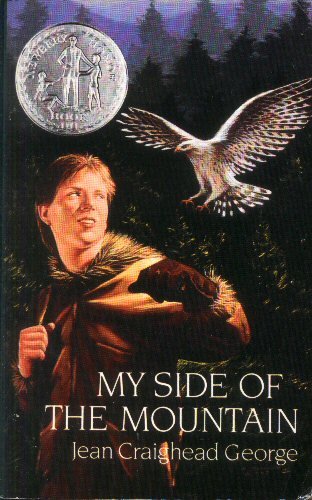
1. My Side of the Mountain by Jean Craighead George, 1959

This is a book about a 12-year-old boy, Sam, who gets sick of living in his parents’ crowded New York City apartment with his 10,000 8 brothers and sisters. His solution to this problem is to take off for the Catskill Mountains and find this piece of property his family abandoned years before (they used to have a house or something there, like, three generations ago, but then they moved to the city I guess).

Sam tells his parents that he’s going to run away to the mountains and basically says that he will go whether they’re cool with it or not, so they totally let him go. Um, amazing! How come my parents weren’t that cool when I was 12? Anyway, he apparently learns some wilderness skills or whatever at the public library (TAKE THAT, ROB FORD), and then is all, see ya, giant family and tiny apartment.

My main memory of this book is that this kid was fucking SERIOUS BUSINESS. He finds a peregrine falcon that he trains to hunt for him. He lives in a tree. He almost dies, like, fifty times. At one point he is skinning a rabbit and is like, hmmm, I really want to eat his liver. So he does, and then he’s like, welp, I guess I was vitamin D deficient. I don’t know why, but that scene struck me as especially hardcore. HE ATE A LIVER, YOU GUYS. A LIVER. I guess liver really grossed me out when I was young?

Another big impression that this book left on me was that I was a huge wuss. I would never, ever go off and live in the mountains by myself in a house that I had to dig with my own hands. I could never be that self-sufficient. Also, I could never go that long without seeing another human face (even if occasionally I fantasize about it). In spite of my wussiness, though, I still managed to identify with Sam because, hey, who doesn’t want to run off and leave everything behind sometimes? Who doesn’t want to push themselves to the limit to discover how much they can endure, and how much they’re really capable of?

And I guess that’s the main message I got from this book: if you really want something, and you really prepare for it, you can achieve it. And also maybe you will get a sweet pet falcon out of the deal.

Image

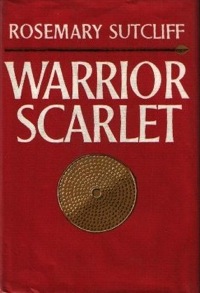
2. Warrior Scarlet, Rosemary Suttcliff, 1958

This one takes place in Britain, during the Bronze Age. It tells the story of Drem, a kid with only one functioning arm. The thing is, Drem really, really wants to be a warrior (in case you were wondering, this is kind of a Big Deal in his tribe). At first everyone is all, no way can you be a warrior, your arm doesn’t even work! You’ll have to go live with the sheep-herders. Have fun with the sheep, Drem! And then they’re like, well, I guess you can train with the other youth. Maybe.

So of course Drem goes to train with the other boys his age, seems to prove that he’s able to keep up with them, and totally starts to get over the fact that he’s different. He even starts to bond with his peers! BUT (you totally knew there was a but coming here), in order to become a warrior he has to kill a wolf. And of course the killing gets all fucked up (the wolf injures him really badly, so his friend steps in to help, which is TOTALLY NOT ALLOWED according to the tribe), and it looks like Drem will be spending the rest of his life with the sheep people. Of course, some other stuff happens, Drem ends up somehow killing the exact same wolf he failed to kill years before, and there’s a happy ending where he completes the super seekrit initiation ceremony and becomes a full-fledged warrior. Yay! Everybody wins! Except the wolf, I guess.

My main memory of this book is how insanely fascinating, beautiful and bad-ass it made Bronze Age Britain sound. I remember poring, practically drooling, over passages about midnight bonfires and sacred rituals and ancient magic, and whoa, did I ever want to live in that world. I remember this being a book that I daydreamed about a lot, and that’s something that I want for Theo. I want him to have books that he loves so much he ends up spending hours and hours imagining what it would be like to exist within the confines of that story.

Plus, you know, super seekrit initiation. SO AWESOME.

3. A Wrinkle in Time, Madeleine L’Engle, 1962

First, can we all just agree that Meg Murry is awesome? She’s not conventionally attractive, she has self-esteem issues, she’s socially awkward, she beats other kids up, and she’s super smart. I mean, sure, she’s not as smart as Charles Wallace, but then who is? Anyway, she’s someone that a lot of people can identify with. And she ends up kicking major ass.

The book takes place in small town America (I want to say somewhere in New England, but I’m not sure) during the cold war. The Murrys are a family that includes two super-smart parents, their super-smart daughter Meg, their super-super-smart son Charles Wallace and their totally boring and average twins, Sandy and Dennys. Mr. Murry disappeared during some kind of secret science mission, and now everyone in their village thinks that he just ran off and abandoned his family. Oh and everyone also thinks that Charles Wallace is developmentally delayed, even though he’s a genius like whoa.

Anyway, Meg and Charles Wallace end up teaming up with some extraterrestrial-type ladies, Mrs Whatsit, Mrs Who and Mrs Which, and Meg’s hot schoolmate Calvin O’Keefe (who is super popular but ALSO has issues) in order to go rescue Mr. Murry. They travel through space and time in a sort of “wrinkle” called a tesseract (SCIENCE!!!!) and have some adventures before finally arriving at the planet where the force of ultimate evil darkness is keeping Meg’s dad prisoner. Even though you would think that it would be Charles Wallace who ends up saving the day (because he’s so frigging precocious), it’s actually Meg’s badass contrariness that gets everyone out of there alive. HIGH FIVE FOR SMART, CONTRARY WOMEN.

My main impressions from this book were: a) whoooaaaa I think I like science fiction and/or fantasy (it was probably the first sci-fi/fantasy book I read) b) I wish I could be part of the Murry family and c) I triple wish that Calvin O’Keefe was my boyfriend (he is seriously so nice, you guys don’t even know). It’s a book about a smart, resourceful young woman who realizes that she’s strong and awesome and ALSO she gets a hot, nice boyfriend without even changing anything about her looks. He even tells her he likes her in glasses! Aw, you guys, I love this book so hard.
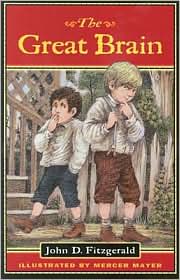
 

4. The Great Brain, John Dennis Fitzgerald, 1967

This is actually the first of a series of books about Tom Fitzgerald, the titular Great Brain. The books, which are set in late 19th century Utah, are narrated by Tom’s long-suffering younger brother, John. See, Tom is a genius, but he only wants to use his powers for evil, i.e. “swindling” people out of their possessions and thinking up get-rich-quick schemes. He also does things like trying to frame the schoolteacher for being “a drunk”. You guys, these were THE BEST BOOKS EVER, basically.

No, but seriously, even though Tom occasionally receives his comeuppance, he still gets away with a lot of stuff. When I was a kid, I mostly wanted to hang out with him and stir up shit and learn how to swindle people out of their possessions because, hey, it sounded like a lot of fun! Plus, they had so many whacky adventures. If these books are anything to go by, Utah is way more fun than any place I’ve ever lived.

Image

5. Le Petit Prince, Antoine de Saint-Exupéry, 1943

There is some kind of law that every French-speaking person has to read this book at least once over the course of their childhood. Now, let’s be totally clear: no kid is going to understand this book. They might enjoy it, but they won’t understand it.

Plot-wise, the book is about a pilot who crashes in the Sahara and is struggling to survive. One day, a young boy, the titular Little Prince appears. Now, this Little Prince is from space (!!) where he lives on his own personal asteroid (!!!) that has three active volcanoes (!!!!) and one rose. Weirdly, the humanoid prince falls in love with the rose (to be fair, I guess he didn’t have a whole lot of options in terms of life partners), who then lies to him because she’s super vain and kind of rude. They break up for a while, but then I guess they get back together.

The Little Prince decides he needs to explore the universe, so he sets off to visit a bunch of other asteroids, each of which is populated by a single, ridiculous adult. One of these adults, a geographer, is all, hey, you should totally check out the planet Earth! And the Little Prince is like, okay cool!

On Earth, the prince meets more ridiculous adults, and discovers that his rose isn’t beautiful or unique after all. He’s pretty bummed about this until he meets a fox (who totally steals the spotlight and gets the best lines in the book) who convinces him that yeah, dude, your rose IS special because she’s the one you love. Whoa! Revelation!  The prince also meets a weird snake who tells him that he can send him back to his home asteroid, but the prince is all, no, that’s cool, I’m good for now.

Anyway, the prince tells this whole story to the pilot, and then helps him find a well so that he doesn’t die of thirst or whatever. Then the prince is like, welp, I guess I’ll go find that snake again! The pilot realizes that the Little Prince will have to let the snake kill him in order to get him back home, and tries to convince him to stay on Earth. The prince totally ignores him and lets the snake bite him. Sorry, pilot! The story ends with the pilot looking for the prince.

As a kid you read this book and you’re like, hmmm, I guess this is fine. It’s kind of funny or whatever. Then you read it as an adult and you’re like, oohhhh, I get it. Adults are boring and totally sucky, while kids are awesome (fact). Also we have to appreciate the people we have in our lives who love us, and not spend time comparing them to other people (double fact). And finally, you realize that you want to spend all day hanging out with the fox, who says things like, “On ne voit bien qu’avec le cœur. L’essentiel est invisible pour les yeux.” (One sees clearly only with their heart – the essential is invisible to the eyes)

As an adult, I’ve read Saint-Exupéry’s other books, and have realized that he is this crazy amazing poetic philosopher. Wind, Sand and Stars is, in particular, my favourite. But I’m glad that I read The Little Prince when I was a kid, even if I didn’t understand it. I’m glad to have my childish impressions so that I can compare them to how I see the book now – I think that’s especially important given that it’s a book about the magical worldview children have that we lose as we age.

I’ll finish off here with a quote from Wind, Sand and Stars:

Old bureaucrat, my comrade, it is not you who are to blame. No one ever helped you escape. You, like a termite, built your peace by blocking up with cement every chink and cranny through which the light might pierce. You rolled yourself up into a ball in your genteel security, in routine, in the stifling conventions of provincial life, raising a modest rampart against the winds and the tides and the stars. You have chosen not to be perturbed by great problems, having trouble enough to forget your own fate as man. You are not the dweller upon an errant planet and do not ask yourself questions to which there are no answers. You are a petty bourgeois of Toulouse. Nobody grasped you by the shoulder while there was still time. Now the clay of which you were shaped has dried and hardened, and naught in you will ever awaken the sleeping musician, the poet, the astronomer that possibly inhabited you in the beginning.

Stay tuned for parts II, III and IV. And please feel free to leave book suggestions in the comments – if I get enough of them, I will do a whole post about your suggestions. I would write about books all day every day, if I could.

p.s. Can we all just agree that Holden Caulfield would be, like, the worst boyfriend in the history of ever?

The so-called Mommy Wars (or, what I learned from watching the X-Files)

15 Aug

If you are a person living in the world who has children, knows people who have children, or has ever spent any time on the internet, you’ve probably realized that people like to debate various parenting ideologies.

Now, for most of human history, I would say that the dominant parenting philosophy has been do the best you can with what’s available to you and hope that your children survive until adulthood (and also it would be nice if they didn’t turn out to be serial killers or Rob Ford or whatever). In fact, this same philosophy is still employed in many parts of the world today. However, for those of us living in the western world, most of us have more options when it comes to how we raise our kids. More options should equal everyone is happier and has a better time, right? Wrong.

Maybe I should rephrase that first sentence: if you are a person living in the world who has access to the internet, you have probably heard of the (sigh) Mommy Wars.

Can I just take a moment to say how frigging much I hate the term “Mommy Wars”? Like, a lot. For one thing, who put the mommy in mommy wars? Yes, every child has a biological mother (I mean, probably – but I’m not super up on science or whatever, so I could be wrong), but many children have other styles of parents or guardians, mostly fathers, but also sometimes grandparents, aunts, uncles, etc. So why the focus on mothers? Oh right, because women are crazy and can’t control their emotions society loves to crap on women.

Full disclosure – I watched a lot of X-Files growing up. Like, I could probably still recite entire chunks of dialogue from that show. Because I am aware of Mulder’s lasting influence over me (paranoia! the unexplained! the government is up to something!), I am hesitant to be all THIS IS A CONSPIRACY. But, you guys, I think this might be a conspiracy.

Here’s the thing: I really do believe that one thing holding women back from achieving equality with men is the fact that we’re too busy fighting viciously amongst ourselves. The energy we spend snarking and nitpicking and flat-out attacking each other could do so much good in the fight against the injustices that we face, if only we could see the bigger picture. And who does it benefit the most to keep women from seeing the bigger picture? Well, you know, the patriarchy.

Although men don’t often participate in the more vitriolic discussions surrounding parenting, many of the things that perpetuate the “mommy wars” (you have no idea how much it makes my skin crawl to have to keep typing that out) come from men. Men in the media who continue to remind us that breastfeeding beyond a certain age is weird and gross (for example, Martin Schoeller, the photographer whose contentious oeuvre recently graced the cover of Time Magazine), men in politics who think they should tell us how, when and why to have children, male doctors weighing in on parenting philosophies that really have negligible impact on children’s physical health, and even the frigging Pope who somehow thinks that he gets some say over our sex lives.

The patriarchy doesn’t want us to be better mothers; it wants us to become so consumed by the idea of doing it “right” that we don’t notice how little power and agency we have in our lives. It wants us to continue to be distracted by busy work so that it can continue to do what it does best: try to run our lives.

Let’s face it – most of the debates that fuel the “mommy wars” (stay-at-home mom vs. working mom, breastfeeding vs. formula, babywearing vs. not babywearing, bed-sharing vs. cribs) are just one valid choice pitted against another valid choice, with the same arguments being repeated over and over, ad nauseam (no, seriously, I actually feel a little nauseous sometimes). The thing is, all of the above parenting choices are fine. No one is a bad parent because of ANY OF THESE THINGS. Every parent is different, and every kid is different, and same style of parenting isn’t going to work for everyone.

So let’s all step away from our computers, take a deep breath and realize that being a parent is really fucking hard work. And you know what the best way to get through these tough times is? Supporting each other, and supporting the choices other people make. Let’s all hug it out and promise to have each other’s backs, okay?

Oh, and let’s get out there and kick the patriarchy right in the balls, you guys.

Image

… that it’s possible to be a parent and not be a dick about it

The Gender Gap (or, what’s up with baby clothes, you guys?)

14 Aug

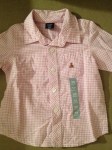
I bought this shirt for Theo today. I bought it for one reason, and one reason only: it’s pink, and it’s clearly labelled “baby boy”.

Can we just take a moment here to consider how amazing it is that Gap, a major retailer, has pink and lavender in their baby boy section?

Can we also take a moment to consider how incredibly depressing it is that, in my two years of shopping for baby clothing, this is the only time that I have ever seen pink or lavender in the boys’ department of any store? And trust me, there have been many stores; I’m, like, a shopping professional.

It’s not exactly a huge revelation to say that baby clothing is hyper gendered these days. Which sucks on several levels. Let’s work through those levels, starting from the most shallow and then digging a little deeper.

First of all, boy clothes are hella boring.

Boy clothing (even baby boy clothing) all tends to be depressingly similar. The major themes are: sports, cars/trucks/other machinery, “boy” animals (think dogs, snakes, bugs, sharks, etc.), rock music, and “cute” (read: stereotyped) sayings, like “mothers, lock up your daughters” and “strong like daddy”.

Not only that, but the colour scheme is always the same: navy blue, grey, brown and dark green.

ZZZZZzzzzzzzzzzzzzzzz

Oh wait, is this post still happening? Sorry, I got so bored thinking about boy clothes that I fell asleep.

Anyway. Moving on.

Secondly, have you ever wondered why baby clothing in particular is so gendered? I mean, it’s actually worse than clothing for preschool/school-aged children. Know why? Because all babies look the same.

I mean, obviously they don’t actually – some babies have dark skin, some babies have birth marks, some babies are Asian, some babies have a lazy eye, and so on. What I really mean is that babies don’t look like one gender or the other. Babies are basically totally androgynous.

So, how do you save someone from the horrible embarrassment of thinking that little Molly is actually a boy? You girl the shit out of her. Lace, bows, a giant flower headband for her hair – you coat her in layer after layer of femininity in a desperate attempt to prove to the world that she’s genetically XX, not XY.

People love making comments about babies’ genders. When I’ve been out and about with Theo, I have had so many people say to me, “oh, he looks like such a boy,” or “he’s got a really masculine face, doesn’t he?”

The funny thing is, when Theo was younger I dressed him in a lot of my old baby clothes, some of which were pretty damn feminine. A lot of people assumed that he was a girl, and cooed over how cute and ladylike his features were. WHO HAS A MASCULINE FACE NOW, EH, RANDOM STRANGERS THAT I MEET ON THE STREET?

So why is this all so important? I mean, why do I care how people dress their kids? Well, that brings me to my final point:

Society is made incredibly uncomfortable by anyone who doesn’t conform to gender norms. Especially boys.

This is one of the very few things that scare the shit out of me about raising a boy.

I read this excellent, intelligent and occasionally heartbreaking piece in the New York Times magazine this past weekend, and one paragraph in particular jumped out at me:

These days, flouting gender conventions extends even to baby naming: first names that were once unambiguously masculine are now given to girls. The shift, however, almost never goes the other way. That’s because girls gain status by moving into “boy” space, while boys are tainted by the slightest whiff of femininity. “There’s a lot more privilege to being a man in our society,” says Diane Ehrensaft, a psychologist at the University of California, San Francisco, who supports allowing children to be what she calls gender creative. “When a boy wants to act like a girl, it subconsciously shakes our foundation, because why would someone want to be the lesser gender?” Boys are up to seven times as likely as girls to be referred to gender clinics for psychological evaluations. Sometimes the boys’ violation is as mild as wanting a Barbie for Christmas. By comparison, most girls referred to gender clinics are far more extreme in their atypicality: they want boy names, boy pronouns and, sometimes, boy bodies.

I have rarely seen my thoughts on gender inequality so neatly distilled and pared down to one perfect sentence:

Girls gain status by moving into boy space, while boys are tainted by the slightest whiff of femininity.

YES. OH MY GOD YES.

It scares the shit out of me that there are people who would refer their son for a psychological evaluation because he asked for a Barbie doll. It frustrates me so much that we don’t have much in the way of support for kids who don’t fit neatly into the boxes marked “boy” and “girl (although obviously things are changing). And finally, it makes me incredibly sad to think that Theo will go through life with people constantly evaluating his masculinity, people who may resort to physical violence if they find him wanting.

I don’t know if Theo will ever question his gender, or want to engage in more traditionally feminine activities, or anything like that. I want him to grow up in a house where he can feel free to be who is, play with the toys he likes, dress the way he wants, and so on. I also want to protect him. I realize that these two desires may end up being mutually exclusive.

For now, I’ll offer him a variety of toys – trucks and trains, dolls and a kitchen set. I won’t narrow his world to only “boy” books and “boy” music and “boy” movies.

And, of course, I’ll dress him in pink checked shirts from the boys’ department at Baby Gap.

The F Word (or, why can’t you just admit that you’re a feminist?)

13 Aug

When I was growing up, my mother always self-identified as a feminist. When she would introduce my sisters and I, she would refer to us as her three contributions to the feminist movement. I grew up with this idea that feminists were awesome, kick-ass women (and men!) who went around fighting injustice and high-fiving everyone. Feminism!

So, not gonna lie, I was pretty upset and confused when, a few weeks ago, I discovered that my mother no longer thinks of herself as a feminist.

It came up during discussion in which I was trying to convince my sisters that they were also feminists (these discussions, as I’m sure you know, always go super well). In a moment of frustration, I turned to my mother and asked her to just tell my sisters that they were feminists so that we could stop arguing about it and get on with our lives already.

To my enormous surprise, my mother said, “I’m not sure that I would call myself a feminist anymore. I don’t like that label.”

Whoa.

Last weekend, when we were visiting my mother, I brought it up again. Because I am a super sensitive individual, the conversation went something like this:

Me: Why don’t you call yourself a feminist anymore? That’s stupid. Feminists are awesome.

Mom: There are a lot of people who use that label whose beliefs I don’t agree with. I don’t want people to associate me with them.

Me: That’s like saying that by calling yourself a Christian, you’re somehow associated with Fred Phelps. It’s like saying that by being part of the United Church of Canada, people will think that you picket gay people’s funerals and believe that AIDS is a punishment from God.

Mom: Annie, I don’t want to argue about this.

Me: WELL I DO.

And I do. I want to argue about feminism with everyone, all the time. I really, truly don’t understand why people don’t want to be known as feminists.

Do you like wearing pants? Do you like being able to vote, or own property? Do you enjoy not belonging to another person and having agency over your own life? Above all, do you believe that women are people and deserve the same rights and treatment as men?

If the answer to any or all of the above is yes (especially about women being people – please tell me your answer to that is yes), then, as Jezebel would say, guess what? You’re a feminist.

I don’t understand why people fear or dislike that label. Sure, stupid, ignorant things have been said (and done) in the name of feminism, but isn’t that true for any movement? If you let those ignorant people dictate what the term “feminism” means, then you’re giving them power, both over yourself and over the movement.

Why are we letting people co-opt our movement? Why are we so quick to wash our hands of it and move on? Why are we so afraid of people having bad associations with the idea of feminism?

Instead of distancing ourselves from the movement, we need to use this as an opportunity to prove that feminism is brilliant, rational, and urgently necessary to our society. Instead of giving away our power, we need to grab it with both hands and take it back.

By silently withdrawing from the label of “feminist”, the message that you are sending out is that those other people, the ones that you don’t agree with, truly do speak for the entire feminist movement. Or, even worse, your silence is communicating that you don’t believe that feminism has a place in our society anymore; people might take your silence to mean that you believe that equality has been achieved (hah!) and male privilege doesn’t exist.

So call yourself a feminist. Prove to everyone how awesome feminism is. Get to work changing everyone’s minds about the dour, humourless feminist stereotypes (and the crazy man-hating ones – those are my favourites!). Go out there, fight injustice and give some high fives.

Oh, and the next person to say “feminazi” gets a swift kick to the shins. Just sayin’.

This is what a feminist looks like