Rape Culture (or, Roman Polanski, I can’t even)

11 Oct

There are few things in life that make as incredibly, blindly, need-to-punch-a-wall-right-now angry as Roman Polanski. Any mention of him makes my blood boil; even just having someone tell me about one of his movies leads to me shouting obscenities for a significant length of time. So imagine how I felt when I saw the following headline on Yahoo News:

Former teen who had sex with Polanski writing book

The article then goes on to say that,

Polanski … fled the country in 1978 on the eve of being sentenced for unlawful sexual intercourse with Geimer, 13 at the time

Let me just sit here a moment while your head explodes a little.

Let’s get a few things straight: Roman Polanski did not have “unlawful sexual intercourse” with a 13 year old girl – he raped her. The victim, Samantha Geimer, testified that the sex was not consensual; in fact, according to her testimony, she explicitly told him no. And you know what? Even if she hadn’t told him no, it would still have been rape. Even if Polanski hadn’t given her alcohol it would have been rape; even if he hadn’t drugged her it would have been rape; even if  she had said yes it would have been rape.

Know why? Because she, a vulnerable 13 year old girl faced with a millionaire film director in his 40s, was subject to an extreme imbalance of power. As Geimer said in her testimony,

We were alone and I didn’t know what else would happen if I made a scene. So I was just scared, and after giving some resistance, I figured well, I guess I’ll get to come home after this

She didn’t fucking know what else would happen if she made a scene. Here was a girl, who had been given champagne and qaaludes, who was faced with unwanted sexual advances from a man more than three times her age, a man who wouldn’t take no for an answer. She was afraid for her life.

What Polanski did was rape. I don’t care that he was later offered a plea bargain (because Geimer’s lawyer did not want her to have to endure a trial) that lessened his charges from rape by use of drugs, perversion, sodomy, lewd and lascivious act upon a child under 14, and furnishing a controlled substance to a minor to the much shorter and nicer-sounding unlawful sexual intercourse. I don’t care that the only thing Polanski plead guilty to was said charge of unlawful sexual intercourse. I just don’t care.

Let’s be really clear on one thing here:

Roman Polanski drugged and raped a 13 year old girl.

Roman Polanski raped a 13 year old, plead guilty to “unlawful sexual intercourse” and, when he realized that he was facing jail time, fled the country. He continued to make movies, continued to receive the financial backing and participation of major studios and A-list movie stars, married a woman 33 years his junior, and had two children. He has suffered basically zero consequences because of what he did.

This is what rape culture looks like.

Rape culture means that we refer to children who were raped by celebrities as “former teens” (what the fuck does that even mean?), and use terms like “unlawful sexual intercourse” instead of “rape” when describing what happened to them.

Rape culture means that Johnny Depp, Adrien Brody, Ewan McGregor, Pierce Brosnan, Kim Catrall, Jodie Foster, Kate Winslet, Helen Bonham Carter Walter Matthau, Harrison Ford, Kristin Scott Thomas, Sigourney Weaver and Ben Kingsley are, by appearing in and promoting Polanski’s films, all tacitly saying that they are just fine with the fact that he raped a 13 year old girl.

Rape culture means that a lengthy list of celebrities, many of whom I used to admire, have publicly defended Polanski.

Rape culture means that Whoopi Goldberg has gone on record saying that what happened wasn’t rape rape.

Rape culture means that so many people are willing to ignore what Polanski did because they just want to sit back and enjoy his movies without having to feel guilty.

Rape culture means that a young girl’s life was destroyed, while her rapist went on to win Oscars for his movies.

Rape culture means that we live in a world where celebrities, the media, and even our friends and family normalize, excuse and condone rape to the point where a rapist can continue to live a happy, normal life with very limited consequences.

Look, I’m not normally the type of person who can’t dissociate an artist from their art; I still love Picasso, even though he treated women terribly. Ditto for Ernest Hemingway. Truman Capote was pretty awful, especially to my girl Harper Lee, but I can still read Breakfast At Tiffany’s and love every word of it. I recognize that the art and beauty a person creates are separate from who they are.

But I will never, ever see a Polanski film. I will not in any way, shape, or form give my tacit support for what he did.

I will not knowingly participate in rape culture.

Samantha Geimer in 1977

Edited to add: A few people have brought up the 1969 murder of Polanski’s pregnant wife, Sharon Tate, and the fact that he is a Holocaust survivor.

A bit of clarification – I am aware of both those facts. I do not like the fact that people use them as an excuse for what he did. I am certain that Polanski was deeply, irreparably damaged by these events. That being said, he made a CHOICE to rape Samantha Geimer. He was conscious of his actions; he even underwent a court-ordered psychiatric evaluation after his arrest. I do not think his past can be used as an excuse or justification.

Bullying Part III (or, all hail Margaret Atwood)

10 Oct

This will be the final instalment of my totally unplanned Bullying Trilogy (seriously, it started out with me just wanting to talk about clothes).

After I made my last post talking about how I was bullied in my teens, my friend Audra asked if I’d read this 2011 article from New York Times, Bullying As True Drama. In fact, I had read it when it first came out and hadn’t really given it much thought. Re-reading it, though, I found myself nodding and muttering, yes, yes, yes under my breath.

So much of this article hits home for me. This part, for instance:

Many teenagers who are bullied can’t emotionally afford to identify as victims, and young people who bully others rarely see themselves as perpetrators. For a teenager to recognize herself or himself in the adult language of bullying carries social and psychological costs. It requires acknowledging oneself as either powerless or abusive.

Or this:

While teenagers denounced bullying, they — especially girls — would describe a host of interpersonal conflicts playing out in their lives as “drama.”

At first, we thought drama was simply an umbrella term, referring to varying forms of bullying, joking around, minor skirmishes between friends, breakups and makeups, and gossip. We thought teenagers viewed bullying as a form of drama. But we realized the two are quite distinct. Drama was not a show for us, but rather a protective mechanism for them.

And especially this:

“Teenagers want to see themselves as in control of their own lives; their reputations are important. Admitting that they’re being bullied, or worse, that they are bullies, slots them into a narrative that’s disempowering and makes them feel weak and childish.”

Like I said in my last post, bullies can smell a victim. The minute that you admit to yourself or to others that you’re being victimized, then I guarantee you that, barring serious intervention, the bullying will get worse. To make matters even more difficult, many kids (and adults) don’t realize that they’re bullies; this behaviour is so ingrained in our culture that it seems downright normal. I’m certain that most of the kids inflicting “drama” on others have, at some point, been on the receiving end of “drama”. To them, it’s an unpleasant but ultimately unavoidable part of life.

We also need to realize that the ways in which bullying happens have changed; it often occurs online, or through texting; it’s not always public. This, then, is where I think David Dickson, chairman of the Bullying Prevention Initiative of California, really misses the mark with definition of bullying as happening, “typically in a social setting in front of other people“. That definition certainly doesn’t hold true today; in fact, I’m not sure that it’s ever been accurate.

One of the best literary instances of bullying that I can think of is the torment that Elaine Risley goes through at the hands of her so-called “best friends” in Margaret Atwood’s Cat’s Eye. Though all three of her friends are party to the bullying, few outside of that group know what’s happening. In fact, Elaine is pretty clear about the fact, were she to tell anyone about being bullied, she would feel as though she were breaking some kind of sacred code:

“Whatever is going on is going on in secret, among the four of us only. Secrecy is important… to violate it would be the greatest, the irreparable sin.”

A few adults in Elaine’s life seem to have some inclination as to what’s going on; she hears the mother of one of her friends saying that she deserves to be bullied because she’s a “heathen”, and, several years after the bullying occurs, Elaine’s mother makes a vague reference to the girls giving Elaine a “bad time”. Those instances aside, none of the grown-ups seem to know or understand the severity of what’s happening. The three girls are at Elaine’s school, and one of them is even in her class, but none of the teachers seem to notice that anything is amiss with their relationship; even her peers see only a group of “best friends” and nothing more.

Based on all the above, I wouldn’t say that Elaine’s bullying is public; in fact, her tormentors are very careful to maintain the façade of friendship that they’ve built up. Does that mean that it’s not bullying?  Elaine is certainly emotionally, mentally and physically scarred by what she’s going through; not only are her self-confidence and happiness eroded to the point of non-existence, she also begins experiencing symptoms of severe anxiety such as fevers, stomach aches and tendencies of self-harm (among other things, she begins biting her fingers, and pulling patches of skin off her lips and the soles of her feet).

Another important thing to note is that, much like the girls mentioned in the Times article, neither Elaine, her friends, nor the adults in her life ever use the term bullying. Instead, they use euphemisms like giving her a hard time. At one point Elaine’s mother even tells her not to let the other girls push her around, and not to be spineless, as if that’s any kind of helpful advice. So the message that Elaine receives both from her “friends” and the adults in her life is that the way she’s being treated is her own fault.

This, then, helps explain why, when the balance of power shifts between Elaine and her “friend” Cordelia,  Elaine begins to bully her back. While Cordelia spent most of grade school bullying Elaine, Elaine turns around and spends much of high school treating Cordelia equally terribly. In her mind, though, she’s not a bully; she can’t be, because, in Elaine’s eyes and the eyes of the world, her “friends” from elementary school weren’t bullies either.

At one point, when things are at their worst, Elaine’s mother says to her,

I wish I knew what to do.

And that, that right there, is often the hardest pill for both adults and teenagers to swallow – the fact that when bullying or “drama” occurs, the adults involved often just don’t know what to do.

I’m going to go out on a limb here and guess that part of the reason teens started using the term “drama” to sort of re-brand bullying was the realization that, possibly for the first time in their lives, the adults around them had no clue how to stop them from hurting. So the term “drama” isn’t just a protective mechanism for the kids themselves; it’s also their way of protecting their parents and teachers, a way of reassuring them that it’s okay that they have no idea how to help because it’s nothing, just drama, and their help isn’t needed.

Matt and I were both bullied when we were younger, and because of that we’ve talked extensively about what we would do if Theo was ever bullied. I would like to say that we’ve come up with an awesome plan but, really, we haven’t. If things were ever to get really bad and Theo were to express a desire to change schools, Matt would prefer to go ahead and do that, whereas I would rather that he learn to work things through with his peers rather than running away. Of course, Matt doesn’t know what he would do if things were equally bad at Theo’s new school, and I have no idea how Theo is supposed to learn to rationally work things through with a bunch of hormonally-crazed teenagers.

I think, though, that at the end of the day that Times article has it right; instead of focussing on the “negative framing” of bullying, we need to work towards teaching our kids what healthy peer relationships look like and how to be good digital citizens. We need to teach our kids empathy and the ability to recognize when “drama” has gone too far. We need to find ways to empower our kids instead of making them feel weak or victimized.

I know, I know, this is a lot of talk without a lot of substance to back it up, but hey – I’ve hopefully got a few more years to figure it out. And while I’m teaching Theo how to be a smart, confident, independent person, I’ve got him to teach me how to be a thoughtful, wise and effective parent. So far, I think we’re both doing a pretty okay job.

Bullying (or, nolite te bastardes etc.)

7 Oct

I’ve written on here about some of the less-than fun stuff I went through as a teenager, but I think that last night was the first time that I’ve ever publicly referred to it as bullying. And now I kind of want to talk about it?

A little bit of background:

I’d had the same group of friends throughout most of elementary school. The five of us had been pretty tight, spending every recess and lunch hour together, pairing up for science projects and book reports. On the weekends we would force our parents to shuttle us around the city for various playdates and sleepovers.  I’d known them for so long that I couldn’t imagine ever not being friends with them.

Then, one mid-day recess in seventh grade, my friends told me they had to talk to me.

We sat in a circle on the schoolyard pavement, near the edge of where the grassy field began. It must have been October or November, because I remember that the sky was grey and there was a chill in the air. My friends started out by saying that they’d been talking about me, and had realized that they collectively found me annoying. They told me that they’d come to the decision that they didn’t want to hang around with me anymore, and asked me to stop joining them at lunch and recess. I tried to argue with them, then tried to bargain, but it was pointless; their collective mind was made up.

Basically, they broke up with me.

What had already been a difficult year went from tough-but-manageable to downright miserable. Even before I was de-friended, I was already being picked on by my classmates for my bad skin, the way I dressed, and the nerdy things I liked. Now, not only was that all still happening, but I suddenly had no one to protect me, and no one to tell me that I wasn’t an ugly pathetic loser.

As the year went on, the kids who made fun of me became braver, making more and more publicly humiliating comments about me. One kid said that I didn’t need to use whiteout, because I could just use the pus from my pimples – the teacher laughed at that along with everyone else. Another kid wondered aloud why my clothes were so terrible, since my father was a lawyer and could almost certainly afford something better than ill-fitting sweatshirts and track pants. Boys from my class prank-called me in the evenings, pretending to ask me out – then repeating everything I’d said on the phone the next day to the rest of my class.

I didn’t tell my parents what was happening because I was embarrassed, although they must have noticed that I wasn’t being invited to my friends’ houses anymore. I didn’t want them to know how much of an outcast I’d become at school, because it seemed like it was mostly my own fault for being unlikeable. Anyway, I reasoned, even if they did know, what could they do?

When I started high school, I chose a school that almost none of my classmates were going to. The only person from my class who was coming with me was the girl I’d become close with in 8th grade, so that was fine. I figured that this was the perfect chance to start over. No one at this huge new school knew me, or knew my past; I would walk through those front doors in September as whoever I wanted to be.

I didn’t get to start over, though. Does anyone ever really get a fresh start? I still had all the problems that had led to being teased in the first place: bad skin, the wrong clothes, and geeky interests. Even worse, the last two years had left me with zero self-confidence, which meant that I was constantly second-guessing myself. Because of this I had a hard time making friends, and when I did I was clingy and jealous. I was even more of a mess when it came to boys. Boy, was I ever.

Bullies can smell a victim, and I was soon back to being the butt of the joke. I went to an arts high school where I majored in dance, and the girls in my dance class were saccharine sweet to my face (most of the time), but made fun of me as soon as my back was turned. By the end of the year I was so tired of it that I transferred out of dance class and instead majored in visual art, where I was surrounded by pretentious art school kids, stoners and comic book nerds – on the whole, a much nicer group.

I don’t mean to make it sound like I was totally friendless. I mean, yeah, I had people that I hung out with – a pretty big group of friends, actually. But even within that group I was teased. Early high school was pretty much just as shitty as late grade school.

My later high school years were better, and the same goes for university. I moved out east for school, made some great friends, and became the stunningly self-confident adult you see before you today. Things are mostly totally fine now. I am mostly fine now.

What’s strange is that now I’m friends on Facebook with a lot of the people who made me miserable (maybe some of you are reading this now – hi guys! kind of awkward! sorry!). We’ve never talked about or even acknowledged what happened; after half a lifetime of not knowing these people, we mostly just “like” each others’ statuses and comment on photos of each others’ kids. Initially, I felt awkward having them back in my life, mostly because I worried that they were still judging me and still finding me wanting, but now we’ve settled into a sort of comfortable camaraderie, reminiscing about our collective school days as if we’ve been friends all along.

Maybe they’ve forgotten what happened, or maybe it just never seemed like a big deal. Maybe they feel bad.  Maybe I’m the one with the problem. Maybe they were right, and I am a pathetic loser. Maybe they were dealing with their own stuff at the time and didn’t realize how much it sucked for me. Most likely it’s a combination of most of the above.

I find that when I talk about what happened, I use a lot of euphemisms; I’ll say that I went through a tough time when I was younger, or else that I had a bad year the year I turned 12, or any other number of variations on the same thing. I’ve been hesitant to use the word “bullying” when talking about my own circumstances, for a couple of reasons:

1. Was I even bullied? I mean, yes, I was teased, but does that count as bullying? When does it cross the line from normal kid behaviour to bullying? Or is bullying so pervasive in our culture that it now seems normal?

2. Weirdly, I feel anxious about what the people who are my friends now will think of the fact that I was such a loser. There’s a part of me that thinks that they’ll start to reconsider our friendship, start to notice all of the less-than-stellar components of my personality.

3. Saying that I was bullied is admitting that I also became a bully later in high school. I made fun of people, talked behind their backs, told secrets. I was even party to making a girl cry in 11th grade chemistry class. I was mean, and I liked being mean.

I do think that it’s important to start a dialogue about this, especially in reference to the first point. In the wake of Jennifer Livingston’s on-air response to an email criticizing her weight, in which she refers to the man who sent her the email as a bully, there has been a lot of discussion about what qualifies as bullying, and whether or not it was the appropriate word to use in that instance. David Dickson, chairman of the Bullying Prevention Initiative of California, says“Bullying, normally, is what someone, in a very mean spirited way, continually and on a repeated basis, does to another person, typically in a social setting in front of other people…It was a stupid letter he wrote, but he commented privately.” 

Now, I’m not an expert on bullying, and none of the definitions that I’ve found online have really been satisfactory, but it seems wrong to ignore this entire discussion just because what happened doesn’t fit Dickson’s fairly narrow definition of what bullying is. Whether or not the letter sent to Livingston was public, it was certainly hurtful and unnecessary, especially considering that she’s likely spent a lifetime of facing comments like that. Also, it sucks to have a so-called bullying expert be so condescending and dismissive, especially when bullying in our culture is so often dismissed as kids just being kids (or, in this case, fat ladies just being too sensitive).

Maybe Dickson wouldn’t consider what I went through to be bullying. I mean, sure, it was public, and it was often mean-spirited, but maybe it wasn’t very mean-spirited, or maybe it wasn’t repeated or continual enough. Maybe it was just teenagers being dicks to each other, and I’m just an oversensitive lady-type. Usually writing things out here makes them clearer (and hey, it’s cheaper than therapy), but this time it just makes them seem murkier and more confused. Was I the one with the problem? Were they the ones with the problem? Was I undeserving of friends? Am I still?

What I do know is this: I’m tired of pretending that nothing happened, and I’m tired of feeling like I did something wrong and have something to hide. I’m tired of waiting for all of my friends to discover that once-upon-a-time I wasn’t cool, and then to high-tail it out of my life – so take that, brain, a pre-emptive admission of uncoolness. Most of all, I wouldn’t want any other kid to feel as shitty as I did.

So yeah. Can we talk about this?

Me at age thirteen, centre, with my cousins and sister.

On Bullying And Being A Clothes Horse

6 Oct

I like clothing. I like it a bunch, and not just because it gives me the ability to not be naked. If avoiding nudity was my only concern, I probably wouldn’t have as many clothes as I do.

For those of you who don’t know me very well, let me be really super clear on something here: I own a lot of clothes. A lot.

I used to not care so much about what I wore; I mean, sure, I liked getting dressed up, but if someone gave me money, I spent it all on books (or sometimes books and candy). Gifts of clothing at Christmas or my birthday were considered boring, and beneath my interest; they were quickly set aside in favour of more interesting packages. When my mother gave me money to go back-to-school shopping, I would spend as little of it as I could on a few shirts and a pair of jeans at Walmart, then save the rest for the more interesting stores.

Then puberty hit, and people started making fun of the way I dressed. Why? Because teenagers, that’s why.

Not only was I lacking in fashion sense, but I was also widely considered to be quite ugly. A classmate of mine took a sort of informal poll on the relative attractiveness of the girls in our class, and I rated lowest. Out of 28 classmates, only one (a girl named Cindy who was well-known to be the nicest person ever) had said that I was “sort of pretty”; everyone else, even (especially?) the boys had marked down “ugly” next to my name.

I tried to laugh it off, but underneath I was heartbroken.

I went home, cried, sassed my parents, ate some ice cream, cuddled my cat, scrawled in my diary, etc.

Then I decided that this was, in part, a solvable problem.

I couldn’t change my facial features or the basic structure of my body, of course, but what I could do was learn how to apply makeup and wear the correct clothes. In order to do this, I would have to figure out what the right ways to do these things was, because I honestly had no idea. I began to observe my classmates as if I were a cultural anthropologist; I made notes on what they wore, how they did their hair, and what shade of lipstick they applied. I bought fashion magazines and pored over their pages, cutting out pictures of the outfits I liked. We didn’t have a lot of money, so I started spending time at Value Village, Goodwill and the Salvation Army, digging through the racks for things that might look good, or fit me well.

I began replacing my wardrobe of printed pastel sweatshirts, track pants, babyish puffed-sleeve dresses and unflattering stovepipe jeans with slightly more grown-up attire. Back then, I wasn’t necessarily trying to be fashionable, or even dress particularly well; I just wanted to fit in and be able to disappear into the crowd. I gravitated towards basics like plain t-shirts and tank tops paired with jeans, khakis or a simple skirt. All I wanted was to be normal, because I thought normal meant that I wouldn’t be bullied anymore. I wanted to use clothing as a sort of protective armour, one that would make me look like an average high school student instead of someone with a target on their back.

By the beginning of university, I’d begun to wear things like vintage slips and old, beat-up leather jackets. I tied my hair back with old kerchiefs I’d bought for cheap in Kensington Market. My grandmother gave me an old coat of hers from the 60s, and I wore the shit out of it. I was starting to look kind of good.

While in Halifax, I was lucky enough to have two roommates who a) were approximately the same size as me, and b) had awesome, badass fashion sense. We instituted an open-closet policy, and having access to a sort of communal wardrobe gave me the chance to experiment with different looks without having to commit to them. I stopped wanting to look normal, and started wanting to look interesting. I learned to accessorize. I started putting outfits together in unconventional ways, and discovered that I kind of liked doing that.

Now, weirdly, some people actually consider me to be fashionable. It’s still a label that feels strange to me (and I often think it means “you sure do own a lot of clothes!”), and I don’t really believe that I dress particularly well. I still sometimes feel like my clothing is a disguise rather than an a form of self-expression. In a lot of ways, I’m still that skinny, ugly teenager who has no idea what to wear; I still study the way people dress (more out of habit, now, than out of necessity), and although I don’t cut pictures out of magazines anymore, I do pin copious amounts of fashion on Pinterest. But now, instead of feeling like this is something that I have to do in order to fit in, I do it because I’m looking for ways to stand out from the crowd. I also do it because I enjoy it.

Having taken the time to look back and write all this down, I’ve realized something: I took an experience that was ultimately really sad and tough and demoralizing, and out of that I developed a passion for something that I didn’t really care about before. Being bullied led me to explore and learn to love something that I might not have thought much about otherwise, something that still brings me happiness as an adult. And really, isn’t that the best possible outcome of a situation like this?

Anyway, here are a few things that are inspiring me these days. Maybe they’ll inspire you, too!

Tweed Skirt from Steven Alan

Failure Is Easy (And Sometimes Success Fucking Sucks)

4 Oct

I did a teaching demo today for the owners of a local yoga studio. It was an amazing opportunity – their space is beautiful, they have a ton of teachers that I love and respect on their schedule, and it’s walking distance from my house. I’ve known the two owners for nearly a year, and they’re wonderful women – both are amazing instructors who have a quiet, gentle presence that would put anyone at ease.

Needless to say, I was fucking petrified.

I started out by nervously giggling my way through a short interview, and then spent a few minutes fumbling around with the audio system, trying to get my music to play and hoping that the trembling in my hands wasn’t obvious. I’d planned and reviewed the sequence that I was going to teach, so fortunately I didn’t forget it or anything, but my voice had gone strangely squeaky, and I could tell that my breathing was shallow. After a few minutes, though, I hit my stride and started to feel more confident. After all, I teach several times a week, right? I know how to do this.

Right?

Afterwards, they smiled at me, and told me what a lovely teaching voice and style I had, mentioned that I’d given excellent cues and had clearly been well-trained, and finally said that I had a beautiful practice.

Even a three-year-old could have heard this but coming a mile away.

But, one of them said gently, we noticed that you didn’t look at us. Do you ever walk around the room while you teach? Do you ever offer adjustments?

I do, I do, I stammered, I mean, maybe not as many adjustments as some other teachers, but I can do them. I mean, we learned how to. And I can walk around the room while I teach. We did focus on that in our training. Walking, that is, around the room, and not just demonstrating the poses to the students. It was something my teachers talked a lot about.

It must have been hard to teach to us, said the other, it was probably overwhelming to teach to the two owners of the studio.

I was totally nervous, I said. Didn’t you hear my voice shaking?

It was the sort of thing I knew I shouldn’t have said even before I said it, but then it came out anyway.

They talked to me a bit longer about the importance of connecting with your students, of having a relationship with them, and of maintaining an awareness of what’s happening in the room at all times. I said a few thing that probably sounded like feeble excuses. They thanked me for coming in, said that they had no immediate spots available on the schedule, but would keep me in mind for the future. I thanked them a little too profusely for having me in to demo for them (because it’s an honour to even be asked, right?) and then rushed out the door.

I don’t know which reaction to criticism is worse: to tell yourself that what other people see is wrong, that they just don’t understand what you’re trying to do, that they’re the ones with the ones with the problem, not you, or to do what I did, which was to tell myself that I’d flat out failed.

The thing is, they were right. I didn’t look at them while I was teaching. I probably don’t connect with and engage with my students enough. I do need to get up off the mat and walk around the room more often.

I could have said to myself that I would work harder, that I would take workshops on how to give adjustments, that I would get better and be the best teacher possible. The problem with that line of thought is that it seemed overwhelming and exhausting. I was tired just thinking about it.

It was easier to tell myself that I’d failed, that I was a bad teacher, that I should just give up and move on. It was easier to blame myself for not being prepared enough, for not thinking to look at them often enough, or even for scheduling a demo like this before I felt fully confident in my skills.

Failure is easy. Failure means that I get to give up, relax, not be so hard on myself. Failure means that I get to spend more time at home with my husband and son, and less time improving myself. Failure, somehow, means less anxiety.

Success, on the other hand, can be totally scary. With every success comes the idea that you need to build on it, keep the momentum going, continue to grow bigger and better every day. And success, of course, makes every little failure seem all the more bitter.

Every time I write something on here that elicits a reaction from people, that ends up being passed around on Facebook, or generates a lot of comments, I feel like my next post has to be even better. And then if I go a few days without posting anything that gets a big response, I feel like I’ve lost it, whatever it is: the ability to write, maybe, or to communicate effectively, to touch people.

A few things, though:

1. Every post I write doesn’t have to win the Nobel Fucking Prize for Bloggers

2. I am still just getting started as a writer who is writing things for other people, and not just scrawling messy feelings in my diary.

3. I am still a novice teacher; I just graduated in June for Pete’s sake

4. Who the hell is Pete, anyway? Is it Peter like the apostle Peter, the one who became the first Pope?

5. I really hate that dude.

I am a good teacher; I am also a good writer. I have innate talent in both of those areas (I mean, if I do say so myself). BUT (did you see that but coming?), innate talent will only get you so far. The rest of the way to success is hard fucking work. It’s hard work, and the road is never smooth – every time I succeed, it will likely be followed by a few failures, and it will be a while before I get to the point where I feel like everything is settling down and working out the way I want to. Maybe I never will. See? Fucking scary.

People like to say that failure is not an option, except that it totally is. I could totally pack up my yoga mat and go home. And I could justify that decision a million ways: teaching was wearing me out (true!), I felt like I wasn’t seeing my family enough (also true!), I wasn’t sure how to improve or move forward (double true!). Failing would be easy.

But I don’t want to fail.

I don’t want that to be the lesson that I teach Theo.

I don’t want that to be the lesson that I teach myself.

So if you’ll excuse me, I will take my lovely voice, my excellent cues and my beautiful practice and go work on learning how to properly walk around the room. It’s going to suck at first, and I’ll probably screw it up the first few times I try it, but I’ll ride that out and see it through until I get better. And I will get better, because I am a smart lady who can figure this shit out.

My child, even though I am a stupid misogynist and it’s totally my fault women can’t be priests, I will pray for you.

The Racist Roots of the Pro-Life Movement

2 Oct

Most people probably think of abortion as being a fairly modern convenience, and imagine that the pro-life movement has probably been around for quite some time. For one thing, people who are pro-life often cloak their message in the Biblical idea of thou shalt not kill, and, you know, the Bible has been around for like forever. With that in mind, it would totally make sense for anti-abortion sentiment to have been rampant and widespread for the last couple of hundred or even thousand years.

Except that it hasn’t been.

The roots of the modern pro-life movement can actually be found in late 19th century America. Laws criminalizing abortion in the United States didn’t begin appearing until the 1820s, and even then they were still fairly rare. In the 1860s (so, during and after the civil war), these laws became more common, and by 1900 abortion was illegal in every state.

Before that, abortion was totally legal up until the “quickening”, i.e. when the mother first feels the fetus move. This was partially because at the time, there was no definite way of knowing that a woman was pregnant until she felt fetal movement; of course there were other signs, such as lack of menstruation or things like morning sickness or breast tenderness, but any of those could be symptoms of conditions other than pregnancy. Because of that, the moment when a woman felt her baby “quicken” (which typically happens in the 4th, 5th or even 6th month pregnancy) was really the moment when society considered her to be pregnant. Before that, she was just a woman with an irregular or disrupted menstrual cycle.

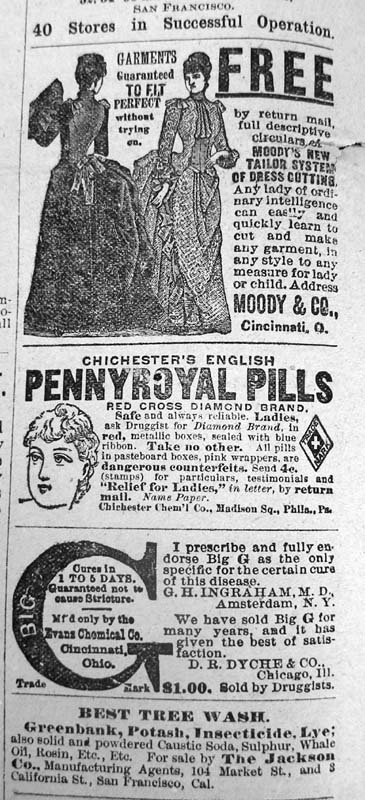
Which is why most advertisements for 19th century abortifacients looked like this:

Most patent medicines promised to do things like “correct irregularities”, or, even more abstractly, offering “relief for ladies”.

Abortion was actually one of the most common forms of birth control in 19th century America. Doctors estimated that there was one abortion for every five or six live births. In fact, the 1867 Richmond Medical Journal reported that,

“Among married persons so extensive has this practice become that people of high repute not only commit this crime, but do not even shun to speak boastingly among their intimates of the deed and the means of accomplishing it.” 

Abortion was so common that classy ladies were chatting up their friends about the best ways to do it.

Probably not what you would expect to hear at a Victorian tea party, right? Kind of amazing to picture, though:

Won’t you please pass the cucumber sandwiches, Priscilla? Oh and did I tell you about this absolutely smashing new way I’ve discovered of aborting unwanted fetuses?

Someone please invite me to that tea party.

So what the hell happened?

Well, people started worrying that if women were allowed to control their own fertility, bad things might happen. Like the end of society as we know it!

Let’s take a look at the historical context: the 1860s were obviously a very turbulent time, especially with regards to racial issues. The fact that there was such an increase in abortion legislation during and immediately after the civil war is quite telling. The aftermath of the war inspired a growing panic among white people that people of colour, who they were sadly no longer able to enslave, might try to take over “their” country. Maybe as payback for all those years of slavery? This panic paved the way for the idea of “race suicide”.

What, exactly, is race suicide, you might ask? I’ll just let my old friend Teddy Roosevelt explain it to you:

” …if the average family in which there are children contained but two children the nation as a whole would decrease in population so rapidly that in two or three generations it would very deservedly be on the point of extinction, so that the people who had acted on this base and selfish doctrine would be giving place to others with braver and more robust ideals. Nor would such a result be in any way regrettable; for a race that practised such doctrine–that is, a race that practised race suicide–would thereby conclusively show that it was unfit to exist, and that it had better give place to people who had not forgotten the primary laws of their being.”

(On American Motherhood, by Theodore Roosevelt, 1905)

That’s right – race suicide is the idea that white people will become “extinct” if they don’t have enough babies.

This fear, that people of colour would out-baby us, is where we find the actual origins of the pro-life movement. It didn’t come out of the idea that abortion was a sin, or the dogma of be fruitful and multiply, but rather the panicked notion that white people might not run the world anymore.

This racism still exists in the pro-life movement, although usually in more subtle ways. I’ve heard of white women requesting abortions and being asked, pleadingly, by medical professionals, if they know how wanted white babies are. And, of course, the pro-life movement is stunningly racist in other ways, for example when they posted this what-is-this-I-can’t-even billboard:

Look, I’m not saying that if you’re pro-life, you must be racist, or that everyone who hates abortion also hates people of colour. But what I am asking you to do is take a look at the history of the movement, educate yourself, and re-examine why you hold the beliefs you do.

I’m also asking you to admit that when it comes to anti-abortion sentiment, it’s not always about God or saving babies or whatever; it’s also about white people, and our xenophobia, and our desire to maintain our death grip on a society that we perceive as being only for us.

ETA: Sadly, the pro-choice movement has a pretty racist history as well. Stay tuned for the next in this series, The Racist History of the Pro-Choice Movement. Racism. It is why we can’t have nice things.

Spem In Alium

2 Oct

Sometimes, when I’m feeling really down, I listen to Tallis’ Spem In Alium, and it improves my life 100%. Like, my house could be on fire, and I’d be all, these harmonies are transcendent.

You may remember Thomas Tallis as the wispy queer composer dude from The Tudors.

He never brushed his hair, could barely form a coherent sentence, and spent most of his time staring dreamily off into the middle distance. Why, you might ask? Because music, that’s why.

Although there is no historical evidence that the real Tallis slept with men, I am happy to tell you that portraits of him (the earliest of which, to be fair, was painted 150 years after his death) make it appear as if he’d actually met a comb once or twice in his life. Which is good, because really – I know The Tudors is pretty much the least historically accurate show of all time, but do you really think Anne Boleyn would have let a dude like the one above hang around her court? NO. NO SHE WOULD NOT.

Probably not really what Tallis looked like, either. Just saying.

Tallis was at court during some pretty violent religious upheavals, and somehow managed to continue to be Catholic and keep his head. This is actually a pretty stunning achievement, considering the times.

The first monarch Tallis composed and performed for was Henry VIII, the king who created his own church so that he could have as many divorces as he wanted. Then there was Edward VI, who only lived until the age of 15 but was still really, really into the Anglican church. Next came Jane, who was queen for about five minutes, which means she probably didn’t have much time to stir up religious shit and/or commission songs. Then came Mary I, called Bloody Mary because she loved killing Protestants so much. Of course, I’m sure Mary was totally cool with Tallis and probably gave him a ton of fist-bumps, on account of how they were both Catholic.

Finally, there was Elizabeth I,  while Protestant, was pretty damn tolerant when it came to religion, at least when compared to her predecessors. I mean, sure, she passed an act saying that everyone in England had to go to an Anglican church once a week or else face a fine, but she wasn’t really killing Catholics, so that was a plus for Tallis.

Spem In Alium was composed during the reign of Elizabeth I, probably in 1570. It’s a forty-part motet performed by eight choirs of five members each (which means that you need 40 frigging people singing 40 totally different lines of music). But even though we know the approximate when of Spem In Alium, we’re still unsure as to the why.

One theory suggests that it was written in response to a challenge issued by the Duke of Norfolk. See, at the time, the Italian composers were doing some crazy shit using a million singers singing a million different melodies at the same time. In particular, people were pretty obsessed with Alessandro Striggio‘s Ecce Beatam Lucem, which was apparently written for either 40 or 60 separate voices. Of course, the English couldn’t tolerate an Italian besting them at anything, so Norfolk challenged English composers to write something similar but even better.

The main reference we have for this story is a letter by law student Thomas Wateridge, which says,

In Queen Elizabeth’s time yeere was a songe sen[t] into England of 30 parts (whence the Italians obteyned ye name to be called ye Apices of the world) wch beeinge songe mad[e] a heavenly Harmony. The Duke of — bearinge a great love to Musicke asked whether none of our Englishmen could sett as good a songe, and Tallice beinge very skilfull was felt to try whether he would undertake ye matter, wch he did and made one of 40 partes wch was songe in the longe gallery at Arundell house, wch so farre surpassed ye other that the Duke, hearinge yt songe, tooke his chayne of Gold from his necke & putt yt about Tallice his necke and gave yt him.

Write an awesome song, get some sweet bling. Well played, Tallis, well played.

If this version of events is true, then it’s likely that Spem In Alium was first performed at Nonsuch Palace, which is maybe the best castle name ever?

Another popular theory suggests that Tallis wrote this forty-part motet in honour of Elizabeth’s fortieth birthday. Get it? Forty voices for forty years. So clever!

A third theory suggests that the Catholic Tallis wrote it to honour the SUPER CATHOLIC Mary I. After all, he did work for her at one point, so maybe he still had some fond feelings for her. Maybe he spent the entirety of Elizabeth’s reign (or the part of it he lived through, anyway) pining for good old Bloody Mary. Seems unlikely, though.

Whoever it was written for, Spem In Alium is one of the most beautiful, other-worldly pieces of music I’ve ever heard. It’s the kind of music that makes my heart beat a little faster because, I don’t know, it’s just so wonderful to live in a world where things like this are created. It’s the kind of music that makes me wonder how the hell man who lived in Tudor England could write something that would make a woman cry 450 years in the future? It’s the kind of music that, for the short time it’s playing, actually makes me wonder if we might live in the best of all possible worlds.

Latin text:

Spem in alium numquam habui praeter in te

Deus Israel
qui irasceris
et propitius eris
et omnia peccata hominum in tribulatione dimittis
Domine Deus
Creator coeli et terra
respice humilitatem nostram

English text:

I have never put my hope in any other but in you
God of Israel
who will be angry
and yet become again gracious
and who forgives all the sins of suffering man
Lord God
Creator of Heaven and Earth
look upon our lowliness

I should also mention that while researching this post I discovered the 97% of men in Tudor England were named Thomas.

Writing, Yoga and Doing What You Love

1 Oct

When you first start writing, chances are you’re not doing it for anyone other than yourself. You might begin by keeping a journal, or producing badly illustrated, yarn-bound books about anthropomorphic cats named Stubby, or else writing raw, angst-written teenage poetry by moonlight while the rest of your family (who, by the way, don’t understand you) are asleep. I mean, maybe. It’s not like I’m drawing examples from my personal life here or anything.

It might be that writing for yourself is all you want to do, and that’s great. That means that you can write whatever you want, edit as much (or as little) as you want, and basically be able to not give a fuck about, well, anything. JD Salinger (the king of giving no fucks) said,

There is a marvelous peace in not publishing. … It’s peaceful. Still. Publishing is a terrible invasion of my privacy. I like to write. I live to write. But I write just for myself and my own pleasure. … I don’t necessarily intend to publish posthumously, but I do like to write for myself. … I pay for this kind of attitude. I’m known as a strange, aloof kind of man. But all I’m doing is trying to protect myself and my work.

If you want any kind of commercial success, though, you need to start thinking about other people. In a best case scenario, you could write exactly what you want to write, and, due to some crazy alignment of the stars or a perfect moment of cultural zeitgeist, it would make the New York Times bestseller list. For example, you could write smutty Twilight fan fiction, change a few names, and have it become a wildly successful work of erotica. However, if that business model isn’t working for you (and don’t worry, you’re not alone), you need to figure out who your audience is and what the hell they want to read.

I feel like this is kind of where I am right now, not just with writing but also with yoga.

When I first started practicing yoga, it was (obviously) something I only did for myself. I remember my first class vividly; I struggled through it, but afterwards I was so relaxed that I felt high. It was love at first downward dog.

In the beginning it was just a physical practice, but later it became something more. I’m hesitant to describe it as “spiritual”, but the way I practice now certainly goes deeper than just my body. There have been times when yoga has triggered unexpected emotions in me; I laughed the first time I went into urdhva dhanurasana (full wheel), and kicking up into handstand still makes me insanely happy. There have been poses that have made me feel irrationally angry, and, much to my embarrassment, I’ve cried in class once or twice. Luckily, the lights were dim, and I was able to slink out the door without anyone noticing that something was amiss.

The feeling that I associate the most with yoga, though, is what I like to refer to as the “bell jar” feeling. I call it that because of the way Sylvia Plath describes feeling after her first shock treatment:

All the heat and fear had purged itself. I felt surprisingly at peace. The bell jar hung, suspended, a few feet above my head. I was open to the circulating air.

The bell jar, of course, is the metaphor she uses to describe her depression:

If Mrs. Guinea had given me a ticket to Europe, or a round-the-world cruise, it wouldn’t have made one scrap of difference to me, because wherever I sat – on the deck of a ship or at a street café in Paris or Bangkok – I would be sitting under the same glass bell jar, stewing in my own sour air.

I mean, let’s face it, we all have bell jars of one sort or another, though some may be lighter and clearer than others. For me, yoga, both the physical practice and the philosophy, was the best way of lifting mine for a little while.

Then I started teaching yoga, and it went from being this beautiful, deeply personal thing to being, well, a business. When you’re teaching, you can’t just do whatever you want. You can’t just teach your favourite poses over and over, or have a 20 minute savasana. I mean, sure, if you’re some kind of yoga superstar and you’re having to turn people away from your overcrowded classes, then maybe. But I’m still working my way up the ladder, and for now I have to figure out what the people want and how to give it to them.

It’s been a tough lesson to learn, especially since people in the yoga world aren’t always exactly, well, yogic. They can get angry if a class isn’t exactly what they wanted, or if they think you’ve made a mistake, or if you go five minutes too long or too short. You, the teacher, are providing a service, and the student, your customer, is always right. Or, rather, they are if you want them to ever come back to your class. Which, by the way, you probably do.

And then there’s the fact that you, as a teacher, should maintain a personal practice. It’s hard, though, to convince myself to roll out my mat when I get home from a day that’s been nothing but yoga: teaching yoga, doing yoga studio admin, writing emails about yoga. By the time I make it back to my apartment, all I want to do is snuggle Theo, hang out with Matt, and write.

So yeah, I’m feeling a little burned out on yoga these days. And then I feel guilty for feeling burned out, because it seems unfair to my students that their teacher is kind of tired of yoga. And then I think about how everyone always tells you to try to find work doing what you love, and I wonder if the natural consequence of doing what you love is that instead of loving your job, you end up feeling resentful about something that used to bring you so much joy.

Today, though, I cracked Patanjali’s Yoga Sutras for the first time in months. Reading through the second sutra, I caught myself thinking, oh yes, I do love this. Later, when I went to teach my class, I ended by talking a little bit about what I’d read in the sutras that day, and that felt good. Afterwards one of my students came up to me and told me how much she’d enjoyed the class, especially the bit at the end. And that felt really good.

I guess that what I’ve realized is that there has to be balance between what you love and what you give out to other people. Yes, you need to offer something that people want, at least if you want to make any money doing whatever it is you’re doing, but you need to inject some of yourself into your work as well. Being yourself when you teach or when you write is what makes your work authentic, and people can sense that. Have you ever read a book that was written specifically to appeal to a certain demographic? Usually they’re pretty terrible. By the same token, a book that’s just the author nattering on and on about whatever their pet subject is can often be just as bad.

So if you can find that perfect sweet spot of sharing what you love and giving what people need, then you’re probably golden. If you can find a way of separating thing-that-I-love-doing from thing-that-I-get-paid-for while at the same time acknowledging that, to a certain degree, they are the same thing, then you’re probably way ahead of the curve. And if you can find a way to admit that it’s okay to feel burned out on the places, people and leisure activities in your life, and that you can come back to them when you feel ready, then you get a thousand high fives.

And that, my friend, is a lot of high fives.

Check out all the fucks I’m giving. Oh wait, there are none.

The Myth of the 39th Week Abortion

29 Sep

If you are a Canadian living in Canada (or even a Canadian living abroad, or maybe even a non-Canadian), you’ve probably been hearing a lot about Motion 312. I know I have!

In case you’ve been living under a rock and/or you’re not up on Canadian politics, here’s a section of the motion that should give you a good idea of what it’s about:

That a special committee of the House be appointed and directed to review the declaration in Subsection 223(1) of the Criminal Code of Canada which states that a child becomes a human being only at the moment of complete birth and to answer the questions hereinafter set forth;

 (i)            what medical evidence exists to demonstrate that a child is or is not a human being before the moment of complete birth?,
 
   (ii)            is the preponderance of medical evidence consistent with the declaration in Subsection 223(1) that a child is only a human being at the moment of complete birth?,
 
 (iii)            what are the legal impact and consequences of Subsection 223(1) on the fundamental human rights of a child before the moment of complete birth?,
 
 (iv)            what are the options available to Parliament in the exercise of its legislative authority in accordance with the Constitution and decisions of the Supreme Court of Canada to affirm, amend, or replace Subsection 223(1)?

You can read the full text of the motion here, on Conservative MP Stephen Woodworth’s website.

The Conservative government has been quick to point out that this is not a motion put forth to criminalize abortion, or even reopen the abortion debate. They want you to believe that they simply want to update the 400 year old definition of what a human being is.

The issue is that this motion could pave the way to giving personhood to fetuses, which would certainly cause legislation to be passed on when and how abortions can be performed.

Currently, abortion is not limited by law in Canada. This means that you can have an abortion at any point in your pregnancy, right up to the moment when you give birth. By ascribing personhood to a fetus, the Canadian government would begin moving towards criminalizing abortion. Because, of course, having status as a “person” would mean that the fetus would be protected by the Canadian Charter of Rights and Freedoms.

And on the surface, that seems pretty reasonable. I mean, a typical pregnancy can go to 40+ weeks, but we all know that a baby born earlier can often survive with little or no medical intervention. My son was born at 36 weeks and, other than a little time on the C-PAP machine (which was more likely needed because of my c-section than because of his premature birth), he was totally fine. I even have a friend whose daughter was born at 25 weeks gestation and, while she obviously needed a lot of medical aid in the beginning, she is now two years old and thriving.

So how, in good conscience, could we allow women the legal right to abort a fetus that could survive outside of the womb?

I’m here to tell you that we can, and we should.

When I was pregnant with Theo, I had my first ultrasound at 11 weeks gestation. I’d had some bleeding early on in my pregnancy, and, going into the ultrasound, I was terrified that they would find something wrong with him.

The minute the probe hit my belly, though, itty bitty Theo appeared on the screen. He was perfect; all blobby torso-head and stubby little limbs. When I saw him, I laughed with relief, and when I laughed, he jumped, waving his arms and legs in protest. We watched, mesmerized, as he wriggled around, his heart a flickering beat in the middle of his chest.

To me, in that moment, he went from being two-lines-on-a-pregnancy-test-morning-sickness-and-achy-breasts to being an actual little person. Seeing him on the screen made me fall in love with him.

And this is the problem: if my feelings could make me believe that a baby the size of a fig is a person, then someone can likely argue that any fetus, at any gestational age, is a person. If I, a staunchly pro-choice feminist can, under the right circumstances, believe that a fetus of 11 weeks gestation is a person, then it’s not impossible for our government to come to the same conclusion.

Yes, I understand that in M-312 they promise to examine “medical evidence” in order to decide whether or not a fetus is a “person” before birth, but really, you could find “medical evidence” to back up just about any claim.

Would they say that a fetus is a person once it can survive on its own, outside of the womb, without any medical aid? Because there is honestly no foolproof way to test this.

Would they say that a fetus is a person once it reaches viability  at 24 weeks? Because the truth is that only 50% of babies born at 24 weeks gestation will survive, and those that do live are likely to have a lifetime’s worth of medical complications. As well, dating ultrasounds are not very accurate, especially once a woman enters her second trimester. Without knowing the exact date of conception, no ultrasound tech could say for certain whether a fetus is 23 weeks or 24 weeks.

Would a fetus become a person at 20 weeks, the age at which some studies have said that they can feel pain?

Would a fetus be declared to be a person at 19 weeks, which is the gestational age at which, if a Canadian woman miscarries, she becomes eligible for maternity leave?

Would a fetus become a person when their heart starts to beat, when they start to grow limbs, or even from the very moment of conception?

You could find medical evidence for all of these claims, but there’s no way of empirically proving when a fetus turns into child, except for the moment of birth, when they begin to live independently of their mother’s body. So, ultimately, the decision would, at least in part, have to be based on the emotions of the committee appointed to decide when personhood begins.

Pro-life advocates would like you to believe that abortion is too common in this country, that people use abortion as a form of birth control, or that it’s wrong to abort a fetus because it could grow up to be the person who cures cancer. Most of all, they want you to believe that women in Canada are actually aborting fetuses at 39 weeks gestation via intact dilation and extraction (more often, and incorrectly, called partial birth abortion).

First of all, let’s look at the prevalence. In 2005, the last year for which this data is available, the abortion rate was 14.1 abortions for every 1,000 women – so, 1.41% of Canadian women had an abortion that year. You guys, that is not a very big number.

Of that number, only a tiny percentage – in 2010, it was something like 0.2 percent of the TOTAL NUMBER OF ABORTIONS – were performed after 21 weeks gestation. I am having a hard time finding actual government statistics for this, but I got that number from a pro-life site, so I doubt that they are underreporting.

Regarding the use of abortion as the only form of birth control – I have honestly never known anyone who has done this. Abortion is still a painful medical procedure, and it’s not something anyone wants to go through. My other issue with this line of thinking is that it’s a way of saying that some abortions are okay, but some are wrong. Like, if it’s your first abortion and it’s because the condom broke and you took the morning after pill and for some reason that didn’t work, then it’s fine to have an abortion. But if you’re not careful with your birth control and you’ve have multiple pregnancies terminated, then it’s wrong to abort. As this brilliant article says, there should be no hierarchy of abortions. On demand, without apology.

The any-fetus-could-grow-up-to-cure-cancer argument is one of my favourites, only because it totally ignores the fact that, if the woman does terminate her pregnancy, maybe she will be the one to go on to cure cancer. Maybe the financial burdens of having a child would have made university impossible for her, or maybe the mental distress of carrying an unwanted pregnancy would have meant that she wasn’t up to the task of higher education. Maybe raising a kid would mean that she couldn’t spend hours and hours in a lab looking at test tubes or whatever the fuck it is researchers do. We so often hear about the fetus could-have-beens, but no one ever talks about what greatness the mother could have gone on to achieve.

And, finally, the 39th week abortion. The great myth of the 39th week abortion. This myth exists because technically, legally even, it could happen. Yes, it could happen – but it doesn’t.

I challenge you to find me an incidence of a healthcare professional who provided an abortion at 30+ weeks, because I doubt you can. Even second trimester abortions are hard to obtain in Canada, and women often end up being sent to clinics in the States if they are over 20 weeks gestation. The vast majority of these women are choosing to terminate that late in their pregnancy because they’ve only just learned that the fetus is severely or fatally impaired, or that there’s a significant health risk to the mother, or both.

I promise you that no one gets to 39 weeks of pregnancy and is suddenly like, gee, I’ve been meaning to get this thing aborted, I guess I should stop putting it off!

Finally, criminalizing abortion won’t stop it from happening; history has proved this time and time again. What it will mean is that women will be forced to seek out unsafe abortions with possibly life-threatening consequences. Sadly, this is an indisputable fact.

I’ve never had an abortion, and I hope I never will. I would frankly be beyond horrified if a woman terminated her pregnancy at 39 weeks. I’m still glad, though, that it’s possible from a legal standpoint. I’m glad that there are no laws that say what a woman can or can’t do to her pregnant body, which, by the way, is still her body. Because once you start creating that legislation, no matter how well-meaning it is, it’s a slippery fucking slope. A slope that ends in the Handmaid’s Tale. Kidding. Well, mostly kidding.

That Time I Wrote A Book And Couldn’t Get It Published (or, you’re all silently judging me right now, aren’t you?)

29 Sep

Did you know that I wrote a book? A novel, even?

Probably not. I haven’t told many people. I’m actually kind of embarrassed about it.

I wrote it back in 2008. One night, Matt and I went to see a Toronto Consort performance of medieval labyrinth music (I guess this is a thing) at Trinity St. Paul’s. It was February, or maybe March, and there was still snow on the ground. Inside the church was warm, cozy even, and the lighting and music were both conducive to drowsy daydreams. By the end of the concert I had the whole plot mapped out in my head, and spent the walk home explaining it to Matt, expanding and solidifying my ideas as I said them out loud.

It took about six months to write, and when I finished, I thought, Phew, the hard part is over.

I’d met a literary agent the year before who had read one of my short stories and liked it so much that she asked me to contact her if I ever wrote a novel. I foolishly thought I was totally set. I finished my first draft in August of 2008, and I was supposed to be going back to school that September, so I gave my little book a quick once over (too quick, I realize now) and sent her off the day before my classes started.

Of course, I ended up having a cycling accident a few days into classes, which effectively ended my educational plans for the next several months.

I decided to devote my suddenly copious amounts of spare time to getting my book published. I started contacting agents and publishers, and actually heard back from a few. A woman at a major Canadian literary agency asked me to send in the first few pages, and then wrote back and asked me to send the rest. A small publisher asked me to send the full manuscript. A few other agents asked for the first chapter, or writing samples.

In early 2009, I heard back from the small publisher. Unbelievably, they were interested in my book. I was so happy. So ecstatically, incredibly, terrified-of-the-other-shoe-dropping happy. Matt and I went out for dinner. I started telling people about my book. Matt’s parents sent him money to buy me flowers. When I met new people, I started introducing myself as a writer.

The publisher asked me to do a second, and then a third draft. They didn’t provide much direction, beyond some vague show-instead-of-tell type of instructions. I felt like I wasn’t doing a great job at editing, but figured if I just pushed through, everything would be fine.

I sent the publisher my third draft, and then in May emailed to follow up with them. They wrote back to say that they weren’t sure if they wanted to publish my book, but that they would let me know for sure in two weeks’ time. In the meantime, they said, I should continue to do rewrites and focus on showing instead of telling.

Three months later, in mid-September, the day after I returned from my honeymoon, I received the following email:

Hi Annabelle,

Sorry for the long stretch between emails. Your manuscript is being sent back to you with a bunch of edits. We can not accept it at this time but we hope that you will read over what we have done and try a new draft. I will be sending you a list of comments made by our editors and hopefully you will be able to put them to use. Thank you for your patience and hopefully we will hear from you again in the future.

The week after that, I received an email back from the original agent I’d contacted, the one who’d liked my short story so much, saying,

[This manuscript] has many of the elements needed for a successful piece of commercial fiction: an authentic-feeling setting—due here, in part, to the author’s attention to period dress and historic cooking; an intriguing premise; and a likeable heroine. However, what [this manuscript] lacks is strong, forward momentum in its narrative.  

Another rejection.

I felt like I was at a total loss. I didn’t know what to do. The hardest part was realizing that this whole thing was my own damn fault – I’d rushed to get it out before it was properly edited, because I just couldn’t be bothered to do it properly. Surely, I told myself, if it shows so much promise, if the characters are likeable and the setting feels authentic, there must be some way to fix momentum of the narrative?

Not only did I have to live with the fact that I’d sabotaged my own success, but I also had to deal with everyone that I’d told about my book. How’s the novel? they asked. When will it be published? Who’s the publisher? 

Embarrassed, I would stutter out that there was a delay, that I wouldn’t be going with the original publisher, that I was still shopping around.

Oh, they said, in a way that was totally loaded with meaning.

Even my mother, who knew the whole story, kept asking and asking about my book. Finally, I had to make her promise to never mention the damn book again until I was the one who brought it up.

It wasn’t just about the book itself; this novel was supposed to Show People. It was supposed to be a giant fuck you to all of the people who had looked down on me, or made fun of me, or just plain wouldn’t give me the time of day. I’d convinced myself that once my book was published, all of the people who didn’t invite me to their high school parties would be kicking themselves for not realizing earlier how awesome I was.

Now, it seemed I’d proven them right. I wasn’t awesome enough to come to their parties, and I definitely wasn’t awesome enough to publish a book. Double whammy!

I stopped writing after that. I felt weirdly guilty devoting my energy to new writing, when here was my poor old book, still waiting to be published. Starting something new seemed tantamount to cheating on her, even though I knew I should put her aside for a while and focus on something else.

I sent out a few more query letters, and a small publisher in Brooklyn asked me to send in my manuscript. So I sent her off again, and waited and waited and waited to hear back. I wasn’t worried, because waiting a billion years is basically standard in the publishing industry. Then, sometime last year, my book, in the same wrapping I’d sent her out in, came back to me.

They hadn’t even bothered to pick her up from the post office.

I often think of the writing process as being like pregnancy, except that you’re gestating a book instead of a baby. But what happens when you’re unable to give birth? What happens to all the time, thought and energy you’ve devoted to making your novel live? What is it that you’ve created, exactly? I mean, other than a stack of paper in a battered brown package that sits on your bookshelf and serves as a reminder of what a failure you are.

I don’t know what to do now. I’m not even sure if my book is any good. I avoid those files on my computer like the plague, and every time I accidentally catch site of one of them, I feel sad and ashamed.

I miss her, though. I think about her a lot. On good days, I tell myself that with a bit of effort, a bit of good old-fashioned elbow grease and some stick-to-itiveness on my part, I could get her out there. On bad days, seeing the name of one of my characters in a newspaper or hearing it in a movie makes me want to cry.

I’m sorry, little book. It’s my fault you’re languishing in my apartment instead of sitting pretty on a shelf at Indigo.

Starting this blog has been an attempt to get myself writing again. By and large it’s been a really positive experience. One of the things that I hated about writing my novel was that it was such a solitary activity – I sat in my dark bedroom and wrote, and the only one who ever read it was Matt. I was dying for feedback, but I felt bad about asking my friends to proofread for me. On top of that, I was terrified that they would hate it.

With blogging, on the other hand, I get instant feedback, most of it insanely great. People read what I write, and for that I’m incredibly grateful. But sometimes I wonder what I’m doing here; I wonder what good it does to write these posts.

And then I wonder if everything I do has to do something or be worth something, and then I wonder why I write at all, and then I kind of get caught up in this endless cycle of self-deprecating wondering.

I guess what I really want to say is:

I failed at something, and I’m not ashamed (much).

I wrote a novel, I poured my heart and soul into it, and it wasn’t good enough (but maybe it could be, someday).

I don’t know what to do now, but maybe someday I will figure it out (I hope).

And maybe someday my little book will find her spot on the shelf at a bookstore, or, even better, the shelf of someone I don’t even know.

Oh and by the way, in case you were wondering, this is what a manuscript looks like after it’s spent a year gathering dust in a Brooklyn post office: