I Hate Flying

10 Dec

In case you were wondering what it’s like to fly on an airplane with me, it’s pretty much like this:

"This should be open because it's civil rights."

“This should be open because it’s civil rights.”

I am terrified of flying. Seriously. Even just glancing up and seeing an airplane in the sky as I’m happily going about my daily business makes me feel queasy. Whenever we go to the airport to pick up or drop off a friend or family member, I think, Better you than me, buddy. I’ve taken the train all the way east to Halifax and all the way west to Edmonton because I refuse to fly. Friends will suggest taking a vacation together to some exotic locale, and I just laugh. If they want to go on vacation with me somewhere exciting, then they’ll have to sit in a dirty, smelly bus to New York or wherever for hours on end; they sure as hell aren’t going to manage to drag me anywhere with palm trees.

I don’t really know where my fear of flying came from. There was actually a time when I loved everything about air travel – from walking along the airport gangway (I don’t know why, but this part always seemed very exciting), to the thrill of the moment when you feel the airplane lift into the air, to the tiny over-packaged meals that taste like reconstituted cardboard. For a kid who spent four gruelling days every summer driving from Ontario to Nova Scotia and then back again, flying seemed like nothing short of a luxury.

All of my flying experiences were positive until the winter of my second year at university, when I was flying from Halifax into Ottawa. Everything was lovely and normal until we hit some kind of air pocket or something and the plane suddenly dropped like the dead weight it was. The actual drop was over pretty quickly and the flight continued as if nothing had happened, but I couldn’t help feeling shaken. To make matters worse, the girl beside me began crying hysterically, saying that her father was in the air force and she’d flown a million times and had never experienced anything like this and we were all going to die. Helpful, right?

Anyway, we landed without further incident, and other than spending a few hours feeling very grateful to be back on solid ground, I didn’t think much about what had happened for the rest of my holidays.

Then, on my way back to Halifax, I realized that two of my close friends were on the same flight. I began to think about how sad it would be if our plane went down and we all died together; how our group of friends would mourn us, maybe even build a memorial. Then I started to think, Aren’t we descending a little quickly? We’re not even over Nova Scotia yet!

Embarrassingly, it didn’t take much for me to go from wondering why we were starting our descent so early to, Oh God, we’re all going to die. 

I’ve been afraid of flying ever since.

The last time that I was on an airplane was when we flew to Paris for our honeymoon in 2009. I managed to convince myself to get on that plane by telling myself three things:

1. I needed to fucking suck it up if I ever wanted to visit parts of the world that weren’t accessible by Via Rail.

2. God would not let Matt and I die on our honeymoon.

3. If we did die, at least it would be romantic. We would be forever remembered as the couple who died in a plane crash while on their honeymoon. Also, we would probably die happy. Right?

I prepared for this trip by doing two things: going to my (prescription-happy doctor) for a bottle full of Ativan, and watching Mayday marathons. Mayday, for the uninitiated, is a documentary show about airline disasters. I figured that it would be helpful to know some of the things that could potentially go wrong during a flight; plus, once I knew enough about airline disasters, it seemed possible that I might be able to avert them. For instance, I learned from Mayday’s episode about Aeroflot Flight 593 that you should never let children fly a commercial airplane. If I were on a plane and saw that happening, I could be like, You guys, this is a bad idea. Total hero material, right here!

A few minutes before we boarded our flight in Montreal, I popped a pill. They were the sublingual type, meaning that they melt under your tongue and enter your bloodstream faster. Once we found our seats on the plane, I took another pill because I still felt anxious. As we began preparing for takeoff I took yet another pill because, although I felt woozy, I definitely still felt anxious. Shortly after our plane lifted off the ground, the safety video began playing on the tiny video screens on the backs of the seats in front of us. Something was wrong, though; the video kept re-starting, and finally the screen just went black.

I started to cry.

A kindly flight attendant noticed my distress and came over. The following is a basic approximation of the conversation we had:

Kindly Flight Attendant: What’s wrong?

Me: I’m sorry, I’m just a really nervous flier! And right now I’m freaked out because the safety video isn’t working.

Kindly Flight Attendant: Oh, don’t worry! Those things have nothing to do with flying the plane. They’re not connected to the engine or anything like that! Plus, the entertainment system is kind of flaky. In fact, some days it doesn’t work at all!

Me: Well what about Swissair Flight 111? That went down because the entertainment system overheated and caused a fire. HOW DO I KNOW THAT’S NOT WHAT’S HAPPENING HERE?

Kindly Flight Attendant: …

Kindly Flight Attendant just walked away and didn’t say another word to me for the whole trip.

Naturally, after that encounter, I had to take another pill.

After that, I fell asleep, and didn’t wake up until we were flying over the UK. We started our descent, which is weirdly the least frightening part of flying for me – it means that we’re either going to be landing soon, or else it won’t be long until we die a fiery death. Whichever way the dice land, at least the anticipation is over!

Once we landed, I was still feeling a little out of it, so I decided to get a coffee. As the guy at the airport cafe poured my drink, Matt noticed me dumping fistfuls of change into their tip jar. He politely yet firmly asked me what the hell I was doing. I told him that I was giving them our Canadian change, because we wouldn’t need it anymore. Because we weren’t in Canada anymore. Duh.

I guess the Ativan might have had more of an effect on me than I’d thought.

We ended up spending a wonderful week in Paris once I’d gotten over my drugged state. I ate my weight in croissants, drank a lot of cheap but delicious wine, and basically decided that Paris was my favourite city of all time. I am an obsessive planner when it comes to travelling, so even though we only had seven days in the City of Lights, I created such an air-tight itinerary that we got to see pretty much everything we wanted to. I also made it my mission to take pictures of every single statue of Joan of Arc that I could find (because Joan of Arc is the best, obviously).
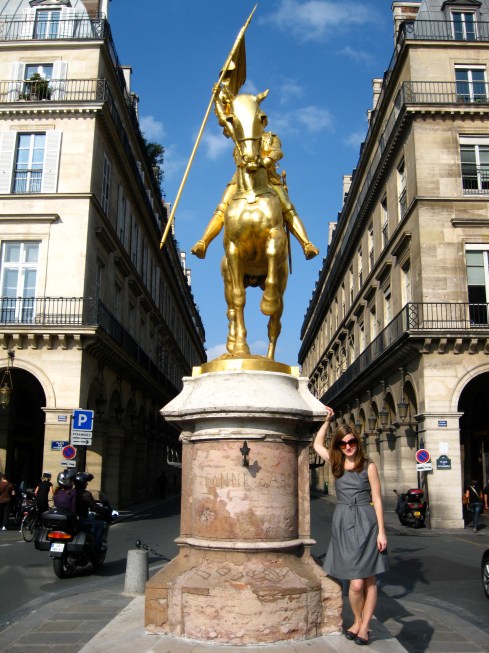
Joan and I - a romance for the ages

Joan and I – a romance for the ages

Of course, the only bad thing about taking a trip to Paris was that we had to come home at the end of it. Which meant that I had to get on a plane again.

No big deal, I said to myself. I’ll just take a bunch of Ativan and pass out again.

And that’s what I did.

Or, rather, that’s what I thought I did.

It wasn’t until a few weeks after our trip that Matt mentioned a show that we’d watched together on the plane. I patiently explained to him that I’d never watched that show with him; I’d watched it with a friend in Halifax earlier that year. He kept insisting that we’d watched it on the plane, which kind of freaked me out, because I’d obviously just married a dude who a) had hallucinations or b) thought it was hilarious to lie so obviously and conspicuously to me.

After another few minutes of arguing, I finally said, There’s no way that we watched that show on the plane. I slept the whole way on both flights.

Matt looked at me like I’d grown a third arm.

No, you didn’t, he said, you were awake for the entire flight back.

Even as I kept insisting that he was wrong, I began to feel a wave of horror wash over me.

I hadn’t slept on the way home. I’d been awake the whole time. I had absolutely no memory of this.

I began interrogating Matt with a Spanish Inquisition level of intensity. What had I said to him? How had I acted? Had I seemed like myself? Did I take off my clothes or do anything else embarrassing? Could he give me a play-by-play of the entire eight hour flight?

His answers were less than comforting. For example, he told me that I’d been talking to the woman next to me for a good chunk of the flight. Naturally, I asked what I’d been saying to the woman. Matt just shrugged and said, I don’t know, you were speaking French.

I WAS SPEAKING FRENCH IN THE MIDDLE OF AN ATIVAN BLACKOUT. I WAS TALKING TO STRANGERS IN FRENCH AND NO ONE HAS ANY IDEA WHAT WAS SAID.

Horrifying.

I begged Matt to tell me that I’d at least stayed in my seat the entire flight and not bothered anyone other than the Francophone woman next to me. I really needed to know that he’d kept an eye on my altered-state self the whole time.

He thought about it, then said that at some point I’d gotten up to go to the bathroom.

Did you follow me? I asked him, hopefully, desperately.

He just rolled his eyes.

The thing is, for all he knows, the minute I was out of his sight I started taking off my clothes and/or making out with the flight attendant. It’s possible! Literally ANYTHING is possible.

I told him that if we ever flew again, it would be his job to follow me everywhere, up to and including into the tiny airplane bathroom.

Of course, when I said that, I had no intention of ever flying again anyway.

You guys, having a phobia of flying sucks. Like, it sucks badly. First of all, every single person that you know feels the need to tell you that more people die in car accidents than in airplane crashes. Every time someone says that to me, I’m like, Whoa, really? You are the first person to ever mention that to me! Thank you! I’m cured!

No, but seriously, the next person to tell me that will get – well, they’ll probably just get a dirty look, but what I want to do is way worse than that.

I know that my fear of flying isn’t logical. If it was logical, I would probably be over it by now. I would just talk myself out of it. I am the master of talking myself out of things. You should see how well I talked myself out of cleaning the bathroom the other day. I did it in like five minutes! So that’s really not the problem here.

Logically, I know how safe airplanes are. I know how unlikely it is for anything to go wrong on an airplane, thanks to my sister-in-law, I even sort of know how they fly (hint: it’s not by magic). But even though my mind knows all those things, it has made an executive decision not to give a shit about facts and to go on being afraid. Thanks, mind. Thanks a bunch.

I hate not being able to fly. I hate that there are so many places that I might never visit because of my stupid malfunctioning brain. I hate that anytime I go someplace far away it takes me fifty years to get there, whereas it would take the average, flying-capable person an hour. I feel like I’m missing out on so much, and I don’t know what to do about it.

I guess I could do the Ativan thing again, although the idea doesn’t thrill me. It’s not so much the blackouts that scare me (well, they might scare me a little), but the fact that a lot of my anxiety happened in the weeks leading up to our flight. Also, in spite of all the drugs I took, I still felt pretty scared on the plane.

Another issue is that now I have Theo. I can’t imagine flying with Theo and Matt; not only would I be totally useless as a parent, but for Matt it would be like dealing with TWO toddlers.

Basically, what I really need is for someone to just knock me out anytime I have to fly, like B.A. Baracus on the A-Team:

If that means that I have to wear a lot of gold jewelry and say “I pity the fool”, well, that’s a price I’m willing to pay.

In all seriousness, what I probably actually need to do is start taking short flights with people who are super chill about flying. People who will hold my hand and tell me that everything is fine and/or tell me to shut up about dying already. I need someone who is willing to put up with my bullshit for at least an hour, probably longer when you factor in the trip to the airport, checking in, going through security and waiting for the flight to board.

I guess that what I am saying here is that I am now accepting applications from people who are willing to put up with my bullshit for a minimum of four hours. COULD THIS BE YOU? Apply within!

p.s. I’m not willing to share my Ativan, even if you’re brave enough to fly with me. I will need the entire contents of my pill bottle, and possibly more.

National Day of Remembrance and Action on Violence Against Women

7 Dec

When I was a kid, my mother had a button that looked exactly like this:

399036_s

I couldn’t find a very large image of this button, but in case you’re wondering, around the edge it reads: “In commemoration of the 14 women killed in Montreal, December 6th, 1989 and all women who have suffered from violence.”

Every year, after my mother retired her Remembrance Day poppy sometime in mid-November, she would break out her rose button and pin it to the lapel of her coat. As a small child, I remember coveting the button, because I liked the picture on it. When I was older, it made me uncomfortable; I didn’t like that my mother wore a pin to commemorate a mass murder, and the look on her face and the tone in her voice when she explained the story behind it frightened me. Strangely, the story itself didn’t frighten me; it seemed too remote, totally removed from my day-to-day life. It was a freak accident; a tragedy, yes, but nothing that could ever happen to a person like me.

Later still, when I was a teenager and irritated by everything my mother did, I found the button obnoxious and sanctimonious. I’d grown up hearing my mother referring to herself as a feminist, a term that I refused to apply to myself. It seemed to me that most boys hated feminists and, when I was a lonely high school student with low self-esteem, the last thing I wanted was to do something that would cause the boys I knew to reject me even more. When they made jokes about women, jokes whose real punchlines were how stupid and pathetic women were, I laughed. Sometimes I joked back, making fun of the way girls dressed, of how many guys they slept with, how idiotic and shallow they were. Sure, I was a girl, but I was on their side – I wasn’t one of those girls. Never mind the fact that I probably would have given my eyeteeth to be cool enough to be one of those girls.

Back in those days, whenever late fall rolled around and my mother broke out her shabby, rusting rose button, I would roll my eyes. He was crazy, I would tell my mother. Like, mentally ill. It had nothing to do with women, he was just nuts. What if he’d killed only Dutch people? Would we have national day of remembrance and action on violence against Dutch people?

When I was a teenager, I thought that feminism was pointless at best, and a way of angering and alienating people at worst. It hadn’t yet occurred to me that sometimes angering and alienating people was a good thing; that there might be situations in which I wanted people to feel negatively about me and the things that I said. At the time, I couldn’t imagine not wanting to please every body, just like I couldn’t imagine anyone wanting to kill me simply because I was a girl.

Now I know differently.

I’m not saying that anyone’s out to get me specifically, because as far as I know, they’re not. It probably helps that I come off as fairly non-threatening – I’m a small, mousy white woman who doesn’t work in a male-dominated field. I’m a shy, quiet woman who pretty much totally followed the status quo – I finished high school, went to university, then married a nice guy and had a kid before I turned 30. Probably the most threatening thing I do is blog (extensively) about women’s reproductive rights, but that hasn’t generated any death threats or anything.

But there are still people who hate me because of my gender. I mean, maybe not openly, maybe not obviously, but they do. We live in a culture of casual misogyny. A culture where over 600 First Nations women are missing or have been murdered in Canada, only to have our government do nothing about it. A culture where female sex workers are treated as objects instead of people. A culture where women are told to be less angry when they talk about the events of December 6th. A culture where women are constantly being ridiculed, judged and set up in competition against each other. A culture where my sister, an avid World of Warcraft player, has been asked repeatedly to turn on her webcam and show other players her breasts in order to “prove” that she’s a woman.

When Marc Lépine went to the École Polytechnique 23 years ago today, he entered the school with the intention of killing feminists. Feminists, he said in his suicide note, had ruined his life. Lépine had applied to the École Polytechnique in both 1986 and 1989 but had been rejected both times because he lacked the CEGEP courses necessary for admission. In Lépine’s mind, however, he wasn’t admitted to the school because women had taken too many of the available spaces. Women, he thought, had taken everything important, and left nothing for him.

Lépine killed 14 women just because they were studying engineering. Lépine killed 14 women for daring to want careers in a male-dominated field. Lépine killed 14 women for being women.

I was seven years old when École Polytechnique Massacre happened. I want to think that the world has changed since then, but really, has it? Women are still the butt of the joke. Women are still lacking in positions of power. Women are still being told that they need to compete against each other. There is still a persistent bias against women in the worlds of math and science. If there’s anything that can be learned from the latest American election, it’s that there are still men who hate women. A lot of men. Powerful men.

I don’t know if my mother still has her rose button. Probably not – I haven’t seen it in several years, and the last time I did, it was looking pretty beat up. I wish she did, though, and I wish that she lend it to me. These days, I would wear it with pride.

Rape Jokes and The Oatmeal

5 Dec

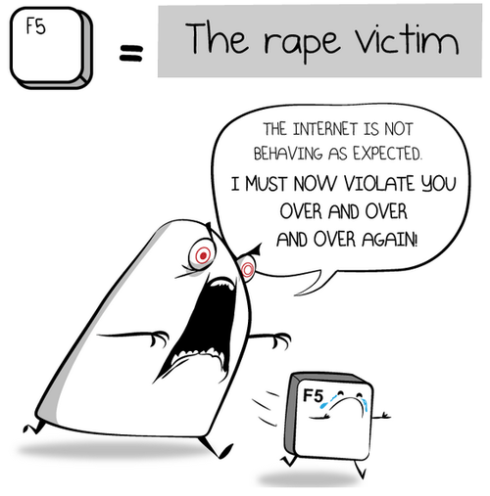
Yesterday, Matthew Inman from The Oatmeal wrote a comic about the “delicate relationship” that he has with his keyboard.  This was the final panel of the comic:

rape-f5rape

The comic in its entirety was about how he feels and behaves towards the various keys in his keyboard. This panel specifically was about trying to get a webpage to load when you have a slow connection, with the joke centering around Matt “raping” his F5 key in order to make the page load faster. Yes, it’s a rape joke. No, I’m not surprised. Yes, it’s supposed to be funny. No, no one would ever  actually “rape” a computer key. Yes, in spite of all that, I’m still grossed out. Now that all that is out of the way, can we talk about how terrible this is? Because it’s terrible. Really, really terrible.

The panel above is the type of joke that normalizes and trivializes rape. Instead of showing rape as an act of sexual violence that will haunt someone for the rest of their life, it’s hilariously portrayed as pushing your F5 key one too many times. What it tells readers is that rape is no big deal, that it’s just this thing that happens. It tells readers that rape is not a powerful word, but instead is a term you can use to describe any kind of forceful action. It tells readers that rape is normal, and even worse it tells rapists that rape is normal. The problem with jokes like this is that not only do they make rape victims deeply uncomfortable, they make rapists feel comfortable.

And I mean, you know what? As far as rape jokes go, this one isn’t that bad. I mean, not really. It’s not graphic, and it’s not even describing a plausible situation since, again, computer keys can’t be raped. If we didn’t live and participate in rape culture, this joke on its own wouldn’t be that big of a deal. But you know what? If we didn’t live in a culture where rape was constantly aided and abetted, a culture where rape is so normalized that we think nothing of making light of it, a culture where rape victims are frequently hushed up, dismissed or outright disbelieved, this comic would never have been made. This comic is a product of rape culture and it perpetuates rape culture. The message that this comment sent out to The Oatmeal’s nearly 800,000 Facebook fans (and the myriad other readers who follow the comic on Twitter or directly on The Oatmeal’s website) is that rape is no big deal.

It is a big deal, though. And when some readers of the Oatmeal told Matt Inman that rape jokes are a big deal, this was his response:

XekGY

I mean, first of all, it seems bizarre to blame Daniel Tosh for this backlash. Just because Daniel Tosh was called out for making a rape joke doesn’t mean that he was the first to do so, or that he invented rape culture. This joke wouldn’t have been funny before Daniel Tosh, and it sure as hell isn’t funny now.

Second of all, it’s really great that Matt Inman donated money to a battered women’s group. But that doesn’t give him license to say whatever he wants. It’s not like making a one-time donation gives him some kind of immunity to ever being called out on misogynistic shit that promotes rape culture. That’s not how it works.

Third of all, this isn’t censorship, and I hope that Matt Inman never lives in a place where true censorship exists. Freedom of speech means that you can say whatever you want, sure, but it also means that I get to call you out when you’re being a dick. You get to make jokes, and I get to tell you when they’re offensive. We are both afforded the privilege of freedom of speech. And you know what? I’m not even offended by this comic; I’m not going to give anyone that satisfaction. See, Matt Inman wants to believe that he’s done something so cool, so edgy, that regular, Family Circus-reading folk will be “offended”. Well, I’m not. I’m contemptuous of this comic, and I’m contemptuous of you, Matt Inman. Every time you make a joke like this, I think less and less of you. So no, you’re not being censored; you’re just hearing the reactions of people who aren’t on board with what you did.

I’m sure that there are people who will accuse me of being so wrapped up in feminism, so focussed on seeing misogyny wherever I look, that I’m just not able to recognize humour anymore. There are people who probably want to tell me that nothing is so sacred that you can’t joke about it, that “censoring” comics is the worst possible thing you can do, and that if I don’t “let” people make rape jokes then I’m some kind of fascist.

First of all, anyone who would think that should look up the definition of “fascist”.

Second of all, I don’t think that all rape jokes are bad. In fact, I even think that some of them are funny. The thing is, in order for a rape joke to be funny, it needs to do two things:

1. Not make rape victims the butt of the joke

2. Challenge the status quo, i.e. rape culture

Below is a video by Louis C.K. in which he makes a joke about rape that’s funny. If you are a comic, or aspire to be one, you might want to take notes:

See, what he’s doing in this joke is challenging the idea that rape is sexy or desirable. He’s challenging the idea that some men would leap at the chance to take a woman without her consent, while she is repeatedly telling them no, just because she’s giving out some kind of vibe. He’s challenging a culture that persistently insists that women don’t know what they want, that they play hard to get, that they lie and manipulate and shouldn’t be taken at their word.

That is a joke that challenges the way we think in a humourous way. That is what comedy should do.

Matt Inman did, thankfully, end up removing the rape joke panel, and tweeted the following earlier today:

It’s not the greatest apology, but at least it’s an apology, you know? I wish that he hadn’t included the “if”, because obviously people were upset, no ifs about it; it would have been better had he just flat-out apologized for the fact that people were hurt and upset. However, this apology is better than nothing, and it’s waaaay better than artists who continue to defend themselves after they’ve been called out for inappropriate behaviour. So I guess there’s that.

Sometimes stuff like this feels so relentless, like there’s no way to fight against it because you’ll just never win. Working to bring down rape culture feels overwhelming, because it’s literally everywhere. How do you fight nearly every movie you’ve ever seen, every book you’ve read, every casually misogynistic word that’s ever been spoken to you? Where do you even start?

Every once in a while, though, you do get someone who reconsiders what they’ve done and issues an apology, and that feels like it’s maybe the beginning of something. And like I said, maybe it’s not a great apology, but hopefully it will start people thinking. Maybe this will get fans of The Oatmeal really considering what that rape joke really meant, and why it wasn’t funny.

I think that if even one person who laughed at that comic sits back, thinks hard and changes his opinion, then this fight is worth it. If this post gets even one person to change their minds about how they view rape, and especially rape jokes, then I’ll be happy. Hell, even if this post does nothing more than get people who agree with me to start a conversation about this, then I’m good. The fact is that talking about this stuff, getting it out into the open and engaging people about it, is a huge first step to changing the status quo.

And I really, really want to change the status quo.

On Judgment And Breastfeeding

4 Dec

If you know me at all, even a little bit, then you know that I am a person who loves breastfeeding. I think breastfeeding is great, and will talk about it until you are super bored and/or uncomfortable. Half of the population of Toronto has probably seen my breasts by now, and not just because of my preference for low-cut tops. Most of the time I’m pretty sure my kid loves me, but there are days when I wonder if he loves my boobs more. If you ask me for breastfeeding advice, I will inundate you with more facts than you could ever possibly need. In short, I breastfeed, I’m proud of it, and I am a huge advocate for breastfeeding.

I think that one of the reasons I’m so into breastfeeding is that Theo and I struggled with it at first. He had a bad latch, jaundice made him too sleepy to stay awake for an entire feeding, and I just plain had no idea what I was doing. In retrospect, I know I got off pretty easy as far as breastfeeding issues go, but at the time it seemed like the end of the world. My son was only 5 lbs 4 oz at birth, and by the time we came home from the hospital he was only 4 lbs 12 oz. Every nursing session was a fight, and I started to dread feeding time. I also dreaded weighing him, because I was terrified of seeing the needle dip even lower on the scale. Here I was, blessed with an abundant supply of milk, and I couldn’t even manage do that simplest, most basic thing: feed my child.

I worked hard to be able to breastfeed Theo. While I was still in the hospital, I attended daily breastfeeding classes and would would call the nurses to come help me get Theo latched on every time he woke up. After we went home, I schlepped Theo back and forth to our family doctor and the hospital lactation clinic on a near-daily basis.  In those cold, sterile offices I would watch as other people weighed him, then I would let strangers manhandle my boobs and stare intently at my chest as I tried again and again to feed my son.

I pumped. I did “suck training” with a tiny tube attached to my finger. I cup-fed him. I bottle-fed him. Finally, I tried a nipple shield, which (hallelujah!) worked. With the nipple shield, Theo was at last able to fill his tiny belly with my milk and start gaining the weight he needed so badly. My kid has been a boob-addict ever since.

Now, the thing is, I know that a lot of my successful breastfeeding relationship is due to good old-fashioned hard work. I wanted to breastfeed, and I fought for it and, in the end, I succeeded. It was really hard at times, like, total-meltdown-cry-until-I-made-myself-sick hard, but even though I sometimes felt like giving up, I didn’t. And I’m proud that I didn’t quit, and I also have to give myself credit for sticking with it even when things felt impossible.

But you know what? Hard work only gets you so far, and I know that I wouldn’t still be breastfeeding today if I hadn’t had an amazing support system. I was lucky that my hospital offered such great resources to breastfeeding moms, I was lucky that our family doctor had breastfed both her children and knew what she was talking about, I was lucky to have a mother-in-law who was a former La Leche League leader (and a sister-in-law who knew a whole heck of a lot about breastfeeding), and I was lucky to have a family who gave me nothing but encouragement and love. If I hadn’t had these things, there’s a good chance that Theo would have been formula-fed, and I know that. So yeah, while hard work has played a big part in our success, I also realize that I’ve been able to breastfeed because I was just plain lucky.

Knowing that I was lucky to have such great support means that I want to offer that kind of support to other people. I cheer people on when they’re struggling to breastfeed, and I offer advice (usually only when asked) to new moms. I upload a ton of pictures of me nursing Theo to my Facebook page, partly because I just think they’re really nice pictures, but also because I think posting breastfeeding pictures publicly help normalize breastfeeding. Basically, if you want to breastfeed, I want to do whatever I can to help you! If you don’t want to breastfeed, though, that’s cool too.

Sadly, a lot of the breastfeeding community doesn’t feel the same way I do. I belong to a few online groups, and while a lot of the posts are asking for advice, or sharing cute, funny stories about breastfeeding, there’s an awful lot of judgment going on against women who don’t breastfeed. Mostly I’m used to it and I just kind of shut it out, because I still see a lot of benefit and good in the lactivist movement. Today, though, really took the cake. Today I couldn’t ignore this judgmental crap anymore.

See, there’s a story that’s been in the news lately about an Alberta mother who can’t afford the prescription formula that her infant son needs to live. Her son, Isaac, was born prematurely and subsequently developed necrotizing entercolitis (NEC), an intestinal disease that means that he has an inability to digest many foods, including dairy products, and can lead to internal bleeding. At four months old Isaac has already had two week-long stretches in the hospital, and continues to be at risk for bleeding and other problems.

Isaac’s mother, Lisa Caskenette, initially tried to breastfeed her son. Unfortunately, he had severe reactions to her milk, and, given the scope of his allergies (dairy products, whey, soy and whey protein, to name a few), she wasn’t sure that she could find an elimination diet that would work for her. As well, during Isaac’s two hospital stays he was allowed nothing by mouth, and although Caskenette pumped during that time, her supply dwindled. After consulting over a dozen experts, Caskenette decided to give her son Neocate, an amino acid-based, hypoallergenic formula which costs her $1,200 a month. $1,200 a month that Caskenette’s family cannot afford.

You’d think that this would be the kind of story that breastfeeding advocates would rally around, wouldn’t you? Unfortunately, what I witnessed today on a Facebook breastfeeding group was the opposite of that. Here’s a small sample of the comments people made after the group’s moderator posted a link to a story about Caskenette and her son:

She should breastfeed. That’s free and better.

She should be breastfeeding! That won’t cost a dime,the Insurance wont need to pay a dime and the baby would be a lot healthier!!!

Yes, she should be breastfeeding…formula use has been shown to increase the chance of NEC [this from the page’s owner/moderator]

Sometimes I wonder if people just don’t feel like sacrificing their own diet to make it acceptable for an allergic baby.

I think the cost is outrageous and I certainly would not be able to afford that, however I breastfed my kids. Or donor breast milk, we have 3 Milk Banks in Canada which you need a prescription for and she would have no problem getting a script for it. I would have pumped and pumped. However, she may not may not have tried that. I feel for the family, but she never mentioned anything about trying to nurse, pump or re-lactate. I do think the cost should be shared though. We have a public health care system and we pay for it by way of taxes etc and if her baby needs it then it shouldn’t have to cost $1200 a month, but I wish someone in her circle would mention she could try to breastfeed if she hasn’t. Her baby would be eating for free.

For the government to start subsidizing an industry that harms the health of its citizens is not the best idea. They should offer to fund the baby’s use of breastmilk from a milk bank if the mom is unable to breastfeed.

I looked up this condition and one of the reasons it occurs is improper mixing of formula, yet another reason breast would been best!

I find it hard to believe with all the support in Canada that NO-One would have given her the information she needed to do best for her baby! And yes the only thing that would stop me from giving my baby breastmilk is death!

Can’t breastfeed…not really. You could do an elimination of your diet. You could breastfeed. You opted not to. You don’t want judgment. You just want everyone to agree with you. Should the formula me covered? I actually think yes but the rest is just crap.

I wonder if she ever saw/spoke with an IBCLC to get support to breast feed? This baby needs human milk not formula to heal his gut. Perhaps she should look into eats on feets or similar organization to find mothers willing to donate their extra breastmilk. So sad that all this baby needs is breastmilk ;(

There are a few comments supporting and sympathizing with Caskenette, but most of them are just repeating over and over, ad nauseam, that she should give him breast milk. Most of the commenters agree that she should either relactate (which is a long and difficult process, and also doesn’t solve the issues she was having with the elimination diet), or else she should get donor milk (which wouldn’t work at all, because she has no way of knowing the diet of the women who donated the milk). Most of the comments were judgmental and hurtful; nearly every single one of the commenters felt that Caskenette was a selfish mother who just couldn’t be bothered to do what was best for her son.

Here is the one thing that I really want all of you to know: when you comment on something like this on a public page, you are writing actual words that will be read by actual people that can cause actual hurt. Is it really so difficult to try to be a kind, empathetic human being? Like, really? Can everyone just stop being dicks for like FIVE MINUTES?

It's kind of true, though

It’s kind of true, though

The other thing is that stuff like this does a total disservice to the breastfeeding advocacy movement. When you make comments like this, you’re making us all look like the crazy, narrow-minded, intolerant people all the stereotypes make us out to be. Comments like these are the reason people end up switching to formula, because they’re afraid of the judgment that will be thrown at them if they ask for help. You are not forwarding your cause, you’re hindering it. I don’t understand how you can’t see that.

I mean, in a perfect world, do I think that every biological mother would breastfeed? Hell yeah, I do! In a world where babies don’t get life-threatening illnesses, and women don’t go back to work after 6 weeks, and sexual assault victims don’t find nursing to be triggering, and no mothers need to take any medication that is contraindicated for breastfeeding, and there aren’t fucking booby traps everywhere you turn, and all healthcare professionals are well-educated about breastfeeding, and no mother had supply issues, and shitty formula marketing schemes don’t exist I think everyone could breastfeed. But I don’t live in that world and neither do you.

If you want to be a good breastfeeding advocate, here’s what you need to do: support and listen. Support the person wherever they are in their breastfeeding journey (even if they’re formula feeding), and listen to what they have to say. Maybe they won’t breastfeed this particular child, but maybe your love, support and advice will make them more willing to try to breastfeed the next one. Or maybe it won’t, and that’s fine too. All you can do is offer your help; you can’t make people take it. And what’s the sense in getting riled up over the fact that someone doesn’t breastfeed? Is that worth ending a friendship or hurting someone over?

If you want to help out Lisa Caskenette and her family, there are a number of ways that you can do that. First of all, you can find her on Facebook, and she does accept private donations to help her family with the cost of the formula. You can also advocate for her by writing to the Alberta Blue Cross (which should be covering the cost of the formula), or to Alison Redford, the current Alberta premier. Or you can just send Caskenette positive messages on Facebook, letting her know that you’re thinking about her and her family.

Anything, really, other than telling her that she’s a bad mother.

Baby Isaac

Baby Isaac

The Past Is A Foreign Country

2 Dec

In the beginning God created the heaven and the earth. And the earth was without form, and void; and darkness was upon the face of the deep, etc.

And then God created the Garden of Eden, and made a dude out of mud to be in charge of it. Then one day when this dude, Adam, was sleeping God took one of his ribs (ew) and from that rib magically made Adam a lady-friend, Eve. Then Adam and Eve lived in paradise for, like, three days, until Eve, the original third wave feminist (she embraces diversity, change and choice!), took some bad advice from a phallic symbol serpent and ruined everything.

And we’ve been nostalgic ever since.

Sometimes I think that nostalgia is the human condition. I mean, we’ve got a minimum of three major religions based on this yearning to get back to a past that none of us remember or even understand; the most we know about it is that Adam thought it was awesome. Then again, Adam also thought that wearing fig leaves was awesome, and was married to someone who was basically his clone (I mean, is that how it works? what with the rib and all? what’s the science here? anyone?). Anyway, what I’m trying to get at is that I’m not sure how reliable of a source he is.

I mean, here’s the thing: I am the queen of nostalgia. Ask anyone – I basically get nostalgic at the drop of a hat.

(Hey, remember that time you dropped a hat? How great that was? How much fun we had? Why don’t we ever have good times like that anymore?)

I don’t just moon over actual things that I’ve experienced either; I spent a good chunk of my childhood feeling nostalgic for just about any time in history, from the ancient world all the way up to The Great Depression (I blame a combination of having an aunt who is an egyptologist, reading excessive amounts of historical fiction, and watching Annie on VHS until the tape wore out). I used to drive my mother bananas by whining at her that I should have been born in the Victorian era (in response to which she would usually remind me of my fondness for indoor plumbing), and nearly every elementary school class photo shows me decked out in some kind of puffed-sleeve Anne of Green Gables floral-printed nightmare, grinning like a Cheshire Cat.

If there was a book at the public library with a picture of a girl in a laced-up bodice and peasant skirt, I’d read it. If there was a weirdo food mentioned in something I’d read (blanc mange, I am looking at you), I’d tried to find a recipe for it. After learning that people seriously believed in fairies until not that long ago, I began to (non-ironically) leave food in our backyard in case the fair folk were hungry for chocolate-covered graham crackers and milk. And you know what? To be honest, my adult self is not that different, although nowadays I would probably eat the cookies, fairies be damned.

What I’m trying to get at here is that I’m totally guilty of romanticizing the past. Totally! That being said, I don’t use that as an excuse to hate the present. I mean, I like flush toilets and computers and being able to vote and science-based medicine and all that good stuff. I am pretty down with modern life (although I am sad that I don’t get to wear bustles or hoop skirts). I guess what I am trying to say is that I am confused by people who think that living a middle-class existence in the western world is basically the worst, ever. I’ve heard women bemoaning the fact that feminism has ruined womanhood (is that even a word? my spellcheck thinks it’s a word), and the fact that women can now vote, own property and work after marriage is somehow preventing them from being stay-at-home mothers or housewives or whatever. I’ve heard people complaining about the “chemicals” in antibiotics, and saying that they only do homeopathic or herbal treatments – nothing “unnatural” or doctor-prescribed. I hear people talking wistfully about the days when science didn’t exist and everything was just natural and wholesome and wonderful.

People talk a lot about “authenticity” when it comes to objects and experiences. They don’t want Walmart to exist; they want everyone to buy things from farmer’s markets and local mom-and-pop pharmacies and department stores. They want to drive to Mennonite country to buy hand-made furniture and hand-dipped candles. They want to practice yoga at sunrise on a mountaintop with someone who has studied in India and can read their chakras. When they travel to South America, they don’t want to go on a guided tour; they want to see the unspoiled part of the rain forest, want to see the “real” locals who are unspoiled by contact with the west. We’re obsessed with our idea of what’s “real”; these days, people worship at the temple of the real.

Sometimes I think that our desire for authenticity has a lot to do with our love of nostalgia. We think that the people who came before us lived lives that were somehow more “real” than our own.

But you know what guys? The past is a foreign country, and so on, and so forth. We don’t know what it was like back then; all we can go by is what we’re told, or by deciphering what’s been left behind. We will never be able to understand how people felt or lived back then; their circumstances, though not totally alien to ours, are different enough that we will never fully be able to grasp their emotions, or beliefs, or the ins-and-outs of their daily lives. We just have to trust that yes, being a woman before feminism was a raw deal, and yes, modern medicine saves lives, and yes, science and modernity serve some kind of purpose. I’m not saying, let’s not be critical of society; what I’m saying is let’s keep pushing forward and trying to make things better instead of daydreaming about a past that we can never get back.

I’m not saying that Walmart is amazing, or that any of the things I mentioned up there are bad in and of themselves, just that it’s hard to have some kind of moral superiority about where you shop when there are kids who would probably starve if there weren’t discount stores where their parents could get a cheap meal. I’m also not saying that our society isn’t obsessed with consumerism, because we are; we’re consumerist as hell. But you know what? People in the past didn’t own less things because they were better than us; it was because they couldn’t afford them. If you want to live a life of simplicity where all you can afford is a mattress on the floor and one change of clothes, then by all means, please go ahead. However, don’t kid yourself that you’re being more “real” than the next person.

Sometimes I think that the appeal of history is that we know how all the stories end. We know who wins the Battle of Hastings, and whether or not Julius Caesar crosses the Rubicon, and whether or not the Titanic will ever reach New York (spoiler: it won’t). And yeah, a lot of history was scary and bloody and downright awful, but at least we know what happens. I mean, better the devil you know, right? Our modern lives terrify us because we don’t know how anything will end; sometimes it seems like we’re careening towards our own destruction, running full-tilt at things like global warming and nuclear war and widespread poverty and famine. I’ve got news for you, though: if these things terrify you, all the hand-dipped candles in the world aren’t going to save you. If you’re scared (and you probably should be), then get up and go do something, for God’s sake. Sitting at home wishing that you lived in Elizabethan England is going to accomplish exactly nothing.

I mean, except reminding you how awesome those giant ruffs were. Can we bring those back, please?

Bustles - the best, right? Baby got back, etc.

Bustles – the best, right? Baby got back, etc.

Female Feticide Is Not A Thing

29 Nov

I’ve been hearing a lot of talk about “female feticide” lately.

First of all, there was this Toronto Star article, published back in April, about the six GTA hospitals (all in areas with large South Asian populations) that won’t reveal the baby’s gender to parents because of fears of “female feticide”.

Then, there was Conservative MP Mark Marawa’s Motion 408, which reads as follows: “That the House condemn discrimination against females occurring through sex-selective pregnancy termination.” 

Most recently, I had the following image pop up on my Facebook feed:


Female feticide, or sex-selective pregnancy termination, is typically defined as an elective abortion performed after a pregnant woman has learned that her fetus is female. In cultures where males have higher status than females, and male children have more value than female children, it is becoming more and more common for women to terminate pregnancies based on the fetus’ gender. Two countries where this practice is especially prevalent are India and China; it’s estimated that the gender ratio in India for children under the age of six is currently 109.4 males to 100 females, and in China is around 106 males to 100 females (although in some provinces it goes as high as 130 to 100).

The fact that these abortions happen because girls have so little value in some cultures is abhorrent to me. The fact that a woman would terminate a pregnancy just because of the gender of the fetus both horrifies and sickens me. But you know what? Female feticide is not the problem, it’s just a symptom. The treatment of girls and women in certain cultures, and the underlying beliefs that lead to this treatment, are the problem.

There are so many things about the discourse surrounding female feticide that bother me; I even find the name itself problematic. I mean, first of all, let’s be super clear on one thing: FETICIDE IS NOT A THING. This is not a word people should use, unless they want to be seen as part of the pro-life movement. It doesn’t matter that it’s female fetuses being aborted; it’s still not called feticide. If a woman chooses to abort her fetus because prenatal testing has shown that is has some form of disability, do we call that “disabled feticide”? If a woman terminates her pregnancy because she can’t afford another child, do we call it “penurious feticide”? No. No we don’t. Why female feticide, then? Why do we target this one type of abortion as being so much more heinous than others?

All of which brings me to my next point:

There is no hierarchy of abortions. There is not one type of abortion that’s fine and another that isn’t. You can’t say that it’s all right for a woman to terminate her pregnancy because it’s just not the right time in her life to have a child, or because it’s her first abortion and she was using birth control and it’s totally not her fault, but then turn around and say that a woman can’t choose to abort based on the gender of her fetus. You are either pro-choice or you aren’t. It’s as simple as that. Sure, you can feel uncomfortable about the reasons why another woman might terminate a pregnancy, but guess what? You don’t get to say shit about it, because it’s her choice.

See, that’s really the crux of the matter here: choice. Choice, and bodily autonomy, and agency. When you don’t give a woman all of the information available regarding her pregnancy because you are afraid that she will make the wrong choice with that information, then you are removing her agency. Ultimately, don’t we want to be empowering women and girls in these cultures that give their lives so little value? How is removing a woman’s agency empowering her at all?

I know exactly what you’re going to say. But what if she’s pressured into the decision to abort? What if she asks for an abortion because her husband is forcing her to get one? 

For one thing, there is no foolproof way to tell if a woman is being forced or manipulated into something. None. We can’t just go around operating on the assumption that any given woman out there is being controlled by a man; I think we have to assume that they are acting under their own power until proven otherwise. For another, what is a woman going to learn if she goes from a partner who is trying to control the outcome of her pregnancy to a doctor who is also trying to control the outcome of her pregnancy? The main thing that she is learning is that she has no agency over her own body. Finally, maybe a better solution would be to provide safer spaces for women who doctors feel are at a higher risk for being in abusive relationships; we should give them the chance to speak their own mind and present them with information and resources, rather than just refusing to reveal their fetus’ gender.

Another issue that I have with the term female feticide and the ways that we talk about it are that it’s hard not to feel like this is an effort by the pro-life groups to try to get feminists and liberal left-wingers on board with the idea that abortions are wrong. It kind of happens in baby steps, you know? First we say that one type of abortion is wrong and should be made illegal, and then another, until finally the procedure is outlawed altogether. I mean, it seems very telling that Motion 408 was put forth by a Conservative Party MP, you know? Looking at that graphic above, I can’t help but imagine it without the text at the bottom – just a fetus with the text, I want to live, Maa. Seen that way, it bears a striking resemblance to a lot of the pro-life rhetoric.

I guess that at the end of the day, I just don’t see how limiting a pregnant woman’s knowledge about her fetus, or not allowing her the choice to terminate her pregnancy, is going to empower women. All that will happen is that she will give birth to a daughter that she (or her husband) doesn’t want, who might end up being neglected, hurt, or even killed; if that daughter somehow makes it to adulthood, she will likely marry, get pregnant, and continue the cycle. What we really need to do is find ways to change these pervasive and damaging beliefs that males are more valuable than females. We need ways to to alter all the big and little cultural practices and ideologies that elevate one sex over the other. We need to attack the root of the problem  if we ever truly want to solve this.

Ultimately, what we really need to do is to find a way to make the world safer and better for all women, so that female children are no longer viewed as a curse. Because they’re not a curse; they, like male children, are a gift.

Odds and Ends

28 Nov

Just a few quick things:

1. I have another post up on Shameless Magazine’s website. It’s called Rape Culture in Popular Culture and includes hot pictures of Joseph Gordon-Levitt. Something for everyone!

2. I am now a regular contributor to Shameless Magazine’s blog, rather than just a guest poster. YUS. WRITER CRED.

3. In the wake of Savita Halappanavar’s death, many people have been wondering if there’s anything they can do to help other women who might be in her position. The Abortion Support Network helps women travel from Ireland to the UK in order to get abortions. They provide financial support, emotional support and accommodation for Irish women seeking abortions, and are a pretty awesome organization.

4. I love, love, love this article from Vice, You’re a Pussy if You Think There’s a War on MenEspecially this part:

“Yeah, no shit men are “pissed off” about “competing” with women. It’s pretty simple—decades ago, lazy men didn’t have to worry about talented women taking their jobs because they were largely relegated to being housewives or teachers or nurses. Now that women can dictate the terms of relationships and don’t need to latch onto a man as soon as possible, they aren’t willing to start pumping out babies and taking care of a household the way some guys would like. Boo-fucking-hoo. Cry me a river.”

Haaaaaaah.

5. I actually cannot stop listening to this song right now. Frig, I hate winter.

6. My kid is hella cute:

Saint Catherine’s Day

26 Nov

Today is the feast of Saint Catherine, a fact which really means nothing to me now that I’m a bonafide adult living in a secular, anglophone world. When I was a kid attending French Catholic school, though, St. Catherine’s Day was one of my red-letter days. Back then, every month seemed to have a holiday or feast day; these little celebrations and diversions helped us make it through the long school year. For anglo kids, the big November holiday was probably Remembrance Day, but for those of us at École Cardinal Léger, November 11th was always overshadowed by November 25th. This was true for one reason and one reason only: candy. Lots of candy.

Saint Catherine of Alexandria is mostly famous for the terrible way she died. Born to the (pagan) king and queen of Alexandria, Catherine converted to Christianity at the age of 14. The reason for her conversion was a mystical vision in which the Virgin Mary gave Catherine to Jesus as a wife, and the two of them joined together in a holy union – I mean, you know, the usual. Catherine went on to convert hundreds of pagans to Christianity which, naturally, angered the Roman emperor at the time, Maxentius. Maxentius, a big fan of persecuting Christians, decided that the solution to his problem was to marry Catherine. When she refused (because she was already married to Jesus, duh), he tried to break her on the wheel. God, naturally, destroyed said wheel, so Maxentius just beheaded Catherine instead. I’m unsure as to how God could destroy the wheel but still allow her to be beheaded, but, um, I guess he works in mysterious ways?

Naturally, you want to know what the hell this all has to do with candy.

Relax. I’m getting to that.

The key to our modern celebration of Saint Catherine’s Day is Marguerite Bourgeouys, a nun who came to Canada in the 1600s. Marguerite opened a public school for girls in Montreal in 1658 (yay!), which marked the beginning of public schooling in Montreal (double yay!). She then decided that the First Nations children should also attend her school (problematic?) and began to devise ways by which she could lure them to her schoolhouse (definitely problematic). Her solution was to make taffy and then leave a trail of said taffy all the way from the local First Nations settlement to her schoolhouse (SUPER PROBLEMATIC). Oh, and apparently she made this taffy on St. Catherine’s Day, and young French Canadians have been doing so ever since.

I mean, at least her intentions were good? That has to count for something, right?

Marguerite Bourgeoys and her First Nations friends: 99 Problematics

Anyway, Marguerite Bourgeoys is a saint now, so at least she’s got that going for her.

My sister was born on November 24th, 1988. I remember the day of her birth pretty clearly; my mother came into my room early in the morning to tell me that she was going to the hospital to be induced, and then my principal pulled me out of class around noon with the news that I was now a big sister. My principal let me sit in her office and make my mother a card, probably assuming that I would produce the standard “YAY BABY” Hallmark-type fare. I, naturally, had other ideas in mind. Most likely influenced by the fact that Christmas was only a month away, I ended up drawing my mother as the Virgin Mary and my new sister as the Baby Jesus. Being a student at a Catholic school, I, of course, had heard the term virgin thrown around. However, being only six years old, I had no idea what it meant. I thought that “virgin” was synonymous with “good person”, which helps explain why, on my card, I wrote, Maman, tu es une vierge [Mama, you are a virgin]. I think I remember indulgent smiles from the grown ups at my school; at any rate, they didn’t immediately seize my card and burn it, so it couldn’t have been too blasphemous.

That night, I went to visit my mother in the hospital. There was an earthquake while we were there; a small one, but big enough that it made the glass tremble on my mother’s bedside table and the tacky framed prints sway on the wall. My parents laughed, and joked that it was an omen portending that my sister would accomplish great things. That one remark was a watershed moment in my life; for the first time, I experienced that complicated, emotionally charged state that we call sibling rivalry. What did they mean that she would accomplish great things? Had they said the same thing about me at my birth? What had my omens been?

I asked if there had been an earthquake the night I was born. No, my parents said. How about a full moon? A thunderstorm? Anything? My parents just rolled their eyes and laughed. Meanwhile, I glared at my fat, red, wrinkled nemesis.

The next night, when my father brought me back to the hospital for another visit, I proudly announced that we’d celebrated St. Catherine’s Day at school by making candy. My parents, who hadn’t yet come up with a name for my sister, gave each other this look like, WHOA, ARE YOU THINKING WHAT I’M THINKING? WE ARE FOR SURE GENIUSES.

Needless to say, they named her Catherine.

Catherine, which I thought was probably the bossiest name I’d ever heard.

Catherine, the perfect name for someone who would accomplish great things.

As if to rub salt in the wounds, my parents insisted on telling everyone that my sister’s name had been my idea. Whenever they said this in my presence, I would yell, THAT’S A DAMN LIE, I WANTED TO NAME HER SOPHIE, and then, naturally, immediately get sent to my room. I spent a lot of time in my room after my sister’s birth, mostly because I couldn’t understand how my parents could equate my casually mentioning a name in their presence with suggesting it as the word that we would ever use when referring to my new sibling. In retrospect, I’m sure that my parents were trying to help me adapt to having a sister after spending more than half a decade as an only child; at the time it just seemed like they were wilfully ignoring everything I had to say.

When Catherine started school, her teachers went out of their way to make St. Catherine’s Day a big deal for her. They would make her a paper crown, and spend the day treating her like a princess. At the end of the festivities, she would bring home a bigger pile of candy than anyone else.

Did I have a special saint’s day that gave my the chance to wear a crown and bring home an exceptionally large pile of candy?

No. No, I did not.

Probably because I wasn’t destined to do great things.

Throughout Catherine’s early years, I found various ways to torment her. I stuck clothespins in her hair. I called her ridiculous names. I made faces at her at the dinner table. Nothing I did was overly terrible, but then, it didn’t need to be; Catherine threw tantrums as if she had a calling for it. Catherine screamed and kicked as if it was her vocation; she once had a legendary meltdown over the fact that her toast was cut  vertically instead of diagonally. This meant that it was both easy and satisfying to provoke her.

When I entered my teen years, my mother developed a fascination with mediums and psychics. She began having her tarot cards read on a regular basis.

“The psychic says that Catherine is the Queen of Pentacles,” she told me once in the car, as she was driving me to a dance class.

Naturally, I was more interested in what she’d had to say about me.

“Oh, she says, you’re boy-crazy,” my mother replied dismissively, “as if I didn’t already know that. But she says that Catherine is the Queen of Pentacles.”

“What does that even mean?” I asked

“I don’t know, but I’d better not hear you making fun of her for it,” my mother said in her most threatening tones.

Why would I make fun of her for it? I knew exactly what it meant. It meant that she was destined to do great things, while I was destined to be a pathetic, boy-crazy teenager forever.

Catherine and I continued to have an adversarial relationship throughout the rest of my time in high school, and my first few years of university. I can clearly remember bringing Matt home to meet my family for the first time, and whining to my mother about how Catherine was being rude to him. I don’t remember what she was being rude about, mind you, just that I didn’t like the way she talked to him. Catherine told me constantly that I was old and boring, and that my music sucked. While I was nearly always single and lonely, Catherine had a steady stream of boyfriends from the time she was 13. Instead of abating, our rivalry seemed to be heating up. On top of all that, I was deeply embarrassed by that I was jealous of someone who was six years younger than me.

This continued on for several years, until, sometime in my early twenties, we had a fight. Like, a big fight. I don’t even remember what it was about, I just remember yelling, even screaming at her. I was furious. Beyond furious. Somehow, having run out of things that actually had to do with what we were fighting about, I got around to the anger and jealousy that I’d been harbouring all these years.

You don’t even like me,” I yelled at her. “Why do you even bother talking to me? You don’t have anything to talk to me about! You think you’re better than me! You think you’re going to do great things!”

At this point, Catherine burst into tears, which, if you knew her, you would know how highly unusual that is.

“What do you mean I don’t like you?” she wailed. “I love you! You’re my big sister! I look up to you for everything!”

That stopped me dead in my tracks. How could it possibly be that my sister, my destined-for-great-things, Queen-of-Pentacles sister could ever look up to me, failure that I was, for anything?

That night was a turning point in our relationship. We’ve been close ever since; she even lived with us for a few months this year. Now that she’s back living three hours away, I miss her, even though we talk all the time.

I hope she had a good birthday.

I hope she knows how proud I am of her.

I hope that this year she continues to do great things.

I hope that she had some candy today, in honour of St.Catherine.

Catherine with her cat, Chairman Mao

Happy birthday, little sister.

p.s. Here is a recipe for St. Catherine’s Day Taffy, if you want to try making it yourself.

An Open Letter to Margaret Wente (please stop perpetuating gender stereotypes)

23 Nov

Margaret Wente wants me to know that I don’t care about my son.

Well, not my son, specifically; she thinks that I don’t care about any boys. Or, at least, any “real boys”, whatever that might mean.

See, Ms. Wente recently wrote this lovely and super-balanced article for the Globe and Mail about the gender gap in education. For this piece, she interviewed the principal of Upper Canada College (one of our country’s most prestigious boys’s schools), two of his colleagues, and the executive director of the International Boys’ School Coalition (a not-for-profit coalition of schools that promote the “education and development of boys world-wide”) – so, all people who have a vested, financial interest in promoting the idea that boys need to be educated separately or differently from girls. She did not interview anyone who does not make money from boys-only education. See what I mean? Balanced.

It’s a fairly well-known fact that, percentage-wise, less boys are entering university than girls, and that more boys are dropping out of high school. Margaret Wente, and others like her, argue that this is because Canadian education today favours the learning styles of girls over that of boys. However, I find it interesting to note that the percentage of males obtaining a university degree has, in fact, increased by 5% since 1991 (though admittedly the percentage of females has increased by twice that amount), and the high school drop out rate for both males and females has been steadily declining for the past 20 years. Also interesting to note is that the gender gap is much smaller for those enrolled in college – there is only a 2% difference between the number of male and female college students. So what, exactly, am I trying to prove with all these numbers? That things maybe aren’t so dire as Margaret Wente makes them out to be, because according to her the situation is pretty dire. See, Margaret Wente thinks that we’ve reached some kind of boy-ocalypse that will certainly end with the extinction of males in academia.

Ms. Wente wants us to believe that women have “stormed the gates of medicine and law” (which may or may not be true – it’s hard to say, because she provides absolutely no sources for any of her claims), but interestingly she neglects to mention that a heavy and persistent bias against women in science still exists, or that most law firms are little more than old boys’ clubs. Ms. Wente wants us to know that,”In the most prestigious programs at some of our leading universities, the gender ratio has reached 70:30″, although she totally neglects to tell us what those prestigious programs are, and which leading universities offer them. It’s kind of hard to argue with someone who provides you with no reference for her “facts”, but I will say that my department at university (Classics) was overwhelmingly male. It’s possible that my program just wasn’t prestigious enough, or that Ms. Wente doesn’t consider Dalhousie to be a “leading” university. Who can say? I mean, other than Ms. Wente, that is.

Anyway, after a whole bunch of hyperbole, Margaret Wente finally gets down to brass tacks and explains what, exactly, she’s trying to get at: she feels that our school are not addressing boys’ needs in the classroom. Fair enough! So, what, according to Ms. Wente, are those needs?

Let’s take look, shall we?

“Boys’ existential issues are different from girls’. For a boy, the two most important life questions are: Will I find work that’s significant? And will I be worthy of my parents?”

Huh. That’s funny, because those things are both really important to me, too! Ms. Wente neglects to mention what the two most important “life questions” are for girls, but I have a sneaking suspicion that she believes they have something to do with marriage and babies.

“When boys themselves are asked what they need, they say: I need purpose. I need to make a difference. I need to know I measure up. I need challenge. Above all, I need a meaningful vocation.”

Well, that makes sense, because those are all things that are definitely not very important to girls. I mean, except for the fact that I would say that most of these are the driving forces in my life.

‘Boys also need to imagine themselves in heroic situations. When girls are asked about Vimy Ridge, they say, “Whew, it must have been horrific.” When boys are asked, they imagine what they would have done if they’d been there. “Our most powerful assembly is on Remembrance Day,” says Mr. Power. “Every boy is thinking to himself: How would I have measured up?”’

Well, I’m sure that that has nothing to do with the fact that we live in a culture that glorifies violence and war, right? Also, and this might just be my vagina talking, I tend to think that “horrific” is a pretty accurate description of Vimy Ridge.

Boys love rituals, trophies and tradition. Those also make them feel part of something bigger than themselves.

None of those are things that girls like. Ever. Girls hate working to achieve something, and if they do somehow manage to stumble upon an achievement, they definitely don’t want a trophy for it.

So far, I’m kind of having a hard time seeing what Ms. Wente is getting at, but then she decides to really lay it out for us. The problem with boys and education is that we’re not allowing them to be manly enough.

Many commentators – men as well as women – blame male culture itself for the problems with boys. In their view, what we need to do is destroy the death star of masculinity and all the evil that goes with it. What we need to do is put boys in touch with their emotions and teach them to behave more like girls.

This argument might make some sense – if you’re someone who believes that masculinity is nothing but a social construct. But people who care about real boys know that’s not true.

See? I told you that Margaret Wente doesn’t think that I care about real boys!

Time to get real, you guys. I’ve been pretty flippant up until now, but I have to tell you, it makes me pretty fucking angry that Margaret Wente likens understanding and acknowledging your feelings to behaving like a girl. First of all, I don’t think that there is any way to behave “like a girl”. Second of all, I think being “in touch” with your emotions is an excellent idea for anybody, regardless of their gender. Third of all, I am so fucking sick of people equating breaking down gender barriers with making boys “behave more like girls”. How about we just stop insisting that people fit into narrowly-defined gender roles?

The funny thing is, it’s those gender roles that are responsible for so many of the issues that Margaret Wente is complaining about.

Here are some examples:

The dominant narrative around difficult boys – at least in the public school system – is that they’re unteachable, unreachable, disruptive and threatening.”

But why doesn’t she question the fact that we live in a culture that puts value in boys behaving in a threatening way? Why doesn’t she wonder how, in our fucked-up view of masculinity, we equate violence with power?

[Women have] all but taken over pharmacy and veterinary work.

Gee, do you think that’s maybe because those career paths have come to be seen as more typically feminine? Do you think that there’s a chance that less boys are entering those fields because they’re afraid of compromising the masculinity that Ms. Wente praises so much?

Before the Industrial Revolution, boys spent their time with fathers and uncles, often engaged in strenuous physical activity. Now they spend their time in the world of women, sitting behind desks. If schools threw out the desks, they’d probably be a lot happier.

It’s interesting to note here that Ms. Wente fails to mention that before the Industrial Revolution it was only boys who permitted to attend school. And guess what? Schools back then included desks as well. In fact, I would argue that, in the past, formal education involved far more sitting at a desk than it does today. And you know what? If we’ve come to equate the idea of school as being part of “the world of women”, then that gender stereotype is likely one of the reasons boys aren’t thrilled with being in school.

Look, I’m not here to argue with the idea that boys are lagging behind in our educational system. I’m not here to say that things don’t need to be changed, or that I don’t believe that boys develop differently from girls; having watched my son and his peers I know that, for example, girls tend to have an easier time with language, whereas boys excel at spatial awareness. I’m not even against the idea of educating boys and girls separately (although I would be lying if I said I didn’t have concerns about the equality of the education they would receive). What I am saying is that I don’t think that re-inforcing gender stereotypes is what is going to fix this. In fact, I think that those gender stereotype are what got us into this mess.

What if, instead of having this be a battle of boys vs. girls, we use this as an opportunity to find a way to meet each student where they are. Can’t we engage our students as individuals, rather than saying that the whole curriculum has to be rejiggered to benefit one or the other? Is there any way to find a curriculum that will be the perfect middle ground? Or will we constantly be going back and forth between uh oh now the girls are doing better, no wait now it’s the boys, no wait the girls without ever finding a balanced way to address the subject?

I hope that when Theo starts school, his strengths and weaknesses aren’t treated as being boys’ strengths or boys’ weaknesses; I hope that they are treated as his own individual issues, his own successes and failures, and that his teachers are able to see past his gender and appreciate him for himself.

That’s what we all want, isn’t it?

I can’t do yoga (and other lies people tell me)

21 Nov

I honestly can’t tell you how many times I’ve had this conversation:

Person I Just Met: So, what do you do?

Me: I’m a yoga teacher.

Person I Just Met: Oh, neat! Where do you teach?

Me: Right now I’m mostly just subbing, but I teach a regular weekly class at [local studio]. You should come!

Person I Just Met: Oh, um, yeah, maybe. We’ll see!

Me: It’s pay-what-you-can and all levels. I would love to have you!

Person I Just Met:  I can’t do yoga. I’m just really not flexible. Sorry!

Here’s the thing: anyone can do yoga. I honestly believe that. I have taught a yoga class to a room full of octogenarians who stayed seated in comfy chairs the entire time – if they can do yoga, then so can you. It doesn’t matter how flexible your body is – any and all poses can be modified to meet you where you are. And really, if you want to try yoga but lack of flexibility is your excuse, how will you ever improve your range of motion without first taking up something like a regular yoga practice? Everyone has to start somewhere – why not start now, today, whatever shape your body is in?

Having said all that, I know there are a ton of reasons why people shy away from yoga, and most of them have nothing to do with flexibility. Part of the problem is that the yoga culture in the west is kind of fucked up.

Yoga is an ancient Indian discipline dating back several thousand years. The first definitive text on yoga, Patanjali’s Yoga Sutras, is estimated to be about 2,000 years old, and the practice itself is even older than that. Yoga is one of the six astika, or orthodox, schools of Hindu philosophy, and in its original form was mainly a mental and spiritual practice with some physical elements.

The second sutra in Patanjali’s book pretty clearly outlines what was, at the time, understood to be the main goal of yoga. This sutra reads, yogah citta vrtti nirodhah, which is typically translated to mean something like, “yoga is the cessation of the movements of the consciousness”. In short, yoga is all about getting your brain to shut the hell up so that you can enjoy a little peace and quiet, for once. Yoga is also about moving past the busy, restless, endlessly nattering part of the brain, the one that Buddhists often refer to as the “monkey mind”, and towards the purusa, which I will loosely define here as a sort of universal consciousness. Yoga is meant to help you see clearly, and one of the things yoga philosophy tells us we need to learn to see is that all beings and all parts of nature are interconnected. We are all part of the same larger pattern, and we are all part of each other. Realizing that is the original, ultimate goal of yoga.

Here in the west, though, we view yoga mainly as a form of physical exercise. Although we chant OM at the beginning and end of every class, and although as part of our practice we often perform surya namaskara (sun salutations), movements whose original intent was to honour the Hindu solar deity Surya, the way we view yoga is pretty much totally secular. Oh sure, some people will tell you that it makes them feel “spiritual”, but most don’t think about the religious aspects of what they’re doing. There’s a lot of cultural appropriation that goes on in western yoga, a lot of white people wearing mala beads and chanting in sanskrit without really understanding what any of it means. In my time in the western yoga world, I’ve seen so many examples of people exoticizing Hinduism and Indian culture, but not many attempts to learn more about what all these words and symbols mean.

I could go on and on about cultural appropriation in yoga, and maybe someday I will. Right now, though, it’s mainly the above-mentioned white people that I want to talk about. See, yoga in the west has, for the most part, become the domain of young, skinny, upper-middle-class, heterosexual white women. I’m not sure how this came about, as, up until just a few generations ago women were forbidden from practicing yoga, but, well, here we are. And I, a young, skinny, white, middle class, heterosexual white woman want to tell you that this is a problem.

The main issue is that people feel intimidated not necessarily by yoga itself, but by the other students in the room. In a worst case scenario, people might feel unwelcome, even unwanted. The message that the yoga community often sends out is that students have to look a certain way, wear certain clothes, have a certain body type and a certain sexual orientation in order to practice yoga. There’s a lot of privilege going on in the western yoga world, and not a lot of yogis who are willing to acknowledge it. And you know what? That’s not cool, because yoga should be for everyone. Yoga is for everyone. Rather than ignoring or dismissing the problem, we in the yoga community need to sit up, take notice, and ask ourselves how do we solve this?

One way to help solve this is to create safer spaces for different types of students. For example, I love Kula Yoga’s Positive Spaces Initiatives, which include classes like “brown girls yoga”, and “queer yoga”. I think that we need more classes like this, more safe spaces catering to the needs of different groups. We already know that some people prefer specialized classes – prenatal yoga, for example, or yoga for seniors – so why not expand this idea? How about yoga for fat chicks, or yoga for trans folk? After all, yoga should be for everybody, not just a select few.

We also need more pay-what-you-can classes, which most studios call “karma” or “community” classes. The average cost for a yoga class in Toronto is between $16 and $20 – paying that amount even just once a week is not manageable for some people. We need to find a way to make sure that yoga is affordable to everyone, not just those with a steady income.

Mostly, what I really think we need is for people to realize that yoga isn’t about how you look, both in terms of poses and clothing, and is really about how you feel. As my (very wise) friend/teacher Charlene recently said, “Yoga isn’t the series of poses and movements that you do during class. Yoga is how you feel after the class.”

The thing is, I honestly believe that yoga has changed my life for the better; that’s why I teach it, so that I can hopefully share that experience with other people. I’m not saying that everyone has to do yoga, or that it’s going to have the same effect on other people as it’s had on me, but I do honestly believe that everyone should have the opportunity to have a regular practice if they want one.

After all, as yoga teaches us, we are all equal and all part of the same greater system.