
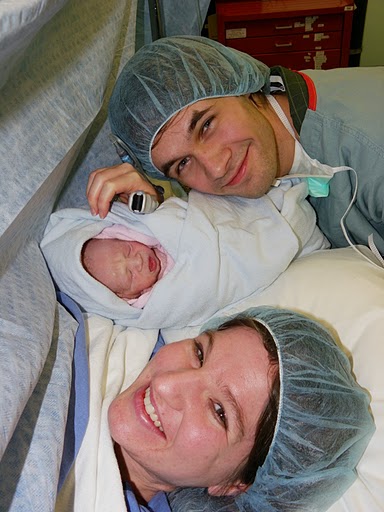
A friend of mine recently gave birth. She’d planned on have a natural, drug-free childbirth, but instead wound up having an emergency c-section. After 30 hours of labour, her son’s head still wouldn’t (or couldn’t) engage, and his heart rate started to plummet frighteningly low. After a few minutes of discussing their options with her midwife and the on-call OB, they decided that a caesarean was her best option.
Her son was born not long after that, a whopping 9 pounds 5 ounces, with a full head of dark hair. He was beautiful and healthy, but instead of feeling as if she’d made a decision that could potentially have saved his life, she felt as though it had been her fault that she’d had to have a c-section. She thought that if she’d just somehow tried harder, or prepared better, she could have had the birth she’d wanted.
I talked to her a few days after her son’s birth, and, of course, asked how she was feeling. “I feel like I failed,” she said, sounding as if she was about to cry. “My son is only a few days old and I’ve already failed him.”
I knew what she meant, because I’d been there. When I’d found out that I would have to have a caesarean, I also, irrationally, had felt as if it was my fault, as if I was already failing my son. I still feel weird about my son’s birth, even now, nearly two years later, or rather I feel like other people are weird about it. I can’t tell you how many times I’ve had someone ask about my childbirth experience, only to shut down the whole conversation when I tell them I had a planned c-section. I often get the sense that other people think that I haven’t really given birth, or that I’ve taken the easy way out.
If you don’t have kids and/or haven’t spent a billion hours on the internet debating all things baby, you might be wondering why natural childbirth is such a big deal. Why does anyone even care?
For starters, giving birth without drugs or interventions means that you and your child will not have to experience the side effects of sedation or the potential harm from invasive procedures. Babies born naturally are more alert, which will make bonding and breastfeeding easier. Plus, not having an epidural means that you can get up and walk around during labour, or find the position that works best for you when it’s time to push. Without drugs, the mother’s recovery will be faster, and she can often leave the hospital the same day, if she wants to. And, of course, there’s the persistent idea that childbirth is more of a “real” experience if you are able to feel every sensation associated with it.
Many people advocate for natural births these days; even the nurse who taught our prenatal class was pretty anti-epidural. Part of this comes as a backlash against the medical model of childbirth, which, not that long ago, saw women in labour being put into a Twilight Sleep, a drug-induced state in which women were conscious but not lucid, and, though these women still experienced pain, were not able to remember it afterwards. In many ways, natural childbirth is an attempt to reassert control over our own bodies; to tell the doctors (most of whom were and are still men) that pregnancy is not a disease, and should not be pathologized. Another part of the desire for drug-free childbirth comes from the assumption that “natural” is better, or from the idea that our bodies are designed to give birth without the aid of drugs or interventions.
Unfortunately, it’s hard to have a natural birth, and I don’t just mean the physical pain and exertion associated with drug-free childbirth. Hospitals make many people anxious, and trying to give birth while surrounded by beeping machines and scary-looking medical equipment is challenging, to put it mildly. On top of that, you have a regular rotation of people coming in and out of your room, wanting to check how far you’ve dilated, what your heart rate is, what the baby’s heart rate is, and a whole laundry list of other stuff. So giving birth in a hospital setting isn’t exactly conducive to that whole Mother Earth Goddess ideal that many of us hold.
So why not give birth at home? Good question. The answers range from being worried about not making it to the hospital in time if there are complications to not want to have to be bothered cleaning up the mess afterwards, and everything in between. One response that I hear very frequently form Ontario women is that they weren’t able to find a midwife; this was my experience as well.
When I had my first prenatal visit with my family doctor, I was eight weeks pregnant. She asked if I’d thought about how I wanted to give birth, and I told her that I wanted a midwife rather than an OB. She looked at me like I was crazy, and said that there was no way I would be able to find a midwife this far into my pregnancy. But I’m only eight weeks! I said. Technically I’ve only been pregnant for six weeks, if you take into account the fact that the first two weeks of a 40 week pregnancy happen before a woman ovulates.
My doctor just shrugged and said that there weren’t enough midwives in Ontario, then asked what hospital I wanted to deliver at. When I told her, she frowned and said, Oh, I don’t know if we’ll be able to get you into Mount Sinai this far into your pregnancy. I honestly thought that she was exaggerating, but it took three referrals before we were able to find an OB at Mount Sinai who was still taking patients for my due date.
That was how I learned how insanely competitive giving birth is in Toronto.
There are 540 registered midwives in Ontario, serving a total population of 12,851,821. 1 in 10 births in this province are attended by midwives; 4 out of 10 pregnant women in Ontario would like a midwife but can’t get one. That obviously makes having a midwife-assisted birth in general, and a home birth in particular, pretty challenging. Which, as I said above, can make having a natural birth difficult or even impossible.
That being said, you would think that the natural birth community would be pretty understanding of the fact that most women still end up using the medical model of childbirth. While I would say that the majority of us are pretty chill no matter how your kid comes into the world, there seem to be a lot of people passing judgment on how women give birth.
It’s bad enough that some proponents of natural childbirth make women feel as if they’ve “failed” if they end up having unplanned interventions, but that’s nothing compared to their treatment of women who know ahead of time that they want an epidural, or those who choose to have a planned c-section. The funny thing is that these are often the same women who are very pro-choice and will throw around the phrase “my body, my choice”.
Well, is it our choice, or isn’t it?
It’s different, they’ll argue, when there’s a wanted child involved. It’s not your body anymore. You need to act in the child’s best interests. They’ll send you scary news articles, like this one, which references a study showing that children born before 37 weeks are 5 times as likely to have autism. That particular article is one that someone sent me when they found out I was going to have a planned c-section at 36 weeks; when I told her that the article had upset me, she said that she wasn’t trying to be mean, just giving me the “facts”.
Here are the facts: if I had had a natural childbirth, my son could have died. If my pregnancy had progressed past 36 weeks, my doctor felt that there was a good chance that my water would break, which could have lead to an umbilical cord prolapse, which would have meant death or brain damage to my son.
The thing is, no matter whether or not you are carrying a child, it’s still your body. You still have bodily autonomy. I’m not saying pregnant women should go out and do lines of coke chased by vodka shots, but I do think that we need to allow women to make choices regarding childbirth without judging them.
The argument that I hear most from people decrying women who choose the medical model of childbirth is that they’re selfish. They want an epidural because it’s easier for them. They want a c-section because they don’t want to have to go through labour. They’re planning to be induced at 39 weeks because they want to skip out on the last week of pregnancy. If these are thoughts that you enjoy thinking, here’s something I really, really want you to keep in mind: you do not know the whole story.
You don’t know why someone wants an epidural, I mean, not really. You don’t know why they might want a c-section. Sure, they might give you a reason, but what they tell you may not necessarily be the whole truth. They might have a medical condition that indicates a c-section, or they might be a survivor of sexual abuse and feel triggered by the idea of a vaginal birth. Or they might just not want to have a natural birth, and that’s okay too. Know why? Because bodily autonomy, that’s why.
The thing that frustrates me the most about this judgmental behaviour is how purely anti-woman it is. It stems from the idea that most women aren’t capable of making decisions regarding how they want to give birth. It assumes that a woman who chooses to have a planned c-section hasn’t done her research, has been brainwashed by the medical establishment, or is uneducated when it comes to birth options. It plays into the idea that women are irrational, thoughtless and downright selfish. It promotes the idea that, being left to our own devices, we will make choices that are harmful to us and our children.
These are the same ideas that lead to the body policing that many pregnant women have to endure. We’re told to eat more, but not gain too much weight. We’re cautioned not to exercise too hard, but also to stay fit and healthy. We have people watching every bite we eat, and I even know someone who was denied service at Starbucks because the barista didn’t think that she should have caffeine. When are we going to let women be responsible for their own bodies?
Look, I’m all for natural childbirth. That was what I wanted when I was pregnant with Theo, and if I ever have another child, I would like to try for an unmedicated VBAC. But that’s my choice, based on research that I’ve done and what I’ve heard from friends. If another woman makes a different choice, then I’m sure as hell not going to tell her she’s wrong. Your child’s birth is one of the most important days in your life (I mean, probably, right?), so why would you want to make someone feel bad about how theirs went down? Shouldn’t we be celebrating the fact that we all went through hell, in one way or another, to bring our children into this world?
I think a big part of the problem is that we still haven’t really figured this childbirth stuff out. We still don’t know what works best for us, both as individuals and as a society. The medical model of childbirth has seen the infant mortality rate decline 90% in the last hundred years, and the maternal mortality rate has declined by 99% in that time. On the other hand, within that medical model women still feel as if they are being bullied into interventions and procedures that they don’t want, and often come out of childbirth feeling as if they were coerced into accepting “help” that they felt they didn’t need.
I don’t know what the answer is, I really don’t. More midwives, for a start. Better education about birth options and the possible complications of interventions would also be good. Above all, though, I think we need to put more trust in women. I think we need to allow women to make more of their own choices, and we need to believe that they are capable of making the right choices, not just for themselves, but for their children.





 The Belle Jar
Deconstructing Racism And Privilege
18 OctBefore we start, let me be really upfront about a few things.
First of all, I am not an expert on racism; I haven’t studied it extensively, and what I’m about to write here is mostly based on a few smart books/articles, conversations with friends, and stuff that I’ve read online. Oh, and feelings. I have a lot of feelings about racism.
Second of all, I’m white. I mean, like, really white. I have the complexion of an anemic Swede. So obviously I don’t fully understand racism and its impact because I will never personally experience it directed towards me. Everything that I’m writing here is offered as the perspective of someone who lives in the land of white privilege.
So with that baseline in place, I want to talk a bit about racism in general and some of the fallout from The Gap’s Manifest Destiny debacle in particular (sidebar: isn’t debacle a great word? let’s all agree to use it more often). I’ve been reading some of the comments left on my blog, on my Facebook page, on BlogHer and on this piece in The Guardian, and many of them are, well, troubling. To put it mildly.
Here’s a small sampling of some of the comments:
“Oh for pity’s sake, must everything be offensive? Political Correctness gone wild.”
“WHAT aboriginal community in the U.S. ? This belief in the U.S. is dead. The only complainers are the very few who were conquered. Conquering is not new to any culture. If the Native Americans weren’t so busy trying to conquer each other, they might have been able to keep more of their land. It seems every culture grew from conquering over a culture for whatever reasons they had. The system is world wide. Just because we finally gave it a name doesn’t mean we alone own it.”
“OMG, and the shirt is black too, with white text. We must read everything into this!”
“What I find truly annoying it that creating a fuss over this sort of trivial nonsense only makes it that much harder to battle genuine racism … Instead of fighting actual racists, they find it easier to make normal people, without racists tendencies, to tread on eggshells around minorities.”
“I think this is absolutely ridiculous that natives feel entitled to stick their nose into everyone’s business because it ‘hurts their feelings’.
We get it, we took your land and you feel a deep entitlement to free education, no taxes and who knows what else. But you know what… throughout history people have been stealing land from other people. You need to stop drawing pity to your people and move forward like the rest of the world.
You are just a bunch of entitled greedy leeches that like to cry out and draw attention to yourselves.”
I think that a lot of these responses are knee-jerk reactions that come from a place of fear. We see something like the Manifest Destiny tee, and we don’t see a problem with it. Then someone tells us that it’s racist, and our reaction falls into one of the following categories:
1. We accept that it’s racist, and work to understand the how and why of it
2. We deny that it’s racist, and then defend that denial
I think that a lot of people choose the latter because accepting that the t-shirt is racist, and knowing that they didn’t initially understand why, means that they are racist. And they’re not racist! They have friends who are people of colour! They would never do/say/think anything racist! So, logically, if they are not racist, then the shirt must not be, either.
For those of you who are afraid of being racist, I’m going to tell you something that will maybe sort of let you off the hook:
If you are white, you are racist.
To be clear, for the purposes of this post I’m defining racism as prejudice plus power. In the western world, in this specific time in history, only white people can be racist. People of colour can certainly be prejudiced against those of other ethnicities, but they can’t be racist because they don’t have the societal power to enforce those prejudices.
Look, it’s not your fault that you’re racist; you’re probably a really nice person and yes, I do believe you when you tell me that you have friends of many different ethnicities. You grew up in a world where you were immersed in white privilege, and that privilege was constantly being reinforced by your education, the media and society in general. You didn’t ask for that privilege; it was handed to you whether you wanted it or not. Given these circumstances, you can’t help being racist.
But believe me when I tell you that you are racist. I am racist. We need to acknowledge and accept this before we move forward.
That fact being established, I want to be really clear on something: it is not for white people to say what is and isn’t racist. It’s not our place to roll our eyes and say, Really, do I have to be offended by everything now?
I’m not saying that there is never any overreaction when it comes to racial issues. What I am saying is, if a person of colour tells you that something is racist, give them the benefit of the doubt. If you don’t understand why it’s racist, ask them to help you understand. If the explanation makes you uncomfortable, ask yourself why it makes you uncomfortable.
And for the record, I would rather overreact to something than under-react to it. I would prefer to be labeled hysterical than labeled an apologist. I would rather be hated for being outspoken than look back on a a terrible event and feel like I could have done something if only I’d had the courage to open my mouth.
So remember earlier, when I told you that I was sort of letting you off the hook? Well, here’s the part where it turns out that I’m not letting you off the hook at all. Yes, you are a good person. No, you can’t help being racist. What matters now is what you do with this information; what matters is whether or not you remain blind to the fact that you are subject to prejudices against people of colour, or whether you accept it and say, okay, what do I do now?
To say stuff like, “… creating a fuss over this sort of trivial nonsense only makes it that much harder to battle genuine racism”, is to remain wilfully blind to your own racism. It’s to see racism as a series of overtly cruel acts perpetrated by other people, and not as an inherent part of the invisible systems we all participate in that benefit white people.
To make comments to the effect that what was done to the Aboriginal peoples in North America is ancient history, and that “conquering” is just a normal part of civilization, is to remain wilfully ignorant to the truth of what happened, and how it’s still happening today.
To say that we live in a society where political correctness has gone overboard and to dismiss the cries of racism from people of colour as a gross overreaction is to assert that it is, in fact, up to white people to decide what is and isn’t racist. It’s saying that people of colour aren’t smart enough to know what true racism is, or that all they want is our pity or our land or our money. It’s perpetuating the idea that only white people know what is best, and it’s insinuating that it would be wrong or even dangerous to have people of colour in positions of power where their poor judgment and conniving ways could have a disastrous effect on everyone.
Okay. What do we do now?
I’m going to say something that might seem really scary, but here it is:
Let people of colour have a voice. Seriously listen to what they have to say. When what they say frightens and confuses you, don’t shut them out. Keep listening. Be willing to work with them; be willing to have them tell you that you’re wrong. Spend every moment of every day fighting against your prejudices. When you want to leave a comment like the ones above on an online article, take a moment before you hit the reply button and think, what am I really saying here?
It’s hard, I know. Many (most?) of us grew up in an era where overt racism was very much frowned upon, but the underlying racist structure of society was never talked about. We grew up with books and television shows and movies that were racist, although we didn’t know that at the time, and it can be difficult to cherish the memories of those things while at the same time admitting that they were problematic. We grew up knowing that racism was so wrong, which means admitting that we’re racist makes us feel like monsters.
The hardest thing of all is accepting that society has to change, because why would we want to change things when everything is set up to benefit us? What motivation is there to have anything be different from the way it is?
Well, for one thing, I want Theo to grow up in a better world than I did; I don’t want him to have to have the same prejudices I do. I want to stop feeling guilty just because my skin is white. I want to look at someone and see who they are, instead of first noticing their race.
Most of all, I want to live in a world where everyone is equal. Yes, I know that people will always be born into different socioeconomic circumstances; yes, I understand that some people will always have to struggle more than others just to achieve the same thing. But that struggle should never, ever be tied to a person’s skin colour. A person should not be set up to fail from the very beginning just because they’re not white.
And if you don’t understand that, then I don’t know what to say.
Tags: Aboriginal Peoples, blogging, colonialism, doooooooom, Gap Inc., I like to rant, Manifest Destiny, Mark McNairy, never read the comments, people of colour, prejudice, prejudice + power, privilege, race, racism, scary shit, The Gap, things that are hard to talk about, things that make me sad, white privilege