Archive | Uncategorized RSS feed for this section

Three Memories

17 Mar

1. It’s a grey, dreary Saturday afternoon in early August, 1997. I’m at my friend Liz’s apartment; she’s throwing me a party for my fifteenth birthday. It’s not a big party – more of a get-together, really, with a handful of friends sitting around on Liz’s living room floor. Somebody has brought the obligatory cake, and there are gifts, too, but those are beside the point.

My real birthday present is that Liz has somehow convinced her mother to rent Trainspotting for us. Not only that, but her mother has actually left us alone to watch it.

I have been dying to see this movie ever since it came out the year before. I own the soundtrack (well, I own a taped copy of the soundtrack that my friend made for me). I have postcards showing scenes from the movie stuck on my wall. I’ve cut out every interview with Ewan MacGregor that I can find and pinned them to my bulletin board. My friend Emily somehow saw Trainspotting in theatres (in spite of the fact that she was too young for its R rating), and I’ve made her give me a play-by-play of all of its scenes.

I am so fucking ready for this.

I sit there and watch the fuck out of that movie, my fingers dug deep into the grey pile of the living room carpet. I drink in everything, even, maybe especially, the things that I don’t understand. I don’t flinch away from the achingly awful, sometimes sickening parts that I later won’t be able to watch as an adult. I watch this movie like I’ll be writing a final exam in which 100% of my grade is based on a essay regarding Mark Renton and his life choices.

I am fifteen. I am a virgin. I’ve never even smoked a cigarette, never mind fucking around with heroin. I don’t cut class. I don’t break my curfew. I try so hard to be good.

But in my whole life I have never had something speak to me the way Mark Renton’s opening monologue does:

Choose Life. Choose a job. Choose a career. Choose a family. Choose a fucking big television, choose washing machines, cars, compact disc players and electrical tin openers. Choose good health, low cholesterol, and dental insurance. Choose fixed interest mortgage repayments. Choose a starter home. Choose your friends. Choose leisurewear and matching luggage. Choose a three-piece suit on hire purchase in a range of fucking fabrics. Choose DIY and wondering who the fuck you are on Sunday morning. Choose sitting on that couch watching mind-numbing, spirit-crushing game shows, stuffing fucking junk food into your mouth. Choose rotting away at the end of it all, pissing your last in a miserable home, nothing more than an embarrassment to the selfish, fucked up brats you spawned to replace yourselves. Choose your future. Choose life… But why would I want to do a thing like that? I chose not to choose life. I chose somethin’ else. And the reasons? There are no reasons.

Because already I know that I’m not going to choose any of those things. I don’t know what I want in life, but the list of things that I don’t want is long and involved. I’m fifteen, so compromise doesn’t yet exist.

I am going to take the fucking world by storm, and I am not going betray any of my values along the way.

2. It’s a bright spring day in 2003. I have recently sort of, maybe started dating my friend. We have been on one, maybe two dates, but we haven’t kissed yet. He comes over to my house and we watch my favourite movie, The Red Violin. I lean against him and put my head first on his shoulder, then on his lap. I am so tentative, so nervous.

I am so in love with him.

Afterwards, he walks me back to the Dalhousie campus. I have to go work at the school call centre, where we try to convince alumni to donate money to the university. We end up wandering over to the stairs leading up to the Grad House (a misnomer of a pub where undergrad students are totally welcome) and I stand on the second step, so that I’m the same height as him.

Suddenly, he leans in and kisses me, then grabs me and spins me around until we’re both dizzy and giggling.

“Well, that makes things less awkward,” he says.

I bury my face in the front of his coat. I can’t stop smiling. In that moment, everything is sharply, painfully perfect. It doesn’t matter that in a little over two months’ time we will end up lost in a blind alley of shortcoming and fears and hurt feelings. It doesn’t matter that our friendship will end, not even with a bang, but slowly, painfully, spluttering and gasping to its death over the course of the next two years. It doesn’t matter that he will break my heart, not just once, but over and over.

It doesn’t matter, because even if someone had told me all of the awful things that were to come, I still wouldn’t have traded that one wonderful moment for a calmer, happier, but ultimately emptier world.

3. It’s a hot, sunny summer day in 2004. I am wearing a brown tank top and a skirt that my aunt bought me for my birthday. The skirt, which hits just below the knee, is cream with a brick-red pattern of swirls on it; it’s made of jersey cotton, which means that it moves with and clings to my body in the best way possible. The waistband is a thick elastic, in the same brick-red colour, and it dips down into a v in the front. I love the cut of this waistband an unreasonable amount.

I am walking next to Citadel Hill in Halifax. I have my discman in my purse, and I’m listening to my roommate’s copy of Hawksley Workman’s (Last Night We Were) The Delicious Wolves. Specifically, I am listening to Striptease. The sun is hot on my face and shoulders. My hair hangs long, dusty, tangled down my back. I am swaying my hips, wiggling my shoulders.

For the first time in a long time I feel perfectly at home in my body. I feel sexy, in a dirty, earthy way. I feel like someone who might be desirable.

I look down and notice that my skirt has slipped enough to show off the top of my black thong. I barely pause for long enough to hike my skirt back up, and then I keep going.

renton_tracks

High School Reunions, Or The Time I Farted Publicly

15 Mar

My high school career started off, quite literally, with a bang.

A few weeks into ninth grade, I was lounging around in drama class, leaning nonchalantly on something or other, when (sorry, there’s no way to be delicate about this) I farted. Loudly.

To make matters even worse, I immediately sat up and said in the most prim-old-lady way possible,

“Oh my goodness, excuse me.”

To say that I was mortified would be like saying … actually, I don’t even know what it would be like saying. I can’t even think of anything clever enough to explain how I wanted to stab myself in the eyes every time I had to go to school.

Up until then, I suspect that I’d already been teetering on the edge of “uncool”, but that one little (actually not so little) fart sealed the deal. I was banished to High School Loser Hell forever. Although there had only been about fifteen people in the class, within a few hours the whole school seemed to know. For weeks afterwards, people would come up behind me in the hallway and make farting noises. My face turned a permanent shade of red.

Imagine being a fourteen year old girl and having to live your life as the girl who farted in class.

My dreams of ever being prom queen or joining student council or even of ever having a boyfriend were all dashed in that moment.

I mean, comedic hyperbole, etc., and I actually did have one or two high school boyfriends, but still. It felt like the end of the world.

I’ve written before about how high school wasn’t exactly great for me. Which, whatever, it’s over and I’m a grown up and I don’t care anymore because my life is awesome now. Right? I mean, right?

Except for how I apparently do care and ended up throwing a little tantrum on Facebook about how I don’t want to go to the upcoming 25th anniversary/reunion of the arts program that I was in.

(Incidentally, this is a really good example of why I shouldn’t be on Facebook, because I just use it to vomit my feelings all over the internet)

Look. It’s not like I didn’t have any friends in high school. It’s not like there were never any good times, ever. It’s just that a lot of factors combined to make me feel like an unlovable weirdo social pariah and I’ve spent the rest of my life trying to get over that.

It wasn’t just the farting (oh God, I cringe every time I type that word, STILL, EVEN NOW, 16 YEARS LATER). It was everything. It was the fact that I was already socially awkward to begin with, and I had no idea how to dress, use makeup or make myself attractive in any way shape or form. It was the fact that I was depressed, and none of the adults around me seemed to have any fucking clue how to handle that. It was the fact that we were poor and I couldn’t afford to do half the things my classmates could.

I wish I didn’t have to use the word poor, because that sounds so, I don’t know, dramatic or self-pitying or something. And the truth is that compared to a lot of people, I had it pretty easy. But it still sucked. Part of it was that I didn’t really have a lot of experience being poor; up until midway through grade eight, we’d lived in a nice area of town, I’d had decently nice clothes, and I’d never had to miss out on anything due to lack of funds.

Then, when I was thirteen, my dad suddenly left, and my mother, sisters and I moved into low-income housing where things were, well, interesting to say the least. Our next-door neighbours (who, by the way, had a ten year old son) spent Christmas day drinking God-knows-what and then taking turns going outside to vomit on their front lawn. We regularly heard gunshots going off in other parts of our complex. Once, when I was in grade thirteen, I saw a man naked and stoned out of his mind lying on the front doorstep of the townhouse across from ours. He was begging his brother to let him in. Instead, the brother called the police, who came and beat the naked man while he screamed, Oh God, please stop.

And honestly, I swear, I’m not telling any of this to you to make you feel sorry for me. It’s just that I felt like my friends, with their intact families living in their mid-century bungalows in their nice, tree-filled neighbourhoods, maybe didn’t really get where I was coming from. Or maybe they did. What the hell do I know?

Anyway, we didn’t have any money, which sucked for a variety of reasons. My clothes were ugly and didn’t fit properly. I couldn’t afford to go on a lot of the field trips my classmates did. I had to miss out on a bunch of stuff because I always had to babysit.

Oh, and I was awkward, which has nothing to do with money, but I just want to mention it again, in case you forgot. And ugly. I had acne like it was going out of style (hint: it was never in style).

All of this was somehow manageable, though, until grade eleven, when I was hit, hard, with my first major depressive episode. I cried all the time. I started cutting (which is another fact that makes me wince with embarrassment, but I figure that since I’ve already told you about the farting I may as well go whole-hog with the unflinching honesty). My grades plummeted. I tried antidepressant after antidepressant, but none of them really worked. I couldn’t sleep at night, so I started napping during class. I lost the ability to concentrate.

And you know what? Almost none* of my teachers seemed to give a shit, or even seemed to have any kind of clue what to do with me. None of them offered me any kind of help or sympathy. One of them, in fact, tried to have me kicked out of the arts package because I wasn’t putting enough effort into school and extracurricular activities. She even scheduled a big meeting with the administration and made my mother attend, which was pretty much the opposite of what I needed right then.

And like, I get it, you know? These teachers were all tired and overworked, and here I was, yet another teenager who wouldn’t do her homework and just wanted to mope around all the time. And they were so used to seeing their students fucked up on pot or acid or heroin (NO BUT FOR REALS, I AM NOT KIDDING, THERE WERE KIDS AT MY SCHOOL WHO DID HEROIN), that maybe seeing me strung out on Paxil and Prozac didn’t seem that different. I wasn’t especially close to most of my teachers, and probably I didn’t really make it worth their time to care.

But weren’t they supposed to care? I mean, wasn’t that their job?

Or maybe they did. Maybe I misread everything and misunderstood their advances and offers of help because I was just too wrapped up in my own misery. Maybe they wanted to be kind to me but eventually got tired of me pushing everyone away.

I was a fucking treat to be around in those days, let me tell you.

The real kicker came in grade thirteen, when I couldn’t even afford the twenty bucks for a student card. The thing was, without a student card you couldn’t collect participation points. And you needed those points to win a White E, which was the participation award that my school gave out every year. You had to do a ton of extracurricular stuff to get a White E, and I’d been only one of, like, three to win one in grade nine. I’d received one every year since, and I knew that if I got one in grade thirteen I would receive a Silver E which was, like, a Big Deal at my school.

But because the school wouldn’t let me collect those points, I had no hope of winning one. And while in retrospect this seems like an especially stupid thing for me to care about, at the same time it also seems incredibly petty of my school to not be willing to just waive the fee for me or whatever.

So anyway, then high school ended, and if I’d had any bridges to burn I would’ve burned them, but I didn’t, so I couldn’t. I just hightailed it the hell out of Ontario and decided to start a new life in Halifax as an Especially Cool Person Who Does Not Pass Gas In Public. And by and large, I succeeded.

Then I moved back to Ontario and joined Facebook and had to face all of my demons former classmates and mostly it was fine. I mean, actually it was all fine, and everyone is super nice and lovely now and no one has made fart noises within my hearing or anything like that. And some of the people I knew in high school are now my closest friends, and I don’t know what I would do without them. And I no longer dread visiting Kitchener because I’m afraid that I’ll run into someone I used to know only to have them point at me and say, “That was the girl we all laughed at in high school!”

But that still doesn’t mean that I’m able to look back fondly on my high school days, you know? And I definitely have a hard time celebrating the administration of a program that didn’t really want to lift a finger to help me when I was at my nadir. I get that lots of people found the program inspiring and life-changing and blah blah blah, but mostly it just made me feel like I was a talentless hack who was going nowhere in the arts world.

Mostly I’m just super jealous of everyone that had a good time in high school. Mostly I don’t want to go to this reunion because I don’t want to hear everyone else’s largely positive interpretations of events that were miserable and embarrassing for me. Mostly I’m just incredibly embarrassed that I’m fucking thirty and I’m still so insecure.

Fuck, you guys, I don’t know. High school fucking sucked, and the shitty part is that it sucked to a greater or lesser degree for everyone, so it’s not even like I get to be alone and special in my pain. I just happen to be the loudest about it, apparently.

Maybe we can just use this as an opportunity to wallow in our collective former misery together?

Maybe that’s the point of high school reunions, after all.

page1-55

*There were a few that cared. My grade ninth and tenth grade English teachers come to mind. In particular, my grade thirteen English teacher, gets my undying thanks for the kindness he showed me then and still shows me today. Apparently I did well, at least, with English teachers, hah.

My Sister Claire, Or Why No One Should Ever Tell Folktales To Children

12 Mar

Have you ever heard of the myth of the changeling? It’s an old one, woven throughout most of the folklore of Western Europe. The details differ from region to region, but the basic premise is always the same: some kind of fantastical being, usually a fairy, elf, or troll, secretly switches its own offspring for a human child. The switch isn’t discovered until it’s too late.

This exchange might be made for a variety of reasons – some tales tell of fairies and elves taking children as servants or slaves, while a handful of Norwegian myths explain that trolls were left in the place of human babies to help prevent inbreeding (because, of course, we all need a fresh injection of troll in our family trees every now and again). Some stories say that the fairies and elves did it out of a desire for human love, and some, like a few variations of the ballad of Tam Lin, refer to the idea that the fairies must sacrifice a life to hell every seven years. One popular version of the tale tells that fairy children require human breast milk, and so the switch is made to ensure the continuation of the fairy species.

When my youngest sister was born, though, I wasn’t overly concerned with why the fairies had left her in place of the child my mother gave birth to – I was just fascinated by the fact that we now had what I thought was almost certainly a changeling in the family.

It was my Irish grandfather who first put the idea into my head. See, my sister was born with slanted eyes and sharply pointed ears, and although the hospital staff seemed to feel that the shape of her ears, at least, had somehow been stretched or compressed into that shape as she’d passed through the birth canal, my Poppa thought otherwise. I remember him muttering darkly that she looked like she had the fairy blood, something that made my mother laugh. When my four-year-old sister Catherine heard, she started crying, saying that she wanted to be a fairy and it wasn’t fair.

I wasn’t laughing or crying, though. I was paying attention.

When Claire was born, I was nearly eleven years old, and happened to be cursed-slash-blessed with a huge appetite for books, a love of mythologizing my own life, and a day-dreamy streak a mile wide. I’d recently been reading books of Irish and Scottish folk tales, so it didn’t take me long to put the idea of my sister having fairy blood and the myth of changeling together.

It didn’t help that Claire was totally unlike my sister Catherine and I. We’d both been skinny, temperamental babies, chronically underweight throughout our childhoods. Claire, meanwhile, was enormous and placid, constantly ranking in the 99th percentile for height and weight and nearly always in a happy, smiling mood. And while, yes, her ears did round out as she grew older, her eyes kept their epicanthic fold and turned a startling green. On top of all that, my mother gave her an other-worldly sounding Gaelic middle name, one that she’d found in a Maeve Binchy book.

I tried to treat Claire as my very own human sister, but the idea that she was a changeling almost certainly coloured some of the things I did and said to Claire.

Like the time when I told her when she was about three years old that she was actually a Victorian princess stolen from her real family by time-traveling bandits.

I even had evidence to back me up – a picture frame that someone had given us containing a sepia-toned image of a thoughtful-looking woman in a huge, frilly dress. This photograph, I told Claire, was a picture of her real mother. Maybe she would see her again one day, and maybe not. She couldn’t go looking for her unless we told her the secrets of time travel because, of course, at this point, the mid 1990s, everyone she’d known and loved in her own time was dead.

Catherine got in on the act, and my mother laughed a couple of times over Claire’s reactions.

She laughed, that is, until she went to hug Claire, who pushed her away, screaming,

“I HATE YOU. I WANT MY REAL MOTHER. TAKE ME BACK TO MY REAL MOTHER.”

She may or may not be scarred for life. It’s probably too early to say.

It was around that time that my parents separated, and my mother, sisters and I moved into low-income housing. The only benefit to our new living situation was that it was backed by a former land-fill site, nicknamed Mount Trashmore, which was covered by acres and acres of meadows and fields. The landfill, which leaked methane gas but was, naturally, considered safe enough for poor people, was a paradise to us. It was that fact, coupled with the series of books I was reading around that time that took place in Renaissance England, that renewed my interest in fairies. After all, if Queen Elizabeth and Shakespeare believed in fairies, then why couldn’t I?

And it’s not like I really believed, except that I sort of did. Or rather, like Mulder’s famous poster, I wanted to believe.

Did I mention the daydreaming and tendency to mythologize?

I started having my sisters perform little rituals. We would leave food in the backyard for the fairies, and chant rhymes that I’d made up. We built nests for the fairies in the fields near our house. I wove daisy chains for us to wear in our hair, and tried to build a maypole. And while Catherine and Claire and I were far apart enough in age that we were rarely able to find something that interested all three of us, these activities, for whatever reason, deeply absorbed each one of us.

I don’t really know how or why our own personal fairy kingdom came to and end. I guess I outgrew it, or at least became embarrassed by it, once I started high school and discovered boys. I don’t know, either, what effect it had on Catherine or Claire, or if they even fully remember it. I do know, though, that it was a nice time, maybe one of the nicest the three of us had together while growing up.

So thanks for that, little changeling sister. I’m glad we got you, although I would still like to know what happened to the real Claire. If you ever find her, let me know okay?

I love you. Happy birthday. You’re the best (possibly non-human) baby sister ever.

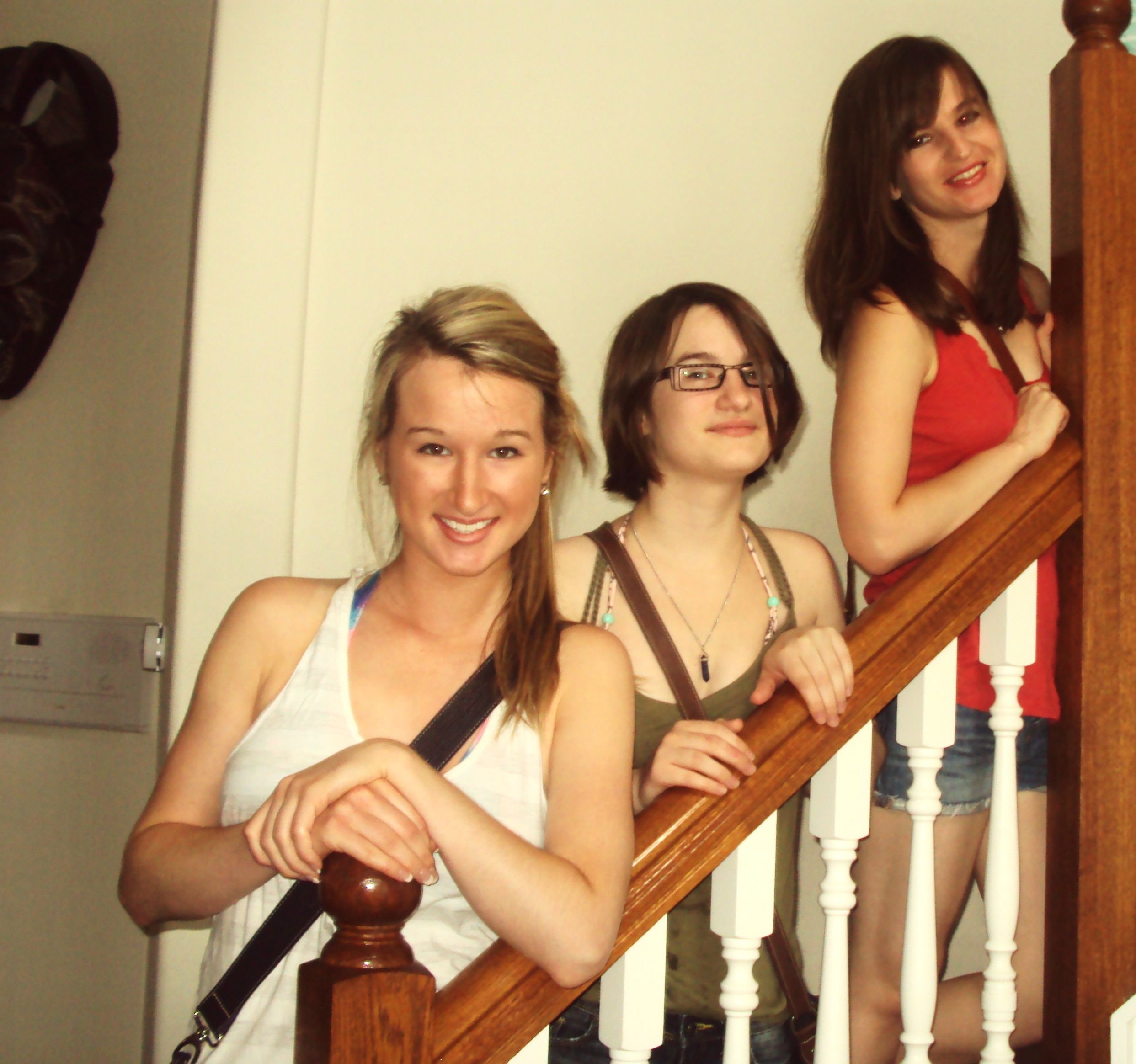
Claire, Catherine and I - see what I mean? Totally a changeling.

Claire, Catherine and I – see what I mean? Totally a changeling.

Nostalgia Machine: On Re-reading Sandman

11 Mar

Matt and I have recently been re-reading Neil Gaiman’s Sandman series, something that I’ve been putting off doing for a few years now.

I’m not sure why we decided to dive back into those books now, exactly – I guess part of it might be because I recently started following Mr. Gaiman on twitter and suddenly remembered how amazing he is. It’s also probably due to the fact that we just recently found the last couple of volumes needed to complete our collection for cheap at a discount bookstore. Mostly, though, I think it came out of how much I’ve been thinking about my friend Annie lately.

The thing is, I’ve been missing her like crazy, and I can’t think about the Sandman books without being reminded of her, and vice versa.

Annie moved in with me in the spring of 2004, just at the tail end of my annus horribilis. She was a friend of a friend, someone I barely knew, but I desperately needed a roommate, and she desperately needed a room. Although I’d met her a handful of times, at parties and theatre department events, I’d only ever spoken to her once. At some get-together or other I somehow found myself standing next to her, and I figured that I should try to make conversation. I racked my brains for something to say, and wound up complimenting her on this pin on her bag that said, “Go Fascinate Someone Else.”

She looked at me as if I’d said the most mundane, meaningless thing possible, took a drag from her cigarette, and said in her smoky, vaguely European voice,

“Yeah. I like it too. Obviously. Or I wouldn’t be wearing it.”

What I want to make clear here is that Annie was a super badass who dressed all in black, smoked like a chimney and never refrained from speaking her mind, even when she knew it was going to get her into trouble. She was a brilliant actress with a mysterious Soviet past and a deadpan stare that could wither just about anyone. Half the city admired her, half the city was afraid of her, and half the city wanted to sleep with her. And no, I didn’t accidentally say “half” instead of “a third” – I just mean that there was a lot of overlap between all three categories.

I had no idea why she would ever want to be my roommate.

I would estimate that there are four people who have had an enormous influence on my outlook on music, clothing, art and life in general. The first was Emily, who I met at a performing arts camp when we were twelve and who introduced me to vintage clothing, the Kids in the Hall and, music-wise, everything from Ani DiFranco to Sonic Youth. The second was Kat, who had first hated then later befriended me in while we were at university, and who is responsible for introducing me to pot, Sylvia Plath and the joys of being loud and obnoxious in public. The most recent one was my friend Audra, who has helped shape my take on third-wave feminism, internet activism and dance movies. The fourth, of course, was Annie.

I’m not sure, exactly, how Annie and I became friends. I think that it happened slowly, by degrees, with me making tentative friendly overtures like buying her beer and lending her books. Then she invited me out to her birthday and I went, bravely talked to a few of her friends*, then left early. I’m not sure what time she came home at, but the next morning she was still drunk. When I got up, she was lying sprawled out on our couch, her tank top askew and her already-short skirt hiked up even higher, and she kept giggling over everything I said. I made us both breakfast, and then suddenly, magically, all of my awkwardness melted away and it was like we’d known each other forever.

Mostly it feels like Annie and I have the kind of friendship that twelve year old boys have. I mean, you know that part in Stand By Me when they’re sitting around the campfire talking about pez candies and Wagon Train and whether or not Goofy’s a dog? And then narrator-Gordie says, “We talked into the night. The kind of talk that seemed important until you discover girls.” That’s what our friendship felt like then, and still feels like now. And if you’re an aficionado of Stand By Me in the same way that Annie and I are, I probably don’t have to explain that she’s Chris Chambers, and I’m poor old Gordie Lachance with the leech on his balls.

Anyway, that summer, the summer of 2004, Annie introduced me to the Sandman series. And as I worked my way through them, she re-read them, and together we fed each others’ obsessions. We would sit out on our North End stoop as the late afternoon cooled into evening, drink whatever we had on hand, share Annie’s pack of cigarettes and try to pull apart the Sandman universe. We teased out each layer, or at least the layers that we could find, and laid each thread of plot bare to examine it. We researched everything, trying to figure out which characters were historical figures and which were just plain made up. I think at some point we even made a flowchart or graph to keep track of our discussions. It was perfect.

That summer was like gorging on everything wonderful in life all at once, and if I could bottle it up and sell it, I could be a millionaire, like, tomorrow.

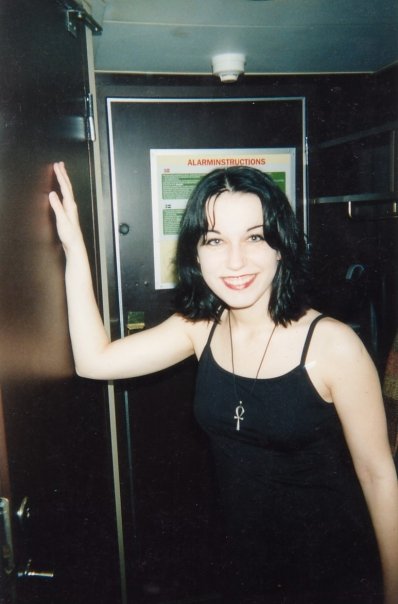
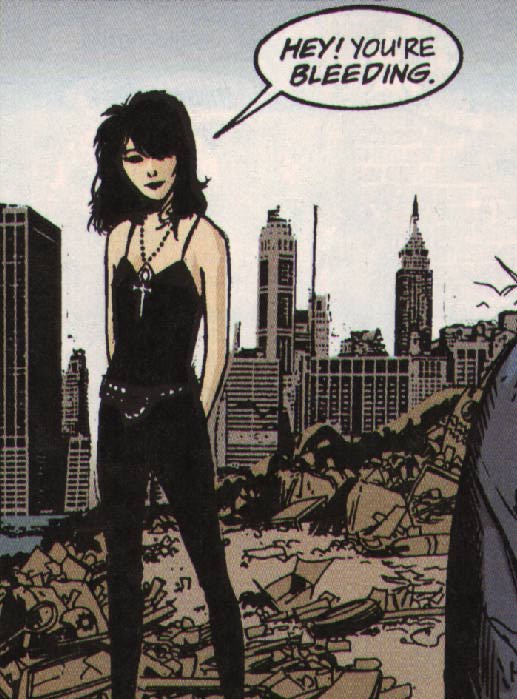
We eventually started casting ourselves and our friends as the Sandman characters. Annie, at the time, was a dead ringer for Death (PUN SO INTENDED):

annie_death

tumblr_m7op1mAbYW1qbgs7po1_1280

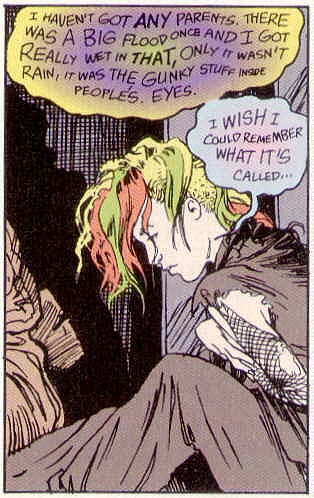
And I felt a weird kinship with Delirium:

gunky

I’m not including a picture of myself because I look nothing like Delirium, but when I first read those books, I felt like her. I understood the stuff she said, even when most other people, both fictional and real, seemed to have no clue.

I loved Delirium. Loved her. I think my adoration for her was part of the reason I put off reading the Sandman books again for so long – because, of course, it’s dangerous to revisit anything that you’ve known too well, loved too deeply, or somehow view as having helped shaped who you are. It’s dangerous to expect something to feel the same after years and years of memories and expectations. Sometimes, if you’re lucky, those old books, movies and places are able to stir enough nostalgia to allow you to overlook all of the failings you’re suddenly able to see, but mostly going back to the things that you view as influential and formative is nothing but a disappointment. First of all, they can never live up to the hype that’s built up in your mind for the last ten or fifteen or twenty years, and second of all they’re often just plain terrible and end up making you feel as if a huge chunk of your childhood or young adulthood is somehow tainted.

And, see, Delirium is a character who would be ripe for this kind of adult realization. I was worried that, as a 30 year old, I would find her character to be ridiculous, and my love of her incredibly pretentious. I was worried that re-reading Brief Lives, my favourite Sandman of all time, would leave me rolling my eyes SO HARD at my younger self and her habit of being overdramatic about, well, everything. I was worried that, this time around, I would hate Delirium, or at the very least no longer love her and know her the way I had. And somehow, that would feel like a huge loss.

But you guys? Sandman is still amazing. And Delirium is still amazing.

Maybe it’s because when Annie moved in with me, I was just coming out of a major depressive episode, and I’m in a not-dissimilar place in my life right now. Or maybe it’s because I haven’t changed as much in nine years as I’d thought. Whatever the reason, Delirium still kills me in all the best ways possible. She says things, and I think, ohhhh, I get that. I’ve felt that.

Like this:

“I feel like … I don’t know. Someplace nobody ever goes anymore.”

Or this:

“It all keeps moving and it won’t stop and I just want it to stop and then I think what if it gets worse? You know? What if it gets worse?”

Or this:

“I like airplanes. I like anywhere that isn’t a proper place. I like in-betweens.”

Or this:

“What’s the name of the word for the precise moment when you realize that you’ve actually forgotten how it felt to make love to somebody you really liked a long time ago.”

Or this:

“You’ve never apologized to me. You just act like you know stuff I don’t know that makes everything you do okay.”

Ahhhhhhh (that is a sigh of total satisfaction after having a fictional character explain what’s in my heart)

I’m not really sure how to end this, except to say that I find myself back in the same curious, dreamy state that Sandman put me in the first time. I mean, it’s probably not just the books – it’s probably also the fact that spring is so close that you can taste it, and that my house is clean for once, and I ate some really transcendentally great yogurt today. But whatever it is, I’ll take it. I like this feeling. I’ve missed this feeling. It makes me feel floaty and insubstantial and wondrous in a way that I haven’t felt in years.

I just wish Annie was here to share this all with me, instead of being half a continent away.

I wish we were back on our stoop, eating Rassy’s pizza and drinking Kahlua cocktails and watching the sparrows hopping around eating our crumbs.

I wish I knew what to do with this feeling, now that I finally have it back.

———————

*It was actually only one friend, the nicest guy imaginable who would deliberately seek out shy, awkward people and talk to them at social gatherings. Seriously. The nicest.

An International Women’s Day Alphabet

8 Mar

A is for Austen, the Regency hellion

B is for Boudica, who raised a rebellion

C is Cleopatra, fierce Queen of the Nile

D is Diana, whose voice does beguile

E is for Ella, breaking down barriers

F is for Franklin, who made DNA merrier

G is Gloriana, anything but conventional

H is for hooks (lower case is intentional)

I is Isadora, who loved modern dance

J is Jo March, who wrote and wore pants

K is for Kennedy, who understood duty

L is Lamarr, who mixed science with beauty

M is MacPhail, political and proud

N is for Nellie, strident and loud

O is for Olave, keen about guiding

P is for Parker, whose wit was so biting

Q is Quvenzhané, who lights up the screen

R is for Rosa, who sat like a queen

S is Suu Kyi, the political prisoner

T is for Tubman, slavery abolitioner

U is Uhura, who kicked ass in space,

V is Victoria, who kept a stern face

W is Wollstonecraft, vindicator of rights

X is Xiang Jingyu, who fought the good fight

Y is Yousafzai, who refused to be rattled

Z is Zoë Washburne, ready for battle

We Can All Do It by Soirart

We Can All Do It by Soirart

Fifteen Assumptions That Might Be Useful To Make

7 Mar

1. Assume that you are loved.

2. Assume that those who love you find some kind of value in you and the things you do.

3. Assume, however, that you don’t need to be valuable in order to be worthy of love.

4. Assume that there is no one out there keeping a tally of all of your failings, ready to throw it in your face when you’re either feeling too good or too awful about yourself.

5. Assume that if anyone actually is keeping a tally of all your failings, that act says more about them than it does about you.

6. Assume that you can’t make all of the people happy all of the time; maybe not even some of the people some of the time.

7. Assume that you will, over the course of your life, sometimes anger or disappoint the people you love.

8. Assume that when this happens, it isn’t the end of the world, even if that’s what it feels like.

9. Assume that there is never an end to learning, or growing, or discovering.

10. Assume that you will always find a way out, even when all the doors slam shut and everything feels impossible.

11. Assume that sometimes earnestness and optimism can trump irony and cynicism.

12. Assume that it’s possible to recapture the way you felt when you were young, how the perfect clockwork mechanism of the universe used to leave you breathless and giddy with wonder.

13. Assume that there will always be more stories to tell, or at the very least new ways of reinterpreting old fables.

14. Assume that nothing is permanent, that someday even the sun will disappear; remember that everything we see and touch and taste is made of stars that grew and pulsed and died long before this planet ever existed.

15. Assume that you are under some kind of obligation to make the world a better place.

earth_moon

On The Anticipation of Pleasure

5 Mar

On Saturday, we took Theo out to Leslieville to the little kid-friendly café where I used to run a French language baby group. It’s a great place; they have a large, fenced-off area for kids full of toys, activities and even a tree house. Meanwhile, they also have a sit-down area where they serve some pretty decent coffee and a few locally-made treats. Basically, it’s a win-win situation for everyone.

The only reason that Matt and I don’t take Theo there more than a couple of times a year is that it’s kind of out of the way (45 mins to an hour by public transit), and once you factor in meals and naps and all that good stuff, in can be hard to fit that kind of trip into a day. It’s probably a good thing that we don’t go there very often, though, because right next door is a Fancy Bakery that sells The Best Cupcakes in the World. And, naturally, because they are The Best Cupcakes in the World, they are pricey cupcakes. Which means that if we went to the above-mentioned cafe as often as we’d like to, I would basically be blowing my entire paycheque on cupcakes.

So anyway, we went, we saw, we conquered Leslieville, and came home happy and with a bag full of cupcakes. Except when we got off the train at St. Clair, I realized that I’d stupidly left the cupcakes on the goddamn Queen streetcar.

Strangely, though, I wasn’t that upset. Because I’d already had, like, two hours of looking forward to those cupcakes. And in some ways, that anticipation was almost better than the cupcakes themselves.

Sometimes, maybe even most times, I find anticipation more pleasurable than the actual thing I’m anticipating.

I’m slowly coming to realize that I have a fucked up relationship with pleasure and joy.

A few weeks ago, I posted Zadie Smith’s Joy on Facebook. It’s a good example of a certain type of essay that I stumble across every once in a while, the kind that leaves me nodding yes, yes, yes because everything it says seems to apply so perfectly to me.

What was interesting was that my friends who read it and commented were firmly divided into two camps: those who identified with and understood what Smith was saying, and those who found what she’d written to be unbearable, pretentious and difficult to read. Even more interesting was the realization that each of us identify and feel emotions differently, and things that I thought were universal were, in fact, deeply personal. It was like discovering that the colour you’ve called green your entire life actually looks to everyone else like the colour you call blue.

See, the crux of Smith’s essay was that there is a difference between pleasure and joy, and that joy is not simply an amplification of pleasure but is, instead, a “…strange admixture of terror, pain, and delight.”

I read that, and I thought, oh hell yes.

And I thought that everyone would understand what she meant, because I figured that everyone experienced joy in the same way that she and I did.

Because, for me at least, joy brings with it the knowledge that you are living this one, specific wonderful moment that you will never, ever get back, a moment that will certainly end, and maybe end very soon. Joy is a breathless, frighteningly intense feeling, and it’s good, but it’s also somehow painful, in a way that I can’t properly articulate.

For me, joy is not on the other side of the spectrum from pain; rather, in my experience, it’s right next to it, and it’s possible for one to bleed into the other to the point where they occasionally seem indistinguishable. In the same way, I don’t think that love is the opposite of hate – those emotions are, in my experience, much more closely linked than we like to believe. Love (and hate) instead find their true counter in apathy.

But while Smith seems to be uncomfortable with joy, she seems to be perfectly fine with everyday, run of the mill pleasure. And I think that this is where we differ.

Because as much as I agree with Smith that joy is uncomfortable (in a thrilling, all-consuming way), the fact is that I don’t fare very well with pleasure, either.

And I’ve come to realize that what I actually find most pleasurable is the anticipation of something, rather than the thing itself.

To this end, I find myself “saving” things because I don’t want to use all their pleasure up right away. I do this with food, with gift certificates, with events, with books. I do it with particularly good emails, ones that I want to read and re-read before I give in to the pleasure of answering them. I do it with phone calls that I have to return, with articles that I want to dissect, with reading and answering comments on my blog.

And I wonder, why do I save these things? Part of it, I think, stems from the idea that I want to wait for a “special occasion” when I will somehow be deserving of receiving that pleasure. But I think that an equal part of it is that I worry that there is a finite amount of pleasure available to me, and once I use it all up, it’ll be gone. I also think that there might be a dash of the old fable of the ant and the grasshopper thrown in there – when some kind of metaphorical winter comes, at least I’ll still have my gift certificate to Red Lobster to get me through those dark times, you know?

But the ridiculous part is that I will literally save these good things until they’re not good anymore. I have set aside delicious food and left it until it spoiled because there was just never the “right” time to eat it – and then I’ve scraped the mould off that spoiled food and eaten it anyway, and told myself that it was worth the wait. I’ve watched gift certificates expire, and told myself that if I hadn’t used them by now, then I didn’t deserve to use them anyway. I’ve put off watching the second half of particularly lovely movies until it comes to the point where I’ve forgotten what happened in the first half. I’ve left off answering emails and comments long past the point where my lack of response has become embarrassing and difficult to explain.

“Dear friend, I’m sorry that I haven’t answered you yet, it’s just that thinking about answering you was so lovely that I kept having to put it off.”

As if there will never be any more delicious food, nice emails or good movies ever again.

And, of course, the problem is that when you live this life of delayed gratification, whatever it is that you’re saving never lives up to the expectations that you’ve put on it. And so the anticipation itself begins to be what gives you pleasure, more pleasure than anything else. In a funny way, thinking about those cupcakes was even better than eating them – I didn’t have to deal with the sugar high and subsequent crash, didn’t have to feel the queasiness that I associate with too much cake and buttercream icing, didn’t have to worry about my teeth aching from the sweetness of it. In my thoughts, those cupcakes were perfect – much better than they could ever be in real life.

These are the things I tell myself, when I look around and see other people enjoying things much more or much better than I seem to be able to.

I am not very good at experiencing pleasure. I am not very good at living in the moment.

I am much better at parcelling things out, making them last, making them endure.

I am much, much, much better at thinking about the future, than I am at giving myself up to whatever joy or pleasure is at hand.

And that’s starting to feel really fucked up.

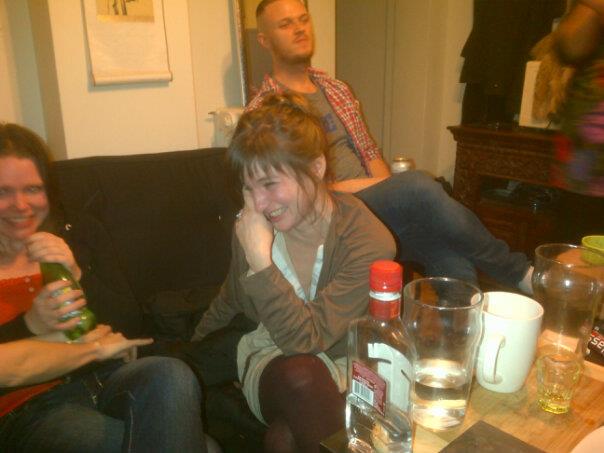
More than anything, I want to be this chick in the photo below, the one who throws caution to the wind, gets drunk on a school night, and laughs til she cries. Because she exists somewhere, I just haven’t figured out how to find her when I need her.

Me, laughing so hard that I'm crying

Me, laughing so hard that I’m crying

On Race and Feminism

3 Mar

In the online fallout of The Onion’s vile tweet about Quvenzhané Wallis, one fact has become abundantly, dismayingly clear:

White feminists have a hard time talking about race.

And we have a hard time talking about the fact that we have a hard time talking about race.

Jessica Luther has a fantastic post up over on Shakesville about the lack of white feminists decrying what happened to Quvenzhané. And while I think that what she wrote is perfect and spot on and everyone should go read it right now, what I find truly fascinating is the weird backlash that she’s received from other white feminists.

It was the same backlash I saw on Twitter the other day when @graceishuman called out white feminists for not defending Quvenzhané.

That backlash? A whole bunch of white feminists explaining why they, personally, chose not to write about it. And I’m sure that they had some spectacularly good reasons (I’m not even being sarcastic), but that’s not what this about. Not by a long shot.

I have actually never seen so many people miss the point of something all at the same time.

What this is about is the lack of intersectionality in feminism. Specifically, it’s about the fact the women of colour do not feel that they are represented or heard within the feminist movement. As Kirsten West Savali wrote for Clutch, it can feel like the feminist movement encourages women of colour to,

” … shrug off our Blackness for the greater feminist good; the end result being a contemporary plantation tableau defined by Ole Miss and Mammie slaying the patriarchal dragon while the issues of racism and classism are hidden behind the veil of  “progress.”  And while this scenario is about as feel-good as The Help, expanding white privilege — feminist or otherwise — is not equality.”

So how the fuck did it ever get to this?

Is it because we (white feminists) feel that racism is an entirely separate issue from feminism? 

Most white feminists that I know would answer that no, of course it’s not, in the same way that homophobia, fatphobia and transphobia are not separate issues either. They would readily admit that women of colour experience misogyny in ways that white women do not. They would say that of course they care about racism.

But these same women, in their own writing, mainly stick to topics that specifically affect them or women like them. They very rarely address issues that are faced only (or mostly) by women of colour. They almost never talk about racism within the feminist movement. Which is funny, considering the racist history of our movement; shouldn’t this be something that we still talk about, all the time?

Is it because we worry that we’ll be co-opting women of colour when we speak out against something like what happened to Quvenzhané? Is it because we’re worried about making a misstep, about somehow accidentally being racist in our fight against racism? 

I would wager that the answer to this is yes, yes and yes. I’ve heard this same argument from several women as explanation of why they didn’t speak out against The Onion, or why they primarily focussed on the misogynist aspect of The Onion’s tweet and not the racist aspect. White feminists mentioned again and a again that they felt that women of colour should take the lead in this discussion, the rationalization being that white women speaking for others’ experiences was, in itself, a racist act.

And yeah, I guess if you’re a white feminist speaking for women of colour, that’s racist, but that doesn’t mean that you can’t call out racism when you see it. Like, fuck, I don’t want men speaking for me, but I sure as hell do want them to stand up against sexism. We complain so often about having to educate men with regards to feminism, and yet we (white feminists) do so little to educate ourselves when it comes to racial issues.

We make comments like, Well, I don’t even know what to call them, like do you say black or Black or women of colour or Women of Colour or minority or non-white or what? I don’t want to accidentally say the wrong thing.

We make comments like, They can write about the issues they face, and I can write about the issues I face. What’s wrong with that?

We make comments like, I thought we were all in this together.

For a group of people who are so hell-bent on (rightfully) pointing out male privilege, we sure as hell don’t like to be reminded of our white privilege, do we?

Which brings me to my next point …

Is it because we don’t want to admit that, as white women, while we do face a lot of overt and insidiously subtle misogyny in our day-to-day life, we face less barriers than women of colour do?

Privilege is comfortable. Privilege is easy. Privilege is invisible and difficult to quantify, facts that make us comfortable ignoring the fact that we benefit from it.

Privilege lead to write a post the other day that I felt was clever and insightful but, as others pointed out, was in several ways flawed and problematic.

I have a lot of privilege, white privilege, cis-privilege, thin-privilege, but it’s easier for me to talk about the privilege that I don’t have. I suspect that the same is true for many other women.

Being reminded of privilege makes people defensive – especially when those same people are complaining about the oppression that they face as women. There’s a tendency within feminism to want to gloss over racial issues and say, Well, first let’s fight against the problems that ALL women face, and THEN we can talk about racism, and I think that feels okay to a lot of us because in a fucked up way it feels like equality. In reality, though, it’s not equality at all – it’s asking women of colour to do work that will especially benefit white women, and then having those white women turn around and refuse to address the additional challenges faced by non-white women.

I think that another issue at play is that it can be hard to view yourself as both the oppressed and the oppressor. But the fact is that we do participate in the oppression of others, and our reluctance to examine that is pretty fucked up. Like, white feminists are perfectly articulate about how privilege works when they’re talking about male privilege, but they seem to plead ignorance pretty quickly when they’re reminded of the privilege that’s associated with their skin tone.

So what do we do about all of this?

Well, first of all, we fucking sit up and pay attention when women of colour tell us that they feel that we dropped the ball on this one. Because you know what?

A) They know what they’re talking about, and

B) They’re right

And then, after we admit that we fucked up, we talk about it. We talk about race until we’re blue in the face. Because pretending that this isn’t happening isn’t doing anyone any favours, and continuing to ignore the racial issues within the feminist movement is only going to serve to further divide us.

Finally, we need to change how things are structured in order to see real equality. We need to give more platforms to women of colour. We need to be more willing to listen to what they have to say. We need to be willing to be called out on our racism. Most of all, though, we need to let women of colour lead the way and let THEM tell us what they want and need in order to do that.

Because reaching down and giving a boost to someone who has less privilege than you do is what real fucking equality looks like.

And to those of you who aren’t interested in doing that, I would ask that you please stop using the word equality. You’re not interested in equality; you’re only interested in benefitting yourself.

I don’t want to just benefit myself. I want my actions to benefit everyone. And right now, I especially want my actions to benefit this kid:

Quvenzhane-wallis-beasts

On Facebook and Validation

27 Feb

I deleted my Facebook account this morning.

Or rather, I deactivated it, because deleting is way more of a hassle and I’ll probably end up reactivating my account eventually. And can I just take a second to tell you how crazy hard it was to get myself off that motherfucker? It took me approximately ten years to find the “deactivate” section, and THEN they make you fill out this thing about why you’re leaving and blah blah blah, like, seriously, Zuckerberg? Everyone and their grandmothers are on Facebook. You can relax about the OCCASIONAL PERSON quitting your site.

But anyway. I digress.

I deactivated my account because I wasn’t really happy about how I was using Facebook. I felt like too often I was using it to seek attention or validation, and that felt really unhealthy. I feel like I have an OK relationship with Facebook when I’m in a good space mentally, but when I’m depressed I tend to make posts that are basically begging my friends to reassure me that they love me, that I’m a good person, that I’m doing a good job. And I don’t want to be that guy, you know?

But this is where it gets fucking tricky, because by posting this, aren’t I kind of, sort of being that guy? Aren’t I using this as a way of asking you for validation that I’m not constantly looking for validation? Or at least validation that this is just how we do it in the 21st century and everyone else (and their grandmothers) use Facebook for the same thing?

Let me tell you a little story.

One time, my ex-boyfriend and I were at the same Hallowe’en party, and then ended up going out to the same club. I was still in love with him and he knew it, but he went ahead and kissed me on the dance floor anyway. He was dressed as The Incredible Hulk and when he kissed me he got green paint on my face, and my best friend dragged me into the bathroom and yelled, WHAT THE FUCK IS HE DOING KISSING YOU AND GETTING GREEN PAINT ON YOUR FACE? THAT IS FUCKING UNACCEPTABLE.

So I tried to ask him why he’d kissed me, but instead he turned around and walked out of the bar. So I followed him, because I was angry, and hurt, and felt stupid and used. I chased him down the street, yelling his name and telling him to turn around and talk to me RIGHT NOW. And eventually he did, and we ended up sitting together on someone’s stoop in the middle of Halifax’s North End. It was midnight and really fucking cold outside, but I didn’t have a coat because I’d been in such a hurry to catch him and chew him out. So I sat there, trying to explain how hurt I was without actually admitting that I still wanted to be with him, and I was so cold that I started shivering. So he put his arms around me, and pulled me close, and I started crying.

We were both really drunk, and really young, and really serious. So we decided we were having this big adult conversation about ourselves and our relationship and our treatment of each other. Because, you know, that’s what you do when you’re sitting on some random North End stoop dressed as The Incredible Hulk and Jackie O on a freezing cold late-October night. That’s what grownups do. Right?

Anyway, at some point I said, “Tell me something that you know about me. Something true.”

And he looked at me and said, “Anne needs to stop relying on other people’s opinions of her.”

And I was actually shocked by how true and accurate that was. Like, even though he was a dick to me on the regular, he still knew me, somehow. And, weirdly, he still cared about me.

I guess I was also shocked because I’d thought that my need for other people’s validation was something that I’d managed to hide fairly well. But it became clear to me that if even my emotionally-stunted ex-boyfriend could see it, then everyone could see it.

And in that moment I felt exposed for the fraud I was: not the loud, brash, ass-kicking lady that I pretended to be, but a scared, lonely, kid with poor self-esteem.

I’ve worked hard in the year since then to have more faith in myself, to not let other people’s ideas shape who or what I am. I’ve tried to grow a thicker skin, tried not to care about what other people say, tried to learn how to stand my ground. And to some degree, I think I’ve been successful. I’ve at least become better at presenting myself as someone who is all of those things.

But when things get tough, I don’t feel like someone who has a strong core. I feel like someone who has layers and layers of gauze bandages wrapped around her midsection, and when you go to unwind them, it turns out that there’s nothing there, like, literally nothing. Just a giant, gaping hole that goes all the way through me. And then maybe all of my internal organs fall out and I get blood and guts on your nice new shoes and I’m crying for you to love me, please love me, and even though I can tell that you’re disgusted, I can’t stop.

So anyway, that’s what Facebook has been feeling like lately. Like I’m a big old vivisected loser who needs you to tell her over and over that she’s fine, she’s good, she’s lovely. And I don’t want to be that loser anymore. And I don’t want to drive you all away with my nonsense.

Thus: Facebook deactivation.

We can still interact here and on Twitter, and I’m happy to give you my email address so long as you promise that you’re not a creeper who wants to send me pictures of his dick. I’ll still be around. It’ll be fun, I promise!

Now if you excuse me, I have to go talk to my cats and make sure that they still think that I’m a worthy owner who feeds them on time and gives them enough cuddles.

IMG_2289

It’s Okay To Feel Weird About Your Pregnant Body

23 Feb

Dear Fug Girls,

I like you. I like you a lot. I’ve been reading your site for, like, probably ten years now. I remember the days when Jessica wrote X-Files recaps for Television Without Pity (and those were some good days!). So, suffice to say I’m a pretty big fan.

And, as a fan, I want to tell you that what you wrote yesterday about Kim Kardashian wasn’t cool. Like, really not cool.

I get that hearing women talking about their weight can be stressful, maybe even triggering, and that one of the ways to deal with that is through humour, but I don’t think that it’s ever okay to make fun of a woman for being uncomfortable about her body. Because you know what? Everything in the freaking world is conspiring to make her feel uncomfortable about her body, and mocking her is not helping.

Look, pregnancy sucks. I mean, in some ways it’s kinda neat, but in a lot of ways it sucks big time. Your body, which has probably remained fairly static for most of your adult life, is suddenly taken over by a parasite and starts expanding in all kinds of weird ways. And suddenly, it’s not your body anymore. I mean, it is, but it’s totally unfamiliar to you, and also its housing a weird tiny thing that kicks and squirms a bunch. I spent a lot of my pregnancy feeling like the dude in Alien, to be honest, although thankfully I gave birth to an actual human being who was surgically removed from my abdomen rather than bursting out in a totally badass, metal way.

Anyway, what I’m trying to get at here is that even though I’m a thin woman, and even though my pregnancy weight looked perfectly fine on me, I still felt uncomfortable gaining weight. And I am not someone whose appearance is routinely picked apart by tabloids. I am not someone who felt obligated to prove that she’s “bikini ready” at six weeks postpartum. So if pregnancy made me feel weird about my body, I can only imagine how hard this must be for Kim Kardashian.

I’ll be honest: I don’t know a whole lot about Kim. I know that she’s with Kanye West, and I know that she’s done a bunch of reality shows, and I know that people love to hate her. I know that people like to make comments about how she’s famous for “nothing” (which is a hilarious criticism, because if anyone offered to let me be famous for nothing, I’d be like, “sign me up, bro” – who wouldn’t want to get tons of money for doing nothing?), although the number of times I see her out promoting stuff make me have a hard time believing that she really does nothing. I know that she’s a woman of colour who’s got hips and boobs, and I know that she’s already endured tons of criticism about her size from the media, long before she ever got pregnant. I know that she’s a woman, and as such she’s going to be scrutinized and mocked and ridiculed far more than her male counterparts.

At the end of the day, I’m just not really interested in shaming anyone for their feelings. Especially when those feelings have totally valid roots in the way our media and culture treat women. If Kim Kardashian wants to talk about how gaining weight while pregnant is upsetting, then more power to her. I’ll be happy to tell her a thousand times that she looks fantastic no matter what. Because there’s absolutely no good that can come from telling someone that their feelings are wrong, or bad, or stupid.

Anyway, that’s all I’ve got. I hope you guys will consider this the next time you post about someone’s weight gain. I mean, as much as I know that making fun of the way people dress is your gig (and usually it’s a pretty funny gig!), maybe you’ll be able to be a bit more empathetic the next time something like this comes up.

Sincerely,

Annabelle

p.s. The pants were pretty ugly, though, I’ll give you that

p.p.s. Say hi to the Mulder and Scully action figures for me! I hope they’re locked in an eternal embrace now that they’re retired from TWOP

p.p.p.s. I kinda hope these crazy kids make it, not gonna lie

kim-kardashian-kanye-west


ETA: Go Fug Yourself put an addendum on their post, which is pretty awesome:

** I may need to clarify that I am not trying to say that pregnant women can’t be thrown off by the changes in their bodies. But there is a difference between that and denial. To me, wearing those pants doesn’t say, “I am feeling awkward about my changing form.” Rather, that garment, to me, is a fingers-in-ears scream of, “LA LA LA NOTHING IS
CHANGING AT ALL.” My point was, don’t let denial get in the way of biological necessity — and also, those trousers are odious. But the former is dipping into armchair psychoanalysis, so I apologize if I overstepped…