Archive | Uncategorized RSS feed for this section

Virginity Is A Social Construct

19 Dec

Jezebel published a piece today with the title “Nearly 1% Of Women Claim They Were Virgins When They Gave Birth,” and, because this is Jezebel we’re talking about here, they used this as an opportunity to shame and belittle the women who say that they became pregnant while still virgins. And just so we all understand what author Erin Gloria Ryan means by virgins, she writes that they are women who,

“… were unpenetrated by the peen of a man when they became pregnant.”

She further explains,

“This doesn’t include women who became pregnant via in vitro fertilization or artificial insemination; these are women who gave birth the old fashioned way and were like *shrug! SERIOUSLY GUYS I DON’T EVEN KNOW HOW THIS HAPPENED!”

Then (incorrectly) asserts,

“Getting pregnant without sex is virtually scientifically impossible, yet dozens of women in the study (who were teens when the research began) swear up and down that their babies happened sans man. This is the biological equivalent of claiming that your glass of drinking water spontaneously began boiling itself without the presence of heat. I mean, maybe it’s Unsolved Mysteries-possible, but it’s highly doubtful that 0.8% of all glasses of water boil themselves. Come on.”

Also, just so that we’re really super clear on how Jezebel views these women, the article was posted to their Facebook page with the following header:

Nearly 1% of women insist they were virgins when they gave birth, which means that nearly 1% of women are delusional.

Oh, Jezebel. Jezebel. I know all the cool kids have already said it, but damn. You sure do suck at feminism.

First of all, it is definitely scientifically possible to become pregnant without having penetrative vaginal sex. It’s unlikely to happen, but it’s possible – all you need is for a someone to ejaculate on or in close proximity to the vagina, or else have some other thing with sperm on it – a finger, say, or a sex toy – penetrate the vagina. Yes, these are unlikely ways in which to become pregnant, but they’re not within the same realm as water spontaneously boiling.

Second of all, can we not have this discussion without calling women stupid or crazy or just flat out accuse them of lying?

Third of all, can we please stop talking about virginity as if it is a real, measurable thing?

Virginity is not a thing. Not really. It is a social construct meant to make people, especially women, feel badly about their sexuality and sexual experience. It is a way of policing other people’s bodies and passing judgment on how they use them. It is, at its very core, a way of controlling and subjugating women.

One problem with the idea of virginity is that there’s no hard and fast way of deciding who’s a virgin and who isn’t. Many people would define loss of virginity in a very heteronormative sense – a sexual act where the penis penetrates the vagina. But does that mean, then, that a queer woman who has only ever been with other women is a virgin? Is a gay man, who has only ever had anal sex, a virgin? Most people, when pressed, would agree that no, those folks aren’t really virgins, even if they’ve never had penis-in-vagina-style intercourse. The flip side of this is that many rape victims don’t feel as if they have lost their virginity even if they’ve had penetrative intercourse forced on them. They consider themselves to be virgins because they don’t consider what happened to them to be sex. So taking all of that into consideration, how do we then define virginity?

Some people have said that performing any sexual act constitutes losing one’s virginity, but that seems like much too broad of a definition. Kids start experimenting with sexual play and experimentation at a fairly young age, so does it then follow that anyone who’s kissed someone of the opposite sex or shown them their genitals has de facto lost their virginity? I’m not sure that this idea makes any more sense than saying that virginity can only be lost through one very specific sexual act.

Another problem is that there is literally no way of knowing if someone is a virgin or not. Oh, people will tell you that you can check if a woman’s hymen is broken, but that’s not a reliable indicator at all. A hymen can be broken without any kind of sexual intercourse, through sports or through some kind of injury. Not all women are born with hymens. Not all hymens tear during penetrative sex. And yet we’ve all been sold this idea of torn flesh and blood on sheets as some kind of definite rite of passage for women. This idea – that you can somehow tell if a woman has been sexually active – has contributed to the oppression and subjugation of women for pretty much all of recorded history. It’s given men a way to control women, to make them ashamed of their bodies their sexuality. It’s led to a double standard where it’s fine – even encouraged – for boys to gain sexual experience, but women who are sexually active before marriage or have sex with too many people are considered to be slutty or damaged goods.

Finally, why is virginity so damn important to us? We don’t have nouns for who or what we were before we hit any other life milestones – there’s no term to refer to a person before they can walk or talk or read and write – all of which I would argue are more important achievements than getting laid – and yet it’s the sex that we focus on. Why do we put so much more weight on this one small facet of human life than we do on any of the others? Why are we still making a big deal out of who is a virgin and who isn’t?

This is the discussion that we should be having – not about whether women are lying or delusional about their virginity, but about why we still use this damaging term. We need to talk about why the idea of virginity continues to hold such sway over our cultural consciousness, and why so-called feminist websites a perpetuating the thought that virginity is a tangible, definable thing. Most of all, we need to figure out a better way to talk to kids about their bodies and their sexuality, because the way that we’re doing it now clearly isn’t working.

Even Mary agrees - virginity is bullshit

Even Mary agrees – virginity is bullshit

Canada’s Apartheid

17 Dec

Thomas Mulcair wrote a very touching tribute to Nelson Mandela in today’s Toronto Star, using Mandela’s story of struggle and eventual triumph over a deeply racist regime as a call to arms to Canadians to affect change in our own country. Like so many of the things that I’ve seen presented by the NDP lately (and by lately, I guess I mean since Jack Layton’s death), it has a nice, socialist gloss to it but, upon closer inspection, doesn’t actually live up to what I expect from my party. To give credit where credit is due, there are several things that Mulcair gets right in his piece. There are also a few things that he gets very, very wrong.

I’ve read quite a few tributes to Mandela written by prominent white folks over the past week, and Mulcair’s is, on the surface, different from many of them. What sets his piece it apart from most of the others is the fact that Mulcair makes a fairly direct comparison between South Africa’s apartheid regime and Canada’s treatment of the First Nations, Inuit and Métis people. He’s not wrong, either – in fact, the apartheid system was based on Canada’s Indian Act. Our residential schools, Indian Reserve and many other deeply racist systems inspired South Africa’s oppressive regime. I’m glad that at least one of our federal leaders has (somewhat) acknowledged this in their remarks on Mandela’s death.

What Mulcair gets so very, very wrong is in how he talks about the fall of the apartheid and Mandela’s role in it. South Africa, he says, is a “miracle.” Mandela, he said, “inspire[d] people to be more forgiving, to be more united, to be better than they ever thought possible.” There is no mention of the involvement of the Umkhonto we Sizwe, which Mandela co-founded, in violent political resistance, resistance that was key in bringing apartheid to an end. There is no mention of the fact that Mandela himself was implicated in that violence; no discussion of the fact that part of the reason Mandela was sent to prison was because he was responsible for bombing a power plant. Though we seem to like to imagine that Mandela brought change to South Africa with nothing but wise words and a kind, grandfatherly smile, the truth is very different. Mandela fought for his freedom, tooth and nail.

And yet the western world has somehow managed to whitewash all of Mandela’s actions, to the point where we no longer remember that at one point in time America considered him to be a terrorist. And the same people who are lauding Mandela are those that I see complaining about First Nations blockades and protests on a regular basis. It’s a funny sort of cognitive dissonance – if we declare ourselves in support of the fight to end the apartheid in South Africa, then shouldn’t it necessarily follow that we also support the fight to end the oppression of Canada’s First Nations, Inuit and Métis peoples? If we can have this kind of unwavering love and support for a man who bombed a power plant in order to bring down a racist regime, then shouldn’t we offer some kind of aid and encouragement to the citizens of our own country who are trying to protect their lands from environmental devastation? How is it that we, as Canadians, manage to view these two situations as being entirely different?

It also seems pretty funny that what Mulcair wrote could almost be taken as an endorsement of radical and perhaps even violent tactics in order to further decolonization, considering that his response to almost any type of First Nations protest is to ask them to work with the Canadian government.

Take, for example, his official statement on the current events in Elsipogtog:

New Democrats are very concerned about the escalating situation involving the Elsipogtog First Nation in New Brunswick. We are monitoring the situation closely. We join the Assembly of First Nations in calling for calm on all sides. The safety and security of all parties is our number one concern at this time. This situation underlines the importance of peaceful and respectful dialogue between governments and Indigenous peoples.

Or else his response to Chief Theresa Spence’s hunger strike:

I would sincerely call upon Chief Spence to realize that there has been a step in the right direction, to try and see now if we can keep putting pressure on the government to follow through. The government seems to be moving so I think that the best thing to do would be to step back from that now.

It’s just the same old racist bullshit of asking the oppressed to work with their oppressors. He’s not adding anything new or helpful; he’s just reiterating what the First Nations peoples have been hearing for generation after generation. His approach is not going to solve anything. Peaceful talks with a racist and oppressive government, a government that has a vested interest in continuing to marginalize the First Nations, Inuit and Métis peoples, are not going to bring about any kind of real change.

As NDP candidate Shannon Phillips said,

“Nelson Mandela didn’t do 27 years in prison for sitting in the wrong seat on the bus. He was there, in part, for his role in bombing a power station in order to make the machinery of a racist regime grind to a halt. A regime most of the world, including Canada under those Great Liberals Pearson and Trudeau, thought was completely a-ok. So can we just remember that next time we see indigenous people blockading a highway? Thanks.”

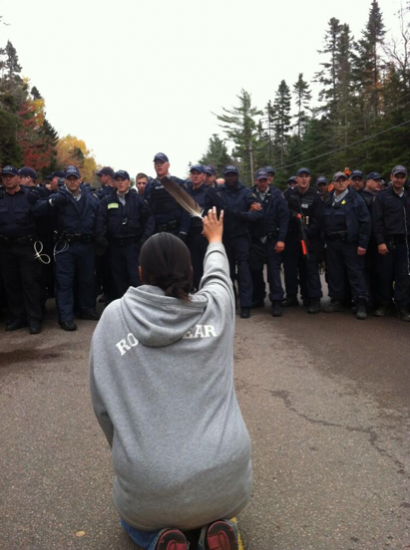
So the next time you hear about a First Nations blockade or protest or hunger strike, I want you to look at it from a different angle. I want you to consider how our government’s treatment of the Aboriginal peoples of this country compares to the South African apartheid. And most of all I want you to ask yourself: if he were here, in Canada today, what would Nelson Mandela do?

Photo credit: Ossie Michelin

Photo credit: Ossie Michelin

“I just do not understand why this moment needs to be Memorexed.”

16 Dec

One swelteringly grey day this past August my friend Nathan and I took the ferry to the Toronto Islands for a picnic. After we’d spread his blanket out on the sand and set up the food and wine, I asked him if I could take a picture.

“Yeah, sure, why not?”

Then he did a double take and frowned at my phone.

“Wait. Why are you asking me if you can take a picture of the baguette and cheese you just bought?”

“Because I want to take a picture of you with the food.”

“Uh, sure? I guess? But don’t post it on Facebook.”

He knew, of course, that that was exactly what I wanted to do. Posting inane shit on social media is my jam. Still, I went along with it and pretended that the thought had never crossed my mind. I snapped the picture and immediately put my phone away, as if Facebook wasn’t even a thing I knew about. The photograph is still on my phone, in fact —I checked today while I was writing this. In it, Nathan is holding a paper cup of wine smirking his I-fucking-hate-having-my-picture-taken smirk. I can tell that he doesn’t understand why I feel the need to take or share this picture.

Later, when we were lying on the blanket staring across the water at the Toronto skyline, I snapped another picture. It’s sort of crooked, because I was trying to be stealthy about it. In it, along with one of my feet, a broad expanse of sky and the distant shore, you can see Nathan in profile.

“Can I post this one to Facebook?” I asked, handing him my phone.

“Oh fiiiiiiine,” he said (you have to imagine this exhaled in a long-suffering sigh — Nathan is very long-suffering). “You can’t see my face, so whatever. Knock yourself out.”

I posted it with the caption, “Weekday afternoon island picnic with Nathan, AKA I am spoiled.”

It’s one of hundreds of pictures on my Facebook profile — documenting and sharing my life is a thing that I do almost reflexively now, as do most of my peers. I post selfies, most of them artsy and pretentious. I post pictures of my kid, my husband, my friends, pictures of pretty places and pictures of trees that I find to be exceptionally lovely. When my sister and I met Jane Goodall I posted a picture of the three of us together, when we saw Chris Hadfield speak at a local bookstore, I snapped and posted a picture of him, too. I don’t post pictures of my food, but that’s only because I’m a terrible cook and most of what I produce is incredibly unappetizing. It’s not just photographs either — I chronicle my daily life in all kinds of ways, from short, pithy tweets to long, emotional journal entries picking apart all of my feelings in excruciating detail. I sometimes feel as if I spend half my life living it, and the other half documenting it as if something incredibly important depends on my ability to perfectly describe the exact shade of my friend Audra’s lipstick as we lounge one late-summer afternoon on the patio at Hurricane’s.

Why, though? I mean, why do any of this in general, and why take and subsequently post that picnic photograph in particular? Was I trying to make people jealous of the fact that my odd-ball work schedule means that I can take off in the middle of the day for an island adventure with a good-looking dude? Did I feel like my friends would be legitimately interested in this little slice-of-life? Was I trying to create a strange sort of public memory for myself?

Probably a bit of all three, if I’m being honest with myself, though the memory part is what stands out the most to me now. Looking at that photograph I remember how Nathan was in a bad mood that day, and how I was hoping the picnic would cheer him up. I remember how it started raining almost as soon as we disembarked from the ferry, and we ended up sitting under a tree drinking warm white wine while waiting for the storm to pass. I remember being upset about the rain, because I felt as if there was so much riding on the day beingperfect; I remember Nathan reassuring me that yes, he was having a very nice time in spite of the rain, and would I please stop worrying and try to enjoy the day as it was, rain and all. I remember that after the sky cleared we bushwhacked our way through the undergrowth on tiny Snake Island to get to my favourite beach, which we had all to ourselves that day. I remember the fire ants biting my legs, and I remember thinking that it was worth a few ant bites just to be lying there in hot sun with one of my favourite people. I remember drifting off to sleep listening to kids yelling and splashing in distant canoes. I remember the dreamy sound of the lake approaching and then retreating across the damp sand.

There’s been a lot of brouhaha over the past few years about how technology has changed our lives for the worse; I’ve heard more than a few whining complaints about selfies and pictures of food on Instagram all swaddled up in a that comfortably familiar blanket of worries about Kids These Days. Kids these days, with their inability to understand consequence and their disdain of privacy and their purported inability to make real-life connections with other people. There was yet another opinion piece on this subject in yesterday’s New York Times, this one specifically about pictures and social media and all the little ways we put our lives on hold in order to document them. In it, the author, Sherry Turkle, frets that we’re losing the ability to be in the moment and sit with our own thoughts — times of what she calls “uninterrupted reverie.” And, it’s like, she’s not wrong, you know? We do pause our lives to in order to record them, and we do share those recorded images or thoughts with the world at large. But this isn’t anything new — it’s part of what it means to be human, and it’s been happening for as long as there have been people, in one way or another.

We document our lives for all kinds of different reasons — because we find ourselves fascinating, because we’re trying to make sense of what’s happening to us, because we want to reach out to other people and ask them to tell us that we’re not, in the end, alone. We want to capture experiences that are by their very nature fleeting and somehow turn them into something permanent. We want some kind of touchstone that represents all the moments we’ll never have again, because by our very natures we are wanting, grasping creatures who can’t seem to accept that there are certain things that we can’t hold or keep. So we started painting on cave walls. We carved gorgeous bas-relief scenes into ancient monuments depicting mundane moments from every day life. We wrote about ourselves anywhere we could, using whatever materials were at hand. We tried to make sense of our short lives through images and words, because that’s what we do. That’s what people do.

That’s what I do, too. In fact, I sometimes I wonder if I don’t enjoy the memories of experiences more than the experiences themselves, and if that’s part of why I obsessively write, photograph and share the things, important or otherwise, that happen to me. It’s rare for me to completely lose myself in a moment; I’m always wondering what comes next, how things will end, whether the outcome of this seemingly-happy moment will, finally, be judged to be good or bad. I’m always picturing the scene through the camera’s lens, watching my hair tangle in the wind and the authentic-looking smile light up my face, as if comparing my life to a movie might help me figure out which direction it’s going to take. It’s only later, when viewed as a completed story, that the happiness of the situation becomes certain, no longer tainted by my doubt or anxiety. It’s only then that I breathe a sigh of relief and let myself feel wholly, perfectly good.

Or else sometimes an event is too big, too overwhelming as it’s happening, to allow me to feel anything as uncomplicated as happiness. Take, for example, the week-long trip to Paris that Matt and I took for our honeymoon. The we spent there wasn’t happy for me, exactly — it was too much a whirlwind of sights, sounds and smells that I was trying frantically to process and understand to be called anything as easy as happy or fun. To quote my friend Susan, everything in Paris is either delicious or beautiful or both, and I was desperate to see and eat as much of it as I possibly could in that short time. The main emotion that I remember from that trip is awe — awe and wonder at almost everything we saw and did, from standing atop the Eiffel Tower and looking out across the orderly jumble of grey buildings to using the funny toilet with the rotating, self-cleaning seat that we found in the little English tea house. Everything seemed incredible. It was only later, after our plane had touched down in Montreal and I’d given my mother and sisters the gifts I’d brought back for them and told the story of our trip over and over, that I was finally able process everything that had happened. It was only then that I had the chance to sit down, sort through the pictures I’d taken, and savour how very good the trip had been.

The photographs I took in Paris — even the photographs that I’d taken while feeling overwhelmed and anxious — helped shape the narrative of a storybook honeymoon. And while my memory tells me that this narrative may not be entirely accurate, it’s the one that I prefer to present to both myself and others as the truth. I also can’t help wondering if perhaps accuracy and truth aren’t really the same thing, after all — because while it’s accurate to say that I experienced moments of dismay, frustration, anger and fear during my honeymoon, I’m also speaking the truth when I say that it was perfect. Pictures that were taken under one set of circumstances might ultimately convey a different meaning, and somehow both ways of looking at the photograph are simultaneously correct. Images like the one below, taken from the top of Notre Dame, seem peaceful and romantic, even though at the time the height was making me dizzy, I was worried that they were suddenly going to start ringing the enormous thirteen-ton bell, and I felt shaken up after climbing the circular tower staircase, slippery after eight hundred years of use, behind an old Polish man with a bad limp who seemed likely to fall on Matt and I at any moment.

But when I see this picture I know that this moment, as frightening as it might have seemed at the time, was also unbelievably wonderful. And even if I didn’t feel particularly peaceful or romantic, the image itself is undoubtedly so. Both ways of looking at that picture are true.

We take pictures and write status updates and scrawl out journal entries because we’re trying to put together some kind of lasting story about our lives. And as much as these things might seem pointless or self-indulgent now, I suspect that someday, someone will be grateful for these records. In the same way that I love poring over old photographs, enjoying the ephemera in the background almost as much as the figures in the foreground, I’m sure that someday someone will squeal over the quaint adorableness of pictures of iPhones and Kindles. We make fun of people who Instagram their food, but I would give my eyeteeth to have similar photographs of meals from 50 or 60 years ago. Posterity of the mundane always seems slightly ridiculous at the time, but I’m willing to bet that our grandkids and great-grandkids won’t be disappointed that we took the time to pause our lives in order to document them.

It seems hardly fair, anyway, to think of it as “pausing” our lives, when the documentation itself has always been so much a part of how we live.

Dealing With Meanies 101

13 Dec

Check out my guest post today over at the Outlier Collective:

Dealing With Meanies 101.

The Consolidated List of Stuff That Isn’t Feminist

9 Dec

As Charlotte Raven helpfully pointed out in the Feminist Times this morning, wearing high heels is not feminist. Nor, apparenty, is staying in an abusive relationship. After reading her piece, I hope that both shoe aficionados and domestic violence victims see how badly they’ve been fucking up and either shape up or ship out, because the feminist movement isn’t interested in the likes of them. I would also like to thank Ms. Raven for being brave enough to say what no one else was women to say – namely, that women who like fancy footwear and who just sit there and let their partners abuse them are failing all women everywhere and just need to find another way to get their kicks other than Louboutins and men who make them fear for their lives.

If I have one criticism of Raven’s piece, it’s just she didn’t go far enough. Sure, high heels are anti-feminist, but so are a lot of things! What we really need is a handy-dandy guide put together by a privileged white woman telling us exactly how to be as feminist as possible. Since Raven has failed us in this regard, it’s obviously necessary for someone to step in and correct this failing. Please allow me, a privileged and lily-white member of the feminist tribe, to be of service.

Feminists Do Not:

1. Wear makeup

2. Wear short skirts. Or any skirts. Or leggings. Or tights. Or tight jeans. Or a bra (note: bandeaus and cute lacy camisoles are fine).

3. Wear saucy shirts that reveal any of the following: cleavage, midriff, shoulders, elbows, collarbone, neck, wrists

4. Shave any part of their body (eyebrow maintenance is, however, strongly encouraged)

5. Get married, even if it’s to another woman. Seriously. Take a close look at the tradition of marriage and tell me WHICH part of that, exactly, is feminist? Is it the part where your father gives you away as if you’re a piece of property, or the part where you promise to love, honour and obey your husband? And don’t tell me that your marriage is different – it’s still promoting an institution that has been and continues to be oppressive to women. Be in a “committed” relationship all you want, but leave marriage out of it unless you want your feminist card revoked.

6. Take their partner’s name – this is basically like stamping “I am my husband’s property” on your forehead. I don’t care that it’s tradition, or that you think it’s nice, or you’re doing it for the kids – it doesn’t matter what argument you come up with, it’s still patriarchal bullshit.

7. Watch network television, except to criticize it (self-explanatory)

8. Let men hold doors, give compliments or pay for dinner. If a man you know tries this, offer him a swift kick in the groin.

9. Have children, unless they have access to a hospital-grade breast pump and a staff of round-the-clock nannies and nurses so that they don’t have to miss more than a few days of work at their high-power jobs.

10. Stay home with their children. Who ends up paying for your cushy suburban life of trips to the library and ice cream cones in the park? A man, that’s who. Feminists are self-reliant – if you think that a man funding your stay-at-home mommy life is empowering to women, you need to sit in the corner, read the Feminine Mystique, and think about what you’ve done.

11. Make jokes, laugh, or otherwise display a sense of humour. Duh.

12. Watch sports. They’re nothing but a masturbatory homage to heteronormative patriarchal ideals. Do you think it’s a coincidence that most sports feature BALLS of some sort? Well, think again. And let’s not even get into the phallic imagery of baseball bats, hockey sticks and golf clubs.

13. Watch ballet. You think high heels classify as self-harm? Check out the damage toe shoes do to feet.

14. Listen to Beyoncé, try to emulate Beyoncé, or even think about Beyoncé. And while we’re on the subject, let’s just be clear about one thing – Beyoncé is categorically not a feminist. How is this even up for discussion? She’s broken basically every rule on this list so far. SHE CALLED HER LAST TOUR THE MRS. CARTER WORLD SHOW TOUR. When the revolution happens, Beyoncé albums will be the first to be burned.

15. Let women of colour speak, unless it’s to toe the same old white feminist line that fails to address many of their most pressing problems. Real feminists know that intersectionality can only be addressed once all white women everywhere are equal.

16. Treat their children in any way that reinforces the gender binary. In the future, the terms “girl” and “boy” will be done away with and everyone will wear sexless onesies with snaps at the crotch. FEMINIST UTOPIA.

17. Diet, or otherwise try to lose weight. If you feel uncomfortable in your body, it’s your own damn fault for buying into patriarchal ideas about how women should look.

18. Smile, unless you’re smiling in anticipation while scheduling your next abortion.

19. Watch or enjoy anything even remotely problematic. See: everything in mainstream culture so far. I don’t care that the Gilmore Girls was your favourite show when you were a kid and you and your mother watched it together when she was dying and it gives you nothing but good feelings – that shit is PROBLEMATIC.

20. Experience any emotion other than rage. There is so much to be outraged about that I cannot fathom how you could feel anything else, unless it’s joy over the aforementioned abortion.

Real talk, though: a lot of the stuff on this list genuinely does not fall within the parameters of what would be considered feminist or egalitarian in a perfect world. In that world, I wouldn’t feel that in order to be attractive and respected I had to slather makeup on my face, shave my armpits, or dress a certain way. In a perfect world women wouldn’t find it romantic to ditch their own last name in favour of a man’s. In a perfect world we would all hold doors for each other, and acts of politeness would not have sexist undertones. But you know what? We do not live in that world.

Yes, we do things that buy into or even promote patriarchal beauty standards. Yes, we sometimes uphold traditions that have been oppressive to women. Yes, we sometimes enjoy stuff that could and maybe should be considered problematic. We’re only human, after all, and we all grew up being brainwashed by the same ideas about how women should look, dress and act. If I hadn’t grown up in a world that told me that removing all of my body hair was considered sexy, would I reach that conclusion on my own? If I didn’t live in a culture that prized a traditionally misogynist ceremony of lifelong commitment as super romantic and de rigueur for all women everywhere, would I have gotten married? The answer to both of those questions is: probably not! But nothing exists in a vacuum, not even feminism. Especially not feminism. And it’s not that we shouldn’t talk about these things – things like why we might get married or take our partner’s name or want our body to look a certain way. We definitely should talk about these things – and we should also talk about why we choose to do them.

We all do things that could be considered anti-feminist. We all compromise sometimes. We give in on some things, and fight tooth and nail on others. We pick our battles and learn to hold two opposing truths at the same time. We let ourselves feel pretty in high heels and makeup while still remembering that this is mainly because men have made us believe that these things make us pretty. We enjoy movies and books that don’t pass the Bechdel test and maybe say some not-so-great things about women, while acknowledging that media representation of women needs to be so much better than it is. We call our children “girl” or “boy” even while accepting that gender is a social construct. We do these things, and it doesn’t mean that we can’t call ourselves feminists.

If I were to make a real list of things that feminists don’t do, there would only be one item on that list: tell people how to be feminists. Because when an individual begins dictating what a movement looks like, then it stops being about what’s in the best interests of women everywhere (spoiler alert: very few things are in the best interests of all women everywhere) and becomes about that person’s biases and opinions. And that? Is pretty unfeminist.

Definitely Not A Feminist

Definitely Not A Feminist

Feelings Machine

3 Dec

I sometimes joke that I’m a feelings machine, but that description isn’t really so far from the truth. My brain churns out emotional reactions a rate that leaves me breathless, too fast for me to understand the why and how. Everything, everything seems to provoke some kind of intense feeling in me, and they almost always seem to be negative. I’m never just a little sad or anxious or concerned – I feel like the world is ending, over and over again, all day every day. It’s like the volume dial on my emotions is constantly cranked to 11. It’s exhausting for me, and I know that it’s hard for the people around me. I’m too intense, all the time, every day. It’s just too much.

The problem is that almost everything feels like an emergency, especially when it comes to interpersonal conflict; I have a seriously hard time distinguishing between an every day, run-of-the-mill argument and a relationship-ending barn-burner. If a friend or family member leaves before the conflict is resolved, I’m certain that they’re never coming back. Nothing ever feels solid enough.

I’ve been thinking about this a lot, trying to figure out why I react with panicked sobbing to stupid differences of opinion that most people would just roll their eyes at. Why do these situations send off deafening alarm bells in my brain when they seem to be just blips on everyone else’s personal radar? And why can’t I ever stand my ground and assume that I might be right instead of turning into a babbling mess of frantic apologies and promises to do better next time?

I’ve come to the conclusion that a lot of it has to do with the relationships that I’ve had with volatile, unpredictable people. And I don’t just mean romantic relationships – I mean any kind of relationship, with a parent or a sibling or a teacher or a friend. For whatever reason (I mean, I can think of actual Reasons, but I’m not going to get into them right now), I’m drawn to these people. For one thing, they’re exciting, aren’t they? You never know what they’ll do or say next, and they tend to stir up my otherwise boring, predictable existence. Staying on their good side seems like some kind of a challenge, and I’ve never backed down from a challenge. And I guess it’s a dynamic that I understand and feel comfortable with, even though you can never really feel as if you understand or feel comfortable with these types of people.

The problem with volatile people is that everything has the potential to be an emergency; something that they think is fine and dandy one day could send them into screaming fits of rage the next. You never, ever know how they’ll react, so you always have to brace yourself. Anything that you do or say could set them off. Conversely, anything that you do or say could also delight them to no end. There’s no way of knowing how things will play out, and so trying to please them is like aiming at a moving target – you’ll probably never be able to hit it, and if by some stroke of luck you do, that strike has nothing to do with your skills or capabilities.

If you live with a volatile person for long enough, it’s hard to maintain a consistent personal narrative. Every event is re-framed by how they saw it, and no matter how hard you try to hold on to your version of events, the force of their overreactions starts to erode your confidence in your own perspective. Trying to fight against them begins to exhaust you – they’re too good at pushing your buttons, know too well exactly what to say to hurt you most deeply, and you can’t keep up, can’t maintain that level of mean-spiritedness. You start to accept what they tell you, because it’s just easier. It’s easier to be wrong all the time. It’s easier to apologize. It’s easier to lie down and let them walk all over you. Of course, you lose yourself in the process, but what does that matter? By that point you believe that that self was worthless anyway.

Once you’ve experienced that type of relationship, it’s hard to know how to interact with other people, non-volatile people. You’re constantly looking for hidden meaning in their words and actions, looking for clues that might tell you how to behave. You don’t trust them when they say that everything’s fine, because you know that nothing is ever fine, not really. Even the smallest thing could escalate into a disaster.

So you overreact. You cry and panic over stupid, petty things, because how can you ever be sure that they’re really so stupid and petty? You grovel and apologize before they can get to the point where they demand and apology, because you know that it’s so much easier that way. You call yourself every bad name in the book before they can even open their mouths. You try so hard to beat them to the punch, even when there’s no punch coming. The new people in your life, these normal, non-volatile people, can’t figure out where you’re coming from. They chalk it up to low self-esteem, and try to build you up or bully you into feeling better about yourself. They all tell you that you need to care less about what other people think, and you want that, you want it so badly, but you have no idea how to stop caring. You’re not certain who you are unless someone else is telling you something about yourself; you feel like a sort of black hole, sucking in everything from the people around you. You’re so hungry for a version of yourself that you can love and accept, but nothing that anyone can tell you is ever enough.

You feel more defined by absence than anything else and incapable of emitting any light.

weird-machine

My Heart Is An Autumn Garage

21 Nov

My little book that I’ve been working on for the last few months, My Heart Is An Autumn Garage, came out today. It’s a short memoir about the breakdown I had in 2003 and my subsequent hospitalization. You can find it here on the publisher’s website or here on Amazon. I am still kind of overwhelmed with Feelings about this, so I’m not sure what else to say.

Below a short excerpt that’ll hopefully explain the book better than I can right now. It takes place shortly after I agreed to sign myself in voluntarily to the psychiatric unit.

Almost as soon as I passed the papers back to the nurse, a hospital commissionaire came to escort me to the psychiatric short stay unit. It was a long walk, to a separate part of the hospital called the Abbie J. Lane building. The name seemed like a funny combination of Abbey Road and Penny Lane and I suddenly wished that I had someone other than the commissionaire to tell this to. No one knew where I was, though – not my friends, not my roommate, not even the mother of the boy I babysat. Oh, I’d called her to tell her that I wouldn’t be able to work that day, of course, but I’d given the flu as an excuse. My voice, rough and shaky from hours of crying, was enough to back me up, and she’d accepted my lie without question.

Once we reached the short stay unit, the commissionaire had to call to get someone to buzz me in. I heard the lock gently snick as the door closed behind me and the sound sent me into a full-on panic. I’d been crying ever since we left the emergency room, but now I started to sob even harder. The commissionaire, an older man with white hair and laugh lines around his eyes, just patted my hand and told me that I would be fine. Then he turned around and the door closed behind him and he was gone, slowly ambling back into the world of people who weren’t locked in psychiatric wards. I turned around and found a nurse standing behind me; I told her, gasping and more than a little inarticulate, that I wanted to leave. I told her that the emergency room nurse had said that I could leave whenever I wanted, and I damn well wanted to leave this second.

She said that I couldn’t leave, though, not until I’d spoken to the psychiatrist on call. So I told her to call the psychiatrist. She just sighed and rolled her eyes.

The nurse went into a glass-walled room and sat behind a desk; I watched her pick up the phone and mutter something into it; I could tell that she was muttering by the way she pressed her mouth to the receiver and barely moved her lips. She paused for a moment, nodding in agreement with whatever the psychiatrist was saying, then muttered something else. She hung up the phone, came over to where I was waiting and, a fake smile plastered on her face, suggested that I let her show me around while we waited for the psychiatrist to come.

The glass-walled room was, she explained, the nurse’s station, where I could always find the nurse on duty. There was also a small closed-in room with a long wooden table where the staff held meetings and took breaks. After that, she showed me around the rest of the ward; most of it was a big, open space sort of set up like an open-concept house. There was formica-topped, institutional-looking table in the middle of the room, surrounded by half a dozen aluminum-and-vinyl chairs. In one corner there two ratty old couches and an ancient television, and in the opposite corner there was a dingy white-tiled bathroom, complete with bathtub and shower. All along one wall were our “rooms”, which were really just small alcoves containing a hospital bed and a bedside table. These so-called rooms didn’t even have doors on them, just heavy hospital curtains that could be drawn if the patient wanted privacy. Each room came equipped toothbrush, toothpaste, and a child-size paper cup full of viscous blue liquid that was both shampoo and body wash.

“You can leave your coat and bag here,” the nurse said brusquely.

There didn’t seem to be much point to that since I would be leaving as soon as I met with the psychiatrist, but I did it just to humour her.

After that I tried to call Denise, figuring that at least someone should know where I was, but she’d already left the office for the day. So I sat and read my book until the nurse announced that it was time to eat and ushered all of us patients towards the formica table. Supper was some sort of grisly meat in a pool of gravy with a side of instant mashed potatoes and green beans from a can, but I tucked into it eagerly. My financial situation had by then deteriorated to the point where I was eating No Name brand macaroni and cheese every night, so I was pathetically excited to find meat and vegetables on my plate. I only had the chance to eat a bite or two, though, before the nurse came over and told me that the psychiatrist was ready to see me.

They took me into the little meeting room where the psychiatrist waiting to talk to me. She had brittle, curly blond hair and spoke in a cold, clipped Eastern European accent. Without any preamble, she asked me why I felt that leaving the hospital was a good idea, and began taking copious amounts of notes as soon as I started talking. Meanwhile, I was struggling to pull myself together enough to properly explain why I wanted to go home. I began by telling her I didn’t feel safe or comfortable spending the night there, and she nodded without looking up, indicating that I should keep going. Having already made what I thought was my strongest and most obvious point, I thought fast to think of something else – unfortunately, the best that I could come up with was that I had a lot of laundry to do and it was my turn to wash the dishes and also I’d promised to call my mother that night. The doctor looked up then, frowning in a way that I knew meant that she didn’t think I was very bright, and said that none of those were good reasons for leaving the hospital. I realized, then, that I should have just kept elaborating on my first point, rather than trying to come up with more.

Still, I said, they’d told me that since I was signing myself in voluntarily, I could leave whenever I wanted. And I wanted to leave.

The psychiatrist ignored that, and told me that if I wanted to call my mother, I could call her from the hospital.

No, I said quickly – too quickly – that was fine. I could call her the next day. It wasn’t urgent.

But, the psychiatrist said, sensing that she’d found a sore spot, I’d listed that as one of the reasons why I wanted to go home. Didn’t that mean that it was important?

The thing was, I explained, hesitantly, the thing was that my mother didn’t exactly know that I was in the hospital. And I didn’t want to tell her, because I thought that it would just worry her needlessly.

The psychiatrist smiled like a cat with a fat, wriggling little mouse pinned under its paw.

That settled it, she told me. If I’d agreed to call my mother, she might have let me go home, but since I hadn’t, she wouldn’t.

Unable to keep the note of triumph out of her voice, the psychiatrist went on to explain that this type of behaviour was known as fragmentation. Fragmentation is the fancy, technical term for only telling one or two pieces of the story to each person, but you never explain the whole of what’s happening to any one individual.

It was a sign, the psychiatrist said, of a deeply disordered personality.

The worst of it was that she was right: I definitely did have a tendency to share only parts of the story and never the whole. At the time, when the psychiatrist first said this to me, I felt panicked, disoriented. Fragmenting, or whatever you wanted to call it, was something that I’d consciously done as a means of protecting myself and the people around me from my sickness; I’d never imagined that I might be making myself sicker. It was as if I’d been climbing and climbing a long flight of stairs, hoping that I’d find the exit soon, and then suddenly realizing that I was instead taking myself deeper and deeper into the labyrinth. And maybe there was no exit. And maybe all paths lead only to the heart of the maze.

Here I’d thought that doling out my life in bits and pieces was a smart self-preservation technique, a way of taking everything on myself so that I would never have to lean too hard on any one person or another. I had this idea that I would somehow figure out what information my various friends and family could handle, and then I could divide up my confessions accordingly. My reasoning went something along the lines of, If I don’t ever tell anyone anything that bores or upsets them, then it’ll be easier for them to love me.

The fact that I was difficult and frustrating to love was, I assumed, just a given.

These days, I’m less convinced of my unworthiness of love, and that fact alone almost certainly means that I’m much more mentally healthy than I was ten years ago. I try much harder to be honest about the parts of myself that I find shameful or embarrassing, and although that kind of vulnerability has been tough, it’s a gamble that has more or less paid off. Having stripped myself down, often publicly, and having bared some of my darker aspects, I feel much stronger and happier. I’m glad that I don’t compartmentalize my life to the extent that I used to.

That being said, I still don’t entirely agree with the idea that “fragmentation” is the sign of a personality disorder. I may no longer convinced that it’s the smartest, healthiest thing to do, but I also feel that it’s a perfectly natural coping mechanism. When you get to a point where you just hate yourself so goddamn much, it makes total sense to think that other people would, if they knew the whole truth about you, feel the same revulsion that you do. It makes sense to want to hide what you think are the terrible, deal-breaker parts of yourself. It makes a whole fucking lot of sad, desperate sense. And, I mean, sure, in an ideal world everyone should have someone, or even better, multiple someones, with whom they feel comfortable sharing all of themselves. In an ideal world no one would ever feel shame or guilt for things that they can’t help, things like sadness or fear or loneliness. In an ideal world we wouldn’t have so much trouble loving ourselves.

But we don’t live in an ideal world, do we?

After the psychiatrist accused me of fragmentation, I began frantically scrambling to explain that no, it wasn’t like that, really. I tried to tell her that everything that I’d said had come out exactly wrong. I wasn’t whatever she thought I was.

It was too late, though. Ignoring my babbling, she stood up, walked across the room and pulled a piece of paper out of a filing cabinet.

“I didn’t want to do this, but you leave me no choice,” she said.

Of course, her tone and facial expression indicated that she didn’t really give a shit one way or another over whether she did this, whatever this was, or not.

“What are you doing?” I asked, my voice cracking with fear.

“I’m certifying you.”

What does that mean?

I felt like I might throw up.

“It means that I’m signing this so that you can no longer leave of your own free will,” she said very calmly.

“No,” I yelled, losing what few shreds of dignity I might have had left. “No, you can’t. You can’t sign that. They told me that I was here voluntarily. I’m allowed to leave. They said that. The nurse and the doctor, they told me that. You don’t understand. This is my life you’re fucking with. You can’t just do this.”

But it was too late, she’d already made up her mind.

Find the book HERE on Amazon. If you buy it, please leave a review!

tc-site6

Fiction: Delphine

12 Nov

TRIGGER WARNING FOR OF SEXUAL ASSAULT

Before she does anything else, Delphine takes a moment to sit down and roll a joint. She does it slowly, carefully, savouring the experience. Every precise movement of her hands, from spreading the paper on her desk and carefully arranging the line of weed down the middle, to flicking her thumbs in just the right way to wrap the whole thing into a neat cylinder, is a distinct pleasure. In some ways, rolling the joint is just as satisfying as smoking it. Part of this satisfaction, Delphine believes, is because you enjoy anything you’re good at.

That’s sort of her motto, actually.

She sits by the window as she smokes, watching the way the late afternoon sun filters through the leaves of the sycamore tree outside. One of her neighbours is playing a Lou Reed album, the familiar gruff, wheezy voice floating across the still air of the courtyard. Delphine holds her breath for a moment, imagining that she can feel the smoke curling and spreading deep inside her lungs, then exhales slowly, luxuriously.

Afterwards, as her body begins to enter the slow, dreamy state that really good pot always brings on, she begins to get dressed. She has a Session today, so it doesn’t much matter what she wears — she’ll just have to change into whatever the Company has picked out for her today as soon as she gets there. Still, she chooses her clothing carefully, taking the time to put together an outfit that pleases her.

It’s nice to look nice, after all.

She digs an off-white baby doll dress out of her closet and pulls it over her head, tying a wide pink ribbon around her waist as a belt. Her tights today are wine-coloured and her shoes are a pair of scuffed-up brown ballet flats – boring, but she knows from experience that she won’t be able to walk in heels by the time the night is over. Last comes the jewellery, layers and layers of necklaces and bracelets; the clinking and swaying as she walks make her feel gaudy and mysterious, like a Hollywood gypsy. She slides rings on her fingers, three on each hand, and puts on her lucky earrings, big, round gold studs.

There’s no point in putting on much makeup, because they’ll just make her wash it all off, so she settles for bright red lipstick and an oversized pair of sunglasses. The finishing touch is her fur coat, a slightly-ratty, knee-length leopard skin affair, one of those remarkable Value Village finds that happen once in a lifetime. Some days the coat makes her feel like a 60s movie star; other days, it makes her feel like Kurt Cobain. Both versions of herself make her happy.

She has some time before the Company’s car arrives to pick her up, so she sits down at her computer and logs onto the oracle message board. Delphine discovers that there’s a new post from the early hours of the morning, so she clicks to open it. She’s surprised to discover a note from Sibyl saying that she’s resigning, effective immediately – the last she’d heard, Sibyl was enjoying her work and was being booked frequently for various Sessions. Sybil doesn’t give any reason for her resignation, either; her post is little more than a brief paragraph saying that she’s enjoyed her time with the Company and wishes them all well.

Sibyl is the third oracle to resign this year. They lost another one, Pythia, just last month. The turnover rate for oracles is pretty high.

Most women leave of their own free will, of course. The Company has to let some of them go, of course, but those cases are few and far between. The vast majority quit because they want to get clean, although a few have quit because of sexual assault or, in one case, rape and battery. Not that they ever come right out and say these things on the message board, which is the only way they’re allowed to interact with each other. They have to use code words, and in this way somehow manage to tell each other quite a lot even while saying very little.

Sexual assault isn’t really uncommon in their line of work; considering what goes on during the Sessions, most of the oracles consider it to be pretty much par for the course. Delphine suspects that it’s happened to her a few times – not penetration, but probably at least groping, maybe even more. She’s woken up to suspicious bruises and unusual aches, and once there was even the angry red imprint of a hand on her breast. It used to upset her, but she’s since come to the conclusion that it’s something she’s willing to accept. Like most of the other oracles, it’s a price that she’s more than willing to pay for all the perks that come with their job. Because there really are so many perks. None of them can say that the Company doesn’t treat them well.

The Company pays for everything the oracles have. It pays their rent, pays all their bills, and pays for the sleek black cars that shuttle them everywhere. It provides excellent health benefits, with full coverage for dental and prescription drugs. Speaking of drugs, the Company pays for those, too, or rather, it supplies them. They’re the best Delphine has ever had, and you can get just about anything you ask for.

Delphine’s drug of choice is heroin, which she realizes is passé in terms of recreational drug use. She likes to think of it as retro-chic – hey, the 90s are back, right? – and has become an expert at finding out-of-the-way veins and contorting herself into strange shapes in order to shoot up. It goes without saying that she can’t have track marks on her arms; that would ruin the look.

Track marks are not a part of the Delphine that the Company is selling.

Delphine wasn’t always Delphine, of course. At some point, in the now-distant past, she was Veronica, a round-faced, well-scrubbed girl from a nice family. She lived in a small prairie town, did reasonably well in high school, and had a nice boyfriend. After graduation, Veronica and her nice boyfriend moved to Toronto, a two-and-a-half hour flight from home, and got a cute little apartment together. Things were great.

Except then the nice boyfriend turned out to be not-so-nice and it wasn’t long before Veronica had nowhere to live and no way of making money. Too proud to go crawling back to her parents and her armpit of a hometown, she was determined to make her way in the big city on her own.

Things were feeling dire for a while. She lived with a succession of terrible roommates in a succession of tiny, filthy apartments while working a slew of miserable, minimum wage jobs. She blew all her money on bad drugs, which were still better than no drugs, and started to feel like she was never going to get out of the trap she’d found herself in. Looking back, she has to admit that she wasn’t far from reaching the point where she would flee back to the prairies, tail between her legs, when one day she came across a cryptic Craigslist ad.

The rest is, well, history. The Company rechristened her Delphine and, at the age of 18, she began her career as an oracle.

Delphine’s phone buzzes, shaking her out of her reverie, and she picks it up, expecting to see a text from her driver. Instead, she sees that it’s Andrew calling her.

“Hello?”

“Uh, hi Delphine. I was just calling because I wanted to make sure that you got the thing I sent you. You know, last night.”

Delphine picks up the little velvet box on her bedside table and flips it open.

“Yeah, I did, Andrew. They’re nice earrings. Really nice. Thank you.”

“Well,” Delphine hears his usual hesitancy, his funny shyness. “They’re not really from me. They’re from the Company. I wish I could say they were from me.”

“But you’re not allowed to give me stuff.”

Delphine walks back over to the window and sits on the ledge. Lou Reed is gone, replaced by The Smiths. She mouthes the words of the song and happily leans her head against the glass, that funny feeling that pot always gives her of being perfectly at home in her own body blossoming somewhere deep in her lower belly and hips. She feels good.

“Yeah,” laughs Andrew, “Yeah, I know. The Company is pretty strict about that kind of stuff. But it makes sense. I can’t let anybody think I have a favourite, right?”

“What were they for, though? I mean, I’m not complaining or anything. Just curious.”

Delphine knows exactly why the Company has given her a pair of expensive earrings, but she wants to hear Andrew say it, wants to have her ego stroked just a little.

“Just for being you. You’re the best that we’ve got, you know. The clients love you – some of them even ask for you by name. And your predictions are so clear that I barely have to do any translating.”

All of this is true. Delphine is doing three, sometimes even four Sessions a week now, and she knows that the Company is able to charge clients several hundred, maybe even a thousand dollars for a Session with her. They recently moved her to a new, more spacious apartment and gave her a healthy bonus.

The Company is never stingy when it comes to showing appreciation for the oracles.

“You’re really fantastic, you know,” Andrew continues. “I think half of your clients are in love with you. I almost am myself.”

Delphine smiles, staring out at the leaves on the tree bobbing gently in the still air.

“Anyway, I just wanted to make sure that you know that the Company is really happy with your work. Things are going great – in fact, one of the higher ups recently told me that you’re at the peak of your career.”

The last words out of Andrew’s mouth make Delphine’s skin prickle, as if it’s suddenly begun shrinking, shrivelling, drying and tightening across her bones.

She stands up quickly and walks away from the window, her necklaces swaying and clinking with the sudden movement. Her heart beats too loudly, too quickly. She struggles to think of what to say without giving away how panicked his words have made her.

“What do you mean?” she asks finally. “What does that mean, I’m at the peak of my career?”

“It – it just means that you’re doing really well. You’re the best.”

“It means that it’s all downhill from here. That’s what it means. It means I’m the best I’ll ever be, I’ve reached the peak of the mountain, and soon I’ll be over the hill. Right?”

“No, Delphine, of course not, I didn’t –”

“Sybil left. Did you hear about that?”

“Yeah, but what does that –”

Delphine can hear him fiddling with something nervous, his tie maybe, or else the collar of his shirt.

“What’s going to happen to me, Andrew?”

There’s a long pause before he replies.

“Nothing,” he says guardedly. “What do you mean by that?”

“I mean, what’s going to happen when I stop being an oracle?”

“Listen, Delphine, I can’t really talk right now, I –”

“I get that you might be someplace where you can’t say certain things, but just give me yes or no answers, all right?”

“I — fine, sure.” His tone is resigned. “Ask away.”

“I’ve been doing this for eight years now. Has anyone ever been an oracle as long as I have?”

“No.”

“Have any of them even come close? Say, five or six years?”

“No.”

“What’s the longest anyone else has ever lasted?”

“That’s not a yes or no question.”

Delphine exhales sharply through her nose, trying to contain her irritation.

“Just say a >number, Andrew, no one will be suspicious.”

Andrew hesitates, then quietly says,

“Three.”

“Has anyone ever gone on to work for the Company in another way, maybe in a clerical job or whatever, after they’ve stopped being an oracle.”

“No.”

“Can I put this job on my resumé?”

Andrew’s voice is growing smaller, more unsure.

“No.”

“Will you give me a reference?”

“No, you know that it’s against -”

Delphine is pacing now, her muscles tensing with anxious energy. She wishes she had time to roll another joint.

“Can I get clean and still be an oracle?”

“No, of course not, Delphine, don’t be silly.”

“Do you honestly think that living this kind of life is sustainable? Do you think I’ll be an oracle til I’m 50? How about 40? Andrew, what the fuck is going to happen to me when I can’t do this anymore?”

Delphine stops suddenly and stands in the middle of her bedroom. She takes a deep breath, and finds that she’s struggling not to cry.

“Listen Delphine, I — we can talk about this later, all right? I have to go.”

Andrew’s voice is gentle but firm. She’s not going to get anything else out of him.

“It doesn’t matter, I’ve already heard everything I needed to.”

Delphine misses the days when you could slam down the phone whenever you hung up on someone. It was so satisfying. Pressing the little square image that appears at the bottom of her phone’s smooth glass screen whenever she wants to end a call just doesn’t feel the same.

Delphine sits on her floor and draws her knees into her chest. Her hands are shaking. She takes a few deep breaths, wishing that she could take a hit of something, anything before the driver arrives.

Most days, Delphine is able to push aside her worries about the future and convince herself that she’s not walking along the edge of a cliff, liable to slip and fall at any moment. When she’s high (which is, admittedly, most of the time), Delphine truly believes that everything will work out fine. She tells herself that she’s not going to be fired, and even if she is, she’ll be able to find something else, something better.

But on cold, grey mornings when she wakes up feeling distressingly sober, she finds that she can’t outrun her fear any longer.

On those mornings, Delphine is forced to look the truth right in its cold, beady eyes:

She will not be able to do this forever. Not even for much longer, probably.

Delphine is a lot of things, but stupid isn’t one of them. She knows that this type of life isn’t sustainable. Sometimes she’s amazed that she’s been able to keep it up for this long. Sooner or later she’ll lose her youthful glow and the Company will decide that she’s too old, too used up to be an oracle. Or else the drugs, those wonderful drugs that allow her to float through her days, will finally take their toll and she’ll be forced to either get clean or die. And if she chooses to get clean, she’ll be out of a job, won’t she?

In the harsh light of those sober mornings, Delphine can see her future self clearly: an addict, homeless and out of a job, with absolutely no career prospects. No resumé, no references, no way to get free drugs.

The worst part is that there’s nothing she can do to change how this will play out. Sometimes it’s like she’s watching a slow, silent disaster, a train derailing and falling lightly, dreamily off a bridge and into the river below. And though to an onlooker it would seem like she has plenty of time to do something, anything to save the people onboard, the fact is that it’s impossible. The most she can do is try to forget about it for a little while.

Luckily, her lifestyle is very conducive to that.

Delphine soon hears her car pull up outside, sees her phone flash with a text from the driver, and, shutting her sleek silver laptop, walks down the stairs and out into the early autumn evening. It’s warm out, too warm for her coat, really, but Delphine doesn’t mind. The man holds the door open for her, and she slides into the car without saying a word. She forces herself to stop thinking about the future, and instead turns her thoughts to the upcoming Session.

Delphine settles back against the rich leather seats, straightening her skirt and pulling a pack of clove cigarettes out of her purse. The funny thing is that doesn’t even like tobacco, but she enjoys the act of smoking itself. She finds it soothing, calming. And the clove cigarettes are so pretty, with their thick gold paper and matte black filters. They smell good, too. Delphine lights one and takes a long drag, sucking the spicy-sweet smoke deep into her lungs, then exhales, admiring, as she does so, the bright red imprint her lips have left on the filter.

It’s not long before they arrive at the Royal York hotel, where the Company rents a suite of rooms. Delphine exits the car, coolly thanks her driver, and saunters nonchalantly into the lobby. None of the staff even bother to look twice at her. They all know her by now.

The suite has two large main rooms, one little side room and a bathroom. Delphine heads to what is commonly referred to as the Staging Area, the room where she will get ready for tonight’s Session. Kate, the makeup lady, and Sue, the woman who does her hair, have already arrived. Andrew isn’t there yet, but that’s fine – they won’t need him until later.

Tonight’s dress is a gauzy, white, semi-sheer affair, all plunging neckline and floating layers. Delphine strips naked and pulls the dress over her head; she’s not allowed to wear underclothes during a Session. Though the lights will be low enough that no one will be able to see through the dress, the Company wants her clients to be able to see the hint of a nipple, the vague shadow of what might be pubic hair. Suggestion is a big part of what they’re selling.

After getting dressed, Delphine settles into the chair by the mirror. Sue begins combing out her hair, making little tutting noises under her breath.

“What?” asks Delphine, already knowing what she’s going to say.

“You need to get your roots done. They’re showing, and it doesn’t look good.”

“But I like the way they look,” protests Delphine

“The Company won’t, though. And that’s what matters, isn’t it?”

Delphine knows that she’s right. That doesn’t stop her from putting up a bit of a fight before agreeing to come see her Saturday morning for a touch-up. Bickering with Sue makes her feel better, more normal.

Sue curls her hair, then piles it in an elaborate, vaguely Grecian-style on top of her head. She secures the mass of ringlets with a fistful of bobby pins, then begins carefully pulling out seemingly random strands of hair to frame Delphine’s face. She sprays the entire thing with several coats of hairspray before she begins adding the flowers, little pink and yellow ones stuck artfully here and there. Finally, she adds a beaten gold crown in the shape of laurel leaves. Although Delphine’s hair and clothing vary greatly from one Session to another, she always wear the gold crown.

Once Sue is done, Kate comes over and gets to work, spreading creamy foundation across Delphine’s face. She dabs highlighter on her cheeks and on her temples, skilfully applies false eyelashes and uses a multitude of brushes on her eyes, lips and brow.

Once her face has been adequately made up, Delphine looks a full ten years younger. Her skin is smooth, dewy; her eyes are soft and bright. She looks innocent and naïve, which is exactly what the Company is going for.

At that moment, as Delphine is admiring herself in the mirror with a vain little smile on her face, Andrew walks in. He’s wearing a suit – no elaborate costume for him – and his hair is, as always, parted neatly on the left. In his hand is the small vial of of liquid that will complete her transformation.

“Who is it tonight?” she asks him, trying to gauge where they stand after what happened earlier.

“James Vipond. A hedge fund manager, very rich, very successful. Wants to know about stock options.”

“A subject I’m intimately familiar with, naturally. This should go well.”

“It always goes well,” insists Andrew, “I told you before on the phone, I don’t know how you do it, but you always come up with top-notch stuff. I barely even have to bullshit it into something the client will understand. You’re gifted or something.”

Delphine just shrugs and looks past him, at her reflection of the mirror. She doesn’t want to be reminded of what they talked about on the phone. Not right now, not right before a Session.

“Oh, and,” Andrew says, lowering his voice, “I just wanted to tell you that you don’t have to worry about what we talked about on the phone. We’ll figure something out. You’re the best we’ve got Delphine, honestly. I didn’t mean to upset you.”

Delphine ignores him and drinks the liquid all in one gulp, gagging a little on the cloying sweetness. It’s the consistency of cough syrup, and just as vile.

She’s not sure what the liquid is, exactly. Ergot, maybe, processed and re-processed until all of the nasty side effects are gone. Or it maybe psylocybin mushrooms, their effects distilled and magnified a hundred times. It could even be some form of acid, too – the Company employs some of the country’s top chemists, and she wouldn’t put it past them to come up with a brilliant new type of LSD.

Whatever it is, it’s the best fucking high she’s ever had.

Whatever it is, it makes everything else worth it.

As Andrew leads her into the room they refer to as the Temple, Delphine can already feel the drug beginning to take effect. Nothing has ever felt as good as Andrew’s hand on her arm; the sensation makes her shiver with delight. She suddenly laughs out loud, for no reason other than that she feels so good. Delphine feels her body expand, warm and glowing, until it’s big enough to fill the room. She has never been so happy. She has never loved life so much.

The Temple is a large, dimly lit room, all candles and smoke and sheer, draped fabrics. There’s an enormous, opulent Persian rug on the floor, and huge, overstuffed cushions scattered here and there. Andrew leads Delphine over to her seat, a gilded three-legged stool set in front of a brazier. As she sits, he begins to light the richly-scented incense in the brazier, and Delphine, still maintaining a weak grip on reality, watches the smoke rise in front of her.

The clients are supposed to believe that it’s the smoke that gives her visions. That’s not true, of course, and anyone who really thought about it would be able to figure that out, but it’s what they want to think, which helps. They all want a little magic, a little mysticism. Delphine is convinced that, more than anything else, they come here for the show.

Andrew makes sure that she’s settled, then goes off to the little side room, from which he’ll watch the show through a two-way mirror. He’ll come out later, to interpret her ravings in a way that ensure that the client goes home happy. He’s the liaison between Delphine and her clients, the bridge between whatever world it is that she goes too and this gaudily-decorated hotel room in downtown Toronto. He’s there to monitor her and make sure that she does what she’s supposed to, but he’s also there to protect her. In theory.

Delphine leans back on her little seat and gives herself up to the drug. The high comes rushing over her, like a wave, and soon she’s lost in a world of fantastic visions. She feels herself floating up and up and up, feels her nerve-endings stretching outward, through her skin and into the world around her, hungry for pleasure. She feels every single one of her cells drinking up pure, distilled joy. She feels. She feels. She feels.

One minute she’s floating, suffused with joy, then the next she’s slammed back into her body, cold, trembling and breathing hard. There’s a moment of confusion – why isn’t she sprawled on the bed in the Staging Room? That’s where she’s always woken up before. Today, though, she’s lying in a crumpled heap on the floor of the Temple, her body aching and strange. The candles have been put out and the main lights turned on, turning the oracle’s exotic grotto into an expensive hotel room filled with tacky, pseudo-oriental decor.

Andrew is crouching by her side, his eyes wide, frightened.

“What happened?” asks Delphine, struggling to get up.

Because she knows that something must have happened.

As Andrew helps her to sit up, Delphine realizes that her dress has been torn down the front, exposing almost everything. Her arms, belly, and inner thighs are covered in red marks and bruises. Her left breast has a deep scratch on it. Her lips feel strange, and when she reaches a hand up to touch her mouth, she discovers that she’s bleeding. Something is wrong with her right eye; it won’t open all the way.

She makes a movement to cover herself up, then realizes that Andrew has already seen everything, has probably been sitting here staring at her body for hours. She folds her arms across her chest and looks at him, waiting for his answer.

“You … you said some things,” Andrew finally says, his voice shaking.

What do you mean, I said some things? I always say things. It’s my job to say things.”

“Different things. Frightening things.”

“What do you mean<!–?”

Andrew takes a deep breath.

“You were doing your usual thing, and everything was going fine, when all of the sudden the client reached over and grabbed you. He started kissing you, touching you. You — you didn’t really put up a fight at first, but he kept going. He tore your dress. I don’t even know why he did that, because he could have just pulled it off, but he took it in both hands and tore it all the way down the front. And then he undid his pants and -”

Andrew stops talking and just sits there, opening and closing his mouth as if he doesn’t know what to say.

“And where the fuck were you? You’re supposed to be watching me, you’re supposed to protect me.”

“I – I didn’t know,” Andrew’s voice is shaking, so he pauses for a moment, takes a deep breath. “I didn’t know that he was going to go so far. I thought he only wanted to cop a feel. That’s what most of them want.”

“And you let most of them do that? You just let them do that?”

“You know it’s not up to me, Delphine,” Andrew says feebly. “The Company -”

“Fuck you,” Delphine spits out. “Fuck you.”

Andrew just sits there, looking down at his hands, until finally Delphine says,

“Tell me the rest of the story.”

“He pushed you onto the floor and started to, um … you know.”

“Say it.”

“I –”

Say it.”

“He started to – to assault you,” says Andrew, struggling to pick out least damning term. “That’s when you started to fight back. As soon as I realized what was happening, I swear I came as fast as I could. I – I … ”

“And then what happened?” Delphine’s voice is cold, emotionless.

“As soon as I got in the room, you sat up, and pushed him off you. I mean, you pushed him so hard that he – he kind of went flying and hit the wall. There was no way you should’ve been able to do that. No way you could be strong enough to do that. But you did. And then – and then your eyes sort of rolled back into your head, like you were passing out or something, but you were still sitting up. And — and this strange voice came out of you, really deep, harsh. Not your voice at all. It was like you were possessed.”

What did I say?”

“You said that there were planes coming, planes that were going to bomb this city out of existence. You said we were all doomed, every single one of us in this room. Then you laughed. You laughed like it was the funnest thing ever. After that you sort of jerked and twitched a few times, like you were having a seizure or something, and then you fell back on the floor.”

Delphine and Andrew look at each other for a long time, neither of them saying anything. Both are trying to digest what’s just happened. Both are reassessing the other person and their relationship to them. Neither knows what to do now.

Delphine is the one who finally breaks the silence.

“So what happened to the client?”

“The client left after that. He was pretty freaked out. I’ll have to file a report.”

“No,” Delphine cries, scrambling over to him, her arms and legs tangling in the remains of her dress.

She places a hand on his arm and looks at him pathetically, appealingly. She tries to keep a grip on her panic, tries to tell herself that she’s not in danger of losing everything.

“Please don’t file a report. The Company doesn’t have to know. Please.”

“I have to. You know that. And anyway, what if the client files a report? It’s better to get our version in first, before he can put his own spin on what happened.”

“Why would the client file anything? What’s he going to say? That he raped me?”

“No,” Andrew says quietly. “He’ll say that you attacked him. Maybe tried to rob him. It’ll be his word against yours, and I already know whose will win. You know it, too.”

Yes. She does.

Delphine changes back into her own clothes, and then Andrew takes her home. They barely speak. When Delphine’s about to get out of the car, Andrew leans over and kisses her, hard. He’s shaking, and it takes her a moment to realize that he’s crying. As if he was the one who was attacked. As if he was the one in danger of losing everything he owned.

Delphine stumbles up her stairs, half-falling and catching herself on the railing several times. Her head is spinning, a side-effect of the drug that sometimes lasts several hours, and she’s more tired than she’d realized. Fortunately, she only lives on the fourth floor, so she’s soon safely locked inside her apartment. She looks in the mirror and determines that she’s going to have a nasty black eye. She touches herself between the legs, wondering if the client had time to come, if she needs the morning after pill, or an AIDS test. She washes the blood off her face, smokes half a joint, then burrows into her bed.

She sleeps deeply, without dreaming, until morning.

When Delphine gets up and turns on her computer, the first thing she sees is an email from the Company. She’s suspended, it says, until further notice. There will be a hearing, and at that time her case will be evaluated. Until then, she’s not to leave the apartment.

There’s a second email, from Andrew, saying that the client had contacted the Company as soon as he got home and lodged a formal complaint against her.

Delphine tries to log onto the oracle message board, but she’s locked out. This doesn’t surprise her.

She starts rummaging through drawer on her bedside table, pulling out vials and needles and packets of powder. How much will she need to take in order to make sure that she’s past all resuscitation efforts by the time someone finds her? What combination will grant her the fastest, most painless death?

She opens her computer, types the names of the various drugs that she has on hand into a search engine. She hesitates for a moment, wondering if she’s being too rash, then adds the words “suicide options” and hits enter. She has to be quick about this. Surely the Company is already increasing their surveillance of her; no doubt they saw what she’d typed the moment it went through. Maybe even before.

How long does she have before they cut off her internet, send someone over to take her to the nearest mental hospital? Or maybe they actually want her to die – maybe this all part of their plan.

Delphine’s hands are shaking; she feels panicked, paranoid. Her breath is coming fast and hard. She’s worried that she might faint. She scrolls through the search results, but nothing she’s reading seems to make sense. She understands the words well enough, but when she tries to put them together they start to lose all meaning.

Fuck it, she thinks to herself.

Delphine starts digging through her kitchen drawers, eventually pulling out an enormous, heavy silver soup spoon. She wipes it down with rubbing alcohol, then carefully takes a new syringe out of the plastic and paper packaging. She fills the syringe with water and squirts it out into the spoon. Then she adds the drug, five times as much as she would normally take. She strikes a match, breathes in the birthday cake smell of sulphur and smoke, then the thick, yellow beeswax candle she keeps on a kitchen shelf. She holds the spoon over the sputtering flame, and watches the fire lick and darken the metal. She takes the plunger out of the syringe and uses that to stir the mixture. Once all the heroin has dissolved, she slides the plunger back into the syringe and, placing the needle in the spoon, slowly draws mixture into it.

Now that she’s doing something familiar, Delphine’s hands are steady, sure. Her breathing returns to normal; her mind narrows, focusses.

Deciding to kill herself was the hard part. Actually doing it is, it turns out, quite easy.

Delphine finds a rubber medical tourniquet and, as she wraps it around and around her left arm, silently thanks the Company for taking the time to consider all of her drug-using needs. She expertly tucks the end of the tourniquet under itself, tugging at it to make sure that it’s not going to come loose. Then she turns her attention to her forearm, slapping it until the veins of her inner elbow start to bulge.

There’s a knock at the door.

Delphine jumps, accidentally knocking the syringe off the counter; it falls to the floor and rolls under the refrigerator. Her panic returns. It’s the Company, coming to stop her, or else coming to make sure that she finishes the job. Of course they’d want to be here while she offed herself; they need to somehow dispose of the body and get rid of the evidence, don’t they? She’d been so stupid to think that she could beat them at their own game.

“Fuck off!” she yells, hoping to buy herself some time. “I’m busy!”

She hears a key in the lock. She gets down on her hands and knees, peering under the fridge, looking for her lost syringe. She hears someone come into the room behind her, feels hands on her shoulders pulling her away from the fridge. She sits back, hard, against her kitchen cupboards, looks down at her hands and starts to cry. The Company has her now. Or rather, they’ve had her all along. She never had a chance. There’s no way out.

“Delphine,” the voice is familiar, though the tone isn’t.

Andrew’s usually hesitant, deferential demeanour has been replaced by a firmness that she’s never heard before.

He kneels next to her, takes her arm in his hands and begins to unwind the tourniquet.

“What are you doing?” he asks, almost sharply. “You don’t have time to get high. We need to figure out a plan.”

Delphine just shakes her head. She’s crying too hard to talk.

He helps her to her feet and leads her to the bedroom. He glances at her open computer and pauses, taking a moment to see what’s on the screen.

“Fucking stupid,” he grunts, slamming the computer closed. “Do you think that’s going to solve anything? I told you, we need to come up with a plan.”

Delphine stares at him, slowly realizing that he’s not here on official Company business.

“What happened?” she asks. “Why are you here?”

“I’ve been suspended too,” he says, starting to pace around the room. “It happened right after I sent you that email. They’re unhappy about the Session last night, but it’s more than that. They’re worried that I’m too close to you, too involved. They don’t think I’ve been able to maintain a professional distance.”

“So?”

“So we’re both going down. We need to help each other if we’re going to make it through this.”

Delphine snorts.

“Right. Like you helped me last night.”

Andrew stops short and, for a second, looks ashamed. Then his face hardens again, and he says,

“I told you that I tried to help you. It happened too fast for me to do anything, and anyway, you seemed to be able to take care of yourself.”

“Well, why don’t you leave me to take care of myself again? I was doing fine before you came. Leave me alone.”

“Look, Delphine.”

Andrew comes over and sits beside her, taking her hand and softening his tone.

“You don’t know what we’re up against. You haven’t seen what I’ve seen. The Company – well, the Company could and would do both of us a lot of harm. And you know as well as I do that the inquiry isn’t going to go in our favour.”

“And you think there’s something we can do about that?”

“Let’s make a run for it. They haven’t frozen my bank account yet, and I’ve got plenty of savings. We could go somewhere else, somewhere they won’t find us. We could do the same oracle schtick, with me as your manager. We could make it work. I promise I would take care of you.”

Delphine’s chest starts to tighten again. She feels hemmed in, as if she’s running out of choices; either she leaves the country with Andrew, who proved last night just how trustworthy he is, or else she relies on the mercy of the Company.

Of course, she does have a third option.

She takes a deep breath, tries to shake off her panic, and says,

“All right, let’s sit down and talk about this. I’ll make us some coffee.”

If all else fails, the syringe is always there as a last resort.

She goes into the kitchen and grinds the beans, the light from the window gleaming off her sleek, vintage espresso machine. As she waits for the milk to steam, she looks around the room. This is her life. Her apartment. Her kitchen. Her espresso machine. Is she really ready to give all of this up and go live in some little backwater somewhere on the other side of the world?

Of course, the truth is that none of this is hers. Delphine doesn’t even belong to herself; she belongs to the Company, and if she agrees to go with Andrew, she’ll belong to him.

By the time Andrew comes into the kitchen to find her, she’s got the tourniquet wrapped around her arm again and she’s back on the floor, digging under the fridge. He grabs her, but it’s too late, she already has the syringe in her hand.

They fight over the syringe in a way that Delphine hasn’t fought since grade school, kicking, punching and screaming at each other. Andrew is red in the face, and Delphine’s cheeks are slick with sweat. Delphine grunts and spits at Andrew, trying to free herself from him. She feels as if she’s just about to get the upper hand and wrench herself out of his hands, when, suddenly, he throws himself on her, using his weight to pin her against to the ground.

A grin of exhausted triumph is plastered across his face as he tightens his grip on her wrist, finally forcing herself to drop the syringe.

The grin disappears a moment later. The loud drone of airplanes, many airplanes, distracts both of them from what’s just happened. In silence, Andrew helps Delphine to her feet and leads her over to the window. They stand there, watching aircraft in their tight military formation filling and darkening the Toronto sky. They hold hands.

The first bombs to fall are distant, down near the lakeshore. They float like snowflakes, and when they hit the ground they make a sound like fireworks. Delphine’s apartment shakes, and one of her pictures falls and smashes its glass on the floor, but otherwise they’re unharmed. For now. Both of them know that it won’t be long.

Andrew turns and looks at her, his face full of awe.

“You saw this,” he whispers. “You predicted this.”

Delphine smiles, squeezes his hand.

“I guess I’m a real oracle after all.”

They watch the destruction of their city in silence. Both of them know that there’s nothing that they can do, nowhere to run.

Somehow, there’s enough time between the moment when they hear bomber’s drone directly overhead and the instant of the brilliant, annihilating flash, for Delphine to have one, final thought.

It’s better this way.

The ending comes in a moment of pure, bright, unadulterated pleasure, a brilliant flash, a rush of warmth, and then nothing. It’s the best last moment that anyone could ever ask for.

Boeing B-17G

Guest Post: Life As A Mountain Hike

7 Nov

My husband Matt wrote the following post about how challenging it can be to have a partner who is depressed. If you are at all technically inclined, you can check out his own blog, Quoth The Runtime, “Segmentation Fault”. He mostly writes about programming, but he also posts some pretty great stuff about the rampant sexism and misogyny in his industry.

LIFE AS A MOUNTAIN HIKE

I’ve come to the conclusion that the best metaphor I can conceive of for everyday life is that life is a mountain trail. Some days you have to work hard to make any progress, other days are simple, and some are nicely balanced. You can see beautiful vistas, or find yourself in the bottom of a dark valley. The weather can be reflective of your mood, a lot like what you see in movies (there’s a reason why it always rains during movie funerals). Some days the air’s become so thin that it’s a struggle to do anything of any great significance. You see your friends from time to time on the trail, and perhaps you’ve arranged to meet sixty miles up the trail in two days, and you only hope it’s downhill or level at worst, because you have a lot ground to cover in not much time.

So, given that life is a mountain trail, what is it like when your partner is depressed? It’s like hiking with someone with impaired lung function. They need to carry oxygen, and some cases are worse than others. Some patients need to basically have the mask on the whole time, while others can operate normally with a couple of deep breaths every once in a while.

How does this affect your relationship? You both have to take more load. Your partner has to carry the tank, so you offset that increased load into your own pack. But you’re also thinking about their oxygen supply. Sometimes it’s “do they have enough air in the tank,” but when you’re really paying attention, it becomes “do they have enough airflow”, and usually that only happens when their depression becomes apparent again. The big problem with depression, not just socially, but functionally, is that it’s invisible. Depression quite literally changes how the patient thinks, both on and off treatment. Enough airflow from the tank, and your partner is brought up to baseline.. except for the fact that they’re still carrying the extra weight, so you’re still taking some of what would otherwise be their load! With the right treatment, the patient can feel reasonably close to “normal”, but if they don’t maintain the treatment, for some reason–maybe a disrupted routine means not taking their medication for a few days, or maybe they’re feeling so good they self-moderate to a lower dose–or their circumstances change and now they just aren’t getting enough air (perhaps their brain chemistry has adjusted), then they can’t perform as well… and as their partner, it’s up to you to keep an eye on that. It’s not just your partner’s concern.

Living with a depressed partner is hard. In addition to everything that normally comes up in any relationship, you’re ultimately their partner in managing their depression, too. Whether it’s as simple as giving them some slack on the harder days, and letting them do their thing while you pick up the housework, or something as detailed as collaborating in their treatment plan, their depression will always be there, whether it’s forgotten, or it’s the elephant in the room, or it’s something than can freely enter the conversation as necessary. But remember, it’s invisible, and it’s insidious. Because it’s part of how your partner thinks (and not, say, an obvious but treatable impairment, like a significant limp) it’s all too easy to forget that it’s even there when it’s well managed.

It’s easy to become resentful that you’re doing more of the housework, because it’s easy to forget that it’s not that your partner is being lazy, they’re depressed. It’s easy to forget that depression manifests itself in more than just tears; it can also be lack of energy, lack of motivation, or lack of interest. When depression isn’t obvious, it’s all too easy to forget that it’s there, and then it’s all too easy to establish a mental separation between your partner and your partner’s depression, because you might only think about it when they’re well and truly despondent. While you and your partner may not want their depression to be a part of their identity, it’s critical to remember that it’s always there, in the same way that an amputated limb is always missing, even if it’s been replaced by a prosthesis.

And when you’re in a long-term relationship, you’ve been carrying the extra weight for as long as you have, it’s easy to forget that what you don’t see in your partner’s backpack is their failing lungs and their oxygen tank. If your partner’s been having an easy time with the hike–perhaps a couple of huffs on the tank a day is all they’ve needed for months–it’s easy to forget why you’re carrying more of the weight. It’s easy to forget that it’s so that they can simply keep up with the pace of every day.

But when the depression becomes apparent again, naturally, you respond with compassion and empathy. You encourage your partner to talk about it, or you give them their space, but if you forget, or don’t realise, just how bad their depression really is when it’s in force, then you may forget how your partner may really need you to respond when their depression strikes. Of course, the deeper problem with this is that your partner is an adult, or at least competent to make their own decisions. It’s very difficult to convince who a person who doesn’t believe they need air–they’re just a tired today, or the trail’s harder than they expected–that they really do need air… At least, it’s hard to do that without coming off as condescending and paternalistic (and, let’s be honest here, if anyone is liable to be offended, and rightly so, by paternalistic talk from her husband, it’s Anne) when you’re in a partnership of equals.

My own overwhelming desire to respect Anne’s agency and autonomy has meant that, on a number of occasions, I’ve dropped the ball badly, because I have a pretty significant mental block around telling anyone I love, “you need to do x.” Particularly so when I know that the thing I believe they need to do is something they would ordinarily object to. Anne has already told the story about how her postpartum depression drove her to pharmaceutical help; but I don’t think she mentioned in that story her difficult history with pharmaceutical treatment, or with psychotherapy. I had broached both ideas in the past during lesser episodes, and met with resistance on every occasion. I didn’t want to press the issue again (and I didn’t know had truly bad her depression had become until I read that post), and every time her depression has resurfaced since, I’ve had a hard time finding the strength to ask basic things like “have you been missing your medication,” or, “have you been using your blue lamp,” because I want to be able to trust that she has, and I don’t want her to think that I think she’s forgotten, or incapable of taking of herself. I don’t think that she can’t take care of herself, but I worry, at those times, that her depression will colour how she hears these things, or tell her that her treatment isn’t working, and that she should just give up.

But as her partner, she does need me to be able to say these things (whether she’ll admit it or not). She needs me to be able to tell the difference between herself talking and her depression talking. She needs me to be able to see that the trail’s too hard for her today, and figure out what needs to be done, whether it’s replace the tank, try to open the flow more, take more of the load (or straight out jettison some stuff, or find someone to help), or even just make her stop and sit for a while. Maybe she needs me to call for help, but I’ll never know–and she may never admit it, even to herself–if I can’t talk to her about her depression.

We’ve both recently started following TSN anchor Michael Landsberg’s Twitter feed. Landsberg, if you weren’t already aware, also suffers from clinical depression, and has written about it on his blog for Off The Record, particularly in light of Wade Belak’s death. Landsberg has been promoting a topic on Twitter, #sicknotweak, in the buildup to launching a website of the same name, in order to promote a change in how we, as a society, view depressed people–that they aren’t weak, but they’re sick, just with something that isn’t normally visible. It’s an important paradigm shift that I need to keep in mind, particularly when Anne’s depression comes to the fore again. Depression is, fundamentally, a disease like any other that needs to be managed.

Just like a hiker with a bad lung needs to manage their air intake.

IMGP3790

On Learning To Love My Nose

2 Nov

I’ve been thinking a lot about this interview with Lisa Kudrow about the nose job she got when she was in high school.

My first thought is that I want to go back in time and hug teenaged Lisa Kudrow. I want to tell her that it sounds like she made the best choice possible given the options she had. But I also want to tell her that it sucks big time that society presented her with so few options, that it’s unbelievably shitty for a young girl to think that her only chance not to feel hideous is to surgically alter her face.

Most of all, I want to tell her that I get it, because I’ve been there. And if surgery had seemed like a viable option when I was fifteen, I probably would have jumped at the chance. But it wasn’t, so I just had to live with how my nose looked, and eventually I learned to like it. I’m not entirely sure, though, that telling a fifteen year old to suck it up and wait it out until they feel loveable is the best way to go.

I hated my nose for a long time. A long, long time. It’s large and pointy, and, as my friend Steve once helpfully remarked, it’s hooked, like an eagle’s beak. It’s what, on a man, would be called “strong” or “aquiline” – on a petite woman, it looks out of place, or so I thought. My sister once told me that my squinty eyes and prominent nose gave me a rat-like appearance. A friend once avoided the question of whether I had an ugly nose by telling me that I have a nice personality. The first time I saw Cyrano de Bergerac I cried, because I thought I would have to spend the rest of my life composing eloquent love letters for friends who wanted to date the dudes that I liked. I hated my nose.

For a really long time, I would only let people take pictures of me from head-on; I avoided shots of my profile at all costs. I looked up makeup techniques that would somehow minimize the appearance of my nose. I kept my hair long so that I could tilt my head and let my hair fall forward, covering my face. I thought about getting a nose job. My grandmother once told me to get a nose job. Or rather, she said, “Annie, you only live once, and you only get one body. If surgery will make you feel happier living in the body you’ve been given, then more power to you.”

Not long after that conversation, my cousin, whose nose resembled mine, really did get a nose job. I worried that when I saw her I would feel envious, but I didn’t. I just felt sad.

Mostly I feel sad that we live in a world where there is such a narrow definition of beauty for women. I feel sad that I scrutinize every photograph of me that goes online, because I don’t want people to think that I’m “ugly.” I feel sad that when I put on makeup it seems more like painting on a mask, one that will hide or at least distract people from my actual face. I feel sad that I’ve spent most of my adult life feeling so goddamn unattractive.

I have, somewhat pathetically, tried to remedy this situation by getting outside validation for my appearance, but that’s a double-edge sword, isn’t it? Relying on people other than myself to make me feel attractive is foolish and misguided at best. First of all, doing that puts a lot of pressure on my friends and family to constantly reassure me that yes, I am pretty, and no, I’m not ugly. I mean, it’s fine to like compliments and everything, but requiring them as some sort of clause in our friendship contract isn’t cool. Second of all, feeling that I need an outside source to provide me with self-esteem just isn’t sustainable. Third of all, when I feel bad about my appearance, it doesn’t matter how many compliments you lob at me, I’m just not going to believe them.

Part of the problem is the format in which I tend to look for validation; usually it’s by posting pictures of myself on Facebook or Twitter. But it’s well within my power to make sure that those pictures don’t necessarily contain what I think is the truth. That doesn’t mean that I edit or doctor these photographs in any way, but I do tend to do things like take pictures in full sunlight, so that my face is completely washed out, or hold the camera above my head, so that it’s a more “flattering” angle. I’ll also often take twenty or more pictures of myself in a row and then delete most of them for being too ugly. And if most of my selfies are ugly, if the vast majority of pictures of myself make me cringe, then doesn’t that mean that the select few that make it to a public platform are really lies? So even the pictures where I think I look good somehow end up making me feel bad.

Look at it this way: yes, I can take photographs and look at these images that I’ve created and recognize that the subject is, in fact, attractive in a mostly conventional way. But that doesn’t mean that I can recognize that I, myself, am attractive in a mostly conventional way; it only means that I know how to use things like angles and lighting and sneaky makeup tricks in order to produce a static version of myself that I find palatable. And then I can take these photographs and post them to social media sites and receive positive feedback on them, but again, that doesn’t so much make me feel attractive as it makes me feel like a liar and a manipulator.

I always worry when meeting someone offline for the first time about how they will react to my appearance. I worry that they will think that I’ve misrepresented myself, made myself seem prettier, my skin smoother, my nose less prominent.

I always worry that when friends who know me in real life see the pictures that I post online, they just roll their eyes at how unlike me these photographs are.

I always worry that I’m never, ever going to learn to love how I look.

I am learning, though, albeit slowly. Over the past year or two my nose has gone from being this huge blemish on my face to being something about myself that I like a lot. It’s different, and it makes my face more interesting. It gives me character, makes me appear somehow both dignified and a bit oddball. It just plain looks kinda good.

I wish it hadn’t taken me twenty some-odd years to learn to love my nose, though. Nobody should have to feel that badly about themselves for that long. And though it would be easy to blame the kids who teased me or grownups who rolled their eyes and told me to get over it, the problem is so much bigger than that. The problem is that we only ever see women who fit one specific model of beauty in the media. The problem is that we put way too much emphasis on women’s appearance, and not enough on their thoughts or character or actions. The problem is that we criticize people for posting selfies “for attention,” but don’t ever talk about why those people might want, maybe even need, positive attention paid to their looks. The problem is that there are so many problems and I don’t even know how to start solving them.

Here’s my first, faltering step at trying to find some kind of solution. A picture of my nose, in all of its enormous, pointy glory:

IMG_4180

Miraculously enough for me, I don’t hate it.